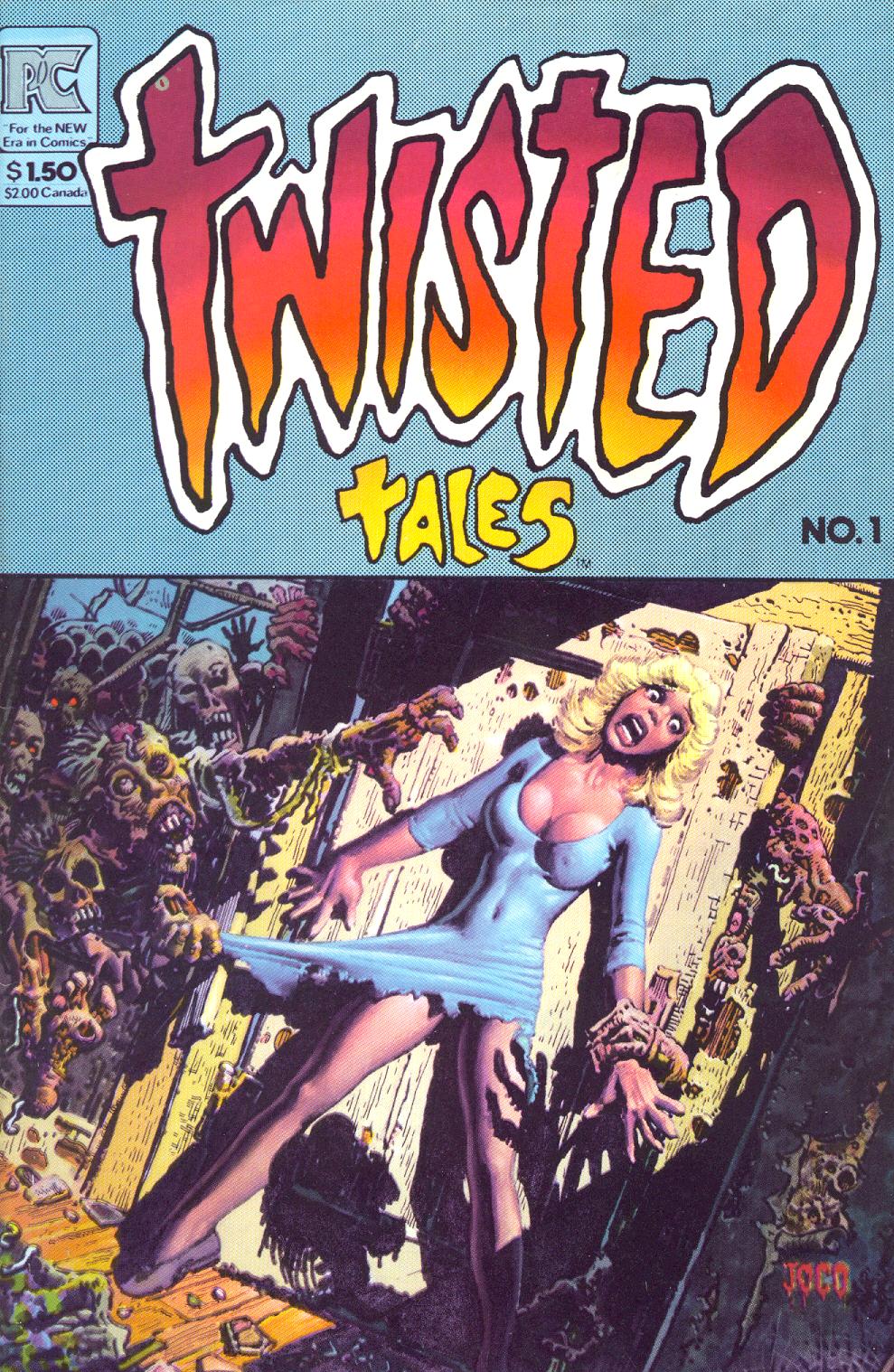


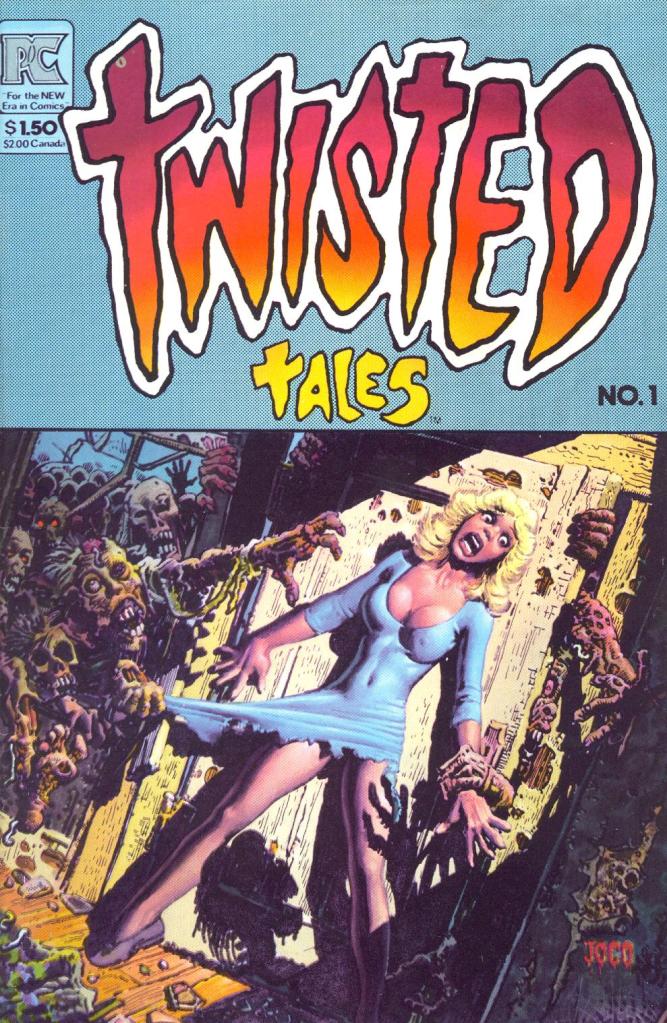
Among comic book fans, the legend of EC Comics loomed large. Even among readers who’d never experienced the books firsthand, there was an awareness of how the company had set a high benchmark for quality, and how they’d been undone and destroyed by the implementation of the Comics Code. There’s been occasional attempts to recapture the magic of the EC line–in particular, Jim Warren’s group of black and white magazines had initially been attempting to do just that. But that ineffable appeal remained elusive. However, in the early 1980s for a brief period of time, one series managed to do just that. This was TWISTED TALES, published by Direct Sales Market newcomer Pacific Comics.
TWISTED TALES was the brainchild of writer/editor Bruce Jones, and it wore its influences on its sleeve. It’s approach to content (four self-contained horror stories of between 6-8 pages), trade dress and even its occasional use of Leroy Lettering made that clear to any member of the audience who cared. But the other thing that TWISTED TALES had going for it was a lack of restraint. “Mystery” comics had become a staple of the American comic book scene, so called because the Comics Code prevented them from publishing anything that could legitimately be referred to as horror. But as a Direct Sales publisher, Pacific Comics didn’t need to submit their books to the Code–they could publish anything they wanted to, and did. The book also hit the zeitgeist at an advantageous time as CREEPSHOW, Stephen King’s tribute to those EC comics of long ago, having opened a short time earlier.
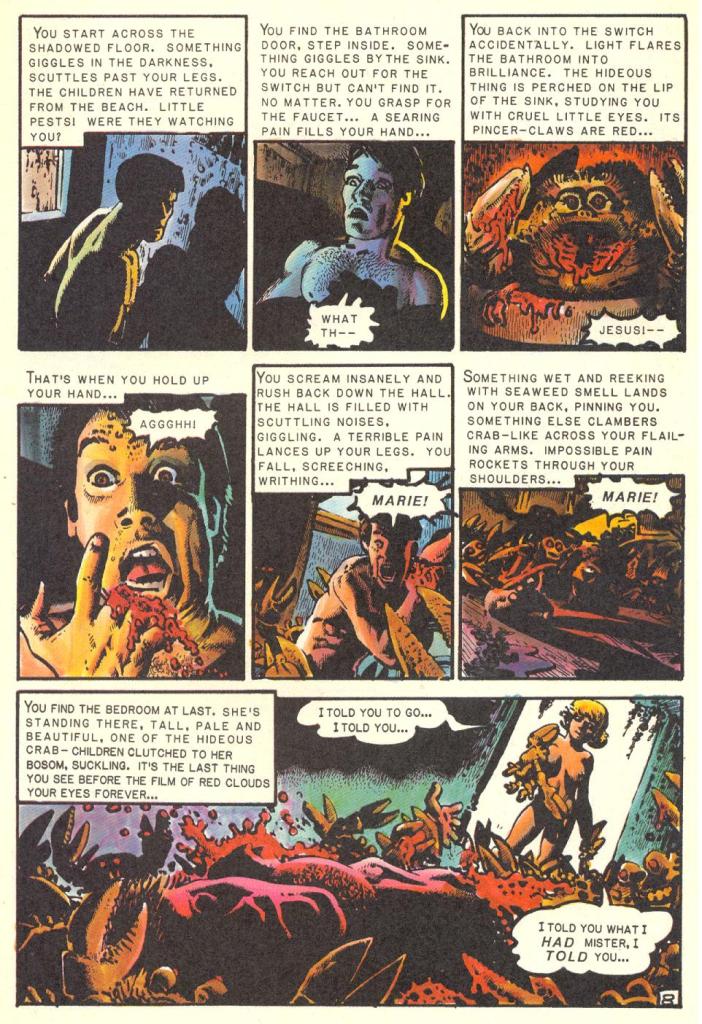
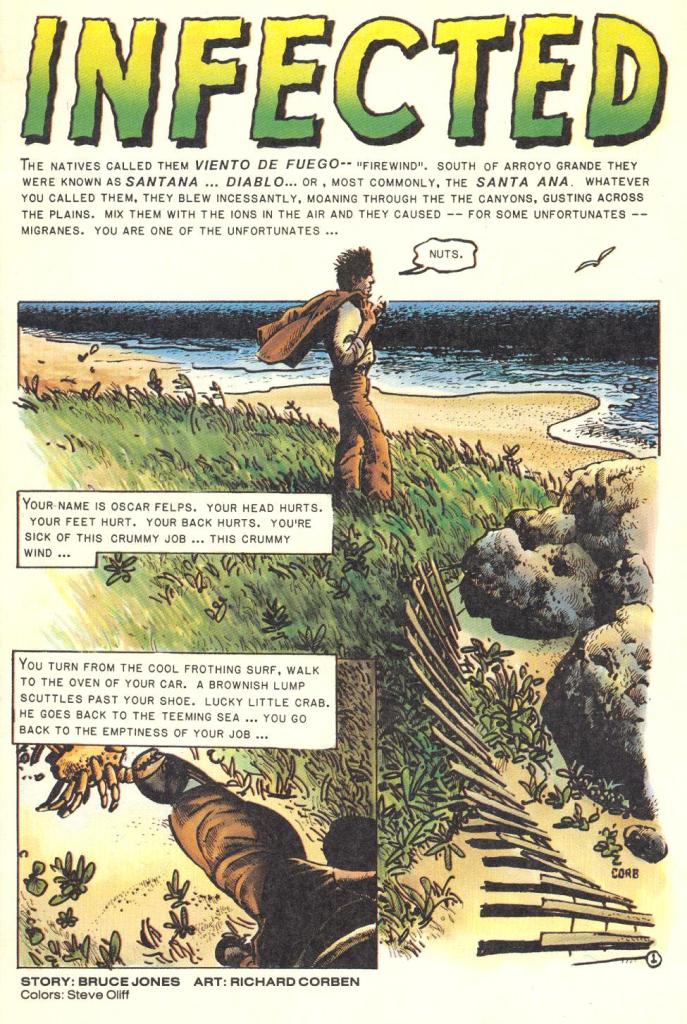
This first issue of TWISTED TALES contained four stories, all of which were written by Bruce Jones. The opener was illustrated by Richard Corben, who had come to prominence at Warren as an artist with a unique style and color approach. Here, though, Jones doesn’t give Corben much space to work. Like the EC books he was emulating, Jones goes overboard on filling blocks of tepid prose, forcing Corben to fit in the visuals around them. As with many of the EC stories, the tale is really told in the final page/ It’s about Oscar Felps, a reposesser for a collection agency who sleeps with a woman whose account is delinquent despite the fact that she tells him that she has crabs. Well, turns out that’s a literal condition, and the next morning, Felps gets eaten alive by the little buggers. It’s very EC, but somehow a bit nastier, a bit more unsavory. But that could simply be the difference between the 1950s and the 1980s.
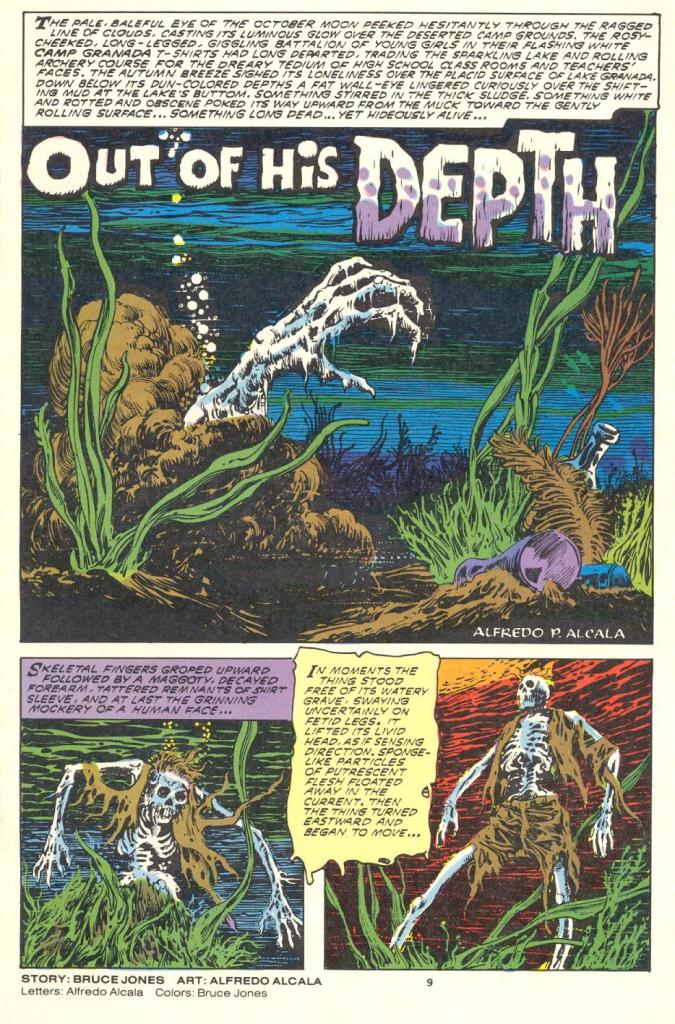
The second story is illustrated by Alfredo Alcala, an artist who was typically used as an inker/finisher in the States. His style was texture-filled and almost tailor-made for black and white. Here, it’s a bit overcolored, and so loses some of its impact and appeal. The story is a riff on the kinds of tales Jack Kamen would inevitably illustrate. It’s about a gold-digging young woman who only has eyes for the new administrator of the Camp at which she serves as a counselor. She in turn is pursued by an ugly and foul-smelling guy named Willie. When the administrator cheats on her, she winds up marrying Willie as payback. Turns out, though, Willie is secretly loaded, so she and the administrator plot to bump him of so that they can have his bankroll. They drown him out in the Camp’s lake, but he rises once again to take his revenge on the two of them. The last page in particular is especially disturbing, as the woman lays down on her bed in expectation of Willie’s return, telling herself that she “should have let him have me when he didn’t smell so bad”. Ugh!
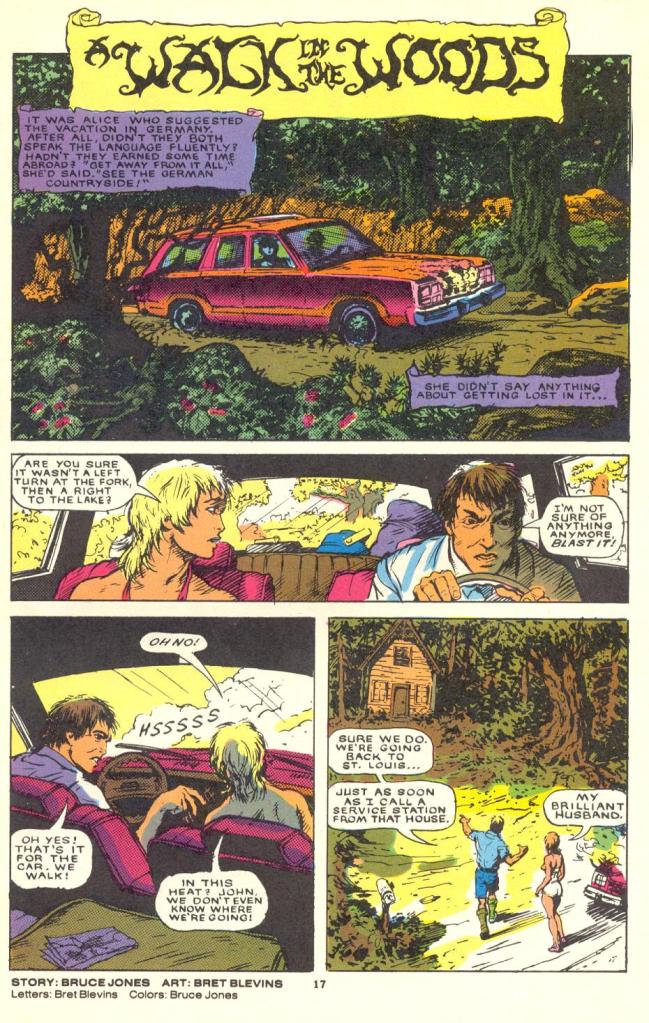
The third story was illustrated by Bret Blevins and was done at the outset of his career. The drawing is nice, but Blevins’ ink line is inconsistent and the coloring once again too heavy, so the end result isn’t as attractive as it ought to be. The story is a potboiler about a couple, John and Alice, whose car breaks down in the woods, forcing them to get out and look for help. They find themselves stepping successively into one fairy tale situation after another: an old witch in a gingerbread house, a cottage containing three bowls of porridge and an angry bear, and so forth. In the end, remaining behind while John goes to the next house of to find a phone, Alice ends up killed when Red Riding Hood’s granny turns out to actually be a werewolf, and John’s own ending is implies as he heads up a steep hill with a woman named Jill to get a pail of water…
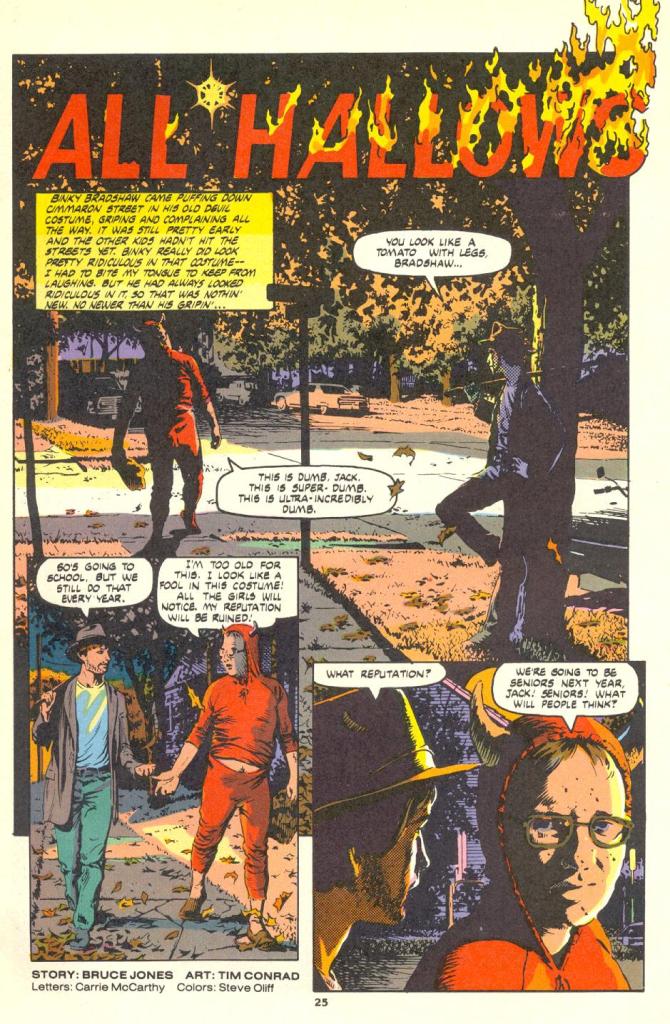
The final tale in the issue was drawn by Tim Conrad, though again the heavy coloring does it no favors. The story is perhaps the most effective one in the issue. It follows a trio of kids trick-or-treating on Halloween. Despite the fact that they’re all a bit too old for this, they dutifully go on about their appointed rounds. But every house they knock at, the inhabitants are utterly terrified by their appearance for no discernable reason. Jones does a nice job building up the slow burn of the mystery of what this is all about throughout the story.
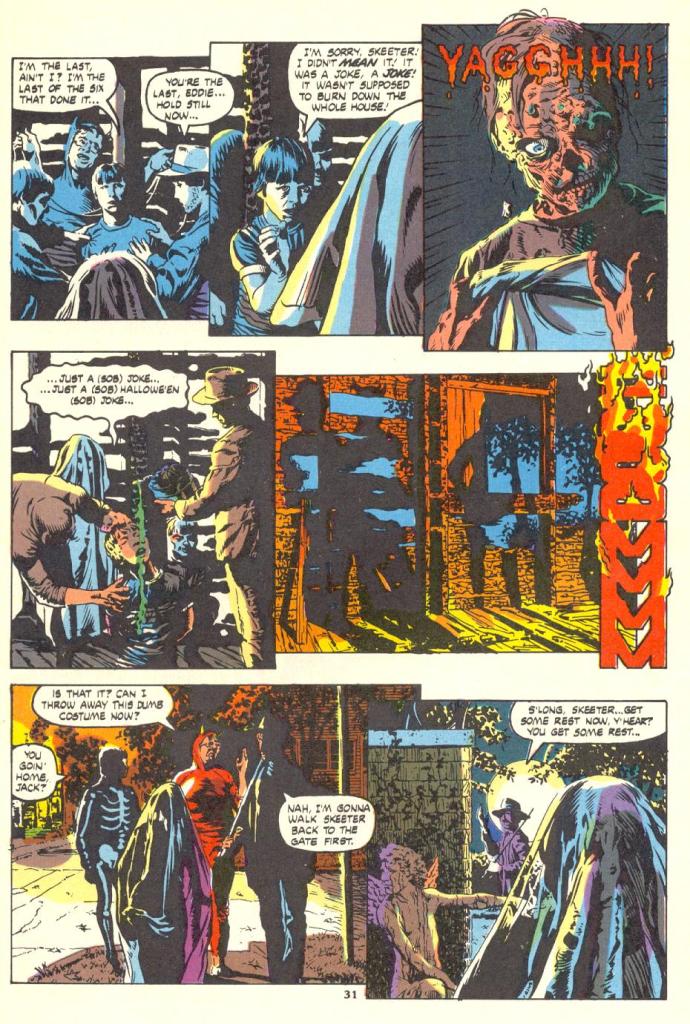
It turns out that seven years before, a group of the kids had set fire to some trash on the stoop of one of the houses as a Halloween prank, and the place burned to the ground with another kid in it–Skeeter. And since that time, on each successive Halloween, Skeeter has come back, and the kids have walked that same pattern once again. Only each time, it’s one of the remaining perpetrators of the original crime that gets burned to death by the others. As a reading experience, while TWISTED TALES wasn’t quite as sharp or original as the EC books it was emulating, it was still pretty effective and lurid. And it’s easy to see why it caused a bit of a stir among fans. Jones followed it up almost immediately with ALIEN WORLDS, his take on one of EC’s science fiction comics–but we’ll get to that in due time.


Horror in comics has always been a difficult beast: the images are static, so there is no dynamic reveal, but at the same time there ARE images, so the dread of imagination can be muted. Let’s face it, it’s hard to pull off. But “All Hallow’s Eve” still sticks with me, just like “Hopping Down The Bunny Trail” from Unexpected #202.
LikeLike
90 percent of EC stuff I’ve read falls flat with me. So if I ever saw this one, I doubt I’d have given it more than a passing glance.
LikeLiked by 1 person
I’ve never liked the horror gene, whether visceral or psychological. I have, on occasion, watched some horror films, but they were either from the 30s through the 50s, or they were mostly psychological, like The Shinning (which I went to see with friends at a midnight showing on opening weekend because they wanted to see it. Having not read the book, I asked someone coming out from the previous showing what happened at the end. You would think they wouldn’t say anything, so as not to spoil it for those around me, yet they did. They said “Scatman saves Danny and Wendy” [I only just now learned that is how the novel ends, so I know understand why the person told me that]. So, if you’ve seen the film, you’ll understand why I was shocked at that point in the film. And now back to my comments on this issue). So I’ve generally not read any horror comics and from the pages scanned here I’m glad I never picked up Twisted Tales.
Note: I hope my digression is of some interest to some of you.
LikeLiked by 1 person
Add my voice to those who would’ve passed on this comic. But while I am not into the horror genre, I’ll definitely bite on your digression, Sean. I truly enjoyed every frame of the 1980 version of The Shining. Jack Nicholson’s riveting performance simply would allow nothing else but remaining until the final scene. And I’ll know that I’m truly suffering writer’s block when I start repeating “All work and no play makes Rick a dull boy.”
LikeLiked by 1 person
I also think Kubrick’s version of The Shinning is excellent and I’m glad I saw it. Jack Nicholson’s performance is one of the best I can recall and there are numerous scenes seared into my memory.
LikeLiked by 1 person
As I recall, I picked this up, not because I liked horror comics, but because I liked Pacific Comics, and wanted them to succeed. I thought it was reasonably well done for what it was, but I’m really not the audience for it, so from then on, I picked up Jones’s anthology books only when there was an artist in them I particularly wanted to follow.
I’m not at all opposed to horror comics — I was a regular TOMB OF DRACULA reader, and I’ve read almost everything Stephen King’s published — but I generally want something more than what EC did. I want to see that kind of story taken to a new level or a new place, rather than lovingly re-created. Sometimes, Jones did that, but mostly I think he was having fun fitting the mold rather than breaking it.
LikeLiked by 2 people
Despite my appreciation for EC comics this one wouldn’t have been for me… though I think the art looks well done. I never went very deep into horror/mystery comics put out by Marvel and DC after the age of ten. I would routinely buy a Charlton horror comic if it had Ditko story though… but they weren’t scary. They were just odd.
I guess Marvel’s Dracula and Werewolf by Night were technically horror books, but did they scare anyone or even give them the creeps? I could enjoy a monster story for what it was, but it wasn’t the kind of thing that would give me the shivers like a few standout DC mystery stories did around 72-74.
I suspect that a lot of recurring horror comic fans liked the overall aesthetic?… I’m painting with a broad brush, but it does seem that short story horror and mystery comics generally require more overall polish than the average super-hero yarn to ring anyone’s bells. If nothing else… the writer and artist need to convey the necessary mood and atmosphere along with making static action dramatic… which aren’t skillsets in every pro’s quiver.
LikeLike
Add me to the group that doesn’t like horror, though it’s across most media. Books I can handle better because my imagination is in charge of the images and I’m not gonna visualize something disturbing. After all, my main rule for movies, for example, is that the insid eof the body has t o stay inside, at least onscreen.
LikeLike
I remember enjoying Twisted Tales and it’s sister book Alien. I think Bruce Jones was behind this who wrote horror stuff for the Warren mags including the seminal story ‘Jenifer’ with Berni Wrightson. I really enjoyed that whole Pacific Comics era.
LikeLike
I may have picked up one or two titles Pacific published but I don’t remember following them. Was Ms Mistic Pacific?
LikeLike
Yes Ms Mystic was published by Pacific. There were two issues published by Neal Adams. I think there’s a back-up story of Ms Mystic in one of the Pacific books as well which I haven’t seen. A favourite of mine.
LikeLike
I recall reading a bit of Twisted Tales, though not this one specifically. From Pacific I mainly read Groo and maybe a couple of other random things, though I picked up more as back issues later on.
As a kid, I also went to their store in San Diego when we were down there on vacation, though that was before they started publishing.
LikeLike
I recall reading a bit of Twisted Tales, though not this one specifically. From Pacific I mainly read Groo and maybe a couple of other random things, though I picked up more as back issues later on.
As a kid, I also went to their store in San Diego when we were down there on vacation, though that was before they started publishing.
LikeLike
I love EC Comics and enjoyed Warren and DC’s titles as well but never picked this up. May have been a tad too lurid for me.
LikeLike
I always love to see Alfredo Alcala’s work. Around this time he was also drawing some really awesome mini-comics packaged with He-Man toys. 🙂
LikeLike
I think the problem with trying to recapture EC horror is that companies focus too much on the gore and “playing the hits” with ironic deaths, and neglect the underlying social satire and send-ups which I see as key aspects. That is, they often replicate the worst, superficial, parts of the EC “formula”, but not the deeper, more analytic, parts.
LikeLiked by 1 person
Too many fans and too many creators forget that EC Comics not only bloodily dismembered a baseball player; it was also the publisher that put a black man in space a *decade* before MLK’s “I have a dream” speech! Violence and gore alone do not an EC homage make.
LikeLike
Framing Twisted Tales against the long shadow of EC Comics and the Comics Code explains why it felt special in the early 80s, especially when even Warren’s magazines couldn’t quite recapture that appeal. Pacific Comics doesn’t get talked about enough. I run Voxalike, a guide site for a browser dubbing party game, and EC-style horror twists make great short scripts to perform.
LikeLike
FOR WHAT ITS WORTH……The final story ALL HALLOWS was adapted for an episode of Shudder’s CREEPSHOW series.
LikeLike