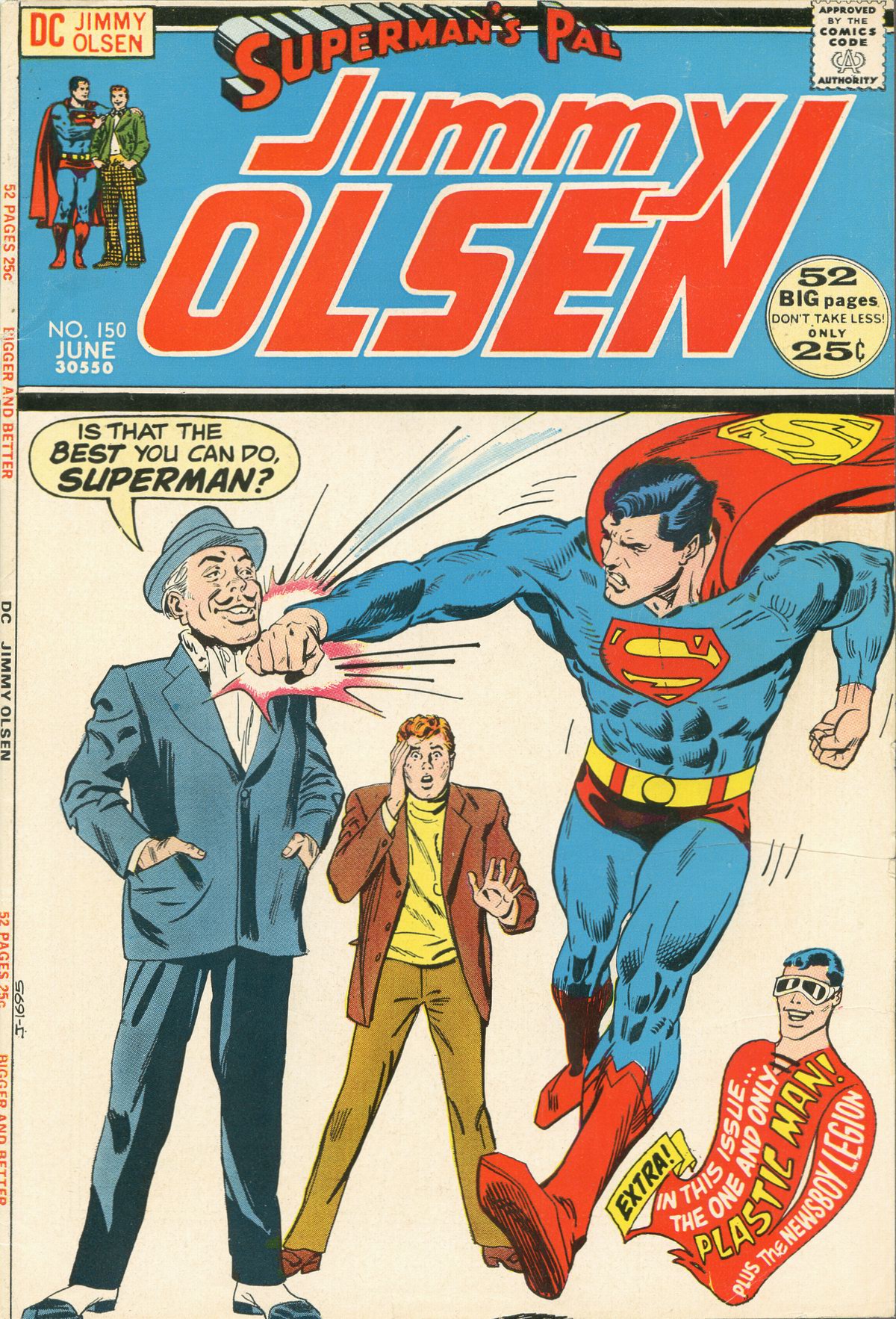


On that same trip to Ed’s Coins and Stamps in the Sun-Vet Mall, I purchased this back issue of SUPERMAN’S PAL, JIMMY OLSEN. I didn’t buy it for Jimmy, nor for the big guy. Rather, I had discovered that this issue had reprinted a classic Plastic Man story from the Golden Age and I was interested in reading more of those. On top of which–a situation that influenced my purchasing more than once–it was cheap. There wasn’t a whole lot of demand for JIMMY OLSEN back issues apart perhaps from those that had been done by Jack Kirby just prior to this point. So I was able to score this issue and its vintage Plastic Man adventure for a relative song.
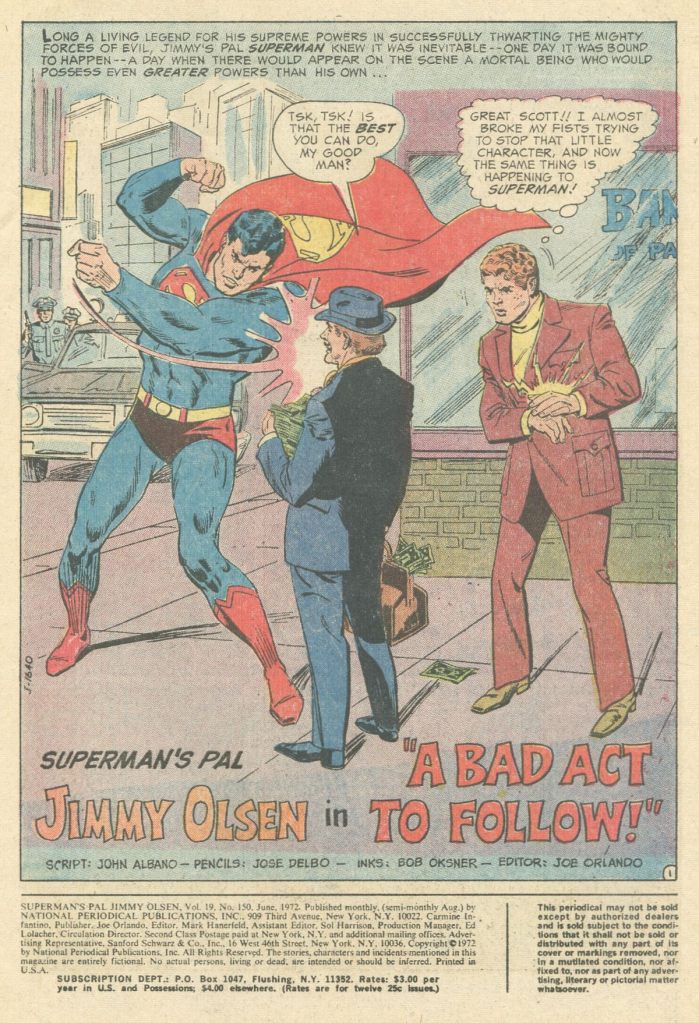
SUPERMAN’S PAL JIMMY OLSEN had passed into the editorial hands of Joe Orlando, who didn’t seem to have very strong opinions about what to do with it. In a lot of ways, this period was a bit of a return to form for the series, with its title character getting into bizarre situations that often required the intervention of Superman to put right. The days when it was a book of high adventure and big ideas under Jack Kirby were finished. From here on out until it was folded into SUPERMAN FAMILY a couple of years later, JIMMY OLSEN would dedicate itself to being lightweight and inoffensive, if not downright silly. The series certainly felt out of step with the times right at this moment, but the very fact that it was still a viable proposition owed a lot to the continuing reruns of the 1950s ADVENTURES OF SUPERMAN live action television series, so trying to channel some of the spirit of Jack Larson’s portrayal of the character wasn’t a bad idea in and of itself.
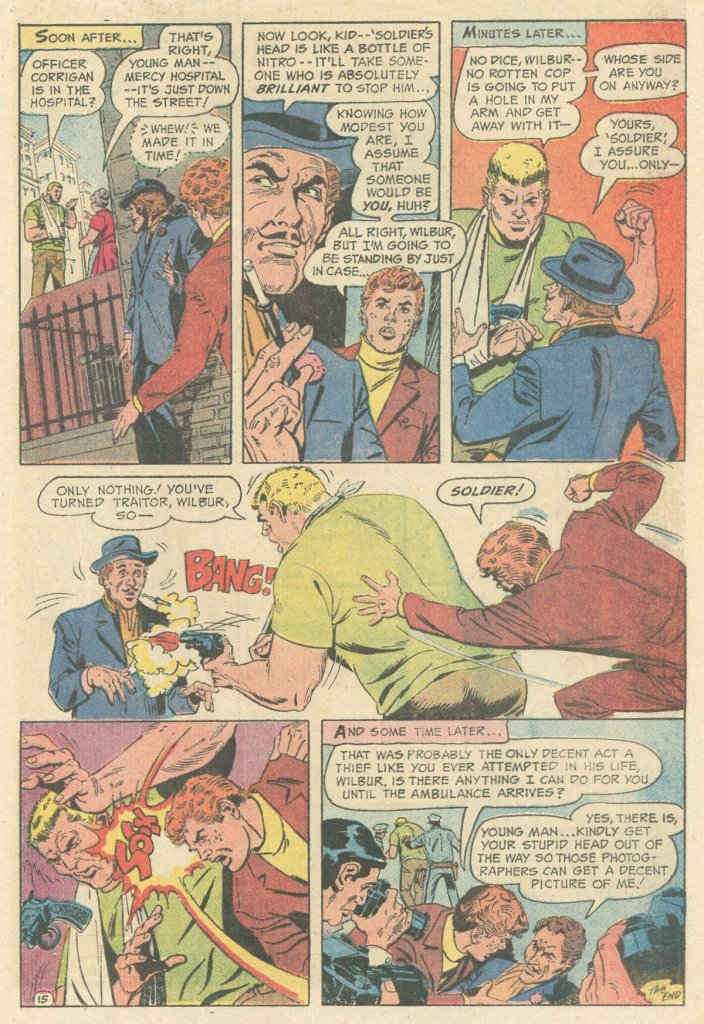
The opening story by John Albano and Jose Delbo is an odd mélange of pseudo-contemporary claptrap and ridiculous science fiction mumbo jumbo. In the opening, Jimmy and his girlfriend Meg are mugged by smooth operator Wilbur Little and his crazed Vietnam vet accomplice, Soldier. Beat cop Corrigan intercedes but is forced to shoot Soldier in the arm in order to stop him, an action which puts Corrigan at the center of a police brutality rap. Meanwhile, Wilbur checks in with a scientist acquaintance of his who as perfected a serum that will give a person indestructibility and the power to become invisible. Wilbur swipes the formula, of course, and embarks on some daring crimes, utterly unstoppable. Even Superman, who shows up for only three panels in this story to justify his appearance on the cover, can’t injure Wilbur. But Jimmy catches up with Wilbur at a point where his serum has worn off and captures him. But then, he needs Wilbur’s help to stop Soldier from attempting to assassinate Corrigan in retribution for the cop having wounded him. The end! The whole tale reads almost like a stream-of-consciousness ramble that only wraps up when it runs out of pages.
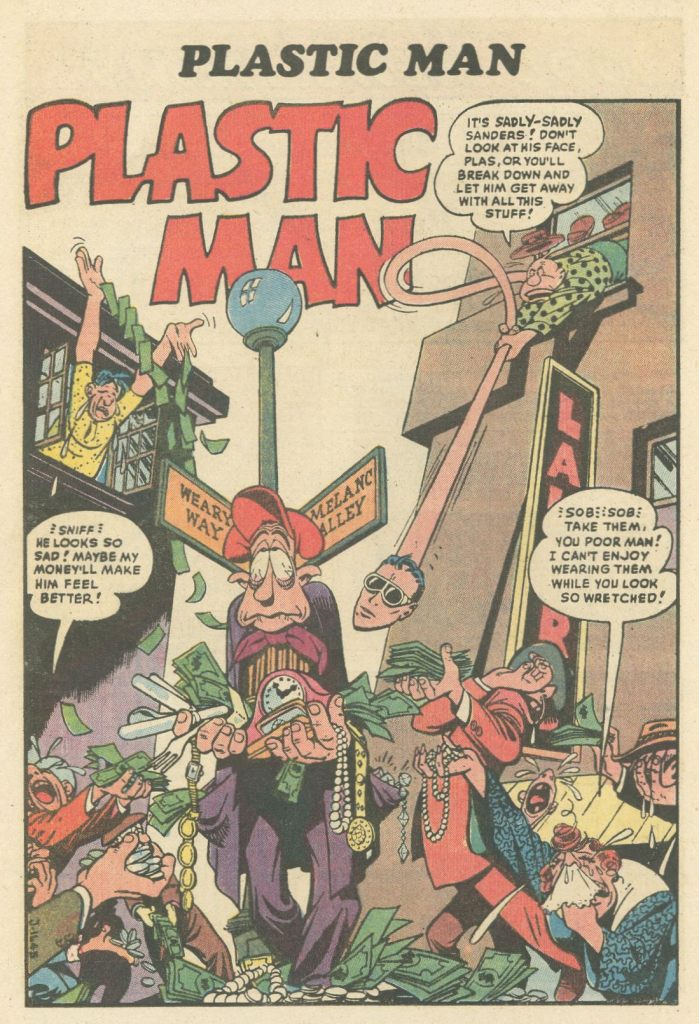
But as I said at the outset, the story I was really here for was the reprint in the center, and it didn’t disappoint. It was written by Joe Millard and illustrated by Jack Cole and it introduces a memorable foe for Plastic Man to contend with: Sadly-Sadly Sanders, a crook whose expression is so pitiful that it forces everyone who sees it to begin bawling uncontrollably, and to give him whatever he wants. Even Plastic Man himself isn’t proof against Sadly-Sadly’s maudlin expression, so he needs to find a way to get close enough to the felon to capture him without succumbing to uncontrollable sorrow and remorse. It’s a fun premise that Mallard and Cole milk for maximum entertainment.
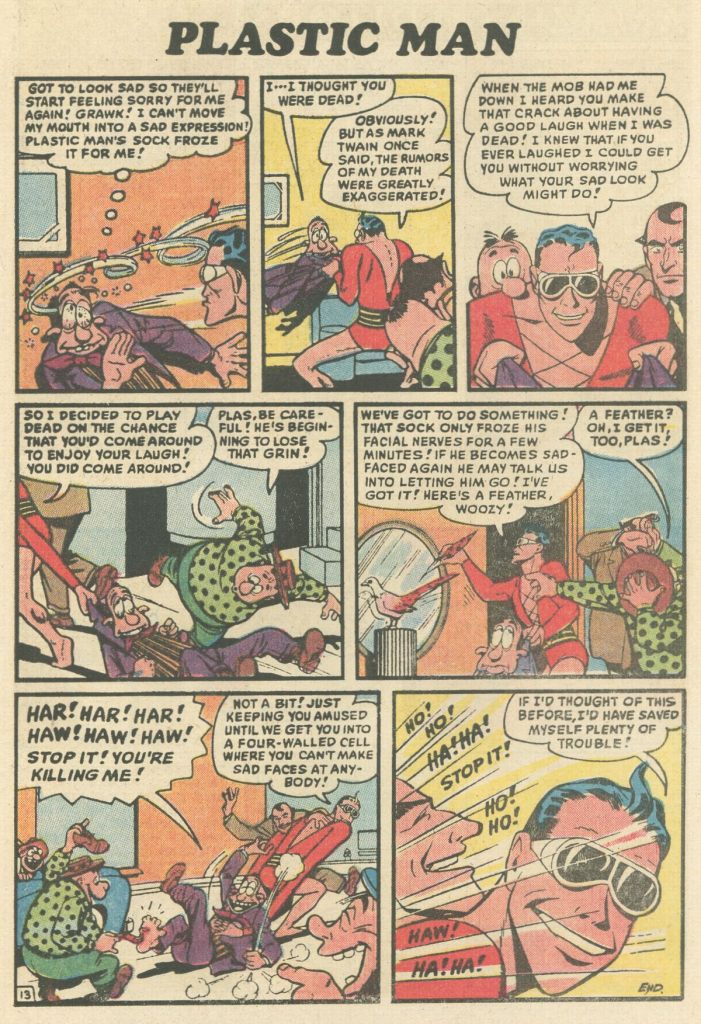
At a certain point, as he tries to arrest Sadly-Sadly, Plastic Man is set upon by an angry mob compelled by Sadly-Sadly’s features to come to his rescue. The mob beats the hell out of the ductile crime-fighter, but provides him with some inspiration. He and Woozy fake Plas’ death and set up a fake funeral which draws Sadly-Sadly out of the woodwork. Sadly-Sadly can’t help but smile when he sees Plastic Man stretched out on a slab, thus giving Plas an opening in which to sock him in the face, temporarily paralyzing his features. Thereafter, he and Woozy convey the crook to jail by tickling him as they go, preventing his features from putting on a sorrowful expression.
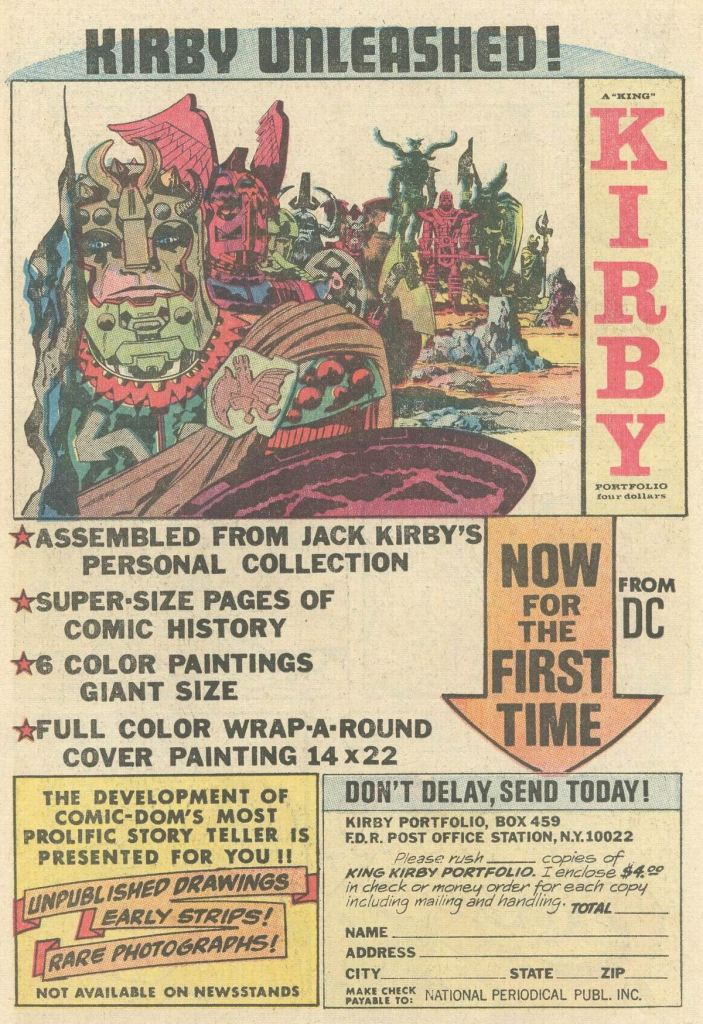
The issue also includes a full page ad for the KIRBY UNLEASHED portfolio, a grand Treasury-Sized compilation of rare artwork and interviews and such with the King. At this point, while his star was steadily diminishing at DC, the company was still pushing its acquisition of Jack for all it was worth, though this portfolio wasn’t actually published by them. It was a spectacular thing, released in a time when it was virtually unheard of for fans to be able to get a sustained look at the work and career of any single artist.
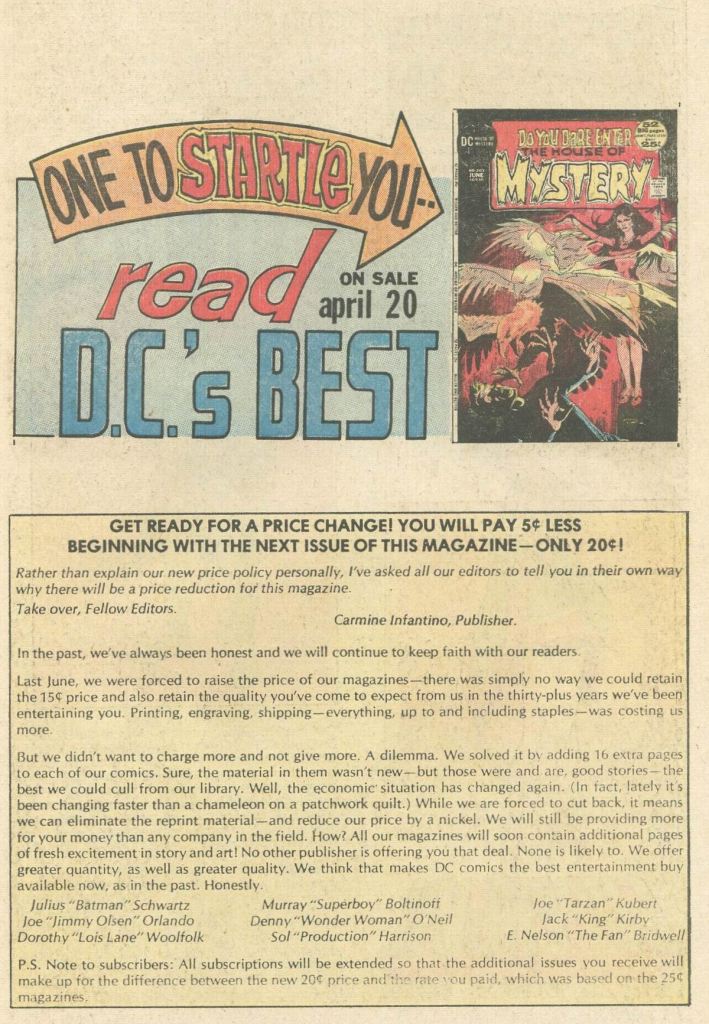
The book also includes this editorial note from Carmine Infantino and the editorial staff of DC at the time concerning the fact that the following month would have the DC line of books dropping their reprint back-ups and returning to the typical 32 page format, now priced at 20 cents. Marvel had been running at that price point for over a year at this time, and that price shift combined with a deal cut with their distribution resulted in Marvel’s sales surpassing those of DC for the first time. Carmine and company certainly hoped that matching the format would allow them to compete on an even playing field, but DC wouldn’t regain its dominance of the marketplace throughout the rest of the decade.
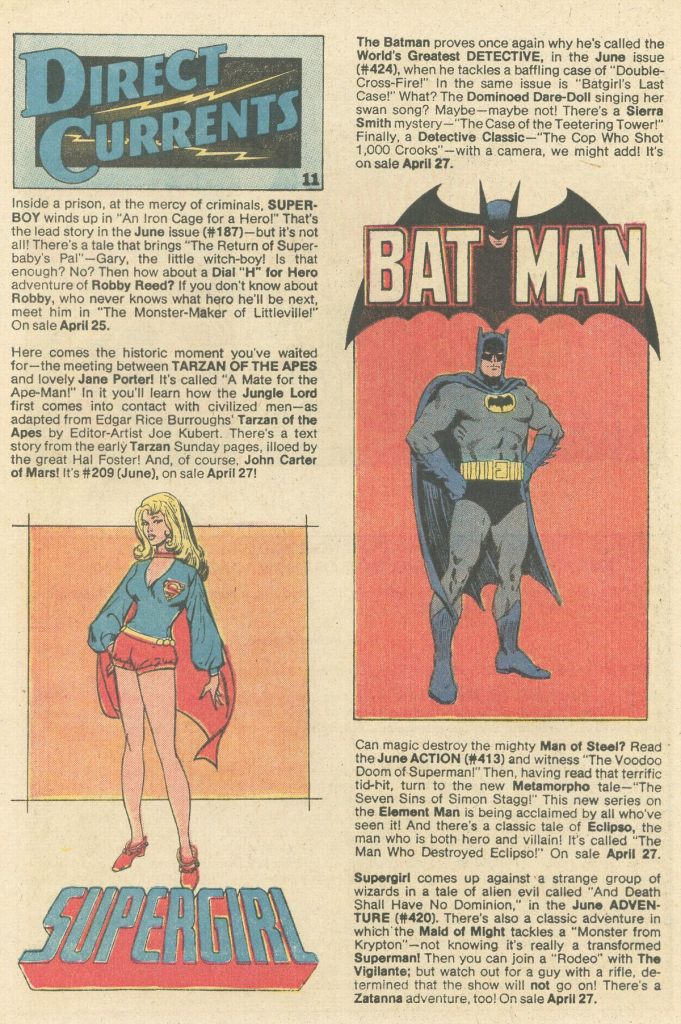
There was also a Direct Currents promotional page dedicated to plugging other releases in the DC line that were then on sale or soon would be. Possibly because it was running in an issue of SUPERMAN’S PAL JIMMY OLSEN, this page puts an emphasis on other Superman family titles such as SUPERBOY, ACTION COMICS and ADVENTURE COMICS. But it also goes farther afield to include TARZAN and DETECTIVE COMICS as well. I always loved seeing these pages in reprint books and speculating on the titles they were shilling, though DC’s efforts in this area weren’t the equal of Marvel’s under editor Stan Lee.
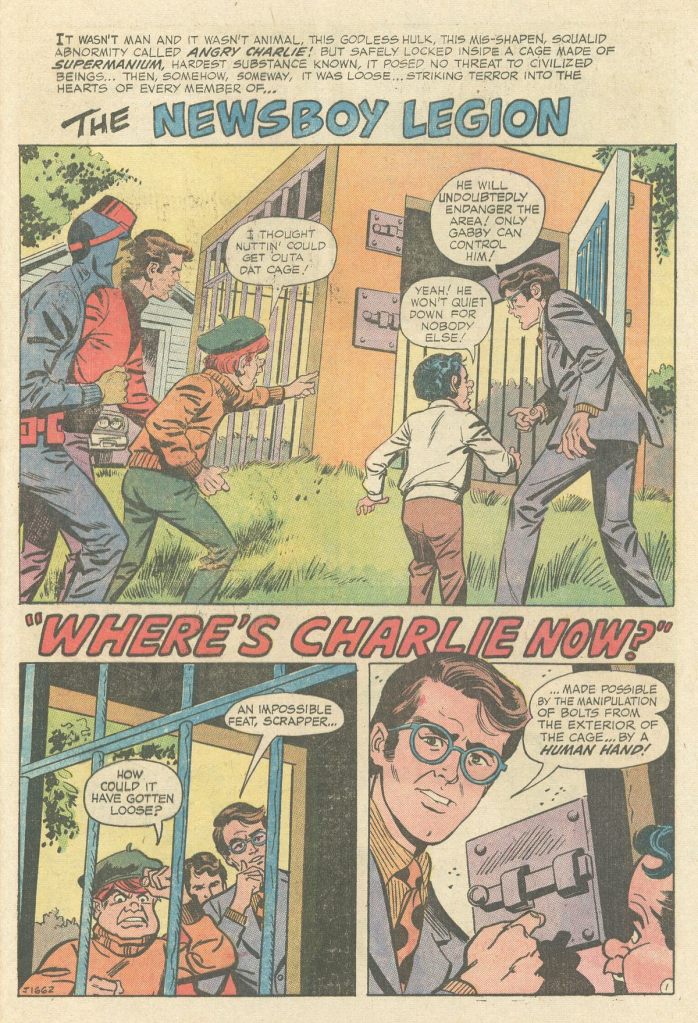
The final story in this issue is an odd bit of continuity bookkeeping, a throwback to the Newsboy Legion who had been supporting players in the title all throughout Jack Kirby’s recently-concluded run. Apparently, DC editor and continuity maven E. Nelson Bridwell was concerned that the Legionnaires had been left taking care of Angry Charlie, a weird DNAlien first introduced during Kirby’s tenure. Accordingly, he co-plotted this tale with John Albano to address the situation, with artist Win Mortimer illustrating it.
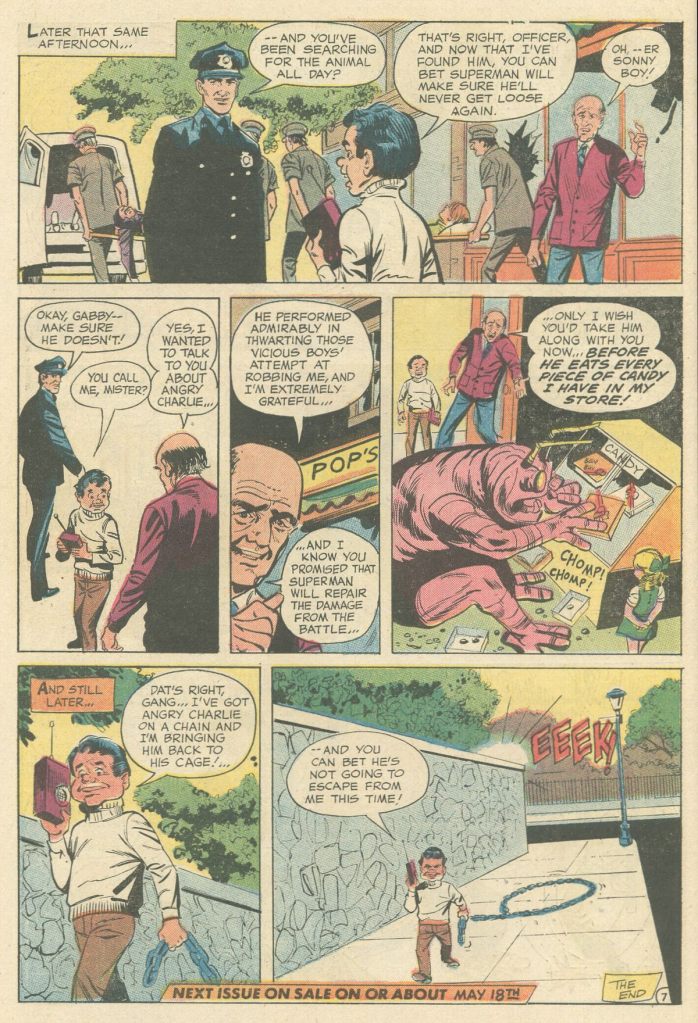
It’s a weird little story that’s also a bit all over the map in terms of tone. In it, the Newsboys discover that Charlie has escaped from the Supermanium Cage he’d been imprisoned in, leading them to search the streets of Metropolis for him. Charlie, meanwhile, has been found by the granddaughter of a local candy store owner who is being shaken down by some local toughs. But one of the gang makes the mistake of striking the little girl, and true to his name, Angry Charlie goes bananas on them. In the aftermath, Gabby of the Newsboy Legion is on hand to bring Angry Charlie back in, assuring the cops that Superman will make sure that he can’t escape and cause trouble again. But in the final panels, it’s clear that Charlie has already slipped his leash and vanished off into Metropolis. I’m not sure why Bridwell felt that this would wrap up Charlie’s story, but despite the open ending the character wouldn’t appear again until the post-Crisis new DC continuity.
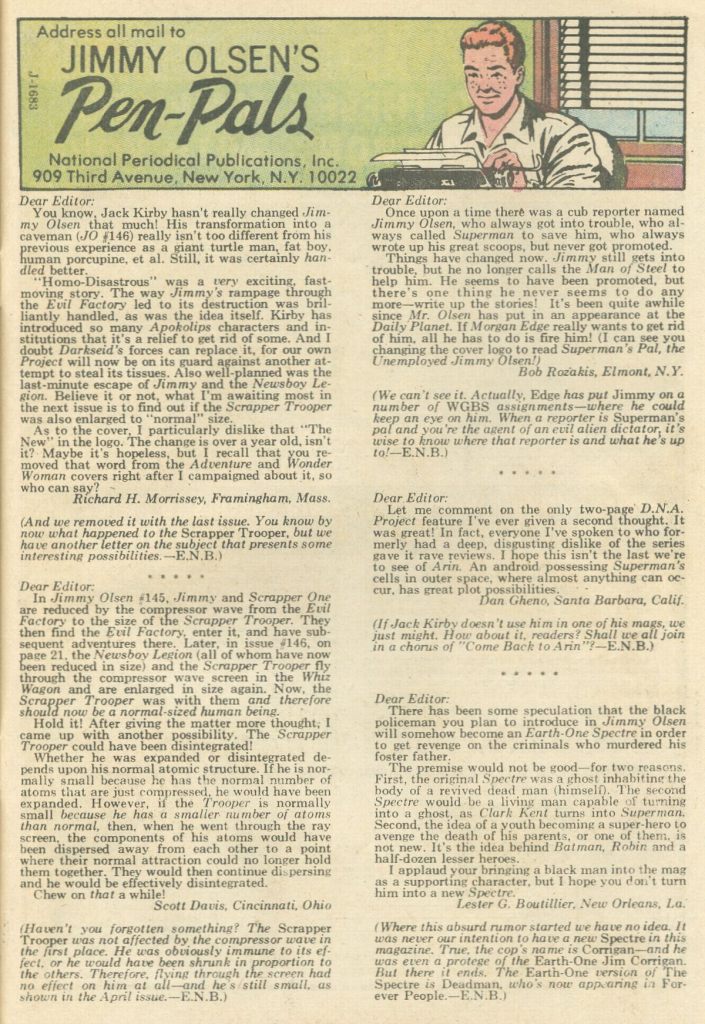
And the Jimmy Olsen’s Pen Pals letters page (which continued to use an illustration of Jimmy that was far out of date) this issue ran a letter from future DC writer, editor and production man Bob Rozakis. It was DC’s way at the time to recruit a bunch of its new talent from the more prolific letter writers, and Rozakis’ correspondence helped make his name familiar to the editors before he attempted to get a job from the company, which could only have helped him.


Having a severe allergy to Jimmy Olsen solo stories I never realized the amazing Joe Delbo ever drew it. As frosting on this cupcake of a revelation Bob Oksner inked him? Nirvana!
Did anyone else notice that the Plastic Man reprint was a bit like the lead story? If the Jimmy story had gone for comedy start to finish like Plastic Man had it would have been good instead of an eye roller. No wonder Jimmy is surpassed only by Lucy Lane as the longtime supporting cast member to get the least panel time post Crisis.
LikeLiked by 2 people