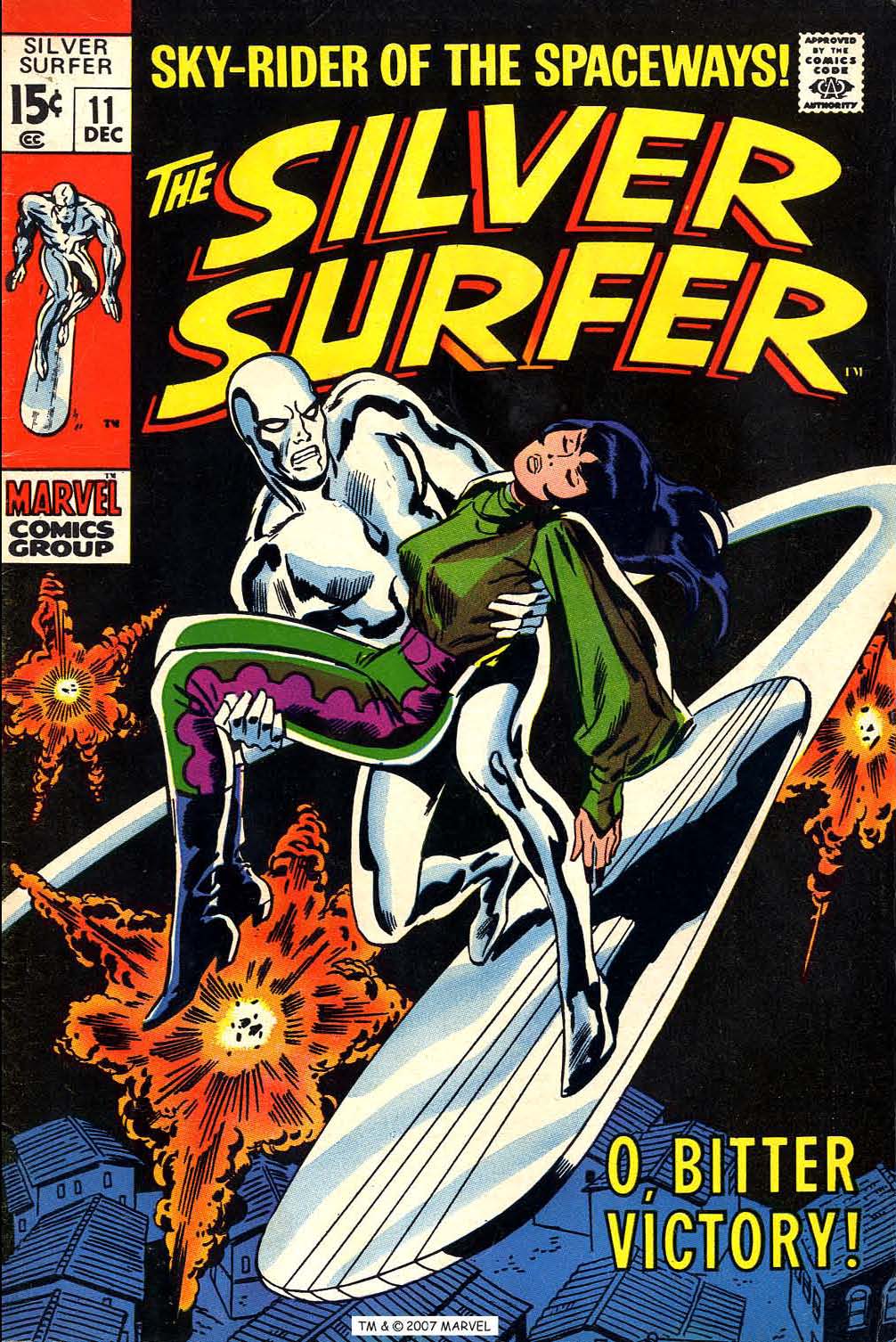


When I was growing up in the 1970s, SILVER SURFER had a reputation as being a very special comic book. Right off the bat, it was a series that wasn’t being published any longer, yet it was held up as a high water mark for what the medium was capable of achieving. Even new appearances of the character were few and far-between, which made any appearance by the titular Surfer in some other comic a bit of a mini event, a moment of greater-than-usual importance. As things turned out, my friend David Steckel had three separate non-consecutive issues of SILVER SURFER that he’d been given by that same older cousin who was done with them. The earliest of the three was this one, #11, from 1969 (which might as well have been the stone age to us ten years later–any comic book published before I’d stared reading in 1973 had the feeling of an artifact to it to my young mind.
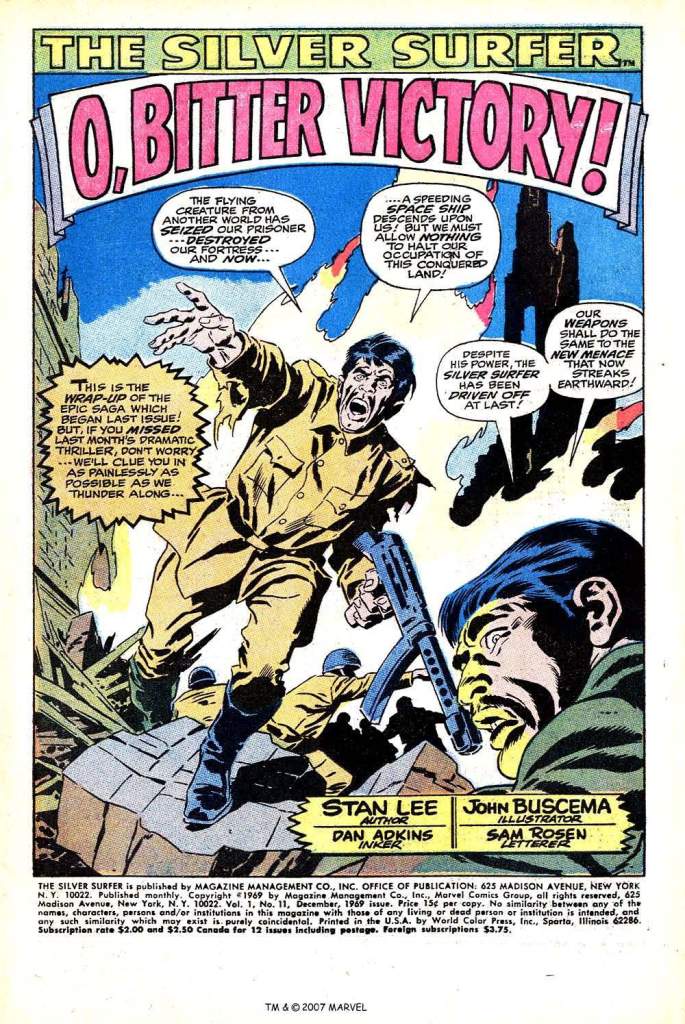
The Silver Surfer turned out to be a bit of a monkey’s paw situation for both of his primary creators. The character was originated by FANTASTIC FOUR artist and plotter Jack Kirby while he was working on the Galactus Trilogy in that series. Kirby envisioned him as a fallen angel, a being created out of whole cloth by Galactus who would find himself learning about empathy and ultimately turning against his master, who would react by stranding him on Earth. There was something about the character that struck a nerve with editor and scripter Stan Lee, and he began to develop him as a mouthpiece for some of the lofty ideals that Stan had been picking up from the counterculture he had been interacting with as he visited colleges on speaking engagements. Ultimately, Stan decided to launch the character in his own series–but he didn’t bother to tell this to Jack Kirby. When Kirby found out that not only was the Surfer getting his own series but that the first issue would reveal an origin completely divorced from his own ideas, he said that it felt like losing one of his kids. He knew that everything he was creating belonged to the company, but to be shut out from his creations on a creative level as well added insult to injury, and so this was the point where Jack started looking for an exit from Marvel in earnest.
Stan, meanwhile, had his own lofty aspirations. Having been compared to the modern generation’s Homer in a newspaper article, he wanted to show that comic books could be a legitimate medium for self-expression. And so he set out with SILVER SURFER to do a more thoughtful and philosophical series than the typical Marvel magazine. He launched it in a giant-size format to give himself more pages for each story, and brough John Buscema, perhaps the finest draftsman Marvel had at that point, on as his artistic collaborator. Stan used the Surfer’s adventures to comment on the state of the world, and to put forth a “hippy-friendly” message of peace, non-violence and understanding while still providing a super hero saga in each tale. The first batch of issues are really good (thought the quality dips after issue #4, a story in which Buscema took a decidedly non-Kirby approach to depicting Asgard and Lee balked at the innovation.) But the big problem the series was having is that it simply wasn’t selling well enough.
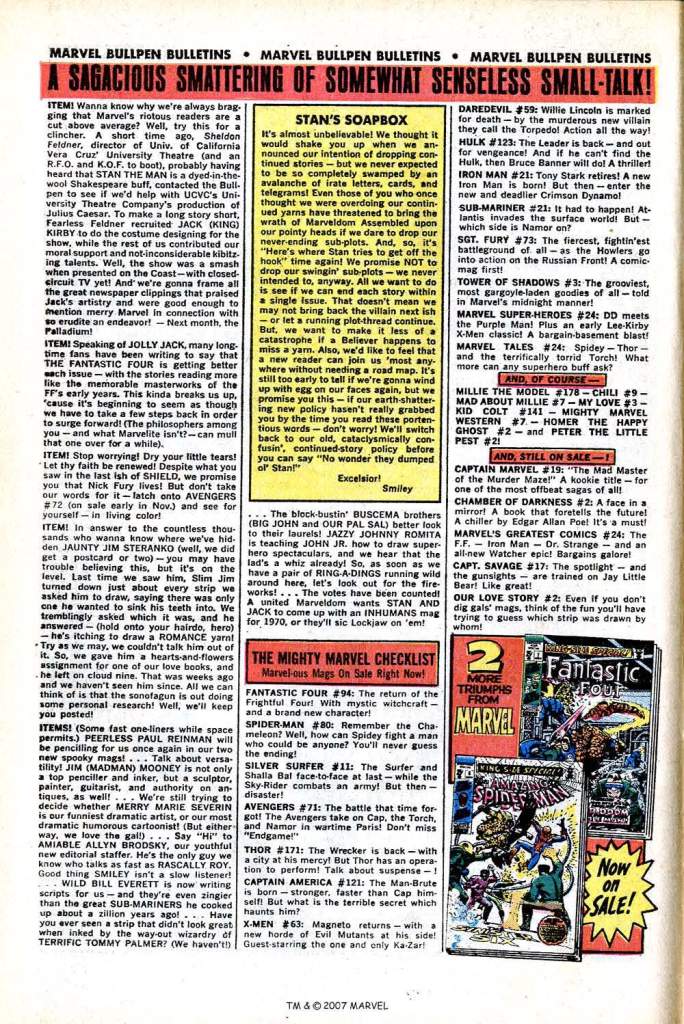
A quick stop-off at this point for the issue’s Bullpen Bulletins page, which is positioned way up front this month. It’s the typical compilation of the latest happenings and plugs for upcoming projects and stories. Stan’s Soapbox has him playing a bit of defense concerning the recent mandate from publisher Martin Goodman that all Marvel books go to a self-contained format after years of serialized storytelling–an initiative that didn’t last long, but which loused up the momentum of much of the line’s efforts. it was also always fun to see the old Checklist of other books then available.
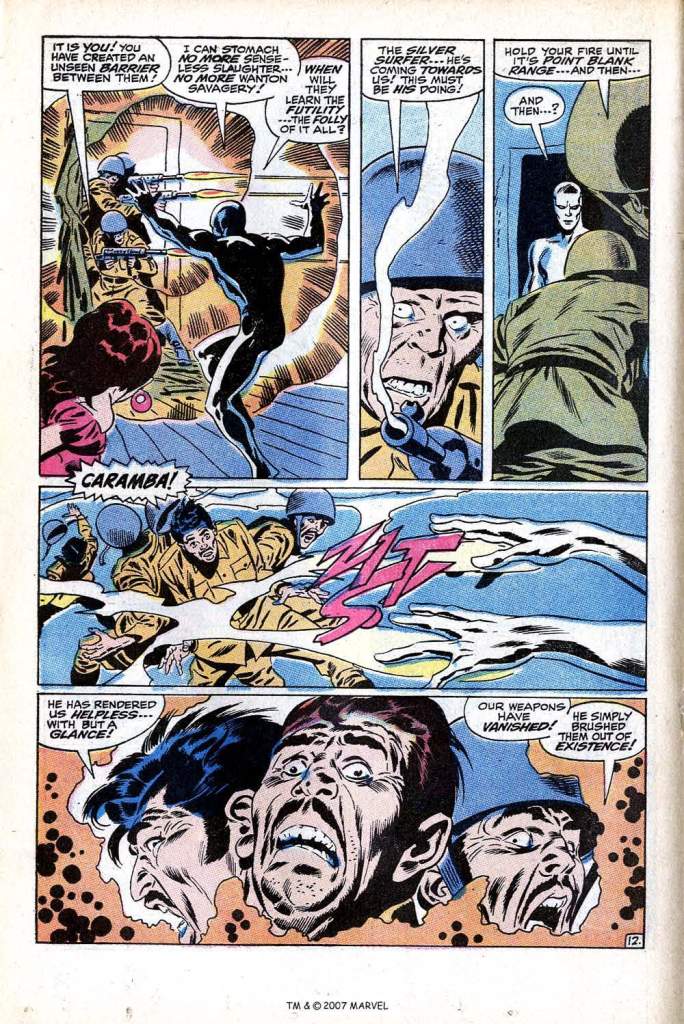
As the sales on the series tanked, Stan began to make moves to try to stave off the attrition. On a seeming dime, he switched the book from oversized to a regular comic, forcing at least one story to be inelegantly cut in half after being drawn. When that price reduction wasn’t enough, he began bringing in a parade of guest-stars, hoping to grab the wider Marvel audience. As a kid finding out about these books, those were all issues that attracted me–but again, it just wasn’t doing it. Finally, at the very end, Lee recruited Kirby to come back to do a single issue that would set up a new direction for the character–one in which he’d become more violent and rage-filled, the Savage Silver Surfer. (Kirby was just about out the door by this point, so he performed as a good soldier but without a lot of heart.) This change of direction was stillborn, however, as SILVER SURFER was cancelled with issue #18. Stan’s bid for greater acclaim and acceptance had failed. He issued a decree that nobody else at Marvel would be permitted to write the Surfer apart from him, except with special dispensation. It was this ruling that made the character so difficult to encounter through all of the 1970s when I was growing up.
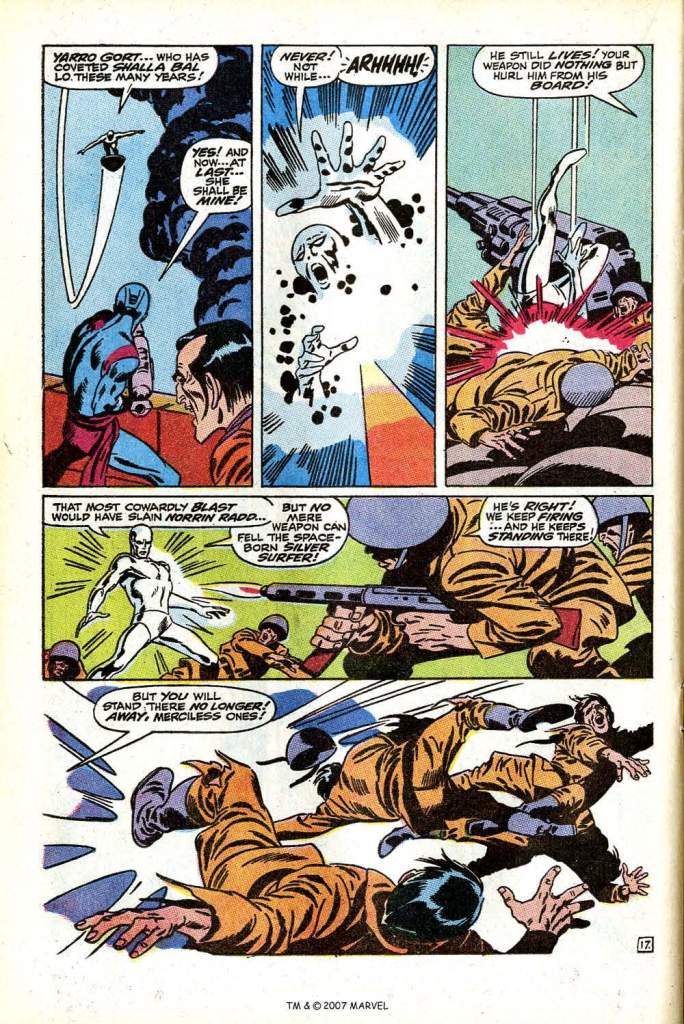
In terms of the story in this particular issue, it’s the back half of one of the early two-parters, and it looks to me as though it had initially been conceived as a single 40-page tale, though by the time it was being drawn, the change in format had come down so Buscema was able to adjust. It involves the Surfer getting involved with some stereotypical Latin-American rebel freedom fighters who are trying to overthrow their nation’s tyrannical dictator, known only as El Capitan. At the same time, sinister Zenn-La scientist Yarro Gort had brought the Surfer’s long-lost love Shalla Bal to Earth in an attempt to show her that Norrin Radd, the Silver Surfer, has forsaken her, hoping to win her for her own. And indeed, at the end of the last issue, Shalla Bal saw the Surfer kissing peasant girl Maria (she was thanking him for his help against the oppressors, of course) and has gotten the wrong idea. But before anything more can come of this, Yarro and Shalla’s spaceship is shot down by the military’s guns and crash-lands on Earth.
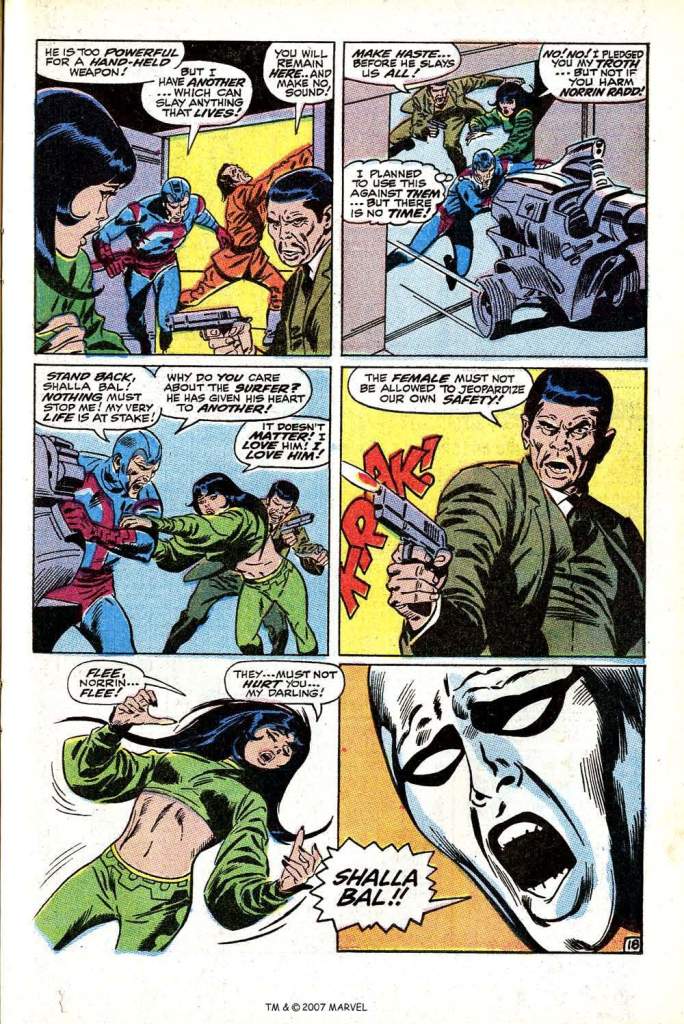
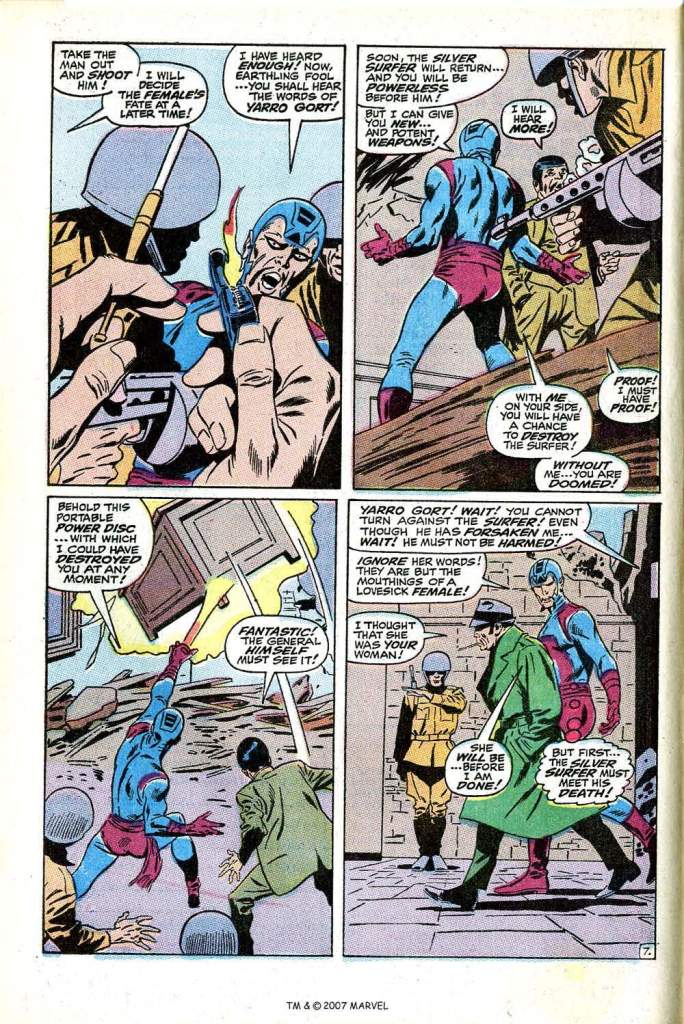
Yarro Gort proves to be a typical Lee snake in the mold of a Loki or a Maximus. When he and Shalla are scooped up by El Capitan’s soldiers, in order to save his own skin he offers to provide them with weapons from the stars. Both Yarro and El Capitan have designs on Shalla Bal, and both plan to off one another once the Surfer is out of the picture. Meanwhile, the Surfer has discovered that the rebels he’s been fighting alongside are just as bloodthirsty and merciless as El Capitan’s soldiers, so he’s had enough of his involvement in this whole mess. But the downed Zenn-La spaceship causes him to investigate further. Yarro Gort sees his chance to eliminate his rival and opens fire, but weapons that might have killed Norrin Radd are useless against the Silver Surfer. When Shalla Bal protests, El Capitan shoots her down–possibly the stupidest thing he could have done at this point.
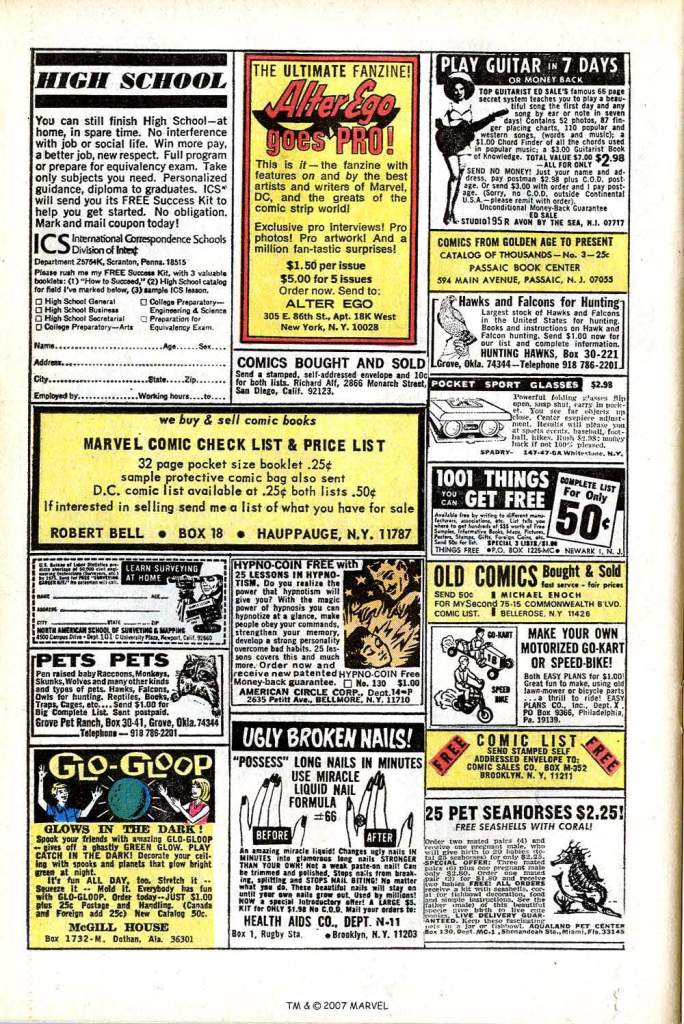
Another quick pause here, this time for one of those pages of random small-time ads that comics used to be full of. This one is noteworthy as it promotes Roy Thomas fanzine ALTER EGO, the tenth issue of which was just about to be published. Roy had been picking away at it amidst work at Marvel, and he clearly thought that advertising in the company’s titles would bring in a lot of new subscriptions. I imagine that it did–though #10 would be the last issue that Roy would produce; an eleventh issue wouldn’t be finished and released until the late 1970s.
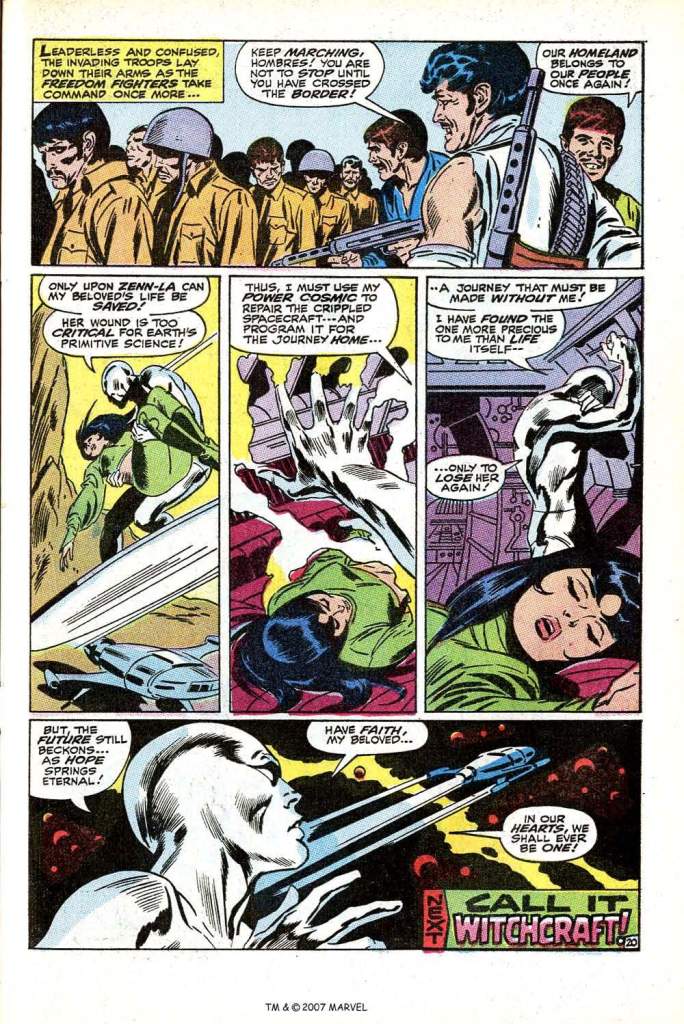
The Surfer goes a bit nuts at this point and strikes down both Yarro Gort and El Capitan (though both the visuals and the copy try to make this seem a bit more like self-defense than Buscema’s illustrations would indicate. With the Dictator dead, his troops are all tossed out of the county as the freedom fighters take over control. But the Surfer doesn’t care about any of this. He needs to get Shalla Bal back to Zenn La where her life might be saved, so even though he himself can’t pass through the barrier Galactus erected around the Earth, he is able to repair the Zenn La spaceship and have it autopilot her back towards medical attention. This all feels a bit facile–we’d seen the Surfer heal bullet wounds previously, but clearly Lee wasn’t looking to change the parameters of the strip by having Shalla Bal a regular presence on Earth–so back home she needed to go. I can’t recall any mention being made of her being wounded in her next appearance, though I could simply be forgetting. The truth is that I found this issue to be pretty ponderous, and looking back on it today, its central conflict feels incredibly thin and more than a little bit racist in its depiction of the people of the unnamed Latin American country that’s being fought over. All of the principles are straight out of central casting without any real nuance to them. So the story is trying to comment on real world things, but its depiction of those things is decidedly cartoonish.
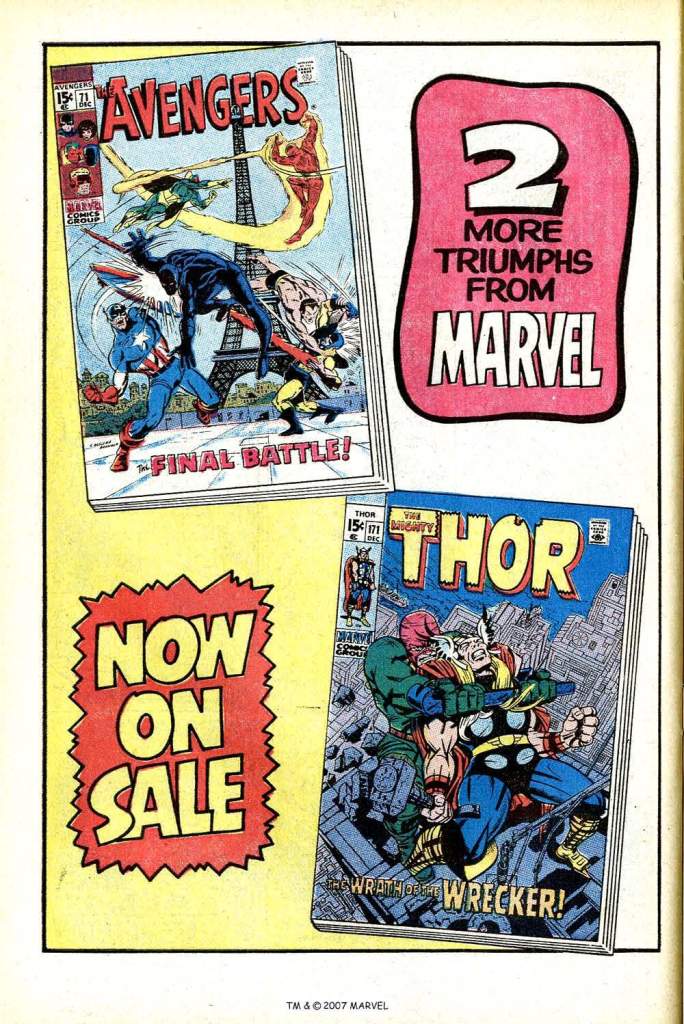
There was another one of these cool two-covers ads that fell before the two-page letters pages, so that was something. I dug getting this glimpse of older comic books I had missed and I occasionally coveted them–in particular, this AVENGERS issue in which Earth’s Mightiest Heroes battled the group that Roy Thomas would later name the Invaders, the World War II-era squad.

