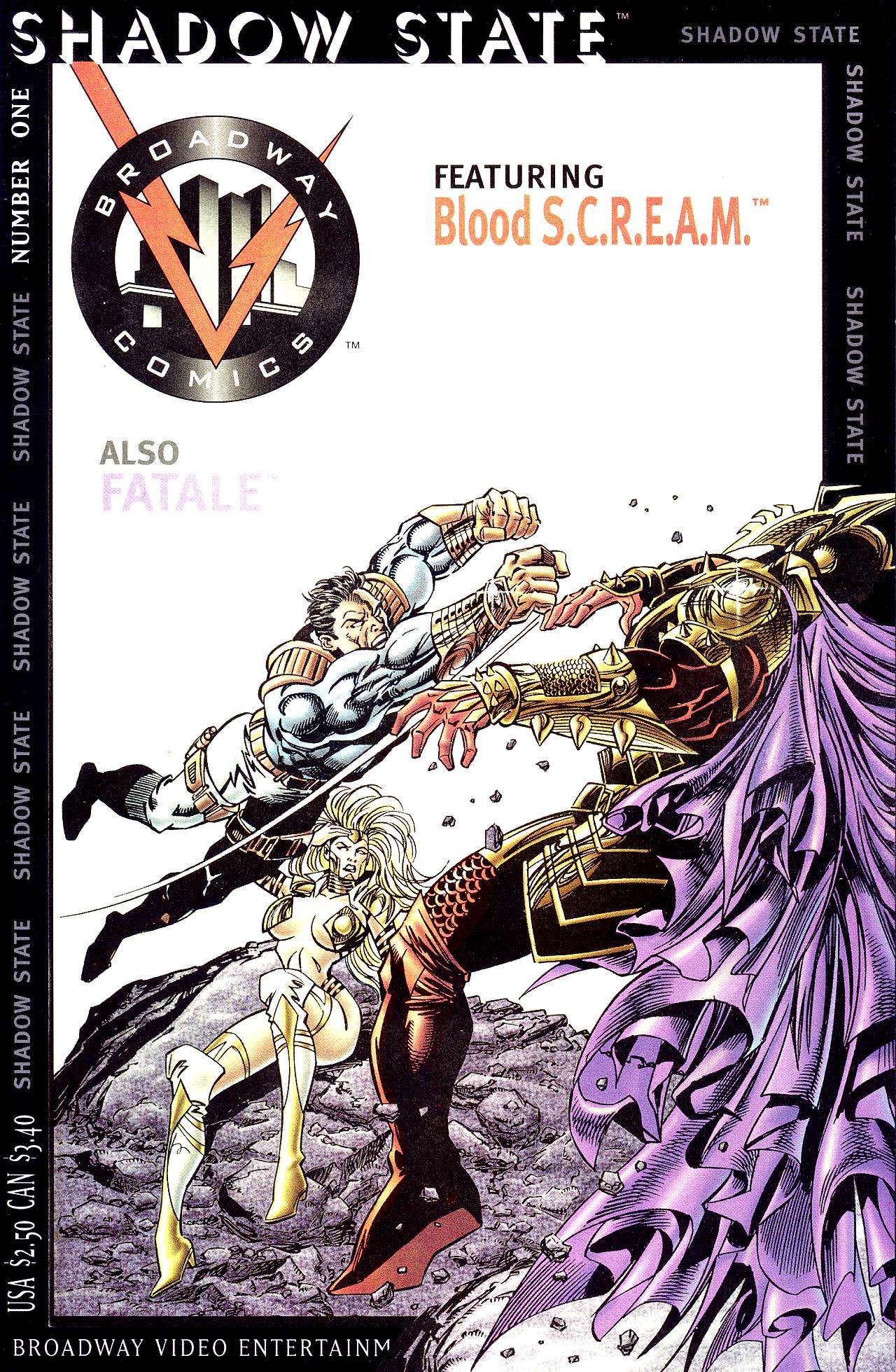


The second comic book release put out by Jim Shooter’s last new comic book company Broadway Comics was SHADOW STATE #1. And to begin with, what a lousy cover–badly composed, poorly colored, overly designed. A real eyesore, for all that it definitely did the job of making a prospective buyer’s eye linger on it on a crowded comic book rack. The design philosophy here is utterly baffling. Why keep the artwork to the bottom half of the cover? Why color the central character almost white so that he doesn’t pop from the background? and why is the dominant image the back of a character that isn’t visually interesting and that I don’t know? Shooter was better and smarter than this, so I can only guess that there must have been some other force inside Broadway that pushed things in this direction. In a few months, Broadway Comics would abandon this cove treatment, but it would be too little, too late. Even for this time period, this is an ugly-looking comic book cover.
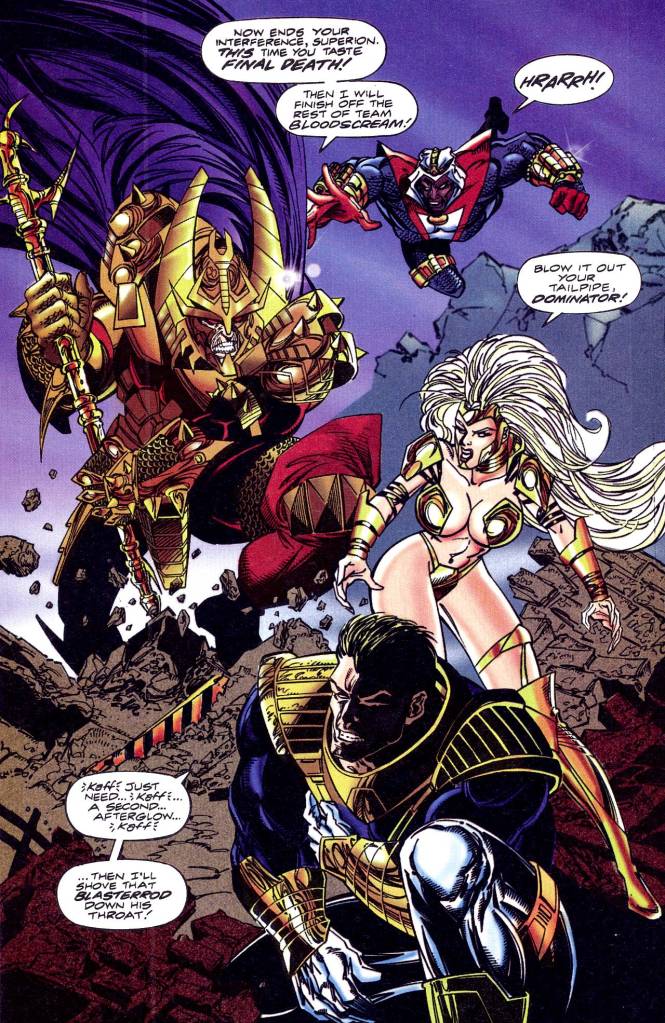
Like the previous POWERS THAT BE title, SHADOW STATE contains two stories (which are actually three stories–we’ll get to that.) The opening feature is BLOODS.C.R.E.A.M., and in case you’re wondering, that acronym stans for Super Covert Renegade Elite Anti-Mutants. As should be almost immediately obvious, this entire tale is a bit of a send-up of the Image style of storytelling that was so all-pervasive in 1995. The story even carries a dedication to “The Magnificent Seven”, a reference no doubt to the Image founders. As with almost all of Broadway’s stories, this one was gang-written by Shooter, Janet Jackson, Joe James and Pauline Weiss, whereas Hoang Nguyen handled the art. The story even includes a mock title/credits page that’s a send-up of the one Todd McFarlane regularly ran in SPAWN–on it, the writer is listed jokingly as James S. Jackson-Weiss III. Yes, that’s right, there are two title/credits pages in a row in this comic book.
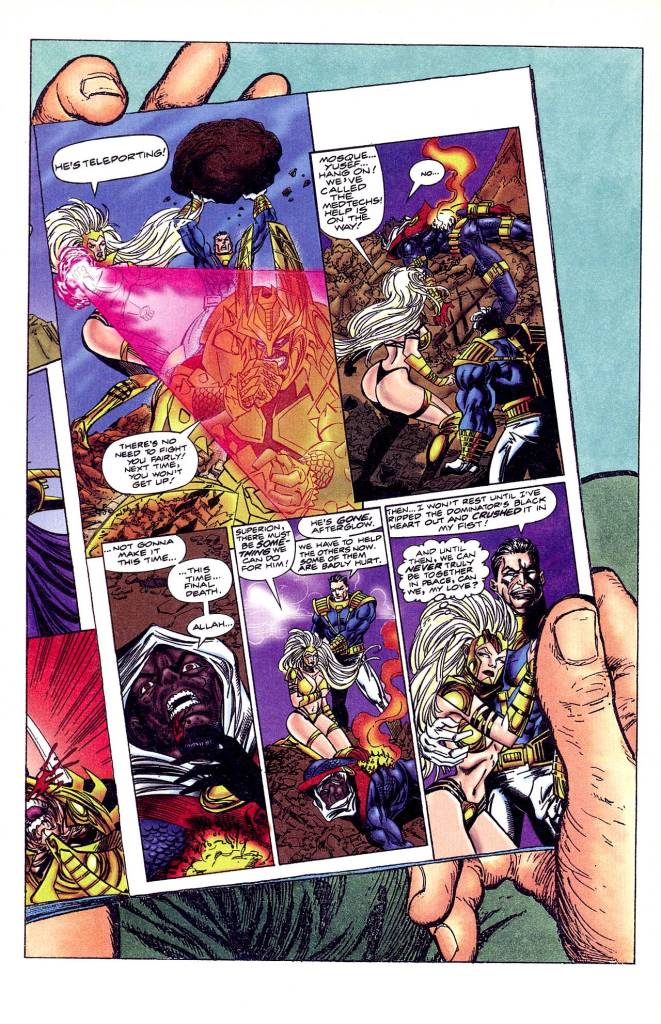
There isn’t much to say about the story–it’s only six pages long and it’s meant to be a pastiche of an Image book. But it isn’t especially funny as a pastiche, nor does it really have much of anything insightful to say about the Image approach other than that it exists. It’s a stakesless fight between the evil Dominator and Team BloodS.C.R.E.A.M., which includes the heroic Superion, barely-clad Afterglow and the quite offensive Mosque. After six pages, Mosque is struck down and dies, and Superion swears vengeance while Afterglow silently hopes that once that is achieved, she and Superion can be together in peace. But it’s at this point that the larger bit is revealed, as the camera pulls back to reveal that what the reader has been experiencing is a comic book being read by the lead character in what is actually the opening story. A strange and somewhat baffling choice among lots of them.
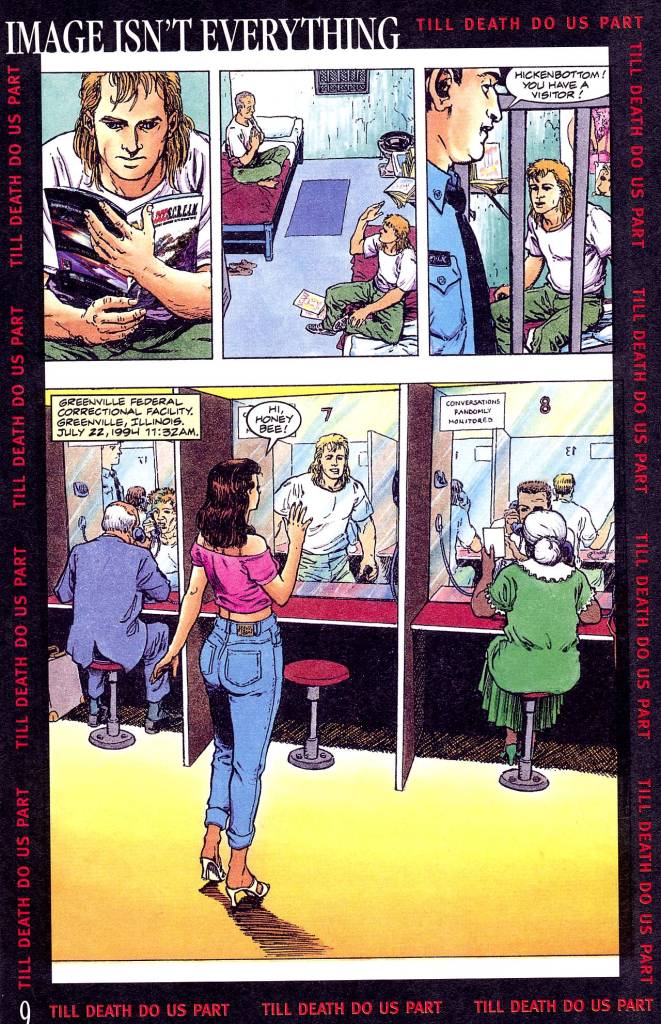
This is the opening installment of the feature ‘TILL DEATH DO US PART, and the comic book reading inmate is Troy Hickenbottom, a criminal doing time for a robbery committed by himself and his girlfriend Wendi. Wendi’s still on the outside, though, and she comes to visit Troy, interrupting his reading time. Troy is apparently horny as hell and lets Wendi know it. He’s also being driven a bit crazy by the fact that Wendi is still at liberty with their loot, as well as the possibility that she may be seeing other men. Wendi does her best to reassure Troy that there isn’t anything to worry about, that she’s waiting for him. But Hickenbottom can’t shake his concerns, and he’s like a caged animal in the cell he shares with older fellow inmate Leo. Leo, though, is more resigned to their situation, but he’s been meditating and attempting to tap into universal forces that shape reality. Troy thinks he’s a kook–right up to the point where Leo suddenly levitates a few inches above his cot.
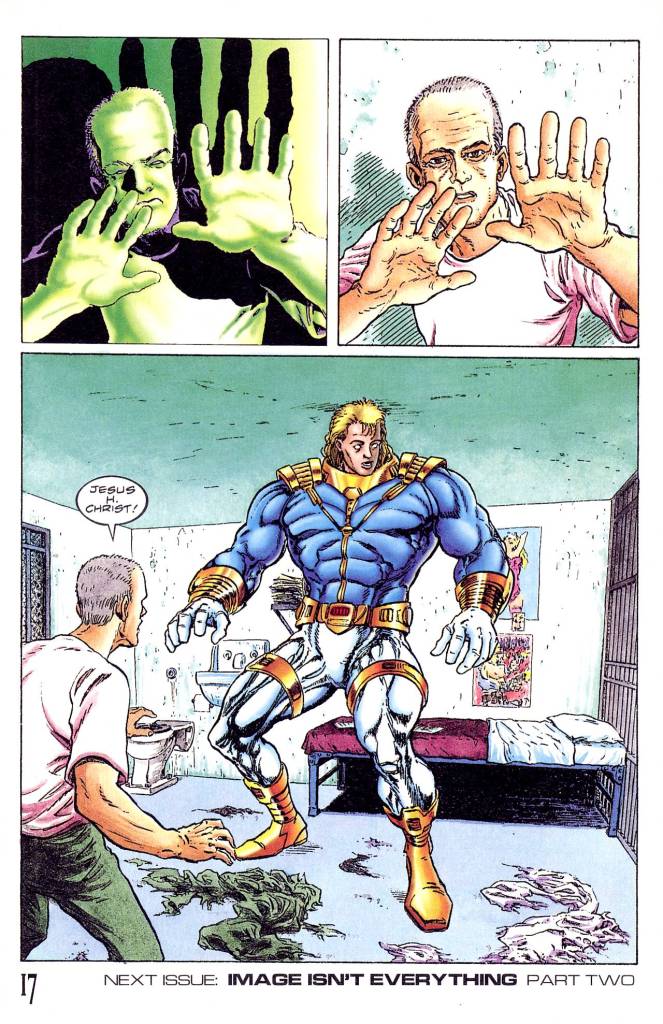
That gets Troy’s attention–he’s a bit of a believer all of a sudden, especially when Leo offers to take Troy with him when he effects his escape. That evening, Leo enters into a trance state, green energy seeps around him and Troy from out of nowhere, and there’s a powerful burst of light and green flame. When the dust settles, Leo and Troy are still in their cell–but Troy had been transformed into Superion, the character from the BloodS.C.R.E.A.M. comic book that he’d been reading earlier. To Be Continued! This story is really nicely executed visually by a young Stefano Gaudiano–while he’s got some unpolished edges, you can see that he has talent. The color work is also nice and restrained. I don’t know that this set-up really required this many pages, given that we only get a slight clue as to what this story is going to be about in an ongoing sense, and the extended Image parody feels like an indulgence. But this wasn’t half bad.
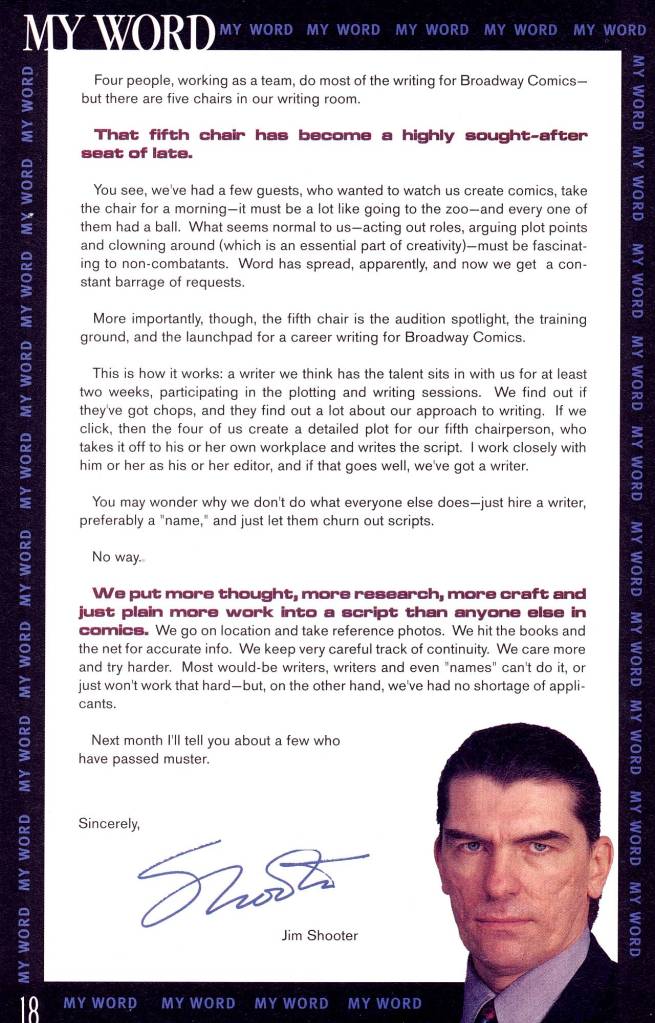
Jim’s editorial this month extols the virtue of the group-writing system that Broadway Comics was using, possibly in an attempt to turn a drawback into a virtue. I know that for myself, both personally and professionally, I’m not a big believer in more writers leading to a better end result–in my experience, the more writers you have, the more the work tends to skew towards the middle, towards the safest option. Which makes sense, the more people you need to get to agree on something the harder it is. But as I said when talking about POWERS THAT BE, it’s not as though every television show in production doesn’t use a similar working model, so the approach here isn’t intrinsically wrong, it’s just different. Honestly, as a reader, I would have been happier if Shooter just wrote the material himself.
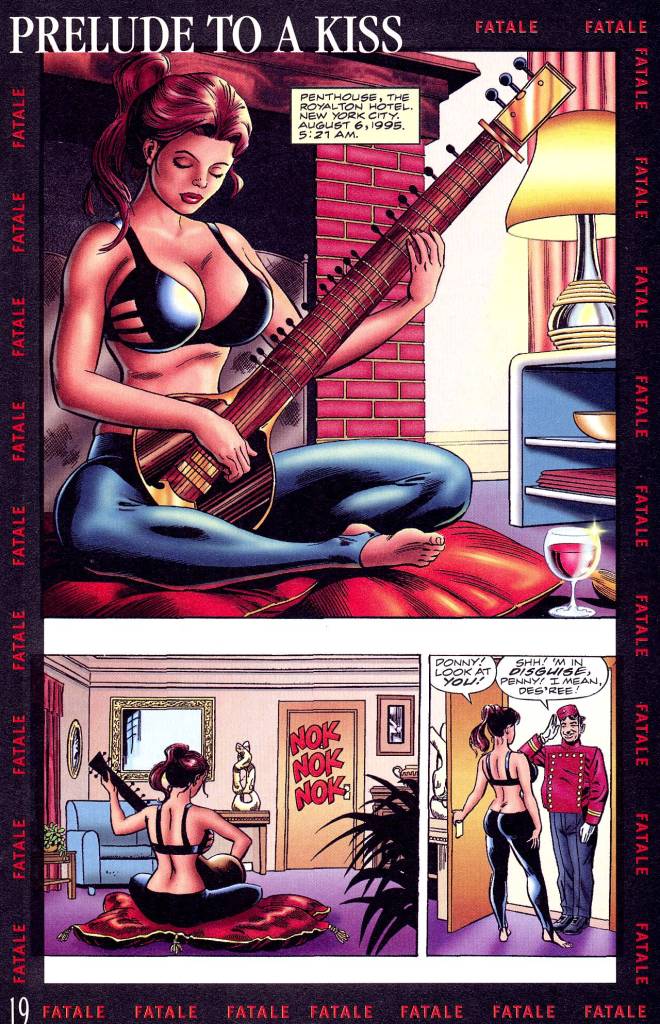
The second story in this issue is the second chapter of FATALE, and what a weird decision that is. I don’t quite follow the logic of launching a series as the cover feature of one comic only to shift it immediately over to a different one. Plus, there’s something about a first issue featuring a second chapter that simply reads wrong to my mind. Fortunately, this installment, while it picks up where POWERS THAT BE left off, is also framed as self-contained enough that if a reader missed the earlier book they could still puzzle their way through it easily enough. The artwork on this chapter was by Dave Cockrum, a storied artist and the co-creator of the All-New, All-Different X-Men whose style had fallen a bit out of favor and who was having to scramble to get assignments that once upon a time would have been gratefully offered to him. It’s not really Cockrum’s best work–he’d had some health issues that seem to have impacted on his drawing abilities over the years–and the inking by Frank McLaughlin, a longtime veteran in his own right, isn’t really all that simpatico.
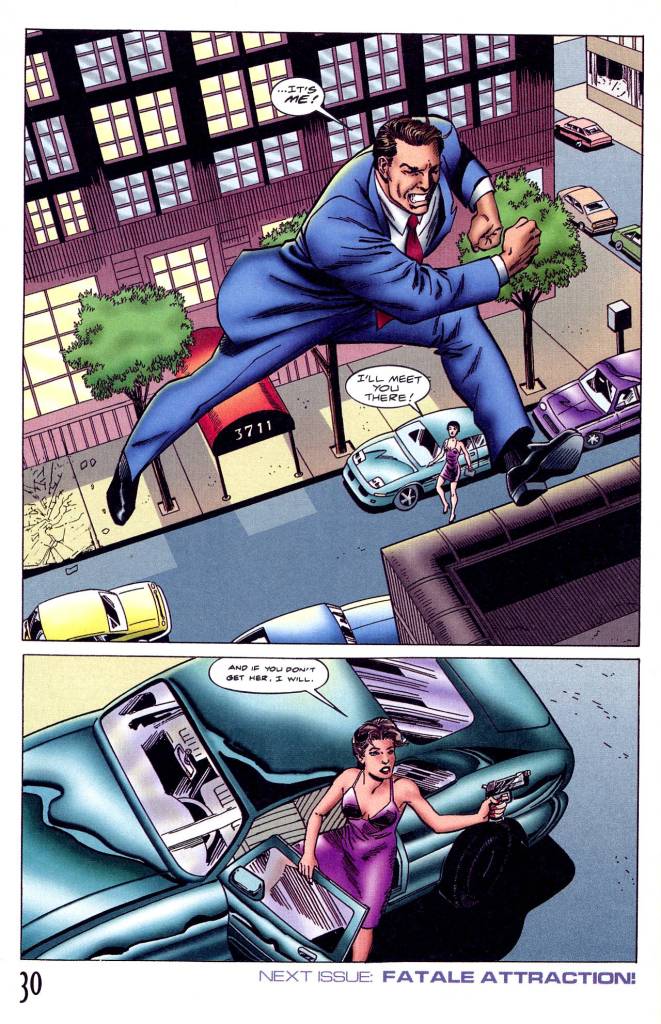
There isn’t so much a story in this chapter as there is a string of incidents. We pick up on Fatale in the hotel room she occupied at the end of her first story. Warned by a friend that she’s being surveilled from a van out front, she leaps out of the window down to the street and clobbers the surveillers. From there, she links up with her friends Duke and Donny, and the trio talk about the Brotherhood, the group that’s been pursuing Fatale all this time, while they drive. Contact with the guys in the van has given Fatale the location of a Brother hood base, and she’s decided to go in tonight and wreck it up while she’s still flush with all of the strength she absorbed in the initial chapter. That evening, the focus shifts to Bill and Natalie, a pair of Brotherhood operatives who are having dinner. A call comes in indicating that Fatale is striking at the base, and Bill sprints outside, then leaps high up into the air, racing in pursuit–he’s clearly superhuman s well. And that’s where this installment is To Be Continued. Once again, there isn’t really a whole lot here to hook a reader into the story. Everything is clear enough, but information is deliberately withheld–the conversation in the car between Fatale, Duke and Donny is oblique, with all of them knowing what they’re talking about but none of them spelling it out clearly enough so that the reader gets the same benefit. It’s meant to be mysterious, but instead it’s unengaging. It doesn’t make me want to know more, it frustrates me feeling like I ought to already know more.
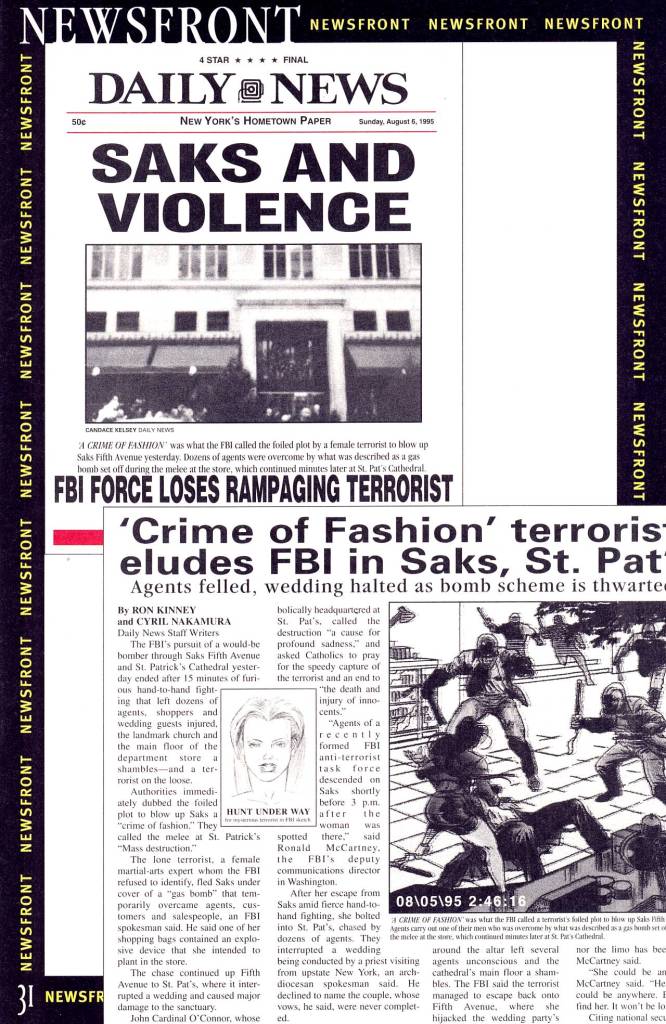
The issue also includes another of these fake newspaper articles, this one about the fight that happened in POWERS THAT BE #1. These pieces are kind of fun, but even after two of them, they’re beginning to become repetitive. They aren’t creating the sense of verisimilitude that they’re after, nor are they really providing any better insight into the events of the story. I can see a version of these that might be worthwhile, but the Broadway team hasn’t quite found it yet.


“Image isn’t everything” – yikes!
Do you have to pronounce every letter in BloodSCREAM? By the time you’re done saying his name the scene is over.
LikeLiked by 1 person
Yeah, this was the one issue of a Broadway Comics title that I bought. I got it for the Dave Cockrum artwork. I actually did like the inking by Frank McLaughlin over Cockrum, but I was so underwhelmed by the writing on this that I didn’t end up getting anything else from Broadway. I completely forgot that Stefano Gaudiano did early work on this.
LikeLiked by 1 person
That is indeed an awful cover. Add to its list of visual sins: the Broadway logo is way to large and oddly placed.
I don’t think there are too many hackier design choices than repeating the same words over and over on a layout.
LikeLike
Although I never saw this book, I suspect my appreciation for Dave Cockrum could have pushed me to purchasing it. But in reality, it is sad to see talents like Cockum and Shooter involved in a comic as overly painful to read as this appears to be. Tom’s noted the former’s health issues and falling out of favor. I’m guessing he’s also correct that factors out of Shooter’s control led to the unappealing aspects of this issue.
LikeLike
It looks to me like the early Broadway covers are designed for a very different kind of trade dress, and when someone imposed the new design on the company, they didn’t have time, or money, or the wherewithal to get new covers done. Or maybe they just convinced themselves it would work anyway.
They seem to have adjusted to the trade dress swiftly (at least, on most books, on FATALE the mismatch lasts a little longer), and then they scrap it. But it doesn’t work, that’s for sure.
I also assume the reason for the lengthy BloodSCREAM sequence is because it sets up the characters they’re going to draw on — it’s not just that one guy who turns into Superior; his wife tuns into Afterglow, and they fight the villain. So the setup is to establish the characters that’ll be used in the main series, where the superhero-fan lead finds out that superheroing isn’t so easy in the “real world.”
Also, I’d assume they wanted the look of the Image-like characters, with the straps and spikes and elaborately-ruffled caps and the yards of exposed female skin to serve as a draw to readers even though they were going to satirize it. So they tried to walk a line between exploiting it, critiquing it, and using it as foundation material, and that may not have worked as well as they’d hoped.
LikeLiked by 1 person
Typically “this is a satire of boobs and butt art” or similar sentiments are simply excuses for more boobs and butt art
LikeLiked by 3 people
I probably missed something, like an earlier post on Broadway Comics, but was one of the writers really Janet Jackson, Michael’s sister?
LikeLike
No.
The comics-industry Janet Jackson is an upbeat, multi-talented blonde, a longtime friend of Jim’s and a delight to hang out with.
I’ve never met the other Janet Jackson and can’t compare, but I can confirm that they’re not the same person.
LikeLiked by 2 people
Hello again! I commented on the last Broadway post talking about the Fatale I drew. It was this story I drew ( more than once-Go back to that post if you wish to read about it: https://wp.me/paxBON-hJN ) !
Anyway, I drew some of this over thumbnails drawn by somebody else in the office and they did not like what I did. Then Cockrum drew over those thumbnails and a few of my alterations. He probably did it as a favor? But his art does not look like his art as we had to draw according to the thumbnails provided for us. My art did not look like my art! : )
LikeLiked by 1 person
While I almost got what Shooter was trying for with Defiant, Broadway was completely lost on me. I was definitely underwhelmed by the return of Shooter’s trope of “If I think really hard I will become superhuman,” which didn’t work with Charlamagne, let alone here. Not sure if I actually bought any of the Broadway title or if just merely “hateread” them at the store I worked at, as I remember getting B&W promo copies of the first few releases, and if you think the covers don’t work in color, just imagine them in B&W with all that dead space!
LikeLike
It seems like both Defiant and Broadway suffered from the “Many Hands” syndrome.
LikeLike