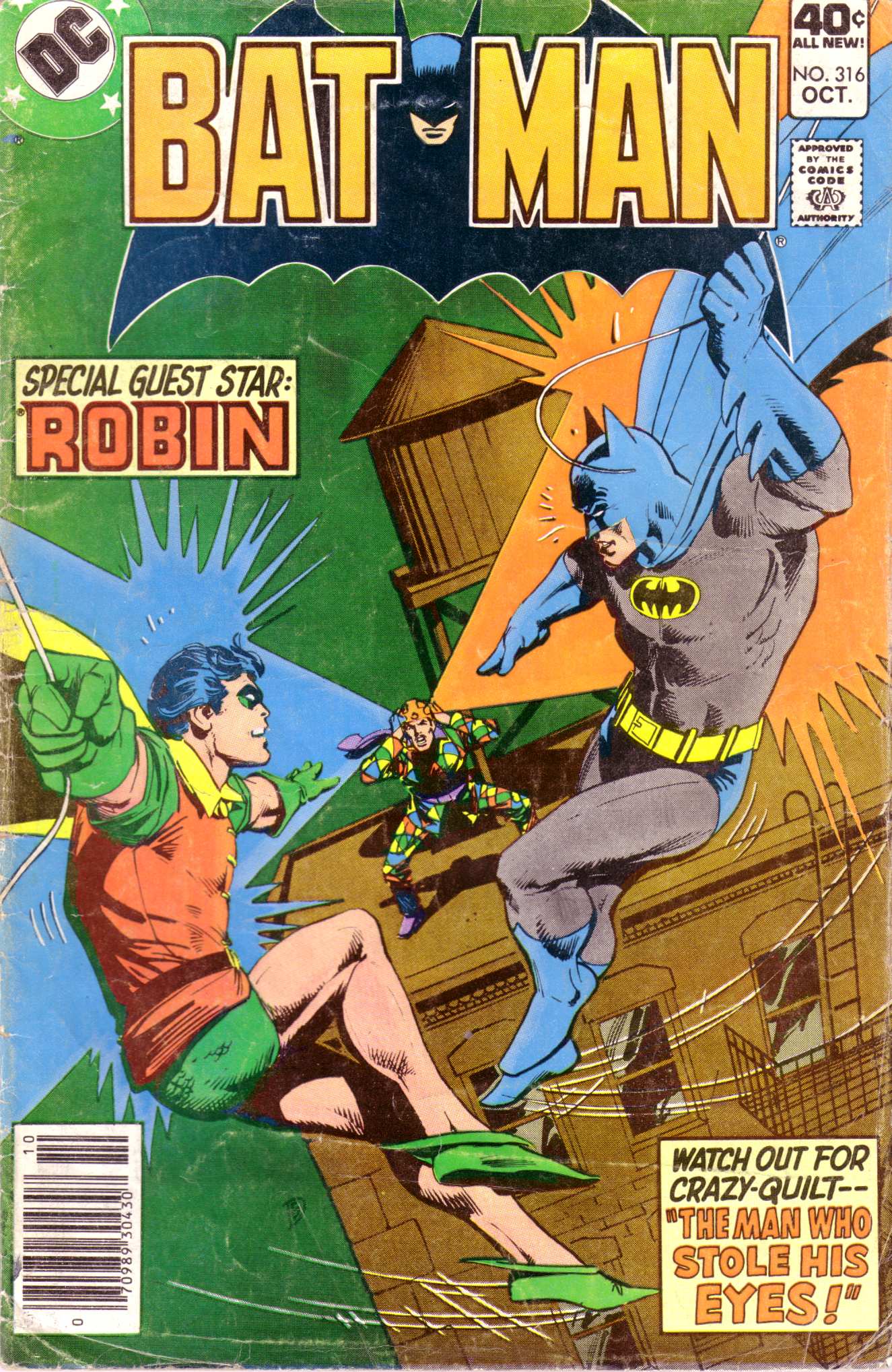


A combination of switching my shopping to the new Stationery Store and having a bit more coin in my pocket (it was during this time that I’d decided to forego school lunches, instead channeling the dollar-a-day I was given by my parents for sustenance into funds for buying more comic books) got me to finally begin to read BATMAN on a regular basis. It was still for the most part never my favorite title, and looking back on it from this vantage point, I can kind of still see why. But it contained decently-crafted super hero stories, and so while they didn’t typically knock me out of my seat, the book did represent a solid and sturdy 40 cents’ worth of entertainment each month. And among comic book readers, it was virtually a rule that you had to like Batman.
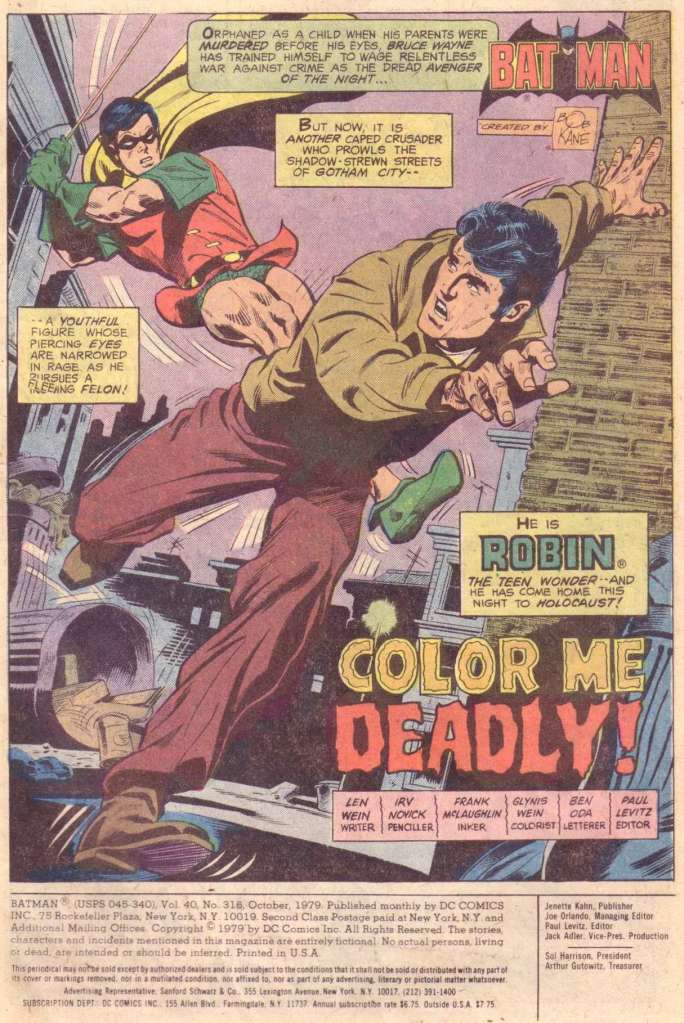
It’s kind of funny to see Robin listed on the cover as a special guest star, but that designation was well-deserved at this point in time. For pretty much all of the 1970s, the Batman and Robin team had been operating independent of one another, with Dick Grayson having gone off to college, leaving his mentor to steer a bit more sharply into his whole creature-of-the-night thing. While the Dynamic Duo remained an inseparable twosome across all other media, and certainly in the world of licensing, in the comics it was rare to see them share a story together in this manner.
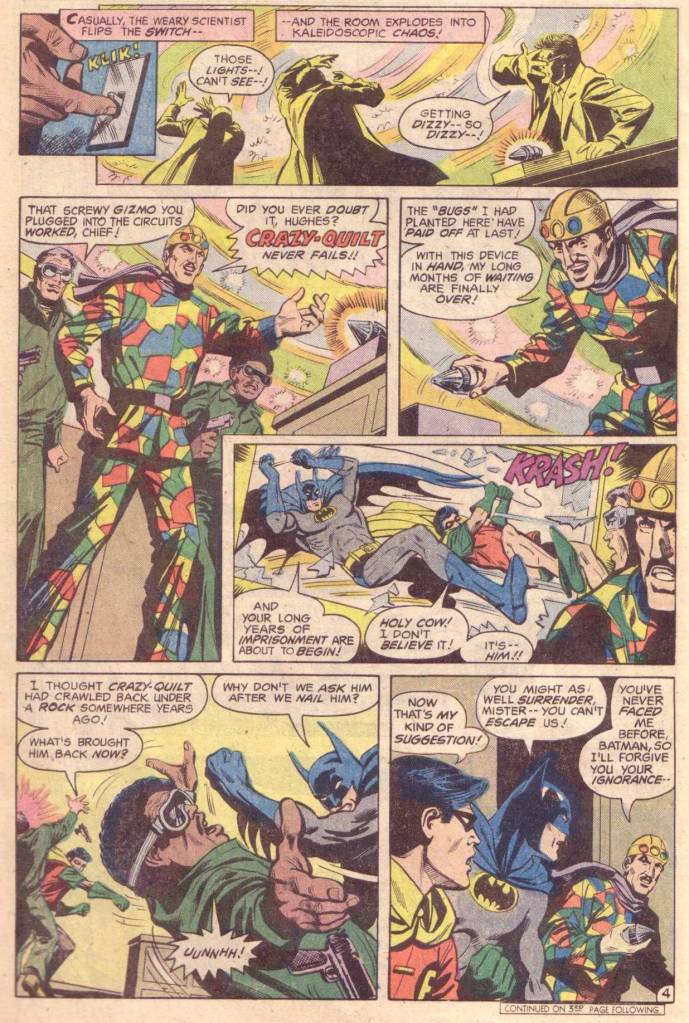
The Batman stories of this period strove for a certain amount of grounded plausibility, but they somehow never really got there. There were too many outlandish villains with cartoon schemes, too much verbal bantering, too much frivolity. The book wasn’t really dark, nor was it especially grim. There was a sense that a lot of the audience was still coming to the character through reruns of the 1966 live action television series. The book was, in a way, comfort food. Len Wein, who was writing the title at this moment, was an established pro with a refined voice by this time. He was a solid craftsman who always delivered. The artwork by Irv Novick was similarly reliable. I didn’t like Irv’s Batman as much as I did his Flash–his Batman drew from the Neal Adams model, but somehow made him chunkier and stiffer and a bit less animated. There was a kind of documentary feel to Novick’s approach–he exaggerated figures for dramatic effect, of course, but he approached each story in a very straightforward manner.
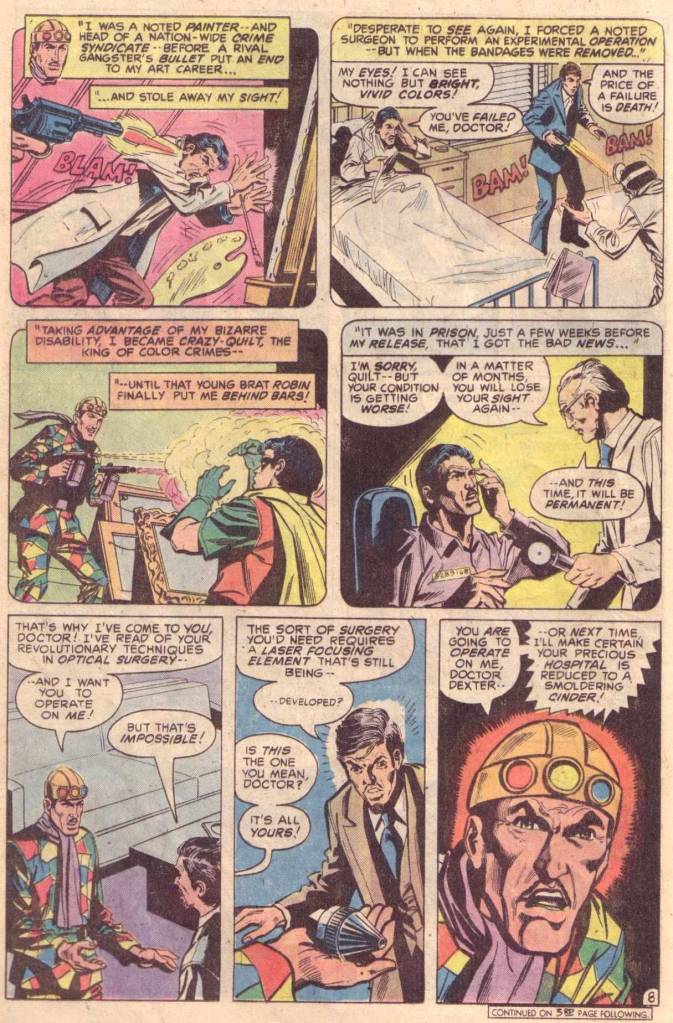
The villain in this particular story was one of the more outlandish members of the Caped Crusaders’ rogue’s gallery: Crazy Quilt! He had originated as an enemy of the Boy Commandos, then in some strange way segued over to fighting Robin on the latter’s short-lived solo series in STAR-SPANGLED COMICS in the 1940s, having forgotten all about his encounters with Rip Carter and his kids. As noted above, CQ had been an illustrious painter until a gunshot wound and an experimental procedure turned his vision all wonky. Determined to share his strange affliction with others, he began a series of color-themed crimes. This is the sort of felon that the modern day Batman would effortlessly fold, spindle and mutilate. But in 1979, he still posed a legitimate challenge, enough to require both Batman and Robin to take him on.
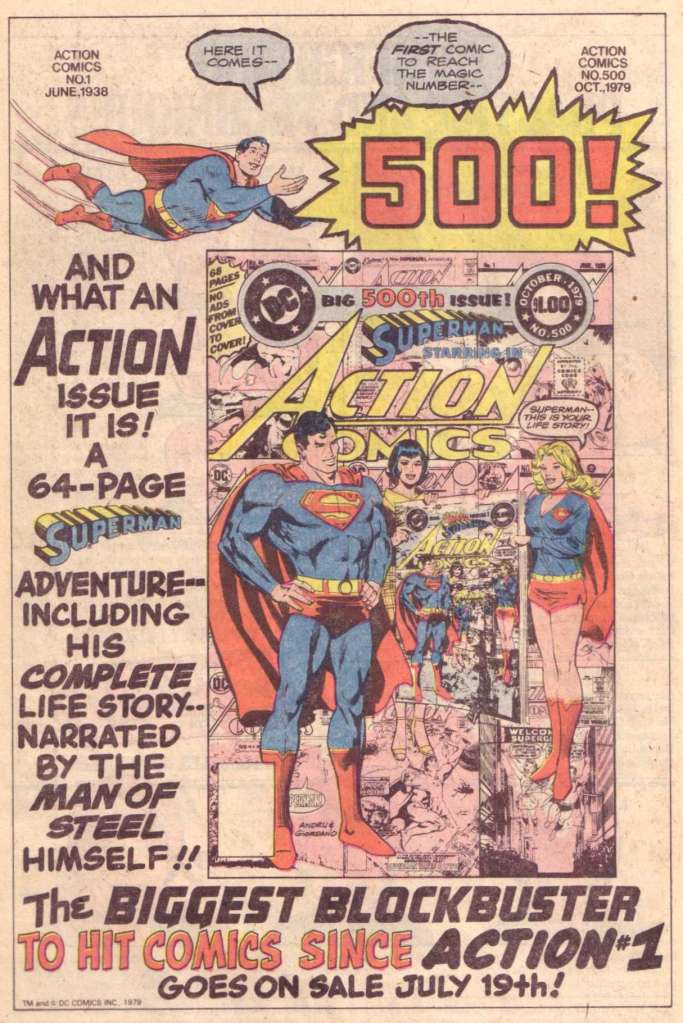
But before we get into more of a play-by-play, here’s a house ad from the issue in question. ACTION COMICS #500 was in the offing, and I can remember the feeling of excitement as the ramp-up to it began. The book was going to be released in the Dollar Comics format, and was one of the first centennial issues to be upsized in celebration–I believe only FANTASTIC FOUR #200 had come out before it. I had no way of knowing that the story contents had initially been commissioned for a Treasury Edition that got pulled from the schedule when the fortunes of that format turned sour, but I still would have enjoyed it if I had known, I expect.
So Crazy Quilt is back, and just at the same time that Robin happens to be visiting Gotham City. The Dynamic Duo interrupt him as he stages a heist at STAR Labs, stealing experimental medical equipment, but having never faced him before, Batman is caught flat-footed by his head-mounted color rays and dazzled long enough for the crook to make his escape. It turns out that Crazy Quilt is losing his eyesight, so he’s stealing the equipment and personnel to enable a delicate operation to save his vision. He and his gang next abduct Dr. Norman Dexter, administrator of Gotham Hospital, to perform the procedure. Dexter’s developed some new techniques in optical surgery and CQ thinks he’s the man for the job.
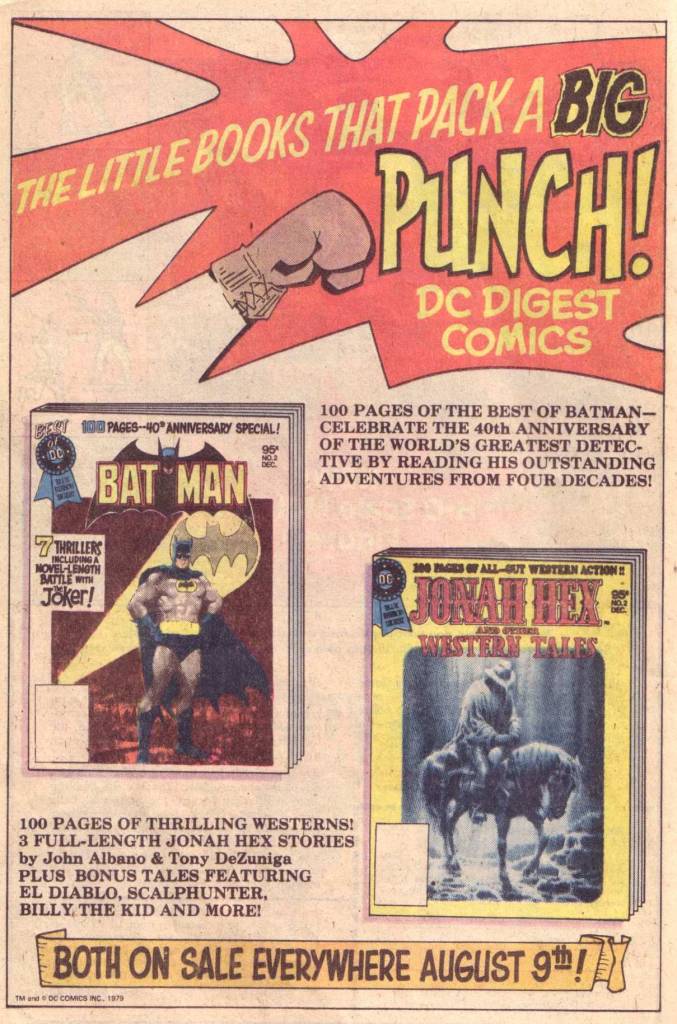
Another break here: at the time, DC was making a concerted effort to experiment with other formats, one of which was the digest. Archie Comics had found great success with these tiny books, and so DC rolled out a regular program of two releases a month that lasted for years. I hadn’t yet seen any of the DC Digests, but my Stationery Store would begin carrying them. And ads like the one above made me aware that they existed. But in this case, I didn’t yet care about westerns, and was still lukewarm on Batman, so I wasn’t especially pulled in or searching for these.
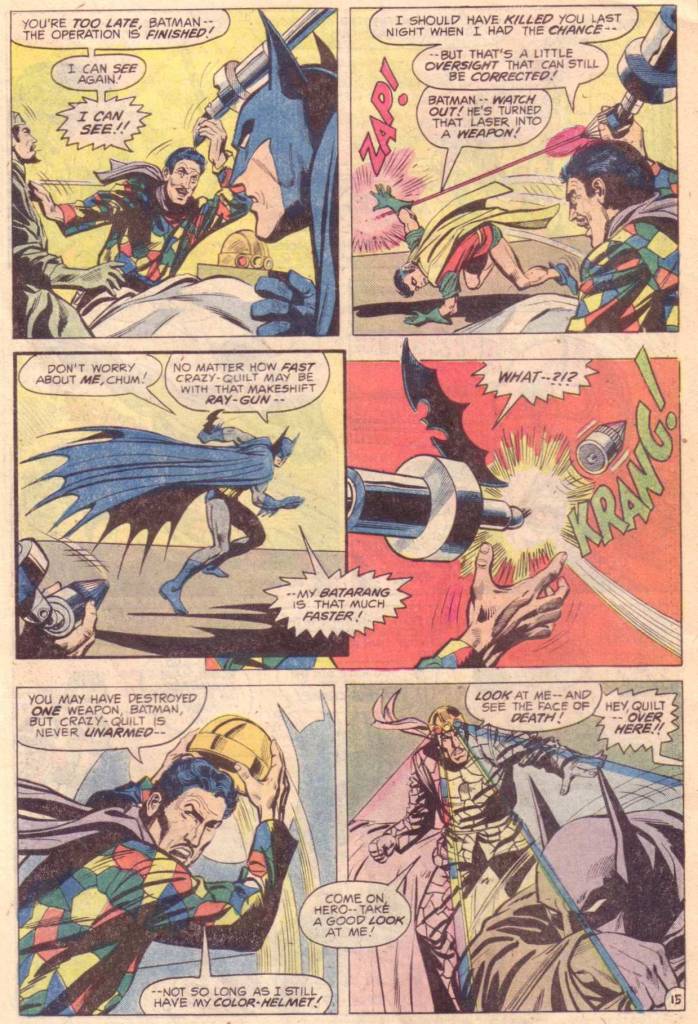
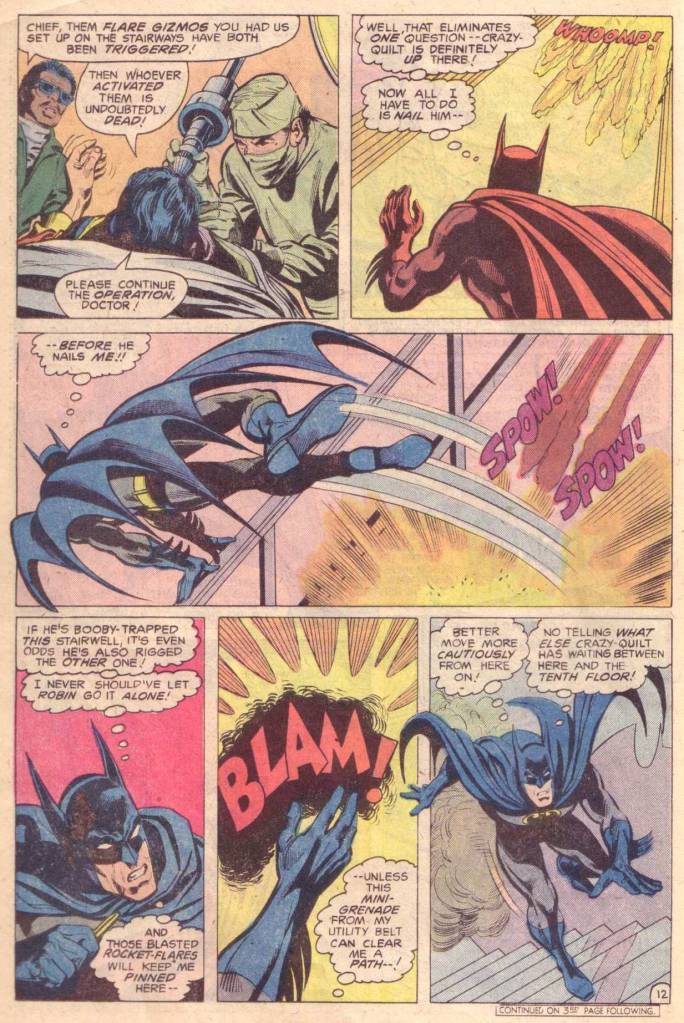
Upon learning of Dr. Dexter’s abduction, Batman and Robin trail his kidnappers to Gotham Community Hospital, where Crazy Quilt will go under the knife on the top floor. But the place has been occupied and booby-trapped to prevent anyone from intervening, so Bruce and Dick split up, each one taking a different stairwell and racing towards the top, battling defenses human and otherwise along the way. But nothing can halt either Batman or Robin–but they are delayed for long enough that the procedure is performed and crazy Quilt’s sight restored.
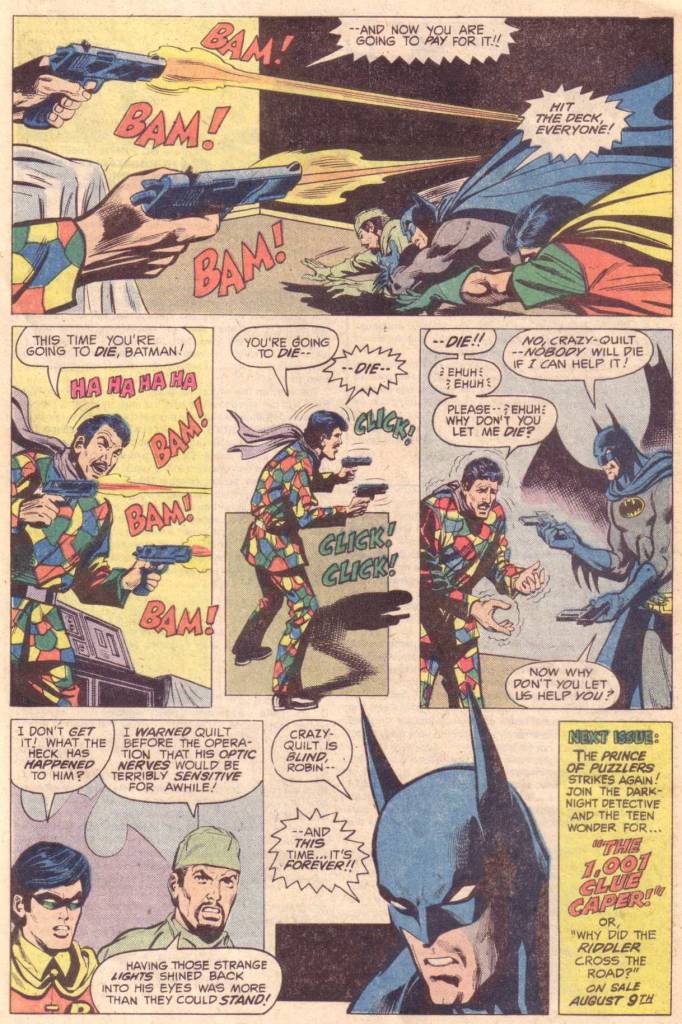
But this turns out to be a temporary fix as, in the course of a battle with Batman and Robin, CQ has his own helmet-rays reflected back at him, causing his newfound sight to fail. Stricken blind, the battle is over, as is seemingly the threat caused by the color-obsessed criminal. Of course, this being comics, he was brought back again and again after this for some reason, so the punch line to this story falls a little bit historically flat. This is a good example of the kind of material that BATMAN was showcasing in the late 1970s. The stakes were fairly small, the amount of characterization largely surface, and the emphasis was on action and color and death traps and narrow escapes. Not all that dark, not all that grim, but more straight-laced than the Adam West version. And one could certainly argue that Batman and Robin are somewhat in the wrong here, preventing a sick man from keeping his vision–even if he did use criminal means in an attempt to retain it.
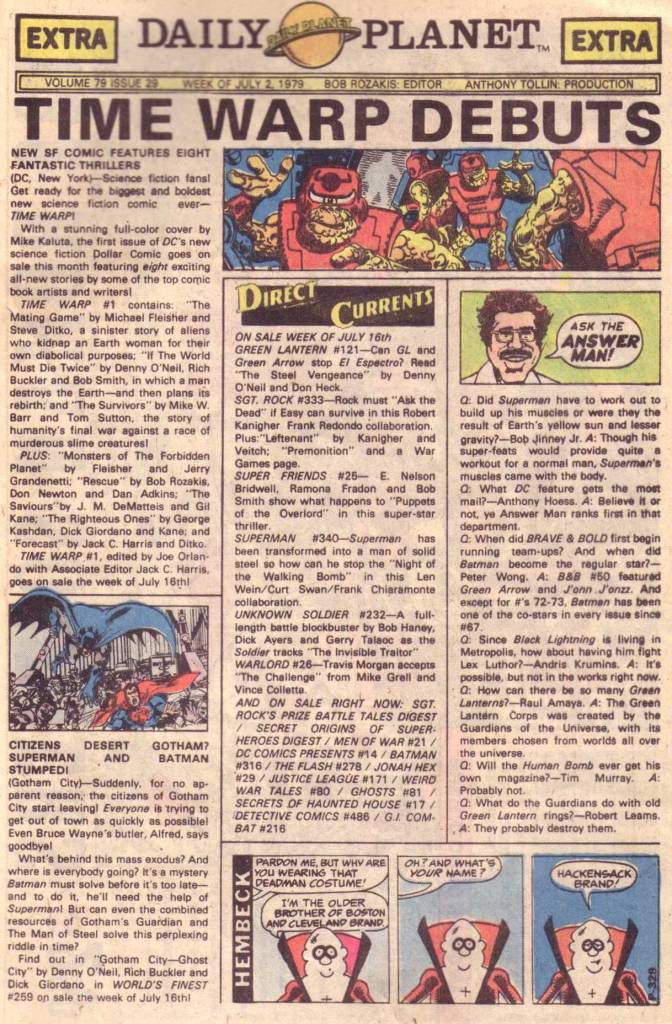
The issue also carried another edition of the weekly Daily Planet plug page that hyped next week’s new releases. Fred Hembeck has a groaner of a gag in his strip this time, while Answer man Bob Rozakis reveals that his column gets more mail than any individual title at the time.

