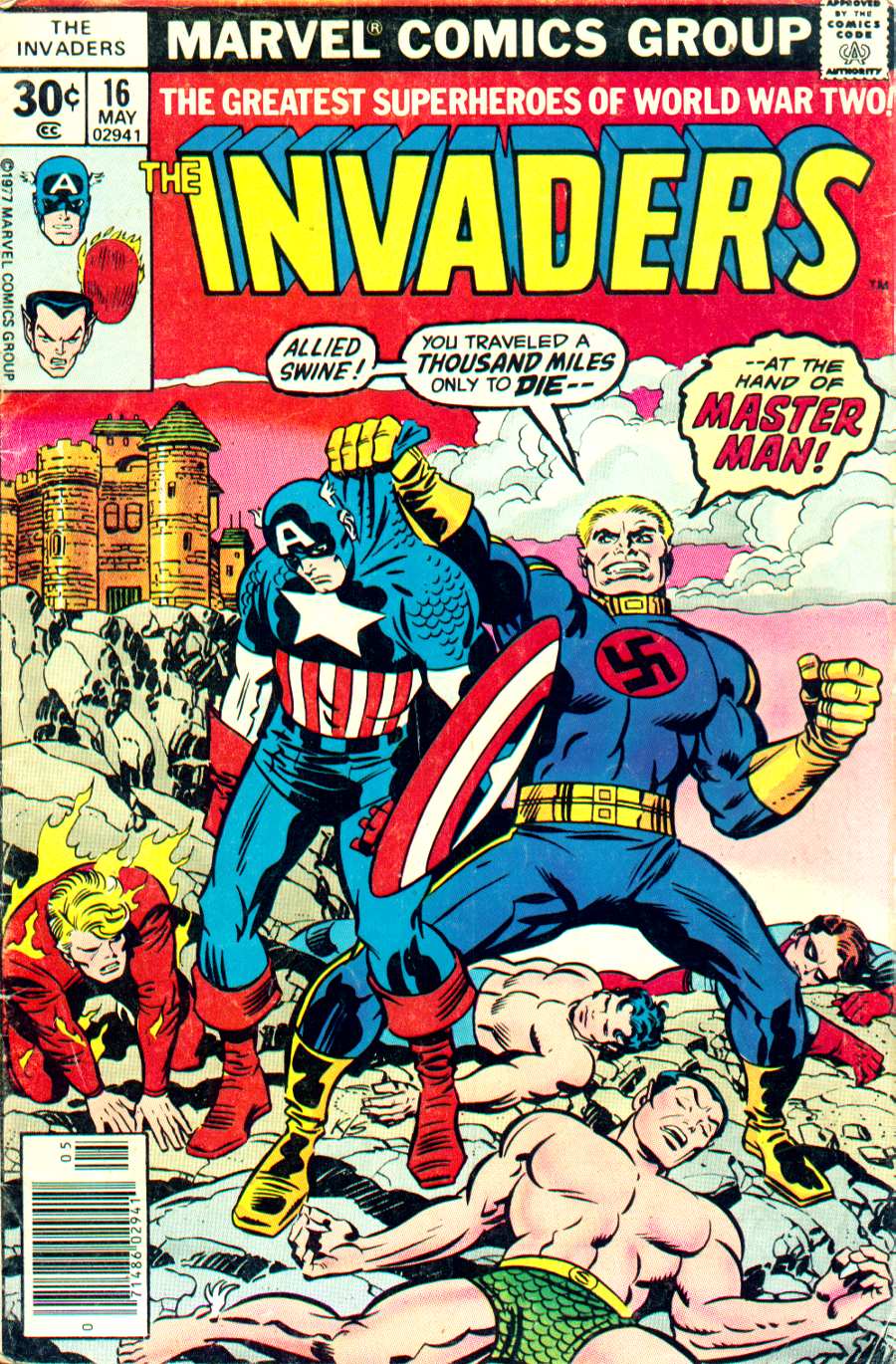


One of the reasons why I got along so well with my buddy David Steckel is that we tended to like a lot of the same Marvel comics. Like myself, he was a huge fan of the Fantastic Four, and that affection carried over to the golden age Human Torch who was being featured in INVADERS. Consequently, he had issues that I had missed, and vice versa. So we would routinely loan our books to one another to read. This issue, #16, was one of the ones that he lent me: I’d read most of the issues situated around it but had somehow never gotten a copy of this particular one.
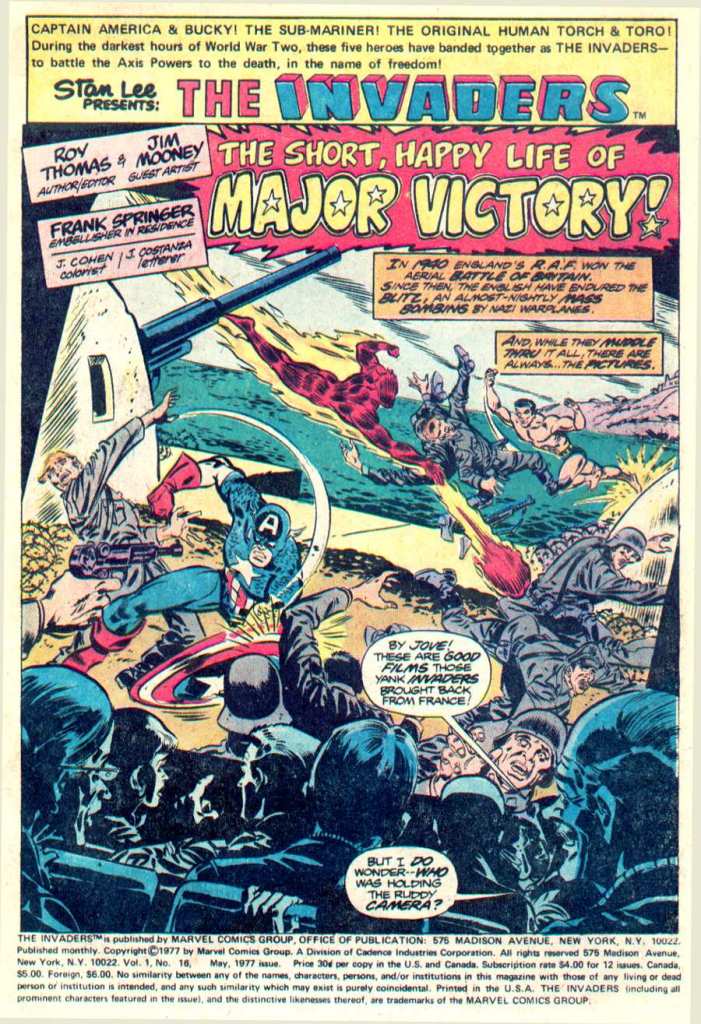
INVADERS was something of a dream assignment for writer/editor Roy Thomas. It was a book that allowed him to write about the versions of the characters that he liked best, the ones whose exploits were being published when he was just a kid. It also permitted him to indulge in his clear interest in the period of WWII, which he delighted in doing. For me, the fact that these were the original versions of these characters with stories set back during their formative years was compelling–I was already both a bit of a comic book historian and I’d also developed a huge fondness for DC’s Earth-2 characters, who were likewise the original versions. So INVADERS was akin to a regular Earth-2 series to me.
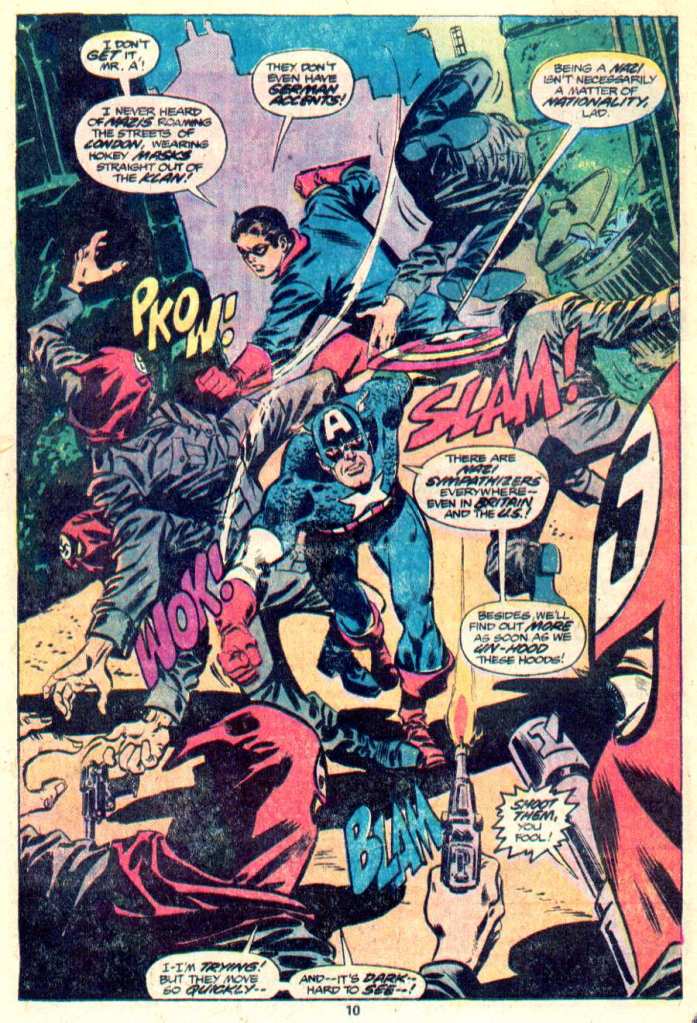
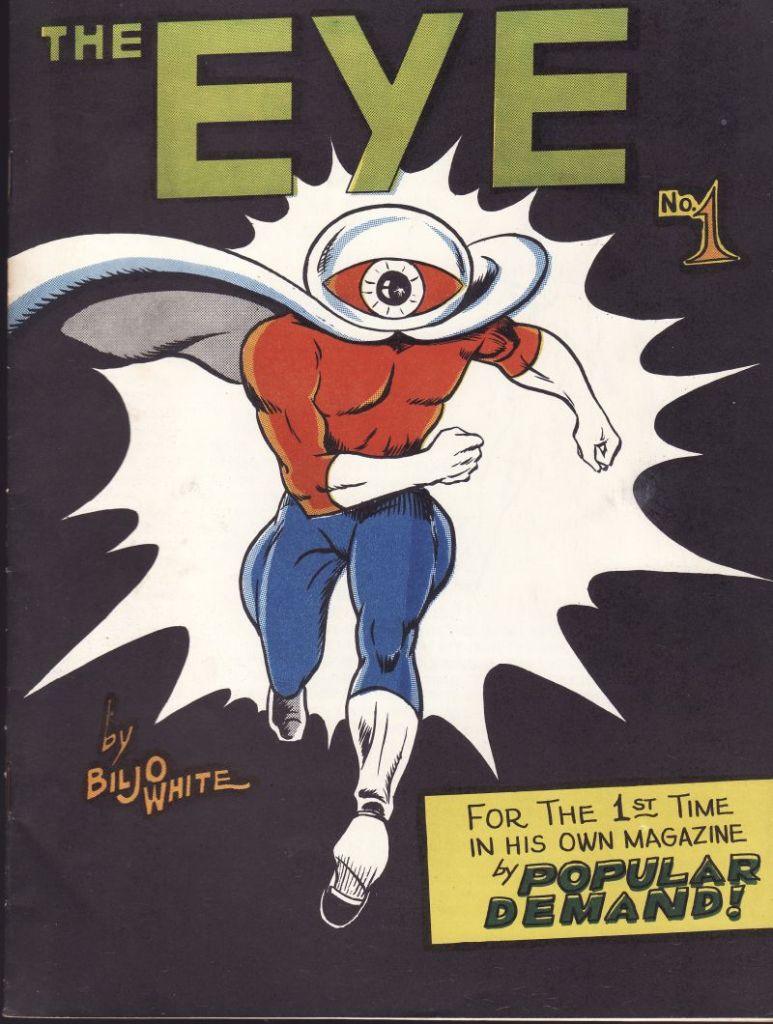
In this particular story, Roy also pays tribute to one of his friends in early comic book fandom. Captain Billy Joe “Biljo” White was a firefighter whose hobby was collecting vintage comic magazines. He stored his collection in a white concrete building out back of his property, which became known as the White House of Comics. Biljo was also a bidding fan cartoonist, and while he never broke into the field professionally, his work could be found in any number of fanzines in the 1960s. His most well-known character was probably The Eye, a crime-fighter whose full helmet was kitted out to look like a gigantic eyeball.
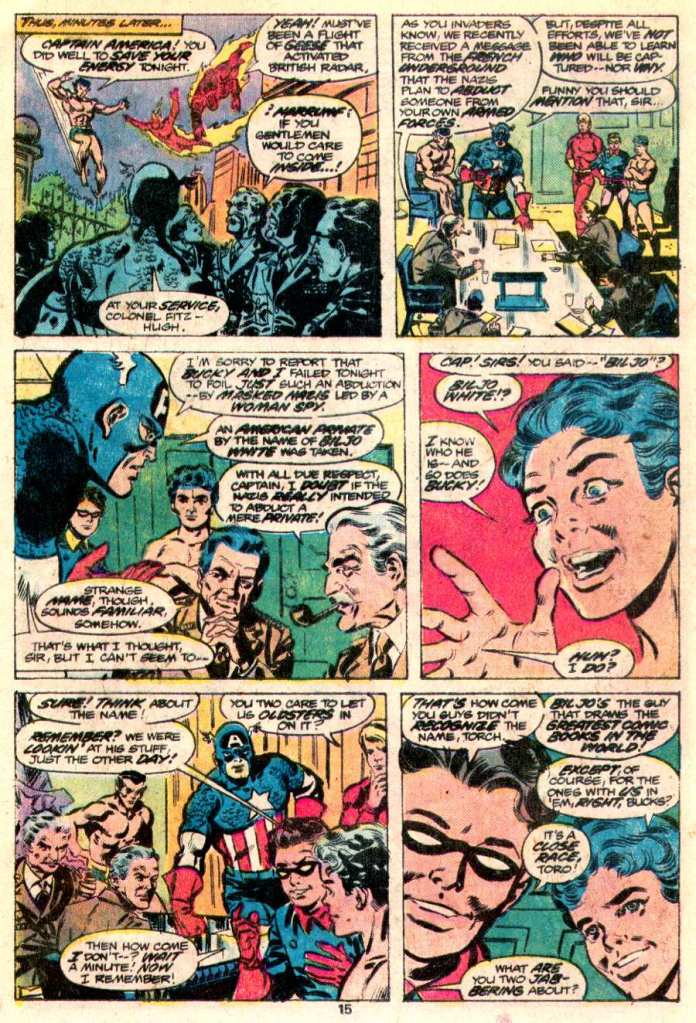
After a preamble that showcases Steve Rogers and Bucky Barnes taking in a newsreel of their latest exploits with the Invaders, the story really gets started as the pair suit up in response to sounds of a scuffle, and find themselves interceding as a gang of hooded and swastika-wearing goons attempt to capture a United States Private named Biljo White. Cap and Bucky put a hurting on the bad guys, but it turns out that Biljo’s date for the night is also a Nazi agent, and she’s able to turn the tables such that the Nazis get away with Biljo. Back at headquarters, as Cap relates the evening’s excitement to the brass, it’s Toro who identifies Biljo White as the artist of the popular Major Victory Comics, the greatest comic book in the world.
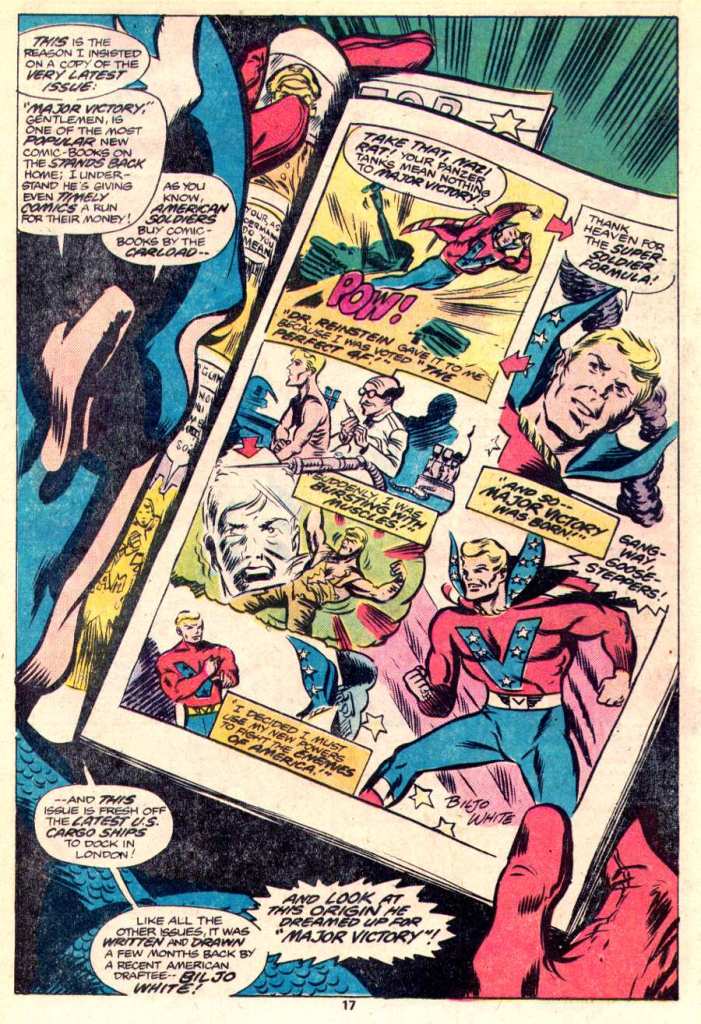
In this regard, Biljo is a stand-in for Jack Kirby, with Major Victory replacing Cap himself. Perusing a current issue, Cap is startled to discover that the origin Biljo gives for his character is almost exactly his own–including references to Dr. Reinstein. It’s now clear that the Nazis were interested in Biljo because they think he may know some of the secrets of the super-soldier formula that created Cap in the first place. Feeling guilty that Biljo is in peril in a way thanks to him, cap is determined to mount a rescue mission despite how the brass feel about it. And of course, his Invaders teammates are all on board as well. It’s worth noting that the actual Biljo White apparently penciled the comic book page Cap is looking at here, so this was all done with his awareness and consent.
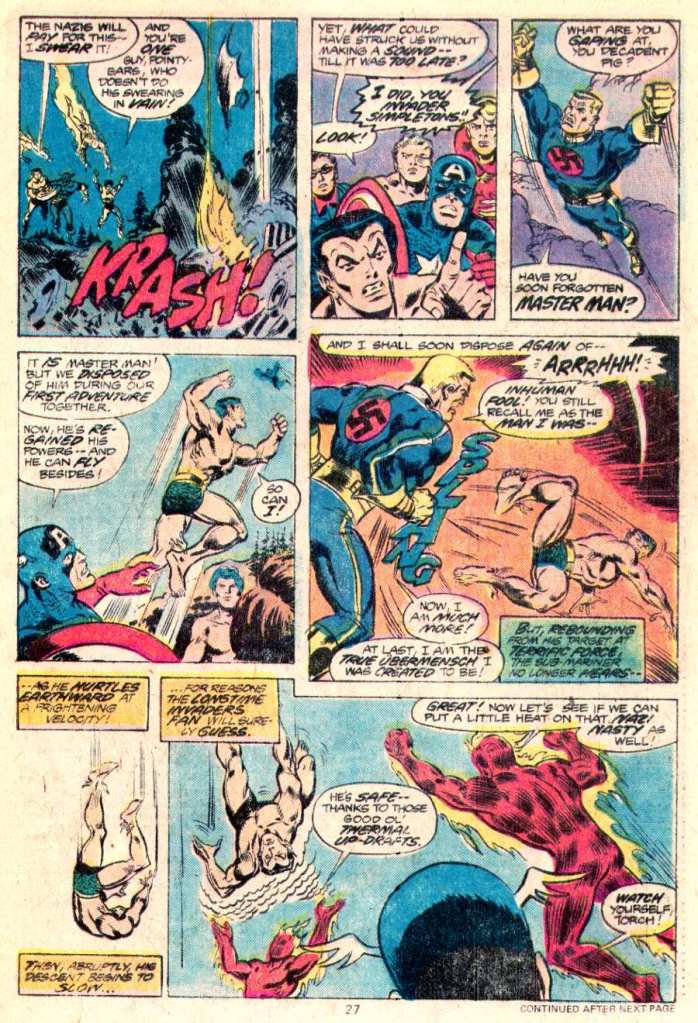
On the flimsiest of evidence, the Invaders cross the Channel and soar into Germany, heading for Berchtesgaden, Hitler’s armored fortress where intel has it that Nazi scientists have been assembling–they figure that if they’re trying to recreate the super-soldier formula, this will be the place. Namor’s airship is able to penetrate German airspace easily (so easily that I sort of wonder why they just didn’t move in and clobber Hitler directly.) But as they near the stronghold, the airship is shot down. The Invaders are able to bail out with not loss of life or injury. But they’re immediately set upon by their old foe Master Man, a previous attempt by the Nazis to field their own Captain America who has now also been granted the ability to fly. It’s a sad day for the Allies as Master Man makes mincemeat out of them in two pages. When the team awakens, they’ve been chained up inside the dungeon of the fortress.
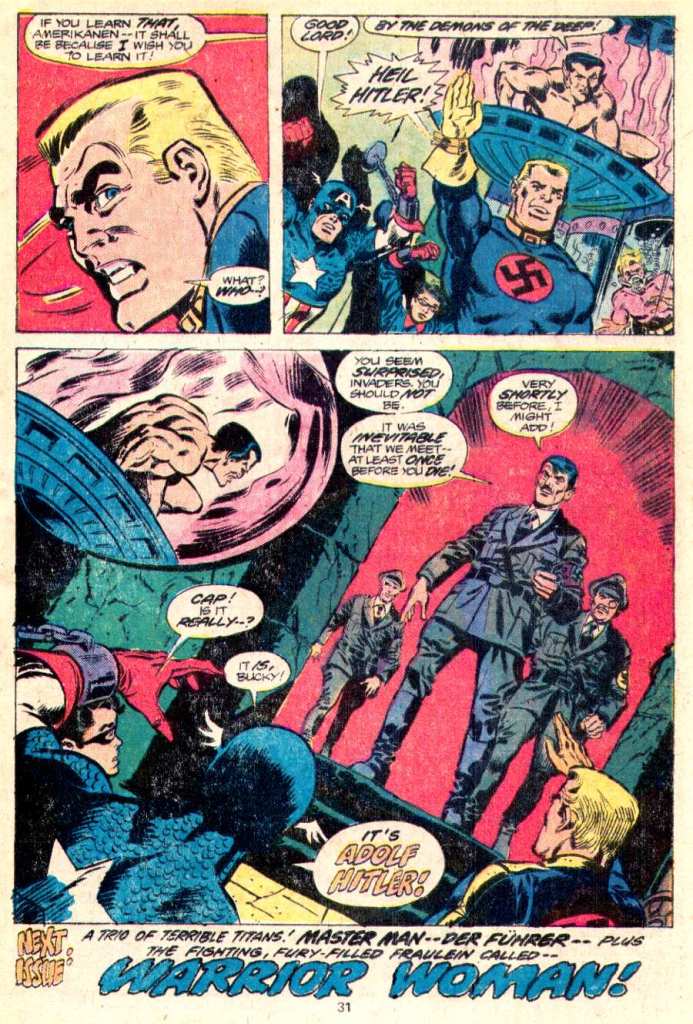
As the issue races to its close, a commanding voice rings out and all head turn. It’s Adolf Hitler himself, who is just about ready and willing to order the deaths of the captive Invaders. And that’s where this issue is To Be Continued! The artwork on this issue was a fill-in job produced by stalwart Jim Mooney, subbing in for the absent Frank Robbins. Robbins’ work was divisive, so my guess is that fans of the era may have preferred what Mooney did here. Inker Frank Springer does his best to keep everybody on model.


“I understand that he’s even giving Timely Comics a run for their money.”
Loved that line as a kid. Just as I loved this comic back then. Ignorance of the Biljo White reference took nothing away from the overall fun of this issue. Master Man makes a perfect villain to utterly despise. Having Hitler show up was icing on the cake. Ironically, as much as I disliked Frank Robbins’s work as a kid, this was the one title where’d I miss his art if he was gone. Nonetheless, I didn’t mind Jim Mooney’s pencils for this issue.
The other more somber takeaway at the time was the notion that Nazi sympathizers existed beyond nationalities. That also remained in my young mind at that time and, unfortunately, is proven true today.
LikeLiked by 2 people
Weirdly, the Biljo character disappears halfway through this storyline, with no explanation. I always wondered if the real guy changed his mind, or maybe Marvel’s lawyers got skittish about it…?
LikeLike
First, I loved Frank Robbins work on the Invaders and hated when he was gone from the series. He was perfect for it. Second, the whole lets kidnap Biljo White to get whatever Super Soldier Serum secrets he might have made no sense since the Nazis already have a superior Super Soldier Serum —the one that created Master Man who unless my memory is wrong says in this issue they used to give him back his powers ( Unless he is like the Thing who some times in the very early 1960s would revert back to Ben Grimm temporarily ) — surely Brain Drain didn’t keep that formula a secret from Hitler. I said this before, to bad Biljo White wasn’t an alias for Atlas Age Venus series character and cartoon editor Jimmy Roger ( see profile at marvunapp.com –Venus#17 ( December 1951 ) 2nd story ) an accomplished cartoon artist who developed the ability to bring his cartoon images, drawn from his imagination, to three-dimensional life and near-human size ( See Hero –Me I would let him do so at human size ) —so that he could manifest Major Victory. Nazi Agent Frieda Ratsel ( Julia Frieda Koenig in later stories ) doing her Diana Prince before she gets turned into a Nazi Wonder Woman known as Warrior Woman( Madame Ratsel/Madame Mystery her original code-name ).
LikeLike
It’s quite possible he did keep it secret (“Ah, my notes are so fragmentary, Fuehrer, I’m trying to write them down so lesser minds in your service can comprehend.”). Even in the real world, people will hoard knowledge when the organization is better off if they share.
Or 2)Master Man ran out of power once. Maybe they’re worried it could happen again and would like to figure it out.
Either way, they days when duplicating the super-soldier formula was a big honking deal are gone — it’s almost as common as silver age kryptonite (https://screenrant.com/marvel-super-soldiers-captain-america-best-characters-steve-rogers/)
LikeLike
The first series I’m familiar with that dealt with an attempt to re-create the Super Soldier serum was in Ka-Zar’s run in Astonishing Tales written by Michael Friedrich, in which it appeared that Ted Sallis’ taking of his version had resulted in his transformation into the Man-Thing (oops!). But one of the A.I.M. scientists fashioned a version that transformed from a scrawny old guy into the spectacularly muscular Victorious, who nevertheless got beaten by Ka-Zar.
Englehart’s first Captain America story ret-conned the 1950s version of Cap to be someone else who created a version of the formula and became a racist fanatic. Apparently that story was based on an idea from then editor Roy Thomas, whose reimagining of the exploits of the Timely Big Three and sidekicks of WWII had the Nazis coming up with their version of the formula. I’m not aware of any story involving anyone attempting to recreate the formula in the 1960s.
LikeLiked by 1 person
You missed 2 other 1970s super soldiers, Silas X. Cragg an WW2 enemy of Captain America [ Captain America#121 ( January 1970 ) ] injected his ZXX serum ( his super soldier serum ) into Bart Dietel ( Man-Brute later renamed Blockbuster when he fought Omega the Unknown ). Then there is Dr. Klemph’s super soldier serum which was stolen and ended up in wrestler Willie Dance ( X the Marvel ) possession who then drank it ( Like with Master Man the serum’s effects faded )[ Power Man#27 ( October 1975 ) ]—see marvunapp.com for profiles
LikeLiked by 2 people
Missed those comics. My Captain America collection began with #153, Englehart’s first, and while I’ve read reprints of many of the Tales of Suspense era and the first 20 of his solo issues, from #100-119, there are still several holes I’ve never filled in. As to Luke Cage, I only began collecting that regularly with about issue 40. But interesting the upsurge in stories involving recreating the Super Soldier serum starting in the early 1970s. Given that in that very first Captain America story in 1940, a spy was trying to get it, might’ve been interesting if Simon & Kirby had followed up on that angle, but even with the example of the Human Torch & Sub-Mariner clash and the later multi-issue Fawcett Captain Marvel story, seems very few Golden Age comics creators did much in the way of subplots or continued stories.
LikeLiked by 1 person
I remember that Power Man story primarily because it was one of George Perez’s first comics. Silly story but damn did it look awesome!
LikeLiked by 1 person
When this issue came out, I hadn’t yet gotten over my initial dislike of Frank Robbins’ art, so you’d figure I’d have liked having a different artist on the book. But I felt something was missing, even though I couldn’t articulate what it was.
It was, of course, Robbins, whose character “acting” was always energetic and propulsive, and whose pages were dynamic and exciting. I would eventually figure that out, but it would take a while.
Jim Mooney’s art was perfectly workable, of course, and I was delighted to work with him, years later. But somehow, INVADERS wasn’t really INVADERS without that Robbins tough.
LikeLiked by 4 people
This issue is lacking without Robbins… though I appreciate the Springer inks giving Mooney some amount of oomph. I loved Robbins’ work the first time I saw it in Giant-size Invaders #1.
Rubbery? Weird? Sure! But so dynamic and strange.
The series is probably at it’s best when they are being formed, and during the Baron Blood, Union Jack, Spitfire intros… after that it starts to run as a reliable comic without much surprise as I recall.
LikeLiked by 2 people
I loved Robbins’ art from the first panel I saw and Mooney, while someone whose work I always enjoyed, just was not Robbins. Springer did do his best for artistic continuity. And while I thought Master Man was a complete joke, the upcoming Warrior Woman (I wish I could remember the German version. I remember thinking it was pretty lame) is one of my all time favorite villainesses, especially with her contempt for Master Man.
LikeLiked by 3 people
The Invaders was a very enjoyable book. Frank Robbins was superb. I also enjoy Jim Mooney’s legendary run on the silver-age Supergirl. Bring back Streaky the cat!
LikeLike
I never really had a problem with Frank Robbins’ art…..I first experienced in with Batman and I thought it was a good fit. When he took over The Shadow, however, it was a huge jolt, having enjoyed Kaluta’s work in the previous issues, so after he later moved the Captain America, I wasn’t happy at all. That being said, I loved his work in Cap and company in The Invaders and was always disappointed if someone filled in. Go figure.
LikeLiked by 1 person
I’ve found the comments on the artwork in this issue by fill-in artist Jim Mooney and regular artist Frank Robbins very interesting. I seem to have pretty much the opposite opinion of most of those who have commented here. This is the first issue of The Invaders I’ve read, and I found the artwork by Jim Mooney quite enjoyable. That may be because he was the penciller on many of DC’s Superman line of comics that I have read and enjoyed. But since this issue is the first of a multi-part storyline, I read issues #17-21 as well. I was totally unprepared for Frank Robbins artwork. I don’t mean to offend those of you who like it, but I find it almost grotesque. Nor have I gotten used to it after reading these 5 issues.
As for the writing, I’ve read a lot of Roy Thomas’ comics, including his complete run of All-Star Squadron. I think you could replace the Invaders with members of the All-Star Squadron in this story without needing to make much in the way of changes. His writing is what kept me reading, not the artwork.
And this issue again shows my ignorance of the Marvel Universe. Toro, a young sidekick to the original Human Torch? I’ve never heard of him. Master Man? Warrior Woman? The Mighty Destroyer? Dyna-mite? Spitfire? Union Jack? Are they all characters from the 1940s, or did Thomas create some thema and retroactively insert them into WWII?
LikeLiked by 1 person
I’m smiling as I read your comments, Sean. They echo my own experiences decades ago when I first encountered Frank Robbins art on Captain America. My middle school buddies and I were aghast at his work. Those awkward postures and horrid expressions inspired hours of harsh criticisms. We giggled with each letter page as other readers shared their impassioned ire.
Yet, when I saw that work art on The Invaders – it worked. A style that appeared far out of sync with mainstream of the mid-70’s eased quite nicely into a series depicting heroes of the 40’s. To my amazement, when Rich Buckler filled in for him in an early issue of the Invaders, I was actually disappointed with art that I typically liked. For want of a more sophisticated description, for me, it was an “Invaders thing.”
As for your question, wiser souls – John Holstein, where are you? – can be far more specific, but if I’m correct Toro and the Destroyer were Timely characters with Thomas creating the villains, Dyna-mite, Union Jack and Spitfire.
And I’m equally ignorant on Thomas’s DC work.
LikeLike
Pretty much all of the villains who appeared in The Invaders were created by Roy Thomas & Frank Robbins. Other than the notable exception of the Red Skull, the original Timely superhero comics from the 1940s really did not have any memorable villains who became recurring menaces.
LikeLiked by 2 people
Technically the Mighty Destroyer ( Brian Falsworth ) [ The Invaders#18 ( July 1977 ) is a Roy Thomas and Frank Robbins ( Plus Frank Springer ) creation. The Destroyer ( Keen Marlow ) [ Mystic Comics#6 ( October 1941 ) ] is a Stan Lee and Jack Binder creation.
LikeLiked by 1 person
What took you so long, John? 🙂
LikeLike
Other than the Red Skull ( and not counting Satan( assuming all the Satans are the same being ( the one in the golden age Black Widow stories is ), Mars ( Ares ) and Death ( who fought no one ) ), Pluto ( in this century identified as the Kro who as Pluto was a foe of Mercury/Hurricane( The Eternal Makkari ) and the Angel/Sub-Mariner-Human Torch ( & Toro ) and Young Allies foe the Python [ Sub-Mariner Comics#2( Summer 1941 ), Marvel Mystery Comics#25 ( November 1941 ), Human Torch#8 ( Summer 1942 ) and Young Allies#10 ( Winter 1943-44 ) ] are the few Timely Comics bad guys that had more than one appearance.
LikeLike
Then there is the Spoiler( crimefighter nemesis ) [ Sun Girl#3 ( December 1948 ) Blonde Phantom story & Sub-Mariner Comics#31 ( April 1949 ) Sub-Mariner 5th story ( Trivia — in the first story Namor fought an old foe named Dr. D.D. Dill whose first and only appearance is this issue ) ], the Parrot [ Marvel Mystery Comics#24 & 26 ( October & December 1941 ) Human Torch Story ], Queen Jarna ( from Venus and is amphibious )[ Marvel Mystery Comics#25-26 ( November-December 1941 ) Sub-Mariner story ] Doctor Crime( Dr. Elmgren — has shrinking formula ) [ Captain America Comics#12 ( March 1942 ) Captain America 1st story and All-Winner Comics#7 ( Winter 1942-1943 ) Captain America story ] and Asbestos Lady [ Captain America Comics#63 ( July 1947 — with Jacques, Smiley & Lifter ) & Human Torch#27 ( Summer 1947 – Mike ( wore a Human Torch costume that gave him the ability to flame one that his exposed hands and head were immune to ) ]– when Roy Thomas used her in The Invaders series he should have had her in shadow and behind the scenes like Ernst Stavro Blofeld in the James Bond movies since CAC#63 ( July 1947 ) was when the Torch and Toro first met her. Timely Comics has some interesting villains ( when you compare them with 1960s-1970s Marvel villains that are similar ) but I guess Timely Comics writers couldn’t see their potential :The Brain [ Marvel Mystery Comics#18 ( April 1941 ) Human Torch foe who like Johnny Storm’s foe the Wizard wore a costume to impersonate the Human Torch — he couldn’t fly in his unlike the Wizard & in Marvel Mystery Comics#4 ( February 1940 ) Human Torch fought the Green Flames ( 5 originally, one killed by the Torch ) whose suits get covered in a green flame from in a box like pit ] or Professor Donaire ( a disembodied brain like Dracula/Nova foe Doctor Sun )[ Marvel Mystery Comics#15 ( January 1941 ) Angel story ] and the Stone Man ( animate statue ) [ All-Winners Comics#6 ( Fall 1942 ) Destroyer story –Professor Schltz ( Nazi scientist ) and Lubitch ( Nazi sculptor ) ] to name a few.
LikeLike
Thanks for all that information. It makes me interested in reading all those comics, although I don’t have enough time to read everything already on my reading list.
LikeLike