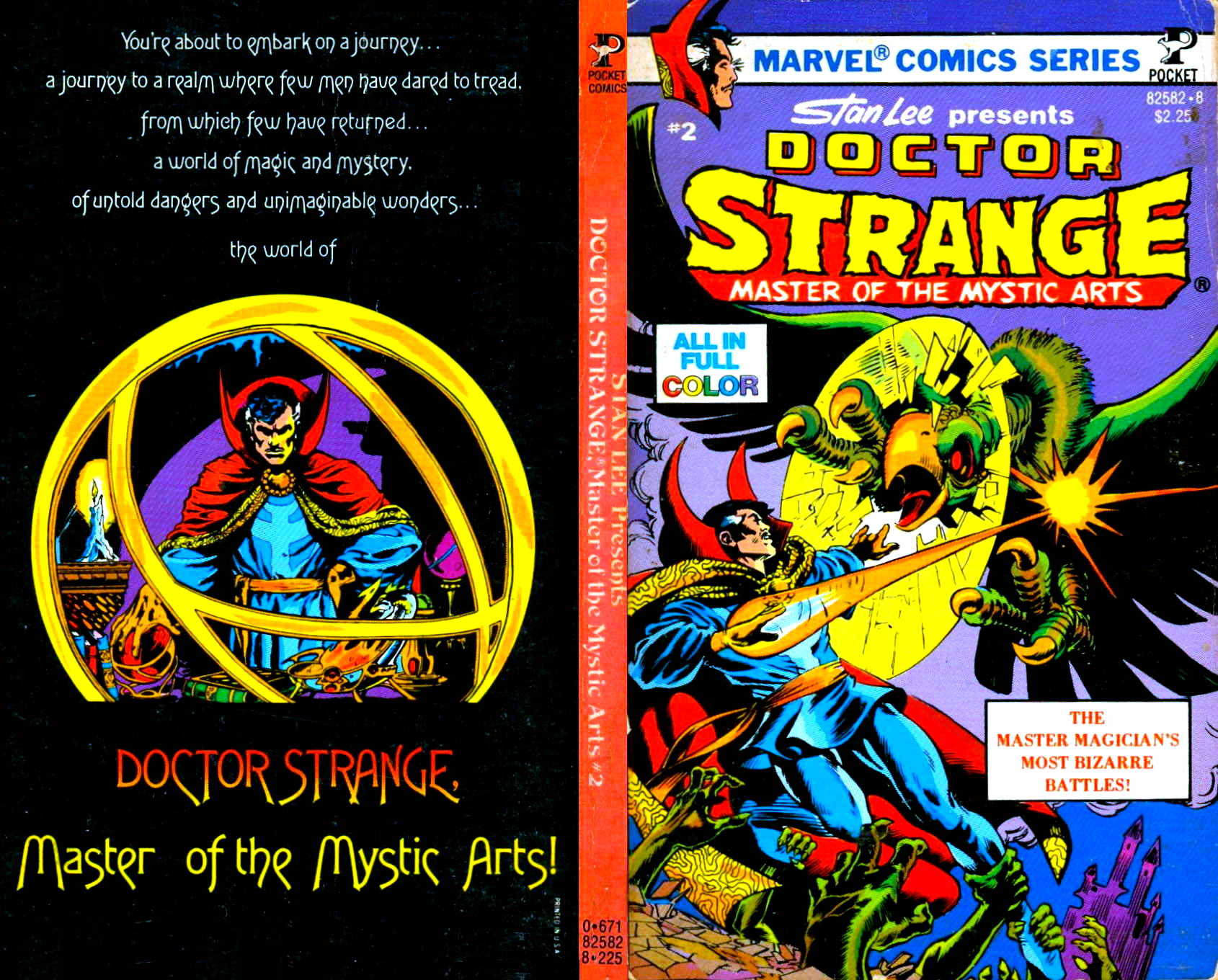


I was very surprised to come across this second volume of Doctor Strange adventures in the Pocket Books line of paperback reprints in a local bookstore. These releases had seemed to have been tied to the appearances of the Marvel characters on television, and while the initial Doctor Strange volume had been released to capitalize on the Doctor Strange TV Movie starring Peter Hooten, that film hadn’t led to any manner of follow-up, not even a sequel as in the case of the Reb Brown Captain America TV film. My only supposition is that either the first Doctor Strange paperback had sold surprisingly well, or else somebody on staff at Pocket Books was a fan either of the character or his co-creator Steve Ditko. Either way, this latest book appeared and I snapped it up.
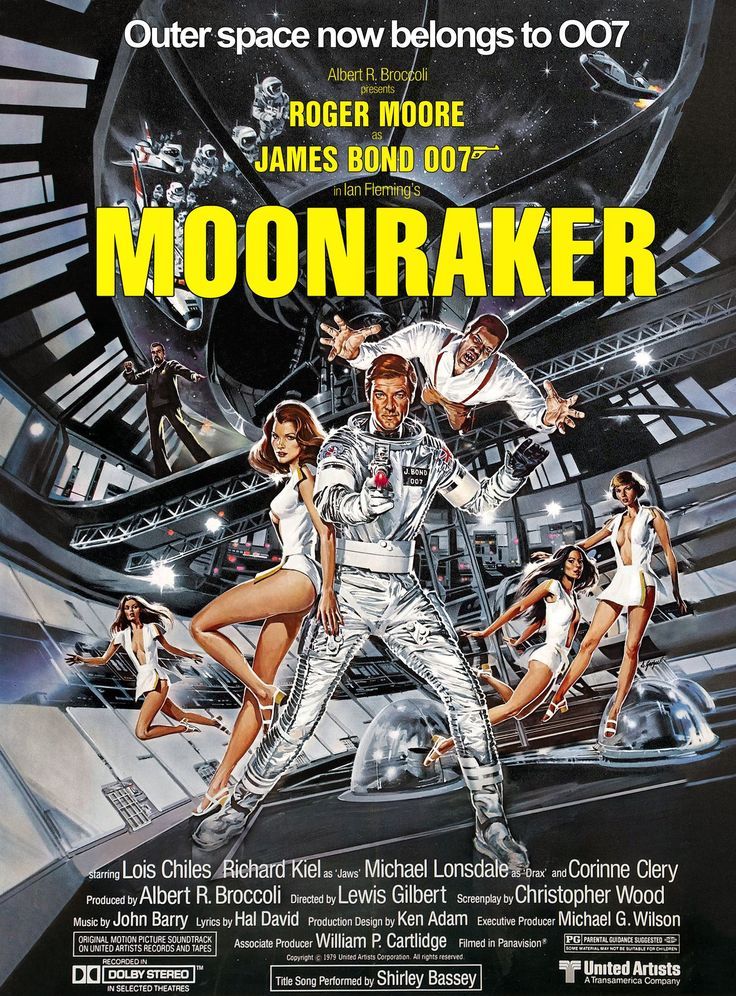
But before we get into that, a brief digression. For it was at around this same time, possibly the very same Saturday on which I picked up this volume, that I saw my first James Bond film, the underwhelming MOONRAKER. I had heard people talk about James Bond before but didn’t really get the appeal. And having sat through this film, I must confess that I still didn’t. If I remember rightly, my family saw it at a drive-in theater, one that we frequented semi-regularly. That was a thing that people did in the 1970s, and it’s both a wonderful and a terrible way to encounter a movie, depending on the specific picture in question. For MOONRAKER, after more overtly fantastical films such as STAR WARS, SUPERMAN THE MOVIE and STAR TREK: THE MOTION PICTURE, I found it to be a bit dull. It wasn’t really about space stuff at all, despite the fact that it had been marketed that way in an attempt to grab the STAR WARS-hungry audience. And I’ve never really like Roger Moore’s smarmy, somewhat grotesque hammy portrayal of Bond–possibly because of the impression this movie made on me. So swing and a miss on that score, I was once again out of step with popular culture on the appeal of 007.
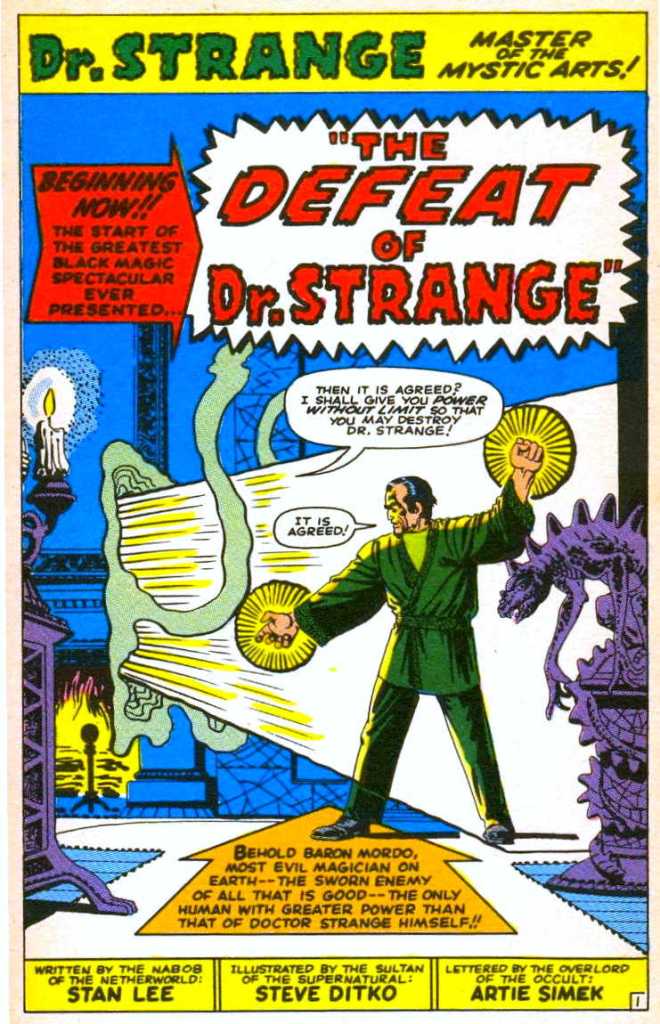
But back to the actual subject of today’s post. This small volume collected almost all of the back half of Steve Ditko’s time working on the character, a storyline that was serialized for over a year in the pages of STRANGE TALES. It’s kind of a shame that this volume stops just two stories from the end of Ditko’s era, leaving the ending slightly up in the air. But I understand the limitations of page counts–I ran into the same situation years later when putting together the first Doctor Strange MARVEL MASTERWORKS edition and similarly couldn’t quite get all of the Ditko era into it. (Eventually, Marvel did release an Omnibus edition that collected it all, a pretty terrific volume all around and one of the defining works of the early Marvel era.)
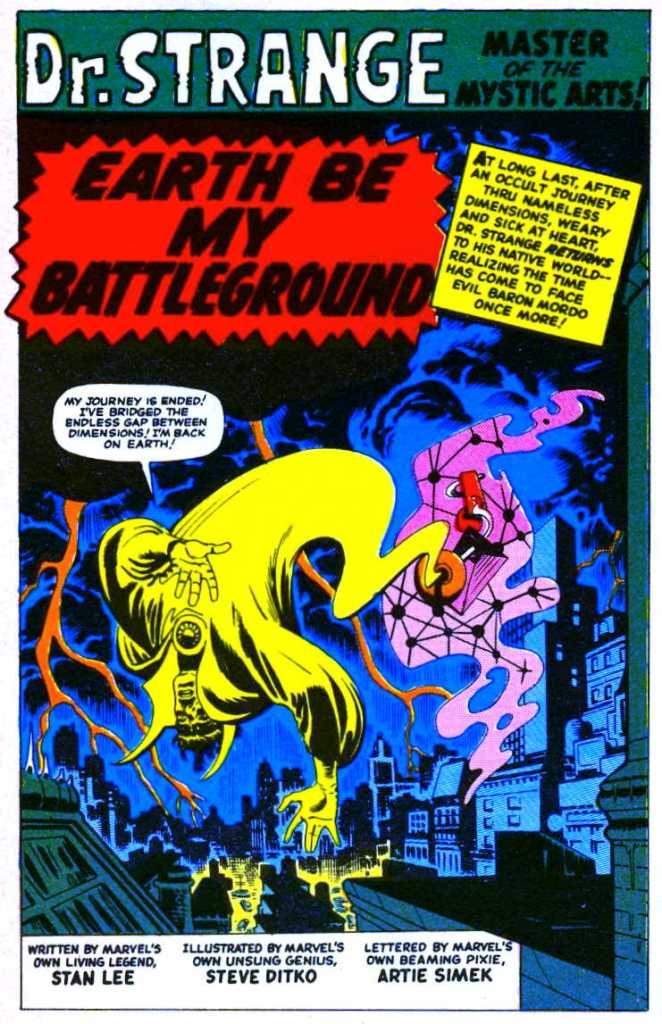
I had read a couple of these stories previously, mostly in the pages of MARVEL’S GREATEST COMICS before it became a normal-sized magazine. But having the entire saga in order made a huge difference to the reading experience. I was never a huge fan of Doctor Strange, his mystical powers felt like too much of a get-out-of-jail-free card to me in any given circumstance, and the contemporaneous comics starring the character in the 1970s tended to be heavily influenced by New Age meditations and focused on the Rising and Advancing of the Spirit. I wasn’t looking to have my spirit advanced, I wanted some cool entertainment with a heroic protagonist. As such, Ditko’s Doctor Strange resonated with me a whole lot more. Not only was his artwork unique and fascinating, but his version of the character was firmly grounded in the real world. Plus he was simply a Master of the Mystic Arts rather than the Sorcerer Supreme–the first implying that there might be somebody else out there who was better, stronger than he was, the latter very much not doing that.
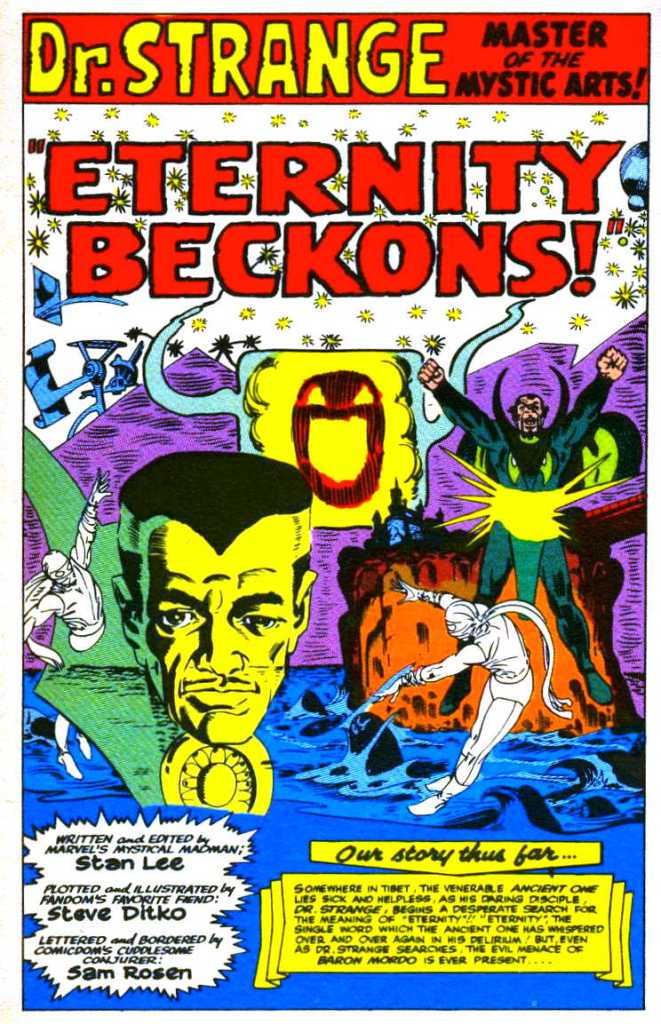
The storyline in this volume starts off simply enough: a hidden mystic benefactor increases the strength of Strange’s rival and moral enemy Baron Mordo to the point where he’s just plain mightier than Strange himself, forcing the sorcerer to go on the run across the world, keeping one step ahead of Mordo’s wraithlike operatives. Eventually, Mordo catches up with Strange, and the only way Doc can get away is by hurling himself into another mystic dimension. At this point, though, he’s doped out who is pulling Mordo’s strings: Dormammu, the ruler of the Dark Dimension who has a grudge against Strange for foiling his annexation of the Earth and its realm. After a brief adventure in that other dimension, Strange is able to make his way back to Earth and seek out his striken master, the Ancient One. The Ancient One is able to mutter to Strange that the only way to best Dormammu is to seek out Eternity, whatever the hell Eternity is. So Strange begins a quest to locate Eternity, doggedly pursued by Mordo and his minions all the way.
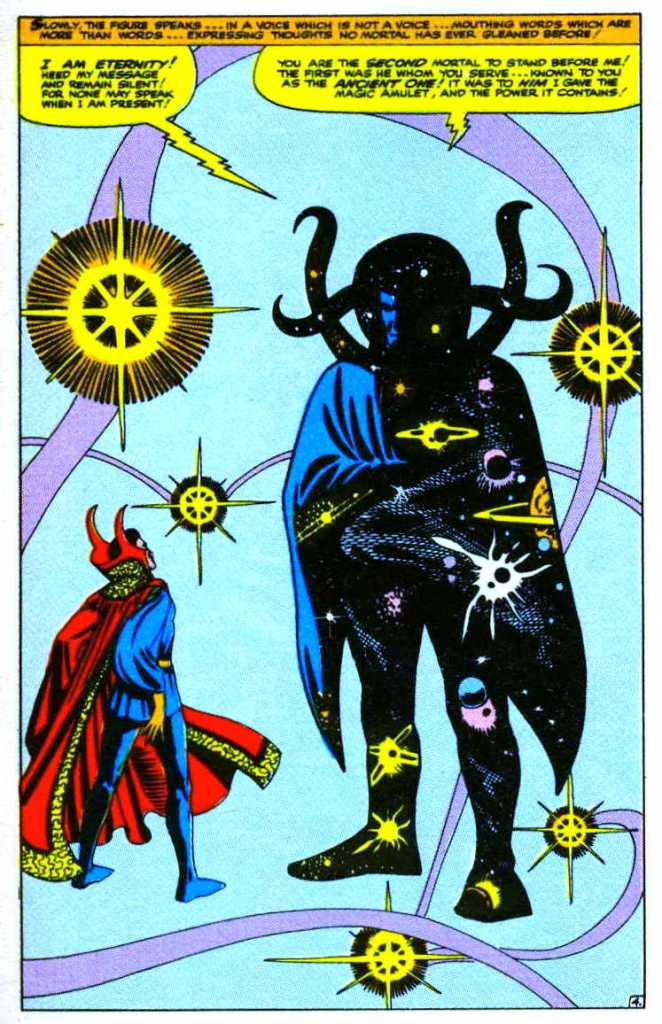
After a number of false starts and blind alleys, Strange reckons that he’s got no choice but to attempt a mystic mind-meld with his mentor the Ancient One to draw the secret of Eternity from him. In doing so, he’s forces to contend with his teacher’s mystic defenses, but he’s able to run that gauntlet and learn that he already possesses the way to Eternity through the mystic amulet that he’s been bequeathed. Expanding it to the side of a person, it opens to become a doorway into the realm of Eternity. Steve Ditko outdoes himself in his depiction of the weirdness of this non-terrestrial expanse. And finally, Strange comes face-to-face with Eternity, a mysterious mystical being of almost unlimited power. But despite Strange’s dire need, Eternity refuses to share any of his power with the sorcerer, telling strange that he already possesses all that he needs to defeat his foes. Sent away empty-handed, Strange returns to the material world, only to discover that Baron Mordo has caught up with him and the Ancient One in the meantime. So it’s right into a showdown. Ditko deliberately crafted the plotting of this storyline as a running serial with strong cliffhangers to keep the audience coming back for more.
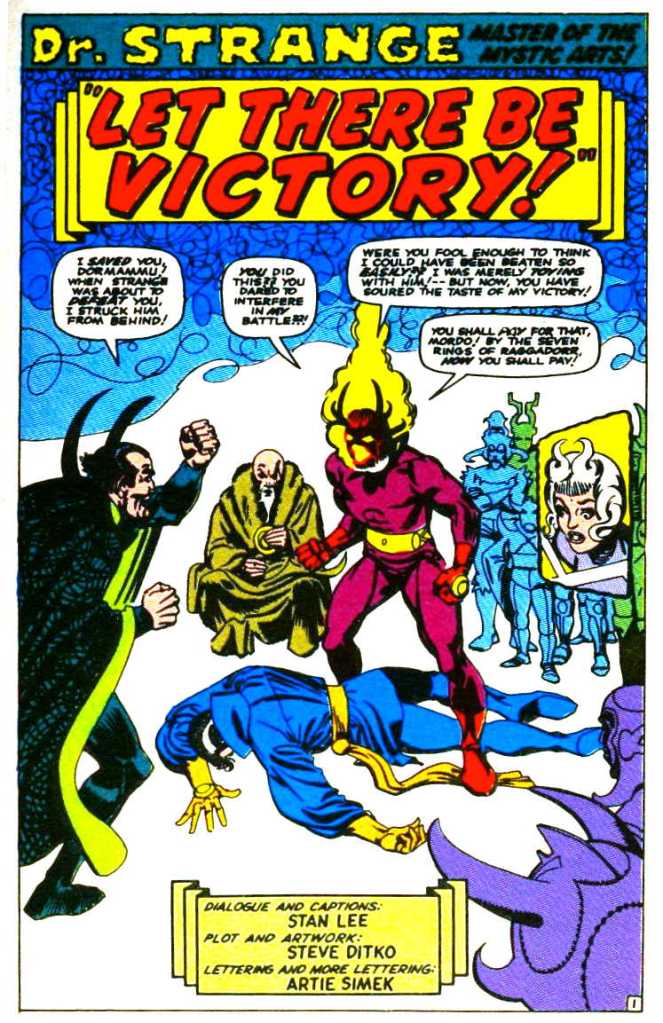
But even outpowered and outgunned, Strange is still a master sorcerer, and he’s able to parry Mordo’s every attempt to destroy him, much to the frustration of Mordo’s benefactor Dormammu. Eventually, the flame-headed despot can take no more, and he draws both Mordo and Strange into his own Dark Dimension, intending to finish his foe off personally. Strange and Dormammu fight a duel before the assembled peoples of the Dark Dimension, using not any mystic powers but rather twin sets of magical pincers, so that they are more evenly matched. Once again here, Strange is able to hold his own until bystander Mordo sees his chance and strikes Strange down with a mystic bold. This pisses Dormammu off, soiling his triumph, and he hurls Mordo into a realm of torments. Strange is still ale to continue to contest, however, and in the end he bests Dormammu with superior skill, exacting from him a pledge never again to attack the Earth or its people. So Strange has finally won. But in an act of petty revenge, Dormammu exiles the Dark Dimension girl who had been helping Strange (who will eventually be named Clea) across the mystic cosmos. So locating and rescuing her becomes Strange’s new long-term mission.
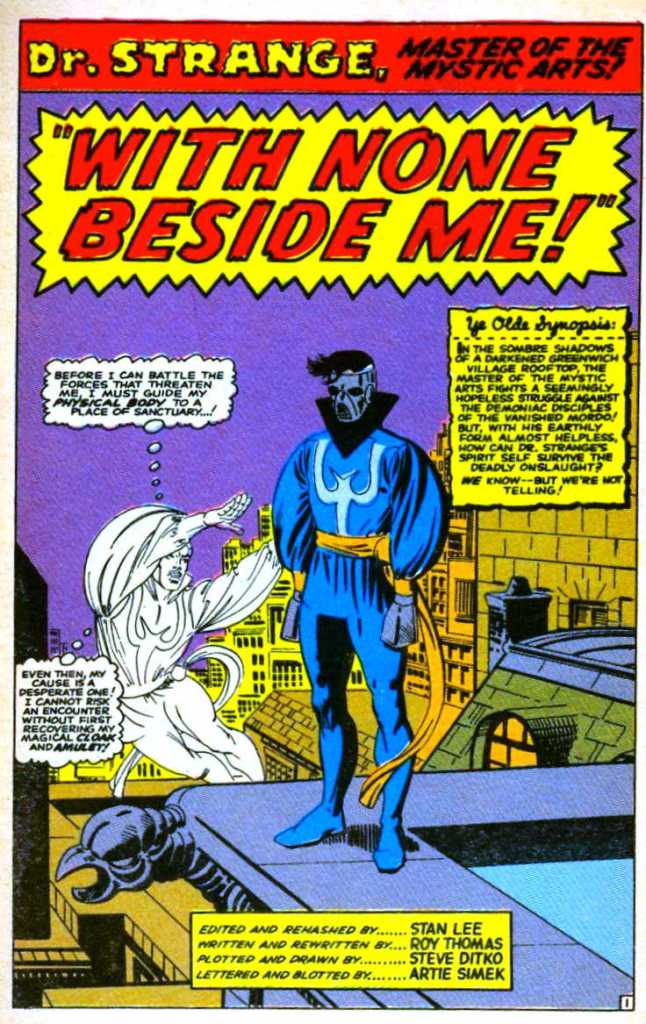
Events power down in the narrative a little bit at this point, though the final stories in this volume are still all fun and gripping. Returning at last to his Sanctum, Strange is jumped by a trio of Mordo’s mystic minions, including the Demon from an earlier story. With his hands and face sealed and bereft of his Cloak of Levitation and his mighty amulet, Strange needs to find a way to escape and turn the tables on his captors. He’s able to use his astral form to peer around as his surroundings, getting momentary glimpses of his surroundings that enable him to stay one step ahead of his enemies. Strange’s foes, meanwhile, are desperate to learn the secrets of his amulet, and he’s able to turn it against them and thus reverse the tables on them. After the more cosmic events of the earlier stories, this more grounded little three-parter is most welcome. This is also the place in the narrative where Stan Lee stops scripting over Ditko’s plots, instead turning over the dialoguing of the series to Roy Thomas, a hint perhaps at the discord that had been building between Lee and Ditko and which would soon cause the latter to quit Marvel.
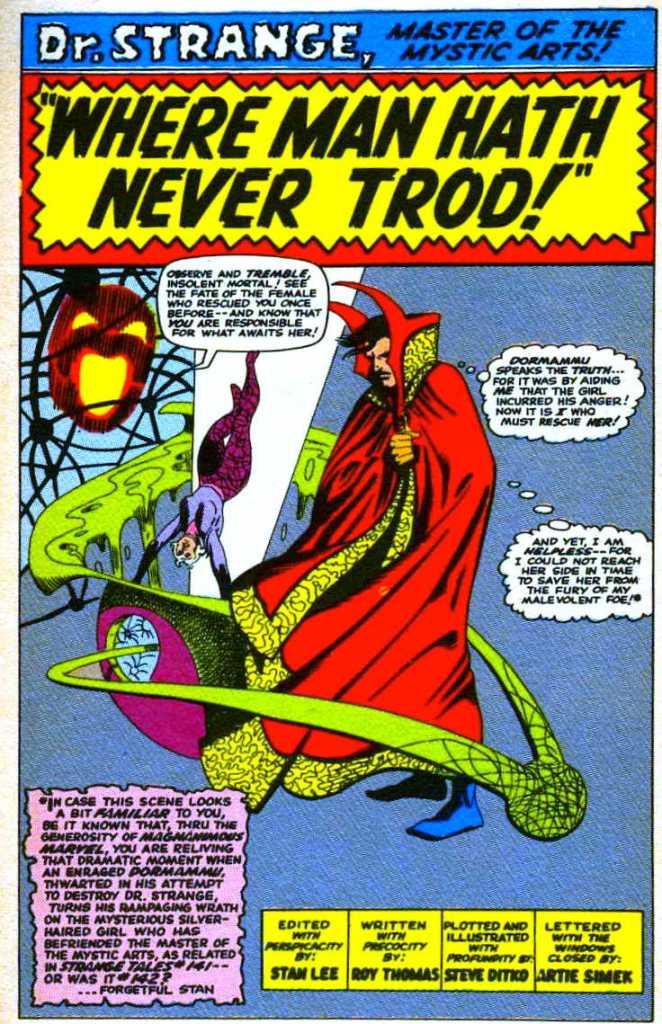
The final story in this volume is a bit of a trifle, involving Strange’s attempts to locate the lost Clea, which bring him into conflict with another interdimensional despot, Tazza. It’s a minor tale, so the volume closes with a bit of a thud, especially since the running plotlines haven’t all been wrapped up. It would literally be decades before I’d get to read those final two Steve Ditko-penned stories and see how it all came out. This frustrated me for some time, as I really liked the stories in this volume. This was all happening right at the point when Marvel’s storytelling was becoming more expansive overall, both in terms of establishing ongoing soap opera-style subplots and in expanding the scope of the narrative of many of its stories to a more cosmic level. This was good stuff, and even with the artwork reduced down to tiny paperback book size, it still packed a punch.


Really enjoyed reading your thoughts on this, Tom.
In fact, it made me think that if you ever wanted to expand ehat you do here, it would be fascinating to read your thoughts on comic runs/stories worth reading. From the best known and most influential stuff, like Ditko’s Strange, through smaller scale stuff like ‘Nothing Can Stop the Juggernaut. ‘ Or oddities like Elektra: Assassin or Meltdowns.
Or if you didn’t want to comment on Marvel I would live to hear your thoughts and recommendations on such disparate publications as Starman, Usagi, Y: The Last Man, All-Star Superman, or Bone.
Just a thought!
LikeLiked by 2 people
Bad mouth Bond? One look at my profile pic should tell you I am indeed a fan of 007 and cannot allow that those remarks to go unanswered. Actually, our host isn’t far off. As much as I am a huge James Bond fan, Moonraker is one of my least favorites. I consider the silliest of the decades long franchise, veering way off into absolute fantasy with the sci-fi tropes as well as Roger Moore enjoying some romantic interlude every 15 minutes. Roger Moore’s Bond movies became much more grounded – and as a result, more enjoyable – starting with 1981’s “For Your Eyes Only.”
As for my second favorite Marvel character (behind Iron Man), this digest does indeed seem a great deal of fun courtesy of Steve Ditko’s bizarre and surreal portrayals of all those magical dimensions and mystic mischief makers. Yes, I know I spoke less than flattering of Ditko with last weeks’ Machine Man review. But his art in these issues were both spot on for the subject matter and occurred at a time when that style fit like a sorcerer’s glove.
When I think of the Stephen Strange that I prefer most – edging over Roger Stern’s – is the MCU depiction from Benedict Cumberbatch. For me, he hits the right note with the arrogance of a gifted and brilliant surgeon who – like a good doctor – searches among the tools at hand to find a resolution to the challenge he’s facing. Cumberbatch balances that necessary groundedness with an ability to deal with the incredible unknown that he has to face.
And Tom, I hope your happy. I now have Sheena Easton’s “For Your Eyes Only” stuck in my head.
LikeLiked by 2 people
I forgot to chime in on Tom’s dismissal of Bond. “Moonraker” isn’t great. I agree “For Your Eyes Only” was a bit better. But at the time, I had the benefit of having seen re-runs of a few Bond movies like “Goldfinger” and “You Only Live Twice” on commercial TV before “Moonraker”. Otherwise I doubt I’d have had any interest in going to the movies to see it.
In hindsight, Moore wasn’t as good a Bond as he could’ve been. And maybe ends up in last place of them all. Including the Aussie, George something, who benefitted from a stronger production, and a fabulous co-star in Diana Rigg.
I liked Brosnan’s. The movies looked good. Though some of the tongue-in-cheek- humor could undermine the weight of the stories’ stakes. The Craig movies maybe perfected the Bond formula. Some of those I liked more than others. “Quantum of Solace” is better than its reputation.
LikeLiked by 2 people
George Lazenby.
LikeLiked by 1 person
Thanks!
LikeLike
I didn’t like the art or types of stories in it but I wouldn’t have bought it under circumstances unless it had held one story I hadn’t read rather than being nothing what had appealed to me in previous reprint titles. I just never cottoned to sizes to far off from regular comic book size. Whether itw as the size of a coaster or a placemat, I didn’t buy it.
LikeLike
I’m with you on Roger Moore as James Bond and I never noticed any great difference between how Daniel Craig played James Bond than Pierce Brosnan’s James Bond ( I’m talking his character/personality. I didn’t hate Timothy Dalton. It has been awhile since I have seen both actor’s movies, so I can’t remember if Daniel’s was more butt kicking than Pierce’s — but I do know when it comes to butt kicking Superspies, I’m team Ethan Hunt ( Tom Cruise — Mission: Impossible films ). Never got any of Marvel’s pocket books, but I do have Strange Tales#185 ( May 1976 ) which reprints ST#134 ( Earth Be My Battleground ) & 135 ( Eternity Beckons ). Plus Doctor Strange Classics Starring Doctor Strange#1-4 ( March-June 1984 –reprinting ST#130-141 –recoloured )
LikeLiked by 1 person
For the record the reprints were just called Doctor Strange Classics ( 1-4 ), I was looking at what comics.org had written and forgot to check the covers of the issues.
LikeLiked by 1 person
Although seemingly no one’s favorite, I didn’t mind Timothy Dalton as Bond. I think he suffered more from rather pedestrian stories that didn’t allow him to be as dashing and daring as the other Bonds. They seem to have noticed that as Goldeneye – the first Pierce Brosnan move – had more of standard Bond touches and flash.
I was actually disappointed when Brosnan was nudged away for someone who didn’t seem to fit the description of what I consider to be James Bond. Of course, five minutes into Casino Royale, those thoughts immediately evaporated as we had a delightful blend of classic Bond with – as you aptly put it – more butt kicking.
I definitely miss this series and cannot wait to see where it goes next.
LikeLiked by 2 people
Dalton wasn’t given much to work with. And the aesthetics of the time didn’t help. The movies had nothing visually to show, meanwhile better movies were being made all around it. But the production level was more like TV, then. Cheaper, and too stuck in what had been done before. All that worked against anything Dalton brought to it.
LikeLiked by 1 person
Dalton, unfortunately, was cast as “action hero who happens to be named James Bond but isn’t.” Bond is a team player, even if he frequently bends the rules; Dalton was the stereotypical “screw your rules and the chain of command, I’m doing it my way!” Particularly in License to Kill.
LikeLiked by 1 person
I couldn’t get into Cruise’s Ethan Hunt. Maybe it was the “disguise technology” I never bought into. The movies felt “skin deep” to me. While there have been more depth in some Bond movies.
LikeLiked by 1 person
Rewatching the film series recently confirmed my impression that the tape recording in more than half of them turns out to be a trap or a deception, so why do they keep doing it? “The tape is a lie” was a standard freelance pitch for the old TV series but the producers had the sense to know that would kill the premise.
LikeLiked by 2 people
Surprised that Moonraker was your first Bond movie as it seems like the other movies were all over TV like a rash before this. Perhaps you mean on the big screen.
LikeLiked by 1 person
I was fortunate to first experience the Ditko & Lee Doctor Strange stories in 2001 when they were all collected together in the Essential Doctor Strange Vol 1 trade paperback. The lack of color was a minor thing to quibble over, since I had the entire story on hand. And I agree, the back half of Ditko’s run on Doctor Strange really is astonishing. It’s too bad the finale from Strange Tales #146, with Dormammu vs Eternity, was omitted from the collection Tom writes about in this post, because it was definitely a monumental finale to Ditko’s tine on the feature.
LikeLiked by 3 people
The first Bond film I saw was Live and Let Die, in the then new cinema two towns over. I really enjoyed the film, especially the boat chase. I was disappointed with Moonraker pretty much all around after what I considered three better movies. I have no idea when I saw my first Connery Bond film, although I remember seeing Diamonds are Forever on TV. I also saw several Connery Bond films at the local theater in the early 80s, which showed all 5 one summer.
As for these Doctor Strange stories, I first read them in that Marvel Masterworks volume (#23 – how did it take so long to feature Docter Strange in a Masterworks volume?), of which I own a first printing. Then I had to wait 13 years(!) to read the rest of Steve Ditko’s run when Marvel Masterworks Doctor Strange Volume 2 finally came out (which means, despite my thinking otherwise, I was still into comics in the 2000s – although I missed the JLA/Avengers miniseries just a year before). While I don’t care for Ditko’s art on Spider-Man, I love it here. It’s probably because on Spider-Man he had to draw realistic backgrounds, while here he could draw whatever backgrounds caught his fancy.
LikeLiked by 2 people
Misc. reactions:
Having studied several photos of Ditko, taken at various points in his life, I can confirm that he never had a widow’s peak.
Ditko and Dormammu seem to have held the same reverence towards their contractual commitments!
I saw Moonraker as a kid–can’t remember if I’d seen Bond on TV before that, I was never a big fan–and was mainly interested in the space aspect, not the manosphere type stuff. What stuck out was that we actually see the villains dump some of that that sterility drug into the earth’s atmosphere before Bond stops them. Some parts of the world should have been affected. As a kid, I remember thinking that the villains were right–that a reduction in the world’s population would be a good thing. (Their plans to repopulate it with a handful of people were more dubious.)
That Peter Hooten Dr. Strange movie…I still remember the magic words “In the name of Rial [sp.?], scourge of demons, I command you–begone!” (as well as its ineffective variant, “…release me!” Okay, yes, it was goofy (Strange is the least professional psychiatrist ever–it was the Seventies!), but I see its influence in the MCU Dr. Strange. Too bad Hooten and Nicholas Hammond were never brought back for movie cameos.
LikeLiked by 1 person
According to his Wikipedia Nicholas Hammond appeared in Spider-Man ( 2002 film ) as Festival Goer ( uncredited ). Second time I looked this up, I was curious if he did earlier this year.
LikeLiked by 2 people
I met Nicholas Hammond a year or so back at a local con. He said he certainly wanted to be part of the franchise in any capacity (and mentioned there was talk at one point) but he also said nothing had happened as yet. I’ve heard the Festival Goer rumour before – but I believe it’s false.
I took the opportunity to ask him why the ‘Uncle Ben’ storyline wasn’t in his 1970s TV series pilot, as it seemed such an obvious element to add more drama. Hammond said he only became aware of the AF#15 story later. He said it was a shame the writer hadn’t used it and agreed it was a ‘missed opportunity’ for the production.
LikeLiked by 1 person
“Encyclopedia John”. 🙏😉
LikeLiked by 1 person
I don’t think the first one sold exceptionally well — if it had, I doubt they’d have wrapped this one in Brunner art rather than Ditko art, apparently hoping for better sales with a more modern look. The whole package feels to me like it was put together by someone who really wanted to get this stuff into print, so they were giving it extra, loving attention, trying to make it as appealing as possible.
I agree that this volume is terrific material, and that Strange is much better as Master of the Mystic Arts rather than Sorcerer Supreme. I like heroes who aren’t the biggest, baddest dude on the block, heroes who have to struggle and reason their way through a menacing landscape. Davids rather than Goliaths.
It puzzles me a bit, though, that the Ancient One trained Strange up as his successor, but didn’t teach him what seems to have been a lot of important stuff, like a fundamental cosmic aspect of the universe like Eternity. Ah well, the things these wise mentors must do to preserve suspense.
And those ninja-ghost bloodhound pursuers were the best!
LikeLiked by 2 people
“Heroes who are the biggest, baddest dudes on the block”. Even Superman, for me. I like seeing him struggle. Being too powerful and always having to use kryptonite or red sun energy to make him vulnerable got old. There should be opponents that even he needs help with, too. Not everything should be easy for him. Or at least situations that push him to use his wits, too. The best stories have done that. But too often he’s been too powerful.
LikeLiked by 1 person
Well, DC did finally create an opponent who was able to kill Superman (although he got better).
LikeLiked by 1 person
While Eternity is clearly powerful and cosmic, the idea he’s an aspect or embodiment of the universe was a Bronze Age thing. Ditko’s Eternity just … is, without explanation. Which works well, but I can see the Ancient One deciding a reclusive enigma Stephen will probably never encounter can wait until later as a topic of study.
LikeLiked by 1 person
Ditko’s Doctor Strange Master of the Mystic Arts is the version of the character I prefer by a fair margin.
The splash for “WIth None Beside me” suggests some influence from Ditko’s studio mate Eric Stanton ala the bondage gear. I think this type of thing popped up a few times through the run.
LikeLiked by 1 person
Some really striking splash pages. The two that either mention or show Eternity. I like how Strange’s eyes are different sizes in the first piece. Most people’s are, but not this pronounced. I got J. Jonah Jameson vibes from Doc’s portrait, but that likely because it’s the same artist/creator. I really liked the shadows Ditko includes in these. Much later his drawings looked more linear and the figures maybe clunky. But not here. And I especially liked Strange’s cloaked figure in “Where Man Hath Never Trod”. I see maybe more than ever why such luminaries like Frank Miller and Paul Smith wanted to participate in Dr. Strange’s visual legacy (even if Miller’s may have just been that one famous house ad).
LikeLike
I really enjoyed the first Spider-Man pocket book (which I got in the UK) but never saw the others when I returned to my home country. No doubt the tiny print would be a bit more difficult to read now, though I have enjoyed the recent Taschen compact editions.
In Ditko’s recollections he wrote that he convinced Lee to let him take over the stories (and resume his inking role) when Lee was considering cancelling the strip. I’ll admit I’m probably one of the few who preferred the earlier Dr Strange one-off stories. I know Ditko wasn’t a fan of Lee’s plots involving ‘haunted houses’ and ‘aliens’ etc. – but I thought they were more in keeping with the original premise (and Ditko’s introductory story). I just wasn’t as invested in the longer narratives that Ditko employed after taking the story reins. That said, they are still superior comic strip fare.
Roy Thomas scripted a couple of Ditko’s later stories and a couple of Ditko’s ‘rough dialogue’ or panel descriptions somehow survived from that period. They have been published in Alter Ego and elsewhere. They were very brief indeed, but of course Ditko’s pictures were worth a thousand words.
LikeLiked by 1 person
Benedict Cumberbatch is a very good actor. He’s just not my ideal Dr. Strange.
A younger David Strahairn (spelling?) would’ve been my choice 30 years ago. He was Pierce Patchet in “L.A.Confidential” among many other things. But in that movie, specifically, he looks like he’d be a great Dr. Strange. .
Johnny Depp, 20 years ago. I think I read that they offered it to him before Cumberbatch, but Depp declined.
LikeLiked by 1 person
MOONRAKER was my first Bond too. I liked it better than Tom did — Moore’s Bond was campy and self-aware in the same way that Batman ’66 had been (and that Austin Powers would later be). Eventually I saw the Connery movies and liked those even better. But by the time Moore’s run was over, I was kind of sick of the formula, and I haven’t actually watched any of the Bond movies since.
I’ve probably mentioned before that the Pocket Books Spider-Man and Doctor Strange volumes were what really won me over to Ditko’s artwork. Beautiful stuff. Agreed that somebody in the chain of command must’ve been really fond of Dr. Strange — he got the 1980 Marvel Calendar all to himself, too.
LikeLiked by 1 person
While I liked Englehart’s more mystical run on Dr. Strange, I agree Ditko’s work is in a class by itself. Unlike Ben, I think the black and white is not a good format (though i bought it) for conveying the weirdness of the visuals. The colors help a lot.
Moonraker, ugy (i reviewed it some time back: https://frasersherman.com/2012/08/12/the-spy-who-bored-me-moonraker/). However it set box-office records for the series so Cubby Broccoli clearly knew what would sell.
LikeLiked by 1 person
As I’ve enjoyed reading everyone’s comments on our favorite British spy, I’m going to offer a totally biased ranking of the various James Bonds over the decades.
6. George Lazenby. In some ways, the poor guy never stood a chance with Sean Connery’s spirit looming so prominent over this movie. Word is that actress Diana Rigg despised him so much that she ate raw onions before their kissing scenes.
5. Timothy Dalton. He had the looks and more youthful appearance after over a decade of Roger Moore. But someone forget to provide him scripts for actual James Bond movies that allowed some swagger and fun.
4. Pierce Brosnan. Just a whisker from being tied with Roger Moore as both had a screen presence that had them nearly winking at the camera. Both epitomized how I envision James Bond with that suave charm and humor wrapped in an unshakeable confidence.
3. Roger Moore. He’s a tad higher primarily because it was his movies that got me hooked on James Bond. I can still watch “The Spy Who Loved Me” anytime. While his movies moved into absolute fantasy with Moonraker and it could be argued that he become too old for the role with “A View to a Kill,” Roger Moore is who I immediately think of when I hear the words “James Bond.”
2. Daniel Craig. Damn was I wrong about that guy – thinking I wouldn’t like him as 007. The franchise needed a reset moving into the 21st century and wow, did this guy deliver! Looks. Grit. And action chops that could make Jason Bourne call for a rest period. He’d be number one on this list if not for…
1. Sean Connery. No one and I mean no one could deliver those lines like the original 007. He had it all – a dashing appeal that remained no matter what Goldfinger or any other evildoer had in mind. The template in many ways for every Bond going forward.
Have fun taking me to task over this. I’m now heading out to watch a three-hour movie I’ve already seen over a dozen times to catch a short post credits scene that hints of what’s to come in a couple months for “Doomsday.” And I promise – no spoilers!
LikeLiked by 2 people
Rick, I think your list is fine, although not the same as mine. Just like Doctor Who, the actor I first saw in the role (Moore) isn’t my favorite.
1. Daniel Craig
2. Sean Connery
3. Pierce Brosnan
4. Roger Moore
5. George Lazenby
6. Timothy Dalton
LikeLiked by 2 people
I thought Moonraker was a lot of fun as a kid – but recognized them as sillier than the Sean Connery films (Dr No/From Russia With Love) I had seen in a double feature at an inappropriately young age. But (ahem!) back to the main topic: I also fell in love with this Ditko Doc Strange storyline, and also didn’t get to read it complete until many years later when I became a serious collector – but never owned Strange Tales 134. At last year’s New York Comic-Con, though I was no longer collecting, I finally picked up a reader grade copy just to complete the run. Ironically, I’m selling my entire collection at this year’s con.
LikeLike
These books blew me away as a young reader and Lee/Ditko Strange remains maybe my favorite run of any comic. Since the Pocket Books, I’ve bought it in multiple formats and probably will buy it the next way it’s packaged, as well. In particular, that extended storyline with Strange on the run around the globe and into other dimensions, culminating in the showdown with Dormammu, is just phenomenal stuff.
Then again, I loved Moonraker in ’79 and still enjoy it today, so take my comments for what they’re worth. 🙂 Regardless of what one thinks about the lighter approach of the Moore era, the fact is the Bond films have never again looked as BIG and felt as epic after 1979. I like a lot of what came later, but it’s just never felt like the big deal it was in the 60s and 70s.
LikeLiked by 1 person
Can’t argue with someone else using a Bond avatar!
LikeLike