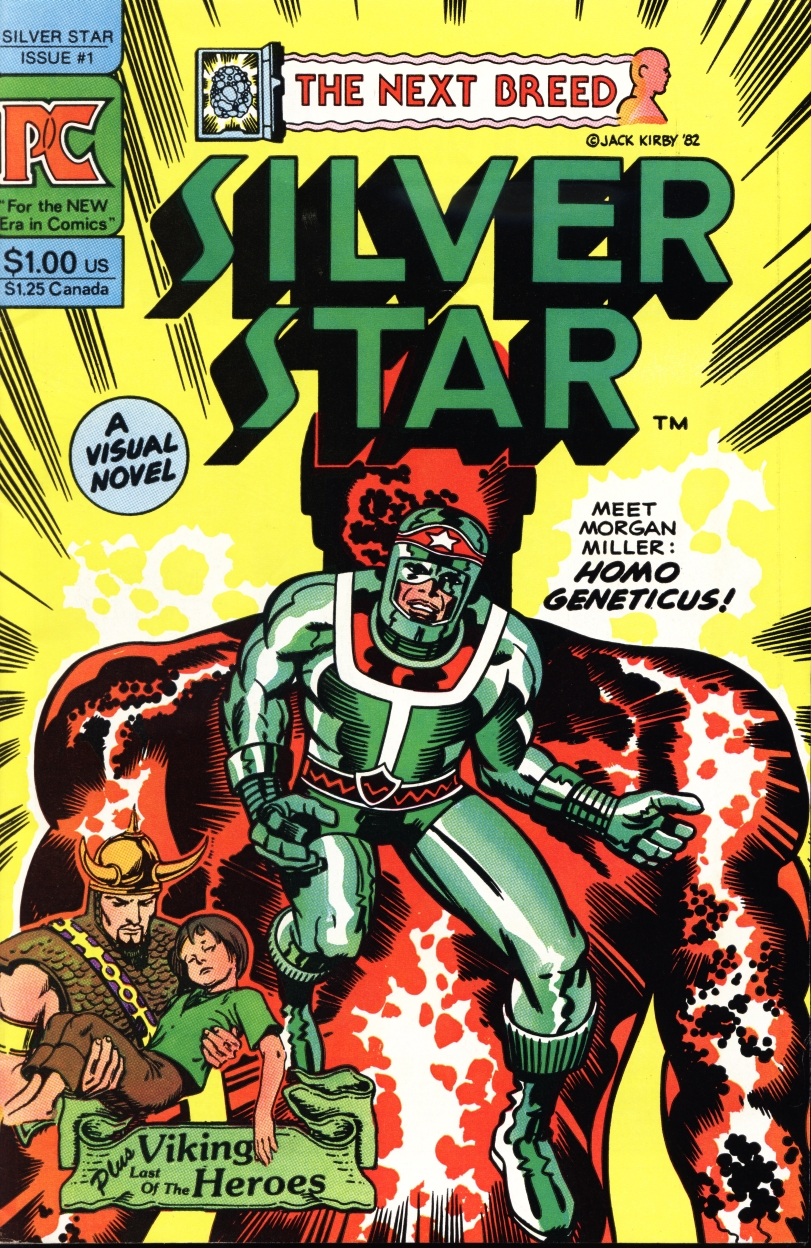


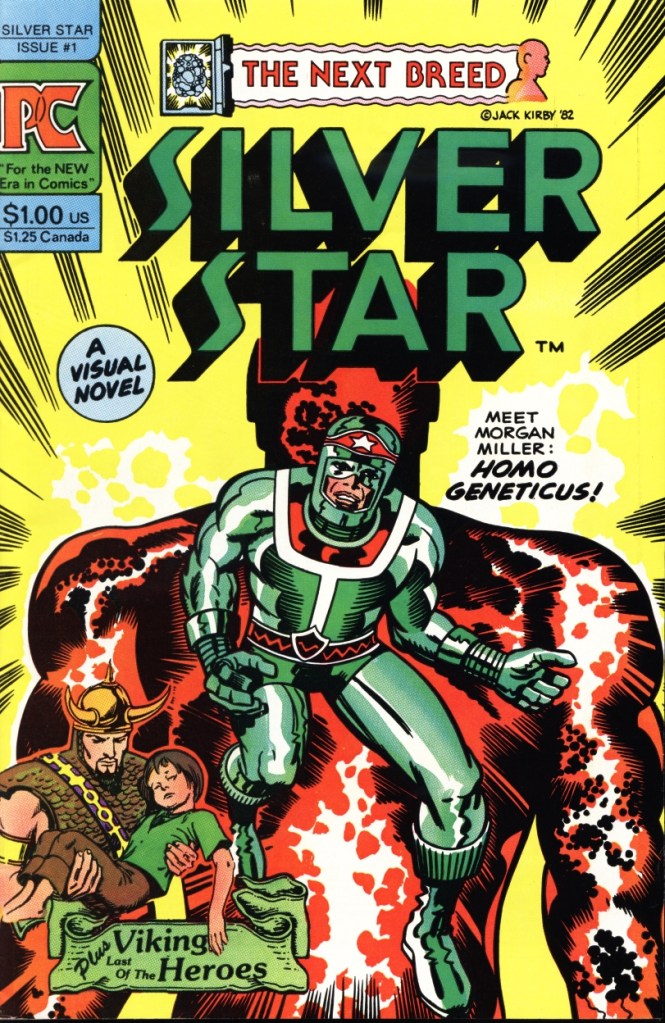
In the early 1980s, after having spent a couple of years working outside of the field in animation, Jack Kirby was making a bit of a comeback. Pacific Comics, one of the new independent publishers that had begun releasing titles into the emerging Direct sales market of comic book specialty stories had agreed to publish Kirby’s work while allowing him to keep the rights to it–something that no prior publisher had done. This relationship was a two-way street, good for Kirby but also good for establishing the bona-fides of Pacific comics as a legitimate publisher. Kirby’s first series, CAPTAIN VICTORY AND THE GALACTIC RANGERS had been running for a bit when a second Kirby title suddenly appeared: SILVER STAR.
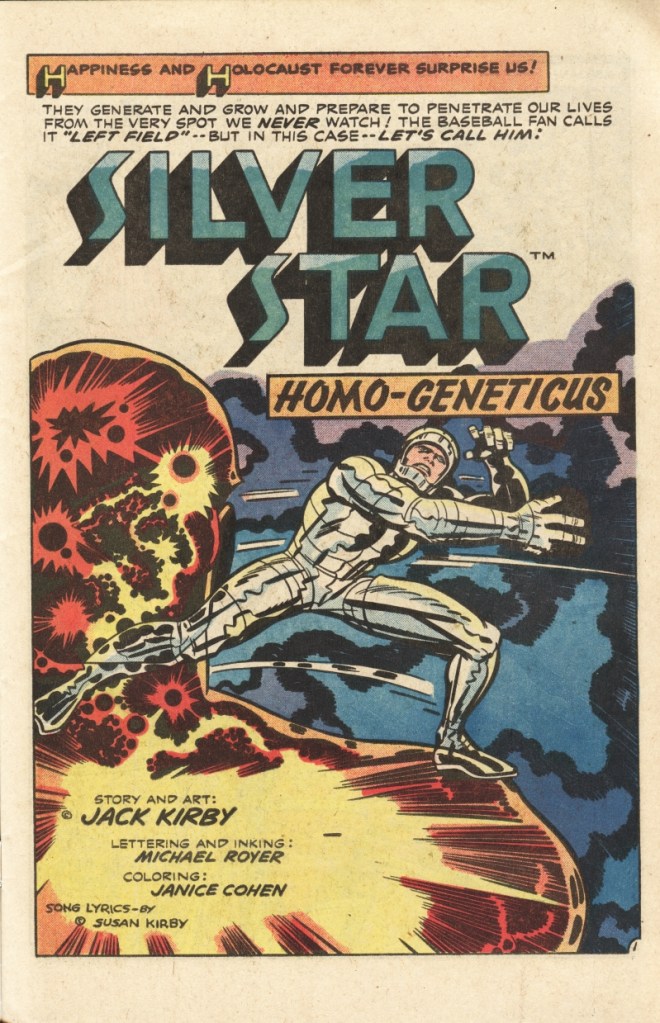
SILVER STAR had started out as a treatment for a proposed feature film put together in the mid-1970s by Kirby and his assistant of the time, Steve Sherman. It was a bit of a wrinkle on the concept behind X-Men, that of a new breed of human being born into the world with superhuman powers as a result of an altered genome. In SILVER STAR, Kirby gave such beings the label Homo Geneticus, which resonated with his labeling of the X-Men as Homo Superior. But if you were going to riff on something in the 1980s, X-MEN was a fairly safe target. SILVER STAR lasted for six issues and adapted in modified form the screenplay treatment that Kirby and Sherman had worked up.
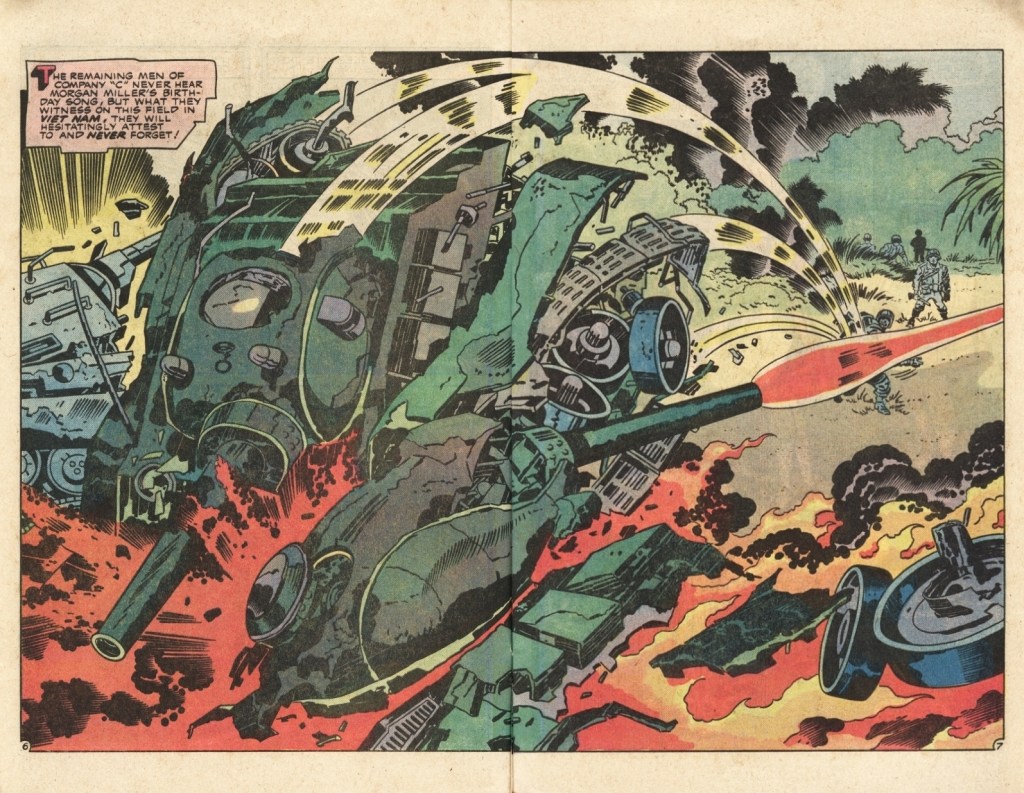
SILVER STAR was also something of a family affair for Jack. Tracy Coleman, the young friend of series star Morgan Miller, is based on Jack’s own granddaughter Tracy, and the song she sings telepathically to Morgan across the opening pages of the story was written by Jack’s daughter Susan, who had a career as a professional musician. By this point in his own career, though, Jack’s eyesight was beginning to weaken. Somewhere around this time, he suffered a stroke that was covered up by the family who feared Jack losing his job and its health benefits. The after-effects of the stroke affected Jack’s depth perception, causing his drawings to begin to distort in odd ways. The impact isn’t too great in this first issue, but it grows steadily more pronounced across the run. Mike Royer’s inking similarly feels a bit heavy and clunky for reasons that I can’t explain.
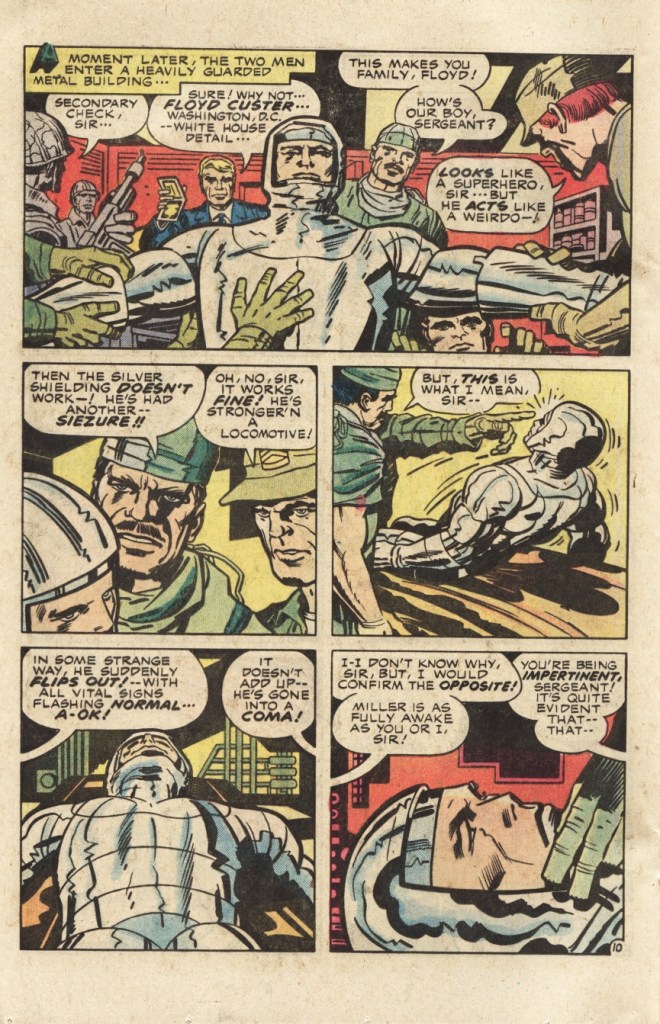
As mentioned earlier, the story introduces us to Morgan Miller, a soldier who has been stationed in Vietnam during the conflict. Under fire, Miller’s powers are triggered, granting him the strength and durability to demolish the enemy forces, including picking up and tank and hurling it into a gun emplacement. In order to contain the power that Miller is radiating, the Army surgeons wrap him in a suit of metallic silver, which is meant to help control his internal reactions like the control rods in a nuclear reactor. But Miller’s body isn’t confined to his physical form any longer, and while the doctors work on him, his essence is frolicking across the mental planes with that of his young friend Tracy.
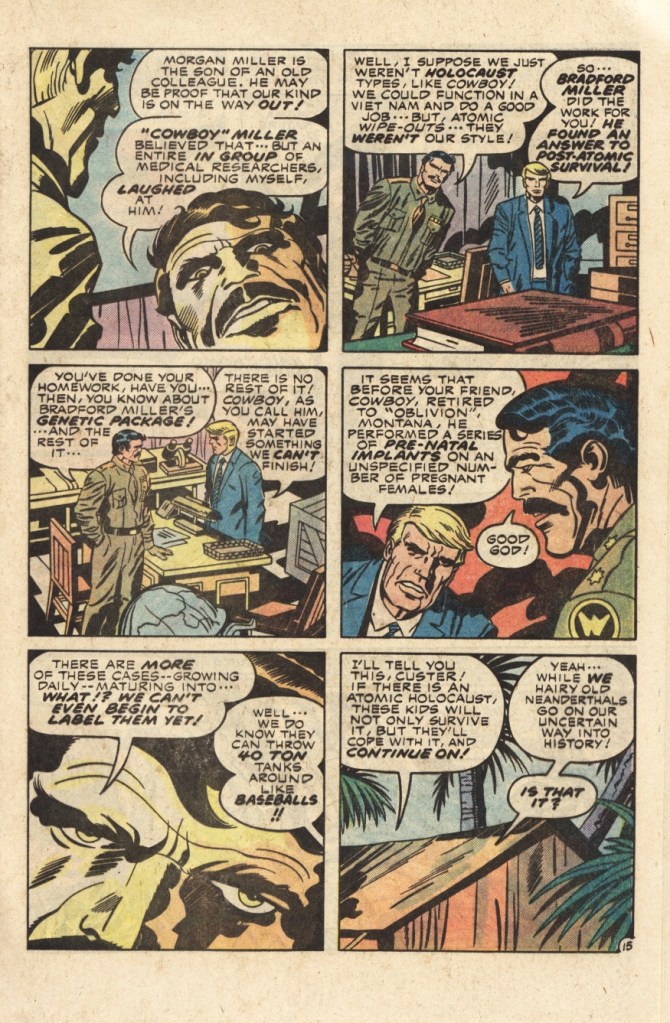
In the aftermath of Miller’s actions, the government has sent agent Floyd Custer to get to the bottom of what is going on. Custer interfaces with Miller’s doctor, colonel Walter Hammer, and learns that Miller is the son of “Cowboy” Bradford Miller, a scientist who had cutting edge theories on the eventual evolution of humanity. In an attempt to prove his theories, the elder Miller performed a series of pre-natal injections on a number of pregnant women, including his won wife. Morgan was the result, a being possessed of the ability to manipulate molecular structures for a variety of effects. Custer is awed and terrified by the potential of what Hammer tells him of Morgan’s potential.
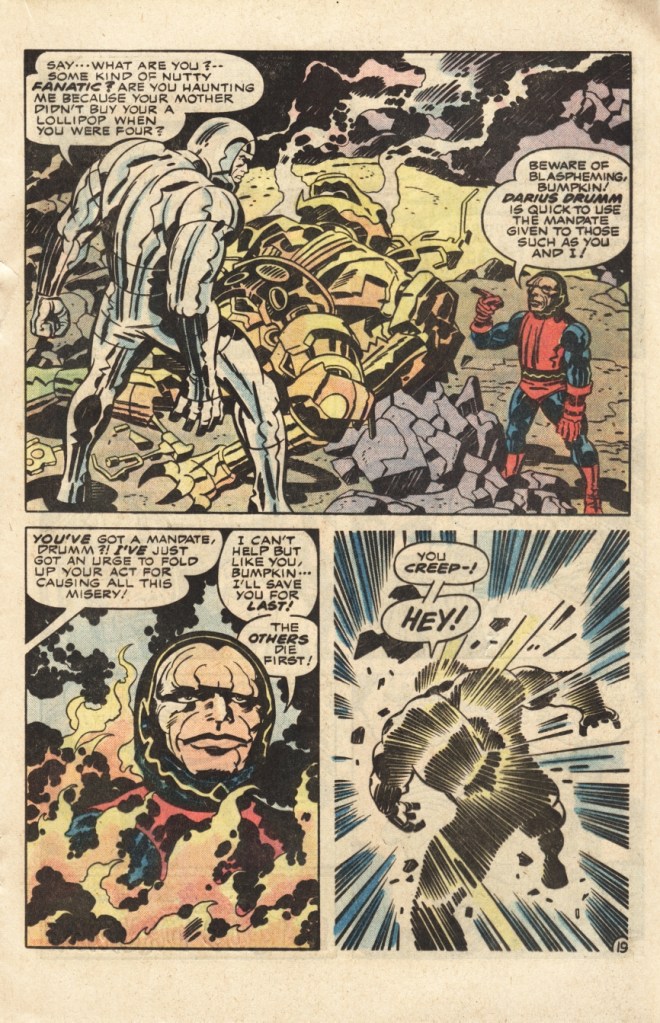
But Morgan isn’t the only example of Homo Geneticus active in the world, and his display of power has drawn another one to him. This is Darius Drumm, a sinister figure bent on destruction. After Morgan sends Tracy back to her body, Drumm decides to test Miller, sending a colossal metallic figure against him in the mindscape. As Morgan increases his own size to take on the enemy on an even level, back in the hospital his physical self also expands, shocking the medical staff. Drumm, Kirby’s narration tells us, is determined to become “King of the Hill”, and so that means putting down any others like him that might stand in his way. Morgan, though, is a fighter, and he’s able to triumph over Drumm’s metallic apparition.
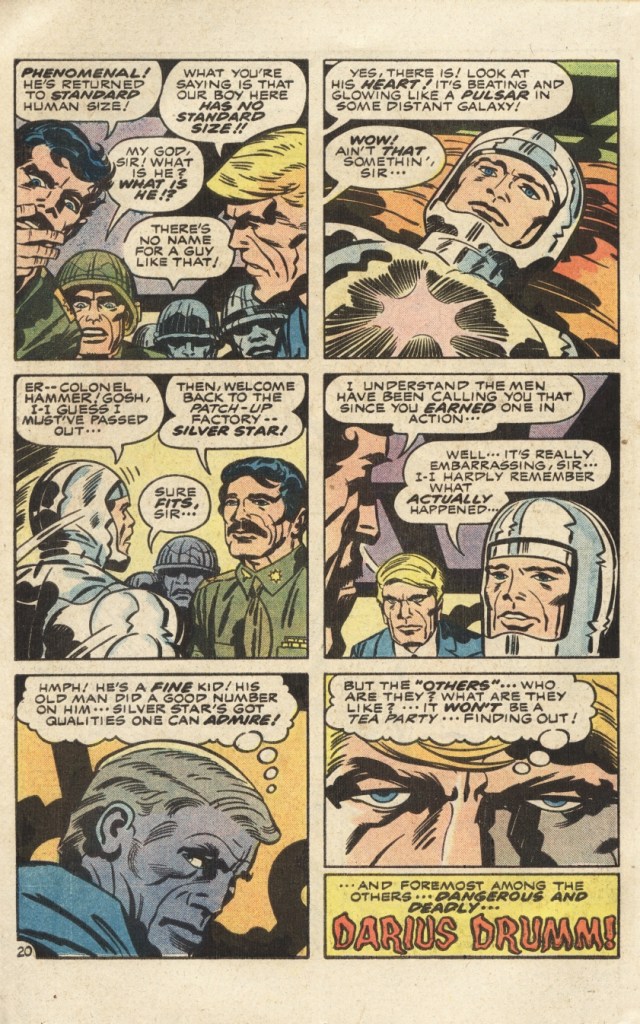
Drumm chooses to make his escape at this point, turning his attention to other, weaker prey, and so Miller returns to his physical form, startling his physicians by suddenly sitting up. Hammer nicknames Miller Silver Star given his silvery outfit and the fact that the soldier had earned that medal for his bravery in combat. And as this issue wraps up. Custer begins to grow concerned about any other Homo Geneticus who may be out there, and the threat they pose to regular people. And that’s where the issue wraps up. There was also an installment of Mike Thibodeaux’s Last of the Viking Heroes filling out the back pages of the book. On the surface, this appeared as though it was going to be a more regulation-issue super hero saga than CAPTAIN VICTORY had turned out to be, but between the oddities in the artwork and the manner in which Kirby’s dialogue was growing even more baroque and abstract, it didn’t hook me in all that much. I preferred CAPTAIN VICTORY–though I was still enough of a Kirby fan to read SILVER STAR all the way to the end of the run.


I don’t recall ever seeing this. Possibly I did and dismissed it — I wasn’t much of a Kirby fan in that period.
LikeLiked by 3 people
A number of years ago I purchased the Silver Star “Graphite Edition” collection from TwoMorrows, which was printed mostly from copies of Kirby’s uninked black & white pencils for the six issues. I enjoyed it, although I never did get around to picking up the full color collection that Image Comics published soon after.
I’ve always thought it was a huge shame that in the last decade or so of his life Jack Kirby suffered from poor health, and that he passed away only shortly after Image Comics came into being and really served as a seismic shift in creator owned publishing in American comic books. I really wish Kirby had lived longer, and of course been in good health, so he could have brought some of his unrealized projects to life at Image. All we got, unfortunately, were the two issues of Phantom Force published by them in 1993.
LikeLiked by 1 person
Kirby’s art output for 45+ years was pretty extraordinary, and those long hours of sitting (plus smoking) doing the work most likely contributed to his health outcomes later in life.
I hope he at least enjoyed doing the work he was doing while he was well passed retirement age. I think it’s unfortunate he didn’t live long enough to personally reap a large financial benefit from his efforts beyond a page rate..something that would have allowed him to just relax in his later years.
LikeLiked by 2 people
Silver Star is part X-Men, Part Captain America ( Morgan Miller wasn’t given his ability like Steve Rogers was, but they gave him his suit and used him as a Super Soldier ) and Part Hugo Danner ( Cowboy Bradford Miller experimented on his pregnant wife, just like Professor Abednego Danner did his pregnant wife ).
LikeLiked by 2 people
This one hits me harder not because of any appreciation of the comic itself, but more about the circumstances facing a truly momental figure in the industry. That someone with such an incredible legacy had to continue working that late into his life while facing such health issues is a stark reminder of the harshness the comic book world. While I’m not shy about tossing criticisms of various artists and writers, I try remember that they were/are real people and while I may not appreciate their work, I wish them no ill. To read of someone hiding a stroke and losing their sight, yet still working is depressing.
LikeLiked by 1 person
Yeah that got me too. The being in the visual arts as your eye sight weakens, the stroke which affected his depth perception, hiding the stroke out of fear of losing his job and health benefits. Over the decades his creations and co-creation brought it how much money and while he ends up fearing losing his job and health benefits after a stroke.
LikeLiked by 1 person
I don’t recall reading any Pacific titles (although I did buy, read and enjoy The Rocketeer, so maybe) and I wasn’t a Kirby fan at the time (and I’m still not much of one). Even if I did see this in the store I would have passed on it. The cover reminds of DC’s New Gods, and I never was interested in them (as does Darius Drumm). However, Tom’s story synopsis for this issue makes it sound interesting.
LikeLiked by 1 person
I loved SILVER STAR.
For all that Kirby was having health problems, and that affected his art, the story also gets rawer and wildly apocalyptic in a way that works with and benefits from those distortions, and the art is still hugely powerful.
I always thought SILVER STAR was one of the Kirby properties most ripe for a revival, because the world is postulates is fascinating — in an X-Men way, yes, but in this case the mutants don’t reflexively wear costumes and pick sides; they become stuntwomen or neighborhood legends or whatever, so there’s a superhero at the center of it all but the rest of it veers more SFnal, more “scattered individuals against the coming holocaust.”
I did get to write a SILVER STAR revival, though it never quite got finished and only one issue of it came out. And it didn’t really wrestle with the core issues Kirby set up (though the ongoing series intended to follow sure would have). But it was so much fun to write.
And I ruefully read all the comments about Kirby’s advanced age, when he did SILVER STAR when he was…my age.
Time flies like an arrow. Fruit flies like a banana.
LikeLiked by 5 people
When Topps published the first titles of the Kirbyverse I bought Bombast #1, Captain Glory #1, Jack Kirby’s Secret City Saga #0, NightGlider #1 and Satan’s Six #1. I didn’t care for Satn’s Six, so I didn’t buy the rest of that miniseries, but I did buy the rest of Jack Kirby’s Secret City Saga (altough I was disappointed that Walt Simonson didn’t pencil them). But, as I wasn’t overlly interested, I didn’t buy Silver Star #1 when it came out a few months later.
LikeLike
That Kirbyverse launch was unfortunately an example of a publisher unintentionally shooting themself right in the foot.
Doing the launch by reuniting Kirby with Silver Age Marvel artists like Ditko, Heck and Ayers was a lovely impulse, but the books were just not commercial, and the fact that they were all polybagged meant that customers were buying them blind. The promo for the event resulted in wonderful launch sales; the readers simply didn’t like the books once they were unbagged.
As a result, retailers wound up with lots of unsold copies of the subsequent issues, and the second wave of books, with more modern-looking art, but still polybagged so readers couldn’t see the books before buying, was DOA.
LikeLiked by 2 people
I love Walt Simonson’s artwork in Secret City #0, but alas, he wasn’t the regular artist, Ditko was. In fact I really like the world of the Ninth Men and would have liked the story to stay in their time.
Topps really made a mess of Satan’s Six #1. They wanted Kirby art so badly they used 8 pages that he penciled and scripted, but his art totally clashed with John Cleary’s (which I didn’t like).
As for the polybagging, Topps was trying to cross sell, with all those early issues having trading cards (I have no idea where mine are).
LikeLiked by 1 person
I was a big fan of Captain Victory and Silver Star. Kirby’s comics were still brimming full of big-screen ideas, even at this late stage of his career.
LikeLike
Thanks for sharing this, Tom. Somehow I didn’t know about Kirby’s stroke and how it affected his art.
A personal note about smoking:
My father smoked Pall Mall’s until his 50s. He did quit, but he had circulatory issues in his later years. A series of small strokes led to dementia, and my father suffered from verbal aphasia in the last years of his life. In his last months, he couldn’t talk or recognize people.
I only point this out to let any smokers on the page know that the health effects of the habit just aren’t worth it. I wouldn’t wish what happened to my dad on my worst enemy. My father worked really hard all his life, and he deserved more time in his retirement.
LikeLiked by 3 people
On the subject of smoking, my mother, who smoked since she was 15, died at 51 from lung cancer (the only cause of death on her death certificate was carcinoma of the lungs).
LikeLike
Agreed. I wish Kirby hadn’t smoked all those cigars. He might have lived longer.
I’m very glad I quit drinking a number of years ago and that I never started smoking in the first place.
LikeLike
On the cover, there’s a plug for Last of the Viking Heroes. Kirby did a couple guest covers for that run.
LikeLike
I’d like to mention Kirby: Genesis by Kurt, Alex and Jack Herbert which featured Silver Star and other Kirby characters. So enjoyable! Jawdropping cosmic wonder and myth with a human touch. One of the best books I’ve ever read. Galaxy Green and other Kirby ideas fleshed out by Kurt and the team. Wonderstruck!
LikeLiked by 1 person
I picked up the series too and also enjoyed it.
LikeLike
Kurt and the team on Kirby:Genesis deserve alot of credit for bringing those wonderful Kirby concepts to life for readers to enjoy. They really capture the science and myth of Kirby’s style adding their own sensibilities. In a better world characters like Galaxy Green the Ferals and the rest would be superstars. Who knows fingers crossed. Kurt’s other dream project JLA/Avengers with those two teams meeting with George’s beautiful art always puts a smile on my face. Superman with Caps shield. Count me in!
LikeLike
I need to reread SILVER STAR in the near future.
Does anyone know: for what animation studio was Kirby working at the time of his stroke, which would have imperiled his job had the studio known?
LikeLike
I don’t know anything about Kirby’s benefit concerns, but in the 1980s he worked for Ruby-Spears.
LikeLike
This morning I went through the Kirby Museum. One quote in Part 25 says that Kirby was put on staff at R-S for six years, presumably starting in 1979. About 1983 or 1984 the KM says that Kirby concealed news of bypass surgery so that R-S would not let his contract lapse. Part 26 also claims that Kirby remained employed by R-S until the company closed its doors. KM does not mention a stroke, but oddly, when I framed the search terms, automatic AI said there was no evidence that Kirby had undergone bypass surgery.
In the game of “fandom telephone” I would tend to trust actual fans than AI fandom, fwiw.
LikeLike
(Before anyone poses the question, I asked because I didn’t know how much staff work, if any, Kirby had done for Hanna-Barbera. KM also mentions that he drew a BLACK HOLE comic strip for Disney, though that would not have been connected to Disney’s animation dept.)
LikeLike
Dang it, I posted before I read all of Part 26, which asserts that JK was still plagued by “mini strokes” after the surgery, which is probably as good as saying that the surgery was a response to a more major stroke– though KM didn’t precisely say this.
LikeLike