

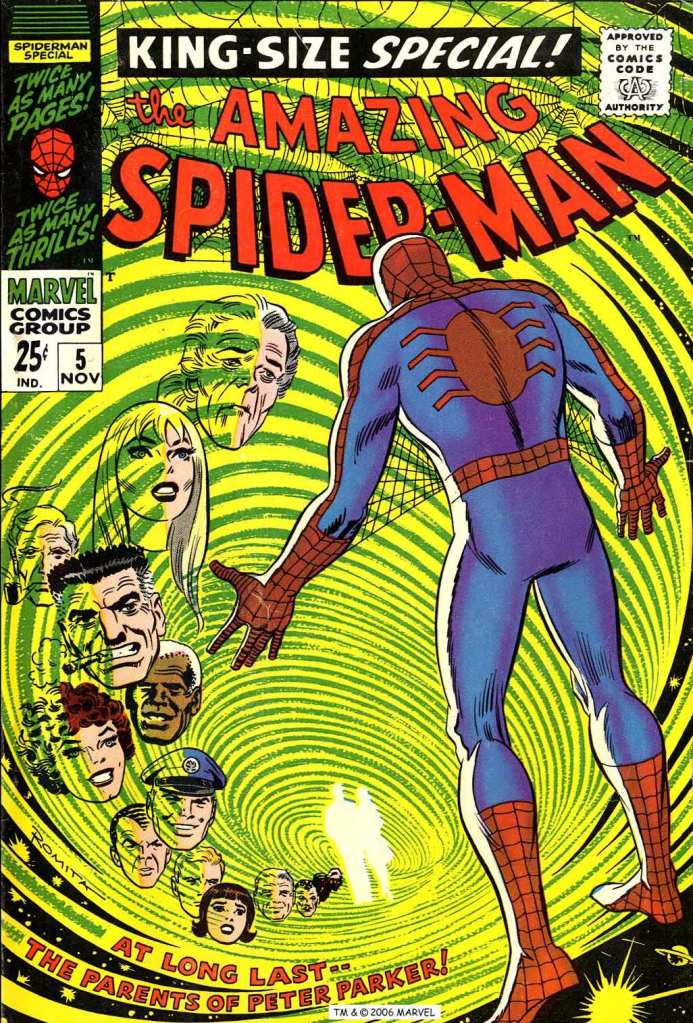
As I’ve related before, my buddy David Steckel had inherited a bunch of assorted comic books from older cousins who had outgrown them, and so his haphazard collection reached all the way back into the 1960s in a scattershot fashion. Among the books that he had, and which he let me borrow and read at a certain point, was AMAZING SPIDER-MAN ANNUAL #5, the notorious story revealing the secret past of Peter Parker’s parents Richard and Mary Parker. That was a hell of a hook for a big Annual story, and i was definitely interested, having heard nothing about them at all in my reading up to this point. The graphic John Romita cover, clearly influenced by the kinds of op-art effects that Jim Steranko had brought to the field, was another eye-catching reason to read it. (That’s Mary Jane Watson sporting her short-lived short-and-curly haircut, an ill-considered attempt to differentiate her from Gwen Stacy. He hair’s been miscolored brown here.)
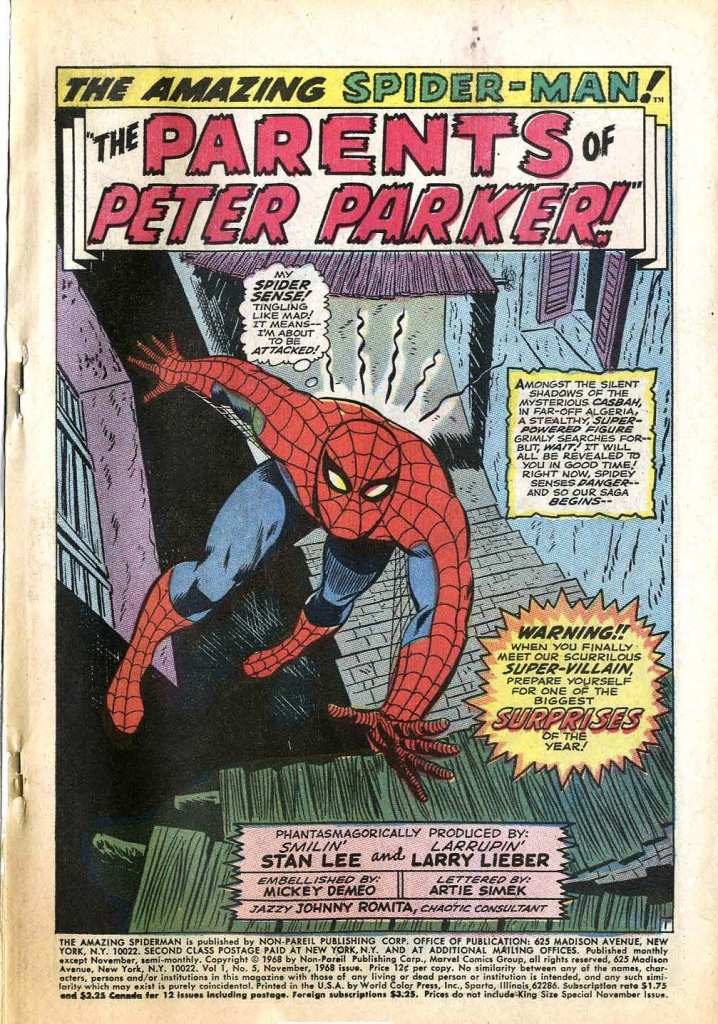
This was a story that really only could have been told at this point in time. While it was cooling by 1968, the spy craze was still a strong fixture in popular culture, so what could be better than setting up Peter’s lost parents as secret super-spies who had been lost on a mission? But if you ask me, it was a bad choice, in that it immediately made Peter’s life extraordinary even before he got bitten by that irradiated spider. Spidey’s appeal was that he was an everyman, but this was another place where his background proved to be anything but ordinary. The story itself is fine, but the ramifications of it were a bit troubling. Stan Lee seemed to come to that conclusion as well, as Peter’s parents aren’t mentioned again for decades after this.
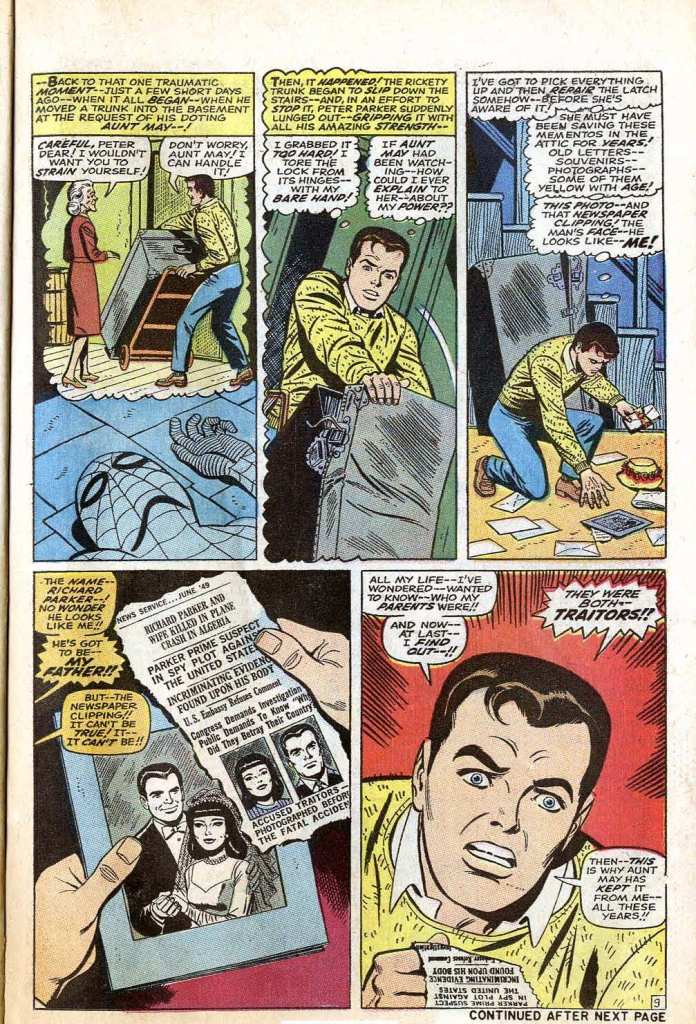
The story was drawn by Larry Lieber, Stan’s younger brother who had mostly been plying his craft on westerns and the like. Larry had been working on this special story for a year–it had originally been announced in the previous year’s AMAZING SPIDER-MAN ANNUAL #4 which he’d also illustrated. John Romita is listed on this job as a consultant, which amounted to him functioning as a bit of a co-plotter, Lee having turned a lot of the management of the series over to John by this time. This was considered an important story, and so Larry spent an inordinate amount of time on it. Lieber’s work is clearly influence by Romita’s (as well as Kirby’s) but his figures are a lot more stiff and he can’t quite capture the smooth, fluid movements that Spidey is supposed to have. The art here is fine, but it’s a bit clunky and restrained when we get to the action.
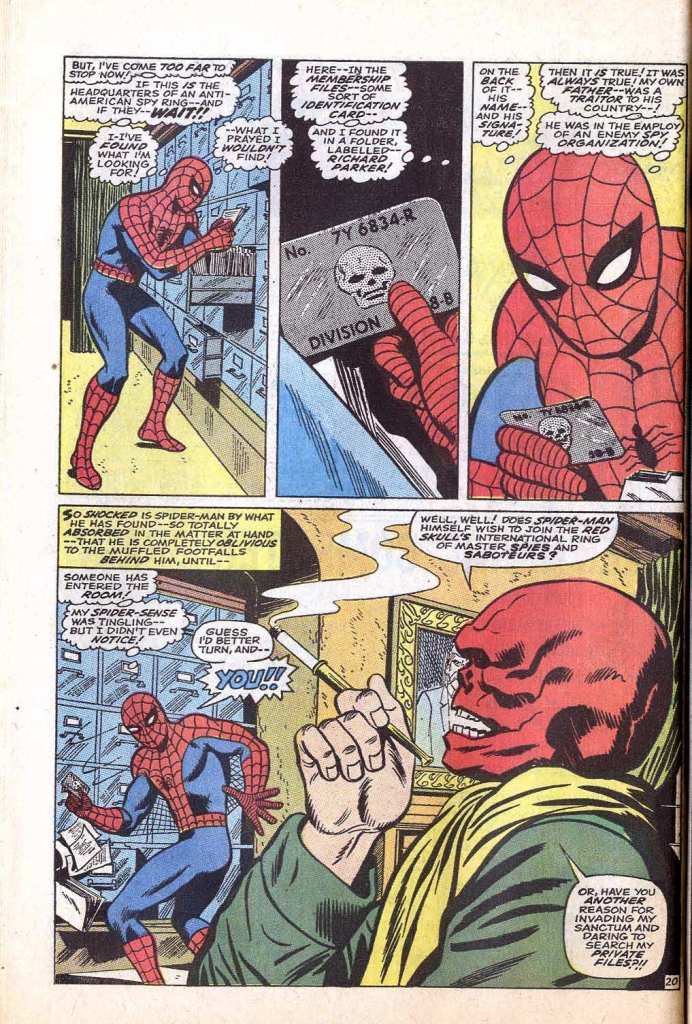
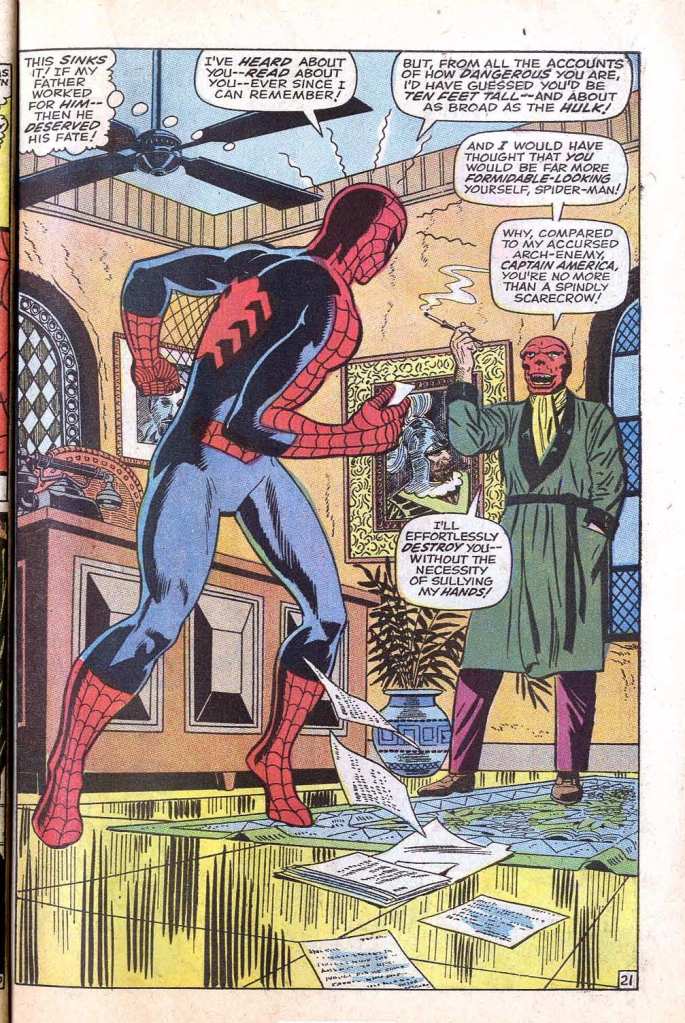
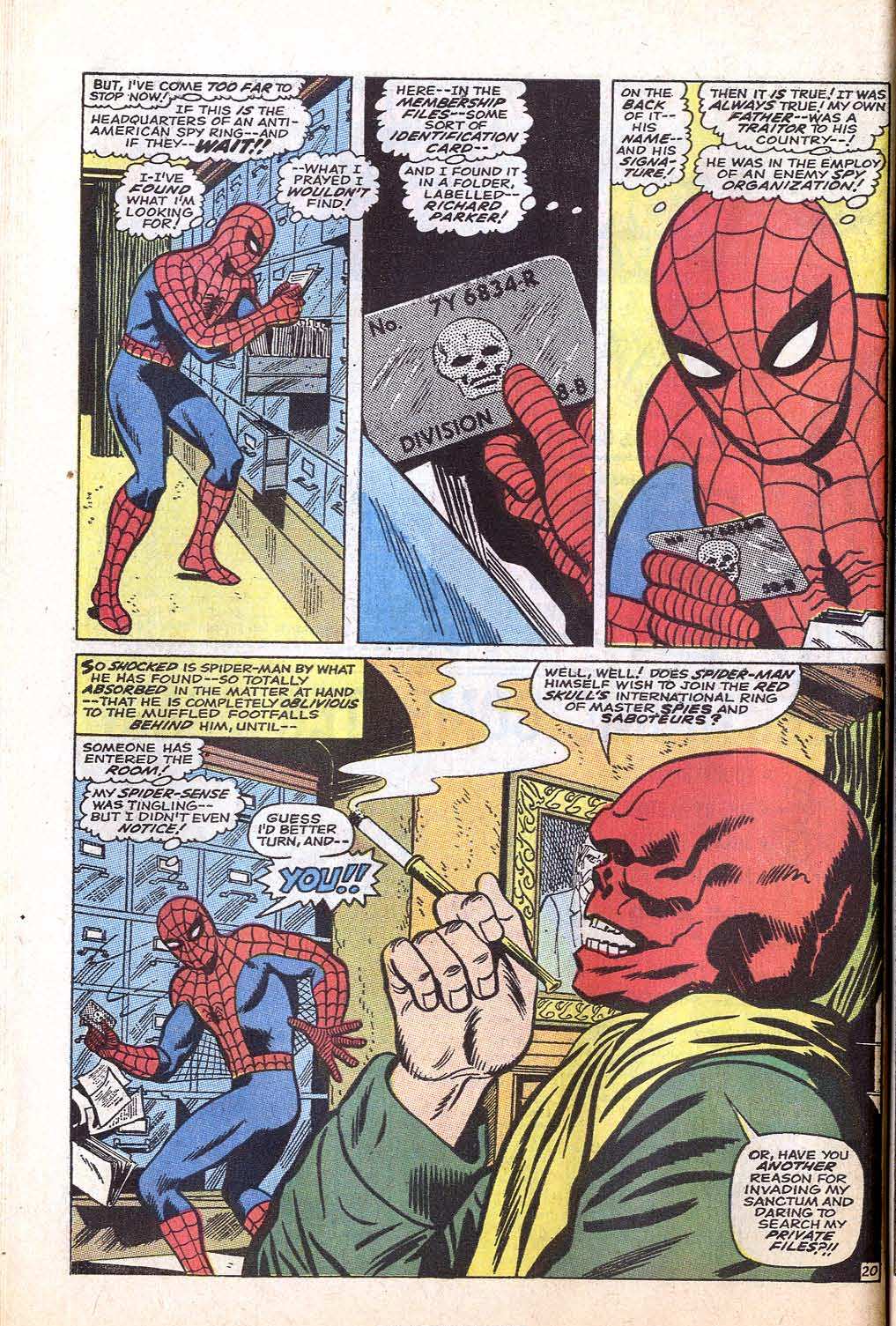
In fact, he spent so much time that the size of Marvel’s original art boards changed while he was only halfway done with the job. So the back half of the issue is drawn at the new, smaller size. You can see the difference in the size of the lettering (which wouldn’t be reduced quite so much at the new board size) on these two continuous pages. It isn’t super-noticeable unless you’re looking for it, but it’s clear-as-day if you are. Also, Lee uses the Red Skull as the villain in this story, the mastermind behind the murder of the Parkers, forgetting that the Skull had been in suspended animation since WWII and wouldn’t have been active then. Later writers have decided that this was the bogus Red Skull who fought the Captain America of the 1950s, but that makes the story even more convoluted. It’s all a bit of a mess.
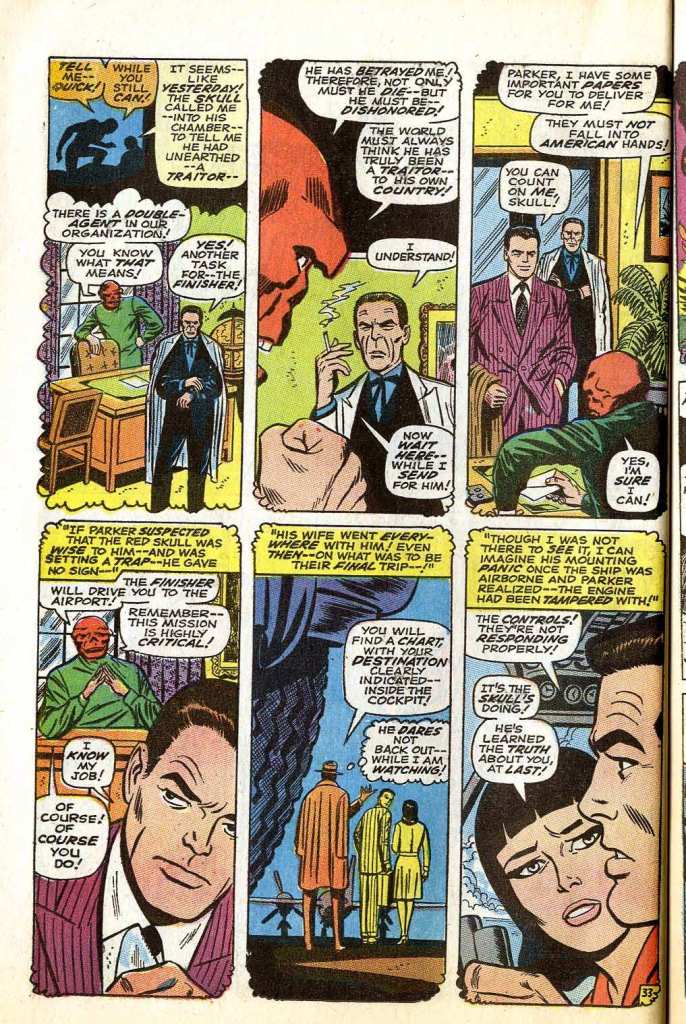
The extra-length story opens in the Casbah within Algiers where Spidey has come seeking answers concerning the disappearance of his parents. After an action sequence in which the web-slinger is attacked by bad guys, we get a flashback to Peter Parker discovering hidden clippings in Aunt May’s things that indicate that Richard and Mary Parker were traitors to their country. Unable to accept this, Spidey borrow a ship from the Fantastic Four and heads overseas, determined to find proof that will exonerate his parents even after so many years. It’s a fool’s errand, but after Spidey starts to poke around, he’s attacked by the guys from the opening, and we’ve now come narratively full circle. The web-slinger is able to follow his attackers back to their base, where he discovers that they’re in the employ of the Red Skull–as were his parents. It’s a crushing blow.
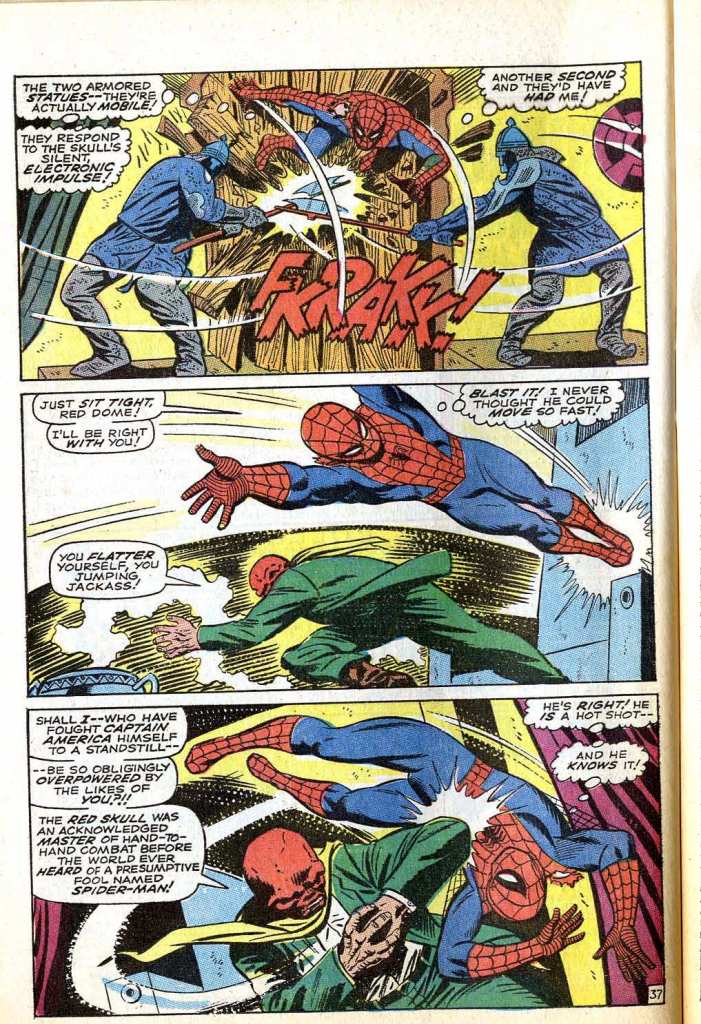
Outmatched by the Red Skull and his superior skill and weapons, Spidey retreats. But the Skull then calls in his master assassin, the Finisher, and set him the task of eliminating the wall-crawler. The Finisher attempts to do so by launching missiles at the hero from his car that will follow his every move. But at the last minute, Spidey doubles back to the car, causing it to be destroyed by its own ordinance. Before he perishes, the Finisher reveals that he sabotaged the Parkers’ plane on the orders of the Red Skull–but Spidey still needs proof of their innocence, and there’s no other way to get it than by confronting the Skull himself. So he heads back to the Skull’s lair and the two combatants duke it out.
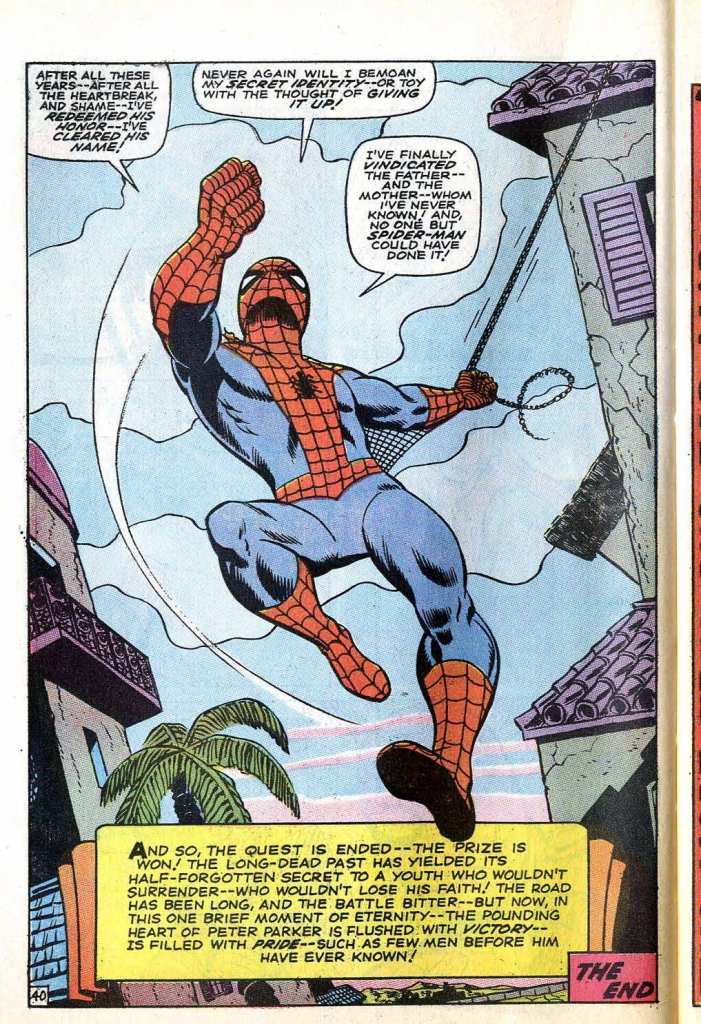
In the end, while the Skull is forthcoming about the fact that he had the Parkers killed because they betrayed him, Spidey still doesn’t have any tangible evidence. The Skull himself is seemingly blown up in the backfire of one of his own weapons, which sets the place on fire. But before escaping, Spidey is able to lay hands on Richard Parker’s credentials as a covert government agent, which were secreted inside his Red Skull Membership Card for some reason. Either way, Spidey now has the proof he needs to redeem his folks, and so he swings away in a triumphant final shot. It’s a pretty fun story, one that owes a lot to the James Bond films of the era. It’s just also an ill-fit for the background of such a relatable and urban character as Spider-Man.
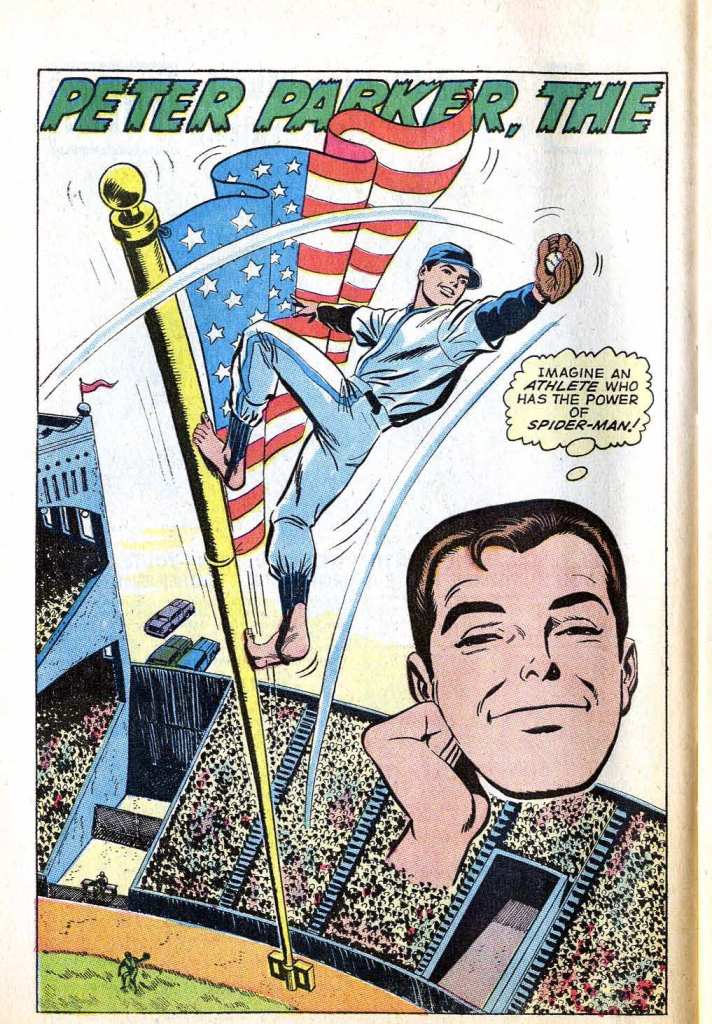
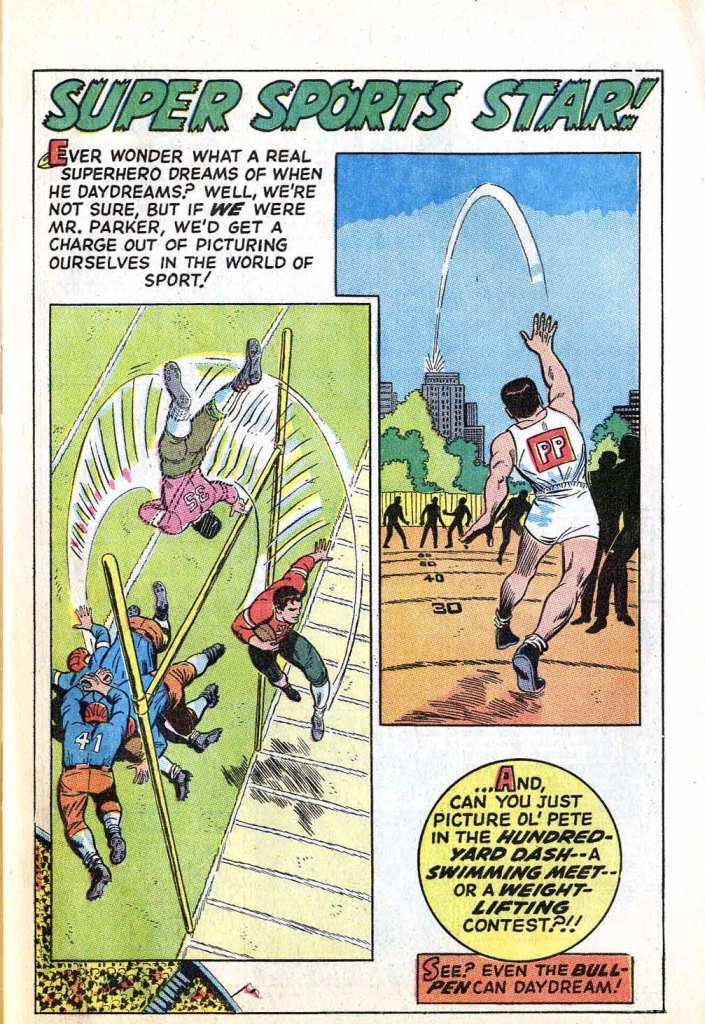
This Annual was also full of secondary features that were a lot of fun–such as this spread imagining Peter Parker using his spider-powers as a professional athlete.
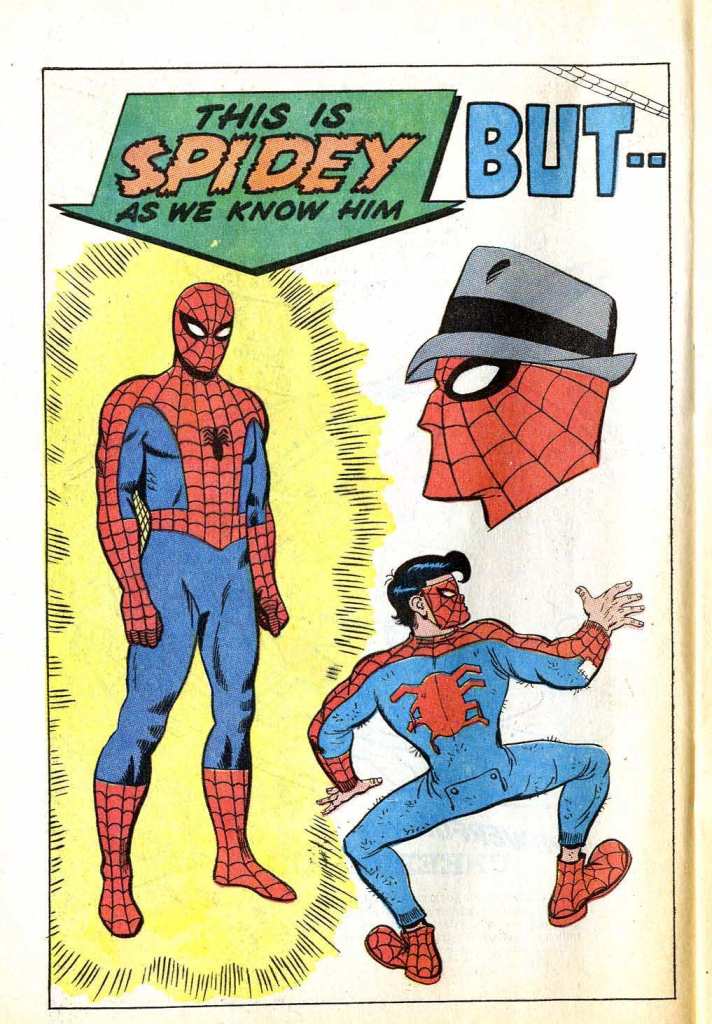
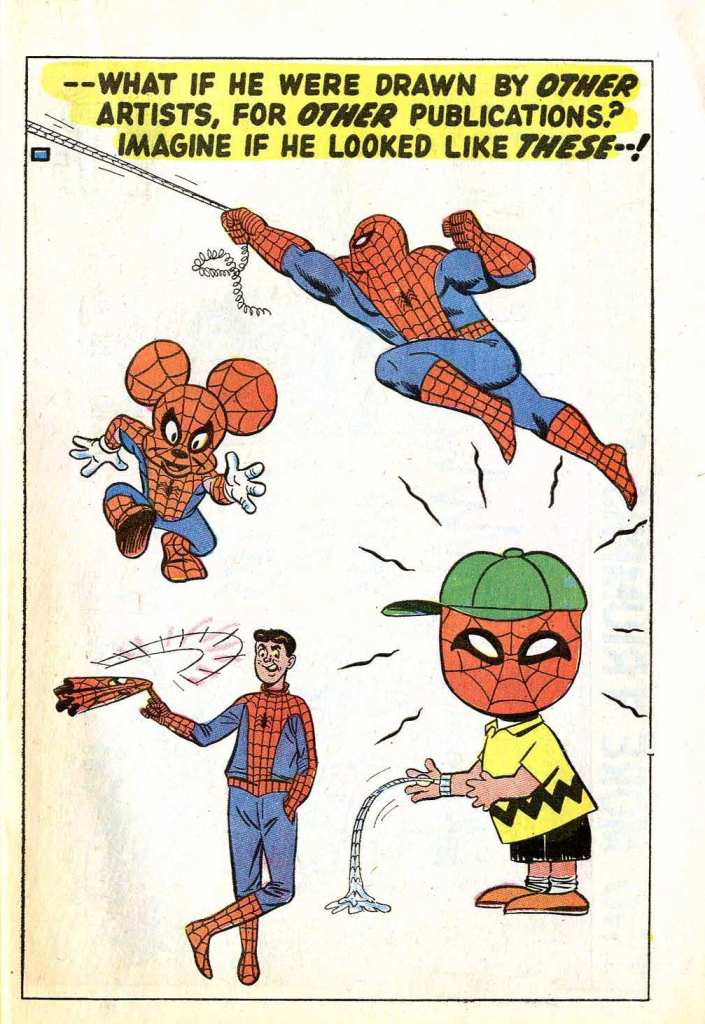
There was also this spread in which the wall-crawler was presented in the style of other cartoon heroes. The one of Spidey as Mickey Mouse proved to be prophetic in the long run.
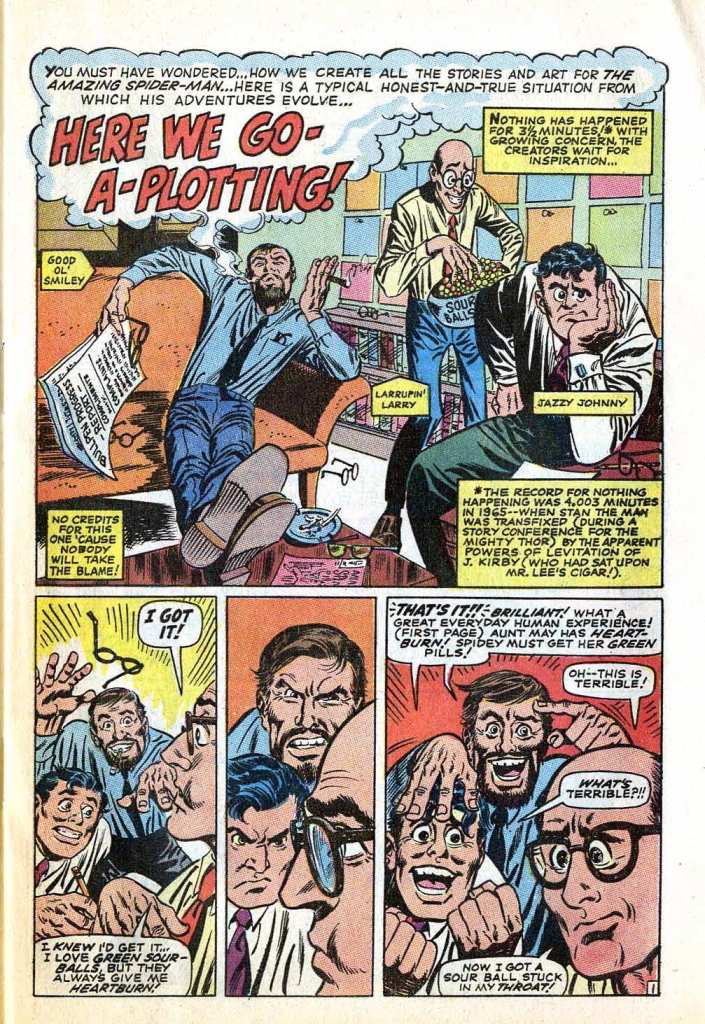
All of the Marvel Annuals for this year included short behind-the-scenes strips about how the stories were produced, another way in which the Marvel Bullpen and its staffers were fictionalized into entertaining personalities. This three-pager by Marie Severin was very funny and much-reprinted. It took the place of a never-finished earlier version that Larry Lieber had worked up with John Romita–despite their many strengths, comedy wasn’t their forte, and so Lee turned to Marie to carry the ball here. It’s maybe the best thing in this entire Annual.


I’ve often wondered why Stan went with Peter’s aunt and uncle in AF 15 rather than his parents. I’ve always assumed it was that deemed too sad to kill off his father so directly but I’ve never seen anything that actually addressed this. I sense Goodman’s hand in this.
LikeLike
Or why they made Peter’s Aunt and Uncle the age his Grandparents would be ( I can only assume that Steve Ditko drew them the age his Aunt and Uncle were at his 1960s age and not the age they were when he was a teen. Having an Aunt and Uncle that old when you are a teen is not the norm ).
LikeLiked by 1 person
Not necessarily. Using real world dates, Peter was born to parents born in the 1920s or 30s, a time when large families with a wide spread of years between oldest and youngest was not unusual. For example, my mother was the 7th of 8 children with a 13 year gap between her and her eldest surviving sibling. While we know that his grandparents only had 2 children alive when Peter was born we have no idea if any were lost in the intervening time.
LikeLiked by 1 person
My sister had six kids and the oldest graduated high school while the youngest was an infant. He’s right. It’s possible even today.
LikeLiked by 1 person
If you believe that the original idea for the character came from Kirby based on his time with Joe Simon being involved with the Silver Spider/Spiderman, Peter being an orphan makes sense. It is one of the reasons I believe that it was Kirby, that and the fact that in spite of being in High School he is Spider-MAN and not boy.
LikeLike
I like The Amazing Spider-Man2 ( the second movie in the Andrew Garfield reboot series ) where Peter Parker’s father, Richard Parker, was a brilliant genetic scientist. Plus wouldn’t the person in the spy agency they ( Cause why would he bring his civilian wife on a undercover mission? ) work for know they were undercover? In the TV series Castle in Richard Castle’s father’s second and last appearance being a rogue agent was part of his cover, but he was alive — why if being a traitors was part of their cover would the spy agency keep it going after their deaths? I don’t see if it was a dead Nick Fury or other Howler turned SHIELD agent any of them not turning over every stone to prove one of them wasn’t a traitor( especially if they had family that would have to live with that )— did the Parkers have no friends in the agency they worked for? Did they all say, yeah, I knew they were traitors?
LikeLiked by 2 people
Instead of doubling down and adding even more convoluted elements, I wish later writers had written this off as a dream Peter had after watching a Bond marathon or something along those lines.
LikeLiked by 4 people
I’d never thought about it but would proving his parents were spies clear them? Spies have been turned before, why not them?
That said, I didn’t have a problem with the backstory. Still don’t, though i see your point.
LikeLiked by 2 people
that cover is great, the whiteout effect of peter’s parents in the middle of the day glo whirlwind is pretty sharp. larrupin larry managed a ditko-esque vibe with the final page full page shot of spidey web cavorting. marie severin’s cartooning is always a welcome addition
LikeLike
Having Peter Parker’s parents as spies is probably not the best idea for the reasons already stated. Adding to that, the careless of using a villain who isn’t really available and art that really isn’t up to the standards of the monthly comic also gives this annual a rather disinterested feel. But that cover is damn sharp!
LikeLike
I’m enjoying Tom’s posts, but I really wish he would write some on DC comics I’ve already read. He’s keeping me pretty busy reading several issues every weekend. But enough of that, onto the issue at hand. The opening scene immediately reminded me of a Connery Bond film (it helped that Tom mentioned Moonraker in his Doctor Strange post yesterday), which is very unlike a normal Spidey story.
I some issues with the story: How does Spidey get back to New York? How was the Finisher’s Electro-scanner able to track Spidey using a piece of his costume? How did the Red Skull get Richard’s U.S. Government ID card? Why did Richard even have it on him? Why did he take his wife on this (and other?) mission? And why did the Red Skull hide it inside(?) Richard’s Red Skull ID card? I doubt Richard’s U.S. Government ID card will be accepted as proof without the government backing it up. The newspaper article headlines mention the U.S. Embassy had no comment, so why would the government make an official statement now. Still, as a spy-lite story it was a fun read.
I think the artwork is good, but not outstanding. I noticed several panels had no backgrounds, just a solid color (usually yellow), while others had minimal background features.
As for the secondary features in the annual, I didn’t find them as much fun as Tom does.
LikeLiked by 1 person
What a stinker of a story. A bad idea, clumsily realized. Even the action stuff is dull.
Esposito’s inks are better than usual, so that’s one thing. But yeeesh.
LikeLiked by 2 people
Sadly, this was typical of a lot of the Annuals over the years — instead of being a special event, they often read like a mediocre fill-in. There were definite exceptions, like that Dr. Strange Annual that P. Craig Russell drew, or Jim Starlin wrapping up the Warlock storyline in the Avengers and Marvel Two-In-One Annuals. But all too often, there was a sense that the main attention (and top talent) was on the monthly titles, and the Annuals were an afterthought.
LikeLiked by 1 person
I’ll just leave this here, shall I? https://50yearoldcomics.com/2018/08/19/amazing-spider-man-annual-5-november-1968/
LikeLiked by 2 people
Looks clear (and I may have read somewhere) that Romita did touchups on Lieber’s art. Lieber was on a panel I attended (hosted by his friend/Marvel editor Danny Fingeroth) and I asked him about this annual. But he didn’t remember it.
LikeLike
Good thing the story was basically left alone, but unfortunately these days the the “everyman appel” of Spidey is long gone.
LikeLike