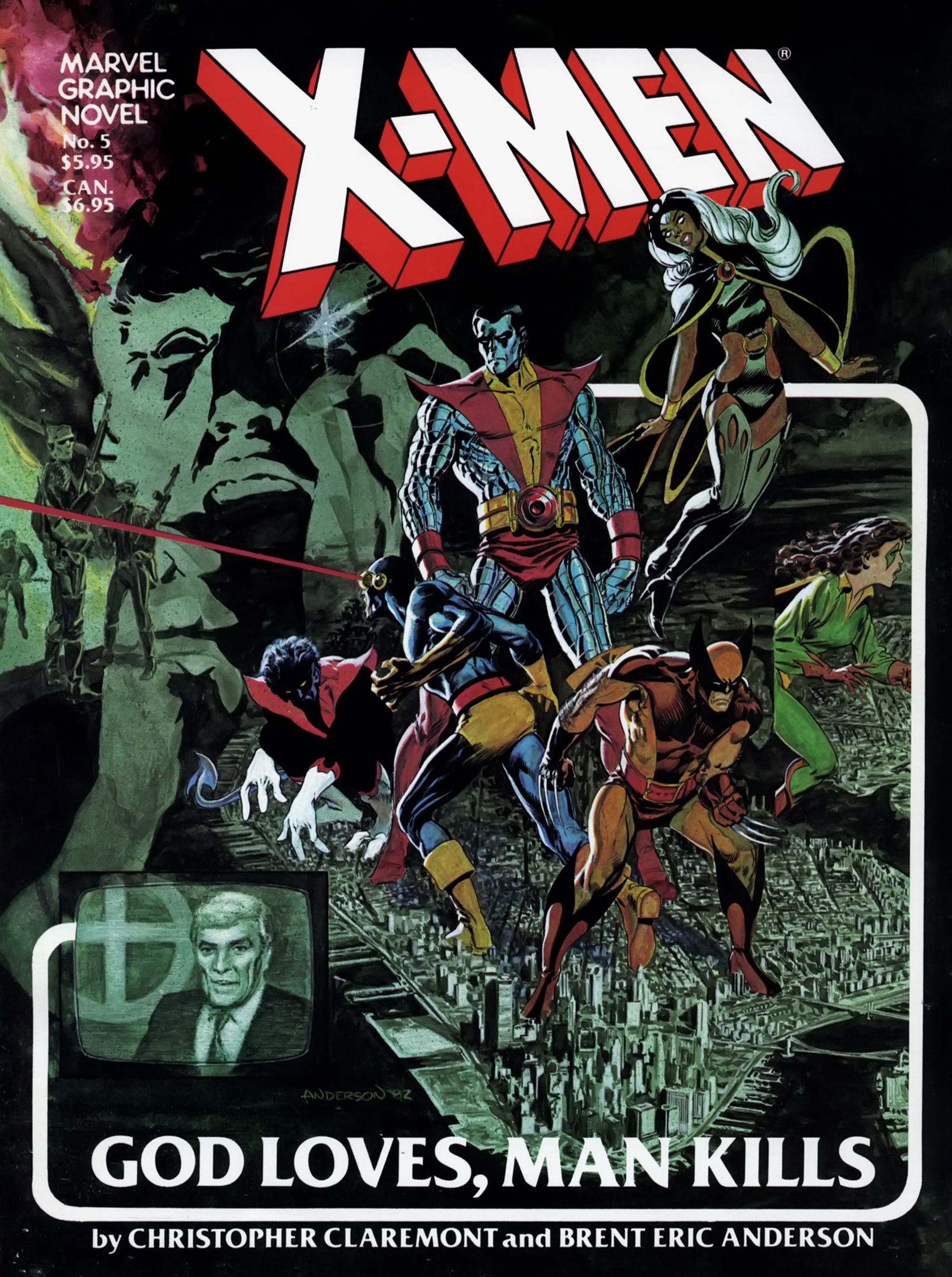


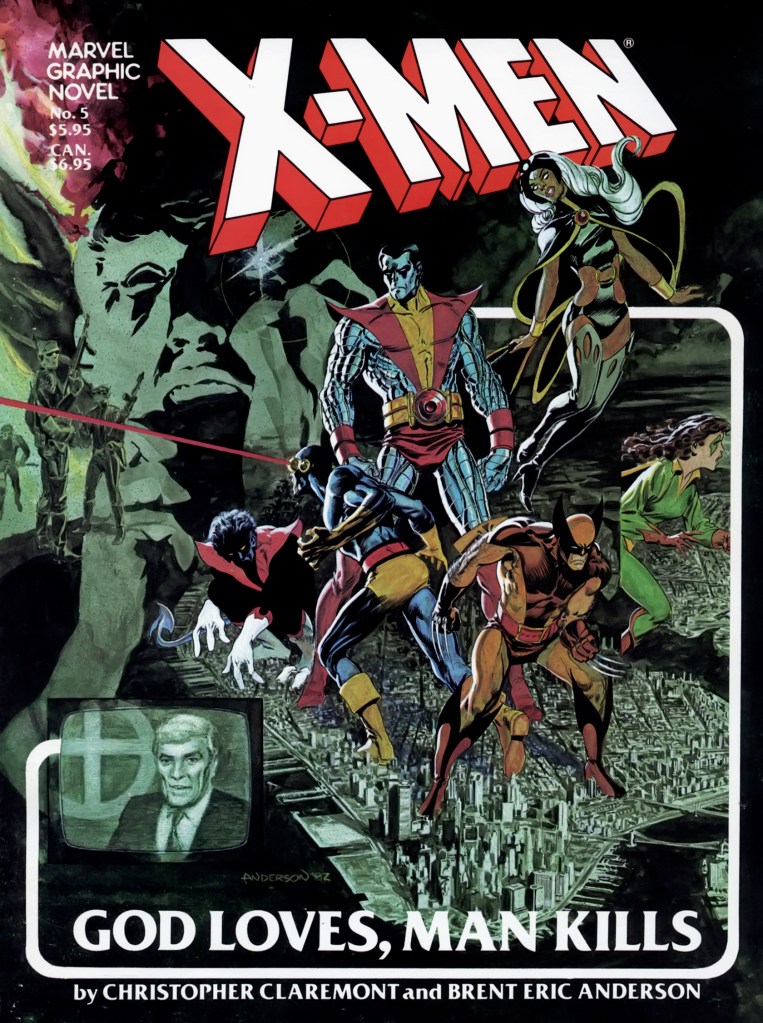
A few years back, I wound up on an X-MEN convention panel along with Louise Simonson, and I was able to express just how impossible a bar she’d set for everybody who came after her as an editor on that particular line. In the space of a very short time, she’d finished up the DARK PHOENIX SAGA, overseen DAYS OF FUTURE PAST, brought Paul Smith on as regular artist, Launched NEW MUTANTS, oversaw the first WOLVERINE limited series and the X-MEN/NEW TEEN TITANS crossover, and put together this graphic novel. It’s an output that’s daunting for anybody to match, and I’d argue that this book is the best single-release summation of the appeal of the X-Men of that period and expression of the themes that were driving the series at that time. It’s a terrific piece of work.
The MARVEL GRAPHIC NOVEL line was part of Editor in Chief Jim Shooter’s attempts to pioneer new formats and to take advantage of the growing Direct Sales marketplace of comic book specialty shops. The MSGs were cast in the image of European albums which had begun to get spotty distribution in the States. They were larger than typical comic books, on better paper with better color. And they were intended to be more sophisticated, as the cover price–$5.95 at a time when a regular issue of X-MEN would set you back a tenth of that–insured that the youngest readers wouldn’t easily be able to purchase them. X-MEN was such a darling of the comic shops that talk about doing a graphic novel had been kicking around for some time. (Before it was shifted into the main series, Days of Future Past was initially conceived as an X-MEN graphic novel that Claremont and Byrne would collaborate on, for example.)
But when the time came to actually produce the X-MEN Graphic Novel, Louise and Chris had another artist in mind: Neal Adams. Neal still had a strong association with the X-Men from his time drawing the series in the late 1960s, and he was still enough of a superstar that him coming back to do such a book was money in the bank. And indeed, the process got far enough along that Neal had begun penciling, producing a number of pages that we spotlighted a few years back:
But ultimately, there were apparently aspects of the legal agreement for the project that Adams was uncomfortable signing, and he wound up walking away from the project, taking his unused and unpaid-for pages with him.
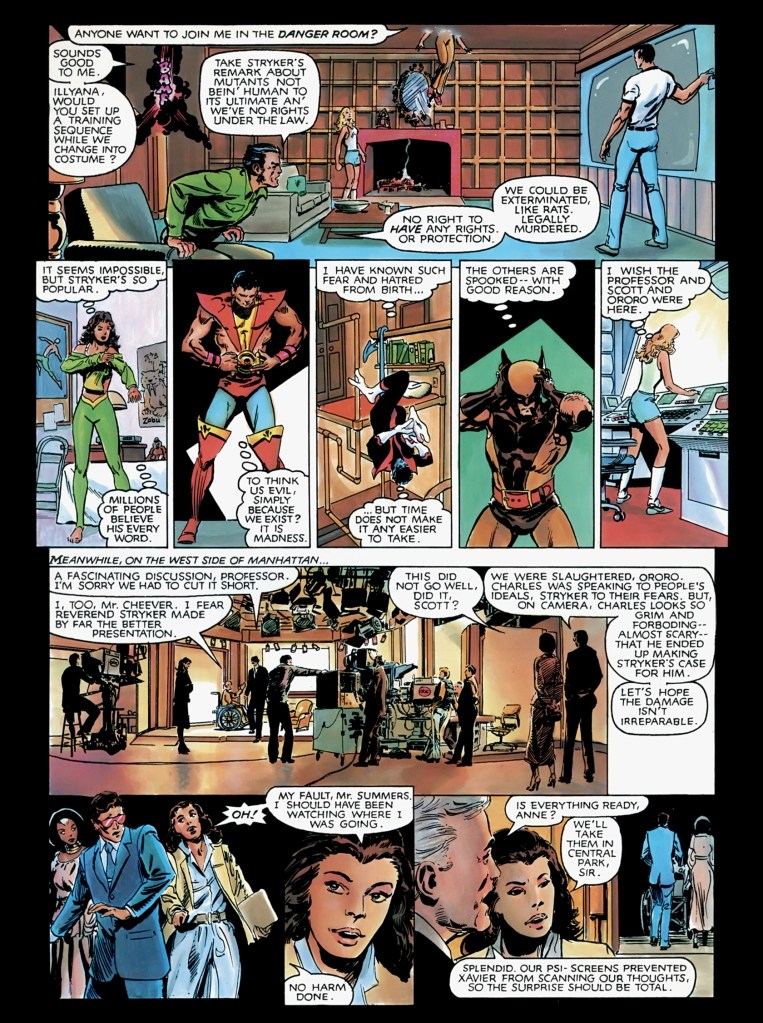
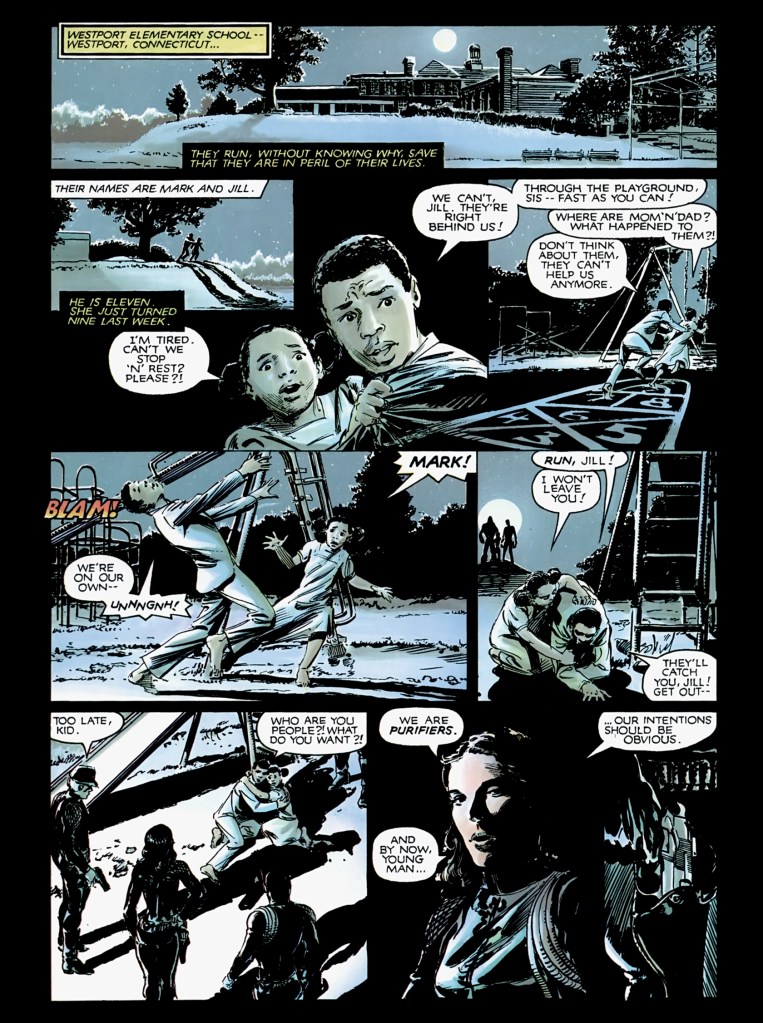
As a replacement, Simonson and Claremont brought in Brent Anderson, an artist who had made a bit of a splash drawing a revival of KA-ZAR. He’d also done a couple fill-in issues of UNCANNY X-MEN that showed that he was simpatico with Claremont and could deliver material that fit the characters and their world. Anderson’s work here is rich and lovely. He uses the larger original art size to allow himself to put more panels on a single page that was typical. Accordingly, he and Claremont were able to fit in a lot more story material than they might otherwise have been able to. The book is dense with incident, but there’s also sufficient real estate for the individual characters to get moments where they shine.
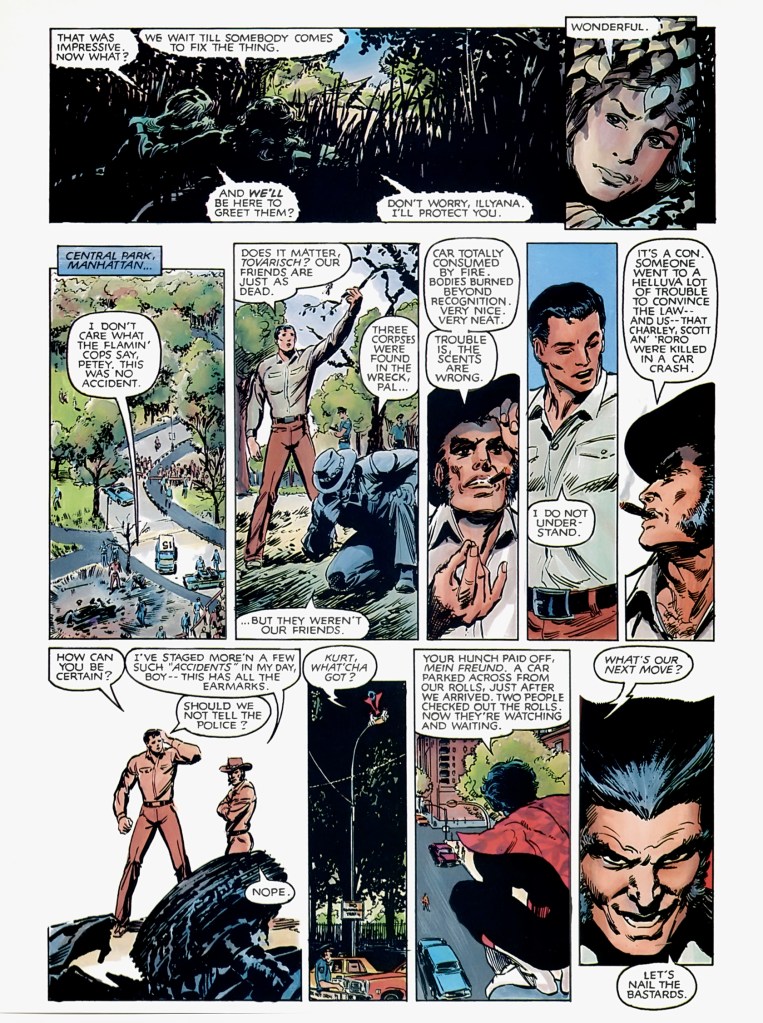
The story itself is a bit more real world and grounded that they typical X-Men fantasy adventure as well, steering directly into the strip’s central themes of persecution and bigotry. the story introduces Reverend William Stryker, an evangelical preacher who believes that mutants are the spawn of the devil and whose Purifier troops are sanctioned to employ lethal force against them. Stryker is cast in the image of the Televangelists of the period, but what makes him especially scary as a foe is that he legitimately believes the hate that he’s spewing and that his work is a holy crusade. He doesn’t merely proselytize against mutants, he’s actively making moves against them, blowing up the car carrying Professor X, Cyclops and Storm back from a televised debate with the Reverend and making it appear that all three have been killed.
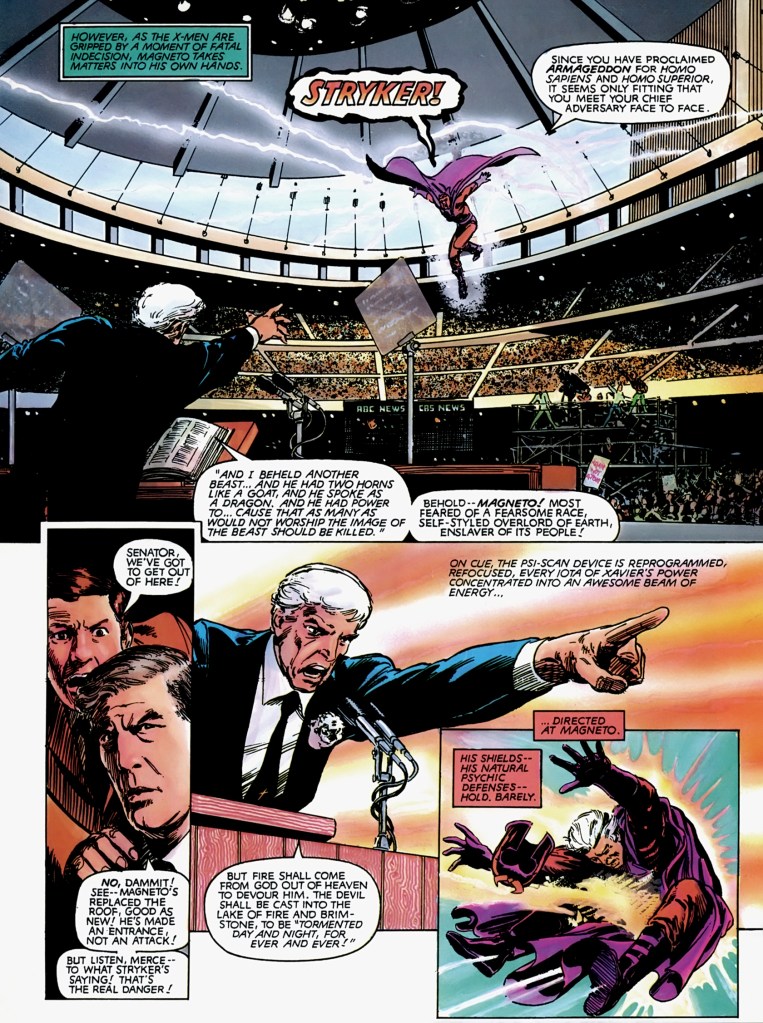
Stryker intends to brainwash the Professor into using his mental powers to destroy the minds of all of the mutants in the nation through a Cerebro-like device. Unfortunately for his plans, Wolverine’s senses aren’t fooled by the decoy bodies left at the scene of the crash, and this leads to the X-Men attempting to follow the trail of the Purifiers back to Stryker. In these efforts they’re joined by an uneasy ally: Magneto. Claremont was well into his efforts to redeem the Master of Magnetism at this point, but this was the first story in which he and the X-Men stood side-by-side. The entire conflict culminates at a religious rally at Madison Square Garden where Stryker intends to put his plan into motion while broadcasting to the world. Magneto and the X-Men confront him there, and despite their best efforts, they still come across looking like the aggressors.
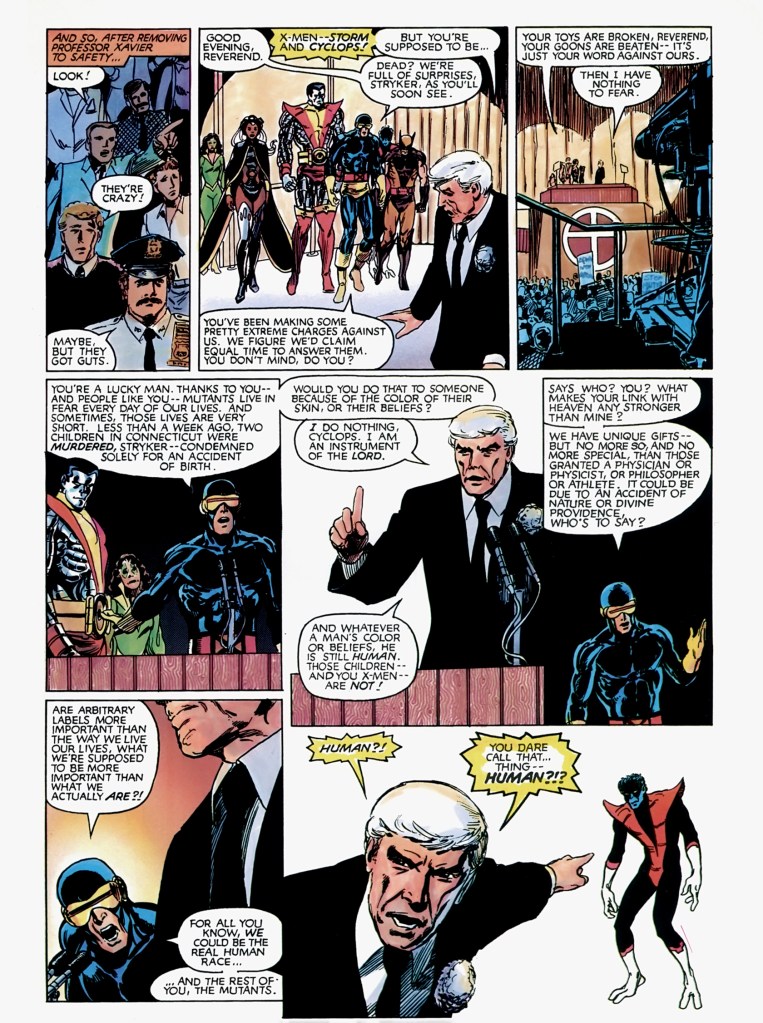
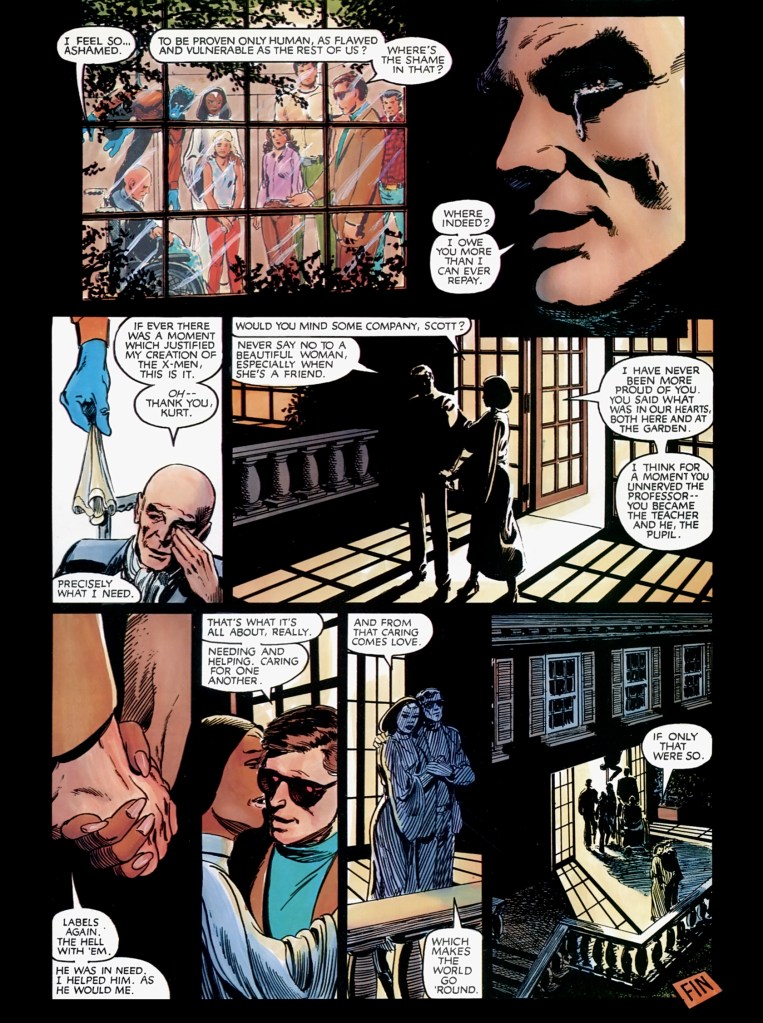
After the requisite action set pieces, the story culminates in a televised confrontation in which Stryker’s fanaticism pushes him too far. When he attempts to gun down the unarmed Kitty Pryde, who stands in defiance of him, Stryker himself is instead killed by one of the cops on duty as security, who couldn’t stand by and watch him shoot a young girl who was no visible threat to him. In the aftermath, Magneto once again argues that his way is the only way, that humanity will never accept mutants for who they are otherwise, and Professor X himself is on the verge of throwing in with his old friend. But it’s the X-Men themselves who refute Magneto’s way and resolve to find a solution to peaceful coexistence, no matter how much a fool’s errand that appears to be. The whole thing is a terrific one-off story that completely encapsulates the series while delivering a meaningful adventure. I really liked it.
But not everybody was so positive about this book. In fact, it got some news pickup about the controversial subject matter. Reporters weren’t convinced that the $5.95 cover price would prevent the book from being available to kids, and they certainly saw the benefit in generating outrage about the material. In particular Pat Robertson of the 700 Club unsurprisingly devoted a bunch of time in an episode to reviewing and excoriating the work:
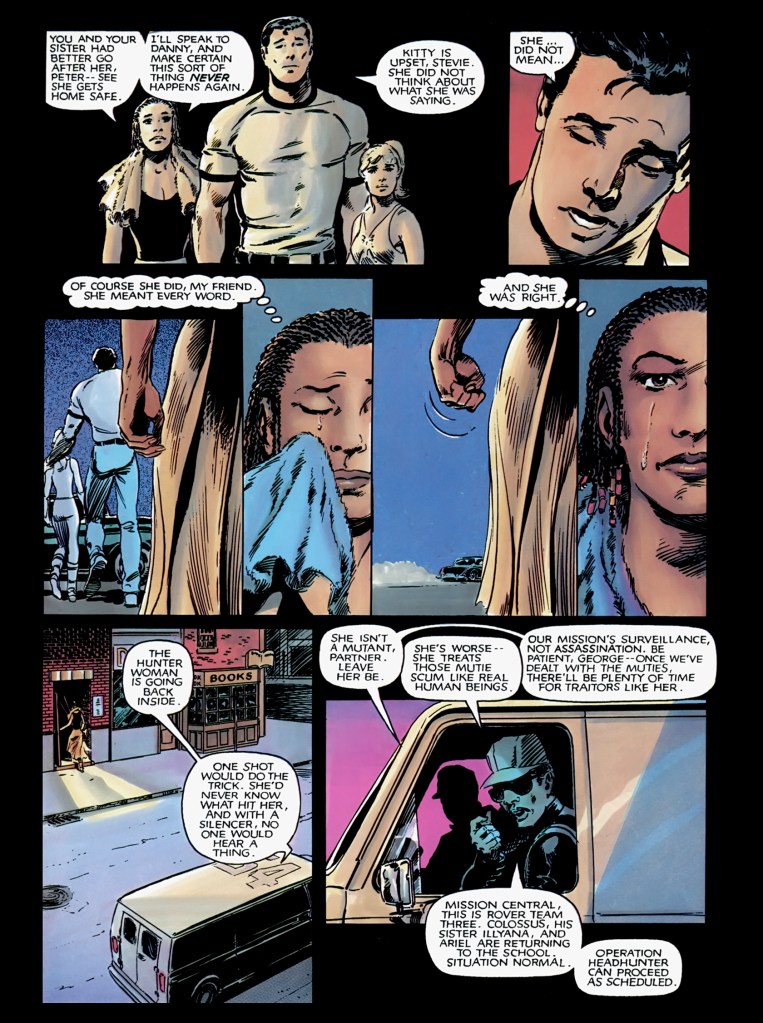
Which, somehow, only increased its luster. “God Loves, Man Kills” is inarguably a strong piece of material, and it holds up well today–except for perhaps one sequence in which, in attempting to make her African-American dance instructor Stevie Hunter understand why she is so upset about the hateful rhetoric being used to describe mutants, Kitty Pryde hits her with the N-word. It’s a powerful moment, but more than a little tone-deaf given that all of the creators involved are white guys. This wasn’t the only time in these days that the N-word would be used in X-MEN in this context, though it’s been redacted for most modern reprintings over the past twenty years or so.


I tend to be a bit frivolous in my remarks, having fun with comics from decades past. I cannot do that with this one. In so many ways – outside the unfortunate N-word usage – this incredible collaboration has held up remarkably well over the decades. So many unforgettable pieces throughout this outstanding graphic novel that I could devote several paragraphs highlighting them. But what now depressingly stands out to me is that the aspects of Ryker’s fascism that seemed a bit of reach in 1982 are more prevalent today. When I think of those who lean that sordid direction and verbalize such hatred, I cannot help but recall Wolverine’s words, “Let’s nail the bastards.”
LikeLiked by 5 people
The only problem with this book is that it took me years to buy it as I could never justify the price, paying for comics with money from my paychecks earned frying hamburgers. It is probably Claremont’s best written works, and the art is amazing. I don’t know if I can add anything that hasn’t already been said.
Even better that it upset the televangelist crowd.
LikeLiked by 5 people
Being religious both Sprite and Nightcrawler should have asked William Stryker how does he know that God isn’t channeling his powers through them like he did ISAIAH: 1 – RETROGRADE TIME REGULATION. 2 – PRECISE PRECOGNITION and HISTORICAL FORESIGHT ( He had an extraordinary gift of long-range prophecy ). 3-SPIRITUAL VISION and CELECSTIAL ASCENT. 4-MIRACULOUS INTERCESSION and MILITARY PROTECTION. 5-SUPERNATURAL HEALING THROUGH PHYSICAL MEDIUMS. OR –ELIJAH: 1 – WITHHOLDING and SUMMONING RAIN. 2 – MIRACULOUS SUSTENANCE ( he was fed by ravens during the drought, and caused a widow’s jar of oil and jug of flour in Zarephath to never run out ). 3-RAISING THE DEAD. 4 – CALLING DOWN FIRE FROM HEAVEN. 5 – SUPERHUMAN SPEED. 6 – PARTING WATERS. 7 – ASCENTION TO HEAVEN. Could have sworn the last time I Googled Elijah looking for powers that he had mental ones too. Plus if NIGHTCRAWLER is proof of the DEVIL’S WORK in MUTANTS then what about the X-MAN ANGEL? If not channeling GOD’S POWER then THOSE PROPHETS demonstrating SOME OF THE SAME POWERS as STORM, QUICKSILVER, DESTINY and the MORLOCK HEALER as GOD’S BLESSING THEIR EXISTENCE. I have to say RELIGIOUS FANATICS are SCARY IN BOTH TV, MOVIES and COMICS — not a fan of when they show up in either ( Not them or the people who hunt humans for sport or serial killers or race killers ). At least now I know why William Stryker ended up MILITARY in the X-MEN MOVIES and NOT A RELIGIOUS FANATIC.
LikeLiked by 2 people
This GN was hugely powerful and enjoyable. Heartfelt writing from the Xmens most enjoyable writer Chris Claremont. Around this time Brent Anderson drew a comic called Somerset Holmes which is a very cinematic thriller dealing with a heroine on the run with amnesia and of course Brent went on to do his greatest work with Kurt on their masterpiece of superhero fiction Astro City.
LikeLiked by 2 people
The true high watermark of the X-Men, not Dark Phoenix. It’s been all down hill since. Sadly, Weezie was the last editor who even tried to rein in Claremont’s excesses.
LikeLike
At the time this GN came out, I was 20 years old, attending San Jose State University and working at a pizza restaurant in Sunnyvale. Although I wasn’t earning much, I still had enough to splurge for this story and thought it was excellent. My religious feelings were agnostic at the time, not having strong feelings about the existence of god or the Jesus myth, etc., but I strongly loathed bigotry and religious fanaticism. On my own, simply due to my interest in history, I’d read several books on the history of Hitler and World War II and would read many more in later decades, as well as much about .
LikeLiked by 2 people
I never read God Loves, Man Kills and if that was all this post was about I wouldn’t be commenting on it. But since Tom embedded the 700 Club piece on and comics in his post I gave it a watch. I don’t think it needs saying, but I’m totally disgusted with it. Of course, Pat Robertson and his 700 Club cohorts prayed on TV for Hurricane Gloria to miss his broadcast headquarters. Then, when it did he declared it a miracle, even though it slammed into Long Island and New England, causing close to $1 billion in damage and multiple deaths. When questioned about it be suggested New Yorker and New Englanders “should have prayed too.”
As for the piece, it starts with Pat quickly showing several comics, including The Inhumans (1976) #4 because the story title, “Night of the Demons” is on the cover. I doubt anyone at the 700 Club read it, as the demons are bad, but it also has Celestials. They are just super-advanced aliens, but since they’re called Gods of Space in the issue, Pat et. al. would still object. He then mentions God Loves, Man Kills and calls the X-Men subhumans.
The piece then begins and immediately mentions role-playing games and rock music. It then claims super-heroes have changed from the Superman and Batman types (they do know that Superman is an alien and Batman is a vigilante?) and that many now are strange looking and somtimes less than human (at which point the cover to The Omega Men Annual #1 is shown). It also takes offense at Arak and Thor for thunder being used in their descriptions. Then it gets to the X-Men and again calls them subhuman beings, as it briefly explains the storyline in God Loves, Man Kills. After the piece ends Pat shows a page which offended him as he mentions one of the mutants being crucified (is he not aware that Jesus was crucified because that was the Roman form of punishment?)
Anyways, sorry for my rant, but I needed to express my thoughts on this so I can sleep well tonight. Also, I have never had any interest in reading God Loves, Man Kills, but after watching that 700 Club piece I now have to. I find it mind boggling that Pat et. al. treat the fictional X-Men the same way they are treated in the comics by fictional humans.
And totally of topic, but I didn’t know how much Jack Kirby liked mythology. I knew he created Thor for Marvel and the New Gods for DC, but I wasn’t aware he also created the Eternals and Celestials for Marvel.
LikeLiked by 4 people
That 700-Club episode is a hoot. Robertson skims the issue and notices the obvious Christian language (he misremembers “ecce homo” as “echo homo”) and symbolism (Xavier crucified), and that the villain is a Christian preacher. He’s right that Christianity doesn’t come off very well in this book–I guess it’s because TV evangelists (like him) were then in the news a lot, or because Claremont thought it would be edgy. In general, explicitly religious characters in Marvel tend to be Catholic or Jewish, or else belong to fantasy religions–evangelical Protestantism is rarely depicted, let alone positively.
Ben Kingsley tells a story that suggests, if I understand him correctly, that Spider-Man wall cutouts may become a conduit for demonic influences. For all I know, this may be true, but gad.
LikeLiked by 1 person
Ha ha! That 700 clip is a good thing to watch whenever anyone gets “misty eyed” reminincing about the ’80s. Yeah, it was definitely a golden age of music, film, arts, etc. I get it. But a lot sucked too, and these clown show hypocrite grifters who dominated the media were one of them. Blaming comics, heavy metal music and Dungeons and Dragons on society’s ills while robbing people blind! Hilarious.
LikeLike
Oops, an errant finger sent the last one too soon! Anyhow, intentional or not, Stryker appears to have been based on Pat Robertson and I regard him and Jerry Falwell as despicable human beings, full of hatred and posing as oh so holy agents of god.
This masterwork by Claremont & Anderson is, sadly, still very relevant today, over 40 years since it was first published. Maybe it’s not my place to say as a white man of north-eastern European Protestant background (I’m now an atheist), but the use of the “N” word in the context as used doesn’t bother me at all. What does bother me is that hatred based solely on what people think or their ancestry or their sexuality is still very prevalent in our society, all the way up to the two highest levels in our current government. God Loves, Man Kills is pure fantasy but strongly echoes insane aspects of American culture, in 1982 and in 2026. Maybe things will have improved significantly by 2070, although I have my doubts. My chances of living to be 108 and seeing for myself are pretty negligible!
LikeLiked by 2 people
I tend to agree that this is a real high point in the Claremont era of X-MEN.
When I read it, I was feeling fairly negative about the main series, and my reaction to this was pretty much, “Look! They _can_ do the kind of story this book is supposed to be about!”
And Brent really got to go to town on the art. Gorgeous stuff.
LikeLiked by 2 people
If you don’t mind asking, Kurt, what was it about the X-Men at that time that had you down on them? I’m curious because at that time, my world all but revolved around the X-Men. Years later, I’m more objective with assessment of the series.
LikeLike
Looking back on it from decades of experience as a comics creator, it’s mostly a bunch of little stuff that I would write off today as rushed plotting or scripting. Back then, though, X-MEN was my favorite book, and it had such a slick finish (in both art and writing) that it really bothered me when something stupid would happen, or a dumb mistake would show up — it was like having your top-of-the-line Mercedes look great, but then when you open the door you find out it’s full of rust and hastily welded joints that don’t really fit together. And that just kept shoving me out of the book, making me think it wasn’t what it should be.
A couple of examples: The X-Men get split up in Antarctica, and the Beast and Jean think the others are dead, and the other thing Hank and Jean are dead. But neither of them makes it a priority to do something like fire up Cerebro, go find Magneto and see justice done; they don’t seem to care all that much. The main group of X-Men don’t even call Warren or Bobby to tell them Jean and Hank are dead. It reads as if the writer knows nobody’s dead so the characters don’t react like they should.
Heck, Jean hangs out with Misty Knight and the others hang out with Colleen Wing, and Misty and Colleen work together, but Colleen never says “Hey, Misty, sorry your roommate died,” because if she did, Misty would say “Huh? I just saw Jean off on a vacation flight to Scotland,” and the plot falls apart. It’s just sloppy work.
There are other things, like being told as one point that the name Jason Wyngarde is “as false as the man himself,” and then like three issues later, we’re told it’s “his real name, ironically enough.”
This is the kind of thing that can happen when you’re doing everything at the last minute and racing to meet the deadline, but I expected better as a reader who thought it was the best book on the stands. And I got mad enough about it to quit reading X-MEN, and even to be biased against X-Men-like books like NEW TEEN TITANS.
Today, it feels like an overreaction, but if teenage comics fans can’t overreact to things, what’s the point of life?
LikeLiked by 3 people
Thanks, Kurt. That all makes sense. I was curious because of your perspective as both a fan and comic book professional. For me, that particular stretch had a minimal impact because they took place while I wasn’t reading comics. As it was X-Men #129 that brought me back, the team was reunited and embarking on an outstanding series of issues. When I read those comics with the team separated, it was all in one setting, minimizing what would clearly have been my frustration had I been collecting that series at that time. Given that this incredible graphic novel was released in 1982, I had also wondered if you had felt as I did about the X-Men issues around that time. As much as I liked Dave Cockrum, I felt that the issues since his return were a step below what I’d experienced with Byrne and Austin on the creative team. In my mind, it wasn’t until Paul Smith arrived that I thought the series truly regained its luster. My thanks again for your response.
LikeLike
I didn’t read those Cockrum issues as they came out — I quit reading X-MEN (regularly, at least; friends would get issues and I’d occasionally read one) with 138, and didn’t come back until I was lured in by the Paul Smith artwork. And, to be fair, Paul Smith’s affability, after meeting him at a comics con.
But I find that, despite the Byrne issues of X-MEN being the better-known stories, I was more engaged by the Cockrum issues, but before and after the Byrne run. I didn’t know this at the time — I tended to blame any story problems. on Chris — but I think I was reacting to John’s somewhat perfunctory approach to plot. For all that I liked his art, I don’t think I was as engaged by his ideas, and I thought Chris and Dave meshed together better as a storytelling team.
This may have been because Chris wanted to tell science fiction stories and John wanted to tell superhero stories, and while there’s a lot of overlap between the two, they were still pulling in different directions. Dave apparently had creative disagreements with Chris as well, but he was more of an SF guy himself, and his art and sense of how to tell a story visually on the page built well off of Chris’s story approach.
So for me, if given a choice between more Claremont/Byrne X-MEN and more Claremont/Cockrum, I’d take the Claremont/Cockrum in a heartbeat.
LikeLiked by 2 people
Well damn. Will we ever agree? Seriously you bring up solid points about the synergy between Claremont and Cockrum as opposed to Byrne. I’ve read past interviews that Cockrum definitely wanted to go into a more sci-fi direction. What was most difficult for me was that Dave Cockrum had been my favorite artist as a kid getting into comics in the mid-70’s. I’ve commented several times before on how incredible I considered his art on Giant-Size Avengers #2. As a result, while I was thrilled to learn he would be returning to the X-Men after Byrne’s departure, it was hard to admit after a few issues that I no longer found his art as appealing as I did just a few years earlier. And with the art that didn’t stand out as much, Claremont’s tic’s or quirks – whatever we want to call them – become all the more apparent.
LikeLike
I think it’s also a matter of taste, too. Chris/John is clearly more commercial than Chris/Dave…but I’m more engaged by Chris/Dave. It doesn’t make anyone wrong to like one or the other more, it’s just a matter of what they happen to like.
LikeLiked by 1 person
And then a decade and a half later you got to work with Brent on Astro City! How was it collaborating with an artist who you admired back during your days as a reader?
LikeLike
Well, I’m still a reader, but I know what you mean.
It’s a thrill when I get to work with an artist I found exciting to read back when I was getting into comics, whether I worked with them a long time, like George Pérez, or only briefly, like Don Heck or José Luis García-López. For that matter, it’s a thrill when I get to work with someone I admired even when I was working as a pro, like Carlos Pacheco.
Brent only had a couple of years on me as a pro (or at least, I’d only noticed him a year or two before I started selling scripts), but it was great to be working with someone who could do all the things the stories needed, and do them well. And on top of that, the fun part is getting to know your collaborators as people and working together as colleagues, not just names in the credits.
LikeLiked by 3 people
I was 14 when this came out and the Claremont-Byrne run had made a big X-fan out of me, so of course I bought it. I haven’t re-read it in some time, but one thing I do recall is that it was in the aftermath of issue #160, so Ilyana was aged up and there is some vague foreshadowing that she had gained powers — but it was fairly obvious even at the time that Claremont hadn’t yet decided exactly what they were going to be.
Claremont had already decided to do a Magneto redemption arc: that began with the very end of issue 150, where Magneto harmed Kitty and then was remorseful about it; this story, whether or not it’s canon (something which I think is still a bit unclear) took the next step, with Magneto working with the X-Men for the very first time. I can recall it being a bit of a shock when he showed up and didn’t immediately start trying to kill them.
LikeLiked by 1 person
I read the first volume of John Byrne’s X-MEN: ELSEWHEN, which picks up where his run with Claremont ended and with the original ending of #137 rather than the Shooter-mandated one that saw print. Lovely stuff, and Byrne’s work looked better than it has in years with panels full of detail like he used to do. The only thing that struck a wrong note with me was his depiction of Magneto as power-mad mass murderer. I know he disagreed with Claremont’s effort to rehabilitate the character but it leaves him one-dimensional and lacking any nuance.
LikeLike
Whatever else, this is definitely a comic to show the “Comics never used to be so political!” crowd.
LikeLiked by 4 people
This being the same crowd who claim that the Star Trek series which went out of its way to have a multiethnic and multicultural bridge crew was likewise not political?
LikeLiked by 3 people
Such forms of entertainment become political only when what’s portrayed falls outside their point of view. I worry that what’s happened to the Star Trek franchise on Paramount+ is a hint of what’s to come with more networks falling under the control of owners with clear political agendas. All going back to my initial comment that we’re a lot closer to the fascism portrayed in this classic graphic novel than when it was released.
LikeLiked by 1 person
This graphic novel, and a good chuck of Chris Claremont’s original 17 year run on X-Men, is evidence that superhero comic books have been political for decades now. It’s not a new phenomenon.
I never did pick up the actual graphic novel, but I’ve read one of the umpteenth reprints of it. It’s a story that, sadly, remains just as relevant as it was in 1982, if not more so.
I did not know that back when “God Loves, Man Kills” first came out that it stoked the ire of Pat Robertson. Well, who *didn’t* Robertson find cause to dislike, if not outright hate, during his lifetime? I consider it a mark of honor that Claremont, Brent Anderson & Louise Simonson managed to enrage that bigoted televangelist. Apologies for the strong language, but Robertson was basically a real-life Reverend William Stryker.
Anderson is such an underrated artist. I’m glad that he finally achieved much more acclaimed & recognized for his work when he partnered up with Kurt Busiek on the incredible Astro City.
LikeLiked by 2 people
Ben, could you tell me why you think Astro City is incredible? I ask because last week my Google feed incuded an ad for a Humble Bundle of all (I presume) 17 Astro City TPBs (plus 5 other of Kurt’s works) and it looks interesting.
LikeLike
Okay, here’s why I feel Astro City is so great…
Kirt Busiek has always been incredibly adept at writing character-driven stories. Astro City is a series that definitely plays to that strength, enabling him to tell very personal, intimate stories set against a tapestry of vast, epic events, at examining the human aspects of superhumans.
LikeLiked by 1 person
I have no idea why it didn’t click with me when it came out but I think I only bought the first issue. I can’t remember one single detail. Despite my high esteem for artist and writer, I don’t think I’ll ever read any more of it.
LikeLike
I feel Astro City is some of Kurt Busiek’s best work, but everyone’s got different tastes.
LikeLiked by 2 people
Ben and Steve, thanks for your thoughts. Humble has previews of the first 5 pages for all 17 trade paperbacks and the artwork looks great. Unfortunately, I don’t recall reading any of Kurt’s work, although I own both Busiek/Perez Avengers omnibuses, as well as the JLA/Avengers miniseries, but I haven’t read them yet (yeah, I know: what am I waiting for?).
LikeLike
I can’t think of one other thing by Busiek I haven’t enjoyed immensely so you can’t go wrong with either choice. JLA/Avengers does need a good knowledge of Avengers lore. JLA not so much but then for years that title felt more like an episodic title while Avengers has had more of a ongoing narrative, at least after Hawkeye, Quicksilver, and Scarlet Witch joined the team.
LikeLiked by 2 people
Of topic, but I just finished reading JLA/Avengers and I think it’s fantastic. I think Kurt Busiek did an excellent job in writing the story. As for George’s artwork, what can I say? I think it’s the best work of his I’ve seen, even better than his work on Crisis on Infinite Earths.
I have written a lot more, but this isn’t the place to for it. I just wanted to say it convinced me to buy the Astro City bundle from Humble (and I customized the split so that Image got the most possible so Kurt would get a few shekels). I hope to start reading volume one this week.
LikeLiked by 1 person
Hell, superheroes were political since Stan Lee had Spidey dealing with campus protests in the late 1960s. Or Superman getting tough with reckless drivers in the Golden Age (a huge political issue in Cleveland at the time).
This was an excellent piece of work, though “mutie is as bad as the n-word” didn’t quite work for me. In some ways Stryker is benign compared to the real-world religious right’s leaders, many of whom are misogynist, racist, corrupt, cover up assaults in the church — by contrast other than being genocidal against mutants, he’s apparently ethical (“say what you will about the tenets of national socialism” as Big Lebowski puts it).
LikeLike
One point I will make w/o arguing it further:
The Right of the 1980s is not the Right of the 2020s–
And the same thing applies to the respective Lefts.
LikeLike
As much as this story tries to make a powerful statement, I’m somewhat contrarian about it. I think it pushes on the metaphor so hard it breaks and backfires.
Cyclops is a guy who walks around open-carrying a machine-gun which has a bad safety and a hair-trigger. This is rather disturbing to many people. He doesn’t even acknowledge this, and maybe plead how is it different from a heavyweight boxer with anger management issues. Or even that in many places in the world, nobody questions one’s humanity for walking around open-carrying a machine-gun. It can even be regarded as high status, indicating that one is a valued member of the community and willing to protect it (this is his best argument, in my view).
Instead, he says it’s “unique gifts”, “no more special, than those granted a physician or physicist, or philosopher, or athlete”.
Being any of those would not let him kill you if he looked at you funny.
Worse, while Professor X may not be the most deadly person on Earth, he’s up there. He doesn’t even have to look at you funny to kill you, just think it. In the Silver Age, he’d regularly mess with random people’s minds for his security reasons.
“Stryker intends to brainwash the Professor into using his mental powers to destroy the minds of all of the mutants in the nation through a Cerebro-like device.” It’s very nice it didn’t work. But the fact that Stryker can even attempt to do this shows he has a point!
It’s really stacking the deck to point at Nightcrawler and say he looks weird. That’s essentially a strawman.
LikeLike
As someone else has mentioned ‘Lets nail the bastards ‘
LikeLike
Marvel Unlimited had the 2020 extended cut online, so I read that version, including the wraparounds. Before reading the story it already had two strikes (in my opinion): one, I’ve never been a fan of the X-Men (although I have read some stories with the X-Men and I do know the members in God Loves, Man Kills, except for Ilyana); and two, I’m not a fan of the painted art style used. But, like a great hitter, the story knocked it out of the ballpark.
Since it’s a self-contained story, you really don’t need to know much about the X-Men to be able to follow the story. That certainly worked well, as it allowed me to focus on the story and not need to know what else was going on with the team or Magneto. I think the story is excellent and the 64-page length works extremely well. The artwork also is excellent, as, despite my dislike of the style I think it works very well here.
I also find it very sad that the story seems more relevant today than it did when it was first published. At least then we were slowing moving in the right direction, while today we’re rushing backwards at breakneck speed.
Also, having just read Machine Man #11 before reading this, after I finished, I couldn’t help but compare William Stryker to Senator Miles Brickman. Brickman is railing against Machine Man to gain power for himself, while Stryker is railing against mutants because he truly thinks that is what God wants him to do (not that be isn’t gaining power, but it’s not why he’s doing it).
As for the wraparounds, they do require additional knowledge, which I don’t have. So, it doesn’t make much sense to me, other than the U.S. government is now actively carrying on Stryker’s work..
LikeLike
Excellent post! X-Men is my fav. I’ve always loved them more than the Avengers >.<!!
LikeLike