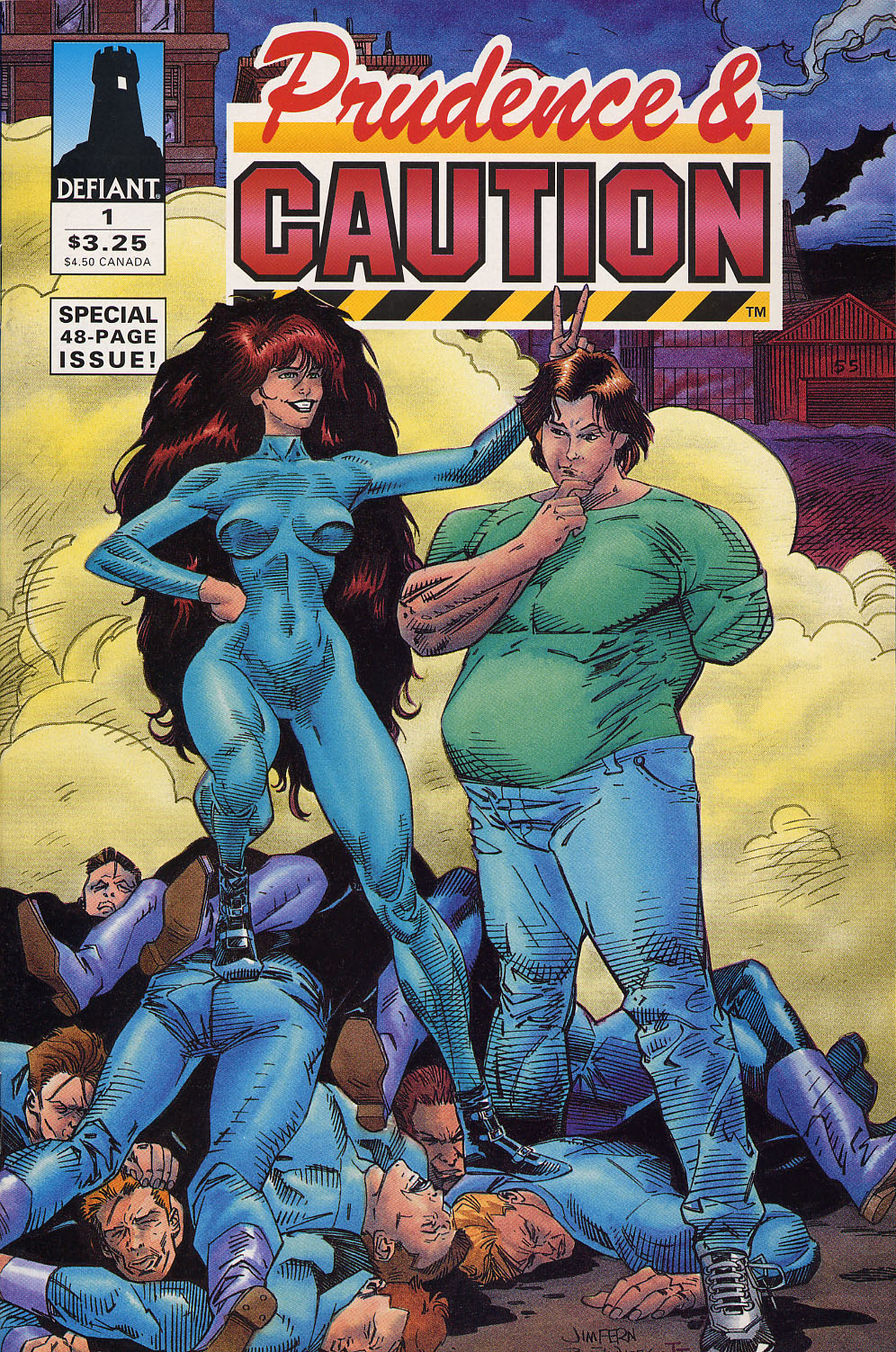


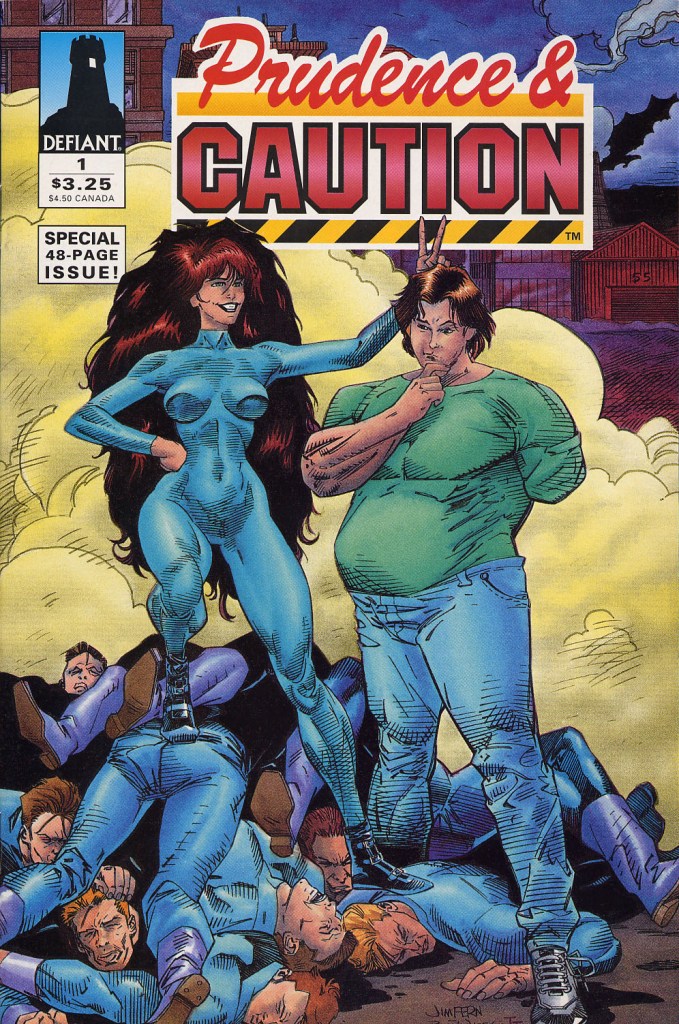
The final series that got launched under the DEFIANT comics banner was PRUDENCE & CAUTION. Like the previous DOGS OF WAR, this title was also a direct spin-off of the company’s core WARRIORS OF PLASM book. And as I said when talking about DOGS OF WAR, there doesn’t seem to have been any indication that the market was interested in more PLASM-based material. But clearly DEFIANT’s Editor in Chief Jim Shooter believed in the concept and was attempting to position it at the very center of the line. Unfortunately, the book was launched right before DEFIANT ran out of money and had to close down, meaning that only two issues were ever released and the ongoing series plots were never resolved.
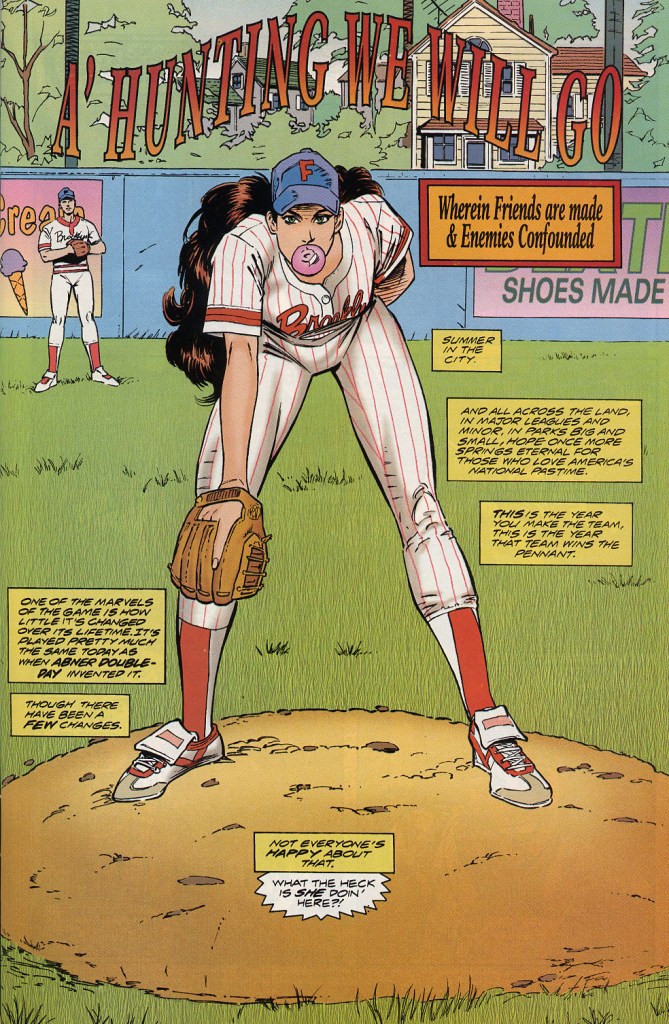
The writer of PRUDENCE & CAUTION was Chris Claremont of X-MEN fame. Having been ousted from the title that he’d made a top-seller for more than a decade, Chris spent some time drifting around the industry looking for something else to sink his teeth into. He had a long-standing relationship with Jim Shooter, and despite the fact that they wound up sometimes on the opposite ends of a particular argument, there was a healthy dose of mutual respect between the two. Shooter apparently invited Chris to contribute to the DEFIANT line and handed him the set-up to the series to develop out from there. Consequently, the book reads a little bit differently than the other DEFIANT titles, though it retains a common connection to them. But you can definitely see Claremont’s stamp on it, starting right from this first page that focuses on a female pitcher at a baseball game.
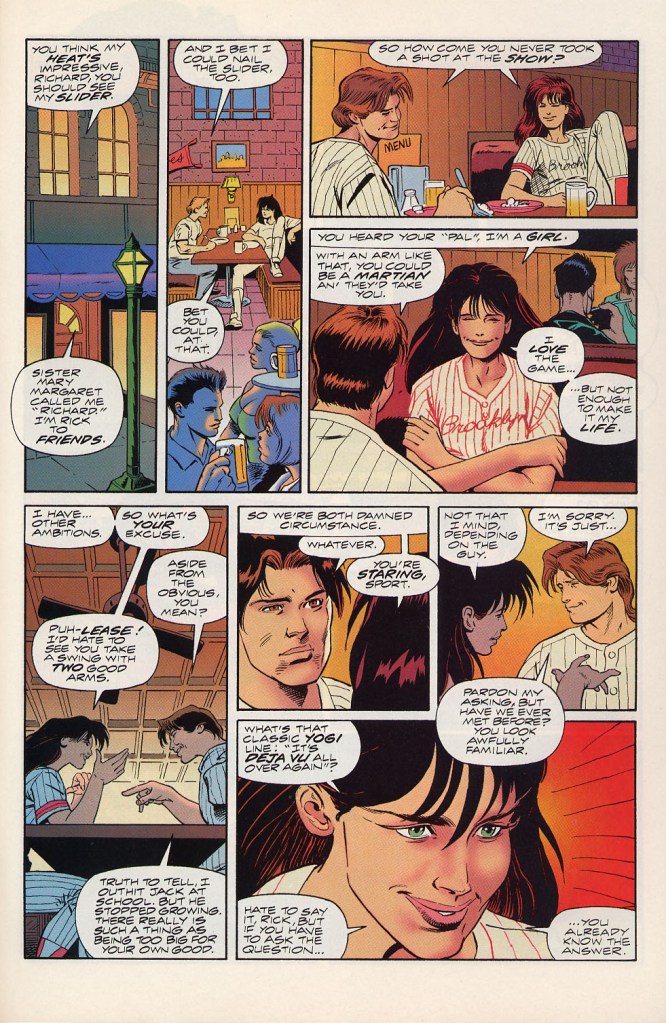
The artwork on PRUDENCE & CAUTION was produced by Jim Fern, Mike Witherby and Keith Wilson. Fern would be active all across the industry throughout the 1990s and 2000s, though he was rarely on one assignment long enough for it to become associated with him. His work here is fine, if a bit linear (as it typically was.) It might have benefitted a bit by having a few more areas of spotted blacks. It also seems pretty clear that Claremont wrote this issue using the Marvel style of Plot-Art-Script, as there are certain sequences where the copy and the visuals are operating at different rhythms. That all said, it’s a bit more polished a presentation than some of DEFIANT’s other efforts, eventually towards the end when they were having to rely more and more on undertested newcomers.
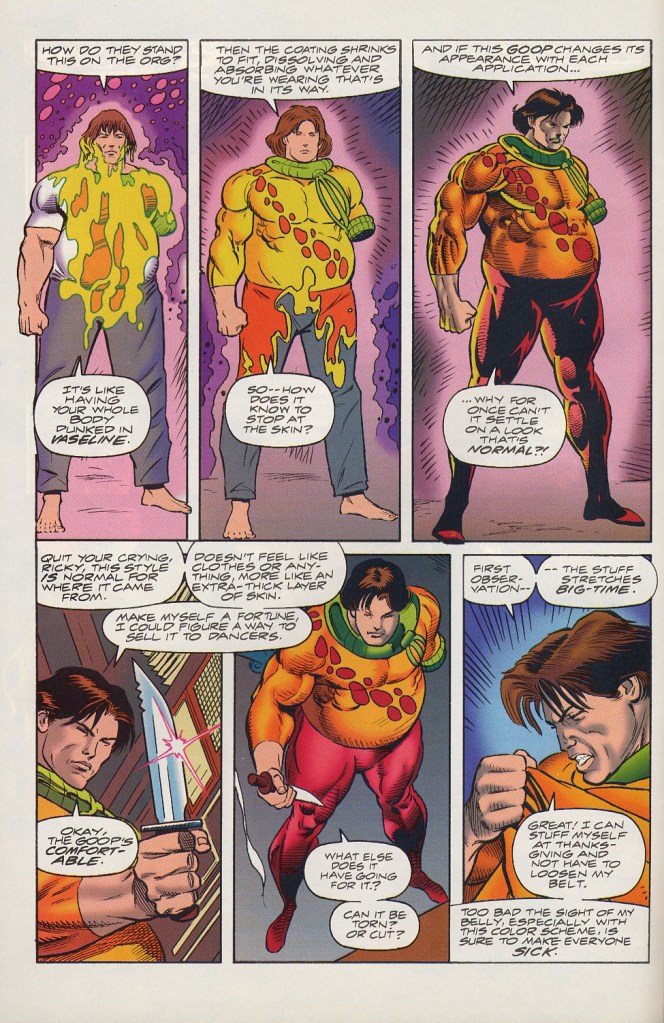
The most established character in PRUDENCE & CAUTION was Rick Teitz, who had been introduced in WARRIORS OF PLASM as Mouse. He was one of the few survivors of a group of ten-thousand random earth people who had been abducted and generically altered in an attempt to produce super-soldiers. He was a quiet one-armed auto mechanic who emerged from his experiences with superhuman strength and durability. In addition to WARRIORS OF PLASM, he had also been used extensively in the opening issues of DOGS OF WAR, so somebody really liked him. In this title, he was paired with Prudence, an entity who had been held captive on the Org of Plasm for many years, due to how dangerous she was supposed to be. This backstory was established in the WARRIORS OF PLASM series and is entirely absent from this debut issue, making Pru’s own superior strength, speed and durability, to say nothing of her unfamiliarity with certain ordinary part of human culture a bit mystifying. For all that Jim Shooter had been an absolute fiend for clarity in the past, at DEFIANT he was a lot more loosey-goosey about making sure the fundamental information about all of his cast members was reiterated every issue.
The intention with PRUDENCE & CAUTION, it seems, was to create a sort of odd couple buddy book in the manner of Valiant’s earlier ARCHER & ARMSTRONG. But this first issue is something of a strange read, relying as it does on the reader having a working understanding of the backstory of its two principle players. It opens up on the aforementioned baseball game in which Rick is playing. Since returning from Plasm, he’s been trying to get back to living a mundane, ordinary existence. Prudence is there, too, pitching, and she winds up getting into a kerfluffle with a local celebrity who is now a sought-after major league player. Pru of course strikes him out, much to everyone’s surprise. She seems to have a particular interest in Rick, and so after the game the two retire to a local watering hole to get to know one another. But as the evening continues, Pru makes it clear that she’s not looking for any sort of a relationship with Rick and he goes home despondent.
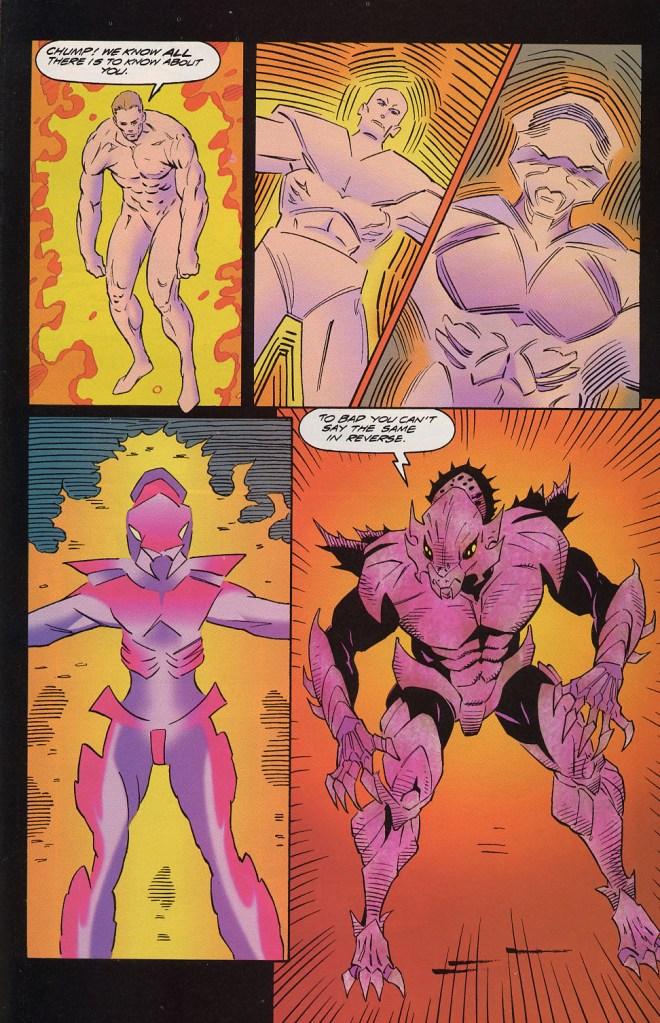
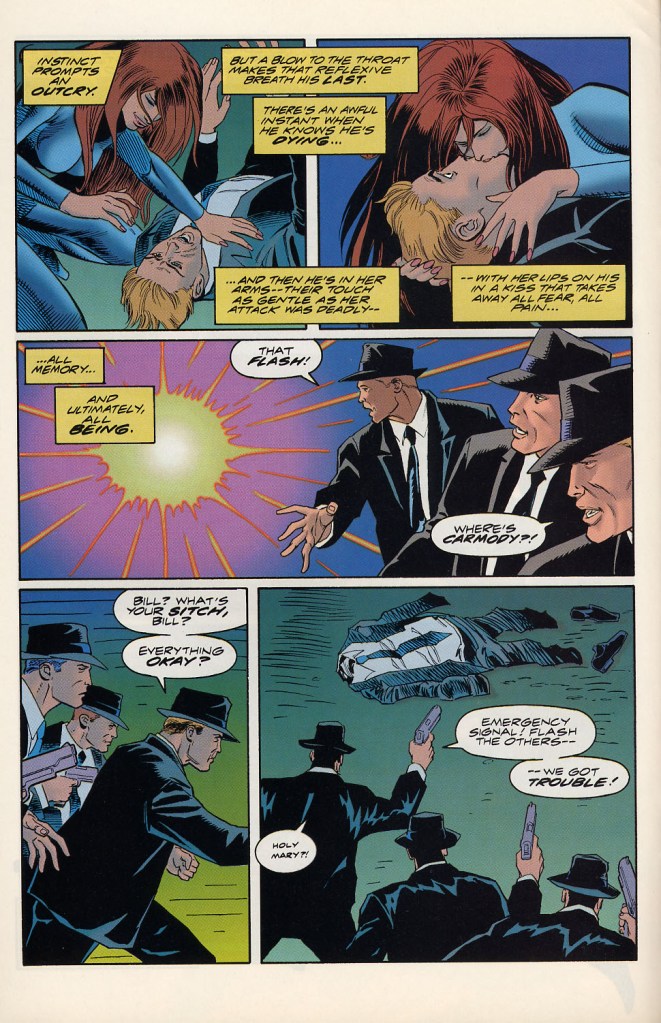
Back home, Rick checks in with Mrs Johnson from the WARRIORS OF PLASM series in a scene that’s clearly intended to get across some of the history of the character. But Claremont scripts it about other matters entirely. From there, Rick heads out to his garage where he continues to experiment with the goopy liquid outfit he brought back from Org. Unbeknownst to Rick, he’s being stalked by a team of government operatives assigned to spirit Rick away for unknown reasons. But unfortunately for them, Prudence is keeping an eye on Rick’s place, and she intercedes, beating the hell out of most of them, including disintegrating one of them with a touch. But a couple of them do make their way into Rick’s garage, where they’ve used nerve gas to put him under. Rick’s constitution is better than expected, though, and he waked up in time to engage in an action sequence with his attackers as well. During the fight, the lead attacker transforms into a monstrous entity, and kicks the stuffing out of Rick. But before the beastling can do any worse, Prudence shows up, and the scene cuts away from the fight.
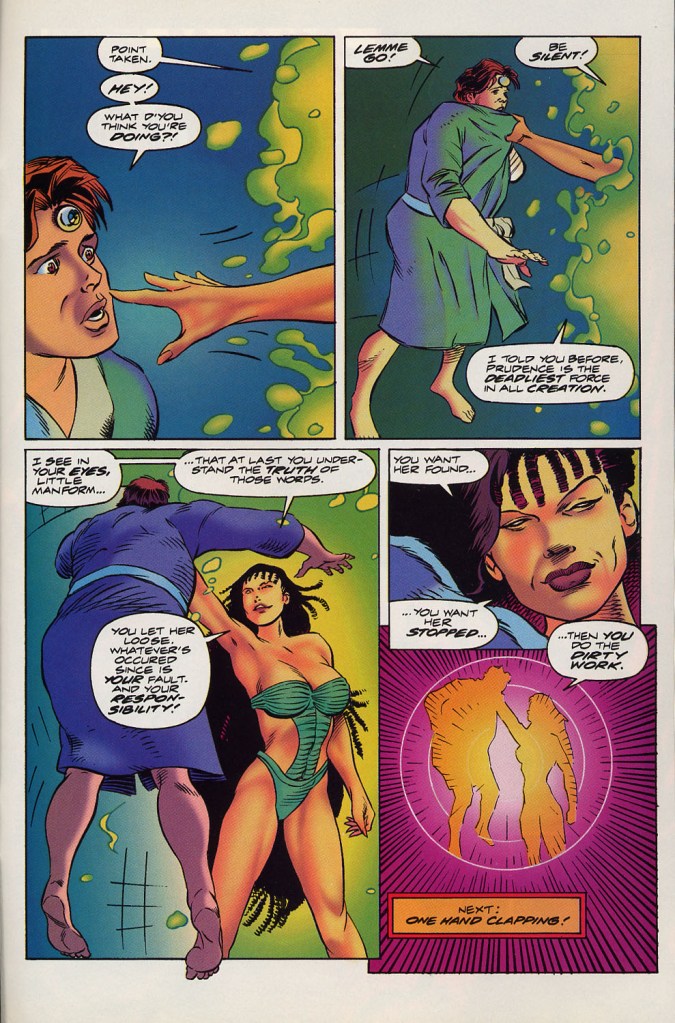
The next morning, Rick wakes up in bed with no recollection as to how he got there. The implication is that Prudence polished off that last attacker then put him there, having wiped his memory. Sadly, she didn’t think to blank out the telepathic eyepieces that Rick uses to communicate with Plasm, so he’s back up to speed a short time later. He contacts Sueraceen, the High Gore Lord of Plasm to report that he’s located Prudence, who is considered the most dangerous being in the universe. Sueraceen holds Rick responsible for Prudence’s escape from Plasm in an earlier story that isn’t even slightly recapped, and she tells him that it’s down to him to locate her and bring her back. And that’s where this issue ends. Honestly, the story is almost incomprehensible without the wider context, and even there it doesn’t do a good job of defining its parameters with the new elements. I’d still not sure whether we’re meant to understand who the attackers are working for or not. It feels as though maybe, with financial ruin impending, Shooter and his crew’s attention was slipping further and further away from the ball, understandably. Still, this feels like the sort of issue that Shooter himself would have torn apart in better days.


from the stuff you’ve posted about the defiant line this book seems to have diverged the most from shooter’s prime directives of comic book storytelling. the every issue is someone’s first seems to have gone by the wayside in addition to page/panel composition and shot size preferences/requirements.
its possible he loosened the reins a bit or was fighting battles on other fronts at the time, or maybe its just the evolution of approach i’ve never read any of these books just going by what i’ve seen here.
LikeLiked by 1 person
Well, that was…disappointing? Underwhelming? Something between okay and painful? Putting aside decent if not exciting art, what strikes me most about “Prudence & Caution” is just how far the mighty had fallen. A decade prior to the 1994 release of this comic book, both Jim Shooter and Chris Claremont had achieved remarkable stature in comics. The former for what he’d accomplished as Editor-In-Chief at Marvel and the latter for what seemed a Midas touch with whatever comic had a mutant gene associated with it.
Yet it seems those talents that took them to those lofty heights largely seem to have evaporated. Tom provides clear examples of editorial shortcomings that Shooter would have once pounced upon suddenly being acceptable. Then there’s Claremont who writing seems a caricature of his past work.
Chris Claremont’s efforts are the saddest part for me. As I shared in last week’s discussion of “God Loves, Man Kills,” there was a time when my world literally revolved around the X-Men with his writing a key piece of that. While the bloom had fallen from that particular rose by the end of decade, to see him simply regurgitating those now tired cliches of his writing were truly sad. As Tom reported, Claremont had not been swamped with work since leaving Marvel. One would have hoped he’d have taken this opportunity to show them and the buying public that his writing indeed still had much to offer. Unfortunately, his work here demonstrates why the doors didn’t swing as open for him as I’d have thought when he was ousted from the X-Men.
LikeLiked by 1 person
Something I’ve noticed about Chris Claremont is that he often does his best work when paired with A) a strong & imaginative penciler, someone who he can bounce ideas off of, if not outright co-plot with (i.e. Dave Cockrum, John Byrne, Paul Smith, John Romita Jr., Jim Lee and so forth) and B) an editor who manages to maintain the delicate balance of being sympathetic to his work while also checking some of his worst plot & character impulses. Claremont has neither here. Jim Fern is, well, fine as an artist, but I imagine he was just drawing the plot as written. And as Tom has observed in these various blog posts, Jim Shooter at this point was for one reason or another very much off his game and was therefore not serving as a balance to prevent the worst Claremontisms from occurring. So, what we end up with here seems like something of a mess, unfortunately.
I feel like one of the rare times after 1991 when Claremont was totally back on his A-game was X-Men Forever circa 2009. And that’s when you had the magic combo again, namely a great, highly talented penciler (Tom Grummett) and an editor who was sympathetic while providing a steady hand (Mark Paniccia).
LikeLiked by 1 person
You make an excellent observation regarding Chris Claremont’s writing. His work is stronger when aligned with that higher calibre of artist. I’m also pleased to know that he found redemption with X-Men Forever. I confess that I’d given up on his work after a few of his issues with Uncanny and Extreme in the early 00’s. It seemed so cliched by that point. I also like Tom Grummett’s art – loved his work on Superboy with Karl Kessel! – sounds like I need to check that out. Thanks!
LikeLiked by 1 person
I agree Claremont does his best with a strong collaborator.
LikeLiked by 2 people
I remember buying and reading both Warriors of Plasm and Archer & Armstrong, but not this title. I had probably already given up on the Defiant line before this came out and just ignored it. From what little I see here I’m glad I did.
LikeLike
I read these two issues recently — and when I say recently, I mean maybe within the last two years or so — at a time when I was wishing for more Claremont in my diet.
I was lost as to the overall cosmology of this stuff — I knew it a little, but I sure could have used a refresher. And I just don’t like the Plasm visual design sensibility, it’s like someone trying to do Ditko who’s not really in any kind of synch with Ditko.
But I enjoyed the Claremontian pace and feel of it, and would have been willing to read more, if there was any. And I liked the logo. I didn’t much like the lettering, but after so many years of Orzechowski, Claremont narrative and dialogue without crisp, sharp lettering is just missing something.
LikeLike
Can’t say I found any of this interesting. “Brand Echh” is starting to live up to its title. Wasn’t it initially “Not Brand Echh”, and would feature good stuff by Marvel’s competitors?
But I will say this is far from Jim Fern’s best work. He did a vampire book for DC with “Buffy the Vampire” vibes. It looked better than “Prudence and Caution”, but the writing on it couldn’t keep me interested.
Jim did draw a few other stories that made me keep looking for where he’d show up next. A couple of Batman stories, but Batman’s ears kept subsequently getting ridiculously longer with each job. Otherwise I liked his dark knight and “boy wonder”.
And one or two Superman stories. His square jaws and big shoulders looked appropriate on the man of steel. I don’t know if Jim was ever paired with the right inker. That may have included an accomplished vet like Joe Rubinstein, but my memory might be failing. I could see those two as a worthwhile combination, though. I’d’ve like to have seen someone who might’ve used a bit more ink, like Brett Breeding, embellish Jim’s drawings. At least with a bit more light and shadow.
Jim could draw very fine figures and faces. Better than what’s here, which is a bit loose and generic, even if the figures are balanced and some raw fundamentals are there. The inks are too much in a few spots, the “fish hooks” that Scott Williams infected the industry with, but few could apply them as well as Scott could. Scott could also be smooth and polished. Mostly the inks here are too sparse. Maybe Jim just didn’t put in enough, so the inks didn’t have as much to “finish”.
LikeLiked by 2 people
That coloring did him no favors.
LikeLiked by 1 person
Agreed. I guess the colouring was attempting to add depth. Jim just left too much open in his figures. “Linear”‘as Tom said.
The worst example is that cover. The lady’s contour is OK. It’s obvious Jim can draw a figure convincingly. But all those interior lines are terrible.
It looks unfinished. The inker didn’t have much else to work with, so they just did what we see here. The inking reminds me of tge sound of static on old TV sets. She looks fake. I’ve seen far better from Jim on other books.
I’d’ve liked to have seen Jim draw Peter Parker and Spidey. Maybe he did. I can’t remember. I just think his style would’ve been a good fit for Peter &:Mary Jane.
LikeLiked by 3 people
Tim, I checked on the GCD and Jim Fern did draw an issue of Spectacular Spider-Man, where he was inked by (ugh) Vince Colletta.
LikeLike
That opening conversation between the two leads is fun. But judging from your presentation, the rest of the issue is indeed a mess.
As for Shooter and Claremont, it’s hard for any creator to keep bringing their A game over a long career. Perhaps tougher in comics where they have to turn out such a huge quantity of material.
LikeLiked by 1 person