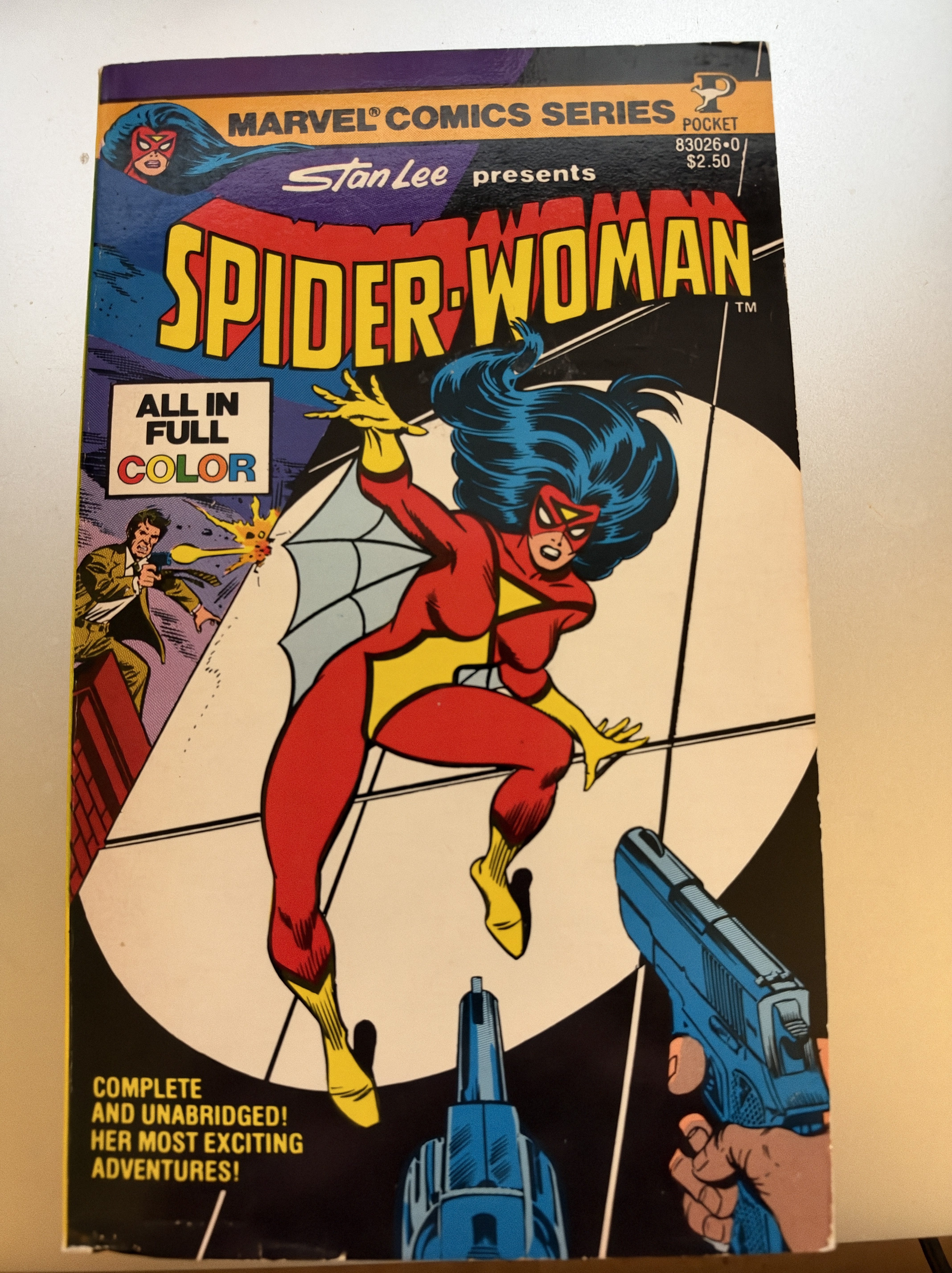


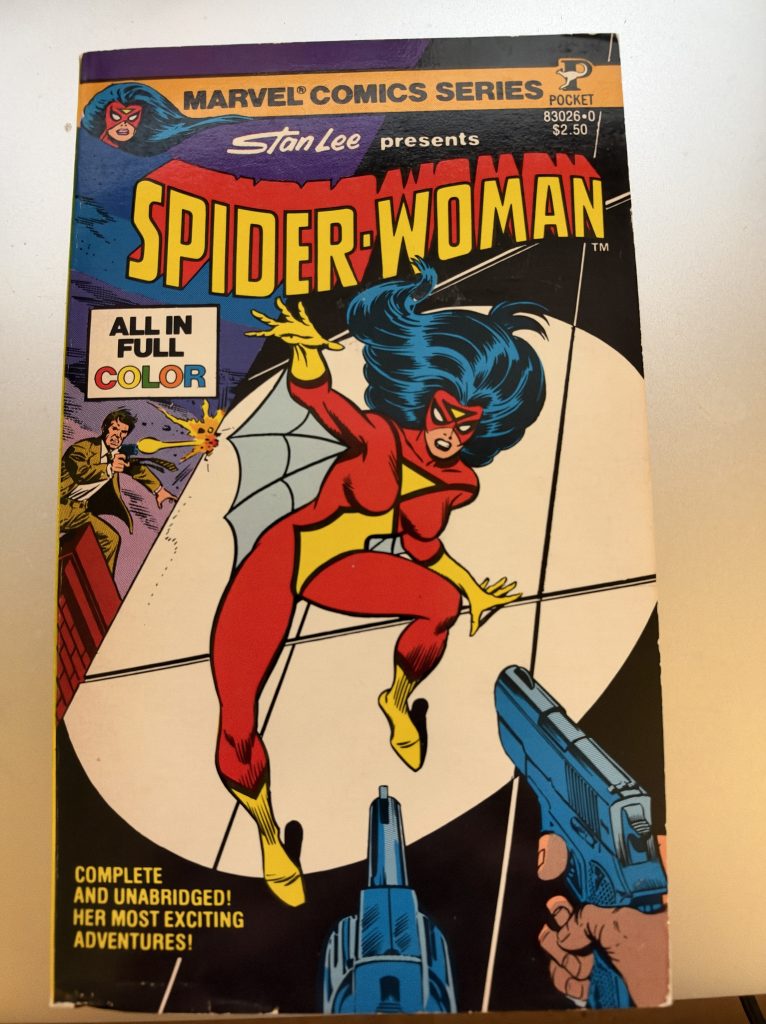
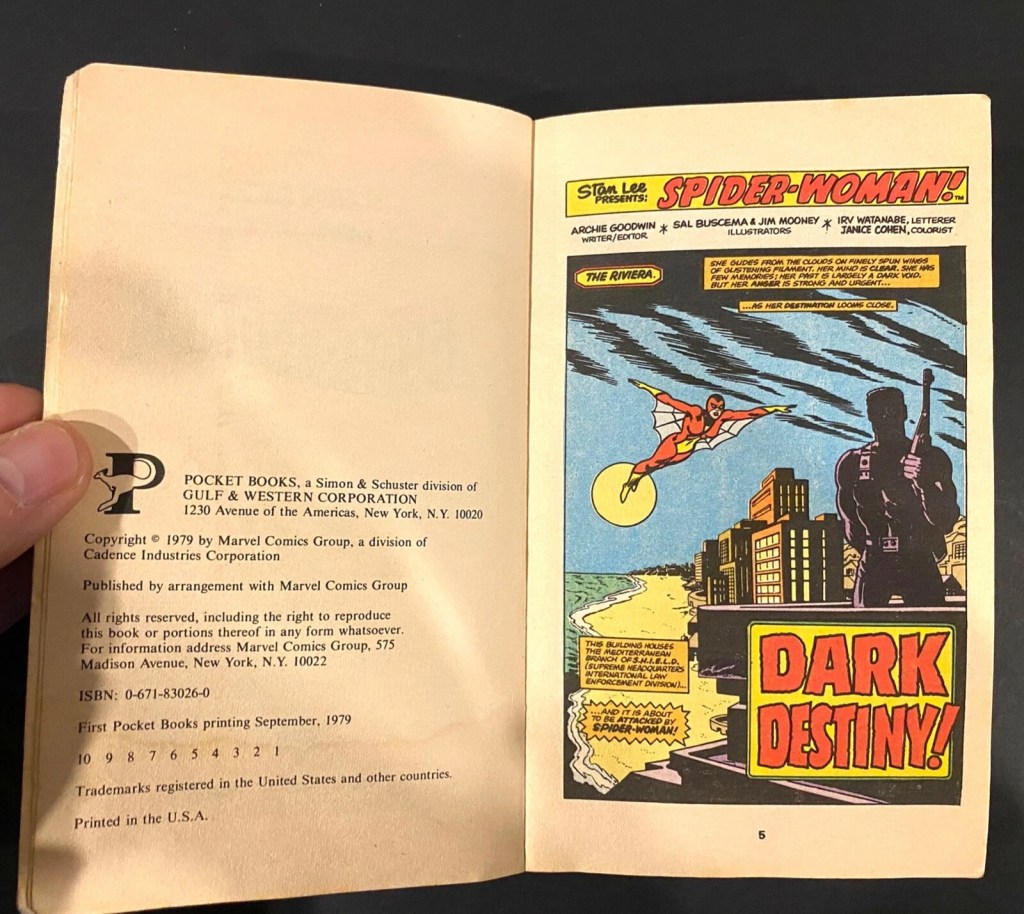
In the late 1970s, there likely wasn’t a format for comic books that I loved more than the Pocket Books series of early Marvel reprints. Getting chronological collections of the earliest Marvel stories was a godsend to me, something that I never quite thought I’d get to experience, and so I pursued them avidly. But that said, I was also a young boy, and as prone to being concerned about not coming off as weak or wimpy or girlish, as that was social suicide, or at least the prevailing wisdom of the recess yards of the time would have you believe. So I was always a little bit skittish about buying comics that featured female leads in those early days. They seemed to be to have bene made with girls in mind, and so weren’t respectable for a red-blooded kid like myself to be seen with. The irony, of course, is that I would have been besmirched past a certain age upon being seen with any comic book–but these are the weights that our psyches carry. Point being, while I had read one issue of SPIDER-WOMAN that I’d gotten in a 3-Bag, the character held little appeal for me. I don’t think I ever saw this Pocket Books collection on sale anywhere, which helps to explain why I didn’t buy it–but I likely would have thought twice in any case. However, it turned out that my buddy David Steckel did come across it and pick it up–and so I wound up borrowing it from him at some point.
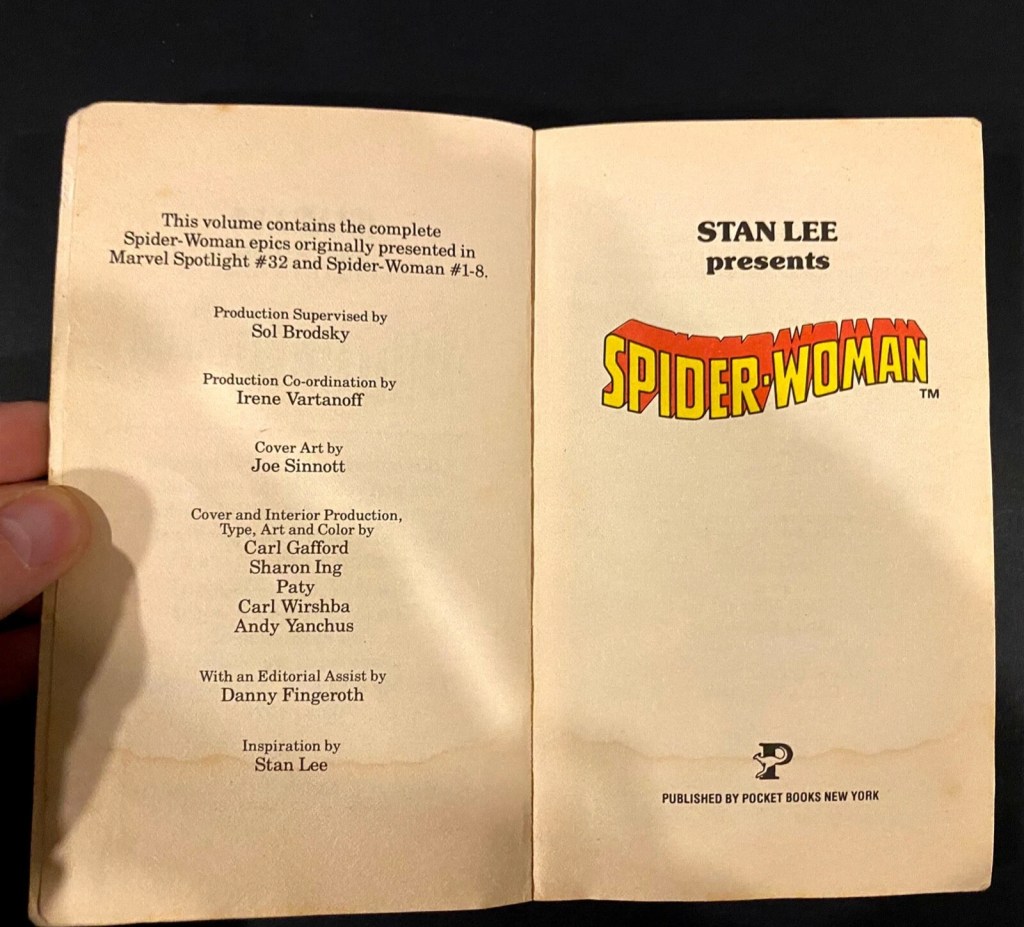
SPIDER-WOMAN was a bit of an accidental success on the part of Marvel. The character came about in response to a potential legal challenge: at a certain point, Marvel heard through the grapevine that animation studio Filmation was developing a block of super hero programming, and that one of the characters intended to be included in it was to be called Spider Woman. Seeing a threat to the company’s Spider-Man trademark, and another outfit trading upon the popularity of that property, Marvel simultaneously filed a legal injunction and set about rushing out a hastily-devised Spider-Woman of its own, in order to secure the trademark. This Spider-Woman was created in a one-off story written by Archie Goodwin and illustrated by Sal Buscema and it appeared in MARVEL SPOTLIGHT #32. In it, the titular character learns by the end of the adventure that she isn’t human at all, but rather an actual spider hyper-evolved into personhood by the High Evolutionary. It was intended as a throwaway story, and it did what it was designed to do–protect Marvel’s rights. (Filmation’s character was renamed Web Woman and appeared as part of the TARZAN AND THE SUPER 7 series.)
But an interesting and not-entirely-unexpected thing happened: that issue of MARVEL SPOTLIGHT sold gangbusters. Whether it was fan interest or speculators taking a position on what looked to be a spin-off of the popular web-slinger, it didn’t matter; Spider-Woman was a hit! So now, the challenge became to bring the character back and to rework her into something that could sustain an ongoing series; nobody felt that a spider turned into a woman would be a compelling lead character. (Funnily enough, the initial Spider-Woman story was close enough to the original origin that had been considered for Wolverine of the X-Men–that he was likewise a hyper-evolved actual wolverine–that the idea was discarded, thus changing the course of comic book history.) The task of revitalizing Spider-Woman fell to writer Marv Wolfman, who promptly began to feature her in several issues of MARVEL TWO-IN-ONE, a title that he’d been writing, to both capitalize on the audience interest and to prime the pump for her transformation.
Upon launching Spider-Woman in her own series, Marv was joined by artist Carmine Infantino, who had previously been DC’s top executive before being ousted in a reorganization Carmine was forced to go back to being a freelance artist, but his kinetic, angular style was a bit out of step with what the marketplace was looking for at the time. Carmine never had difficulty finding work–there were too many writers and editors who had been fans of his earlier stuff. But he inevitably wound up with assignments that other artists didn’t especially want, and I suspect SPIDER-WOMAN was one of these. Marv and Carmine made some minor adjustments to the character’s costume, primarily letting her hair show through the top of her mask, and adjusted her backstory. Now, she was Jessica Drew, the daughter of an associate of the High Evolutionary’s who was stricken by an illness that was only cured through an injection of spider-blood. This wound up giving her spiderlike powers–similar to Spider-Man’s, but not quite exactly the same. It was clear that both Goodwin and Wolfman took great pains to separate Spider-Woman from the company’s headliner.
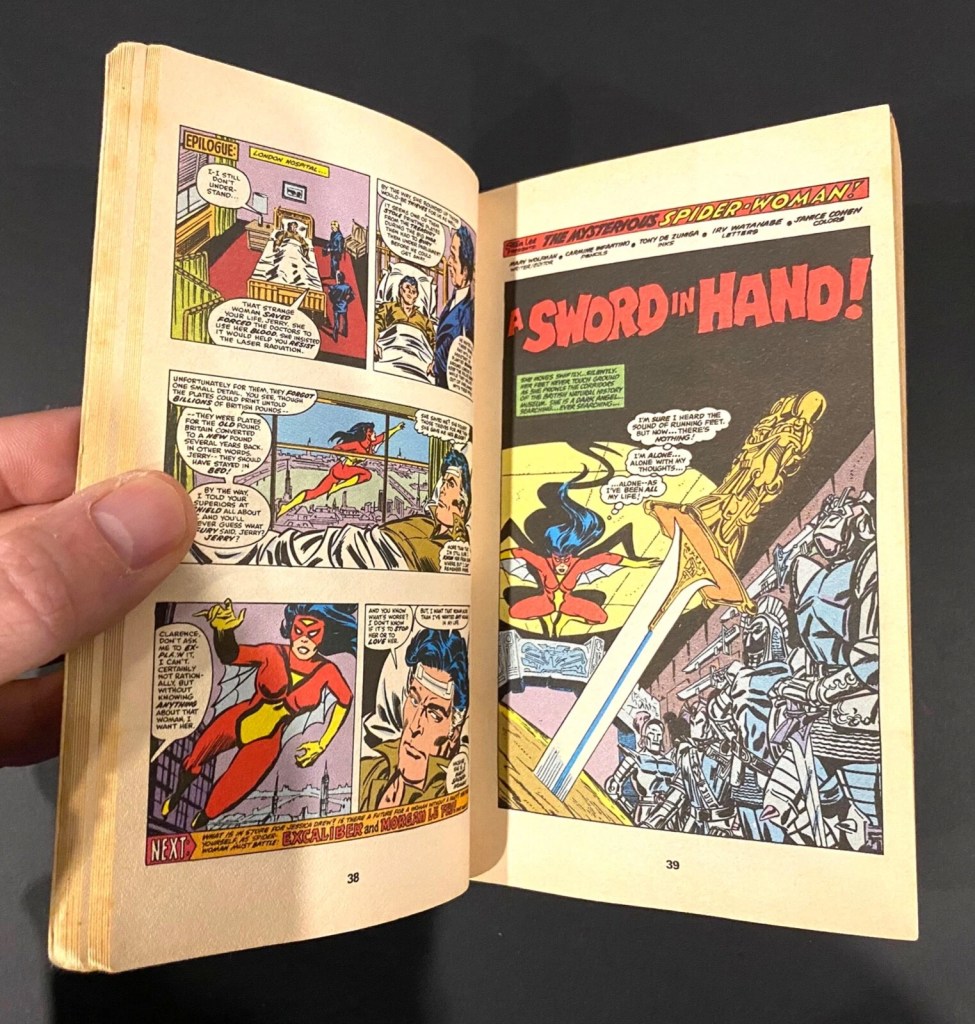
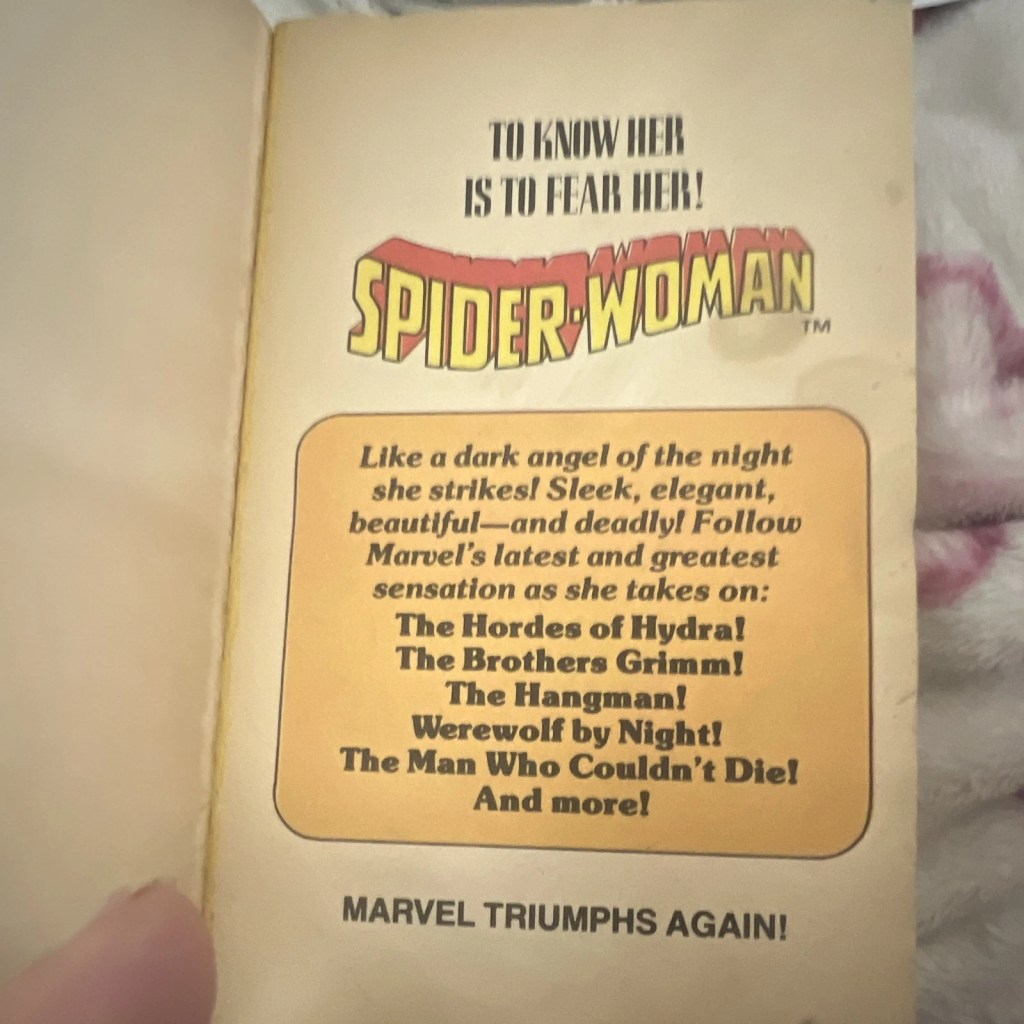
SPIDER-WOMAN was a bit of a weird strip. It leaned more into mysticism and the supernatural than one might expect. There was an attempt to make Jessica Drew something different from Peter Parker, as summed up by the tag line: To Know Her Is To Fear Her. Which sounded good, but wasn’t really true in practice. In these early issues, Marv pitted his new superstar against Morgan Le Fey, the Brothers Grimm, the Hangman (a villain from the WEREWOLF BY NIGHT series) and an immortal man who longed for death. It was all much closer in tone to Marv’s work on TOMB OF DRACULA than the free-wheeling heroics of Spider-Man. Consequently, it never really won me over. I read this volume on loan from Steckel, but didn’t start reading the SPIDER-WOMAN series for several more years, not until Chris Claremont came on to write it and the X-Men guest-starred.
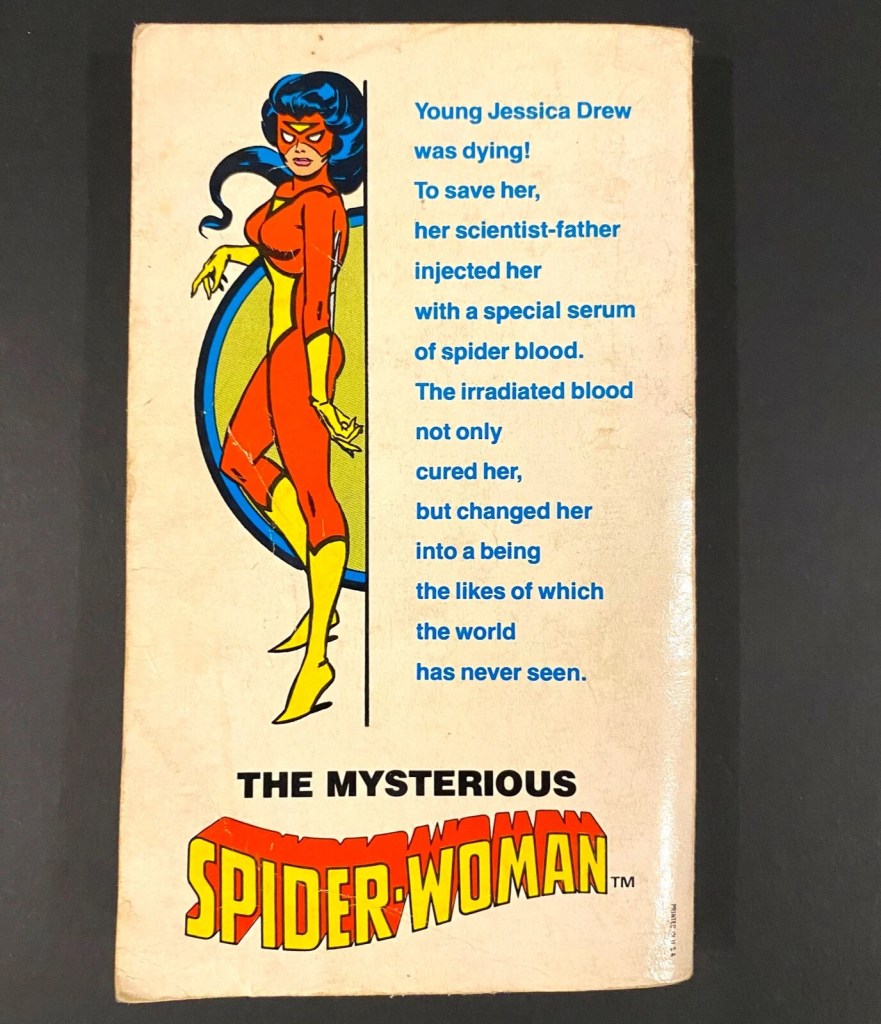
But Spider-Woman became an immediate success even outside of the pages of comic books. By 1979 she was starring in a weekly animated series on Saturday mornings on ABC produced by DePatie-Freleng (who immediately afterwards would be acquired by Marvel’s parent company and transformed into Marvel Comics Animation). The show threw out most of Marv’s set-up for the character. There, Jessica Drew worked as the editor for Justice Magazine (thus taking a bit from Gerry Conway’s set-up for Carol Danvers in MS MARVEL) along with her nephew Billy and photographer Jeff Hunt. Her powers were still chalked up to a serum given to her by her scientist father to save her life. And in at least one episode, Spider-Man guest-starred, his first animated appearance since his 1967 series had ended.


Never seen this style before. All the comic paperbacks I’ve seen from this era have the panels arranged separately on the page.
LikeLike
“he inevitably wound up with assignments that other artists didn’t especially want, and I suspect SPIDER-WOMAN was one of these” Given Infantino has said how much he enjoyed backup strips like Detective Chimp and Elongated Man, that may have suited him fine.
I didn’t know that first issue had been a hit but I really enjoyed the bizarre tone Wolfman brought to the character, and the later oddball approach by Gruenwald. Claremont’s run was … generically Claremont and didn’t fit her at all.
LikeLiked by 1 person
Yep…. and having a bunch of younger fans in the industry that want to work with you doesn’t sound like the worst position to be in.
I can’t say I ever sought out Carmine’s Marvel work on it’s own merits… but he never wrecked my experience when he popped up on a book I regularly bought.
I’m a little confused why a number 1 issue for a new popular character written by Marv Wolfman would be considered a lesser assignment for an artist in the scheme of things.
I know that in any industry there are “plum” and not so plum assignments… but Carmine’s late career doesn’t seem so dissimilar to Sal Buscema’s in terms to being able to reliably feed the machine and also not being in the “hot” artist category. Though I guess other than Spider-woman, Nova, and Star Wars…. Carmine was more or less a fill-in guy.
LikeLike
The Gruenwald/Infantino run on Spider-Woman is a high point for the character.
LikeLiked by 2 people
Spider-Woman originally being an evolved spider( We share a portion of DNA — often cited informally around 63% –due to basic, shared HOUSEKEEPING GENES required for fundamental cellular processes like cell division and metabolism. We also share DNA with unexpected things like bananas ( about 60%-70% ) –is someone planning to evolve a banana into a person? ) is right up there with attaching optic nerves to the sensory cells in the fingers of Philip Reardon( Ten-Eyed Man ) so he can see through his fingertips ( which have no Cornea, pupil, lens, retina, rods and cones to the optic nerves ). I was a 90% collector of Spider-Woman’s series. I liked her original hair covered mask. I liked that she had hand-to-hand combat skills like Ms. Marvel ( Carol Danvers ). Not a fan of Tony DeZuniga’s inks over Carmine Infantino or pretty much any artist I have seen him ink.
LikeLike
I didn’t mind DeZuniga’s inks over Infantino. It sometimes “straightened up” Carmine’s more extreme quirks in his own style. But I agree Tony’s inks would overpower other artists’ styles who’s work I liked, like John Buscema’s. I think my favorite inking by Tony was on John Byrne’s drawings in that classic “Marvel Team-Up” featuring Spidey & Thor, vs. the Living Monolith. Really added a depth and weight to Byrne’s work.
LikeLiked by 1 person
I didn’t mind DeZuniga’s inking on that Marvel Team-Up.
LikeLiked by 1 person
@John Holstein BHOC: MARVEL TEAM-UP #70 – The Tom Brevoort Experience here’s the link to Tom’s article on it. 🙂
LikeLiked by 1 person
I think Marvel Team-up 70 is where I first noticed his inks, and I love the art on that issue. I’m not sure which issue came first, but I liked his inking over Simonson on Thor #269 as well…. a comic I’m very sure I bought just for the art because I wasn’t a regular Thor reader… and I probably didn’t buy it for Stiltman.
LikeLiked by 1 person
I plead considerable ignorance to nearly all of Spider-Woman’s early adventures. I caught one of her appearances in MTIO and surrendered some dimes for the issues where Claremont brought in the X-Men. But I didn’t pay much attention to her because she just didn’t grab me as a character. However, once Jessica Drew showed up in Alias under Bendis and Gaydos’s care – where she seemed far more normal, talking about a costume making her butt big – I suddenly became quite intrigued with her. She became one of my favorites during Bendis’s tenure on the Avengers books. I’ve never picked up any of her books following those issues primarily because I liked who she was in the hands of the Portland guy. For me, it shows how a certain creator or creators can add appeal to virtually any character.
LikeLiked by 2 people
Always thought her comic book series logo/masthead looked really good. Different enough than Spidey’s, but that “bend” is still very cool. Maybe it was harder to pull off for the aminated cartoon TV show, or their designers just wanted their own version. .
Very cool character design. I personally think the loose, long black hair is much more appealing than the “skull cap” mask. I like that she didn’t wear high-heels. Way too impractical, but so many female characters were still drawn wearing them.
If she were new today I’d opt for a black body suit, and maybe with red boots & gloves, with the yellow torso design intact (only black & yellow could invite comparisons to the New Mutants or some of the Wasp’s suits) but who am I? For the late 1970’s her costume was pretty dynamic without being too eccentric or clumsy. And as Rick Moore mentioned, worked well thirty plus years later in Bendis’s Avengers.
I’m guessing the voice over introduction was by the same guy who did the one for “Thundarr the Barbarian”, a few years later. Well done, for both shows. I hope Jess’s Spider-Woman was able to guest on “Spider-Man & his Amazing Friends” in the early 1980’s. I can’t remember if she did. Bit I’d bet “Encyclopedia” John Holstein knows. 😉
LikeLiked by 1 person
Iconic cover by Joe Sinnott, too!
LikeLike
Fun fact: Spider-Man and His Amazing Friends were suppose to be Spider-Man, Iceman and the Human Torch but legal issues about the rights to the Human Torch. I remembered Iceman half-sister Lightwave ( Aurora Dante ( she has same mother as Bobby ) and is an agent of SHIELD –can manipulate and control light, project laser blasts, photonic force fields and solid light pressor beams, transform herself into light ). Unless I missed it no Spider-Woman, but Modred the Mystic, Frankenstein’s Monster, Dracula, Black Knight, Shanna the She-Devil, Dr. Faustus, Thunderbird, Loki, Surtur, Ymir and someone called Ariel ( Spidey Meets the Girl of Tomorrow –she isn’t Sprite who does appear in The X-Men Adventure ) — not that I remember all the characters that appeared, I only remember Lightwave and Hiawatha Smith ( The Quest of the Red Skull — I remember some Nazis mistaking a Native American symbol for the Swastika ) –wikipedia.
LikeLiked by 2 people
The Cartoon Spider-Woman has powers that the comic book version doesn’t: a clairvoyant “spider-sense”( remote viewing ), weblines from her palms or finger, Wonder Woman Twirl to change into costume ( Timely’s Miss America did that once ), flight ( instead of gliding on air currents ), spider-telepathy ( mentally communicate with spiders and ask them for assistance ) and protective “spider-bubble” allowing her to function underwater without diving gear.
LikeLiked by 1 person
I only watched one episode of Spider-Woman’s cartoon. It had the Kingpin with his girth emphasized by his chomping on something in every scene. That was enough to scare me back to the security of the Superfriends! I can also state with 100% certainty that the lovely and talented Ms. Drew did not appear on Spider-Man and his Amazing Friends. That was the first animated show to break me out of my Hanna-Barbera bubble back in those Saturday mornings in college.
LikeLiked by 1 person
Thanks, John! 😉
LikeLike
It is a little weird that her TV show intro shows her flying, and then swinging on a webline. I mean, why bother with the webline if you can fly (glide, whatever)?
LikeLiked by 1 person
I suspect those same legal issues were the ones that forced Herbie upon us in September 1978 when that less than delightful robot took the Human Torch’s place on Marvel’s Fab Four cartoon. If IRRC, Johnny Storm’s rights were tied up with Universal for a potential movie deal that never happened.
LikeLiked by 1 person
And that’s definitely the same voice over actor who did Thundarr’s theme. I don’t know his name, but if IRRC, he did a lot of commercial work around that time.
LikeLiked by 1 person
Was it his voice on this intro, too? Spidey’s Amazing Friends? Not to be confused with Spidey’s other amazing Frenz, Ron. 😉 Who later on drew Superman, as a real super Frenz… Spider-Man and His Amazing Friends (1981) Intro
LikeLiked by 1 person
“2000 years later, the Earth is reborn…” Thundarr The Barbarian Intro
LikeLiked by 1 person
Yep. That was indeed the same voice for that delightful show from the fall of 1981. Dude was getting around.
LikeLiked by 1 person
Mark Evanier wrote once that there were two kinds of cartoon voices in that era: people like Mel Blanc who could do 5700 different voices and people with a single great voice. I’m guessing the narrator was the latter.
LikeLiked by 1 person
As a 70s buff I really enjoy Infantino ‘s Spiderwoman. I like the way her hair whips out. Striking villains as well. Fantastic costume. Jessica rules!
LikeLiked by 2 people
I think Carmine wound up on SPIDER-WOMAN (and NOVA), not so much because no one else wanted them, but because Marv was a big fan of Carmine’s and like working with him. He also worked with Carmine on DIAL H FOR HERO at DC, an assignment I don’t think Carmine was right for, but I bet Marv enjoyed it.
Anyway, I liked that Marv set out to create a rogues’ gallery for S-W of new and striking foes, and liked that Mark Gruenwald continued that approach with his own flair.
I thought Dezuniga was likely chosen to give the book a moody illustrative look, in keeping with the character being a mystery even to herself, and the stories being fairly dark. But I liked Al Gordon’s inks on the Gruenwald run even more, since they leaned in to Carmine’s design sensibility with strong, hard-edged lines.
And I, for one, loved the Claremont/Leialoha run, and want it collected in a shmancy deluxe hardcover. Yeah, I know it’s in Masterworks, but it’s broken up over three volumes. Much like I want the Claremont/Davis EXCALIBUR in hardcovers without the presence of unrelated fill-ins, I think it deserves a setting that presents it as worthwhile in its own right and not just as part of a run of stuff. But then, DC’s always been better at Marvel at presenting standout runs in packaging that elevates them.
Maybe someday.
LikeLiked by 2 people
Second that on Leialoha. I mostly got this series in back issues, and very sporadically. I really really didn’t like Infantino’s work on anything – though I later developed an appreciation for his work inked by Murphy Anderson – but I loved Leialoha’s work on this series, and pretty much anywhere else I could find it. [Years later, I was fortunate enough to meet him and get a sketch of Spider-Woman fighting the Hulk (my favorite character and sketchbook subject).]
Kind of a strange series as I recall, but fun.
LikeLike
I loved Al Gordon’s clean, slick, inks, whenever I saw them. I imagine his style looked good over Mark’s drawings. Al wrote and/or co-wrote some LoSH (the “5 years later” series) I wanna say one was “The Quiet Darkness” story (sequel to “The Great Darkness”).
LikeLike
I liked Spider-Woman from the get go but really fell for the character in her own series. Infantino really made that hair of hers pop. There’s a panel where Jessica’s in a bathrobe with a towel wrapped around her head that was burned into my memory the second I saw it. Claremont brought her into the X-Men’s orbit which led to some useful connections later on but was indeed an ill fit. It also led to some fun stuff with Viper, first with her repudiating what Claremont established then Bendis using it to make her loony in a sinister way!
LikeLiked by 1 person
Frank Springer did a couple of issues of Spiderwoman , a shame he didn’t do more. Bendis & Maleev’s SW was hot stuff ( and Moon Knight) followed by Spiderwoman: Origin an enjoyable read .
LikeLiked by 1 person
Sorry, gotta give a quick shout-out to that fantastic Joe Sinnott cover. I had no idea it was him, but it looks amazing.
LikeLiked by 1 person
Very enjoyable is the Wolverine book in the 80s where he goes by the name ‘Patch’ set in Madripoor. Jessica Drew appears prominently as a PI without her powers. Created by Claremont/ John Buscema . JBs Jessica is great. The plots have a Indy Jones/Terry & the Pirates feel. Very enjoyable
LikeLiked by 1 person
I just finished re-reading Essential Wolverine Vol 1 yesterday, reprinting the first 23 issues of the ongoing Wolverine series. Claremont clearly decided that if Marvel was going to give Logan a monthly solo book then it should be about something different than just the usual X-Men business. Those were some fun stories, with nice artwork by John Buscema. Bringing in Jessica Drew for the supporting cast in Madripoor was a good idea, since no one else was using her at the time.
LikeLiked by 1 person