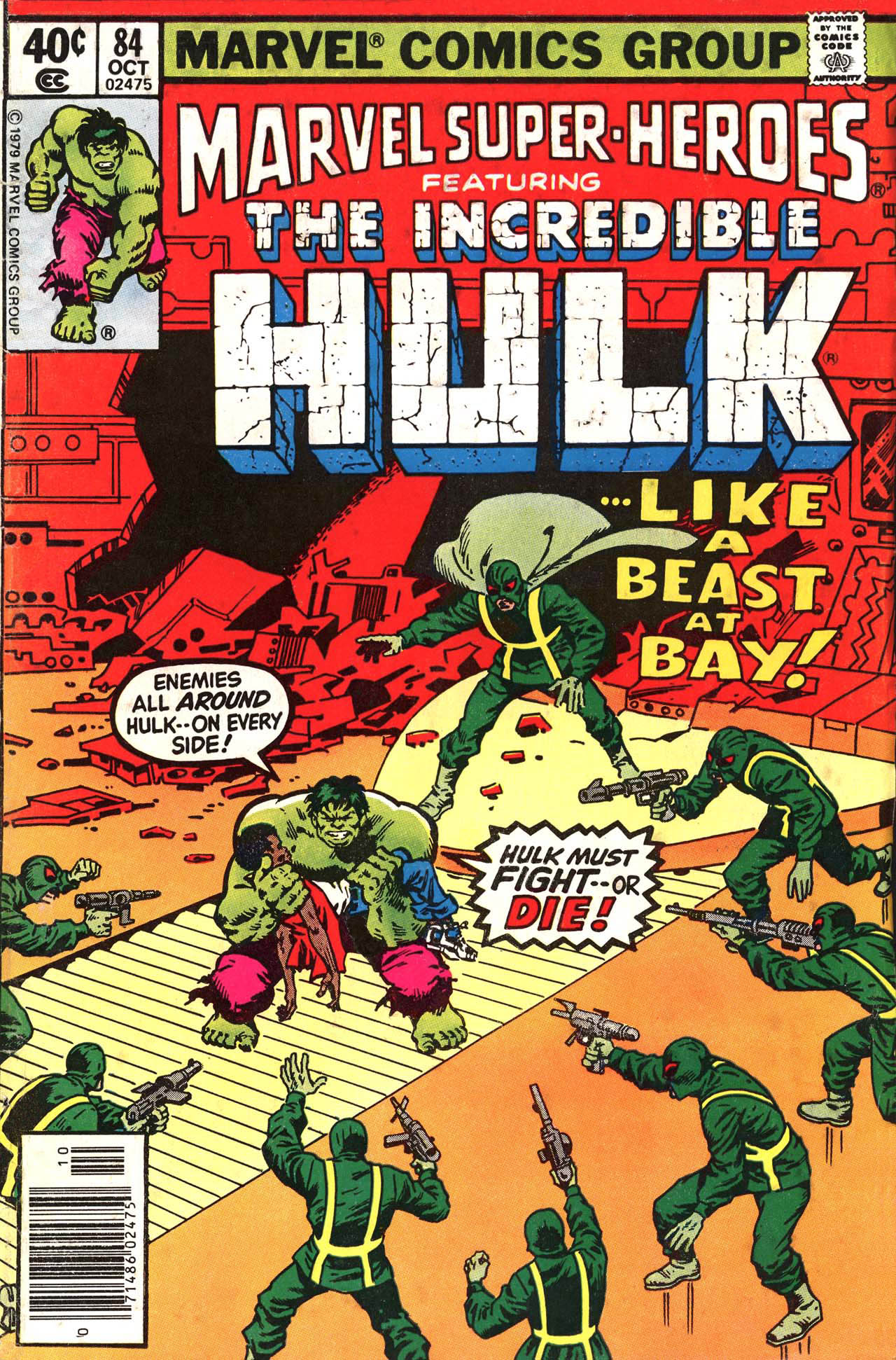


MARVEL SUPER-HEROES continued in reprinting Incredible Hulk stories from a couple short years earlier, but which were old enough that they were still new to me. To be honest, I often enjoyed these older tales more than the new ones appearing in the Jade Giant’s current series–that isn’t surprising, I had a real connection to the comics of the 1960s (though by this point MARVEL SUPER-HEROES was into 1970s reprints.) I continued to purchase the series regularly, and did so all the way up to its eventual demise some years later.
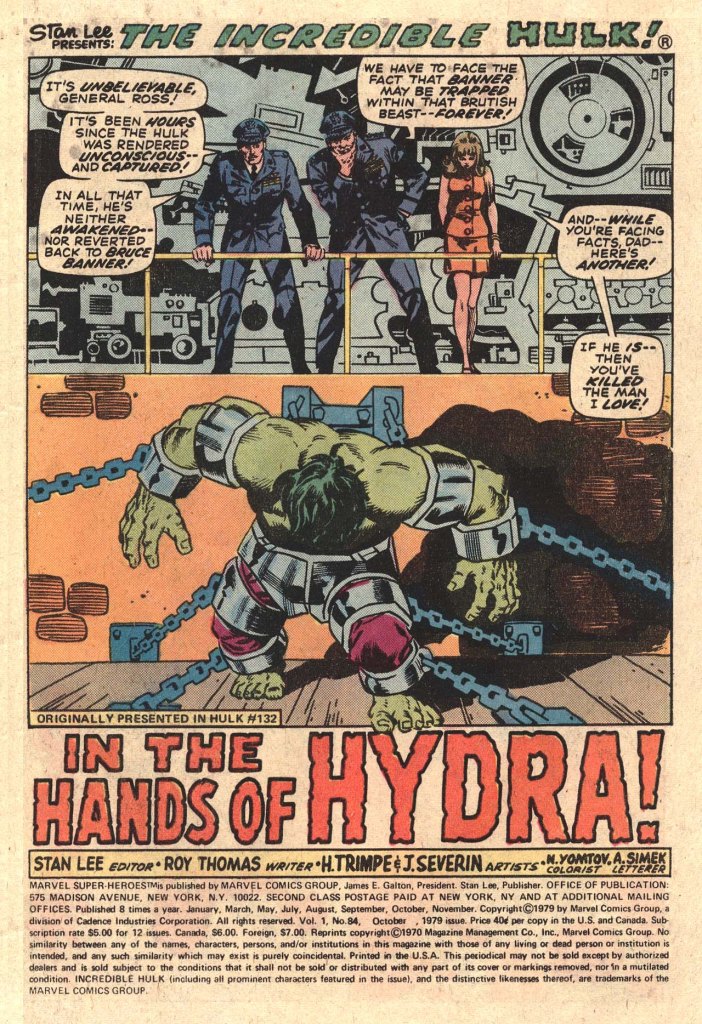
This was a relatively good period for the title back in the day. Writer Roy Thomas felt like he was a bit more invested in crafting a running narrative after a period when individual issues sometimes felt like one-off throwaways. But more crucially, the solid storytelling of Herb Trimpe was being embellished by one of the greats in the field, John Severin. Severin was a “thick sauce” and tended to somewhat overpower the pencilers that he worked over. But that was usually a benefit as he was a skilled craftsman with an expert line. He maintained Trimpe’s strengths but gave the finished work a lot more polish and texture. It was a terrific combination, one that also took the burden off of Severin to work out the layouts and the storytelling himself–I get the impression that he wasn’t a fan of the Marvel method where the artist drew the story from just a brief overall synopsis.
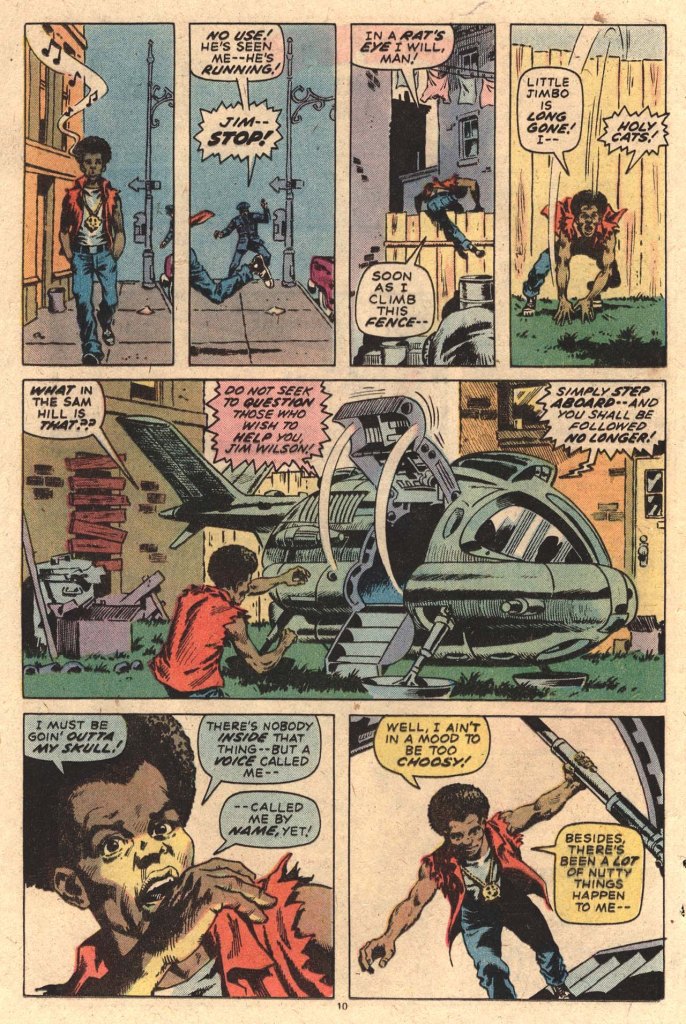
This story was done at a time when the other artists in the Marvel Bullpen were being encouraged to look at the work of Jim Steranko and emulate the manner in which he broke down a page and a sequence. Trimpe was never as imaginative with his layouts, but he did attempt to do just that during this period, as in the case of this page above with its top tier of staccato panels. Roy steered into these efforts, keeping that first panel silent to allow the artwork to tell the story. At a time when many of the Marvel books felt like they were a shade overwritten, this was a welcome development, though it only lasted for so long before attention shifted over to the latest new flavor-of-the-day creator.
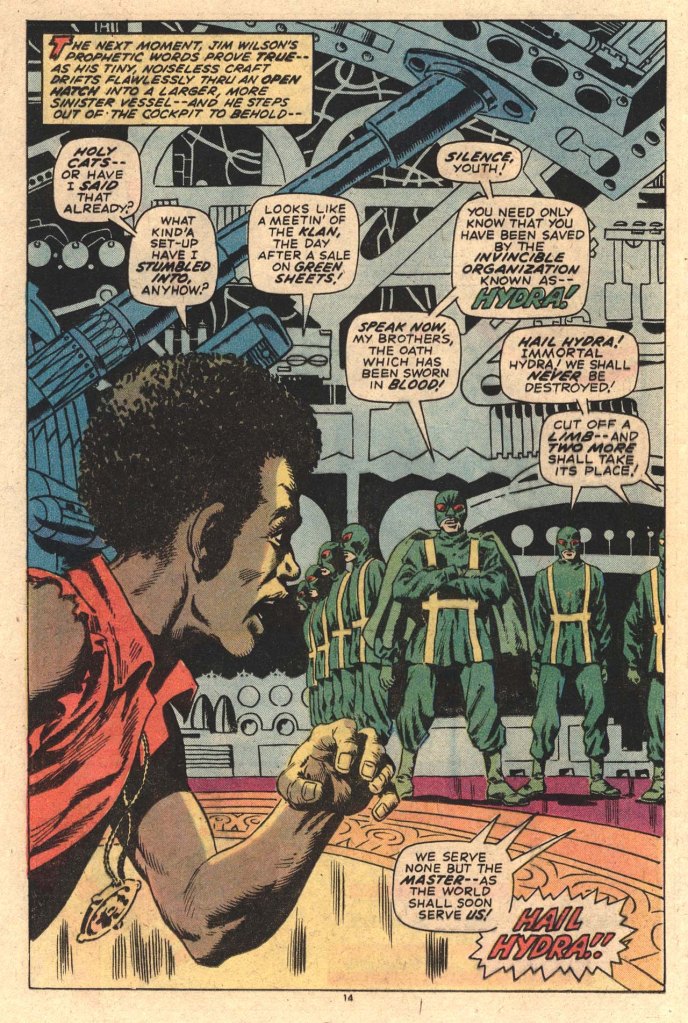
Last time, with the aid of Iron Man and the betrayal of Jim Wilson, the army had succeeded in capturing the Hulk and reuniting him with Bruce Banner, who had been separated from him–though Banner’s persona appears to have been entirely subsumed by his brutish alter ego. As this month’s story opens up, the unified Hulk makes an escape attempt but can’t get himself to freedom before the safeguards the military has put in place strike him down. Young Jim Wilson is feeling like crap about his part in this, even though he knows that it was the only way to save both Banner and the Hulk, and so he cuts out. But T-Bolt Ross correctly reasons that having Jim around might help them to keep the Hulk docile, so he sends major Glenn Talbot out to bring the boy back. A chase breaks out, and in a clutch moment, Jim finds himself being rescued by a flying craft that belongs to the notorious terrorist organization Hydra.
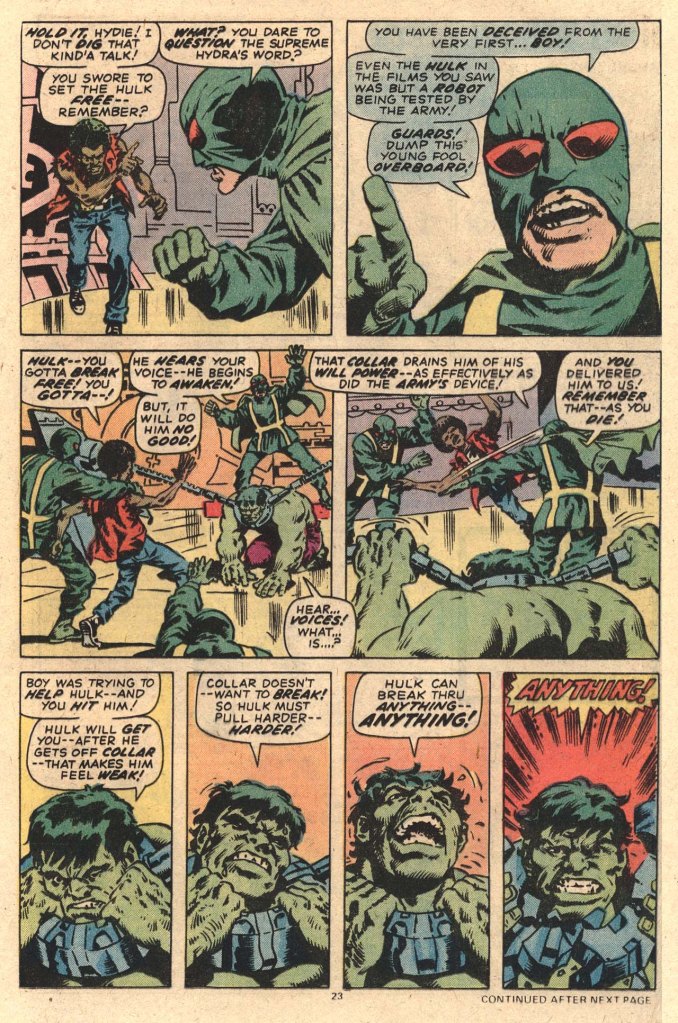
The Supreme Hydra tells Jim that like him, he is sympathetic to the Hulk’s plight, and so he offers Hydra’s resources to help liberate the captive brute. So Jim heads back to the military base, where he bluffs his way into the Hulk’s cell and succeeds in opening up an air vent to the place through which Hydra can draw the Hulk out by magnetic attraction. But of course, Hydra only wants the Hulk so that they can turn him into an obedient slave bent on carrying out their world-dominating efforts. Hearing this, Jim shouts for the Hulk to wake up and break free, and he’s clobbered for his troubles by Hydra goons. But the sight of his friend being struck is all it takes to get the Hulk’s back up, and in another cinematic sequence, he gets angry enough to break the collar that has been restraining him and launch himself at the Hydra troops.
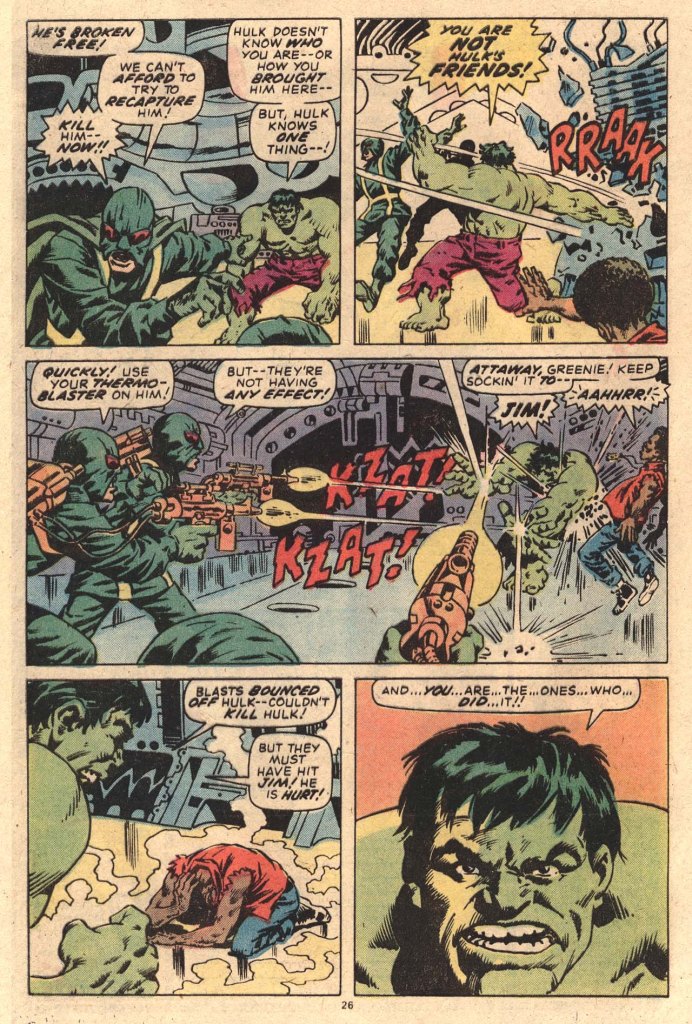
Seeing that the Hulk has broken free, the terrified Hydra men open fire–and while the Hulk himself is bulletproof, one shot ricochets off of the gamma-spawned goliath and strikes Jim. And the Hulk goes absolutely bananas, tearing apart the craft that they’re on with a vengeance. Hydra is in full retreat aboard their own flying base at this point, and to make matters worse for them, a pursuing squadron of fighters has launched from the Air Force base with orders to recapture or shoot down the Hulk. Taking the better part of valor, the Supreme Hydra and his men lit out in an escape craft, leaving the Hulk and Jim to whatever fate is waiting for them.
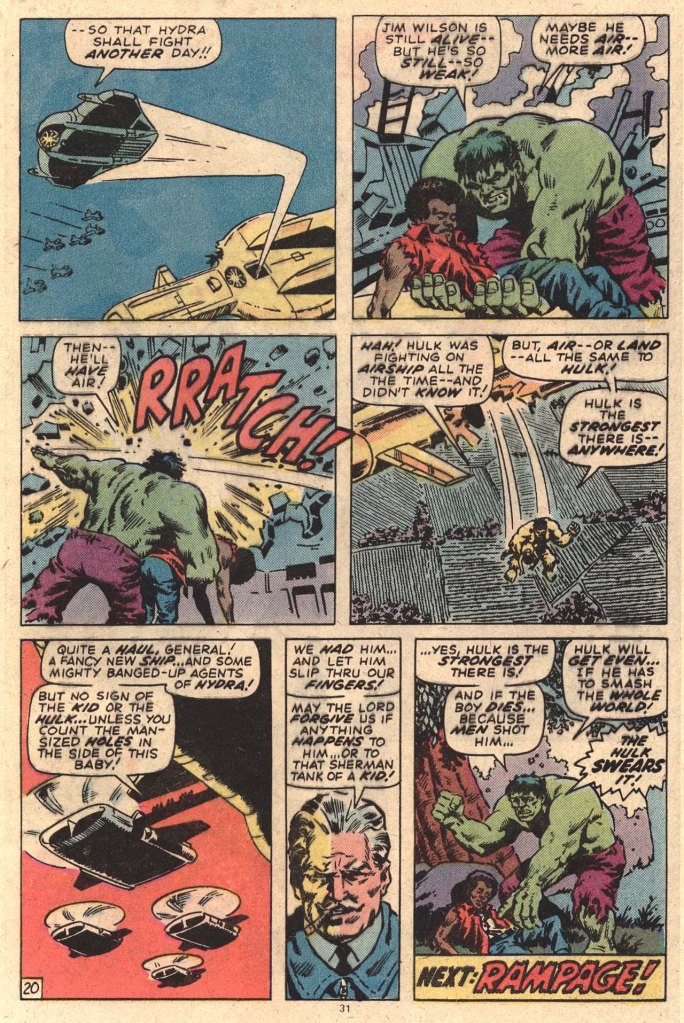
The Hulk, though, has turned his attention back to the stricken Jim, who is still breathing. Recognizing that the boy needs metical attention, the Hulk lifts him up in one arm and smashes his way through the Hydra ship to freedom, launching them both into the countryside below. By the time the military gets there, all they have to show for their efforts is a half-destroyed Hydra ship and a bevy of clobbered Hydra footsoldiers. The Hulk, though, is in the wind–and as the issue closes out, he vows revenge against the human race should his friend Jim perish. To Be Continued! This was typical of the Hulk plots of the era: it wasn’t especially complex or deep, it put a premium on action and demolition, but it had some good inter-personal moments between the Hulk and Jim Wilson and it was an entertaining and undemanding read. It’s easy to see why INCREDIBLE HULK did so well as an impulse purchase by readers who weren’t interested in following every issue but rather wanted some momentary mayhem in their lives.


It is funny how both Rick Jones and Jim Wilson spent more time around the Hulk than the Thing and yet in Fantastic Four#167( February 1976 ) Ben teaming up with the hulk ( starting in FF#166 ) caused him to permanently transform back into a normal human.
LikeLike
I noticed that Hydra’s plans for the Hulk mirrors my suggestion for Jack Kirby’s Discarded Pages for Incredible Hulk#4: When I suggested that Stan could have created the Maggia sooner than Avengers#13 ( February 1965 ) and make Jack Story into a Maggia plot to get their hands on the Hulk using Rick Jones ( Fake basketball players as backup in case Rick doesn’t cooperate ) and brain-washing/mind-controlling the Hulk into their weapon. Justice League of America#8 ( December-January 1961-1962 ) criminal Pete Ricketts finds a mind-control ray that he uses to turn the Justice League into a gang of mind-controlled criminals that he auctions off to the highest bidder. The Red Skull mind-controls 4 of the Original Invaders ( Captain America, Human Torch, Toro and Sub-Mariner ) [ The Invaders#5-6 ( March-May 1976 )-Marvel Premiere#29-30 ( April-June 1976 ) ] for the Nazi cause. The Mask [ Whiz Comics#15-18 ( March-June 13,1941 )used a Brainograph and a Hypno-Chair to brainwash Spy Smasher into serving the Axis as a saboteur ( Which was what the 4 Invaders were doing — that Roy Thomas’ influence for his Invaders-Liberty Legion story? ).
LikeLiked by 1 person
This issue (original and reprint) really is remarkable and a lot of fun. Severin’s “thick sauce” really is so palpable here — probably one of the best examples of Severin over Trimpe in the HULK run. It’s beautiful work though — but we still should appreciate Trimpe’s layouts, for the very reasons you mention. It’s a really well-paced story with lots of variety and cool use of panel sizes and beats. I wish I could read a comic like this produced now in 2026, but I know I shall be disappointed to think so.
You mentioned that “Roy steered into these efforts, keeping that first panel silent to allow the artwork to tell the story.” I wonder if that is true — it could have been a Trimpe choice with Jim whistling to himself.
LikeLiked by 1 person
I wonder about that, too. Steranko was hardly a sales magnet. I can see why other artists might want to try out his effects, but I don’t get why editorial would push for it.
LikeLike
I agree. He was distinctive and somewhat innovative but he’s also a blip in Marvel history that didn’t bring in the sales.
LikeLiked by 1 person
I do love Jim sneering that Hydra is the KKK with green sheets.
One of the things I like about this period is that General Ross comes across as a decent man capable of respecting and sympathizing with Bruce. I didn’t see that much after Roy left the strip.
LikeLiked by 1 person
Despite starting at a dramatic point from last issue and ending on a smaller cliffhanger, the story is pretty well self-contained. I don’t recall seeing the art of Herb Trimpe and John Severin before, and while I think it’s good, I also find it different from most of the other Marvel art I’ve seen from the sixties. One think I noticed was Trimpe used closeups on faces in many panels, especially Jim’s. That, along with the story focusing on young Jim Wilson and not the Hulk, made the story feel quite intimate to me. And only knowing a little about the Hulk, Jim Wilson is completely new to me. He is clearly a character of the times, but I think he’s well written and a complex character in this story. I also liked his Green KKK comment.
LikeLiked by 2 people
Obviously, it’s somewhat before my time, but I did eventually read a few of the Incredible Hulk stories from this era via back issues, including this one, and I agree that the combination of Herb Trimpe & John Severin on artwork was certainly appealing.
LikeLiked by 1 person
I loved Trimpe’s work without reservation but Severin was by far his best inker.
LikeLiked by 1 person
Like Tom with some of the comics he reviews, I encountered several Thomas-Trimpe-Severin Hulks courtesy of a childhood friend. Although often coverless, these were still a fun read. Even as a 7th grader barely into comics, I never really cared for Herb Trimpe’s pencils. But I found them much more palatable with John Severin’s inks over them. Although those coverless wonders didn’t include this issue, I distinctly recall the one with Tom Wolfe at a party where a young woman is transformed into the Valkyrie – not long after her first appearance in the Avengers. Thomas definitely found the right note for this series.
LikeLike
Trimpe was the guy who always drew the Hulk like Tuska was the guy who always drew Ironman when I was kid… it’s just how it was. I generally thought he was a good fit for the character and his general environment. Trimpe looked odd on other books, but on the Hulk I think he was good at doing “big.” Big engines, big machines, big hero, big monster, etc. He seemed into it as far as a reader could tell.
I think as time went on… Herb’s work got more and more “mannered” if you will. His early work on the title (after he stopped working over Marie Severin’s layouts) is less exaggerated and more naturalistic in approach than his later work that I think became more simplified in terms of anatomy and overall detail.
I only encountered Severin as Hulk inker through reprints, but I like the look. When I occasionally bought the Hulk monthly as a kid the inkers were Abel or Staton…. who I also like. I think Staton is also an standout inker on Sal. B.
I have a love/hate for Trimpe’s work on Ironman. I’m glad he was never the regular artist, but I kind of like the sporatic issues he did for different reasons. Even the overwhelmingly bad Ironman #39 has a kind of interesting unpolished energy about it. It might be as close to folk art as a 1970’s Marvel comic ever gets.
LikeLiked by 2 people
Are you sure you weren’t part of my group back in junior high? Seems we lived in that same world. Trimpe on Greenskin. Tuska on Shellhead. Two certainties in my young world. Truth be told, while I was never a Trimpe fan, I didn’t mind him on the Hulk. Big machines and big monsters were right up his alley.
But having Herb Trimpe draw Iron Man. No! Just no! As for Iron Man #39, I think I vented all my spleen had to offer on that mess on my blog.
https://www.ironmanrevisited.com/post/review-iron-man-39
In Trimpe’s defense, I still think he had less than 15 minutes to draw the whole thing.
LikeLiked by 1 person
In regards to Ironman #39… I can see how it falls short of what’s expected as representative of a consistent, somewhat slick product, but I think it’s a cool issue for being visually off-brand… the way Charlton comics were also not exactly of the highest quality… but nonetheless interesting. Say what you will about Ironman #39 but it isn’t more of the same.
LikeLike
“Are you sure you weren’t part of my group back in junior high? “
I was the skinny kid in the back.
LikeLiked by 1 person
I think Roy’s run on HULK — like his run on SUB-MARINER — is underrated. Really solid stuff, month after month, that delivers a strong sense of character and a lot of thrills.
A lot of that, in the Hulk’s case, is that Trimpe is such a good story guy. He was working from very skimpy “plots” — as Peter David mentioned, when he did a story with Trimpe once, he asked how he preferred to work, and Trimpe said he was most at home working from a phone conversation.
So the overall arc of what gets accomplished in the issue may be coming from the writer, but the pacing, the character focus, the choreography, the presentation of dramatic moments, it was Trimpe as director, developing the story and realizing it on the page. And Roy was always good putting punchy dialogue on top of strong artwork.
And yeah, Trimpe/Severin was wonderful. Trimpe’s storytelling and dynamics are solid and blocky enough to survive any level of overpowering inks, and Severin brought texture, atmosphere and subtlety in the finishes. What a terrific combination of talents.
LikeLiked by 3 people