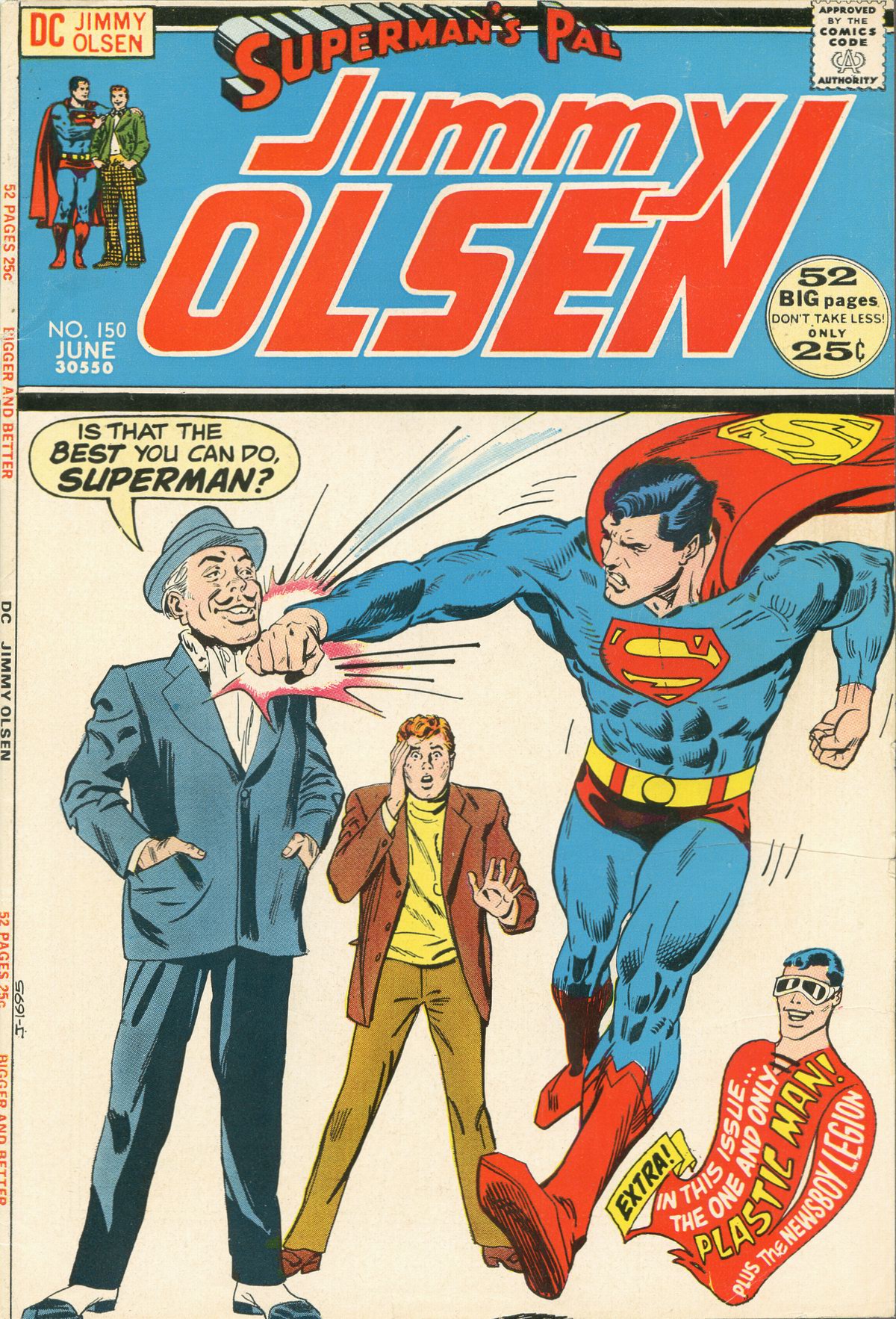


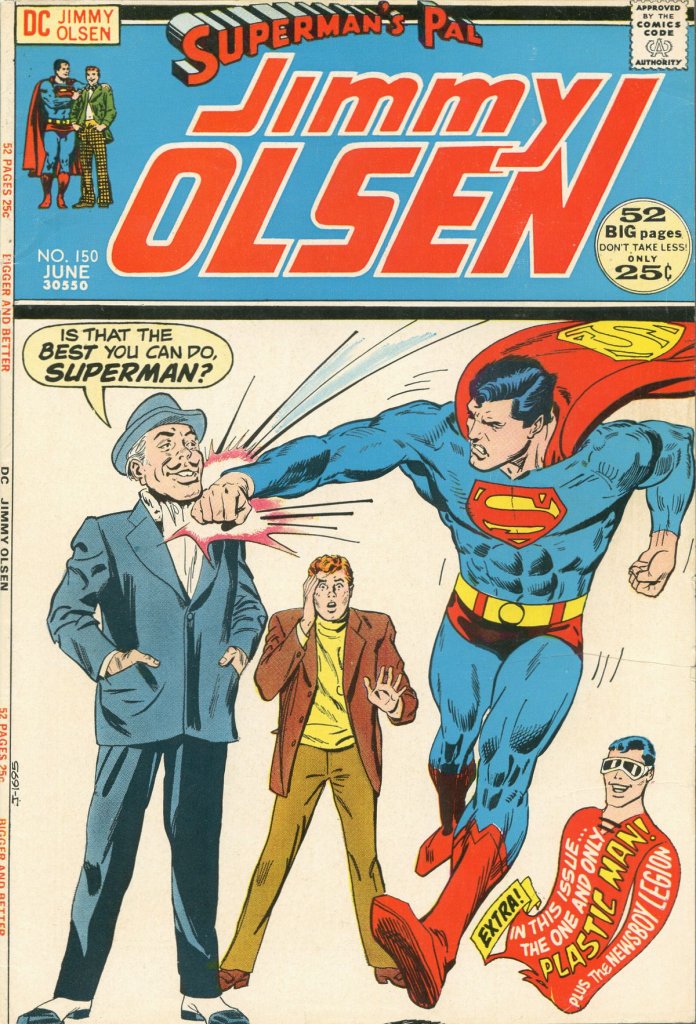
On that same trip to Ed’s Coins and Stamps in the Sun-Vet Mall, I purchased this back issue of SUPERMAN’S PAL, JIMMY OLSEN. I didn’t buy it for Jimmy, nor for the big guy. Rather, I had discovered that this issue had reprinted a classic Plastic Man story from the Golden Age and I was interested in reading more of those. On top of which–a situation that influenced my purchasing more than once–it was cheap. There wasn’t a whole lot of demand for JIMMY OLSEN back issues apart perhaps from those that had been done by Jack Kirby just prior to this point. So I was able to score this issue and its vintage Plastic Man adventure for a relative song.
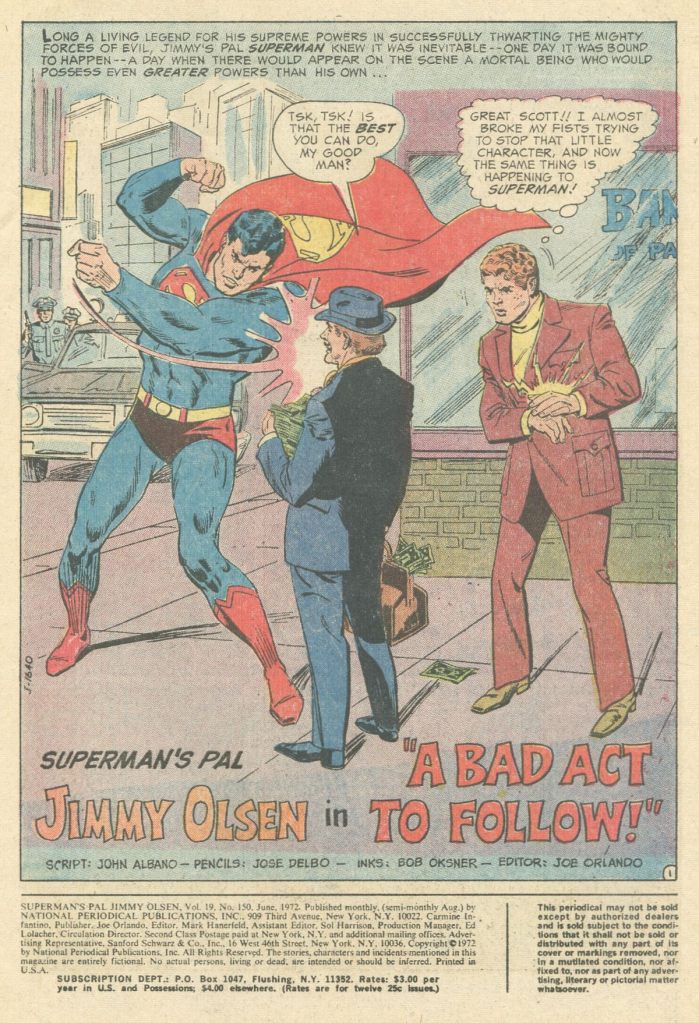
SUPERMAN’S PAL JIMMY OLSEN had passed into the editorial hands of Joe Orlando, who didn’t seem to have very strong opinions about what to do with it. In a lot of ways, this period was a bit of a return to form for the series, with its title character getting into bizarre situations that often required the intervention of Superman to put right. The days when it was a book of high adventure and big ideas under Jack Kirby were finished. From here on out until it was folded into SUPERMAN FAMILY a couple of years later, JIMMY OLSEN would dedicate itself to being lightweight and inoffensive, if not downright silly. The series certainly felt out of step with the times right at this moment, but the very fact that it was still a viable proposition owed a lot to the continuing reruns of the 1950s ADVENTURES OF SUPERMAN live action television series, so trying to channel some of the spirit of Jack Larson’s portrayal of the character wasn’t a bad idea in and of itself.
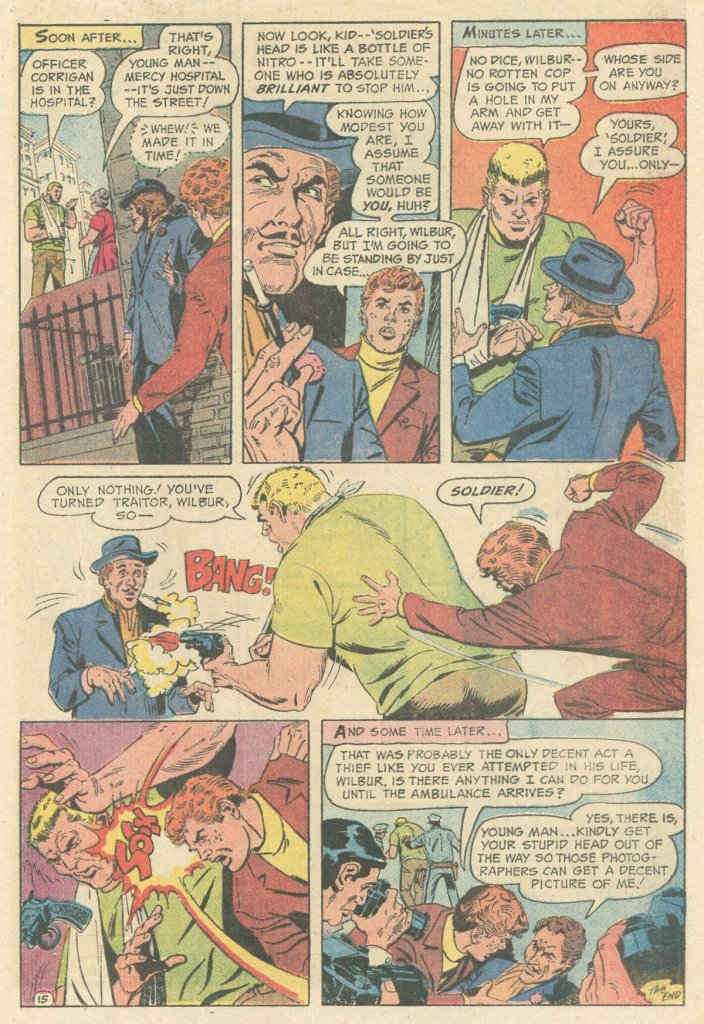
The opening story by John Albano and Jose Delbo is an odd mélange of pseudo-contemporary claptrap and ridiculous science fiction mumbo jumbo. In the opening, Jimmy and his girlfriend Meg are mugged by smooth operator Wilbur Little and his crazed Vietnam vet accomplice, Soldier. Beat cop Corrigan intercedes but is forced to shoot Soldier in the arm in order to stop him, an action which puts Corrigan at the center of a police brutality rap. Meanwhile, Wilbur checks in with a scientist acquaintance of his who as perfected a serum that will give a person indestructibility and the power to become invisible. Wilbur swipes the formula, of course, and embarks on some daring crimes, utterly unstoppable. Even Superman, who shows up for only three panels in this story to justify his appearance on the cover, can’t injure Wilbur. But Jimmy catches up with Wilbur at a point where his serum has worn off and captures him. But then, he needs Wilbur’s help to stop Soldier from attempting to assassinate Corrigan in retribution for the cop having wounded him. The end! The whole tale reads almost like a stream-of-consciousness ramble that only wraps up when it runs out of pages.
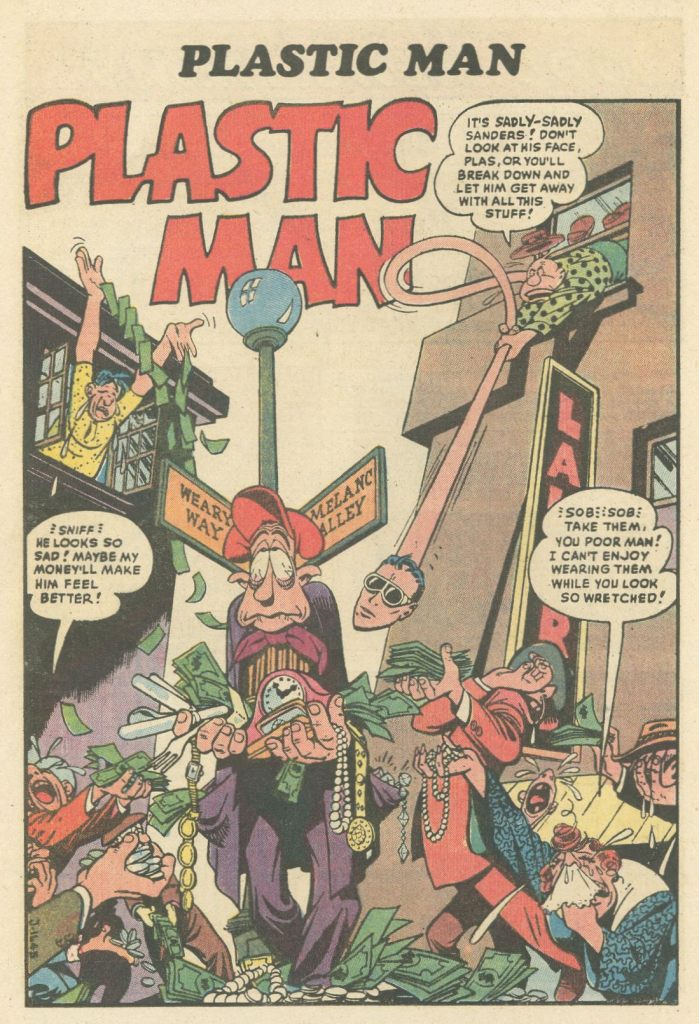
But as I said at the outset, the story I was really here for was the reprint in the center, and it didn’t disappoint. It was written by Joe Millard and illustrated by Jack Cole and it introduces a memorable foe for Plastic Man to contend with: Sadly-Sadly Sanders, a crook whose expression is so pitiful that it forces everyone who sees it to begin bawling uncontrollably, and to give him whatever he wants. Even Plastic Man himself isn’t proof against Sadly-Sadly’s maudlin expression, so he needs to find a way to get close enough to the felon to capture him without succumbing to uncontrollable sorrow and remorse. It’s a fun premise that Mallard and Cole milk for maximum entertainment.
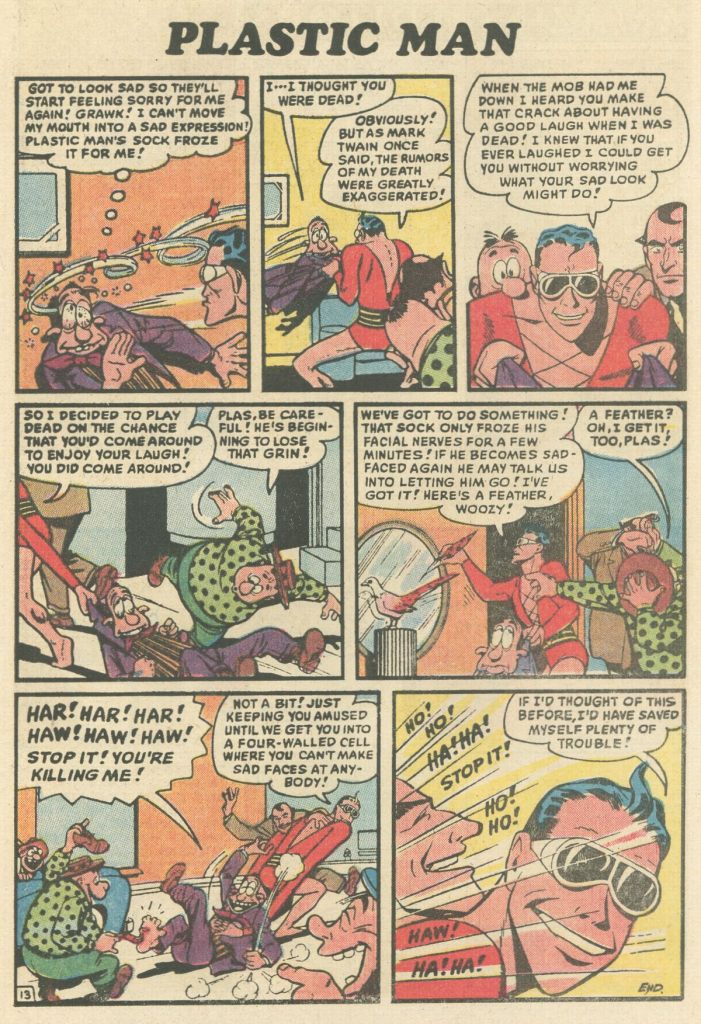
At a certain point, as he tries to arrest Sadly-Sadly, Plastic Man is set upon by an angry mob compelled by Sadly-Sadly’s features to come to his rescue. The mob beats the hell out of the ductile crime-fighter, but provides him with some inspiration. He and Woozy fake Plas’ death and set up a fake funeral which draws Sadly-Sadly out of the woodwork. Sadly-Sadly can’t help but smile when he sees Plastic Man stretched out on a slab, thus giving Plas an opening in which to sock him in the face, temporarily paralyzing his features. Thereafter, he and Woozy convey the crook to jail by tickling him as they go, preventing his features from putting on a sorrowful expression.
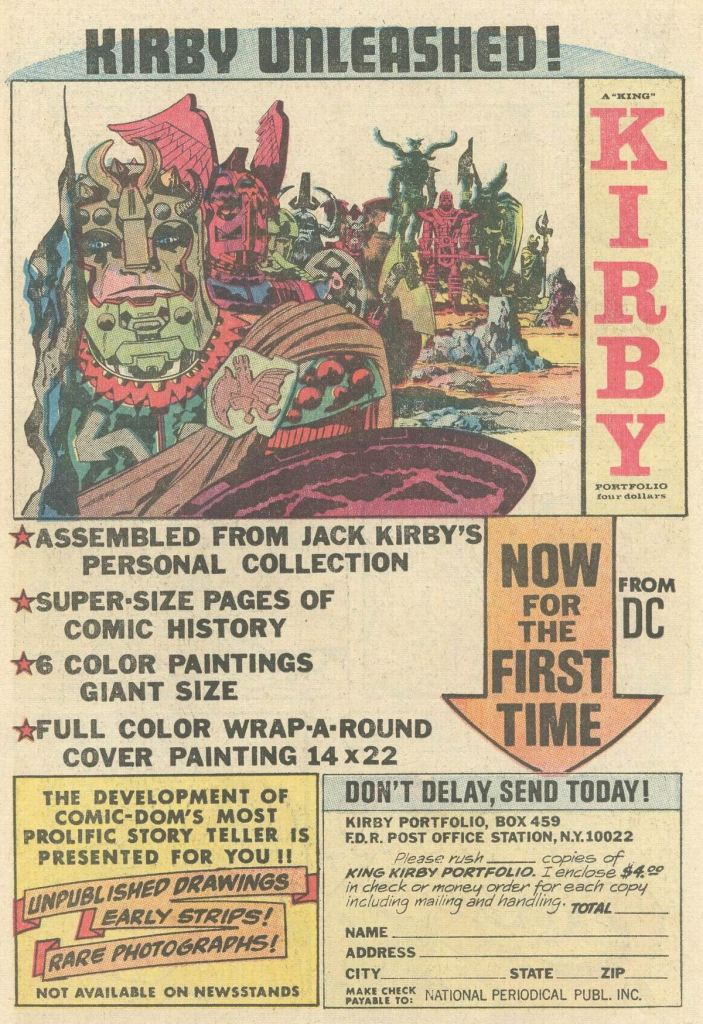
The issue also includes a full page ad for the KIRBY UNLEASHED portfolio, a grand Treasury-Sized compilation of rare artwork and interviews and such with the King. At this point, while his star was steadily diminishing at DC, the company was still pushing its acquisition of Jack for all it was worth, though this portfolio wasn’t actually published by them. It was a spectacular thing, released in a time when it was virtually unheard of for fans to be able to get a sustained look at the work and career of any single artist.
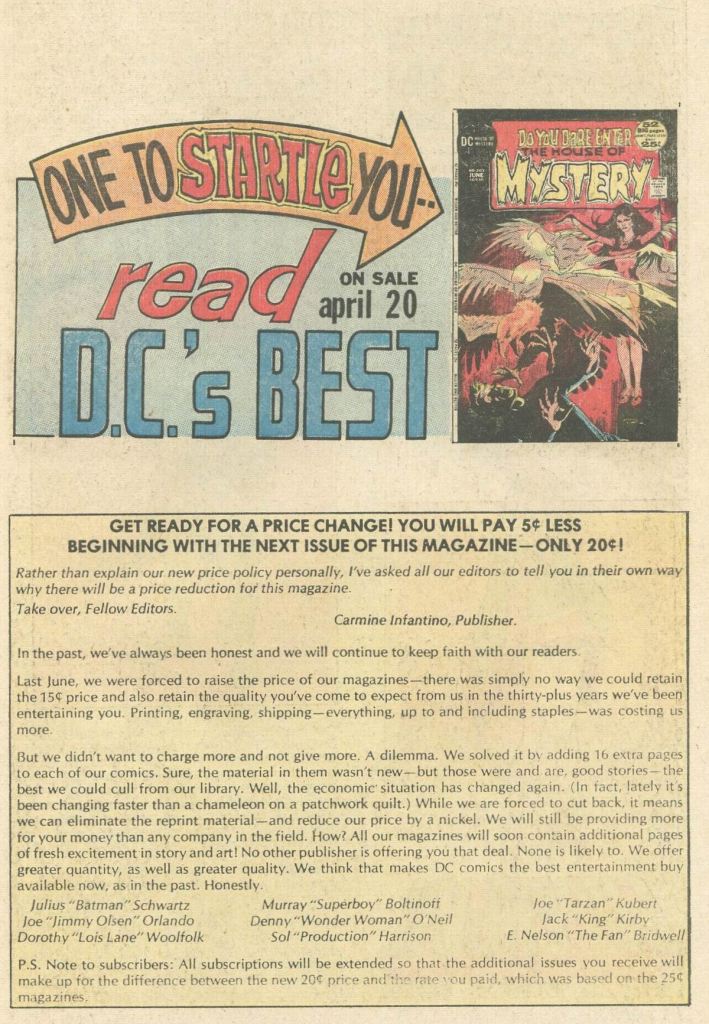
The book also includes this editorial note from Carmine Infantino and the editorial staff of DC at the time concerning the fact that the following month would have the DC line of books dropping their reprint back-ups and returning to the typical 32 page format, now priced at 20 cents. Marvel had been running at that price point for over a year at this time, and that price shift combined with a deal cut with their distribution resulted in Marvel’s sales surpassing those of DC for the first time. Carmine and company certainly hoped that matching the format would allow them to compete on an even playing field, but DC wouldn’t regain its dominance of the marketplace throughout the rest of the decade.
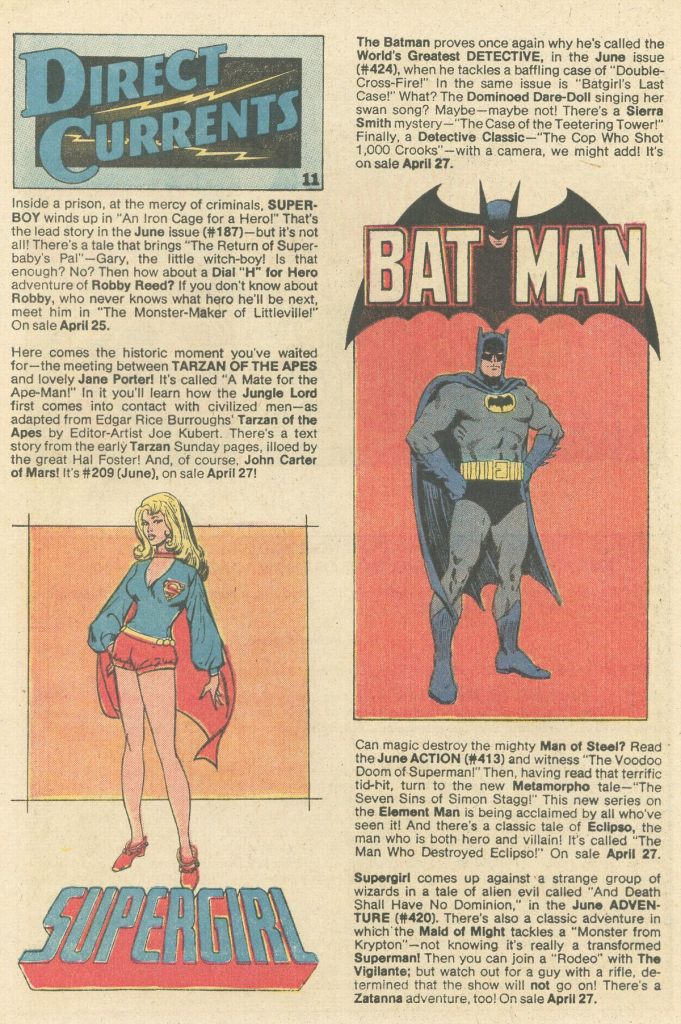
There was also a Direct Currents promotional page dedicated to plugging other releases in the DC line that were then on sale or soon would be. Possibly because it was running in an issue of SUPERMAN’S PAL JIMMY OLSEN, this page puts an emphasis on other Superman family titles such as SUPERBOY, ACTION COMICS and ADVENTURE COMICS. But it also goes farther afield to include TARZAN and DETECTIVE COMICS as well. I always loved seeing these pages in reprint books and speculating on the titles they were shilling, though DC’s efforts in this area weren’t the equal of Marvel’s under editor Stan Lee.
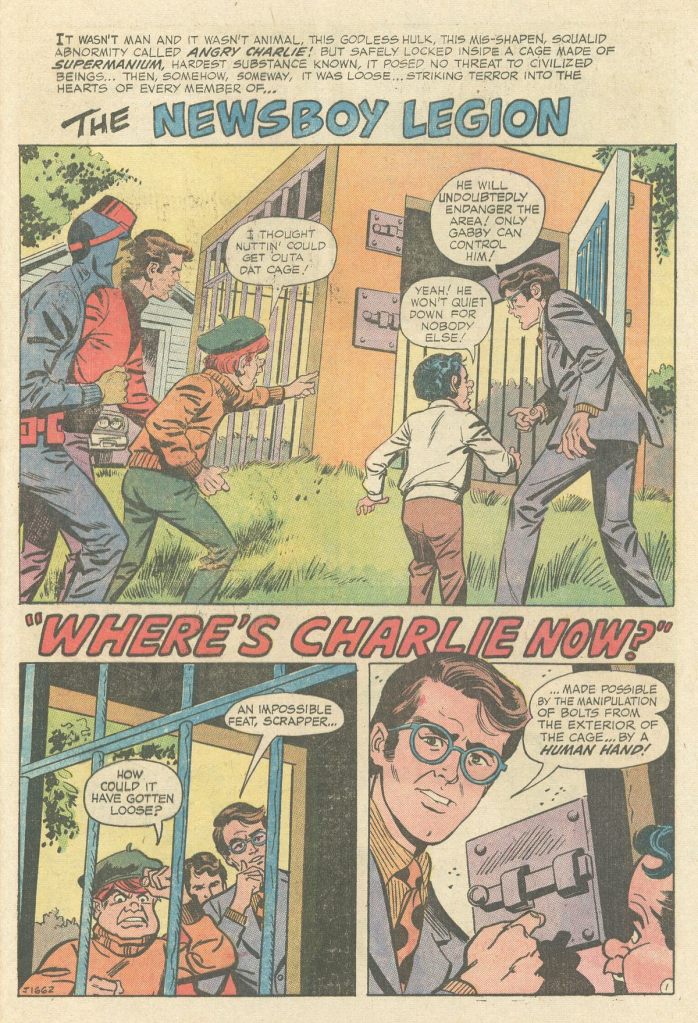
The final story in this issue is an odd bit of continuity bookkeeping, a throwback to the Newsboy Legion who had been supporting players in the title all throughout Jack Kirby’s recently-concluded run. Apparently, DC editor and continuity maven E. Nelson Bridwell was concerned that the Legionnaires had been left taking care of Angry Charlie, a weird DNAlien first introduced during Kirby’s tenure. Accordingly, he co-plotted this tale with John Albano to address the situation, with artist Win Mortimer illustrating it.
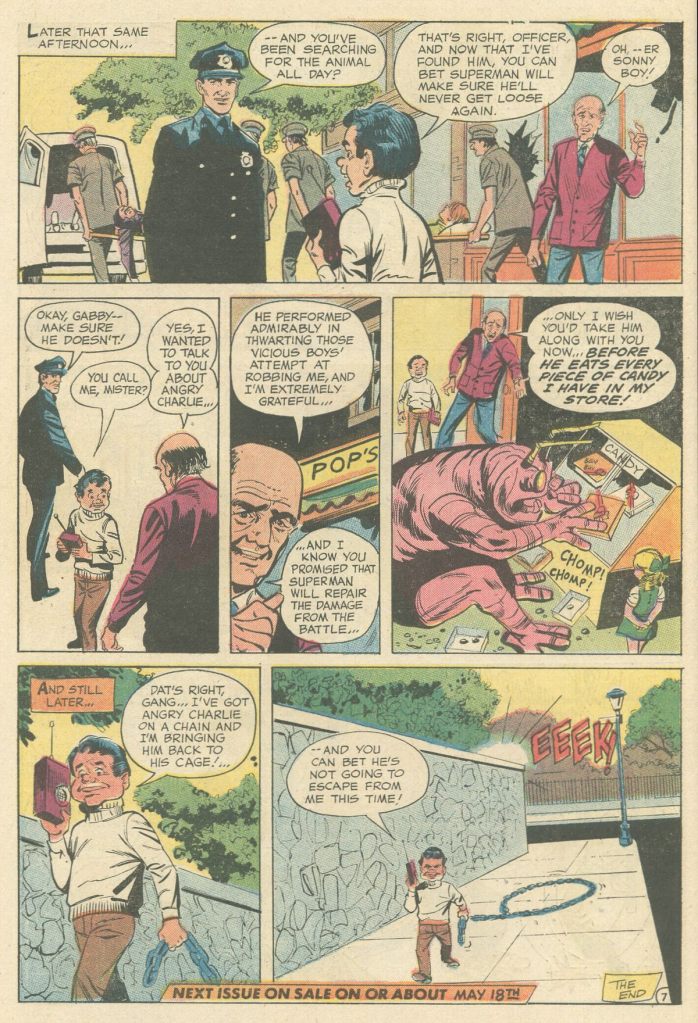
It’s a weird little story that’s also a bit all over the map in terms of tone. In it, the Newsboys discover that Charlie has escaped from the Supermanium Cage he’d been imprisoned in, leading them to search the streets of Metropolis for him. Charlie, meanwhile, has been found by the granddaughter of a local candy store owner who is being shaken down by some local toughs. But one of the gang makes the mistake of striking the little girl, and true to his name, Angry Charlie goes bananas on them. In the aftermath, Gabby of the Newsboy Legion is on hand to bring Angry Charlie back in, assuring the cops that Superman will make sure that he can’t escape and cause trouble again. But in the final panels, it’s clear that Charlie has already slipped his leash and vanished off into Metropolis. I’m not sure why Bridwell felt that this would wrap up Charlie’s story, but despite the open ending the character wouldn’t appear again until the post-Crisis new DC continuity.
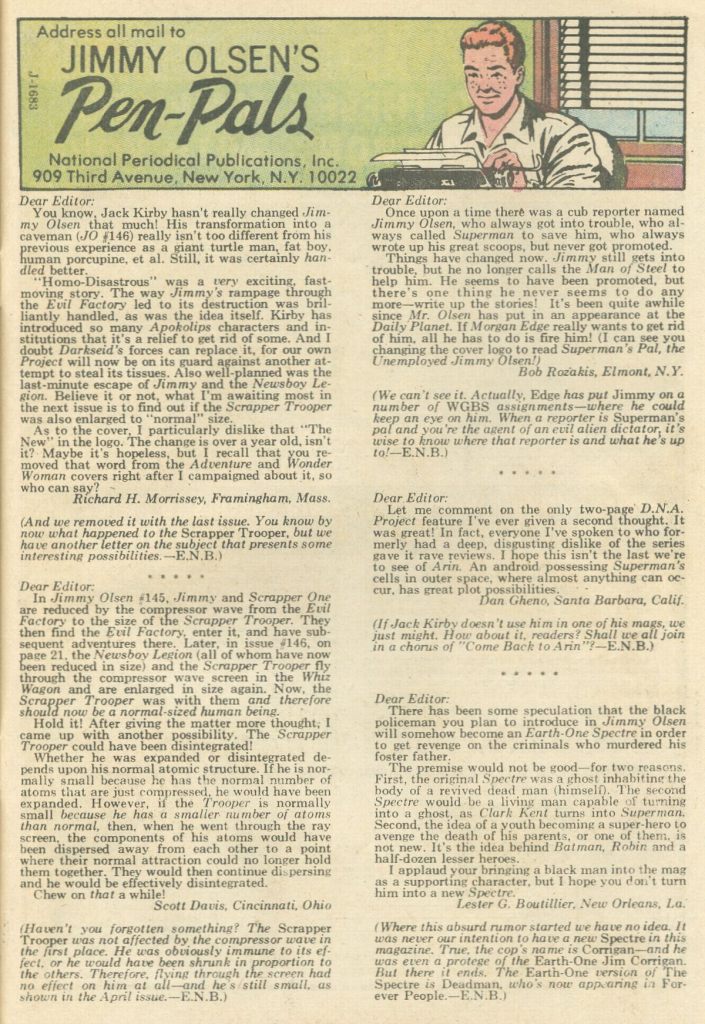
And the Jimmy Olsen’s Pen Pals letters page (which continued to use an illustration of Jimmy that was far out of date) this issue ran a letter from future DC writer, editor and production man Bob Rozakis. It was DC’s way at the time to recruit a bunch of its new talent from the more prolific letter writers, and Rozakis’ correspondence helped make his name familiar to the editors before he attempted to get a job from the company, which could only have helped him.


Having a severe allergy to Jimmy Olsen solo stories I never realized the amazing Joe Delbo ever drew it. As frosting on this cupcake of a revelation Bob Oksner inked him? Nirvana!
Did anyone else notice that the Plastic Man reprint was a bit like the lead story? If the Jimmy story had gone for comedy start to finish like Plastic Man had it would have been good instead of an eye roller. No wonder Jimmy is surpassed only by Lucy Lane as the longtime supporting cast member to get the least panel time post Crisis.
LikeLiked by 3 people
Like you I picked this up for the Plastic Man reprint. And it was worth it.
LikeLiked by 2 people
Yet another shining example of a DC comic seeming to be 10 years older than it actually is.
LikeLiked by 2 people
Agreed. Compared o Marvel’s stuff, too. Though 1972 wasn’t far enough from the previous decade to really break away. Makes me think Tom’s saying the letter column’s picture of f Jimmy wasn’t really outdated, next to the comic as a whole. And was in line with the aged, entrenched editorial, that was causing or enabling the creative stagnation.
LikeLiked by 1 person
At the time, the editor on this run of Jimmy was Joe Orlando, one of the younger hires who was shaking things up with books like HOUSE OF MYSTERY and JONAH HEX. And John Albano was another one of the newcomers.
But they didn’t really have a handle on how to modernize JIMMY OLSEN.
LikeLike
It definitely took some time for the Olsen series to find its equilibrium, post-Kirby. But once you get to the steady team of Leo Dorfman and Kurt Schaffenberger, it gets a lot better (and then falters again once they leave). Steve above might have a point that they’d have been better off emphasizing the comedy aspects of the character, but I do like the “Mr. Action” era a lot.
I get the impression that E. Nelson Bridwell was one of the few people in DC editorial who was really in Kirby’s corner, and it was cool that he continued to reference characters like Angry Charlie and Morgan Edge (over in LOIS LANE).
LikeLiked by 2 people
“Disposable Comics.”
That was the term my young mind conceived for issues like this one. As a young collector eager to delve deeply into the perplexing waters of these unique mythologies, I had to budget my limited economic resources. Marvel was tricky enough as even the most offbeat character could somehow become the cornerstone of some future epic – thereby ensnaring my utmost attention to a good portion of their superhero titles – DC at the time had too many comics such as Superman’s Pal Jimmy Olsen. The main story was harmless enough – polite term for lightweight – but nothing of substance would come from it. Nor was that the intent. As Tim commented, these stories already seemed a decade behind the times. Time has not diminished that opinion. That said, oh yeah, that Plastic Man story was definitely a kick!
LikeLiked by 2 people
One might figure Sadly-Sadly’s name, at least, was inspired by Nicely-Nicely Johnson from GUYS & DOLLS. But this story came out before GUYS & DOLLS debuted, so they must have gotten it from “Pick the Winner,” the 1933 Damon Runyon story featuring Nicely-Nicely Jones, the namesake of the above Mr. Johnson. Ahh, trivia.
I was not much of a fan of this period of JIMMY, but when the editorship passed to Murray Boltinoff and the stories were by Leo Dorfman and Kurt Schaffenberger, the series was a delight. Still pretty goofy, and apparently not enough to save the book (although SUPERMAN FAMILY continued the numbering from JIMMY, suggesting it was the strongest of the amalgamated titles), but lots of fun and really nicely drawn.
I will quibble with one bit of that Newsboy Legion story — they make a thing of how the cage had to be opened by a “human hand,” but Angry Charlie’s hands are pretty clearly human-like and perfectly capable of undoing such a lock. Maybe he couldn’t reach it, but the way Mortimer drew it it looks like all Charlie would have to do is reach through the bars and slide it back; it’s not much of a lock.
LikeLiked by 1 person
The Newsboy Legion story was reprinted in the volume which collected the Kirby Jimmy Olsens, and after reading Kirby it came as a little bit of a shock because…the scripter (Bridwell?) actually gave Big Words a noticeably different speech pattern from the other characters! Which Kirby very much didn’t. The Kirby stories were so high-energy that I didn’t really notice at the time, but then reading this one brought that into relief.
LikeLiked by 1 person
Some big disappointments in life still hurt, the breakup of The Beatles and The Clash, Jim Steranko leaving Marvel, my 1995 divorce , and the dirty deal DC gave Jack Kirby.
In one month Jimmy Olsen went from Kirby’s avant garde epic to … this.
LikeLike
Wilbur Little temporarily gained indestructibility and the power to become invisible, the indestructibility is the one that is useless against Superman because it doesn’t prevent Superman from picking him up and dropping him off in jail. Plus the cops must have cuffs that can hold him. Breaking out of jail would take as long as it would using a sledge hammer.
LikeLiked by 1 person
Angry Charlie on the page seen here, doesn’t look as cool as Jack Kirby and Tom Grummet version of the character. The 1994 Superboy series was where I first saw Angry Charlie and like the character.
LikeLike
Invisibility is of limited use against Superman either, assuming the guy’s still tangible. Even assuming for the sake of discussion that invisibility works against Superman’s array of vision-powers, which see much more than visible light, the moment Superman knows the quarry is in the general area, it’s over. For example, Superman might locate him via super-hearing his heartbeat, his breathing, or the noise/vibration when he walks. Or blow a cloud of dust around, and see where there’s a distortion (or cause him to sneeze, which is again audio location). Come to think of it, Superman should be able to do echo-location by making noise himself and listening for any sound reflections (I can’t come up with an example of this, but it’s probably been done in some story over the decades).
I call invisibility the superpower which can be defeated by shag carpeting.
LikeLike
I was thinking of Superman using his freeze breath to locate him ( Trying to runaway while invisible is better than standing there ), I was just thinking that punching him was stupid when all he had to do was grab Wilbur Little. Also I have Superman Vol. 2#44 ( June 1990 ) and Adventures of Superman#483 ( October 1991 –when he was defeated ) where Superman encounters Intergang operative Blindspot who uses an invisibility device.
LikeLike
Castle season 7 episode titled “Clear & Present Danger”: The killer is not a ghost or demon, but a person wearing a high-tech invisibility cloak ( more like suit ) that bends light rays using metamaterials. Castle and Beckett used fire extinguisher to spot the invisible killer. Don’t know why this popped in my head last night, when I was thinking about Superman using his freeze breath to make the air cold enough to see the breath of an invisible foe.
LikeLike
First time I remember seeing art by Bob Oksner was in 1985, I think it was the “Who’s Who in the DCU” entry for Lois Is ane. I really liked the sharp lines. It made me think of Chaykin a little bit. I think I was only 13 years old. And then I started noticing Bob’s name from older comics. And other pages in “Who’s Who”.
This story from 13 years before that didn’t have the same impact on me. And I remember seeing Bob’s inks over the great Jose Luis Garcia-Lopez,’s drawings. Definitely in a Superman story, though unsure in which of his titles. It gave Jose’s work a more rugged, choppy look. Which wasnt an improvement over the more impressive finish Jose’s own smoother inks gave, or even Dick Giordano’s sharp, rugged but less rough style (than Bob’s). Did Bob also ink Jose’s”Hercules”? I’ll have to look that up.
I much prefer Oksner inking his own drawings. But he remains one of the artists (“Bronze Agers”?) I liked most from that time.
Jose Delbo’s a name I certainly recognize, but don’t know enough of his work to appreciate it. I used to get his work confused with a slightly later artist, Alex Saviuk. Maybe Jose Delbo’s work was more refined. Maybe it would’ve benefited from more refined inking by someone as sublime as Al Williamson. I’d have to see more of Delbo’s art. Hopefully there are more dynamic examples than this.
I can’t imagine him rendering exciting versions of action heroes like Captain America or the Hulk. Nothing really visually dynamic. But I might be remembering past examples of Saviuk’s work. I’m pretty sure I’ve seen Jise Delbo’s version of Batman somewhere. And it was a bit too understated for me. But I’d be interested in seeing more of his work. I’d like to be proven wrong. And see some good art in the process.
LikeLiked by 1 person
It looks like an Oksner cover too.
LikeLiked by 1 person
I agree that solo Oksner is the best Oksner. But I did very much like his inks over Carmine Infantino in the ’80s Supergirl series.
Unfortunately, Jose Delbo’s most sustained run at DC — Wonder Woman — was mostly (entirely?) inked by the notorious Vince Colletta. Colletta’s inks never did any artist any favors, but were especially damaging to artists like Delbo, who’s work was already a bit on the “quiet” side, and Vinnie just blanderized it even more.
LikeLiked by 1 person
Good points.
LikeLike
“Jose Delbo’s most sustained run at DC — Wonder Woman — was mostly (entirely?) inked by the notorious Vince Colletta.”
Not entirely — at least one issue was inked by Wally Wood (but, sadly, not a healthy and energetic Wood), and toward the end of his run it was mostly Dave Hunt.
I never thought Delbo was particularly suited to superhero stories, but if he was going to do it he needed an illustrative inker who added to the pencils rather than a dutiful inker who preserved the line, or an illustrative one who just buried it.
LikeLike
“I’m pretty sure I’ve seen Jose Delbo’s version of Batman somewhere.”
Possibly in WORLD’S FINEST, where he drew the tail end of the series, mostly inked overwhelmingly by Alfredo Alcala.
And yeah, understated is a pretty good description.
LikeLike
It was Wally Wood who inked Garcia-Lopez on HERCULES UNBOUND.
Oksner had spent most of his career drawing humor stories like BINKY and JERRY LEWIS, and he was excellent at it. When the humor market started to fade out, he shifted over to the adventure/superhero material, but at this point he’s still figuring it out. He could draw realistically, but finding the range for what the editors wanted in superhero imagery was something he worked out slowly, trying for a textured inking style and tough-hero images, and he was reasonably good at it — he was good at just about everything — but it took a while for him to figure out how to be himself while drawing adventure, but he got there, and the sharp, slightly-cartoony Oksner of his later LOIS LANE work, and his inks on Carmine, strike me as much more in tune with the kind of drawing he liked to do.
LikeLike
DCUI only has two dozen issues of Superman’s Pal, Jimmy Olsen, 2/3rds of which are the Kirby issues, so I’m not able to read it. I bought a number of silver age issues at the local used bookstore over the years. It was never at the top of my list, but I usually enjoyed the stories when I bought an issue.
I don’t recall ever buying a new issue, although I do remember seeing the logo on the cover of this issue. Interestingly, this issue was the second one to have this logo, which was introduced with the first post Kirby issue. I find that odd, as I think DC should have changed the logo when Kirby took over the title. Of course, I’ve never like this logo, so maybe not.
LikeLike