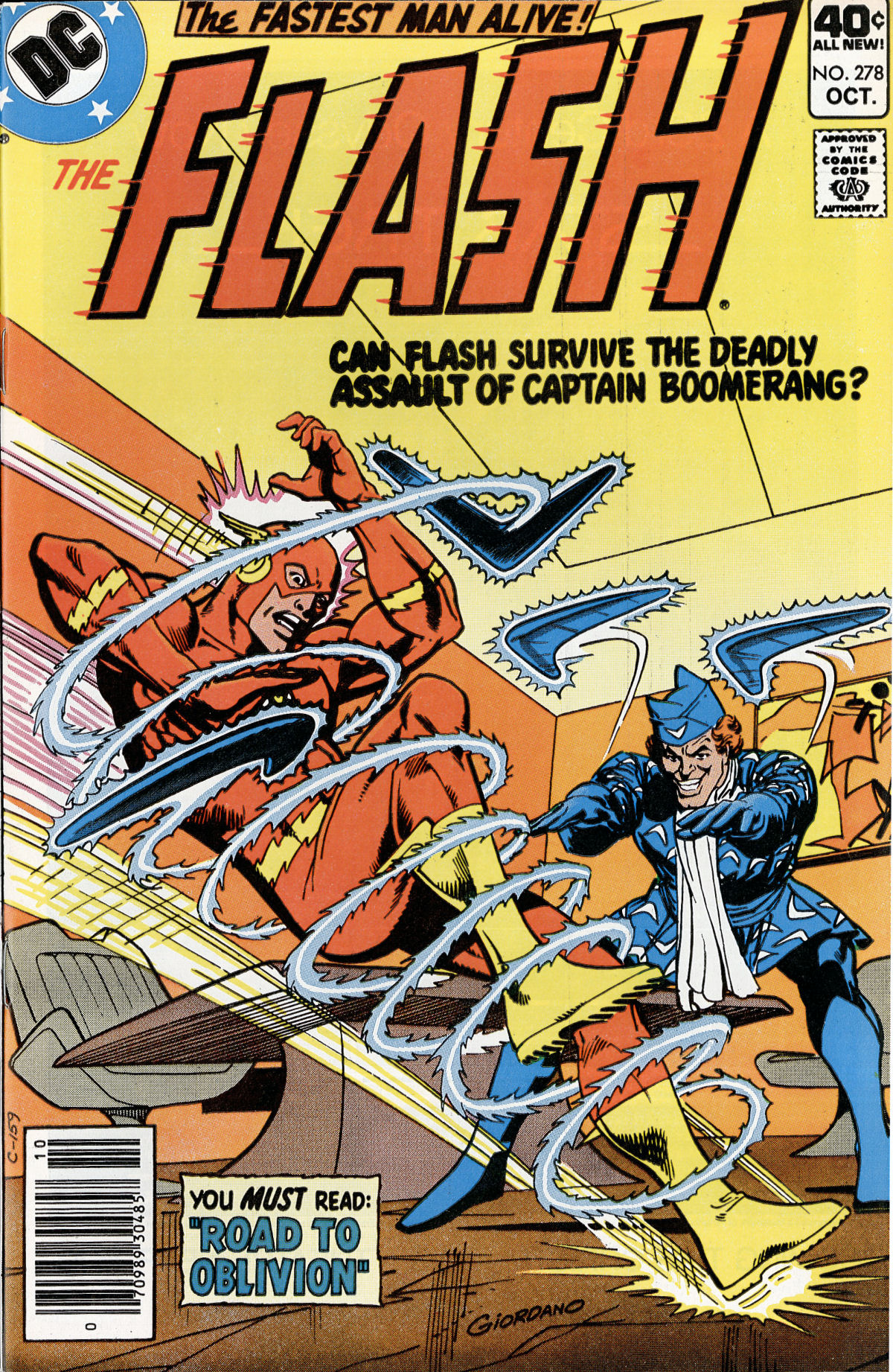


So after a bit of a bumpy road as a reader over the preceding year, where I wasn’t able to consistently get copies of the issues, my new Stationery Store outlet made it possible for me to once more become a regular reader of THE FLASH. The character had been my absolute favorite as a young kid, and even though my attention was at this point more focused on FANTASTIC FOUR and the Marvel books as a hot new thing to me, I never lost my affection for this series. At this time, though, the book was in a time of transition. Longtime editor Julie Schwartz had been replaced by Ross Andru and in an attempt to bring the series up to date with the times, storylines began to include more contemporary situations while still featuring the typical fast-action and colorful costumed super-villains. In all honesty, this isn’t a period that I really love, but it was definitely a necessary step to keep the book viable, regardless of how well I feel they executed some of it.
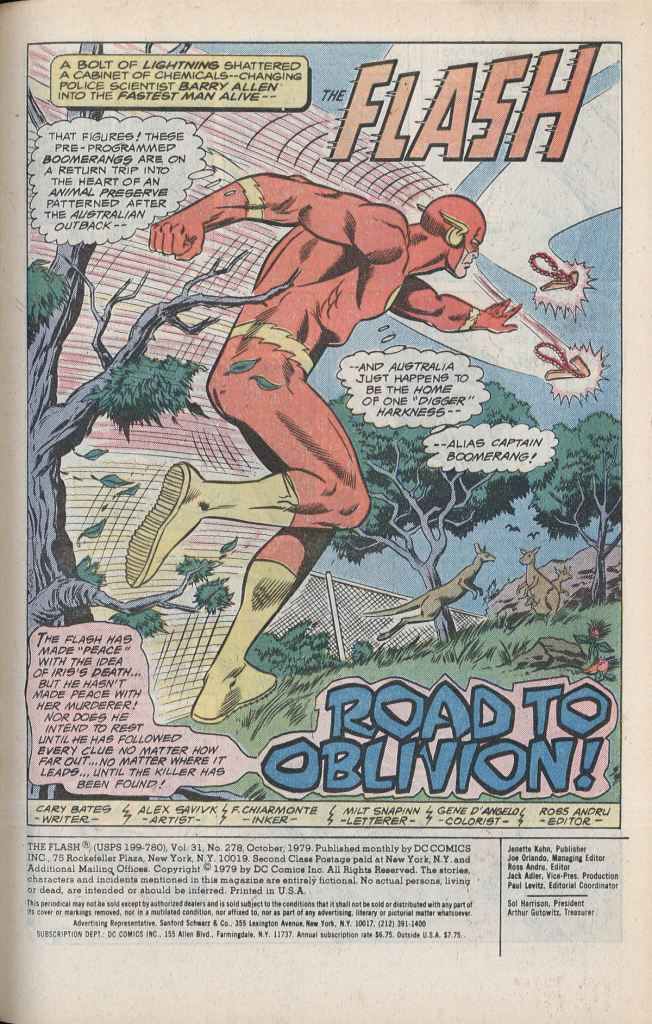
The big thing that had happened that would cast a pallor over the storylines for the next several months was the sudden and unexpected murder of the main character’s wife Iris Allen. I missed the two issues in which this shocking event happened, so I was still reeling from the idea a little bit moving into this issue. One of the things that was appealing to me about THE FLASH was that it was stable, about a generally-contented married couple one of whom is also a colorful super hero on the side. So this change wasn’t to my liking, but it had happened, so I tried to get on board with it and see where the story would take us. Anyway, as we enter into this story, the opening blurb reminds us that Iris’s killer is still out there somewhere, giving Flash an objective to chase down. To do so, his first move is to hunt down one of his old foes, Captain Boomerang.
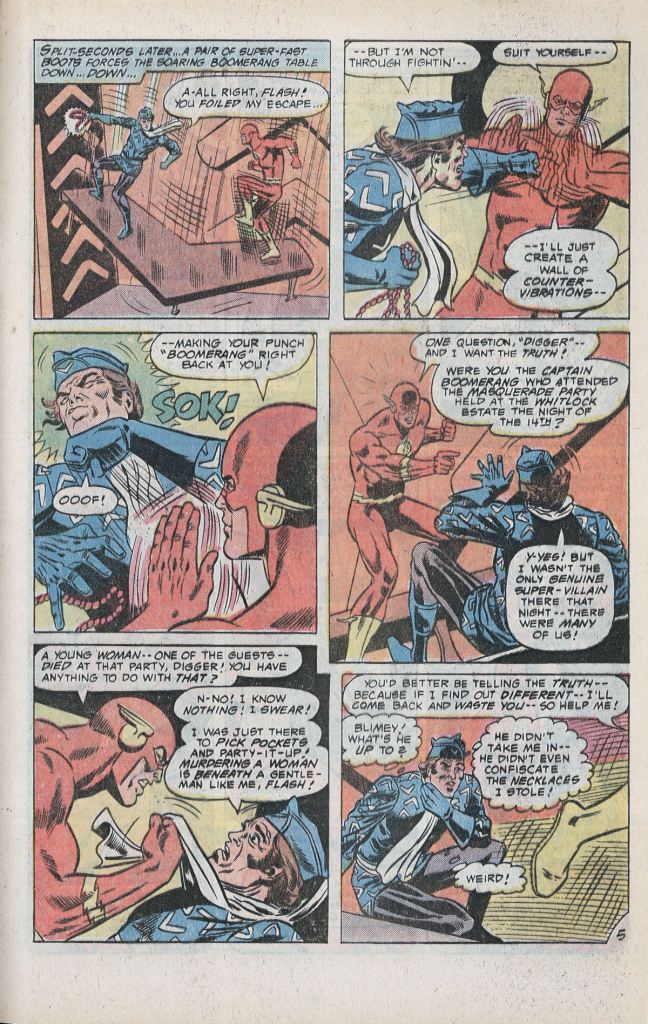
Captain Boomerang is one of the sillier enemies of the Scarlet Speedster–a man who can circle the Earth in an instant being befuddled by a guy who tosses boomerangs by hand, at speeds far less than that of sound. But that said, i always liked him–I didn’t really care that he was absurd, I sort of liked that in my Flash villains. Anyway, after bursting in on Boomerang’s latest heist-in-progress, Flash questions him: was he the Captain Boomerang who was at the costume party where Iris was killed? And this is why I love this character–Boomerang admits that he was, that he was there pickpocketing the other patrons. The idea is so low-rent that I simply adore it. What’s more, Boomerang tells his flashy foe that he wasn’t the only genuine Rogue in attendance that night, there were a bunch of them. Flash races off without confiscating the gems Boomerang has stolen nor bringing him in to the law, a turn of events that disturbs the Captain a little bit. Flash has more important matters on his mind.
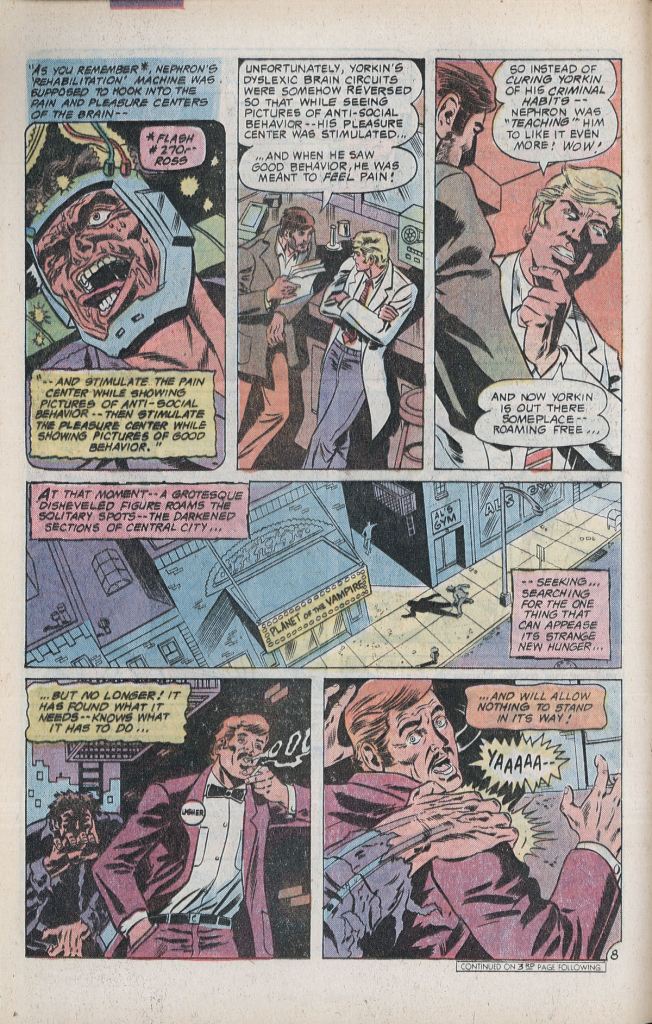
The next morning, Barry Allen’s new friend Detective Frank Curtis finds the Police Scientist already at the crime lab. Barry tells Frank that he’s been undergoing deep self-hypnosis to see if he could recall anything else about the night Iris was killed. Barry had been injected with what should have been a lethal overdose of LSD that night–it was only his super-speed powers that allowed him to survive it–and he’s worked out that it was the partier in the Sandman costume who was mock-shooting the assorted guests who likely injected him with it while playing out his shtick. Frank also has news about the prime suspect for Iris’ murder, escaped convict and test subject Clive Yorkin. Turns out that Yorkin was dyslexic, so when the Nephron Project’s conditioning attempted to wire his brain to be repulsed by criminal acts, his dyslexic mind did the opposite and became addicted to violence instead. I don’t know that this is really the way dyslexia works, but two points for Cary Bates for trying to make this plot point feel legitimate. Anyway, Yorkin is out there in Central City somewhere, and until Barry can catch up with him, there’s no way to get the full story.
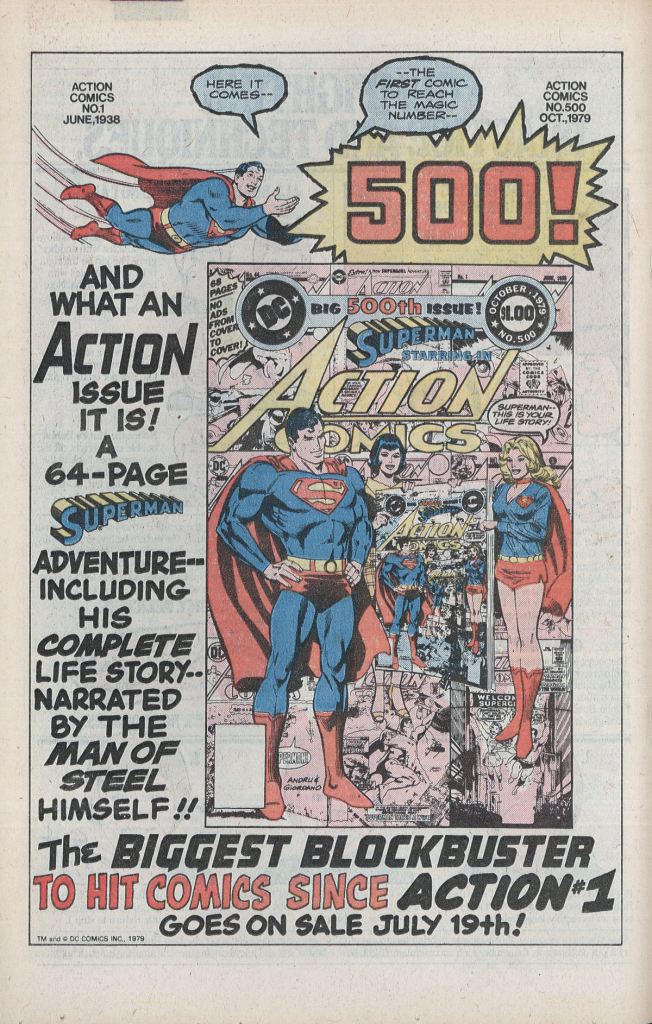
A quick break at this point for this full-page ad touting the impending release of ACTION COMICS #500. This seemed like a massive thing to my young self–the first comic book to ever reach issue #500. It looked to be a big deal, and so I was primed and ready, determined not to miss it when it came out in a few short weeks.
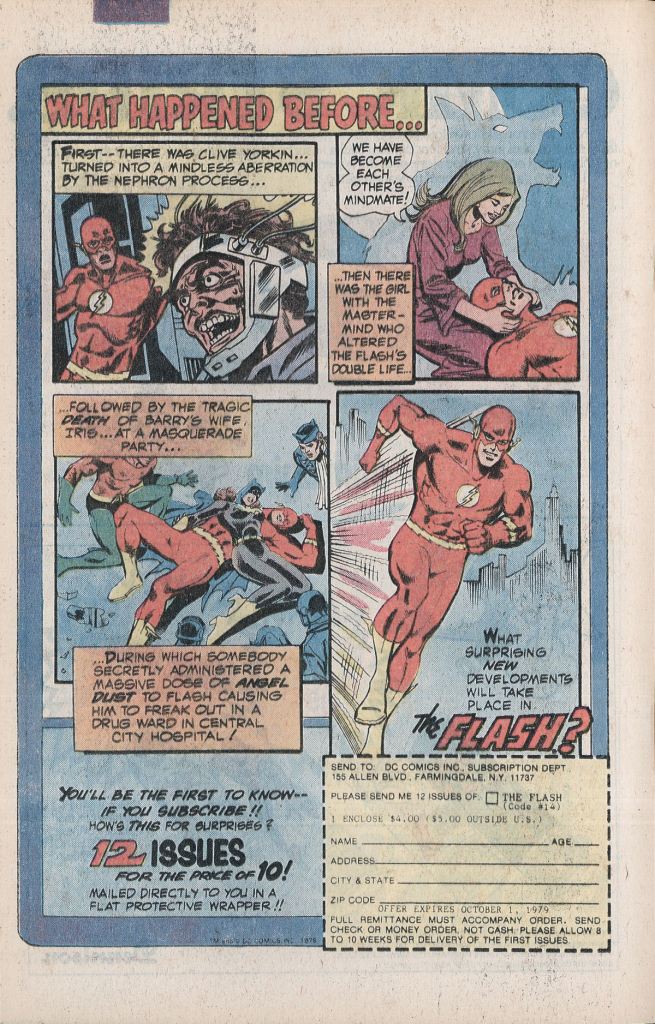
And since it runs here again, I might as well also show you this bespoke subscription ad for THE FLASH which recaps recent events in the series. DC did one of these for every book in their line, though they only tended to run inside the titles they were advertising. Which makes a certain amount of sense–but wouldn’t those readers already be the ones who were up-to-speed on recent events and following the book? Might have been smarter to mix them up a bit more across the line.
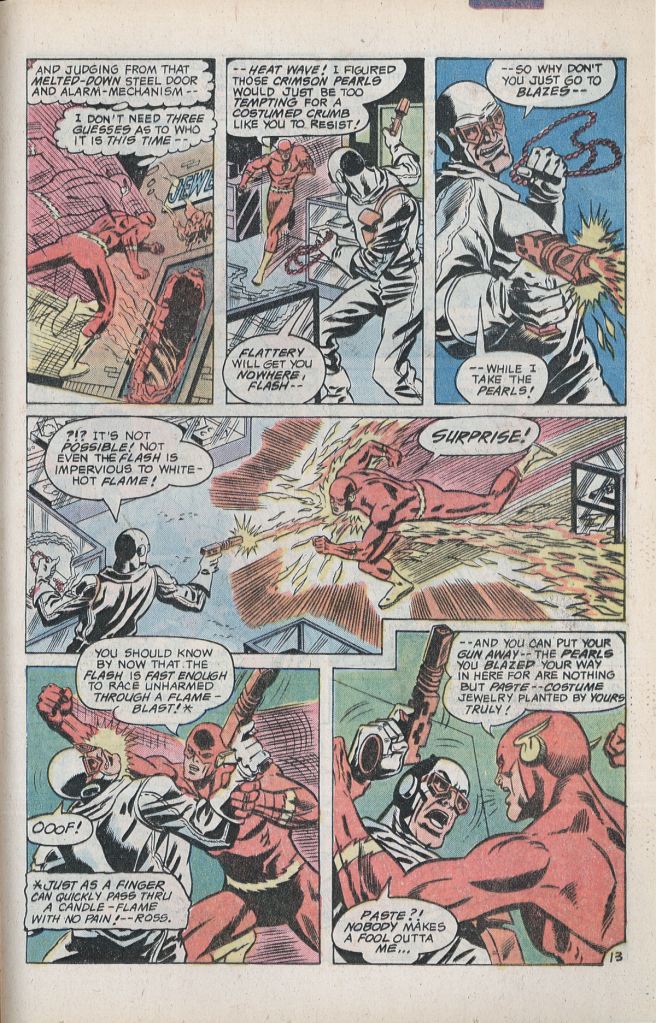
After a bit more investigating, which leads Frank and Barry to the Sandman costume that Barry’s would-be killer wore the night of the murder, Barry’s watch blinks red and he makes excuses to split from Frank so that he can become the Flash. And now we learn why the speedster hadn’t worried about Captain Boomerang’s loot: it’s all fake, decoys that Flash had put into place around Central City knowing that his money-hungry Rogues would make a play for it. Now another jewel heist is in progress, and racing there, Flash finds that the heister is Heat Wave, the fiery felon. What’s more, Flash isn’t messing around, and he races straight through Heat Wave’s flames in order to clock him–he wants answers about Iris’s murder and he’s only just keeping himself in check. But before he can get them, Flash is startled by the sudden appearance of the sought-after Clive Yorkin, who bursts into the room, drawn there by the intense emotional energy being given off by Flash’s rage. This gives Heat Wave the opportunity to get the drop on the hero and try to make a run for it.
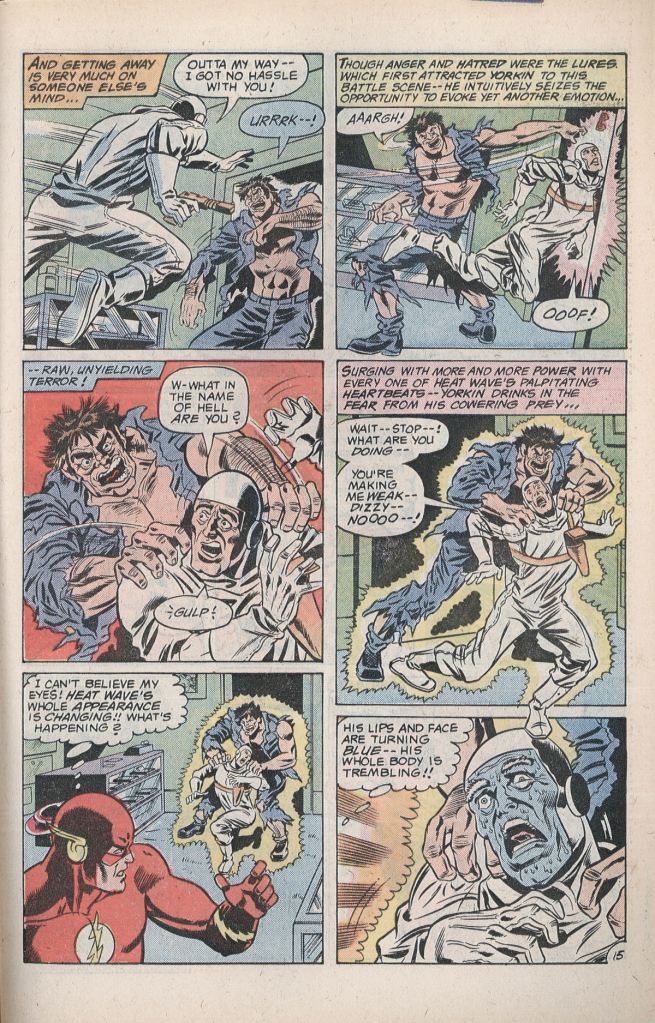
Heat Wave is momentarily able to stun Flash, leaving only Clive Yorkin between him and freedom. But there’s something that he doesn’t know about Yorkin, which we readers only learned a few pages earlier: exposure to the Nephron Process has turned Yorkin into a kind of emotional vampire, one who is drawn to high-intensity emotions and why drains them out of his victims in order to feed his own need to self-satisfaction. Yorkin grabs Heat Wave, and in instants the Rogue is down, his skin turning blue and aged-looking, his vigor and vitality being sucked right out of him by Yorkin’s touch. It’s a pretty impactful and horrifying moment by FLASH standards of the day.
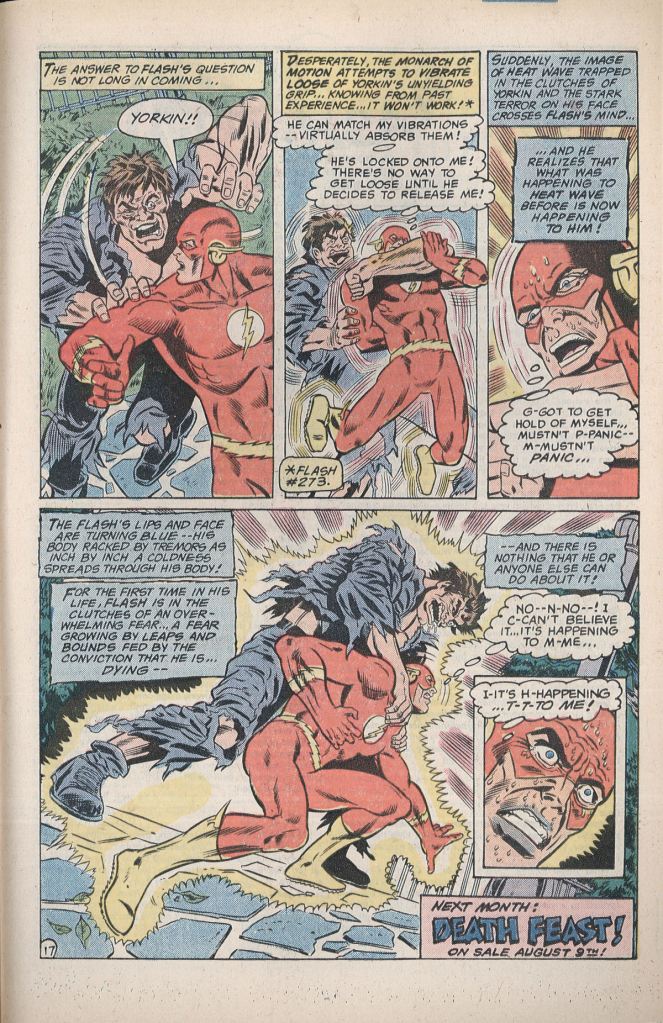
Barry doesn’t want Heat Wave killed, though, so he launches himself in a flying kick that knocks Yorkin away from his half-dead enemy Heat Wave. But as Flash turns to render aid and assistance to Heat Wave, Yorkin takes the opportunity to make a run for it. You wouldn’t think that this would be a huge problem for the Flash, but by the time the speedster makes it outside, he’s lost track of Yorkin. Which is a real problem. because Yorkin leaps out at his scarlet pursuer and grabs him–in a grip that Flash can’t seem to vibrate his way out of. What’s more, Yorkin’s touch fills Flash’s heart with overwhelming fear–fear that Yorkin begins to feed off of just as he had with Heat Wave. Flash is facing a similar fate–and that’s where the story is To Be Continued. This was a very solid outing for the story, advancing several plot threads while giving a good amount of action and drive and being slightly more contemporary than the title usually was. The art still suffers a little bit from Alex Saviuk being still a relative newbie whose style isn’t quite as gritty as the material is calling for, but it all works well enough for what it is.
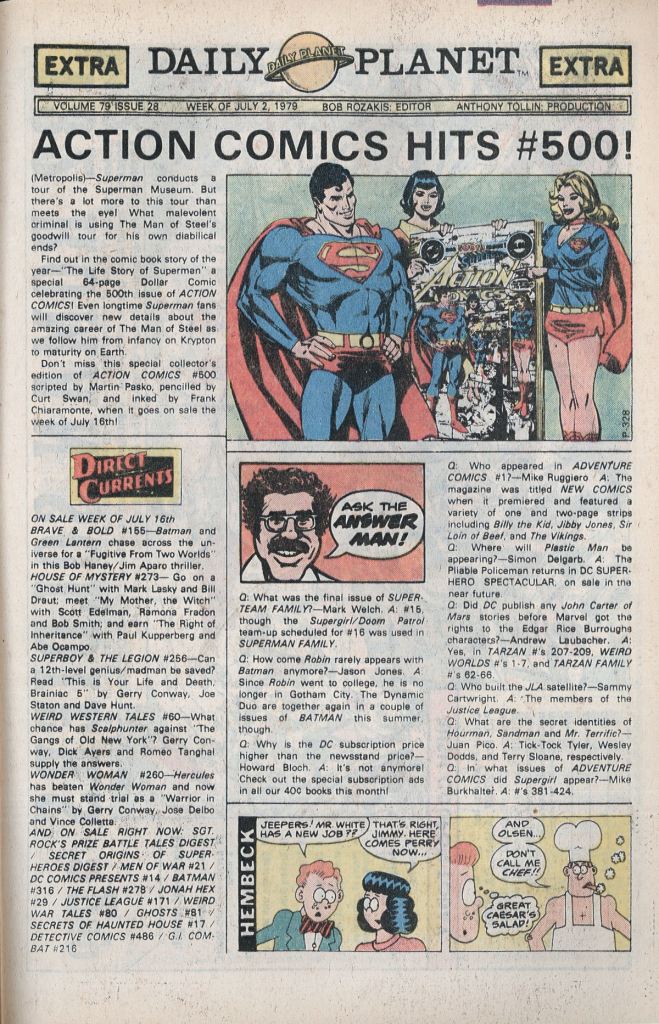
And the issue closes out on that week’s new Daily Planet promotional page, in which the aforementioned ACTION COMICS #500 is spotlighted. And as usual, it also contained a gag strip by fan cartoonist Fred Hembeck as well as another installment of Bob Rozakis’ popular Ask the Answer Man column. This time, Bob winds up listing the features that appeared in NEW COMICS #17 as well as plugging DC SUPER HERO SPECTACULAR, a project that fell apart before publication and whose proposed contents were used elsewhere. That was a typical state of affairs for DC in the post-Implosion period.


Regarding the subscription Ad… Was casually dropping a “Massive Dose of Angel Dust” reference really the best way to entice Mom’s or Grandma’s to gift a subscription to a child?
LikeLiked by 3 people
Maybe Ross was watching too many 1970’s TV cops shows. NOT the same target audience, Mr. Andru… 😉
LikeLiked by 1 person
I’m not sure why it couldn’t be. Barry is a forensic criminologist — one could easily write FLASH as if it was CSI: CENTRAL CITY with a superhero as one of the scientists. Of course, CSI didn’t exist yet as a model, but FLASH was a crime series — a colorful crime series involving weird crimes and lots of costumed criminals (and the occasional gorilla), but crime nonetheless.
Leaning into those roots and making it more like a contemporary cop show, when those shows got millions of viewers, a far larger audience than any comic book, would not have been a bad idea. And it worked, at least temporarily.
It might not have been all Andru, either. While I think I’ve read that it was him who decided they should kill Iris, Cary Bates was a big fan of James Bond, and later of HILL STREET BLUES, a show that influenced his run of FLASH in later years. So it may have been that Julie Schwartz, and his puzzle-plot instincts, was what was keeping the book a strongly Silver Age-influenced series, and Andru gave Cary the chance to open up to other ideas, bring in approaches he liked from other media.
FLASH as a cop show could have been a way to make it more current and distinctive as its particular corner of the DC Universe…
LikeLiked by 1 person
I think I was just too young back then. But I agree with you that some of those old enough to get the themes or even gist of those TV cop shows would’ve likely appreciated it if done well in “The Flash”. In October 1979 (or earlier when this issue hit the stands), I wasn’t 8 years old yet, and only knew the TV cop shows of the day by overhearing adults talking, or mentions in “TV View”, roughly comicbook sized (but all newsprint, even the covers) from the local Wilmington, DE News Journal, an answer to the thicker, “digest” formatted “TV Guide”.
I was in bed when those aired on network TV. It would take until the early to mid 1980’s for me to watch the 70’s cop shows in re-runs in syndication. I was able to watch some “Hill St. Blues” in early the 80’s if my parents were distracted.
LikeLike
I love the John Wesley Shipp Flash series. It’s been a long time since I watched it, not long actually, but I thought he spent a fair amount of time as Barry Allen working in the crime lab. I guess I’m going to have to rewatch it now to see if I’m right or not.
LikeLiked by 1 person
I haven’t read Geoff Johns’ Flash run but I’ve heard it described as CSI: Central City. Not with enthusiasm.
Sean Pickett: yes, they did a lot in the lab though a chemist friend of mine winced at those scenes even though she liked the show.
LikeLike
It’s odd that back then some superheroes were allowed to get married ( Flash II, Adam Strange, Aquaman-Mera, Atom II, Hawkman II-Hawkwoman ) and others ( Superman II, Batman II, Wonder Woman II ) weren’t — not counting the Earth-2 heroes. I find Clive Yorkin’s abilities interesting.
LikeLike
Fantastic Four#94 ( January 1970 ) the Frightful Four attacked the Fantastic Four at Agatha Harkness’ home, but what if on the shared Marvel-DC Comics Earth that before this Agatha Harness just happened to be in the same bank, jewelry store or museum that “Digger” Harkness/Captain Boomerang came to rob?
LikeLiked by 1 person
Ah, “The Great Harkness Saga”. 😉 Captain Boomerang, the Prince of Harkness?
LikeLiked by 2 people
I liked Alex Saviuk from the start. Yes, here he was a bit unpolished but there was a sense of fun to his style that appealed to me. It’s also nice to see a reminder of the days when Flash’s Rogues was a general term for his enemies and not a set group. Today’s Rogues are now jobbers to me. Once they were each a genuine threat and now they get taken down en masse. Up there with Predator being an appropriate avatar for the Lantern Corps powered by love for Johns’ worst decision. Had they not been dumbed down, a group of Silver Age Rogues would have been adequate to battle the JLA on equal terms.
LikeLiked by 1 person
But right there is the contradiction Tom point out. “A sense of fun” in art that’s supposed to be illustrating a pretty grim storyline. But hey, the Flash’s wife’s MURDER shouldn’t mean we can’t have a good time, right? RIGHT? 😉 A bit disjointed and confusing.
For me the “unpolished” look comes from the flat, dull inks. As for the drawing, it’s cluttered, especially some of the faces. The figures are static, bulky, and not dynamic enough.
I couldn’t get into the Flash, despite several attempts, until Waid’s run many years later, and even that the art didn’t excite me much until Pacheco, LaRocca, and Jiminez each took a turn.
The best looking page here is the ad for Action Comics # 500, and I credit Giordano for that more than Andru.
Dick’s cover was also better, to my eyes, than anything inside this issue.
LikeLike
Cap is a genius at designing trick boomerangs, but it never occurs to him to try working out what the connection might have been between Flash and the woman whose murder has him so uncharacteristically enraged.
LikeLiked by 1 person
I don’t think that’s a problem. It’s well-established that Flash and Iris know each other from Iris being a journalist and having reported on Flash. It’s not going to be suspicious to Digger if he finds Flash is enraged over the murder of someone he’s known for years, at least a professional friend, especially if he’s suspicious that Digger was somehow involved. If anything, given how Digger’s mind works, he wouldn’t go to Flash was married to Iris in his secret identity, but that Flash was having an affair with Iris. I imagine something like this:
Digger: “Oh, that Sheila was your side-piece, eh?”
Flash: “You’re disgusting”
Digger: “Ya didn’t deny it”
Flash: “You’re disgusting”
LikeLiked by 1 person
Good point. There’s actually a scene in one of the GL/Flash teamups where Carol Ferris asks Iris if she doesn’t find Flash sexier than Barry and the reply is a firm No.
LikeLike
The genius part is right ( I was curious as to who created his boomerangs ) cause dc.fandom.com says he created and planted special getaway boomerangs in every jail within one hundred miles of Central City, where they would remain invisible until he concentrated his brain waves to materialize them and he also created a machine that sent the Flash hurtling like a boomerang into another dimension [ The Flash#227 ].
LikeLike
I never liked Capt. Boomerang because of his ridiculous appearance. He looked like he belonged on the 1960’s “Batman” TV show. He wasn’t interesting to me until John Ostrander made him really despicable in “The Suicide Squad”. But even then, the suit was just silly.
LikeLike
The actor who played him in the Suicide Squad in an interview for the first movie said the comic book character dressed like a flight attendant( If my memory is correct ).
LikeLike
That garrison cap is the best bit in the costume — it’s the part that makes him look like a flight attendant, but it’s also distinctive and sharp. I could see changing the rest of his costume, as long as you keep that cap,
LikeLike
I always assumed that this was just how Australians really dress.
LikeLiked by 1 person
@Bei Dawei 🤣🙏
LikeLike
Although Batman and Spider-Man get the props for having the best rogues gallery, I have always had a soft spot for Flash’s wonderfully imaginative villains. Are they dorky? Absolutely. One-trick ponies? Clear down to the bridles in their mouths. But time and time again, various writers have found clever ways to utilize them. With all due respect to Steve’s comment, I thoroughly enjoyed Geoff Johns’ take on Captain Cold and crew. (I don’t know what happened after that run, but comics being comics I suspect a shark has been jumped somewhere along the way.)
As to this particular issue, I always liked Iris and the notion of a healthy marriage so I wouldn’t have been pleased with this storyline. Nor did Saviuk’s art excite me to any great degree. Throw in phrases like “Monarch of Motion” and this one would have stayed at the comic store or spinner rack.
LikeLiked by 2 people
Agreed on many points. Cary Bates was a much better writer than the “Monarch of Motion” moniker might suggest (the 1st year of “Captain Atom” was solid evidence). Maybe it wouldn’t so out of place if the story wasn’t about investigating the murder of Flash’s wife. Ross’s attempt to somehow make the Flash more compelling by turning up the drama doesn’t seem thought out well enough to succeed. The tone was conflicted. And the art for a super speedster needed more energy and fluidity. DC finally got there somewhere in the 1990’s.
LikeLiked by 1 person
I hated Johns’ take on Grodd while he was writing Wally’s Flash book. The idea that because Grodd’s a gorilla he’s more savage and scary than human villains? What, did Johns hit on that after an all-night marathon bingeing old pulp jungle adventures? We’re way more aggressive than gorillas.
LikeLiked by 1 person
It’s been quite a few years since I read John and Kollin’s Flash, but what I distinctly recall and liked about the Grodd issues were how much the villain truly frightened Wally. It made sense because he had limited experience with him and while I agree that we are far more savage than gorillas, Grodd is one very nasty hombre. I suspect that they’d have had a different approach had it been Barry tackling Grodd again. (And anytime I read Grodd in a comic, I still hear Stanley Ralph Ross’s wonderful voice from the Challenge of the Super Friends.)
LikeLike
Agree on the voice. I’m not so sure it would have been different with Barry.
LikeLiked by 1 person
I should find Challenge online and start rewatching.
LikeLiked by 1 person
Challenge of the Super Friends is incredibly silly, poorly animated and all over the place in terms of stories. Yet I find myself every few years rewatching it all over again.
LikeLike
Partly it’s nostalgia — it’s beyond anything I’d seen on TV to that point. Not least because they embraced villains like Solomon Grundy and Sinestro that non-comics readers would never have heard of.
LikeLiked by 1 person
I’ve been reading along for awhile, but now we’re getting to the point where I discovered comics in 1979. I get a tremendous rush looking at just about any DC comic from this period. I get transported right back to a much simpler world.
I came in to Flash during this run as a 7 year old. (The next issue, 279, was actually my first.) I loved this storyline and the run from 270-284 is still my all-time favorite Flash run, though I admit I got off the train with Barry Allen at 250. I, of course, had no idea what angel dust was.
And I tried out that Yorkin death grip on everyone I knew.
LikeLiked by 1 person
This is one of the covers I mentioned in the other thread — it’s penciled and inked (and signed) by Dick Giordano, but it’s obviously from an Andru layout.
As for the issue itself, I think this whole overarching story is nicely structured, with two main stories developing at once (Clive Yorkin and the death of Iris) and individual conflicts with Rogues and others along the way. But I think Saviuk just isn’t an experienced enough penciler to get the mood and suspense right — he’s having enough trouble with basic storytelling that there are a lot of panels that have been art-directed by Andru, as he’s kind of forcefully teach Saviuk what he wants. But where Cary Bates is trying to write a noir crime drama with powers and costumes, Saviuk makes it look like a bright, conventional superhero comic. The clash of styles harms the story pretty badly.
[And they were having enough trouble telling the story that they lost sight of certain elements — the prison Yorkin’s at starts out in a remote location north of the city, but as the story goes on it’s eventually just on a street corner in the city itself; visual slip-ups like that.]
As for killing Iris, well — I like Iris, but I agree with Tom that FLASH clearly needed a shake-up, and this provided one that boosted sales. If the art was up to the ambition of the story, sales might have stayed higher, but they slumped down again reasonably quickly. So the stunt did what it needed to do, but the book wasn’t able to hold onto the new readers.
LikeLiked by 2 people
I really, really disliked this storyline as a kid. Looking back, I can understand that sales were down, and a shakeup was needed. But Clive Yorkin was a complete non-entity of a character. No personality, no grand scheme, no coherent plotline at all, really…he was just this big lummox who would randomly show up, snarl and drool for a few panels, and then disappear again. The fact that Flash struggled to capture this guy was a little embarrassing. And I can’t be the only one who sees his one bulging eye and tongue lolling out and thinks of Bill the Cat. Ack!
LikeLiked by 1 person
Most enjoyable thing here wasn’t even exclusive to this issue of “The Flash”. It was Fred Hembeck’s quick 2 panels in every book that month. “Don’t call me Chef” Perry White and “Great Ceasar’s Salad”. An outsized inside joke. If ya know, then bon appetite.
LikeLiked by 1 person
I was wondering about that “lethal overdose of LSD” since I was under the impression that unlike other drugs, LSD had no such thing — but the subscription ad says “angel dust” (PCP) rather than LSD.
LikeLiked by 1 person
I should look it up, but my precaution lary advice was “too much of anything will kill you”. I did know some guys whose brains got scrambled by taking too much of it.
Then there was that whole “MK Ultra” stuff with the CIA in the 1960’s or 1970’s. It’s been decades since I read about it, so I could be way off.
Could be DC wanted to sound topically relevant, and was just inconsistent with the drug names.
LikeLike
Even water: Jennifer Strange ( 2007 ) a 28-year-old woman died after drinking nearly 2 gallons of water during a radio station’s “Hold Your Wee for a Wii” contest in California. Matthew Carrington ( 2005 ) a 21-year-old college student died from water intoxication during a fraternity hazing event where he was forced to drink water from a 5-gallon jug –I think it was the radio contest that I remembered. Then there is Ashley Summers ( 2023 ) a 35-year-old mother from Indiana died after drinking about 4 16-ounce bottles of water ( half a gallon ) in 20 minutes while feeling dehydrated after a lake trip.
LikeLiked by 1 person
Yikes. See, too much of anything…
LikeLike
Yeah, Tom was just misremembering there. It was angel dust. PCP, not LSD.
LikeLiked by 1 person
Either way, it sounds like quite a party.
LikeLike
My first Flash comic (among a handful of “first comics” in the summer of 1979 … and my last. The cover (the best part of the book) brings me right back to that summer, but I honestly don’t recognize the interior art or story; that’s how forgettable it was to me. This issue and Action Comics #499 — compared to Iron Man #126 and Marvel 2-in1 #56 — made me a Marvel fan.
LikeLiked by 1 person
I just read this issue, which DCUI had online, but it’s missing the second part of the story. It’s alright, as far as it goes, but I don’t think it’s anything special. I did notice that the cover, as nice as it is, is misleading. Captain Boomerang is only in the first 5 pages of the story and is only a minor subplot of the story.
I wasn’t reading new comics regularly at this time, but when I started to in the eighties I learned Iris had been killed, but I still haven’t read the issue in which she was killed. I’m not sure when I started reading The Flash, but I know I read the entire “Trial of the Flash” storyline (#340-350). I prefer the silver age stories, although I recently read the entire Flashpoint storyline and tie-ins and I really enjoyed it.
I’m also pretty sure that dyslexia doesn’t work the way Cary Bates explained it.
LikeLike
I kept buying this book because Flash was my fave but I hated it. It started with the really clunky efforts to have Barry and Iris in heated arguments and never got better — I’m sure it’s possible to write a good Flashy arc in which Iris is murdered but this emphatically wasn’t it. And Sauviuk’s art … urgh.
LikeLike
Yeah, this definitely would not have picked me up as a Flash or DC reader; it took NTT to do the latter, and Mike Baron to do the former.
I remember Saviuk as kind of a generic artist, where it was really the inker that determined whether I liked.
One interesting thing on the subscription ad page – besides the unique (to me) home-title-specific approach – is the “You’ll be the first to know” claim. Unless DC was different from Marvel in this time period subscription titles went out anywhere from two to four weeks *after* the books went on sale through the direct market. Seeing the books at Gary’s and having to wait several more weeks before I got mine was one of the reasons I stopped my subscriptions, even though they were technically cheaper. Was DC different in this respect?
LikeLike