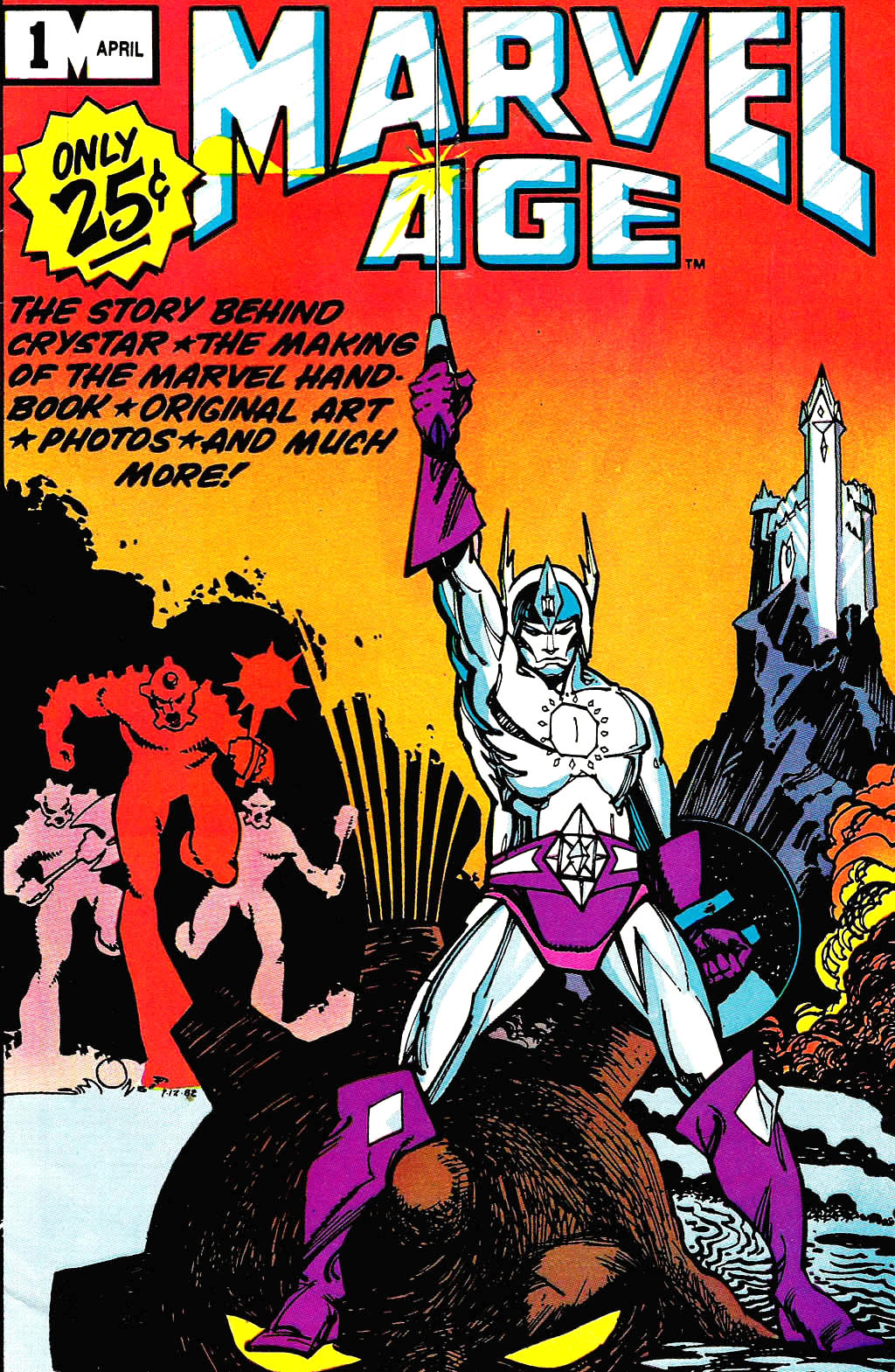


In 1982, I was still ordering my comics through the mail order service offered by Geppi’s Comic World in Maryland. I didn’t yet have a driver’s license, and my family’s new homestead was in a new development that was too far away from any center of civilization to get to easily by walking or bike-riding. So I’d bitten the bullet and signed up for C.O.D. home delivery–a situation that led to some nail-biting weeks when a package would arrive and I’d be counting up coins scavenged from all over in order to make the required amount. This also meant that I needed to select exactly what I wanted weeks earlier from an order sheet. And sometimes, information about those offerings could be scarce in those days. All of which is to say that I ordered the first issue of MARVEL AGE almost blind, knowing nothing about it apart from the title.
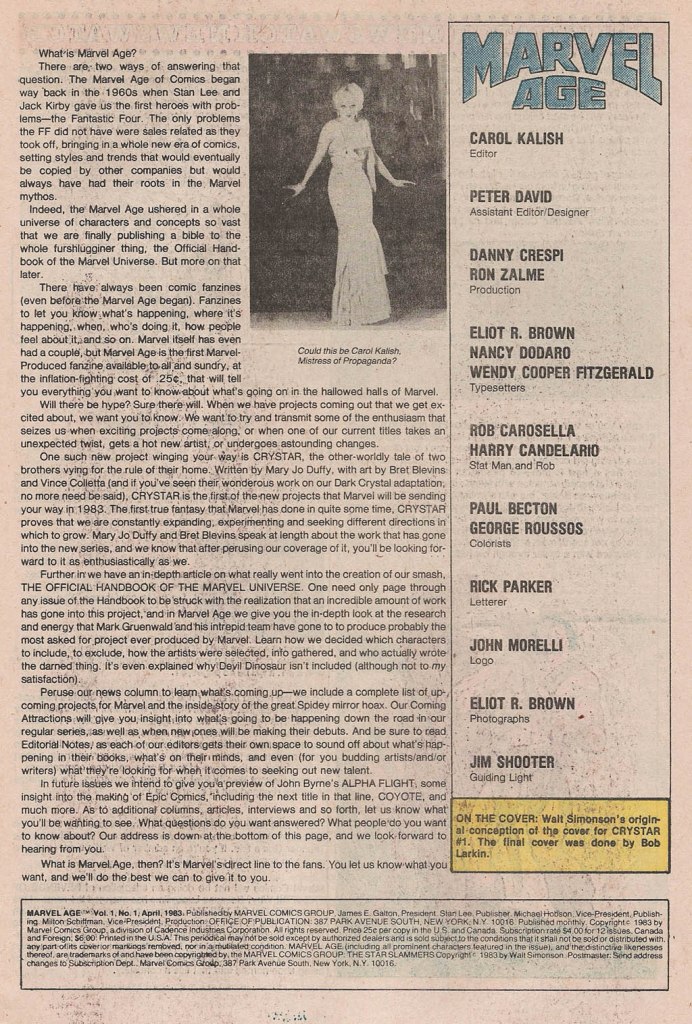
MARVEL AGE, as it turned out, was Marvel’s new in-house promotional publication dedicated to both showcasing whatever was new and upcoming at the House of Ideas and also to putting forward the Marvel perspective on whatever was happening in the world of comics. It was very successful for a long time, due in part, I’m sure, to its affordable cover price. This first issue only cost a quarter, and even once it went up to 50 cents (for more pages) it was still something of a bargain. All told, MARVEL AGE lasted for 140 issues over ten-plus years, which is quite an achievement.
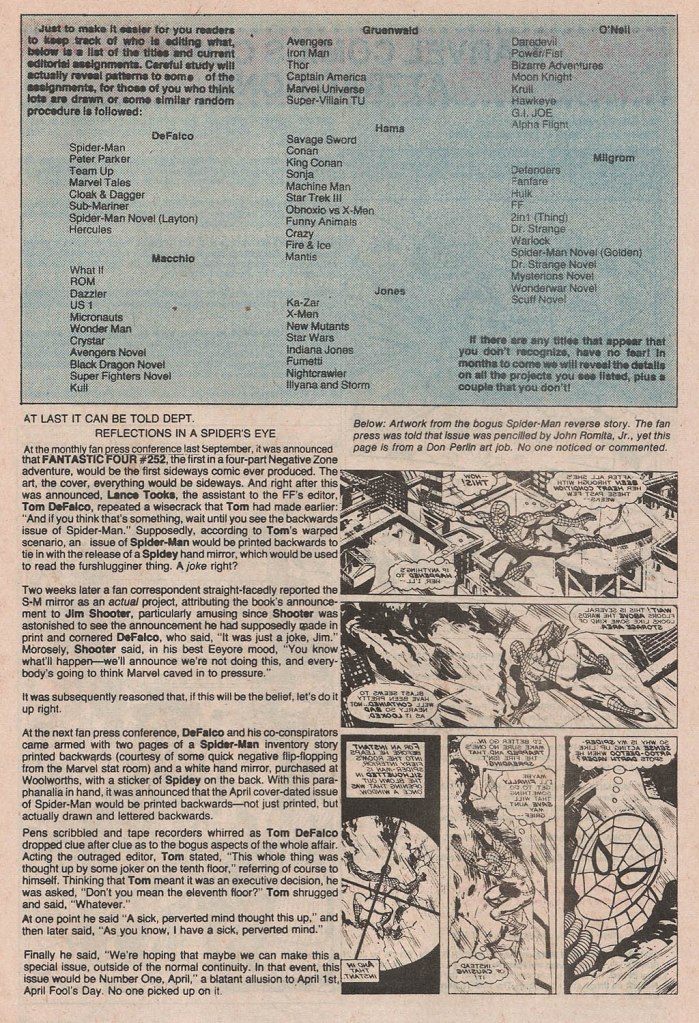
This first issue was produced by Marvel’s Direct Sales team under the command of Carol Kalish, who oversaw the initiative. A good deal of it was written and edited by future Marvel writer Peter David, who was then working on that department. I can remember this reporting of a joke made at a monthly fan press conference about a backwards issue of Spider-Man getting traction as a legitimate thing and then certain parties, notably the Comics Journal, becoming indignant at this reveal that the whole thing was a gag. It would be so wonderful if this sort of thing was the worst P.R. situation that anybody in the field had to worry about today.
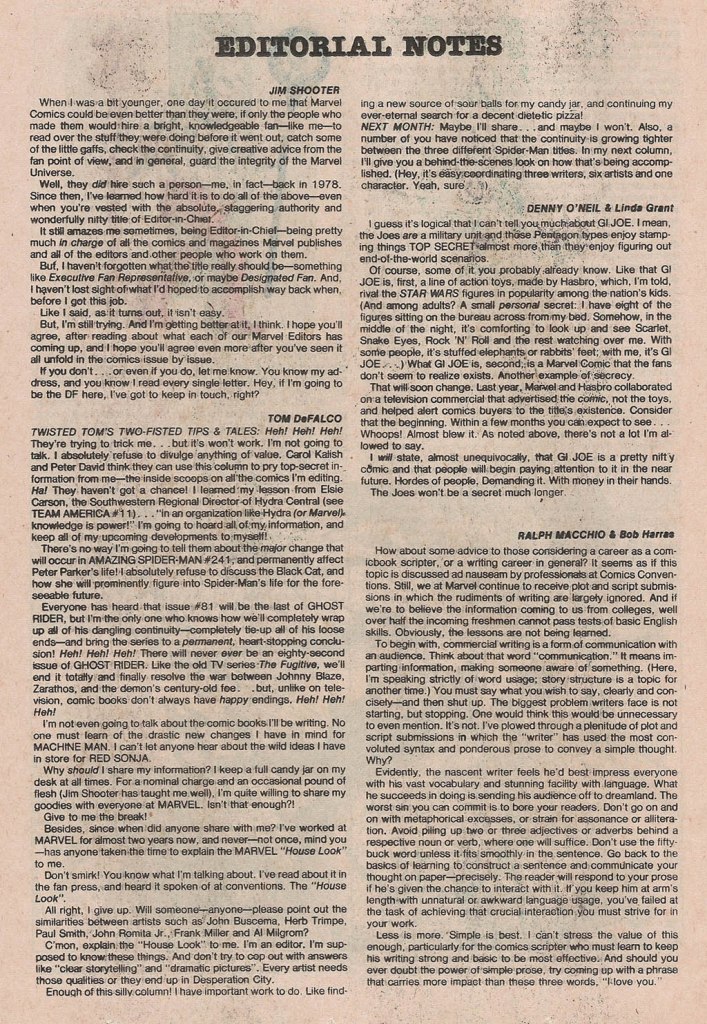
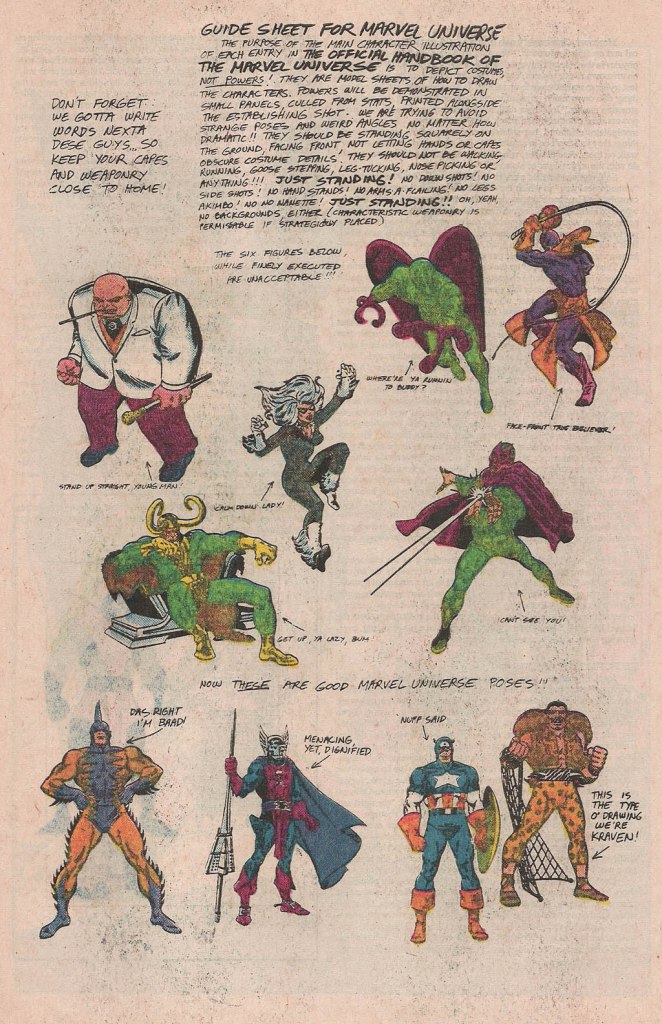
The opening section of the issue was devoted to Marvel Coming Attractions, sort of an expanded version of the Mighty Marvel Checklist from the old Bullpen Bulletins page with a lot more detail added in as well as some visuals. There were two feature articles in this inaugural issue, both of them penned by Peter Sanderson. The first gave a behind-the-scenes look at the development of CRYSTAR, a comic book and toy line intended to be a home-grown Marvel addition to G.I.JOE and TRANSFORMERS and the like but which never captured the attention of toy-buyers in sufficient quantities. The second was about the development of the OFFICIAL HANDBOOK OF THE MARVEL UNIVERSE, a project that would have a bit of a longer tail than poor CRYSTAR.
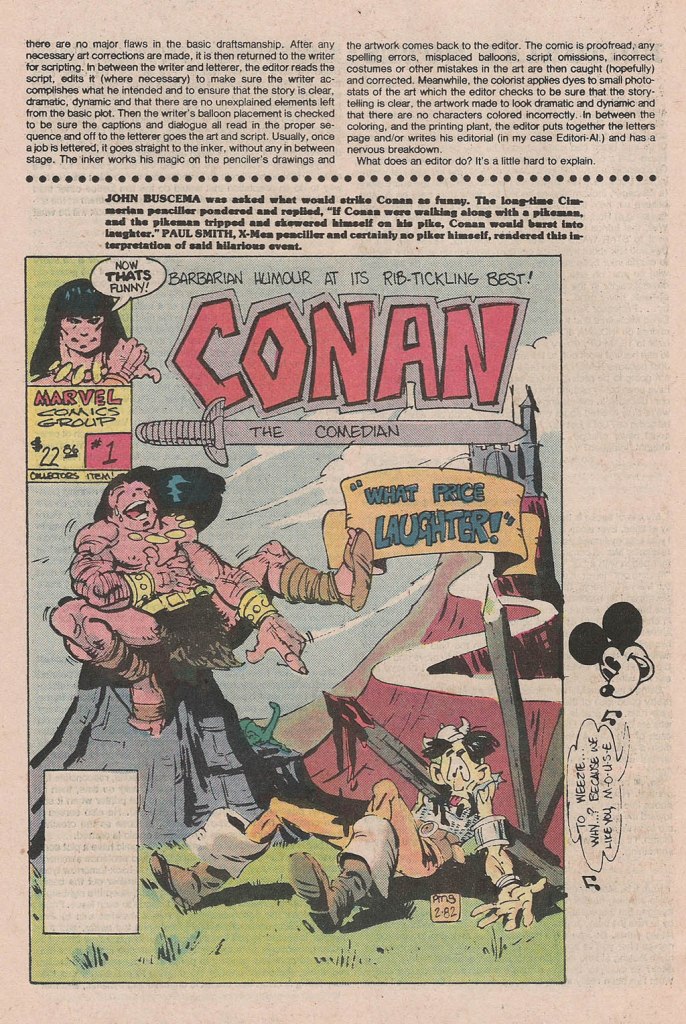
There was also an Editorial Notes section in which each of the main editors within the group wrote up some general thoughts about what was coming up, or making comics in general, or pretty much whatever struck them as momentarily diverting. Possibly the best thing from it was the above cartoon by Paul Smith, which he had faxed to Louise Simonson upon hearing an anecdote about John Buscema being asked about what Conan might find funny.
All in all, MARVEL AGE was a nice little behind-the-scenes package, especially for those who didn’t already have access to magazines such as AMAZING HEROES or COMICS FEATURE that covered the field broadly and which weren’t limited in presenting a company-approved opinion on whatever was being talked about. But for me, I was already starting to be plugged into that group of publications, and so I was a bit skeptical of MARVEL AGE. I did buy the first four issues, which carried things along up to the point where I stopped using Geppi’s Comic World to get my new books and instead dealt with picking them up locally. At that point, I didn’t read another issue of MARVEL AGE until I cane on staff at Marvel.


I remember Crystar in the sense I remember how forgettable it was.
LikeLiked by 1 person
I remember Crystar too. Remembered his name and look but was never curious enough to pick up and issue to see if I wanted one. I picked up Marvel Age from time to time ( I can’t remember I think either finished pages or rough ones ( Original Human Torch in Professor Horton’s lab? ) for Kurt Busiek & Alex Ross’ Marvels appeared in an issue — that is the kind of thing that probably made me pick some up ). Near the end I wish they had put Official Handbook profiles of characters Mark Gruenwald said he left out because they hadn’t been used in awhile — he promised a Handbook dedicated to those characters that never happened. I remember thinking that writers would probably use those characters if they knew about them and a Handbook would come in handy ).
LikeLiked by 1 person
I barely remember Crystar, but I do recall Marvel Age. And quite fondly, I’ll add. I say that because living on a tight budget which didn’t allow the other publications that Tom referenced, this book was essentially manna from Heaven above. Was it propaganda? Sure. But since 95% of my comic purchases were MC as opposed to DC, I didn’t mind. That and if nothing else, Hembeck’s page was always good for a chuckle or two. In the early 90’s, I recall the owner of the local comic book shop telling me that I was only still collecting this title.
LikeLiked by 1 person
If memory serves correct (which these days it rarely does), Westfield Comics used to provide “Marvel Age” free as part of one’s monthly subscription, so I had a steady run there for about a year-and-a-half starting in 1985.
LikeLiked by 1 person
i remember TV commercials for the Crystar “action figure”. No idea of the other characters involved. I think I saw sporadic issues on spinner racks.
Maybe if it had an animated cartoon TV show it could’ve raised its profile, & helped sales of both the toys & the comics.
Maybe “Insectoids” had a similar situation. Toys, comics, & a TV commercial . But no animated cartoon TV show.
The Marvel Age #1 cover by Walt Simonson looks good. The issue’s credits are impressive, too. Carol Kalish’s name I recognize sadly from the obituaries published after her tragic death. I think she was married to an artist, too. Brent Anderson?
Peter David, of course. Just a few years before his status of being in the top 3, then later 5, and eventually 10 selling comics writers at different points in his career. Still my fave Hulk writer. And his Spidey was darn good, too.
Harry Candelario was one of my early favorite inkers for Greg Capullo’s drawings, specifically Greg’s “Quasar”. Incandescent.
Paul Becton colored some of that “Quasar” run.And JR,Jr’s 1990 “Iron Man”(inked by Bob Wiacek). George Russo’s a comics art legend, colors & inking.
Rick Parker was a pretty prolific letter. Deservedly so.
Ellot Brown and Peter Sanderson were also almost everywhere a text piece or technical drawing was needed. Especially in the “Official Handbook of the Marvel Universe”. Top notch stuff.
I was so into comics that I frequently added “Marvel Age” to my buy list. I wanted the advance & inside scoop.
LikeLiked by 2 people
You’ve a keen memory of a number of stellar future talents. Most notable for me is Peter David’s “Hulk” that bolted an “also-ran” character into an absolute “must read.” I heard similar praise for his work on Spider-Man, but unfortunately, I never tipped my toes into that particular pool.
LikeLiked by 2 people
Peter also took over the New Universe title “Justice”. It was drawn by a young Lle Weeks. I wasn’t into the character or concept, but Peter & Lee kept me coming back each month. The new costume was almost like a cross between a helmet less Magneto and Nexus (lightning bolt, executions). With a trench coat.
I think his first high profile Spidey storyline was the death of police captain In ean DeWolf. After that, the great Mark Beachum drew just some of Peter’s Spidey. In either “Peter Parker, the Spectacular Spider-Man” or “Web of Spider-Man”.
LikeLiked by 1 person
I’m one of the teeny-weeny minority that liked the original Justice and didn’t care for David’s reboot at all.
LikeLiked by 1 person
And I have mourned Jean De Wolf ever since.
LikeLiked by 2 people
I liked her as well. My poor wife heard my explanation of Jean De Wolf’s comic book background on the way home from Spider-Man on its early premiere. More information than she wanted.
LikeLiked by 2 people
Has her brother ever appeared again?
LikeLiked by 1 person
The Steve Who Is Always Right. according to his Wikipedia the Wraith ( Brian DeWolff ) was driven mad by his sister’s death and attempted to take vengeance on the New York Police Department but was shot and killed by the Scourge of the Underworld. Later resurrected by Hood using the power of Dormammu and killed by the Punisher with an arrow in his chest. Unless someone brings him back or someone is already using the Wraith name it looks like it is up for grabs
LikeLiked by 1 person
I gotta see if some witches I know can contact Dormammu. I could be a good wraith. Think of all the money I’d save on food and property taxes. No need to sleep. Plenty of free time. Hmmm.
LikeLiked by 1 person
Not so sure about that, Tim. What if I think I’d be a better Wraith? More time to keep up with two blogs and make my wife happy by binge-watching TV with her. I would have more time to offer my thoughts on sites beyond comic books. I could bestow my knowledge on running, fitness, gardening, wine-tasting, union work, politics and Star Trek. With a name like the Wraith, it’d be easy to remember. And hey, I not only read Brian DeWolff’s MTU and Iron Man appearances back in the day, but I had to re-read them again for one of my blogs. That’s gotta count for something.
LikeLiked by 1 person
Yeah, you’d do a lot more good being a wraith than I’d be. I didn’t think of all those ways of helping people that you did. You’d be like a much nicer Spectre. While I’d be a less friendly Casper. 😉🙏
LikeLiked by 1 person
How about joint ownership? You can have M-W. I’ll go Th-F and we can alternate weekends. Besides, I want to be tangible for at least part of the time to enjoy all my hobbies 😉
LikeLiked by 1 person
i don’t think we’d be so lucky for that to work. Once you cross over, there’s no coming back. One the soul’s been sold.
LikeLiked by 1 person
Good point. What the heck. I’m going to retire in a few months and I can have that time without supernatural strings attached. As a result, it’s all yours.
LikeLiked by 1 person
Carol’s long-time partner was artist (and writer, editor, letterer, colorist and what else y’got?) Richard Howell.
LikeLiked by 2 people
Thanks, Kurt!
LikeLike
I apologize for thinking of the wrong person. No offense intended at all to Richard Howell.
.Re-reading “All-Star Squadron” last year, I think, his too few issues scattered in the late 20’s to early 30’s remain my favorites. Whether drawing or inking. The Spectre vs. Dr Fate story. And then Superman vs. Captain Marvel.
Richard added a real weight & dramatic lighting to Rich Buckler’s drawing (Supes vs. Cap) that elevated the everything.
LikeLiked by 1 person
I’ve always found Richard Howell to be a good, solid, underrated artist with a fun style. He drew one of my favorite versions of the Scarlet Witch, and I also enjoyed the vampire soap opera Deadbeats he wrote & penciled for Claypool Comics for over a decade. I’ve met Richard on a few occasions, and he came across as a good person.
LikeLiked by 2 people
I’ve known Richard since 1975, and he’s been a good person the whole time.
LikeLiked by 3 people
Did Geppi actually charge you for Marvel Age? When I finally signed up for a sub/pull list at my LCS (and future employer) in last 1983, one of the benefits was a free copy of it every month. A sub discount was a few years off.
My older brother bought Crystar, the same older brother who bought US 1 and Team America. Between these and the post movie Star Wars comics, his awful taste kept me out of comics for about five years after dipping my toe in in the mid 70s. 🤣
LikeLiked by 1 person
I saw that Paul Smith cartoon up on the wall in (I’m almost positive) Bob Harras’s office, and turned it into a short comics story, “Conan’s Favorite Joke,” drawn by Bruce Timm.
I had a history working on MARVEL AGE, as well, but not this early…
LikeLiked by 4 people
Am I the only one who bought the entire run of Crystar? I can’t tell you why I did so but I do remember liking it.
LikeLiked by 2 people
My father bought me Crystar #9 for me. I was eight years old, and I really enjoyed it, read it so many times it became pretty dog-eared. I’m surprised I never got around to looking for the other issues, but I did, not surprisingly, become a fan of writer Jo Duffy’s other work.
LikeLike
My older brother did and I know I read at least the first issue. I had no clue there were action figures but it sure read like a toy based comic. I also remember Nightcrawler showing up in a later issue.
LikeLiked by 1 person
Did any of those graphic novels Milgrom was listed as editor of actually appear?
LikeLike
Since folks are discussing CRYSTAR in the comments, I just wanted to pipe in and say that I loved the first issue of CRYSTAR when it came out. However my love was mainly due to the production quality. It was one of the first comics I’d ever read that was printed on Baxter paper, which made the colors really pop. Some of the lava-creature villains looked almost 3-D to me in some of the scenes. I was amazed, and it felt to my 12-year old mind in 1982 like the future of comics.
I never bought another issue, though. I think the reason that I dropped it was because subsequent issues were printed on regular paper, an obvious downgrade that now made it look like any other mediocre comic on the spinner rack. I think that one of the unintended consequences when a publisher gives the reader something and then takes it away is that the reader inevitably feels cheated. I felt the same way when World’s Finest Comics and G. I. Combat were no longer extra-long Dollar Comics, or when CARtoons magazine stopped offering free T-shirt iron-ons in each issue. It didn’t matter that I didn’t need the iron-ons, but once they were not there, it felt like the series was less than what it had once been. And that, I think, is what kept me from buying CRYSTAR after that awesome first issue.
As for MARVEL AGE, I collect the series now, whenever I find them in cheap bins. And back in the 1980s, I had acquired a few issues for free from friends of mine, and enjoyed them. But I only ever once bought an issue of MARVEL AGE when it was new, and that was #7 (Oct. 1983), which came out shortly before my 13th birthday. I very much enjoyed that issue, but it’s sneak-peek behind-the-scenes may have been too much of a good thing for me at the time. Weird as it may sound, it took away some of the innocence of buying Marvel comics for me. It was nice to know what was going to be hitting the stands, but on the other hand I began to miss the surprise of not knowing what to expect. The Official Handbook of the Marvel Universe, too, was a mixed blessing because it increased my knowledge of the MU, but made me long for the days of simpler comics aimed at the general reader and not the obsessive fan. Marvel Age had the unintended effect of making me want to get away from reading so much Marvel, to get a break from it all and try something else instead.
LikeLike
Even though I had started buying Marvel titles, I was a DC fan first and foremost (and with several smaller publishers ahead of Marvel), I had no interest in Marvel Age. It’s somewhat unfortunate, as I love reading (and now watching) about what goes into producing TV shows and movies, so I would probaly have been interested in it. I did however, buy and read Amazing Heroes for many year. Are there any issues that would be worth reading now? As I’ve subsribed to Marvel Unlimited I have access to all the issues.
LikeLike