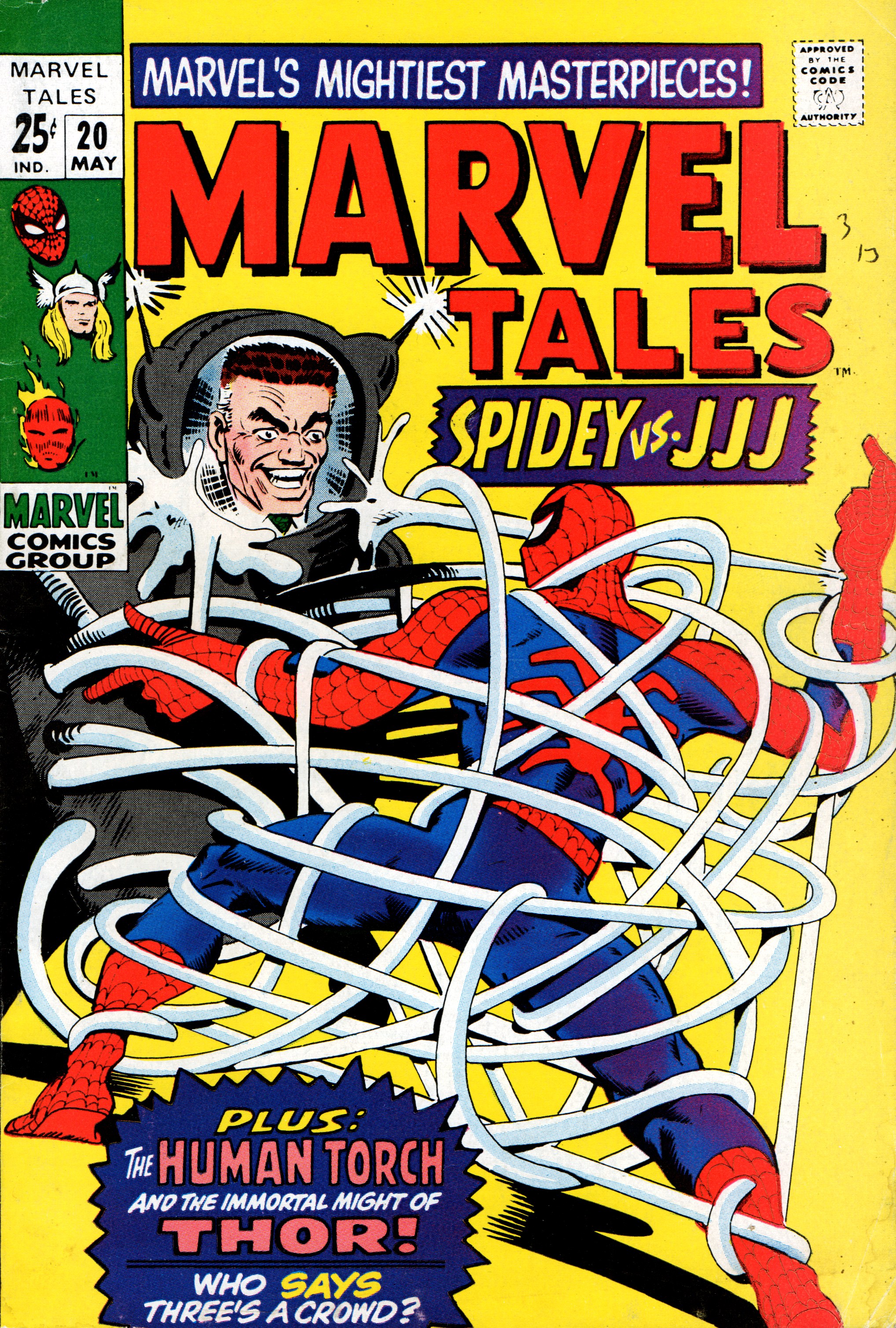


On my unanticipated trip to the Batcave comic book shop that weekend, I needed to make my meager funds stretch to their furthest. There was a cornucopia of back issues laid out before me. But I had only limited money with which to make my purchases. And so one of the books I wound up coming home with was this early issue of MARVEL TALES, the series that in the present reprinted AMAZING SPIDER-MAN. This issue, though, was from the same era in which MARVEL COLLECTORS’ ITEM CLASSICS was being produced, meaning that the issue was annual-sized and squarebound, and contained additional stories alongside the web-spinner. Plus, as a reprint title, it was cheap–reprint books weren’t accorded much of any value as back issues, at least during this time period, so they could be had for a relative song. I was most interested in reading the stories, so this was fine with me.
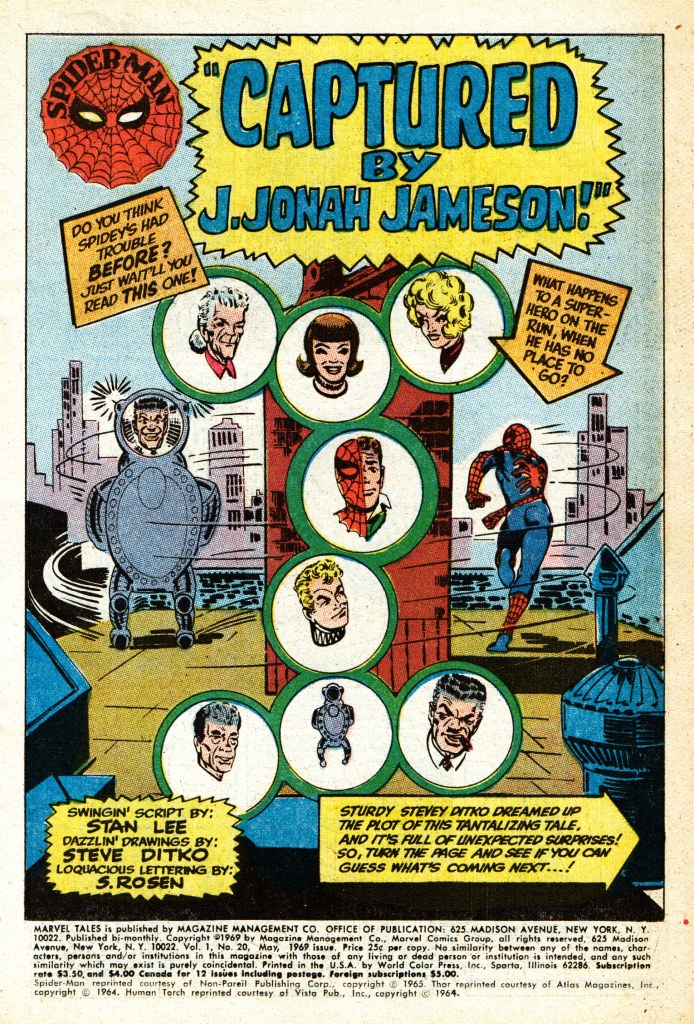
The lead Spider-Man story is something of a minor classic, and it’s one of my favorites from the early Lee/Ditko era. Or perhaps I should say Ditko/Lee, as this was the first issue on which Steve began receiving plotting credit for. He’d been doing most of the plotting for most of the run, and he felt that a creator should be correctly credited for his work. Lee couldn’t dissuade him, so from this point on until the end of Ditko’s time on the strip, he began receiving a plotting credit. Contrary to what some believe, this didn’t have any effect on payments. At Marvel at the time, “writing” a comic book was defined as putting the words on the page–that’s what was paid for. There wasn’t any functionality in the accounting department to pay for plotting, not yet (though it’s entirely possible that Lee increased Ditko’s page rate slightly as a way of getting him some sort of payment. But it’s also possible that he didn’t.) This story was later adapted in a stripped-down fashion in the 1967 Spider-Man cartoon (without giving Ditko any credit for the story there) so I was already familiar with it before I read this issue. But Ditko’s version is much more fun.

The story in a nutshell involves Daily Bugle J. Jonah Jameson being approached by Smythe, a scientist who’s invented a robot that he believes can capture Spider-Man, and who wants Jameson to fund his research. Peter Parker thinks the idea of the robot is ridiculous, and he eggs Jameson into buying into it–much to his regret when he discovers that the robot is far more dangerous and formidable than he’d anticipated. The whole thing is mainly an elaborate chase across the city with Spider-Man staying just one step ahead of his tireless pursuer. Meanwhile, at the Parker household, Betty Brant and Liz Allan are introduced to a character who’s been a running gag in the strip for several months: Mary Jane Watson. Aunt May had been attempting to set Peter up with her neighbor’s niece MJ for several months now, though she remained unseen. This is MJ’s first on-screen appearance and her features are obscured by household items and scarves and so forth all throughout it, maintaining the mystery of her appearance (though Betty and Liz’s reaction makes it clear that she’s a knockout.)
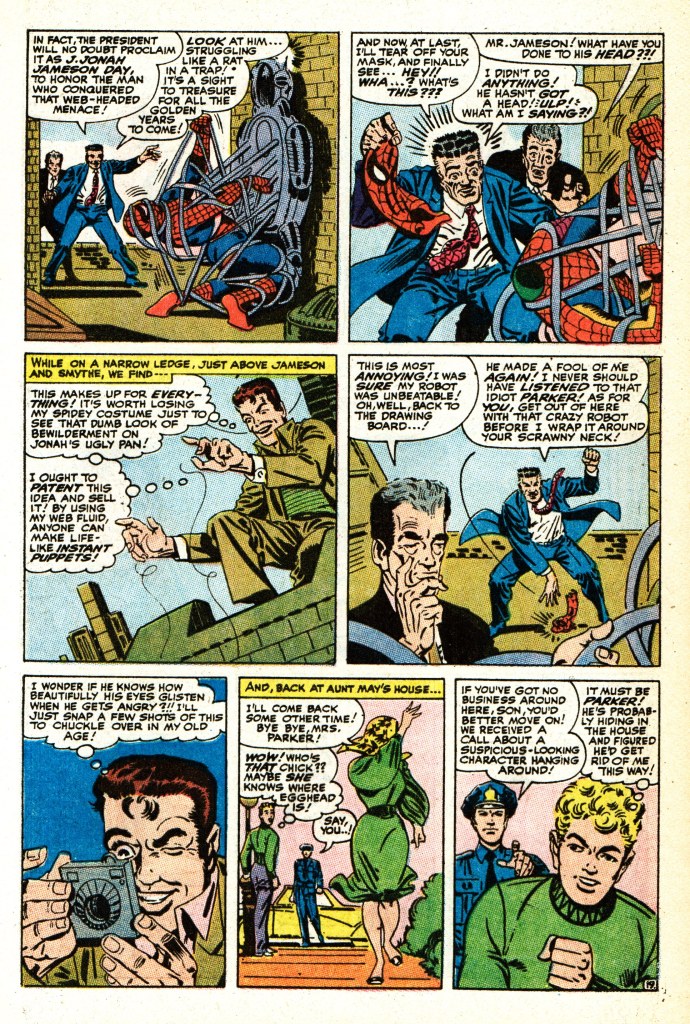
In the end, despite a good effort, Spidey can neither elude nor stave off his robotic pursuer, and he winds up captured, ensnared in a pseudo-web of unbreakable metal tendrils. Jameson and Smythe race to the scene, leaving the robot in lockdown mode, and Spidey takes advantage of this to use his science smarts to open up its workings and liberate himself. Then, he fills his costume with webbing, making it into a crude marionette, and waits for Jonah to show up. The moment where Jameson goes to unmask Spidey and instead pulls his head clean off is a classic. This gag costs Spidey his costume, and at the story’s end Aunt May discovers Peter’s spare, which leaves him without a uniform to wear–a situation that will cause him to have to go into action in the next issue in an inferior store-bought replica. Anyway, this whole story was a lot of fun, without any villain per se but with al of the strip’s regular players getting their time in the spotlight.
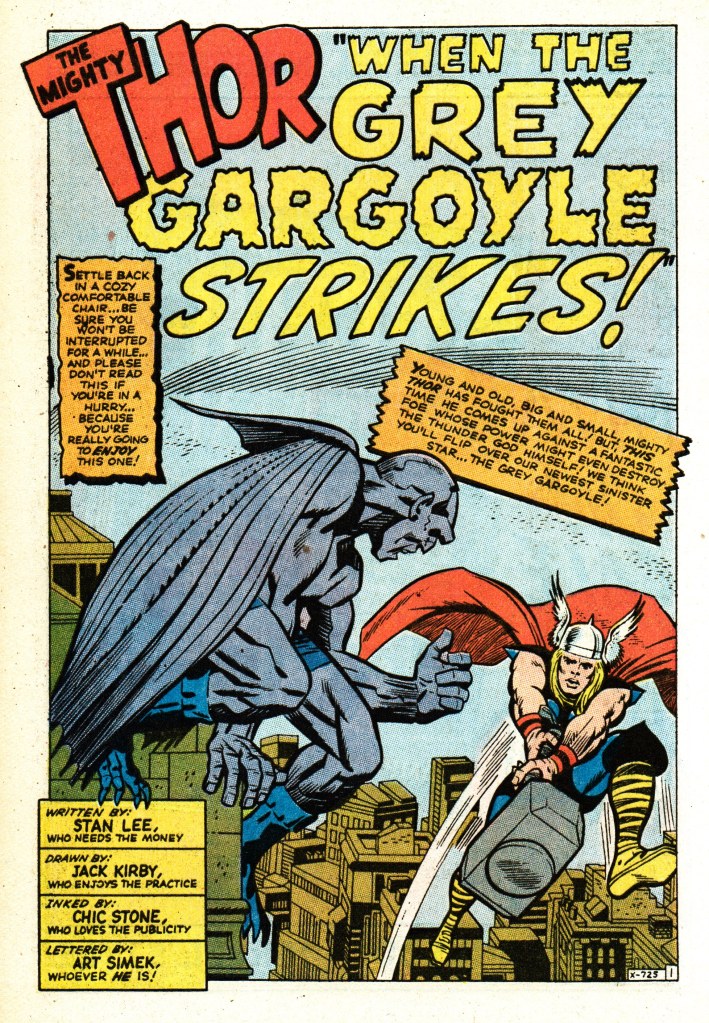
The second story in the issue was reprinted from the pages of JOURNEY INTO MYSTERY and featured the Thunder God, Thor. I wasn’t as huge a fan of Thor at that time, but any Lee/Kirby story was always worth reading. I’d come to see this one dramatized in animation a short while later as well, once my local station began syndicating the 1966 MARVEL SUPER-HEROES cartoon again under the title THE INCREDIBLE HULK AND FRIENDS in response to the popularity of the Green Goliath’s live action TV series. it introduces a new villain, the Grey Gargyole, who possesses the power to transform anything he touches into stone. I’d seen the Gargoyle already in one of the THOR issues I already owned, so he was a familiar figure to me.
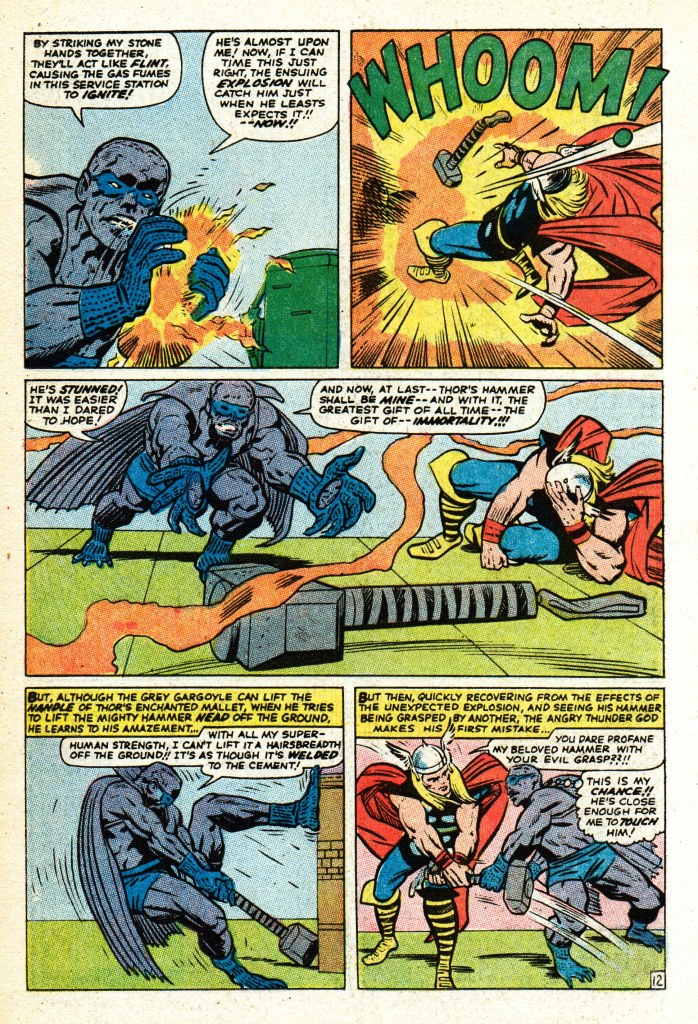
The Gargoyle has come to America from his native France with one objective in mind: he intends to steal Thor’s enchanted hammer, which he believes will make him immortal. He’s wrong, of course, but that doesn’t stop him from giving the Thunder God a proper tussle. In the end, it’s powerless Don Blake using a hologram projector helpfully whipped up for him by Stark Industries at Thor’s request who’s able to trick the Gargoyle into plummeting off of a riverside pier, where his stone form sinks to the bottom like a stone. All in all, it really isn’t one of Thor’s better stories of the period, but the artwork is great, and Lee’s snappy dialogue and melodrama are really working, so it’s still entertaining.
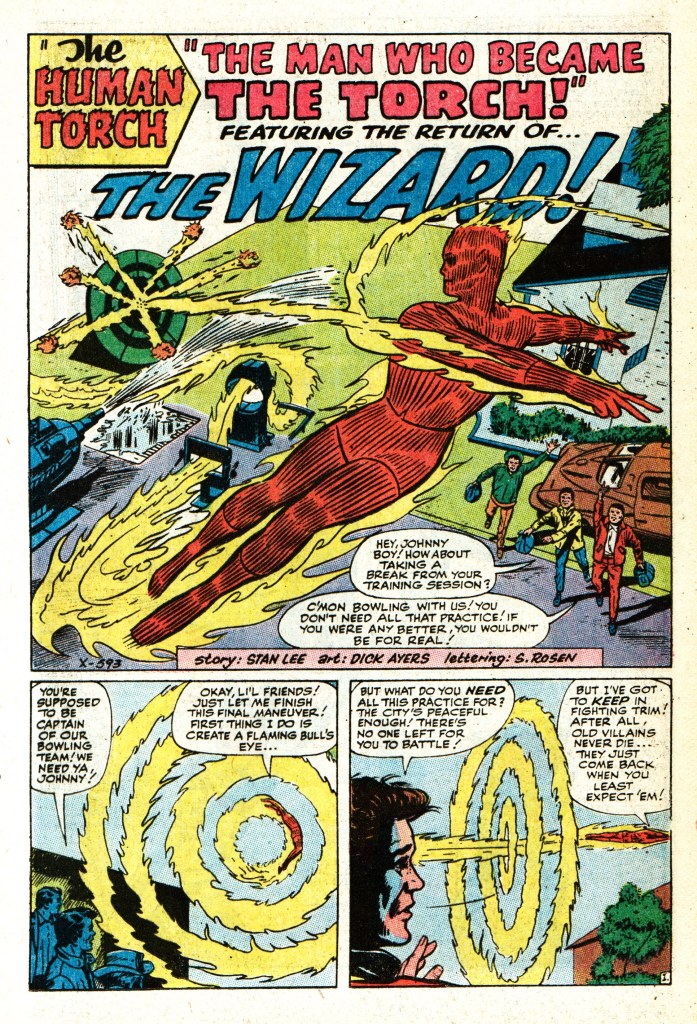
The final story in the issue was a bit of a step down from the other two features, even though it starred a character that I cared about a bit more: the Human Torch. it was from the early days when the Torch headlined his own solo series in STRANGE TALES alongside his appearances in FANTASTIC FOUR. This was no doubt motivated by publisher Martin Goodman and editor Stan Lee remembering how the Torch was a popular solo headliner all throughout the Golden Age of Comics. Anyway, artist Dick Ayers does his best here, but without the creative powerhouse of Jack Kirby, the story is a bit lifeless, and Lee doesn’t have much to work with. it really gives a sense of just how much of the lifting Jack Kirby had been doing on their stories together.
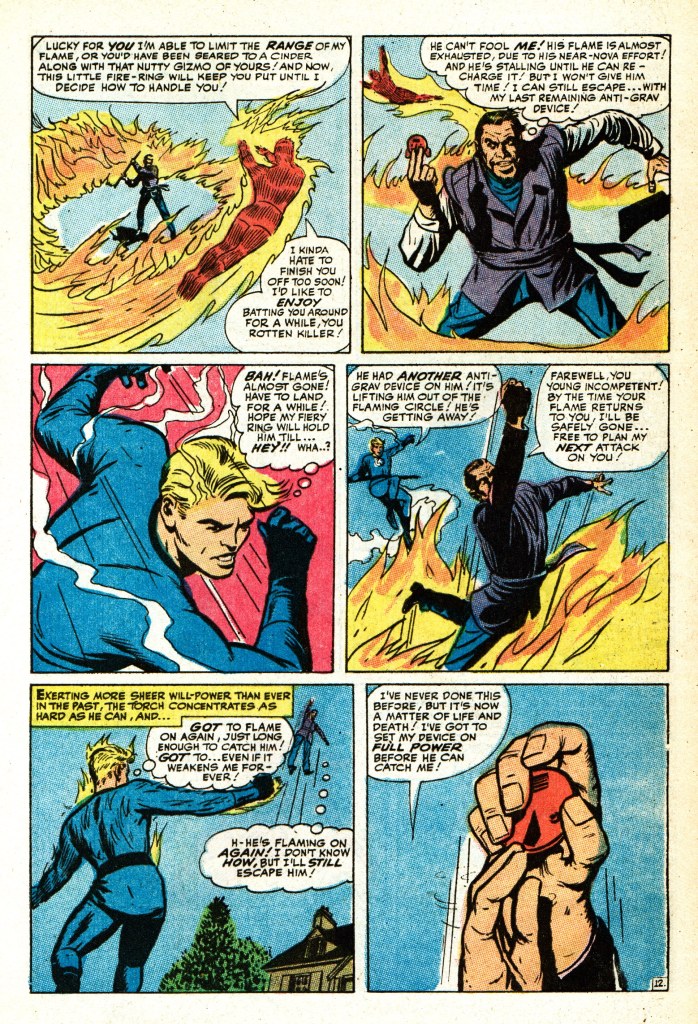
Anyway, this tale brings back the Torch’s recurring foe the Wizard, who was merely a super-smart criminal in these early days. In fact, this is the story in which he adopts his signature weapon: circular anti-gravity disks that enable him to fly and perform other feats. Using them, he’s able to capture both the Torch and the Invisible Girl and trap them in an advertising display for cigarettes containing a limited air supply so the Torch doesn’t dare use his flame. But the pair are cleverly able to alert Reed and Ben to their whereabouts and are rescued–at which point the Torch turns this into a grudge match with the Wizard and bests him. The Wizard’s final anti-gravity disk malfunctions, carrying him up into the stratosphere, never to return (until he did, of course, a few months later in FANTASTIC FOUR.)


My first thought about Mary Jane’s face being hidden in that story is you’d think this was a TV series: I remember when the character Root was introduced on Person of Interest but was only seen in shadow and her voice clearly was not that of the actor who would play her in the light ( Amy Acker from the Buffy the Vampire Slayer spin-off Angel ) or the actor whose face was hidden on that same Person of Interest series but was not Camryn Manheim ( who played a government Amanda Waller type ). Did Steve Ditko not have look for Mary Jane yet or was just about building suspense?
LikeLiked by 1 person
There’s a long tradition of what a friend calls “Mystery Mastermind Interior Decorating” where the mystery villain’s lair is laid out so we can’t see anything but his high-backed chair as he sits at his desk/monitor screen. Gerry Conway’s Mr. Kline is one example.
LikeLiked by 1 person
Do not – I repeat – do not say the name “Mr. Kline” again! Invoking it more than three times risks his return to comics and am not sure the industry could withstand that! 😉
LikeLiked by 2 people
Who was Istermay Ineklay? (Does pig latin prevent the Rule Of Three?)
LikeLiked by 1 person
I think he did have a look in mind, but that’s only a guess. More old-school glamor girl than the hip swinger Romita envisioned.
LikeLiked by 1 person
What a delightful tour through Marvel’s Silver Age! The Spider-Man story serves to me as a perfect example of how certain artists are absolutely perfect on certain books. While I greatly respect his legacy, Steve Ditko is not my favorite artist. When I see his work on some of Iron Man’s earliest appearances in Tales of Suspense, I’m not as impressed with his art. But those same odd poses and cartoony expressions are absolutely amazing on Spider-Man. I’ll add that I find Ditko’s art on Dr. Strange equally incredible – which is all the more impressive given how little both books have in common. All of which is a long way of saying I enjoyed every panel Tom shared of that classic story.
As for that long-haired Asgardian’s segment, I always had a soft spot for Grey Gargoyle. Sure, he’s a gimmicky villain, but thanks to Jack Kirby’s design, the guy’s a visual treat whenever he shows up.
Speaking of wonderfully dorky old villains, who doesn’t get a kick of The Wizard? Sure, the art doesn’t “pop” as much as the other two stories. But still, it’s a kick to peek at those old Strange Tales when Marvel tried to see if this Torch could fire up an audience like his predecessor.
LikeLiked by 2 people
I have to agree with you about Ditko. I hated his Iron Man artwork. Kirby and Heck really did Tony justice. Ditko’s artwork on Spidey was priceless though.
LikeLiked by 1 person
The cartoons mentioned above were where I first saw the Spider-Slayer, Smythe and the Grey Gargoyle. Marvel Treasury Edition#22 ( 1979 ) which Marvel Team-Up#13 ( September 1973 –Captain America; it had 3 other Marvel Team-Ups ) was my first Grey Gargoyle comic book story. But the Grey Gargoyle’s appearance in The Avengers#190-191 ( December-January 1979-1980 ) drawn by John Byrne is probably my favourite.
LikeLiked by 1 person
That issue of MTU was not only my introduction to the Grey Gargoyle, but Nick Fury and SHIELD as well.
LikeLike
Ditko’s brief Ironman output doesn’t have nearly the same spark as his Spider-man, but he did yeoman’s work imo by redesigning the suit, and just as importantly… devising the “how to” sequence of Ironman suiting up. Artwise… they’re a mixed bag, but there are a number of sequences and panels where Ditko’s unique storytelling choices come through even though he’s only doing light pencils or breakdowns. In TOS 49 he has Ironman tooling on his suit to repair it while he falls from the sky… something that would be considered a signature move for the character now.
Tales of Suspense 47-49 are strange on multiple fronts: three different inkers, three lackluster antagonists, and a total redesign of the central character’s look. Was Ditko filling in or trying out? I know he was offered the strip and didn’t want it… so maybe this was a test and he just decided “nope”?
LikeLiked by 2 people
You’re right about the redesign of Iron Man’s armor. I would be curious to know if that’s all Ditko or if anyone else had input into that important redesign. I will also say “ditto” with Ditko’s panels of TS suiting up. As for the adversaries, where would my Iron Man’s blog be if I didn’t have Mr. Doll to continually pick on?
LikeLiked by 1 person
And yet Marv Wolfman rebooted the oh-so-forgettable Mr. Doll into the much more entertaining Brothers Grimm.
LikeLiked by 1 person
Steve Ditko was the best at panel-to-panel fight choreography, better even than Kirby. The way the action flowed through those 0-panel grids was incredible.
LikeLike
Arrgh! 9-panel grids!
LikeLike
That should be 9-panel grids, of course.
LikeLike
I think by this point I knew the Torch solo stories were crap so neither that nor theThor story would have appealed. Never having enjoyed Ditko’s art, maybe having seen Kane and Romita’s work first and them being more the style I liked was also a strike against me touching this book back then.
LikeLike
Regarding the Spider-Man story, Ditko clearly created Mary Jane Watson.
LikeLike
Ditko created a placeholder labeled Mary Jane. Romita created her look and Lee created her character.
LikeLiked by 1 person
Ditko created her then Romita, Lee, Gerry Conway and others developed her. Her movie star looks and bubbly personality were there from the start, then not really developed much beyond that until Conway wrote her.
LikeLike
So if a creator draws a shadowy figure and a different creator comes up with the details never present or hinted at for a Big Reveal later on, the original creator gets the ‘created by’ despite having done nothing substantive by that logic. I don’t think we’ll ever agree on who created the character of MJ and that’s cool by me. It’d be boring if everyone acknowledged I’m always right.
LikeLike
Marvel.fandom.com settles it: Mary Jane Watson’s creators are Stan Lee, Steve Ditko and John Romita Sr.. Her wikipedia says the character was created by Stan Lee and Steve Ditko, making her first appearance in The Amazing Spider-Man#15 ( August 1964 ), and subsequently designed by John Romita Sr. in #42 ( November 1966 ). She has 3 creators.
LikeLike
Comics’ attribution of creation has always seemed bizarre to me. Not the case here but I’ve seen arguments that an artist drawing one panel of a character on a last page of a story who never draws them again is thus one of the creators. Here, Ditko basically only created her figure. Everything that makes MJ Mj was Lee and Romita. Let’s just agree that we have different opinions of whether an artist gets to be called creator when he adds nothing of substance to said character.
LikeLike
One of my favorite Spidey stories.
Ditko does a great job of selling the Spider-Slayer as an absolutely formidable and terrifying threat, and it actually feels like it could slay Peter Parker! Like a 1960s Terminator.
But at the same time, Ditko makes the damn thing look utterly ridiculous in its general shape, and with JJJ’s face constantly leering and gloating through a completely nonsensical TV monitor on its head. Not only is Spider-Man facing utter defeat, but also in the most ludicrously humiliating way imaginable!
LikeLike
And yet it has a down-to-Earth quality, like something that Smythe cobbled together in his garage. Not as if Ditko put any thought into it, even though, as you say, he did. As many people have said, one of the secrets of really great artists is that they make it look easy.
LikeLiked by 1 person
So the Grey Gargoyle wanted Thor’s hammer because he thought it was the source of his immortality which meant he believed that Thor was who he claimed to be, so why risk the wrath of Odin by going after his son? I know Odin doesn’t have Zeus’ Greek Mythology’s reputation ( To quote the A-Team’s B.A. Baracus, “I pity the fool!” — in this case that would be to those that do harm to Thor or Hercules, in the case of the Greek gods they don’t need to be Zeus, Hera, Poseidon, Hades class to mess you up ( turn you into a plant, animal, rock, monster, curse you or drive you mad ) ). Plus I can’t help but wonder if the Grey Gargoyle was wasting his time chasing the thing he might already have thanks to his stone form. Wouldn’t his aging stop while in stone form and restart at its normal rate once in human form?
LikeLike
There’s a famous Norse legend about a giant stealing Thor’s hammer, and Thor and Loki have to try to get it back. Odin doesn’t intervene at all. Thus, I’d say Grey Gargoyle would be justified in not worrying about that. Thor gets into all sort of dangers, and Odin seems to take the view that daddy shouldn’t interfere with his (arrogant, headstrong) son’s fights. He’s not exactly a “helicopter parent”.
The immortality bit is indeed odd though. I think the story would have worked better if GG had heard the legend about stealing Thor’s hammer, and decided that he (GG) could succeed where the giant failed, in stealing the hammer and then ransoming it.
LikeLike
If I remember that myth correctly Thor had to dress in drag in a plot to steal the hammer back( and Google AI confirms this and the reason for the disguise: The giant Thrym stole the hammer and demanded the goddess Freyja’s hand in marriage as ransom, she refused so Heimdall suggested that Thor dress up as the bride which he reluctantly agreed. Loki disguised as a maidservant to do the talking. The wedding feast ( Thor almost blew their cover with his massive appetite and fiery glowing eyes, but Loki had a lie about “Freyja” being so excited for the wedding that she had fasted and stayed awake for 8 long days and nights ) the hammer was brought out to bless the wedding, but once the hammer was in Thor’s hands he ripped of his veil and disguise, and slaughtered Thrym along with all the assembled giants.
LikeLiked by 1 person
Also, the Marvel Odin behaves more like Zeus in that he punishes Thor either by stripping his power of cutting in half or banishing him, so he does that to his own son for minor things ( Your not in Asgard enough, I need you — but dad you are more powerful than me, so you need me why? ). In Norse Myth they punished Loki for Balder’s death ( Didn’t they do that in Marvel too ). In Norse Myth Odin and Thor were rivals: Odin viewed as the god of the elite and warrior aristocracy and Thor who was favored by common farmers. The myth with Odin, Thor and Starkad demonstrates this: Odin and Thor famously came together to place competing alternating blessings ( Odin ) and curses ( Thor ) on Starkad, a legendary, giant-descended human hero, creating a tragic tug-of-war over his destiny ( Google AI ).
LikeLike
I had to click on the YouTube link to the animated cartoon episode. Always loved the “groovy”, jazz-influenced musical score. And some of the re-used stock swinging sequences. Paul Soles was Peter/Spidey. He also voiced Herbie the Elf dentist in “Rudolph the Red-Nosed Reindeer” from Rankin-Bass. Paul Kligman, Carl Banas, and Peg Dixon were also in both voice casts.
LikeLiked by 1 person
The MJ moment in this issue seems to me to be another collaboration misfire.
By hiding MJ’s face, it looks like Ditko is playing the scene for suspense — Betty and Liz react to her, but the reader shouldn’t know whether they think she’s gorgeous or hideous; the dialogue would indicate that they’re surprised, but not quite how, so the reader’s left wondering what MJ looks like and is anticipating the upcoming reveal even more. Instead, Lee has two moments that confirm that MJ is a knockout, defeating the point of hiding her face at all.
Ah well. Comics!
LikeLiked by 2 people
My two cents: Liz and Betty’s reaction being vague when they meet MJ might have meant for an interesting or funny “is she” or “isn’t she” panel, but it wouldn’t have set up MJ as a wedge between Betty and Peter. Peter doesn’t even know MJ (and not seeing her face means the reader doesn’t either), but Betty becomes unfairly jealous… that story point doesn’t work nearly as well if MJ isn’t stated to be a knockout.
LikeLiked by 1 person
I tend to agree. Even going only on body language, Betty and Liz might look stunned if MJ was either beautiful or ugly– but on the subsequent page, they’ve no reason to act diffidently toward Parker unless they both think they’re outclassed by MJ. Also, Ditko had done at least two jokes about Parker not wanting to meet MJ. I don’t remember just how Parker justifies this reluctance– he was too polite to say “any girl set up for my aunt and her friend must be a DOG”– but if he’s afraid she’s a woofer, and then she really is a woofer, there’s no conflict of expectations.
LikeLike
Based on their reaction she’s either a stunner, she’s scarred like Doc Doom, or she’s someone they both know and are shocked to see…. it might have worked out if their initial reaction wasn’t spelled out exactly I guess. But the ultimate reveal was still a pay off.
Also… sharing this pic by my photo professor from college (this dog is also a looker) Very sure he never saw the Ditko panel : https://www.instagram.com/p/DcQH1u6AD_U/
LikeLike
It’s a flower eats dog world, after all.
LikeLike
I gather Ditko had such a deterministic mindset that he never would have done such a thing, but part of me still wonders if he ever left things ambiguous enough in his pages and story notes just to see what Lee would do. From the art, you can easily see Betty, Liz, and Flash reacting to Mary Jane thinking that she looks like the Elephant Man.
LikeLike
I just read/reread these stories (although in the issues they were originally published in). Some fun stories, but not outstanding in my opinion.
I had read the Spidey story in Marvel Mastwerworks Vo. 10, but I really only remembered the end of it with the hidden Mary Jane. Personally I don’t really like Ditko’s faces in his Spider-Man work, and I’m not sure MJ’s reveal would have wowed as much if he had drawn her face.
I don’t recall the Thor story at all, but I’m pretty sure I read it in Marvel Masterwoks Vol. 26. I’m not sure why the Grey Gargoyle thought it was the hammer that made Thor immortal. And as wriiten by Lee it seems that the story starts at the end of the day, but then Thor brings the stone taxi driver to Blake’s office and it seems as if it’s earlier in the day (and Jane Foster is still there). Other than that I liked the story and think it was a nice twist that it was Don Blake who was the one who defeated the Grey Gargoyle.
I had not read the Human Torch story before and I enjoyed it. I also like Dick Ayer’s art a bit more than Kirby’s (but then I have have never been a Kirby fan). I do have issues with the Wizard being able to disguise his face so easily, what with him having a beard and mustache. Despite Stan claiming actors’ putty made from crayon wax would hide the facial hair I think it would just make it obvious he wasn’t the guard or Jonny Storm (and totally off subject, but Batman wearing a face mask of Alfred over his cowl – and very pointed ears – in The Brave & and Bold #141 is much worse).
https://1drv.ms/i/c/05dcb20a6dea90d4/IQB41xvaQhcYRq0U2G52mb9GAfBfhMn-T-ru05R2WFA4Nvs?e=5LbrJ2
I also think it interesting that the Thor story ends with the villain sinking to the bottom of the ocean and the Human Torch story ends with the villain rising into space.
LikeLike
Seeing that panel again brought a smile and this time I pictured the Bat-Ears retracting with pressure and popping up like a Jack-In-The-Box when the mask is removed.
LikeLiked by 1 person