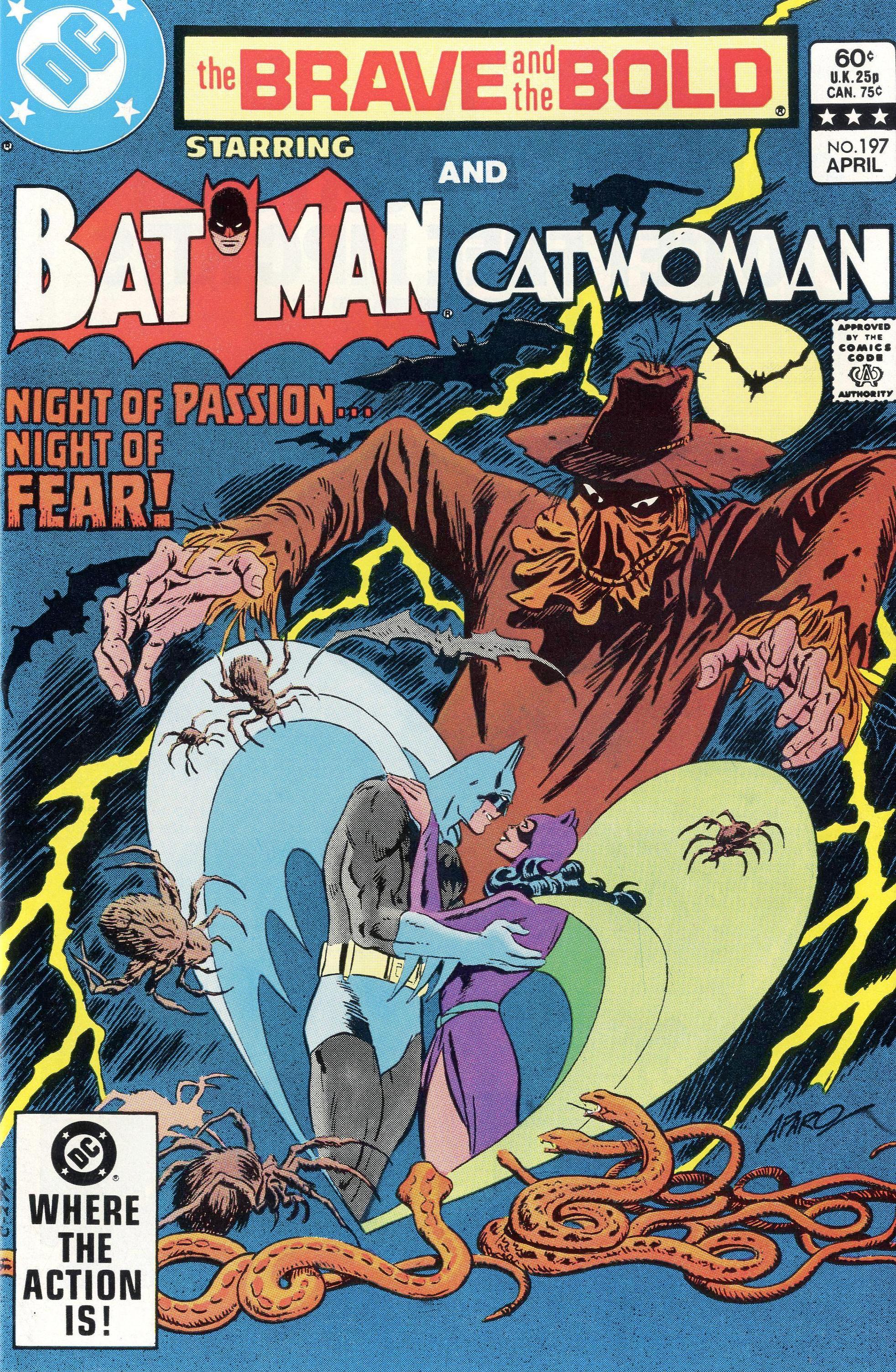


BRAVE AND THE BOLD had almost run its course at the point when this issue first came out. It was something of a holdover of a rapidly-diminishing era, one in which comic books were largely an impulse purchase by entertainment-hungry buyers. In those days, team-up titles typically did well, giving a reader two characters for the same price as one. But as emphasis shifted to the more fan-oriented Direct Sales marketplace, such books lost their luster. Their stories were more often than not modular and forgettable–they didn’t “count”, didn’t matter to the ongoing continuity. And so one by one they wrapped up, replaced by more modern titles. But B & B still had some life left in it, and the story in issue #197 has gone on to become an acknowledged classic. It’s been reprinted a bunch of times over the years, because it’s genuinely terrific.

Writer Alan Brennert is one of the great almost-was stories of the era. His primary vocation was as a television writer, a field in which he’d had some considerable success. But he was also a huge fan of comic books, and he took advantage of his credentials to break into the field, producing one classic story after another. Had he dedicated himself to the medium full time, I expect we might speak of him today the same was we do Alan Moore. But television was simply too lucrative for him to walk away from, so he remained a “tourist” in the comic book field. His overall body of work is relatively small, but it’s just one home run after another–and this issue was no exception. It was set on Earth-2, the parallel world on which the original Golden Age DC heroes lived, which meant that I was already on board with it, being a massive fan of those characters. Even the cover uses the original Batman logo rather than a more modern equivalent, signaling just when this story is going to be set. It’s all about the original Batman’s final case.

The story is set in 1955, though it’s narrated from the vantage point of the modern day as an older Bruce Wayne writes his memoirs of those earlier years. The story opens with Batman being summoned by the bat-signal to police headquarters. But as he arrives, Commissioner Gordon sees the Caped Crusader shot down before his eyes. This, as it turns out, is a fear-based illusion: the Commissioner has summoned Batman to tell him that the Scarecrow is at liberty once again. But Batman has other concerns at the moment. His old girlfriend Linda Page is getting married, and having to attend the ceremony has him feeling old, and contemplating what his life is going to look like when he is no longer spry enough to be Batman and after Robin has gone off to college and Alfred has retired. He’s facing a foe that he can’t overcome so readily, his own mortality.

The Scarecrow attacks the wedding ceremony, since it’s known that Linda Page is a friend of the Batman. Robin and Batwoman are also there, but the Scarecrow hits Batman with a chemical bomb, and before his eyes, his friends start to melt away into nothingness. The Scarecrow’s toxin has seized upon his Autophobia, his fear of being alone, and caused Batman to not be able to perceive any of his friends or allies. Special note needs to be given here to artists Joe Staton and George Freeman who do a wonderful job of capturing the design flavor of the 1960s Batman while still making their pages look kinetic and modern.

Bereft of allies, Batman decides to turn to an old adversary for help: Selina Kyle, the Catwoman. In a 1950s story, it had been revealed that Kyle’s Catwoman persona had been the result of amnesia, and so she was serving out a shortened sentence for her crimes. But when the obviously-disturbed Batman seeks out her help, she’s quick to don her costume once again. The pair pursue the Scarecrow, who is able to stay one step ahead of them all the way, exposing them to a series of different phobias in an attempt to find their Achilles heel. What’s more, Batman begins to realize that Catwoman knows more about her former criminal career than she ought to given her amnesia. As they pursue the case, the two grow closer, and Batman confesses the secrets of his origin to Selina.

Batman’s condition, and his obsession with getting his lost friends back gets worse and worse as the quest continues, and the Scarecrow is able to stay just one step ahead of the pair. In frustration, Selina lets slip that the reason she first became the Catwoman was to stop feeling powerless, and this reveals to Batman that her amnesia was all a feint, a trick. Catwoman tells Batman that the reason she made up that story was that she was getting older and she wanted a fresh start, a chance to find love and have children. Batman tells Selina that she found a way back to herself, but that he doesn’t know how to do that for himself, and the two lovingly embrace.

But the Scarecrow has one final gambit left: he imbues Batman with intense Ailurophobia, a fear of cats, and Catwoman with Chiroptophobia, a crippling fear of bats. There’s only one way for the pair to overcome it, and Selina realizes it, removing her cowl and unmasking. Batman, of course, has to overcome decades worth of conditioning to do the same–but he does, and find his way back to Selina. The Scarecrow is still out there, but it’s a secondary problem to be solved (Bruce reveals in a caption that he eventually tracked him down) but the real issue of Batman’s solitude has been conquered.

There’s a lovely one-page epilogue that brings matters up to the present day, a time at which both the Earth-2 Selina Kyle and Bruce Wayne had perished. The whole story is at once a terrific little continuity implant that plays fair with the established stories up to that point, but more importantly a moving tale about Batman finding true love. As much as anything, I feel like it was this story that made the inevitability of a Batman/Catwoman pairing such a driver for the fan community. The two had been paired romantically on occasion prior to this (their marriage was established in the backstory that introduced their daughter, the Huntress) but this is the story that sold it on an emotional level.

Also worth looking back at is this month’s installment of Executive Editor Dick Giordano’s regular Meanwhile column. This was a kind of equivalent to Marvel’s Bullpen Bulletins and succeeded Jenette Kahn’s Publishorials. Dick’s pieces were always conversational and pleasant, and they struck a necessary tone in establishing the “New DC” as an exciting and inviting place. This particular column promotes a number of upcoming projects, including a few that would go off the rails a little bit. The DC COMICS PRESENTS ANNUAL spoken of here wound up coming out as a SUPERMAN ANNUAL instead, and the JLA/AVENGERS crossover is a saga in and of itself. This may have been the first place that I heard about it being in the pipeline.


An absolute classic.
Alan Brennert did an incredible job scripting this story. The artwork by Joe Staton & George Freeman is beautiful. The layouts & storytelling by Staton on page 19 are astonishing. And I love the cover by Jim Aparo, which manages to be simultaneously atmospheric and romantic.
I first read this around 1990 when I picked up The Greatest Batman Stories Ever Told, in which it was reprinted. I’ve lost count of how many times I’ve re-read “The Autobiography of Bruce Wayne” since then.
About a decade afterwards, I was at one of the Big Apple Comic Con shows in the church basement near Columbus Circle. Joe Staton and Jim Aparo were both guests. I happened to find a copy of The Brave and the Bold #197 for sale relatively inexpensively at that show. I got it autographed by Staton, but unfortunately Aparo left early so I wasn’t able to get his signature, and he passed away a few years later.
In any case, I do consider this to be one of the best Batman stories ever published. As I’ve said before, I really do wish Brennert had written many more comic books. Well, Tom, at least you got to work with him several years ago.
LikeLiked by 3 people
IMHO this issue is one the Best single standalone Comics stories ever written. Also its a perfect companion to DC Super Stars 17.
LikeLiked by 2 people
If you can find or afford a copy, I highly recommend getting the collection “Tales of the Batman: Alan Brennert”. It seems like it’s out of print, priced around $50 on eBay. It collects the above story and others, full of gems and classics.
LikeLiked by 3 people
I got it when it first came out. Agreed, it’s a really good collection.
LikeLiked by 1 person
So damn good, so damn moving.
LikeLiked by 1 person
I recognized George Freeman’s inks right away. He drew and inked the lead story in “Batman” Annual # 11, 1987, “Mortal Clay”, written by Alan Moore. That story was something else. Much more skin deep. On another level than anyone else before him in the Bronze Age. And Freeman managed to capture the similar figure power and size of Miller’s recent Dark Knight, with the energy and elegance of Sprang and Robinson. So his fine touch is very welcome over Joe Staton’s clean, kinetic work.
I miss seeing the credits page. Did George Freeman color this issue, too. Otherwise I’d just be guessing who the colorist was. Adriene Roy was also top notch, and very active on the Bat-books in the 1970’s through the 1990’s. Though it could’ve been her husband, Anthony Tollin. I don’t think it was Jerry Serpe.
I think letterer Ben Oda was retired by 1983. John Costanza and Tod Klein were both pretty busy back then.
LikeLiked by 1 person
I don’t have the issue in front of me, but according to the GCD the story was lettered by John Costanza and colored by Adrienne Roy, with the cover colored by Anthony Tollin.
LikeLiked by 2 people
Hey, thanks, Ben! I forget there are resources like the GCD. I’m glad Gotham City provides that. 😉
Adrienne might have colored 1,000 issues. At least hundreds. Reading comics for decades, you start to look forward ro seeing those familiar names. Associate them with the material you like. And then miss seeing their names when they’re gone from the credits.. Nothing compared to the family and friends left behind. I was sad to hear about her passing. And that was quite a few years ago now.
LikeLike
The best tear jerker Batman has ever starred in. It made me wish for stories of the couple throughout their years married. Mister and Missus Batman would have been as much fun as the Superman version.
LikeLiked by 4 people
The Mr and Mrs Superman story in SUPERMAN FAMILY #211 features the couple at Bruce and Selina’s wedding – a series I would buy in an instant if DC ever collects it.
LikeLiked by 2 people
I’ve been a fan of George Freeman ever since I saw his cover for Captain Canuck #13.
LikeLiked by 1 person
I absolutely LOVE this story. I was 10-years-old when this issue was released. I didn’t start reading comics regularly until about a year-and-a-half later, so this must have been an impulse purchase when I was out and about with my father. I was oblivious to the DC multiverse at the time, so I was baffled by the reference to “Earth-Two” on the first page, but I went with it and just assumed that Earth-Two was where all the DC characters lived and that we, the readers, lived on Earth-One. I can’t remember when I figured out the correct explanation. My incorrect assumption didn’t impact my enjoyment of the story which is still one of my all-time favorite Batman stories.
Brennert and Staton did another terrific story together several years later in Secret Origins #50 that told the streamlined post-Crisis origin of Black Canary. Not only was it a really good story in and of itself (and soooo much better than Black Canary’s almost comically convoluted pre-Crisis origin by Roy Thomas and Gerry Conway), but it also elegantly tied together the post-Crisis history of Gotham City in just 20 pages (interweaving Black Canary and her mother, Batman, Alan Scott Green Lantern, Ted Grant Wildcat, and Mike W. Barr’s Reaper character into one interconnected timeline). Like this issue of Brave and the Bold, that issue of Secret Origins was kind of a masterclass in comics short story writing. Both are included in that Alan Brennert hardcover collection that DC released about 10 years ago.
As a kid who preferred the more “realistic” interpretations of super-heroes drawn by George Perez and John Byrne, I’m kind of surprised at how much I’ve always liked Joe Staton’s more cartoony artwork. But he’s always been a favorite of mine (DC needs to release an omnibus collection of his Green Lantern run with Steve Englehart from the 1980s). George Freeman was another favorite. His inks on Staton’s pencils are terrific, but I also really liked him as a penciler as well (I think he penciled an Alan Scott issue of Secret Origins that I thought was beautifully drawn).
LikeLiked by 2 people
A perfect single-issue story.
The script is a gem, and the Staton/Freeman art is a wonderful treat — active and exciting when the story needs it to be, nuanced and sensitive when the story needs that.
Alan had the good luck to work with a variety of talented and very simpatico artists (or his editors had the good sense to assign the scripts that way), and that was a strong selling point when Mark Waid and I were bugging DC to do that Brennert collection. But the Staton/Freeman team stands up with the best of them.
LikeLiked by 2 people
it’s funny how we just “went with it” as kids reading something surprising like that. I remember something similar the first time I saw “Earth-2” heroes, specifically Superman with white hair above his ears like an older guy, with Power Girl who I’d never heard if, but knew from her appearance (and shorter hair) it wasn’t Supergirl. I didn’t recognize the Huntress, either. And was bummed to learn that Batman was dead. What the heck was going on?
Then in that same story I saw Alan Scott as GL, who I recognized from a Direct Currents ad of a Mike Grell cover from years before, when Scott guested in Hal’Jordan’s GL book. And the reproductions of 1940’s covers in price guides. Same for Jay Garrick’s Flash.
I’ve no idea which comic book that was, but the Superman (“Earth-1”) I knew was on the cover of the “normal” “Superman”, or “Action Comics” issue on the same racks, so I knew there was something else going on. A “flash forward” story, or as I learned, a story set in a place where those Golden Agers had spun off “uninterrupted”.
Black Canary’s origin did get messy. I guess Roy and Gerry still had to juggle two Earths in their explanation. It actually became easier when there was a single Earth, and 2 Black Canaries. Mother and daughter. Wonder Woman eventually adopted a similar backstory in order to acWW in the Golden Age. Though that fades in and out of continuity, depending on the current DC decision makers.
Why Earth 1’s Black Canary couldn’t have been completely separate, like Barry Allen’s Flash or Hal’s GL or Hawkman and Hawkwoman, I’ll never know. But Dinah taking up her mother’s mantle gave it a different dynamic than many others. And the Hawks’ streamlining never seems to end.
But then Superman , the first superhero, was now someone who showed up decades after the same heroes he’d initially inspired. And Batman, another trend setter, was now also following in other heroes’ boot steps.
But we just go with it. 😉
LikeLike
The retcon pre-Crisis origin for Dinah also meant the daughter had her mother’s memories of banging Larry Lance, her own father. Something which occurred to apparently every adult who read it, but not the writers.
LikeLiked by 1 person
Uh, maybe not those memories. Maybe the effect was “selective”.
LikeLike
No, it was most of us creeped out by that thought that it was never even hinted that those memories were left out so we couldn’t avoid thinking about it.
LikeLiked by 1 person
I was just getting back into comics when this was published, but I missed this issue. Most likely becaue it was the Batman team-up title, which I didn’t buy or read. Silly me, as I really liked the golden age heroes and usually bought every title/issue that had them in it.
I think is certainly one of the greatest single issue stories I’ve read: the writing is excellent and the artwork compliments it perfectly. I just added Tales of the Batman: Alan Brennert to my to read list on DC Universe Infinite.
LikeLiked by 1 person
Thanks for this; I believe I have a copy of The Greatest Batman Stories Ever Told around here, but I don’t think I got to this story. But now I need to.
Unfortunately, both Brennert and Freeman I saw so little of, they never really got on my radar the way they should have.
Secret Origins in that era had some absolutely amazing work in it; it was one of those great titles nobody seemed to notice. Lots of great single-issue stories. I can’t get to mine right now, but the Phantom Stranger and the Flash origins especially come to mind.
LikeLike
I bought this issue when it came out. I had just started reading comics seriously enough to start purchasing them, rather than just reading random back issues that my friends and older cousin had. I loved it so much that I made sure to buy more B&B issues. Issue #199, which featured Batman and the Specter, was another one that I remember fondly. (Was that the last issue of the series?)
I also remember purchasing Batman #361 around the same time (it has this extraordinary cover with Batman fighting Man-Bat over Gotham). And Captain America #286 (the one with the fantastic Deathlok cover).
I can still remember the corner store where I bought all those issues. Few things fill me with greater joy and excitement than the first comics I purchased many decades ago.
Thank you for reviving these memories!
LikeLike