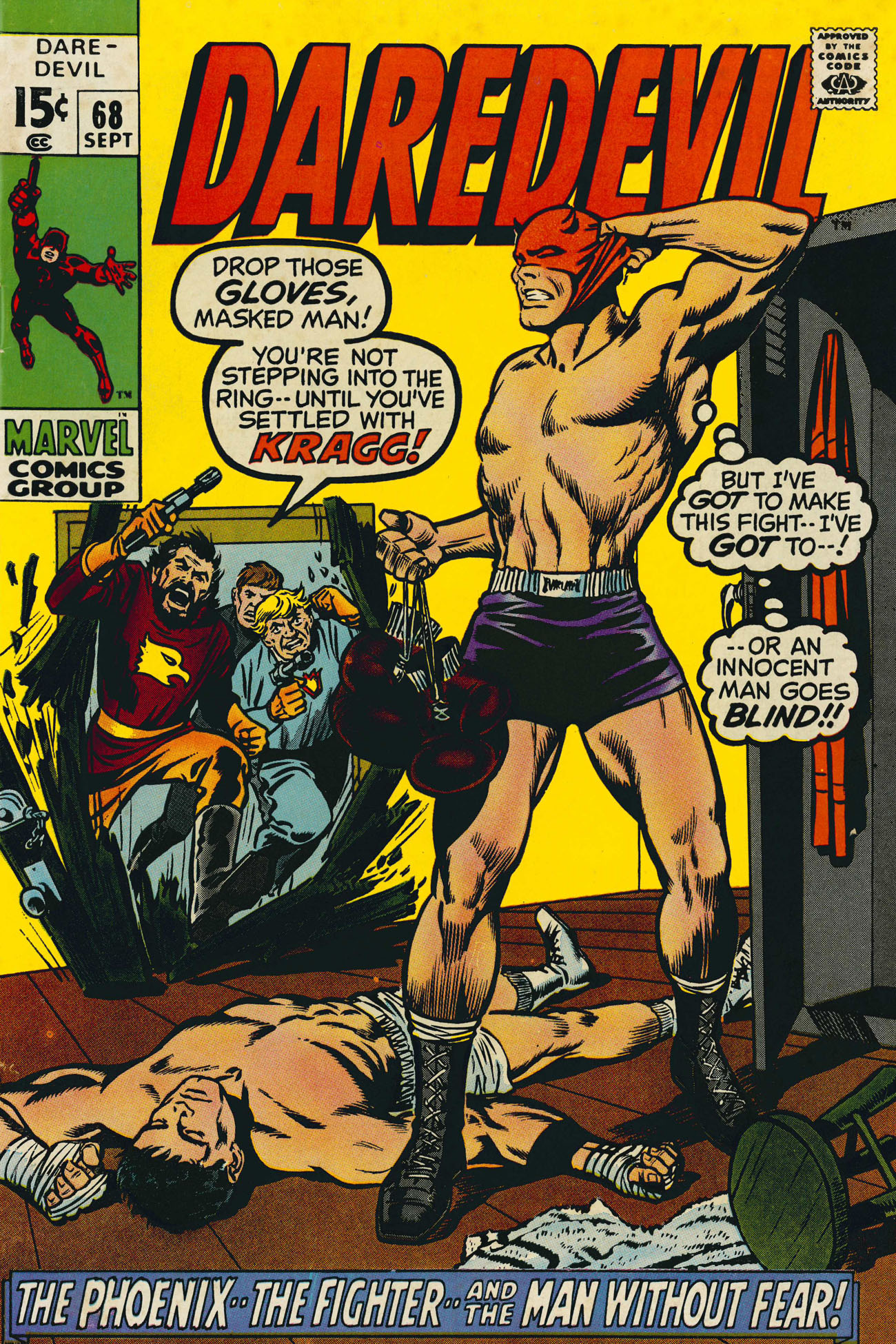


My pal David Steckel had gotten a bunch of his comic books from some older relative who was over them, passed down as such things often were in those days. Consequently, he possessed an assortment of random older issues of various titles, and this was inevitably of interest to me. For example, for no particular reason, he owned one older issue of DAREDEVIL–this one, #68. It was immediately appealing to me simply because it was relatively old at that point, released at a time before I had started reading comic books (which is how I measured such things in those days.) There was always something fascinating and vintage to the comics from before my time–they felt like antiques, but crackled with a sort of formative power to them. Whether the stories inside were bad or good–and this one wasn’t especially wonderful–the books retained an ambiance to them. In general, I really loved the comics of the 1960s, so anything that was adjacent to that period (this issue was released in 1970) was attractive.
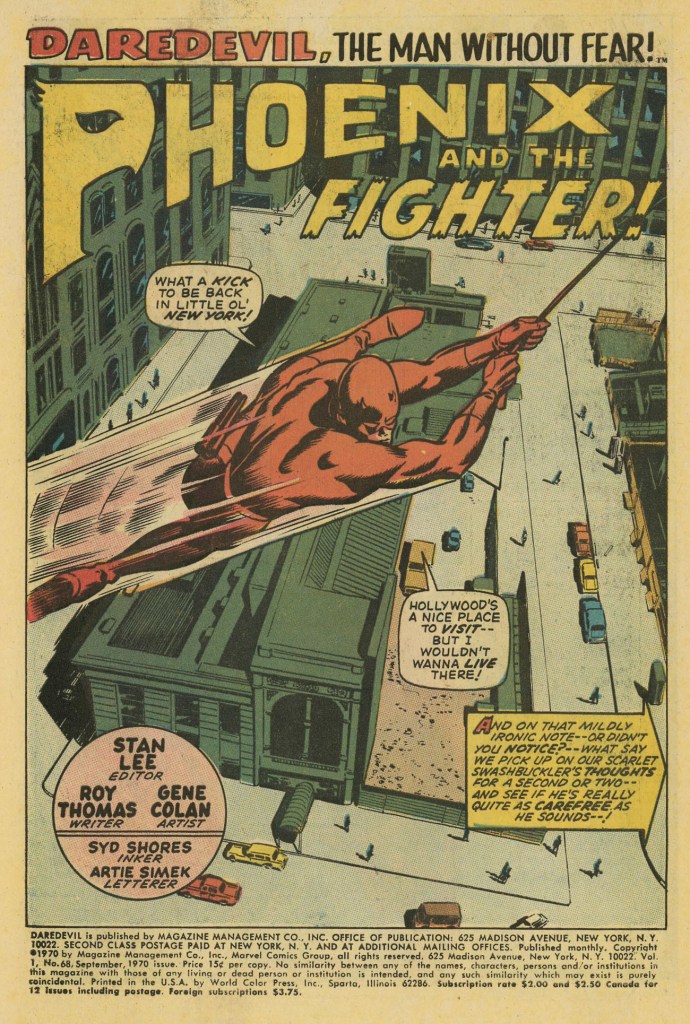
A couple of different things were going on at the time this story was created. The first is that, after having fielded a number of complaints about Marvel’s overuse of continued stories from his distribution contacts, Marvel’s publisher Martin Goodman handed down a short-lived edict that every story had to be complete in a single issue from then on. This was a crippling move for the Marvel line, as ongoing soap opera-style narratives were the foundational bedrock of what had been built there. But for about a year, editor Stan Lee and everybody else tried their best to comply, mostly with middling results. The second thing was a rising interest in “relevance” as a sales driver in comic book stories. Some attention had been garnered from recent tales concerning drug use and pollution and anti-war activities that had caught the eye of the press, generating news stories. As a result, a lot of the stories in this era were less about battling costumed villains and instead grappling with more grounded social problems. This too was a passing phase and it soon ran its course. But both of these ideas had an impact on this issue of DAREDEVIL.
DAREDEVIL as a title at this point was starting to fall into something of a rut, one that it would take years to climb back out of. Writer Roy Thomas was delivering solid stories, but he didn’t seem especially interested in the character, and he moved away from the over-the-top daffiness of Stan Lee’s version of the strip to try to do something more grounded with it. Gene Colan continued to be the swashbuckler’s main artist-in-residence, here inked nicely by Syd Shores. While he’s been overshadowed by Frank Miller and the like in the years since, for a decade Colan defined the look of the character. So this was a good creative team, just not one that was feeling especially inspired at this point.
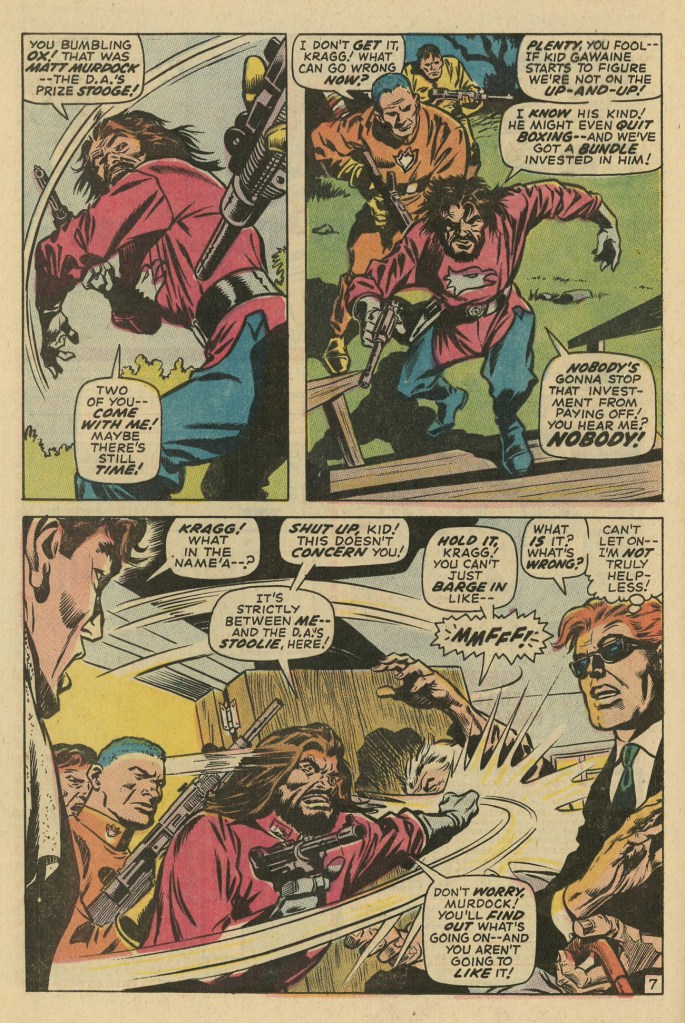
The story here is a bit of a classic potboiler with a veneer of relevancy draped over it. At this time, Foggy Nelson was the District Attorney for Manhattan, and as the story opens and DD returns from some time on the West Coast, he catches Foggy in a contentious argument with a trio of goons from a leftist organization called Phoenix. The group’s leader, Kragg, wants Nelson to stop investigating the fighter that Phoenix sponsors, Kid Gawaine. So of course, that’s exactly what Matt Murdock decides to do. He’s got a bit of an in too, given that the Kid’ trainer Pop Fenton had previously trained DD’s dad Battlin’ Jack Murdock. Heading out to the training camp, Matt is quickly able to ascertain that Phoenix is trying to coerce the Kid to take a dive in his next match, so they can bet heavily against him and thus rake in a ton of money to help put forward their leftist cause. (Exactly what that cause is remains deliberately sketchy. As I said, a veneer of relevance rather than the actual thing.)
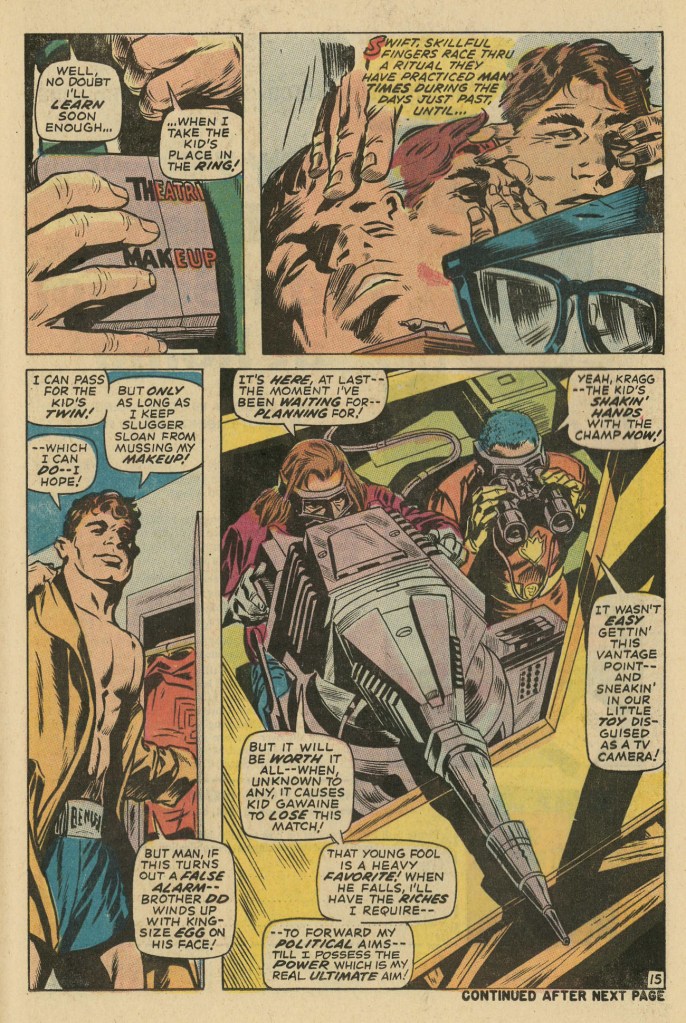
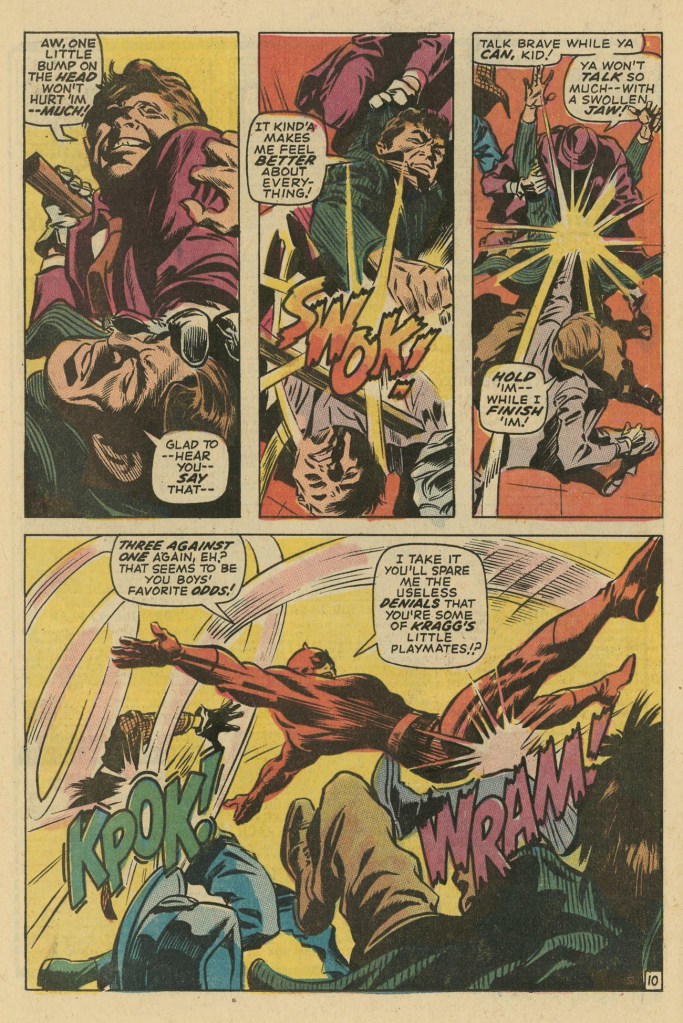
But Gawaine is a good kid and a straight shooter, and he doesn’t want any part of throwing a fight. Accordingly, Phoenix sends some guys out to rough Gawaine up on the street and coerce him into complying–but Daredevil shows up to kick their behinds. On fight night, Matt Murdock is in the stands, and his super-sensitive hearing is able to make out a conversation between some of the Phoenix thugs about how they’re going to use a “neural whatchamacallit” to make sure that Kid Gawaine goes down. Matt figures that he’ll have a better shot in the ring that the Kid will, so he knocks out Gawaine with a nerve pinch and then makes himself up to look like the contender.
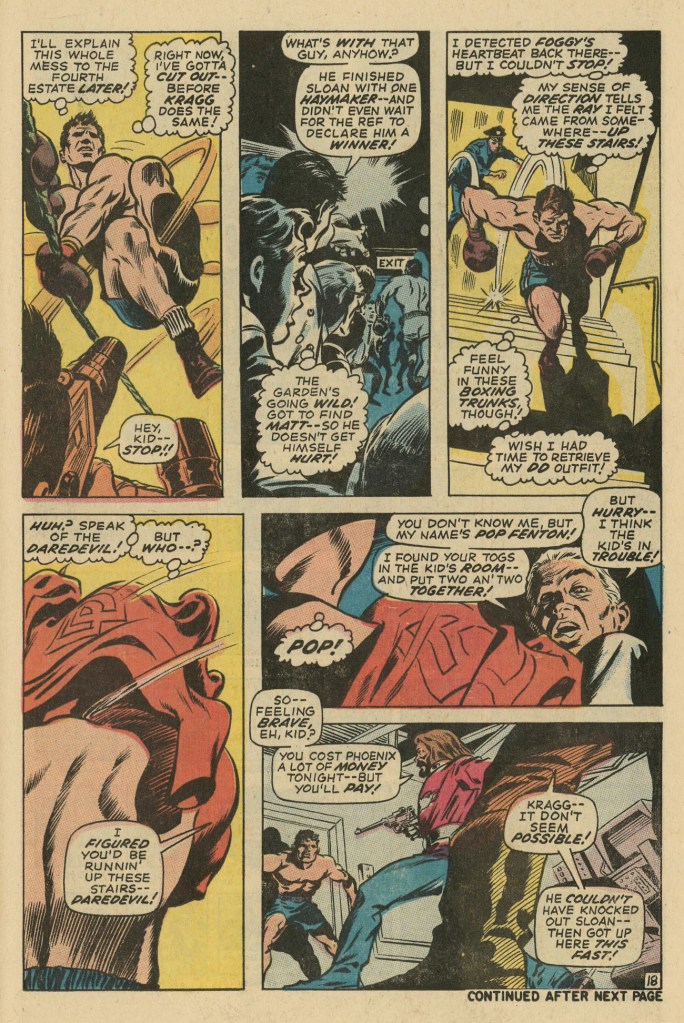
Daredevil winds up dancing around with the champ for a few rounds before Phoenix plays its trump card: they’ve snuck in a ray device disguised to look like a television camera that is designed to blind Kid Gawaine at a crucial moment. (One wonders why Phoenix didn’t just use the millions that developing and building such a ray weapon to fund their political ambitions rather than betting proceeds, but this is a typical problem for a story from this era.) But Daredevil is already blind, and so the ray doesn’t have any effect on him at all. He kayos the Champ, then races out to track down Kragg. Pops Fenton tosses DD his costume, having worked out that the fighter isn’t his guy.
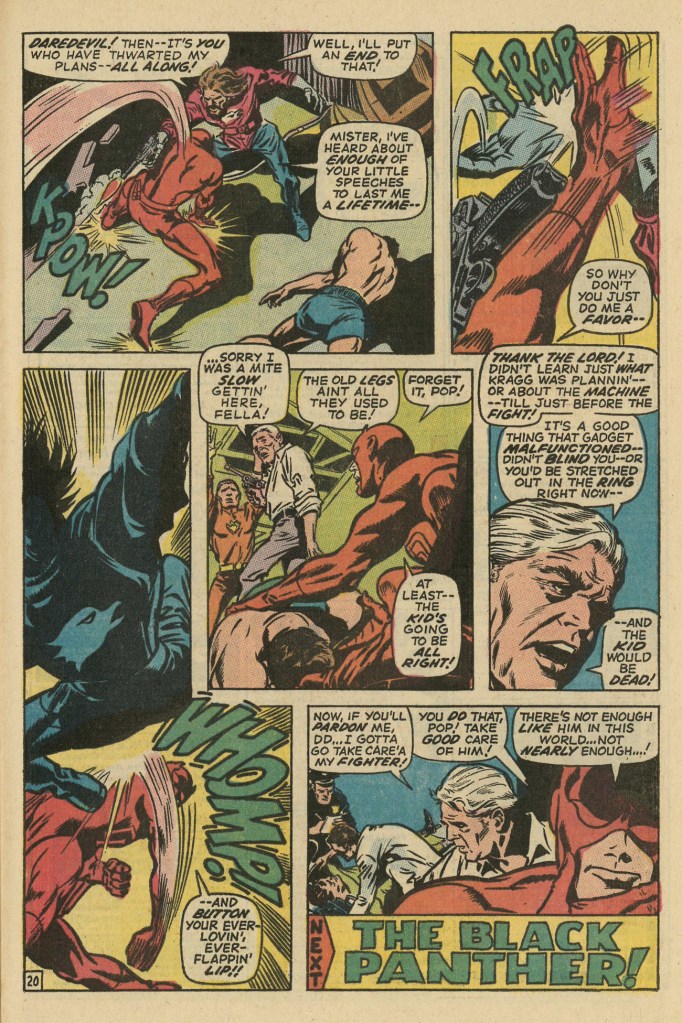
Then, it’s climax time. Kragg finds Kid Gawaine waking up in his dressing room and proceeds to shoot him. DD comes crashing in and clocks Kragg. There’s a balloon that indicates that Kid Gawaine isn’t dead that feels a hair like an afterthought–possibly Colan’s artwork made it look too much like the fighter had been killed. Anyway, in the wrap-up, Pops Fenton tells DD that it’s a good thing that Kragg’s ray-weapon malfunctioned or he’d have been blinded in the ring, thus maintaining Daredevil’s secret at least from this old trainer. And that’s the end. It’s an utterly forgettable by-the-numbers effort that doesn’t have much to offer outside of Colan’s solid artwork. Still, it was fun to get to read.
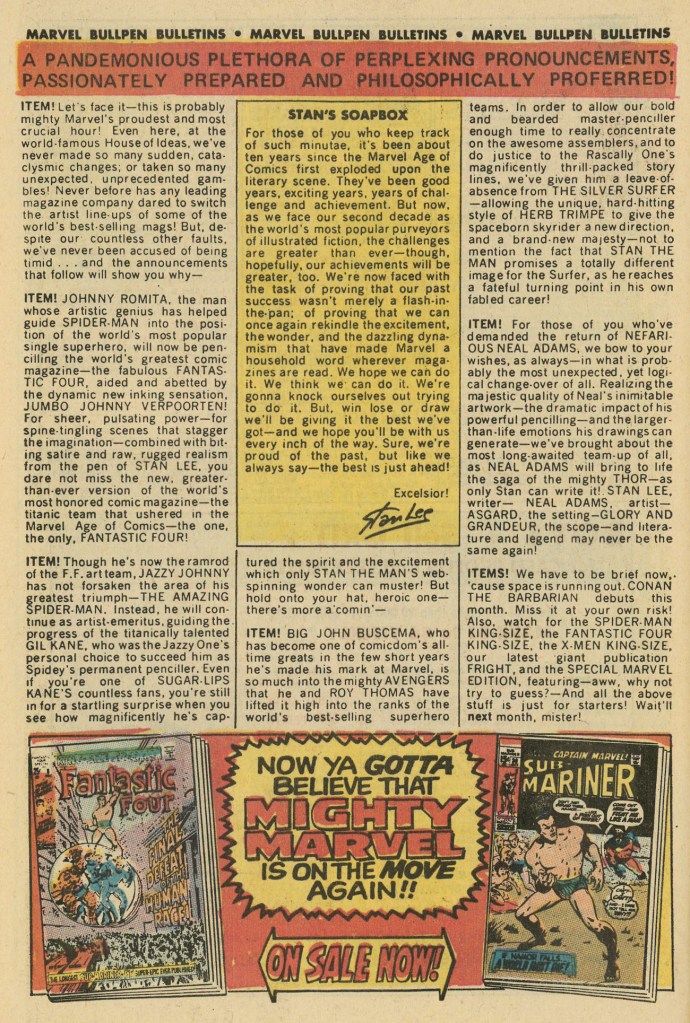
This issue came out the month after Jack Kirby had departed the House of Ideas for rival DC, and so the Bullpen Bulletins page this month is all about editor Stan Lee excitedly announcing all of the new artistic shifts without once ever mentioning Kirby’s name. So we learn that John Romita is going to be handling FANTASTIC FOUR, with Gil Kane stepping in to spell Romita on AMAZING SPIDER-MAN (though Romita would wind up inking Gil on more than one occasion.) John Buscema was going to be handing off SILVER SURFER to Herb Trimpe so the former could concentrate on AVENGERS–this became an unnecessary announcement in that SILVER SURFER was cancelled before a single Trimpe-drawn issue could be produced. And Neal Adams would be doing THOR (at least for a short time, after which Buscema was called into service on that title.) Marvel had fortunately built up a large enough roster of popular artists to cover all of the firm’s most important titles even without Jack. This was also the month that CONAN THE BARBARIAN debuted, making it a crucial pivot-point for the entire industry.


colan makes even the most average plot into some high drama, damn, his angles and where he puts the quote-unquote camera never fails to thrill me. im not roy thomas’ biggest fan, and colan makes him more than palatable, this issue is a great example. sure, people can nitpick on colan’s pacing stuff sometimes, but even that usually worked for me for some reason? when colan collaborated with brubaker on that captain america issue like 40 years later he still had that magic working, love his work
LikeLiked by 3 people
I remember in the 1970s as a tween/teenager the thrill of finding $0.10-$0.10 comics “in the wild.” Whether it was a bookstore with a box of them in the back-room, a neighbor who knew you liked comics & gave you a stack of them, or a garage sale. Don’t give me wrong, I love the convenience of the Internet, but I don’t know if you can re-create that thrill.
LikeLiked by 3 people
Apologies for the typos. I was using speech-to-text and did not self-edit, obviously! 🙄
LikeLike
Well, that’s not an especially good story, was it?
Gene Colan was a consummate professional, so of course his layouts, storytelling, and penciling are all high quality. And I’ve always felt Syd Shores, a solid artist in his own right, was an underrated inker over Colan, as well as over Jack Kirby.
But, yeah, this is hardly Roy Thomas’ finest hour. Tom Brevoort does raise a valid point, that Thomas was probably constrained by Martin Goodman’s “no multi-part stories” dictate. But even so, the logic in this one is incredibly dodgy.
I’m also not happy with the villains being “leftists” who are actually engaged in criminal acts and who are ultimately in it only for themselves. There were a lot of pressing social & political problems in the United States in this era (and, of course, a lot of them unfortunately still exist) and most real-life self-proclaimed leftists really wanted to make vital reforms & improvements to American society. Yeah, okay, there were groups like the Symbionese Liberation Army in this period who unfortunately made the whole reformist movement look bad. But most were not like that.
Thomas’ story kind of falls into the same sort of wishy-washy middle-of-the-road liberalism that Stan Lee too often engaged in during the late 1960s, with stories where he made it seem like leftists and conservatives just had to take the time to sit down to talk and hash out their differences or, worse yet, Gary Friedrich’s story where a militant “black power” movement was being secretly controlled by the Red Skull. A lot of that material really hasn’t aged well.
LikeLiked by 2 people
These were difficult times for Marvel. Not had the King left for DC, but the mandate of single issues stories and more “relevance” were twin anchors around the neck for any writer. I also share your frustration with the depiction of “leftists.” What was their insidious end game? Health care for all? Fair elections? Breathable air and safe water? Heaven help us!
However, no argument from me regarding Gene Colan’s considerable talents. He and Syd Shores provided excellent artwork that dressed up a dud of a story. Knowing that Gerry Conway’s dreadful “Mr. Kline” saga is just around the corner and how DD was nearly paired with Iron Man into a single comic due to poor sales, I wonder if this title would made through the early 70’s without Colan’s art?
LikeLiked by 2 people
Can I add that I started my Iron Man blog with #30 during this difficult time. (https://www.ironmanrevisited.com/). Instead of the likes of the Mandarin or Titanium Man, he faced naughty monster makers and crazed eco-terrorists. Not a great time to commence a collection!
LikeLiked by 2 people
See also the Thunderbolts (no relation), Stoneface and the Diamondheads, all crooks using a radical left-wing/black power front to advance criminal gains. A relevant story without any actual relevance. The Valkyrie’s debut (radical feminist who’s really the Enchantress) fits into the same vein.
LikeLiked by 3 people
They did the same with the women’s movement in Marvel Team-Up#8( April 1973 ) Man-Killer and her unidentified Militant Group ]: In reality–No, the mainstream women’s rights and suffrage movements in the U.S. did not use organized violence, relying instead on peaceful tactics like lobbying, parading, and civil disobedience (Reddit –Google AI Overview ). In 2026 there are women claiming that women never wanted the vote, that a radical minority forced voting on women ( Reality debunks that since in the U.S. women are registered to vote at higher rates than men ).
LikeLiked by 3 people
It’s pretty impressive that Matt’s enhanced other senses let him match all sorts of facial details with theatrical makeup, even though he’s blind. As well as presumably copy a general body build too. And it’s even better for him that the “neural whatchamacallit” has just one effect which won’t affect him, instead of, say, destroying his balance, or even giving him a splitting headache.
Note did Phoenix actually develop and build the ray weapon, or could they just have stolen it from somewhere? It’s actually somewhat reasonable they just stole it, since during that era, there were many protests against military research. And that sort of weapon is something which could conceivably be grabbed from a lab where there isn’t much security. It wouldn’t be easy to sell it for cash either.
LikeLiked by 2 people
Decades before ( Plus before he demonstrated his face changing ability and in a later story demonstrated his full body shape-changing ability ) Superman also impersonated an athlete [ Action Comics#4 ( September 1938 ) Superman impersonates ( using make-up grease paint ) a football player ( Tommy Burke ) from Cordell University ].
LikeLiked by 1 person
Colan’s long run on DD always made the scripts look much better than they were.
LikeLiked by 1 person
Maybe a couple of decades ago, I got this and a few other old issues of Daredevil relatively cheap. The story made so little impression on me that I barely remember it, although I remembered the cover, although certainly not because it’s a particularly great cover. I was 7 years old as 1970 began and my family did a lot of moving from December 1969 to September 1970. I had begun the 2nd grade in Japan (dad was in the Navy) then we moved to Massachusetts, and after a few months my mother & two younger brothers went to stay with my aunt in Mineola, TX, where we ended the school year. By August, we have relocated to Long Beach, CA, where I started 3rd grade. Before I finished the 4th grade, we had moved to Salt Lake City (dad got recruiting duty there). I didn’t get too many comics during that period and a lot of those I did get wound up getting thrown out by my dad during one of our moves, so by the time we got to Salt Lake City in the spring of 1972, just before I turned 10, I was essentially staring my comics collection from scratch. But even by the time I was 7, I was already a devoted Marvelite and I didn’t mind the continued stories at all. Somehow, they excited my imagination far more than most of the done-in-ones. Of the few I did get in 1970, I don’t recall noticing the switch, although maybe that was because my collection was so meager that it just didn’t register with me at the time. Among the issues I remember I had but which got thrown out were issues 101 – 106 of the Fantastic Four, which included Kirby’s last two issues – 101 being a done-in-one with the Maggia; and 102 the beginning of a three parter featuring Namor and Magneto, with Kirby leaving on a cliffhanger. Those were among the issues that got thrown out. In later years, however, through both reprints of stories from that period I got in the late ’70s as well as from some of the back issues I purchased in the 1980s or later, I did find there was a significant dip in the quality of many of those stories in 1970. Of Kirby’s last few issues of the FF, from 94-102, all but the last done in ones, the best, IMO, were 94 (the introduction of Agatha Harkness, and a thrashing of the Frightful Four, making their first comeback as a team in over 50 issues, since #43) and 102. Most of the others seem like Kirby on auto-pilot, not particularly enthused and stories that weren’t all that interesting, certainly not the 100th issue. But 102 began with a fun scene of the team at the Baxter Building, then Namor coming across Magneto and making the mistake of bringing him down to Atlantis where our favorite evil mutant schemes to initiate tensions between the Atlanteans and the surface-dwellers, ending with a signal of pending war -and aside from inserting a few pages of the discarded Janus story a bit later, that was a wrap for Kirby’s run on the Fantastic Four.
As to the DD story, I know Thomas did some pretty good Daredevil stories during his run, but this certainly wasn’t one of them and is too ridiculous and hackneyed, with Colan’s art being about the only good thing about it. I’ve read a few of Thomas’ “social relevance” stories, and none of them were good – Thomas seemed overly cautious about taking any sort of stand that might offend anyone, which came off as only superficially understanding any of the issues. Some of the writers who were only a few years younger than him and would get their starts in the early 1970s, like Englehart, Gerber, and McGregor, were much better at handling social issues while also being entertaining (IMO). Thomas just seemed surprisingly clueless. Other than the Man-Killer issue of MTU in which the Cat guest-starred, I don’t recall Conway doing any social relevance type issues, and although he was 12 years younger than Thomas, he didn’t seem any better at it, so it seems it wasn’t really a generational thing as much as some of those other writers being more involved in the youth subculture of the late ’60s and early ’70s and having stronger feelings about the hot-button issues of the era (and not in the reactionary mold of Ditko!). Kirby, despite having been born in 1917, also seemed sympathetic to the concerns of the youth of the era, certainly in regards to support for civil rights and opposition to tyranny, whether fascist or communist.
LikeLiked by 2 people
1970 U.S.( Google AI Overview )– RADICAL LEFT and UNDERGROUND GROUPS: WEATHER UNDERGROUND ( Weathermen ): Grew out of the students for a Democratic Society, turning to a violent ‘days of rage” underground campaign of bombings targeting government buildings and police stations. BLACK LIBERATION ARMY (BLA): Emerged in 1970 as an underground, armed splinter of the Black Panther Party that used guerrilla tactics and ambushes against police officers. ANTI-WAR and CAMPUS UNREST — STUDENT STRIKE MOVEMENT: Triggered by the U.S. invasion of Cambodia and the Kent State shootings in May 1970, leading to violent clashes, ROTC building arson, and police confrontations across hundreds of college campuses. HARD HAT RIOT ( New York): A violent May 1970 confrontation in lower Manhattan where pro-war construction workers physically attacked student anti-war demonstrators.
LikeLike
“Awright, so we need a boxer, like Kid Galahad, but — hmm, what other knights of the Round Table could we use?”
DAREDEVIL was the first series I really got hooked by (X-MEN was a very close second), so I was filling in back issues at a furious pace. I liked Colan’s energetic art, always full of motion, and Roy’s smooth scripting kept things moving along in a satisfying manner. It wasn’t until I had a near complete run that I read through them in order and noticed that there was a real shift in focus from Stan to Roy, as that daffy action-farce gave way to a second-tier combo of Batman and Spider-Man. And then Gerry Conway shifted things again, with the soap opera stuff becoming more intense…but really, it was Colan who was carrying the book, and when he left, it cratered. It managed to climb back out of the hole, thanks to some talented writers, artists and the amazing Klaus Janson. But this part of the run was just…stuff. Good-looking stuff with an urgency to the voice of it, but not much underneath.
I wasn’t all that fond of Sid Shores on Colan, either. He was much more suited to Colan than he was to Kirby, but still, sandwiched between George Klein on one side and Tom Palmer on the other, he just didn’t really measure up.
Still, I liked Colan’s storytelling and Roy’s dialogue, and that was enough.
LikeLiked by 2 people
Continuing my reading the comics Tom posts about, I just finished reading this issue. When I finally started reading Marvel titles in the eighties I bypassed Daredevil (likewise I bypassed it when I started buying and reading Marvel Masterworks). Being a silver age DC fan, to this day I like self-contained stories, so I found it nice to read this one.
I have read a lot of Roy Thomas’ DC stories and I agree that this ione s average at best. Likewise, I’ve enjoyed Gene Colan’s DC work on Batman, Detective Comics and Wonder Woman and I think his work here is almost cinematic.
LikeLike
Gene’s DD is the definitive version. Am I the only person who remembers the strip he did with Don McGregor which appeared in Eclipse magazine in the 80s called ‘Ragamuffins.’ A masterpiece from both creators.
LikeLike
I remember buying this off the spinner rack, and feeling a lot was “off” about this one…from the awkward cover, to the story itself. It was done in one, but made me feel someone wasn’t paying attention to Daredevil as they churned these out monthly. (This is a Marie Severin cover, right? I never felt she was “right” for superhero comics. Humor, and comedy, YES…but drama…no.)
LikeLike
But Marie was made to be one of the few inkers who could make anyone look better.
LikeLike