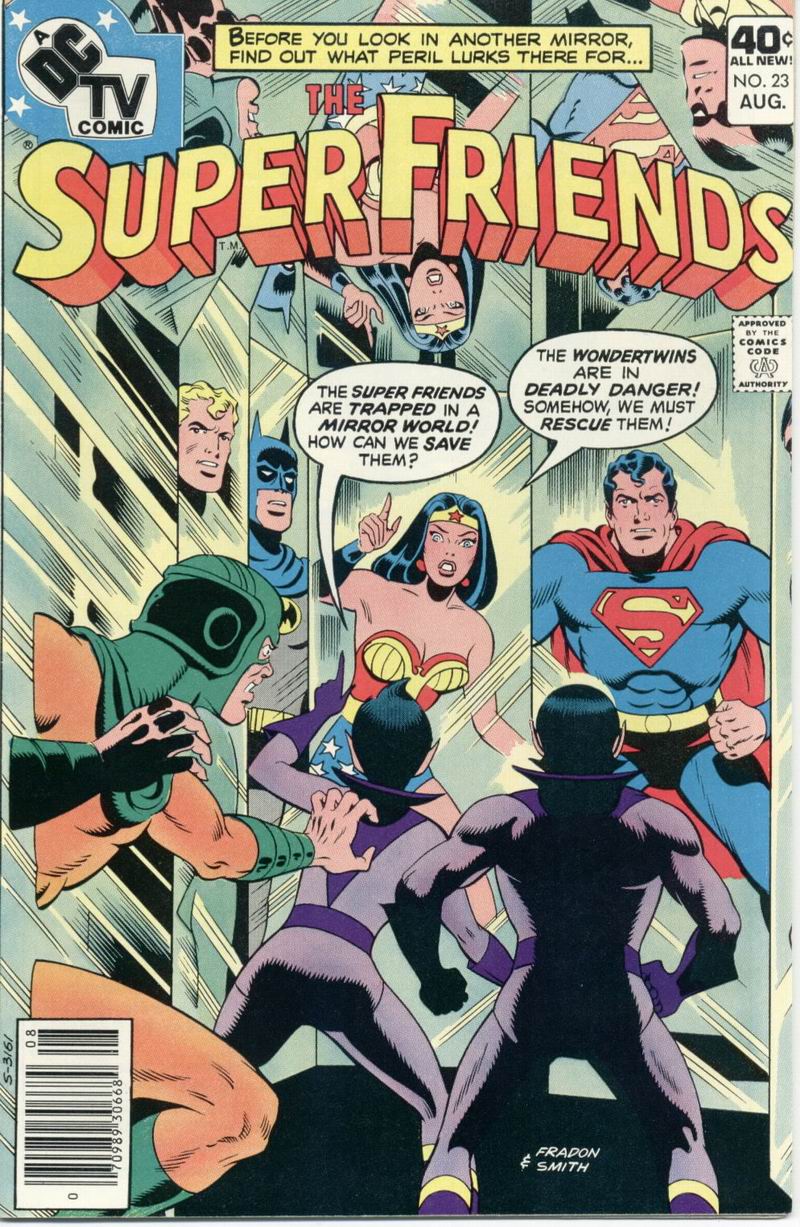


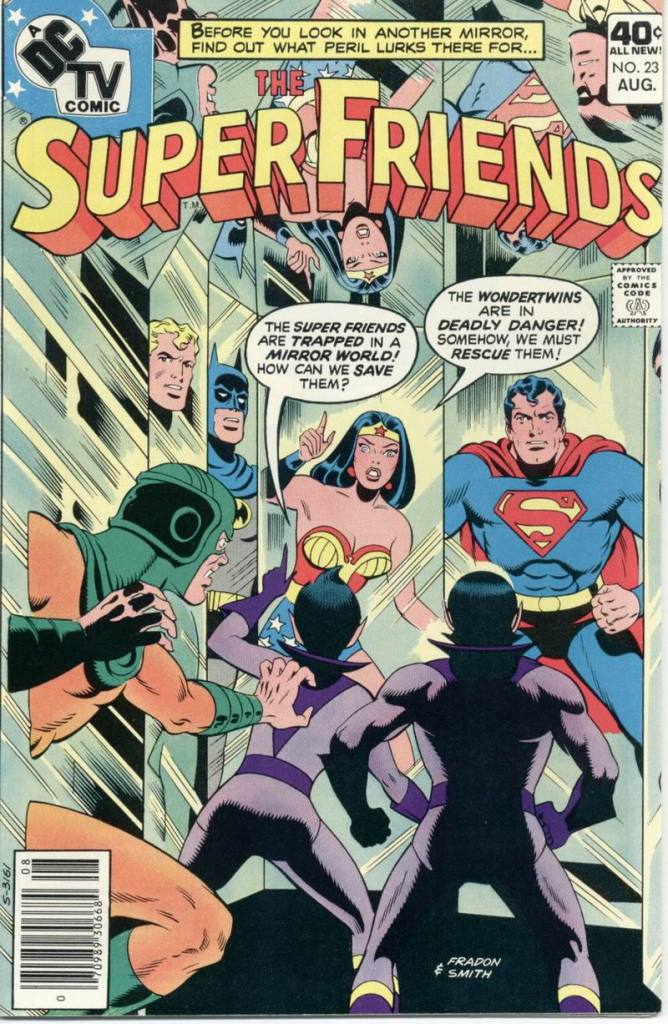
Despite the fact that it was by all measure a solidly-crafted and consistently entertaining comic book, I avoided picking up issues of SUPER FRIENDS, the tie-in series to the long-running Saturday morning animated show. And that was because it embarrassed me. I knew that Super friends the cartoon was aimed at a younger audience than myself, so even though I watched it regularly each week, I was a bit sheepish about it. It’s an incredibly arbitrary line to draw given that the sorts of kids who might give me grief for still reading comics of any kind weren’t going to differentiate between SUPER FRIENDS and JUSTICE LEAGUE OF AMERICA. But I still did. I knew there was a more grown-up sensibility behind JLA (or at least that was my read on matters) whereas SUPER FRIENDS was intrinsically “kiddie stuff”. So I’d only pick up an issue when there was something of relevance to me within its pages–as was the case with this issue, #23.
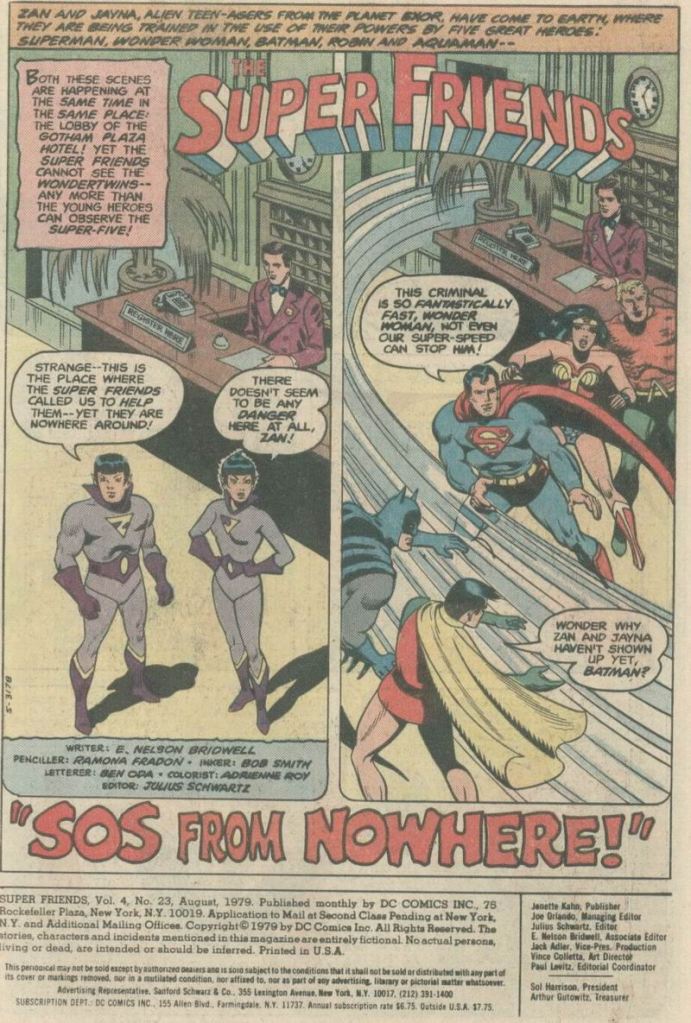
The three big drawbacks from my point of view with the book boiled down to: 1) The use of the name Super Friends, which seemed silly to me, as opposed to the more legitimate Justice League. 2) The presence of cartoon-created Wonder Twins Zan and Jayna (and their space monkey, Gleek). They weren’t genuine Leaguers and I knew that. 3) The artwork of the great Ramona Fradon was more overtly cartoony and therefore less serious than that of DC’s cadre of regular artists. Fradon’s work is excellent, but the sensibility simply reinforced to me that this was a book for kids younger than me. It all made me self-conscious in a way that only young comic book readers of the 1970s, before there was any social acceptance for the hobby, can relate to. Getting caught with a copy of SUPER FRIENDS in my possession would have been an unspeakable crime somehow, a black mark on my soul. This was the same reason why I avoided reading WONDER WOMAN for so many years, I didn’t want to be socially stigmatized for it. I worried about this stuff as only a 12-year-old can.
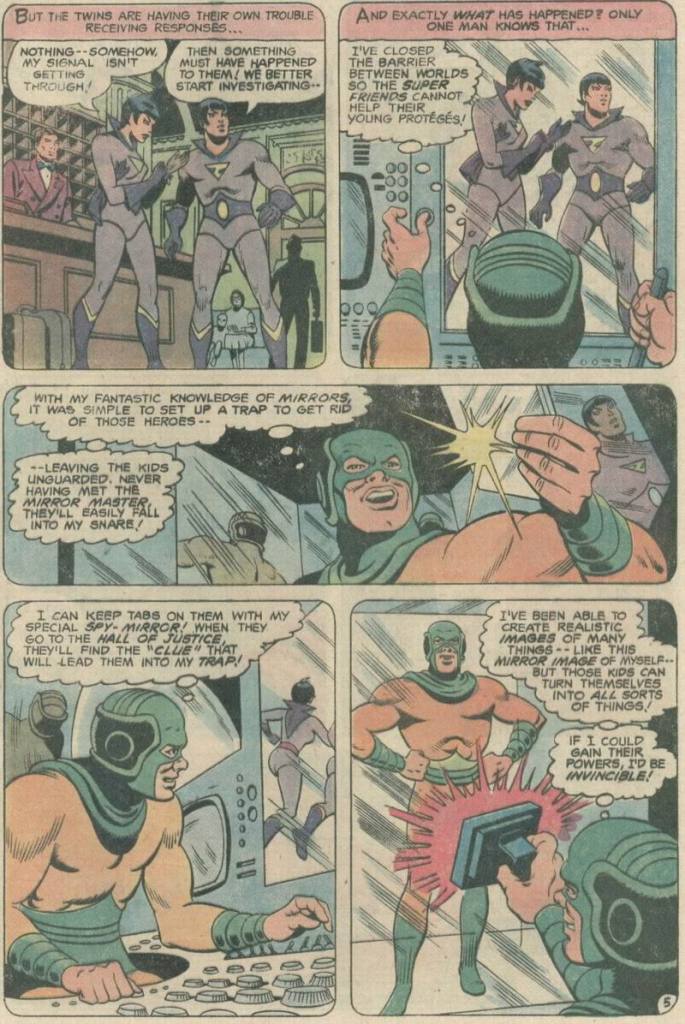
The thing that made me take the plunge on this particular issue was the involvement of the Mirror Master, a key member of the Flash’s rogues’ gallery. My love for the Flash outperformed my misgivings about SUPER FRIENDS–if he had been featured regularly, I likely would have bought every issue. The story also turns on the events of a previous Flash tale. In a bit of self-control uncommon for him, writer E. Nelson Bridwell doesn’t give an editor’s note pointing to the specific issue–luckily, I’m here to tell you that it was FLASH #174, the very last story of the Silver Age drawn by the character’s co-creator Carmine Infantino. In that story, the Mirror Master discovered a parallel mirror dimension in which his counterpart was a hero and the Flash was a villain. That all comes back into play in this tale.
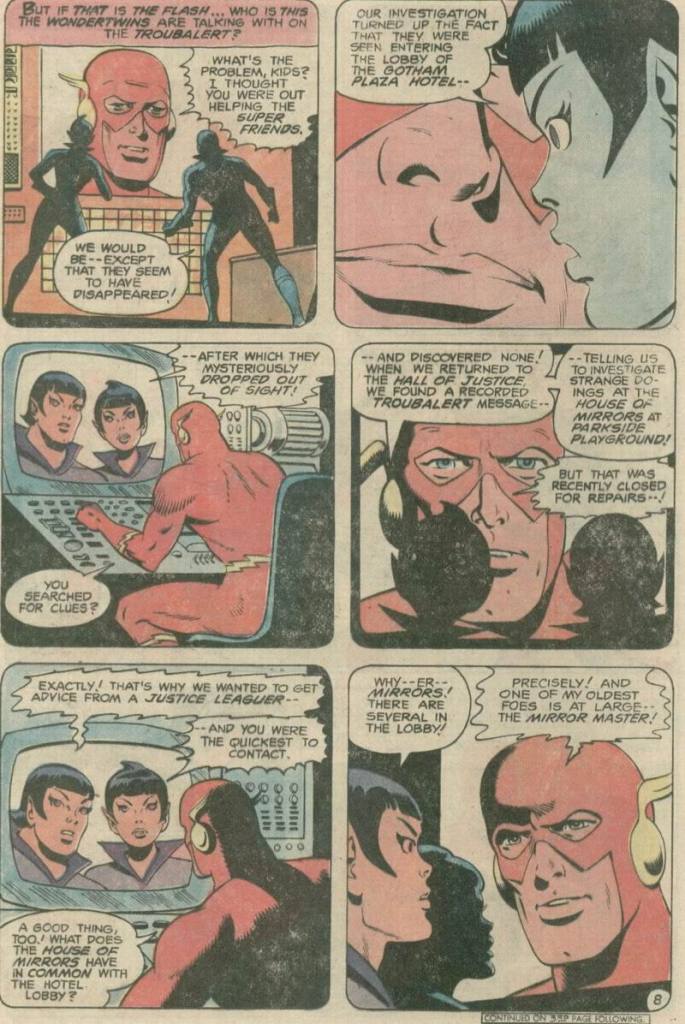
This story opens with Zan and Jayna being summoned by the Super Friends’ TroubAlert to the Gotham Plaza Hotel, where their mentors are investigating a series of baffling robberies. But when the Wonder Twins arrive, there’s no sign of the Super Friends–yet the Super Friends are investigating the crimes in the same space and are perturbed that the Wonder Twins haven’t arrived. This is because they’ve unknowingly been transported to that old mirror dimension by the Mirror Master, who has designs on stealing the Wonder Twins’ powers. In that mirror world. Wonder Woman is able to catch the evil Flash with her magic lasso–he’s the one who’s been committing the baffling thefts at super-speed. But the Super Friends are surprised to see that this bad guy Flash is also Barry Allen.
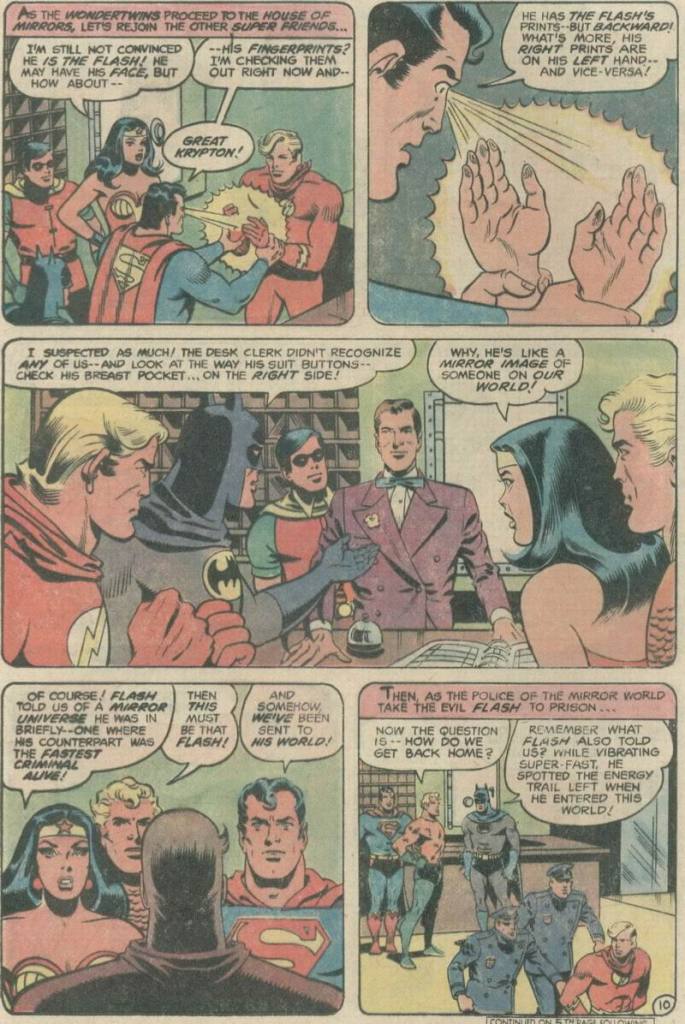
Unable to locate their mentors, the Wonder Twins check in with the JLA satellite headquarters and speak with the Flash, who is on monitor duty at the time. Monitor Duty is apparently so important and unyielding that, despite being informed of the seriousness of the situation throughout the story, the Flash never once gets off his chair and comes to render aid. Anyway, he deduces that it’s likely that the Mirror Master is responsible for the disappearance of the Super Friends. Despite the fact that they are the likely targets of the Mirror Master’s attack, Zan and Jayna head out to the Parkside Hall of Mirrors to confront him. Meanwhile, in the mirror world, the Super Friends realize where they are when they examine the evil Flash’s fingerprints and find them to be a mirror image of those of the real Barry Allen. Realizing this, Superman and Wonder Woman are able to use super-speed to break the dimensional barriers and get the heroes back home.
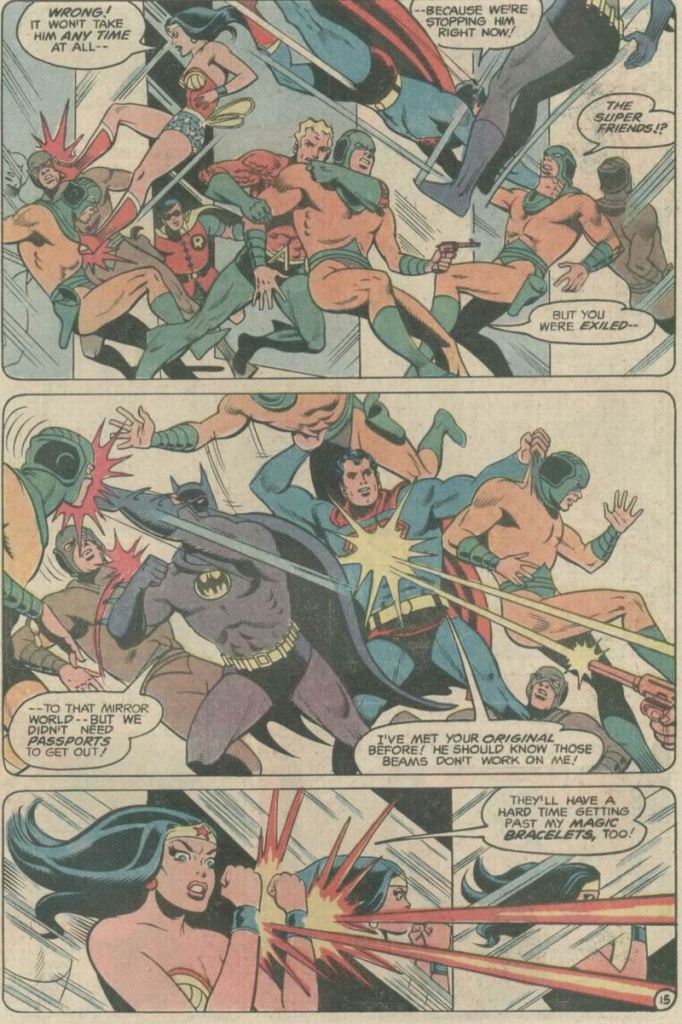
Once back in their home dimension, the Super Friends check in with the JLA satellite, and the sedentary Flash gives them a rundown on what’s happened so far. Accordingly, they head to the Parkside Amusement Park themselves. Meanwhile, Zan and Jayna are attempting to infiltrate the Hall of Mirrors, but the Mirror Master sees them coming and unleashes a bevy of copies of himself from every reflective surface to overwhelm the kids. Fortunately, it’s at this point that the other Super Friends show up and begin to whale on the army of Mirror Masters.
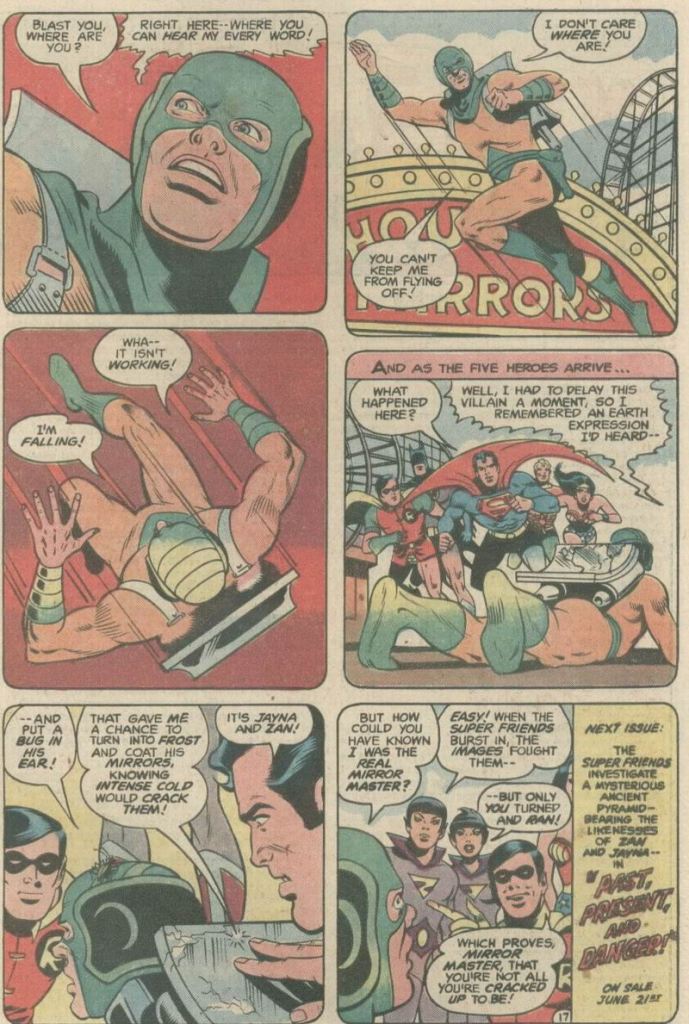
Knowing when he’s cooked, the real Sam Scudder takes a powder, counting on his duplicates to delay and confuse the Super Friends long enough for him to make his escape. But he hasn’t reckoned with the Wonder Twins, who realized that the one Mirror Master who was running away must be the genuine one, and tagging along. In the form of a bug, Jayna speaks into the Mirror Master’s ear, making him think he’s being watched by some unseen figure. And as ice, Zan cracks the mirror powering the villain’s flight, foiling his escape. And that’s the game! It’s a lightweight story, and one without an ounce of actual tension–in a lot of ways, it plays very much like a Silver Age DC adventure, which ought to have appealed to me. And I did like it–just not enough to pick up the next issue the following month.
 The Tom Brevoort Experience
As a huge comic, Batman and JLA fanatic, Super Friends on tv was a huge embarrassment to me
LikeLiked by 2 people
I started to like the Super Friends cartoon towards the end, when Firestorm and Cyborg joined the team, and they fought against Darkseid. The cartoon was my introduction to all of those characters.
LikeLiked by 1 person
That final season was when they used model sheets from Garcia-Lopez over Alex Toth. It was a different look, but a season that worked well. Unfortunately, it was also limited to an only a few episodes .
LikeLiked by 2 people
I think Super friends was the first TV show I “hatewatched.”
LikeLiked by 3 people
As a tween I felt the exact same way about picking up Marvel’s SPIDEY SUPER STORIES comic book. I remember buying an issue off the rack without First going through it. When I got home and read it, I was retro-embarrassed, and hoped no one I knew saw me buying it! 😂🤷♂️
LikeLiked by 2 people
The first season of the Super Friends was particularly painful to endure – I still have tremors when I hear the phrase “Wendy, Marvin and Wonder Dog” in Ted Knight’s voice. Zan and Jayna weren’t much of an improvement when they arrived in 1977. Still, I told myself each Saturday morning, they were the only superhero game in town and if I wanted cool superhero cartoons to ever return, we had to start somewhere.
Although far from perfect, I will totally confess to loving every poorly animated minute of Challenge of the Super Friends. Grodd! Braniac! Luthor! Black Manta! Sinestro! Giganta! All on my TV on a Saturday morning more than made up for every utterance of “Wonder Twin Powers Activate!”
Did I ever purchase a Super Friends comic book? Are you kidding! Someone could have seen me.
LikeLiked by 5 people
No love for Marvin, Wendy and Wonder Dog? Yeah, me neither. I really don’t like them.
Having said that, I was *not* pleased when I learned several years ago that the characters had shown up in Teen Titans just for Wonder Dog to turn out to be a demon who brutally murdered Marvin and mauled Wendy. I just checked, and it was writer Sean McKeever who did that. Look, if you don’t like the characters, just don’t use them. No need to grim & gritty every single thing up.
LikeLiked by 3 people
I did not know about that. I dropped the Teen Titans after Wendy, Marvin and Wonder Dog made their appearance – although that wasn’t my reason for saying farewell. I completely agree with you. Why bring in the characters just to do something that horrid.
LikeLiked by 2 people
I’m getting some Paul Smith vibes from the art. Especially from the three top panels of Mirror Master on the last page.
LikeLiked by 1 person
Ramona Fradon was a great artist with a fun style, and this series was well suited to her. I get the impression she probably enjoyed working on it more than some of the other assignments she got (certainly more than Freedom Fighters, which she said she hated working on) but years later she observed with some annoyance that E. Nelson Bridwell would only publish readers’ letters that were about his stories, and none that were about her artwork.
LikeLiked by 1 person
He was also very firm about how she should draw the scripts, she says, which left her feeling stifled. A shame.
LikeLiked by 1 person
The first two issues of Super-Friends came out when I was 18. I had much the same reaction. A gang of villains takes on kid sidekicks of their own? Who of course, learn to see the light at the end. The only pluses were 1)Bridwell showing his mastery of the obscure by making Aquaman’s foe the Human Flying Fish; 2)He explains the origins of Wendy and Marvin and the Super Friends as a JLA offshoot in the letters page, and quite well.
Three, though (if you’re wondering why I kept buying, keep in mind I also bought the entire run of the Bronze Age Sandman), with a good villain the World-Beater and some shout outs to DC’s current continuity … I was hooked. It was a fun, oddball book, occasionally inspired (I loved the Global Guardians).
LikeLiked by 2 people
I watched every single episode and bought every single issue. Unlike Mister Brevoort, I had few friends to impress so it never occurred to me not to. The only thing that frustrated me were the twins picking lame ass transformations. I wanted to see ‘shape of a hurricane’ and ‘form of a Kryptonian’ used!
LikeLike
In later stories they did get wilder — “shape of a frost giant” and ‘form of a sphinx” when they went up against the Seraph (the twins having been turned evil).
LikeLike
Although I was a DC fan and I watched many Saturday morning cartoons, I don’t recall ever watching The Super-Friends. I also never read the comic tie-in, which makes sense as I was focusing on silver age comics and not current ones. I just read this issue and it’s not a bad story, but I do think it’s for younger readers. I do like the artwork, which although cartoonish, I think looks nice and clean. Can’t say I care much for the Wonder Twins and Gleek.
I also just read The Flash #174 and I think it’s quite a good story. It’s one I hadn’t read beforeas I only looked at available back issues of The Flash when there were no issues of titles I liked better that I wanted when I went to the local used bookstore in town. I also like Infantino’s art here much better than I do his artwork from the ’80s.
LikeLike
I was born in 1973, so I was the prime age for the Super Friends cartoon which I loved at the time. I remember having two issues of the Super Friends comic when I was a kid that my mother must have bought for me when I was four- or five-years-old. I really, really like Ramona Fradon’s artwork on Aquaman in the 1950s which I think is beautiful. The artwork on this issue is fine, but not her best.
LikeLiked by 2 people
I was 18 by the time this issue came out, but I wouldn’t have cared if anyone thought me juvenile for buying it — I was still buying comics at 18, so what difference did it make?
Still, I wasn’t buying SUPER FRIENDS (though I’d start, later in the run). On the one hand, I wasn’t yet buying most of the Julie Schwartz line, or even FLASH, yet — my taste at DC ran to LEGION, GREEN LANTERN and ADVENTURE COMICS. And on the other hand, it wasn’t so much that it was aimed at kids but that the heroes had very little personality and there wasn’t much issue-to-issue continuity or subplots, or the various other stuff that I liked about comics.
Had it been written to appeal to 7 year olds but still had subplots and cliffhangers and interpersonal drama, I’d have still liked it fine. But it was very Fox-esque, as Tom noted, and I was an Englehart guy. I didn’t start reading SUPER FRIENDS until I’d gotten to like E. Nelson Bridwell’s writing on SHAZAM and “Mr. & Mrs. Superman” (as well as THE MANIAKS and INFERIOR FIVE), and decided that I wanted to see what else he did.
But it’s a really well done book, and in particular, Bob Smith is an excellent inker for Ramona Fradon. He’s an excellent inker all around, and was very good on Joe Staton, too. He’d probably have been a good Curt Swan inker, in a George Klein-ish kind of way. I’m a little surprised they had him stay so long on a book that the company never seemed to value very much.
Then again, maybe they did offer him other stuff, and he turned it down because he just liked inking Fradon. In a pre-royalties era, there wasn’t really all that much impetus to be on a more popular book…
LikeLiked by 1 person
I was 15 in the summer of ’79, and became a comic fanatic that July. My cousin introduced me to comics, because he learned how little I knew about the various superheroes while looking at a John Buscema poster advertised in Starlog magazine. He set out to rectify this gap in my education. We went around to the various convenience stores in his tiny hometown, picking up various titles. I had watched Superfriends a fair amount, and was shocked at how much more sophisticated superhero comics were than cartoons. It somehow didn’t seem possible. What a revelation!
As for this Superfriends comic … my cousin bought it! He claimed he couldn’t pass up a comic with the Mirror Master, but I was a little embarrassed for him. It was clearly aimed at kids, unlike Iron Man #126, X-Men #125 — or even Brave and Bold #154 — which were among my earliest purchases.
LikeLike