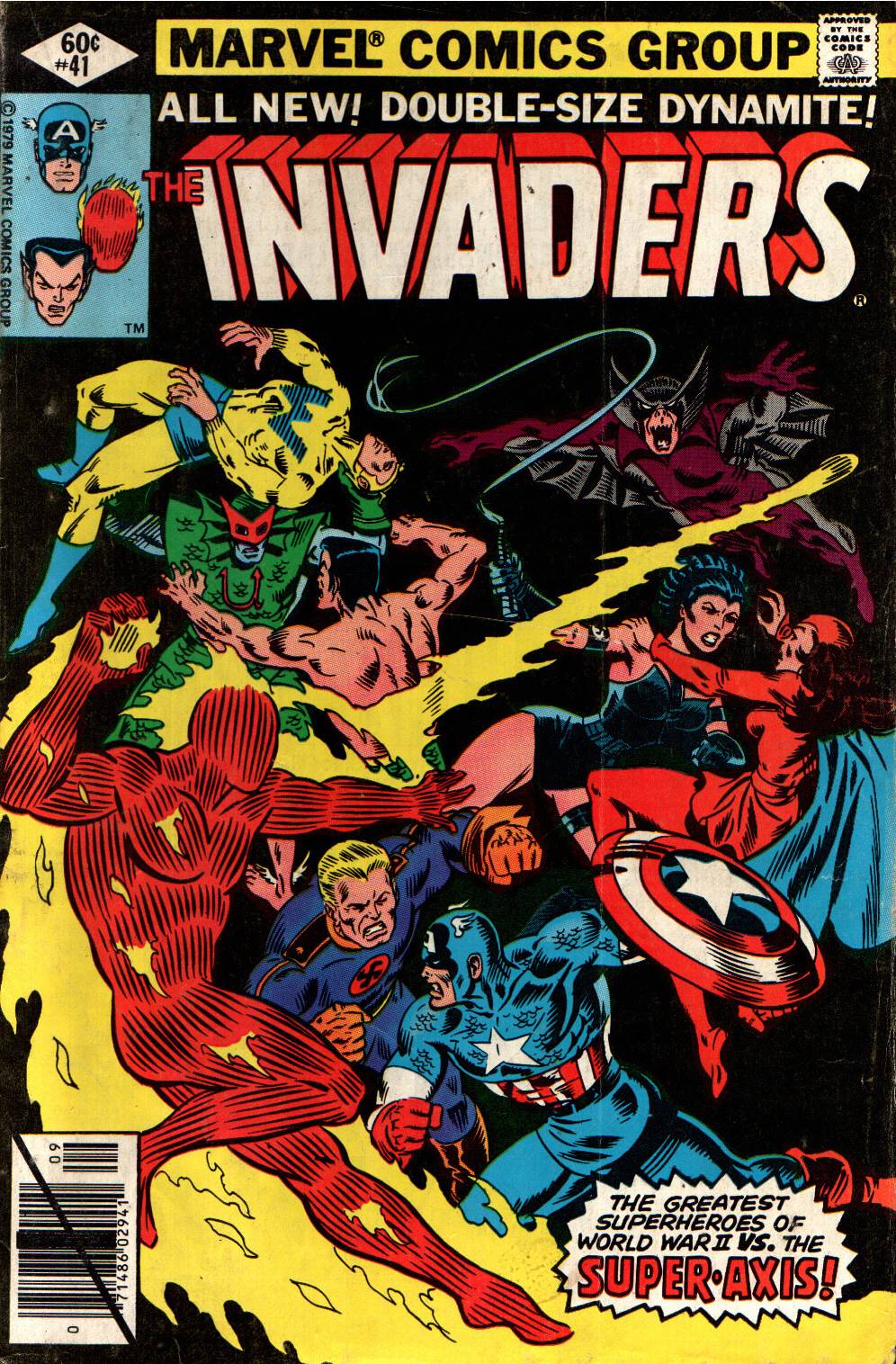


The appearance of this book constituted something of a surprise. I seem to recall that it showed up on the spinner rack of my local 7-11, which I still continued to frequent in addition to the new Stationery Store. INVADERS had been a title that i had followed regularly, but a number of months earlier, new issues had stopped showing up. This is how we readers of the 1970s found out that a comic book we liked had been discontinued–there typically wasn’t any advance notice and often it wasn’t mentioned within the last issue itself. I wasn’t yet in a place where I was aware of or had a way of getting one of the fanzines of the era such as the COMIC READER that might have hipped me to this intel a bit sooner. INVADERS had given up the ghost in the middle of a multi-part storyline, the remaining two chapters of which had been worked on. So editor Roy Thomas was able to convince the powers-that-be at Marvel to release them as a giant-sized final issue during the summer months when comic book sales tended to be at their best. So this was an exciting and unexpected surprise.
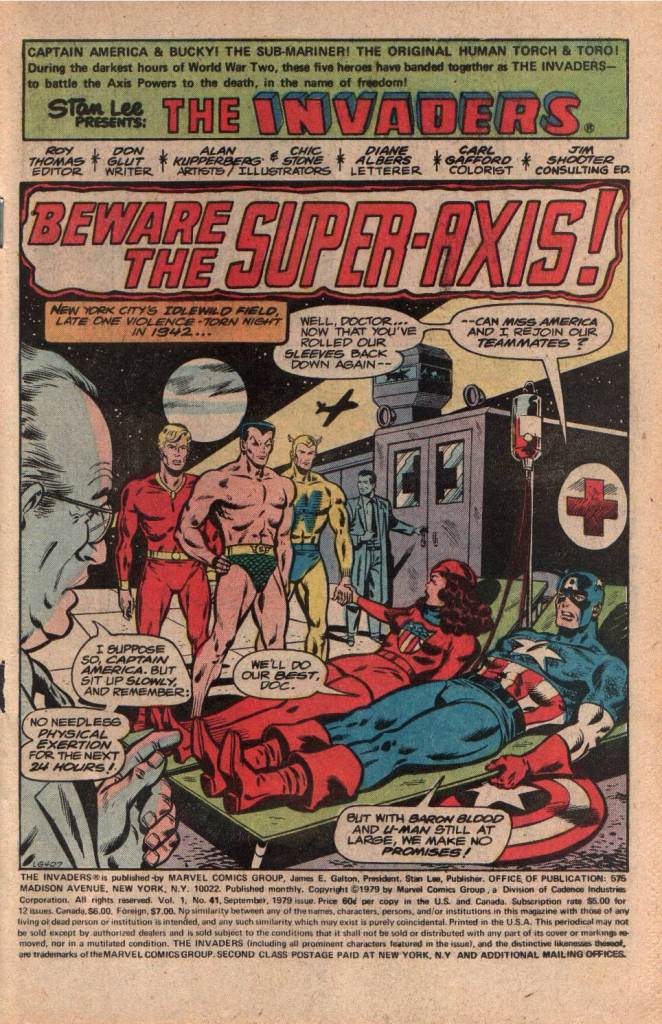
But the truth is, at the time of its cancellation, INVADERS was only a shadow of its former self. Following the departure of artist Frank Robbins and Roy Thomas passing on the authorship of the titles to other hands, the book had languished a bit. The folks involved–in this instance writer Don Glut and artist Alan Kupperberg–did the best they could with the material. But they lacked Roy’s driving love for the source material and for the period, and they also didn’t have his skills as a comic book write. So INVADERS began to feel like a second-tier title, like an also-ran in the Marvel firmament. It really was no huge surprise to me when it ended, for all that I still liked it. The book had been running on momentum for almost a year at the point when it had been axed.
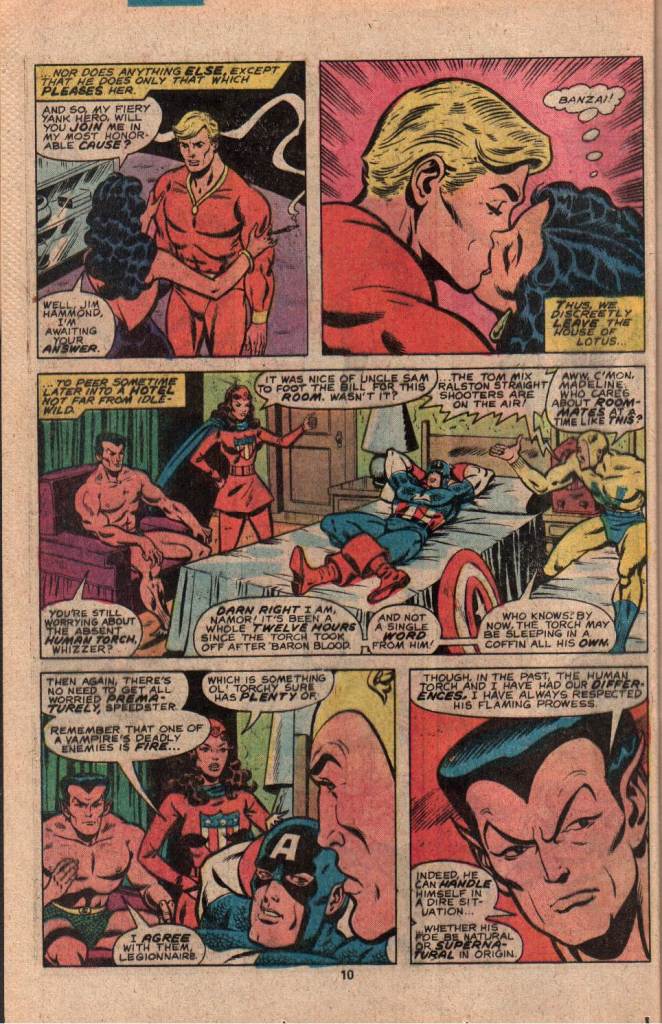
The book opens up with Miss America and Captain America getting medical treatment for wounds suffered in their recent battle with Nazi vampire Baron Blood. He’s one of a whole crew of past Invaders villains who have been brought together by the mysterious and mind-controlling Lady Lotus to form the Super-Axis in an effort to counter the Invaders and win the war. Other than Lotus and Baron Blood, the group included Master Man, Warrior Woman and U-Man. Anyway, the Human Torch trails the smoke residue from the earlier attack back to Chinatown, which brings him to the House of Lotus, where Lady Lotus is holed up. But using her hypnotic powers, Lotus enchants the Torch (this despite the fact that the original Human Torch was an android, which you’d think might make him proof against such manipulations.)
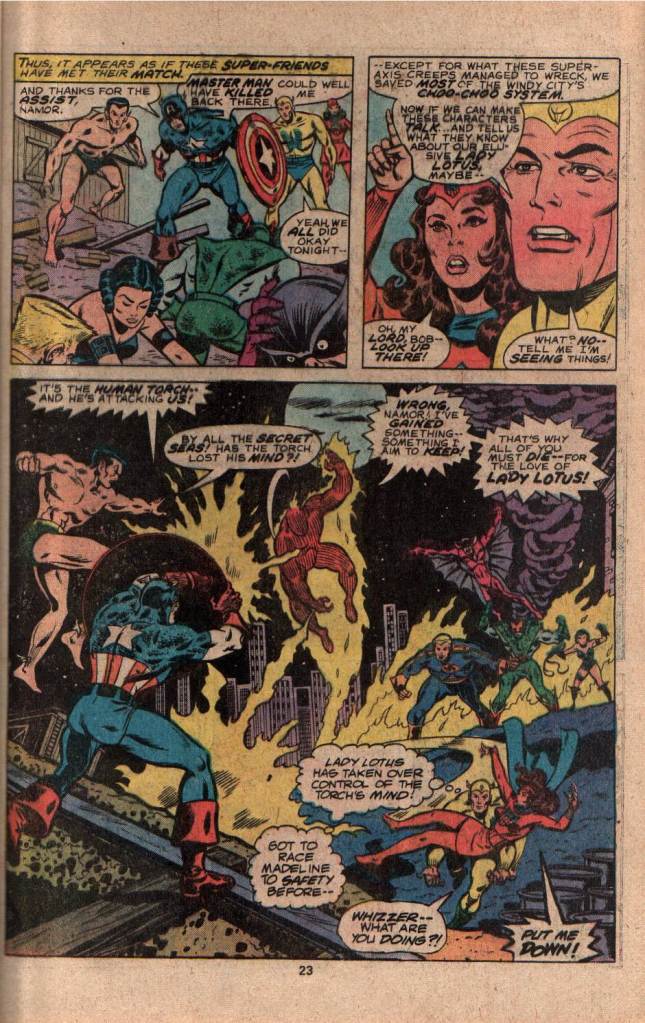
Anyway, the Invaders sans the Torch follow the Super-Axis to Chicago, where they’re laying waste to the railway lines in an effort to sabotage the delivery of vital wartime resources to the front. As you’d expect, a big old fight breaks out–but Cap, Namor, the unfortunately-named Whizzer and Miss America are able to trounce a quartet of Super-Axisers, at least for the moment. But as we reach the point that would have been the climax of the issue had it been released as originally intended, a new figure enters the fray: the Human Torch! And he’s, of course, ready to throw down on the side of Lady Lotus’s forces! But not To Be Continued, because the adventure immediately continues without a break on the very next page.
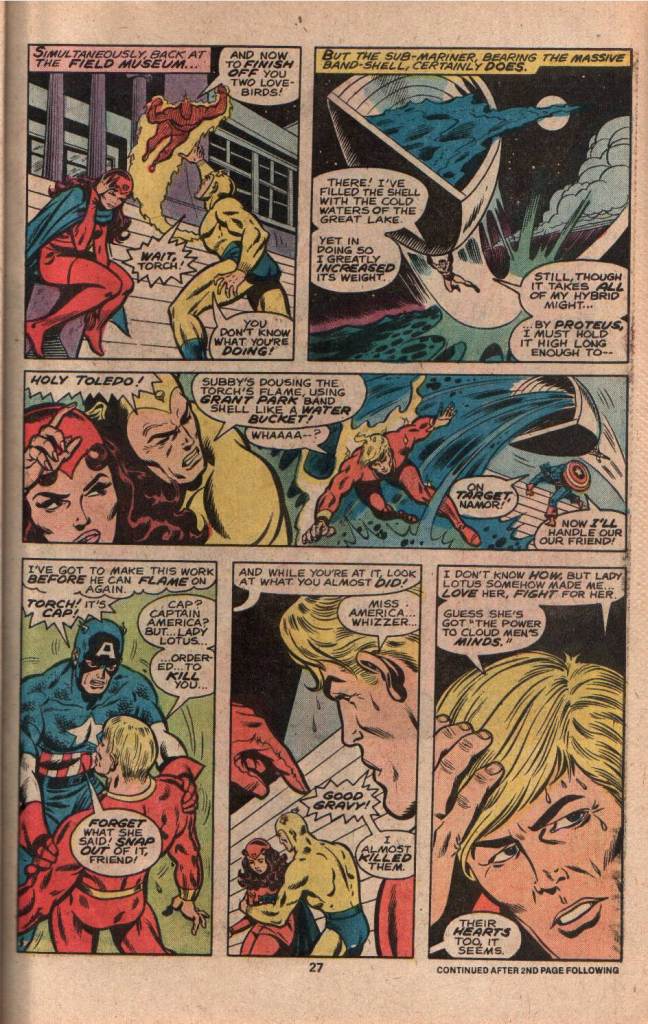
The Invaders are understandably reluctant to unleash all of their fighting efforts against their own former comrade, and so the Torch winds up holding all of them off while the rest of the Super-Axis makes their escape, moving on to the next of Lady Lotus’ sabotage targets. Eventually, though, the Sub-Mariner is able to snuff out the Torch’s flames with a torrent of water, and Cap is thereafter able to get him to snap out of it by…well, pretty much just telling him to snap out of it. From there, the reunited Invaders head over to the Riverview Amusement Park, where the Super-Axis are terrorizing the citizenry. The Invaders wind up all pairing off, with each one battling an individual Axis member–all except the Torch, who makes off with Namor’s flying flagship and instead heads back to the House of Lotus in Chinatown for a bit of revenge.
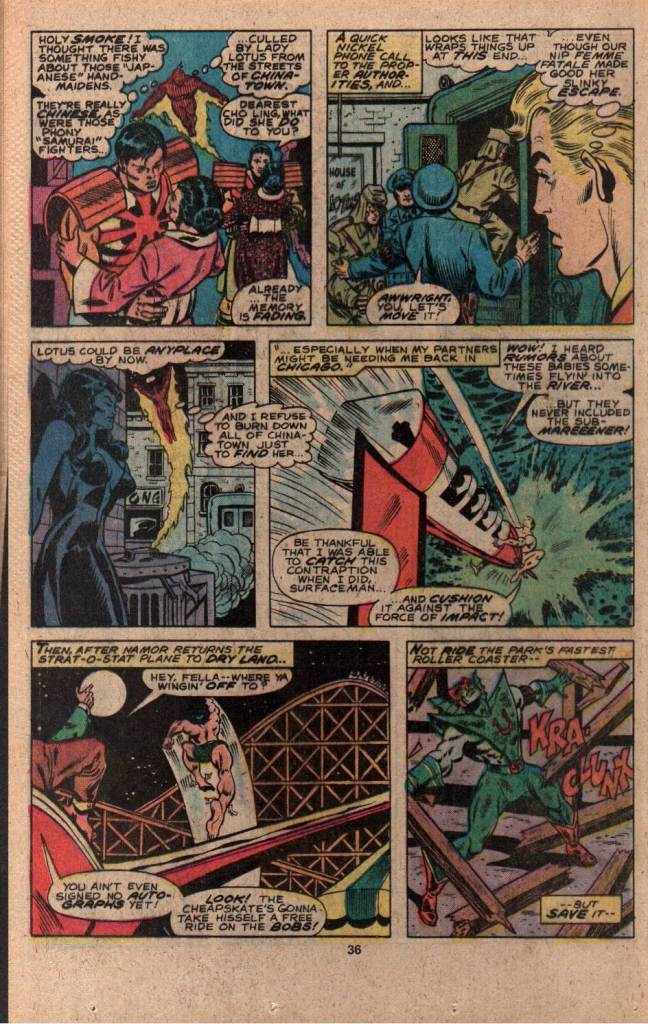
The torch burns his way into the storefront, battling his way through Lotus’ mesmerized Samurai (who turn out to be innocent Chinatown citizens who had bene hypnotized by Lotus and then kitted out in Japanese garb.) But Lotus herself is able to escape in the melee. Back at the park, Namor, Cap, Whizzer and Miss America hare having to save ark-goers from collapsing rides and general mayhem all the while carrying on a running fight with the Super-Axis. This battle is perfectly fine, but a bit lifeless and by-the-numbers. Everybody does the stuff that they’re supposed to do, but there isn’t really any drama to any of it. And the dialogue is mostly concerned with making either cutesy references to the events and pop culture of 1942 or else working in cameos from other characters of the period such as Diana Prince and Steve Trevor. Point being, it’s a fight but not much more than that–a good way to fill up some pages.

But alas, all fights must come to an end, and so one by one the Super-Axis fall before the power of the individual Invaders. They’re all carted off to prison in a paddy wagon at the end, a vehicle that you’d have to imagine that any one of them could break out of with little effort, even after having been trounced. But that’ll need to be left to our imaginations, as the final pages hastily show Cap, Torch and Namor bidding farewell to Whizzer and Miss America and flying back overseas to their base of operations in England, where they’re rejoined by Union Jack and Spitfire–the point being to set everything back to factory settings in this final story. There’s a final bit of business where the fleeing Lady Lotus encounters the Yellow Claw and his niece Suwan on a Chinatown street for no real reason, and a self-indulgent line about how long it will take before the Claw begins his own personal plans of conquest that coincides with the release of his series in 1956. Its an exchange that perfectly encapsulates the problem with INVADERS: it was speaking to a very small audience of aficionados more often than a general audience. I was relatively steeped in the history of comic books even in 1979 and I didn’t get the Yellow Claw reference here (outside of recognizing that it was a reference to something.)
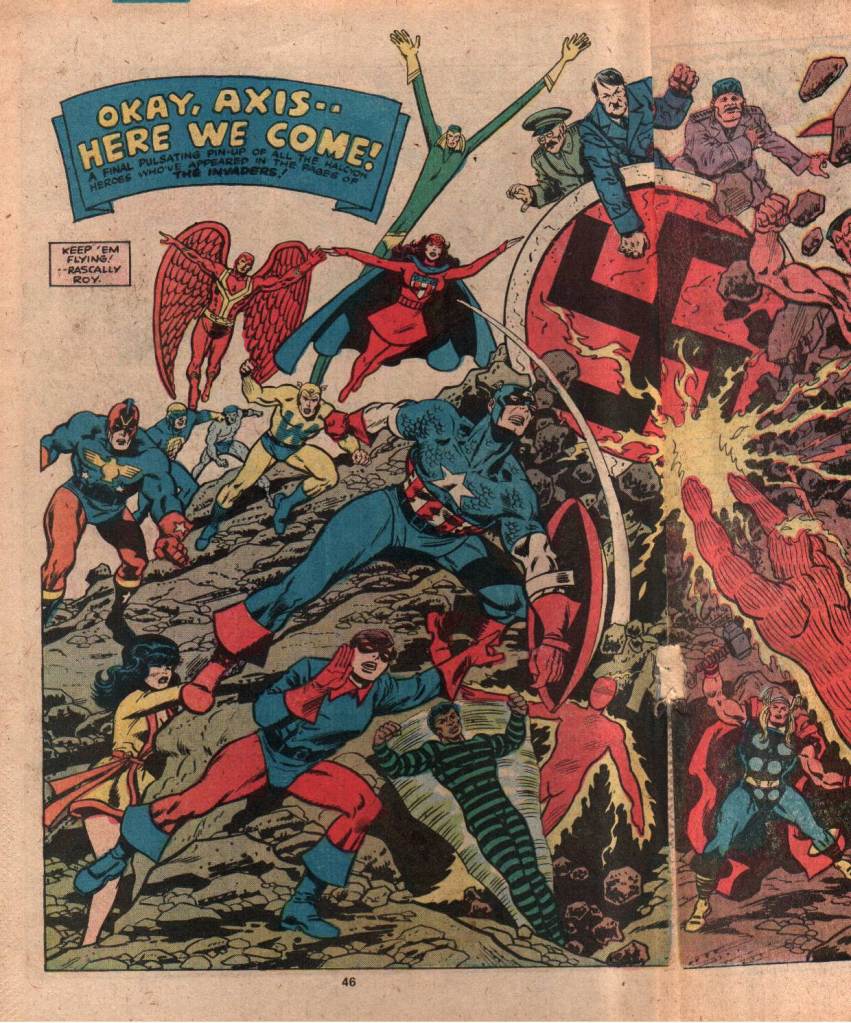
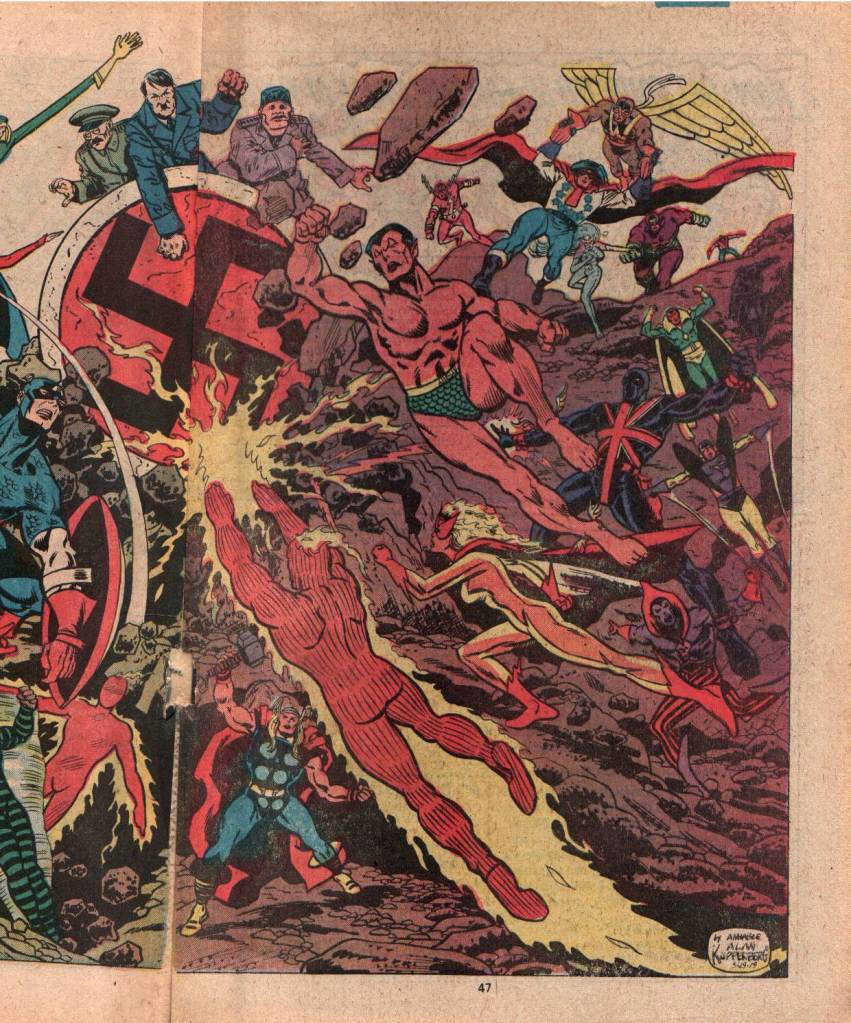
Possibly to make up for cutting the splash page and recap sequence to what would have been INVADERS #42, Roy includes a double-page pin-up at the end of all of the super heroes who’d appeared in the series during its run. A reference to it being a “final” pin-up is as close as the issue gets to making it clear that this will just be a one-off release to burn off accumulated inventory, the series won’t be continuing after this. It isn’t a terrible piece, but it also isn’t great. It evidences a bunch of the weaknesses in Kupperberg’s work: pedestrian composition, rubbery anatomy, and an overall lack of punch. But what he did do well was to take on the challenge that Roy laid down of producing an image of a couple dozen super hero figures (even if most of them are relatively tiny) and getting all of their costume-details correct.


I remember owning this issue and I wasn’t even aware that it was the final issue. Lost it in a house fire, but if I’d kept it I’d be rolling in the dough. I just found it online for as cheap as $4.00, and mine would definitely have been a reader’s copy.
LikeLike
I understood that Warrior Woman was a Wonder Woman knockoff but I never understood her being a brunette. She supposed to be the ultimate Aryan Woman, which meant blonde, blue-eye and have a wonderful pair of knockers – to horribly misquote a wonderful line in a wonderful movie. But I do remember the series fondly even if many issues weren’t that great.
And the Whizzer is still be better name than a British character by the name of Billy Whiz.
LikeLiked by 1 person
Invaders #40, released a few months beforehand (four months, by cover date), had a big announcement on the letters page that the book was being cancelled, but that material intended for issues #41-42 would “appear somewhere-or-other in the next few months, possibly in special issues”.
So for anyone who’d been buying the book regularly, the fact that this was the end of the road was pretty clear.
LikeLiked by 2 people
The entire original INVADERS series plus the 4 part mini Roy wrote later were collected in two volumes I’m very happy to have. However, Roy being Roy not all his Invaders-related tales have been collected since he wrote several others in various places over the years, which could usefully be collected in a further volume if the interest is there, IMO. Based on internal chronology running order would be:
1. SUB-MARINER #1 (2009 – Timely Comics – one shot) – 1940
2. CAPTAIN AMERICA & THE INVADERS #1 (2019 – one shot) – 1941
3. CAPTAIN AMERICA #423 (1994 – 1st meeting w/Namor) – 1941
4. CAPTAIN AMERICA: THE MEDUSA EFFECT (1994 – one shot) – 1942/3
There may be others I’ve missed.
LikeLiked by 1 person
There was Giant-Size Invaders #2, released in 2005, some 30(!) years after the first Giant-Size issue, which in addition to reprints of the first two monthly issues of The Invaders, had a brand-new story by Thomas drawn by Lee Weeks. But I think that one was actually contained in the second of the two volumes you mentioned. I can’t think of any newer stories by Thomas off the top of my head. Oh, well, if there are any, they’ll probably come to me in about five minutes 🙂
LikeLike
Yes, that 16 page Thomas/Weeks tale was included in vol 2.
LikeLike
Yeah, Invaders was DOA by this point. Did this Kupperberg ever grow past this stage of art? I never liked what output of his I saw and if I hadn’t been a completist still at this point I would have dropped the book. Still, it’s hard to see any other artist putting much life in the pedestrian stories. This was a mercy killing.
LikeLike
He never got all that much better.
He did a couple of autobiographical comics that suggest to me that he might have been better off trying to be a writer, but I guess art was what he really wanted to pursue. Just without putting the work in to improve.
LikeLike
He did an Avengers fill-in that was basically a send off for the Beast as a member of the team before he left in #211 that I recall liking if for nothing else than the creepy atmosphere… and the art in What if #9 is likewise rubbery, but it sort of fits the aesthetic of the weirdo forgotten 50’s characters.
As far as the titles I followed he was a fill-in guy.
I presume everyone is doing their best. Being a distinctive artist is hard, but easier than being a a lot of other things so they tell me.
LikeLiked by 1 person
I remember being happy to see this issue pop up, since I’d resigned myself to the likelihood that the story would never be resolved. It wasn’t spectacular, but at least it was closure. And I was just the right age to appreciate Lady Lotus and her whole femme fatale schtick. 😉
It’s a shame how quickly INVADERS went from one of Marvel’s most consistently readable titles to running on fumes. It was clearly Roy Thomas’ baby, and once he lost interest (or maybe he just got pulled away by other commitments?), it was doomed.
LikeLiked by 2 people
I feel that in addition to Thomas not writing the last several issues, the series was also hurt by Frank Robbins leaving the book. Yeah, I know some people really dislike Robbins’ superhero work from the 1970s, but I think that he was a really good fit for the World War II period setting of The Invaders. Robbins’ final issue was #29, I believe, and after that seems to be when the series began its gradual decline in quality, which was then compounded by Thomas’ departure.
LikeLiked by 2 people
I know for me the magic just left the series once Frank Robbins was gone and not replaced with someone as good or better. I liked Frank’s character designs( Granted I think John Byrne[ Captain America#253-254 ( January-February 1981 )] & Stuart Immonen’s Baron Blood ( John Falsworth ) [ All-New Captain America#1-2 ( January-February 2015 ), 5-6 ( May-June 2015 ) ] look cooler ).
LikeLike
During my teenage years in the 1990s I worked on putting together a complete run of The Invaders. It took me almost the entire decade, but I finally accomplished it. Every few years or so I dig out my copies and re-read the full run. Might be time to do that again soon.
So, anyway, looking at this issue, it’s a good but not great ending to a series that had previously been better. It’s a bit of a shame that Roy Thomas didn’t end up writing the last several issues of Invaders, although Don Glut was still pretty good, and Alan Kupperberg’s penciling is solid but unspectacular. The GCD says the cover to this issue is by Al Milgrom, and I think it’s a decent effort by him.
I will say that, although somewhat underwhelming, at least this final story did actually get published, and with only a relatively short four-month gap after the previous issue. After all, quite a few Marvel (and DC) series got cancelled so abruptly during the 1970s that they never received a proper conclusion, and I’m glad The Invaders escaped that fate.
LikeLiked by 2 people
TOM considering the date on this final issue was September 1979 and Yellow Claw appeared in a 1050s story in What If?#9 ( June 1978 ), I take it young you never got that issue or it wasn’t memorable to you ( That What If? issue inspired me in this century to go see if I was right about Gorilla-Man and the Human Robot, plus Skull-Face not being the only Atlas Age characters to be recruited to be Heroes and Villains. The Communist Red Skull, Electro & Dr. Standish ( Stanoff? –Young Men#26 ( March 1954 ) Captain America story ), plus a communist sorcerer[ Astonishing#19 ], communist human looking robot assassin ( stopped by American human looking robot ) and a female telepath working for some foreign government could take Yellow Claw and his team of villains place in this story ( so could 2 Human Torch Atlas age foes — Hypnotist & Vulture ). Atlas age has 2 other bad guys with electrical powers, Elk Diamond ( see marvunapp.com ) and a guy with the last name Barnes ( last seen crawling out of his grave ).
LikeLike
According to his wikipedia.org Fu Manchu’s Si-Fan also tries to eliminate fascist dictators and halt the spread of communism around the globe, for its leader’s own selfish reasons ( Dr. Fu Manchu knows that both fascism and communism present major obstacles to his plans for world domination), Marvel could have had his counterpart Yellow Claw choose to work in disguise ( Like time travelling Hans ( Dr. Doom — The Invaders#32-33 ( September-October 1978 ) for his own goals ) for the Axis as a Yellow Claw imposter [ All Select Comic#6 ( March 1945 ) Captain America story — mutated Japanese soldiers into his Mole-Men ( creates a chemical which dramatically increases the size of men’s hands — very Wu Fang III, Jess Nevins’ Pulp Heroes site ) comics.org ] and behind this Yellow Claw ( Captain Elliot ) [ Captain America Comic#14 ( May 1942 ) Captain America 2nd story — poisoned flowers ( aroma of flowers — very Fu Manchu or his copy Wu Fang ). On the Splash panel and page 2 the Yellow Claw who has his scarf covering his mouth and wearing a mask could be the real Yellow Claw and the one wearing only the mask and his mouth showing is Captain Eliot ] — this way he gets access to Axis resources without using his own and maybe sabotaging them from within. Marvel not using him is like in the Pre-Crisis DC Universe with the exception of Darkseid not using any other villain that would have been alive in the Legion of Super-Heroes time
LikeLike
What I they never even tried do use the Golden Characters ( villains in this case ) in their reprint books in The Invaders series? Fantasy Masterpieces#5 ( October 1966 ) The Ringmaster and his Circus ( Tommy Thumb, Zandow the Strong Man, Omir the Snake Charmer, Trapeze Trio and others [ the modern Ringmaster and his Circus of Crime went up against the Avengers in The Avengers#60 ( January 1969 ) Yellowjacket & Wasp’s wedding ) & the Dragon of Doom [ used in Marvel Universe#1-3 ( June – August 1998 ) Baron Strucker & Hydra vs. Invaders ]. You would need to resurrect the Butterfly ( Dr. Vitrioli ) & Lenny but not the Hunchback ( Craig Talbot –any relation to Glenn Talbot? )[ Fantasy Masterpieces#3 ( June 1966 ) ]. Resurrect Gorro [ Fantasy Masterpieces#4 ( August 1966 ) ].
LikeLike
Then there is Fang and his Hatchet Men [ Fantasy Masterpieces#6 ( December 1966 ) — Chu Yin, Baron Nushima his Japanese handler/contact ]. The Fiddler [ Fantasy Masterpieces#8 ( April 1967 ) ] could have faked his death since he was immune to his fiddle’s effects before his “death”. Countess Mara/the Satan in Satin ( called that on splash page and by a Captain America foe in a later story –the Spook? it’s in the Official Index )[ Fantasy Masterpieces#9 ( June 1967 ) ]. Like Thor/Journey into Mystery had Tales of Asgard the Invaders could have had Tales of the Homefront with Liberty Legion stories ( The Butterfly story had a Kali idol that was used to communicate orders that could be revealed to be a robot too so the super-strong Liberty Legionnaires ( Blue Diamond & Miss America ) have something to fight. Lenny could use a strength upgrade ( Either Baron Blood or Kree or Kraven the Hunter level ).
LikeLike
Then there is Marvel Super-Heroes#14 ( May 1968 — Red Raven Comics#1 ( August 1940 ) Mercury story ) with the villains Pluto ( alias Rudolph Hendler — later identified as Kro in Marvel Universe#4-7 ( September-December 1998 ) — issue #6 ), L-5 ( Thea Shilhausen ), Heinrich Goertz and the Sturm Staffel ( 2 other members unnamed ). Prussland could be identified as a renamed Latvaria.
LikeLike
No, he opposed fascism because he Axis was attacking China and Fu Manchu was a Chinese patriot. He despised Chinese communism because at heart he’s a Chinese nobleman and a philosophy that glorified the working man offended him.
From writer Sax Rohmer’s point of view this was all necessary to adjust Fu Manchu to the changing geopolitics of the 1930s and beyond. The “devil doctor” had been introduced as an anti-imperialist whose goal was to liberate China from European control. Then Japan occupied Manchuria, then the commies took over …
More detail here: https://atomicjunkshop.com/twentieth-century-geopolitics-and-east-west-relations-in-the-shadow-of-dr-fu-manchu/
LikeLiked by 1 person
TOM, in The Invaders#19 ( August 1877 ) page 30 the Human Torch was given the same drug as Toro, Bucky, Captain America, Sub-Mariner & Spitfire. As for this last issue of the Invaders, you would think that getting a blood transfusion from Captain America would enhance Miss America or restore her original powers.
LikeLiked by 2 people
As you say… this title lost its bounce with Thomas, Robbins, and Springer gone…. though I bought a few issues after they had departed. It wasn’t likely an option, but I would have been pretty jazzed if they had given the series to Kirby … who had done a number of covers. It probably wouldn’t have lasted any longer as a series, but it would have meant at least a handful of weird and wild comics…perhaps only if Kirby would be allowed to treat WW2 era MU as an unexplored world. The continuity for a number of the secondary characters was at least malleable. Even better would been a Joe Kubert Invaders… which is wishing for the moon and the stars, and free pizza forever.
LikeLiked by 1 person
Seems like Roy could sell a WWII superhero book if he had excellent art. ALL-STAR SQUADRON had a much longer fadeaway after the departure of Jerry Ordway, but the heart seemed to face out of that book, too, and a lot of what Roy did toward the end seemed like he’d lost interest, too.
I mean, CRISIS kicked the hell out of the Earth-Two books, but it seemed like Roy had stopped caring before that.
I should say that he didn’t stop caring completely, as he went on to do YOUNG ALL-STARS, trying to keep it going somehow. So he was still invested enough to keep going. Just not invested enough to do a good job, as writer or editor. Or so it felt to me.
It may be that he was still interested in playing with the characters and setting; he just didn’t have any interest in trying to sell it.
But yeah, this was a pretty lifeless finale. Even during the days I’d have said I didn’t like Frank Robbins’s art, I found the book compelling, but once he was gone it was just blah. So I was absolutely responding to the Robbins art, the energy, the storytelling, the character “acting” — even if I didn’t know why.
LikeLiked by 2 people
Agreed about Roy Thomas losing interest in the Squadron a couple of years prior to Crisis On Infinite Earths. In my opinion that started in the mid 30’s right after the excellent Crisis on Earth-X multipart-er. By the early 40’s the book was a total slog to read.
While I’m not a Robbins fan either I get what you saying. Hoberg and Kupperberg art was serviceable and easier to follow than Robbins but lacked the energy you spoke of…
I’m thinking if Buckler had penciled Invaders regulars and paired with an inker who got him that to book could have looked as nice as early All-Star Squadron…?
LikeLiked by 1 person
I would take Robbins over Buckler any day, myself. Drawing style aside, he’s just a better storyteller.
I think Adrian Gonzalez was an improvement on Buckler as well, and wish he’d had a more extensive comics career. But I guess animation paid better, and/or was otherwise more rewarding than drawing ALL-STAR SQUADRON or ARAK.
LikeLiked by 2 people
I’ve been working on putting together a complete run of All-Star Squadron, which is taking me quite a while, since some of the later issues had low print runs, plus trying to find a copy of the issue that Todd McFarlane penciled that isn’t super-expensive is proving to be really difficult.
Anyway, I agree with you and Kurt Busiek, it does feel like Roy Thomas was losing momentum on All-Star Squadron even before Crisis hit. He seemed to be really going full steam ahead when it was Rich Buckler inked / finished by Jerry Ordway and when Ordway was doing full art. Even after Ordway moved over to the Infinity Inc spin-off Thomas still seemed pretty invested in All-Star Squadron. But, yeah, once it gets into the early 40s the book seems to drift, which is a shame because I feel that Arvell Jones is an underrated artist. Then we get to Mike Harris inked by Vince Colletta, and those issues really cannot hold a candle to the ones Ordway was involved with, either story-wise or art-wise.
So, maybe just as Roy Thomas really needed Frank Robbins on Invaders, he also needed Jerry Ordway on All-Star Squadron.
LikeLike
Kurt, I forgot all about Adrian Gonzalez coming in-between Buckler & Ordway and Ordway going solo. Yes, Gonzalez did good work on All-Star Squadron.
LikeLiked by 1 person
Robbins grabbed me from the get go on Invaders. I remember reading the first Giant-size issue with the same intensity as discovering Kirby years earlier. Weird super-hero anatomy to be sure, and out of the box compared to other Marvel artists… but he sure dialed up the intensity. Once Springer came on board I thought they were perfect. I loved the Daredevil fill-in he did with Springer…though I think he would have been an odd fit as the regular artist ( I would have bought it) A Spider-man annual would have been plum, but he was also a good fit for horror.
His comic strip Johnny Hazard looks great.. and he as no slouch as a fine painter.
LikeLiked by 2 people
I loved everything Robbins drew. I didn’t care it was idiosyncratic. It had dynamism, energy, and sexiness, a troika few artists could manage at once for me. Wasn’t he in line to take over Daredevil when he passed and that’s how we got Miller? Sort of like how Bob Brown’s passing gave us the Byrne drawn Avengers?
LikeLiked by 1 person
Robbins quit comics and retired to Mexico to paint, years before he died. He did draw an issue of DAREDEVIL (and a nice DD guest-appearance in HUMAN FLY), but I don’t know if they’d assign him a new book just as his contract was expiring.
On the other hand, 70s Marvel, you never know.
Bob Brown died years before Byrne drew the Avengers — Sal Buscema was the regular penciler after him. Are you maybe thinking of how Dick Dillin dying resulted in George Pérez taking over JUSTICE LEAGUE?
LikeLiked by 1 person
When they used that fill in they had on hand drawn by Bob Bown, the lettercol said that if he’d still been around, he would have had the book as necessary after Cockrum. I had no idea there was such a gap.
LikeLike
Sorry, I got mixed up. Brown died in 1977, the same year that fill-in appeared. He didn’t leave AVENGERS because he died; he moved on to DAREDEVIL.
But him dying still had nothing to do with Byrne taking over AVENGERS, since it was an X-MEN fill-in…
LikeLiked by 2 people
I remember the lettercol saying he would have had X-Men. Whether that’s a good memory fifty years later…
LikeLike
What it said was that Chris and Marv agreed that if Dave left X-MEN, Brown would make a perfect replacement.
But since Brown drew the story in 1975, in the first year of the revived series, it wasn’t an actual plan, just an opinion — Dave wasn’t leaving at that point. And by the time Dave did leave, Archie was EIC, so Marv wouldn’t have gotten a vote.
I think, by that time, with the fan reaction X-MEN had begun to garner, they wouldn’t have gone with Brown even if he’d been available at the time. X-MEN was a fan-favorite, by the old definition — a series that wasn’t a big seller with casual readers, but had an intensely-devoted fan readership — and they’d have wanted someone more suited to that kind of audience. Which is exactly the kind of choice they made.
LikeLiked by 1 person
Oh, and Brown dying had nothing to do with Byrne taking over X-MEN, either — by the time they ran that fill-in, Brown’s contract with Marvel had wrapped up and he’d gone back to DC, and taken over WONDER WOMAN, but he only drew one issue before passing away.
So even if Chris wasn’t just being nice in saying that Brown would have made the perfect replacement for Dave — and it’s hard to believe they’d give the book to such an old-fashioned artist on a regular basis, even back when the book wasn’t a big hit yet — he wouldn’t have been available when the book went monthly and Dave had to give it up.
LikeLiked by 2 people
Kirk mentioned Adrian Gonzales, loved his art work only wish there was more of it.
The phrase underrated is overused but still it most certainly applies to Adrian Gonzales!
Ben I agree 100% about Ordway he was the All-Star Squadron glue. But other than several covers after the mid 30s his time ended.
Interesting that for both Invaders and Squadron there were many issues without a popular artist.
LikeLiked by 1 person
The bottom portion Page 23 was original to have been Invaders 42 p1.
Found the art with an internet search. Full size it’s a really nice battle splash!
LikeLiked by 3 people
Wow, cool, thanks for sharing this. I was always curious where the break between would have occurred if this had been published as two issues as it had been originally intended.
LikeLiked by 2 people
Ben, that Invaders splash page is on CAF where I’ve also seen art you own 🙂
LikeLiked by 1 person
Well, Rift Corbitt, it’s not like it’s possible to have seen *every* piece on Comic Art Fans 🙂
So, anyway, thanks again for posting it here.
LikeLiked by 1 person
Here’s the full size page 46-47 double page spread. Apparently the same person owns or owned (?) them both. That’s a lucky dude, right…
For my and my buddies at the time this double page was treasure as many of the characters appeared before we became comic readers. I recall us thinking the Thin Man was really Mr. Fantastic. We have zero idea who the Crusader Characters were then we even asked soem of the older comic readers in our area. To be be an elementary school-er again 🙂
LikeLiked by 2 people
Not much to add that hasn’t already been said other than Invaders was my first lesson in certain titles being the right fit for certain artists. Prior to the launch of this title, my buddies and I truly disliked Frank Robbin’s art. We’d gleefully giggle as only middle schoolers could over comments we’d find on the letter pages where readers criticized his work. Yet the moment I saw his art on Giant-Size Invaders #1, it was an absolutely perfect match for the look and energy this book required. Even fill-ins from artists I professed to like better didn’t work as well on the Invaders.
On a final note, I wish I’d been wise enough at that time to also note how offensive a name “Yellow Claw” was for an Asian character.
LikeLiked by 3 people
Giant-size Invaders is an amazing action book. They just take Masterman apart as he fades and shrinks, and Robbins’ rendition of Cap’s origin makes the whole thing feel epic. The run up the highway feels kind of visceral in a way that comics just weren’t at the time. Effort seemed to be made that Bucky could take out a full grown guy. I was ten so what did I know? Colletta is on board but so what? It still looks great!
I agree about the Yellow Claw name… he was also still colored a tint of process yellow in the mid-70’s like he had been in the 50’s and 60’s. The Mandarin on the other (ringed) hand was always colored like any other character… go figure. Still problematic… but a few degrees less so guess.
LikeLiked by 3 people
Yellow Claw is only offensive if no one links his choice of name to the Yellow Emperor/Huangdi in Chinese Mythology ( the legendary first ruler of China and the ultimate ancestor of all Han Chinese ): the colour yellow represents the earth phase, the Yellow Dragon, and the center. Link his name to the Five Emperors and that Yellow Claw is the only known surviving Claw ( 5 in total, with the colour before the Claw matching with with the colours the 5 Emperors represents — Yellow Emperor ( earth/center ), Red Emperor ( fire/south ), Black Emperor ( water/north ), White Emperor ( metal/west ), Green Emperor ( wood/east ) ).
LikeLiked by 1 person
I call BS. The “Yellow peril” is a persistent and pervasive negative ethnic American stereotype. Yellow skin, pointed nails, buck teeth, and pointed ears are part and parcel of it.. and the The Yellow Claw checks all the boxes.
No comic creator was looking at Chinese myth when they created these guys.
LikeLiked by 3 people
ONE, I never said his creator looked at Chinese Myths when they created Yellow Claw — I suggested that WRITERS NOW look at Chinese Mythology. Yellow Claw was created to be Atlas Comics answer to the original Yellow Peril Dr. Fu Manchu ( Which China’s Xi is trying to live up to, not to mention 2 other Caucasian so-called world leaders ) but he never needed to stay that way. I see him no different than Tyrannus or Doctor Doom or the Red Skull or Centurius or Atlas Age Human Torch foe the Hypnotist or Timely Comics Green Terror. Yellow Claw never had buck teeth and he never had yellow skin when he was used in Marvel: The Lost Generation#3 ( December 2000 ). I like Yellow Claw in thinking up Timely Comics villains ( I have already linked him to Timely Comics Yellow Claws ) to give John Steele a rogues gallery, I see him as his Brainiac or Lex Luthor or Ultra-Humanite ( human body )— I had sent a letter to the Marvel Project suggesting they give John Steele ( who I see as Timely Comics answer to Hugo Danner ( Whose creator I learned on Monday on his wikipedia saw Hugo destroying the Brooklyn Bridge and lifting a locomotive ( a 1918 locomotive weighs 95 tons ( light passenger/switch engines –140 tons with the tender ), 135 to 150 tons ( for engine alone for Standard passenger engines ), 145 tons ( Medium freight engines ), 217 tons ( Heavy Freight engines ) ) and suggested that his foes should ne counterparts to characters in Literature ( I meant finding Timely Characters like the Grinner ( a Mr. Hyde type ), Stone Man ( a Nazi Golem science created ) .
LikeLiked by 1 person
IIRC The last time he turned up in Agents of Atlas he was rechristened Golden Claw and his original shade was declared a mistranslation, which seems like better fix to me.
LikeLiked by 1 person
I appreciate everyone’s thoughts on the topic of the “Yellow Claw.” I know that he was later referred to as the “Golden Claw” which seems to support my initial concern. In my Iron Man blog (https://www.ironmanrevisited.com/) where I review his past issues, I plan to simply refer to the character as “The Claw.”
And yes, David, the Mandarin is a whole other discussion.
LikeLiked by 2 people
For what it’s worth I regret writing “bs.” I might have misread the intention of the point you were trying to make.
LikeLiked by 3 people
Before I got distracted in having to defend my suggestion in my there could be other Claws suggestion I remembered one of The Shadow’s enemies The Hand ( an international conspiracy. The organization was led by 5 distinct “Fingers”, and The Shadow had to hunt down and defeat each individual leader ( or as wikipedia.org put it defeated one Finger of the organization ) across multiple stories ). So my Claws suggestion could mirror The Shadow’s The Hand.
LikeLike
Yellow Claw did spawn Caucasian counterparts in the Marvel Age: Doctor Carlo Strange ( Yellow Claw ) & Carla Strange ( Suwan ) [ Tales of Suspense#41 ( May 1963 ) Iron Man story ]. Imperial Hydra/Arnold Brown ( Yellow Claw ) & Agent H/Laura Brown ( Suwan ) [ Strange Tales#135 ( August 1965 ) Nick Fury story ]. In the Altas Age Suwan was more like Karamaneh ( She falls in love with Dr. Petrie like Suwan was with Jimmy Woo ) in Dr. Fu Manchu’s stories, but in The Agents of Atlas she became more like Fah Lo Suee ( a devious mastermind in her own right — wikipedia.org under Fu Manchu ). I wonder if the Mandarin betrothed Mei Ling and Doctor Doom’s Valeria were the non-family versions of Suwan?
LikeLiked by 1 person
I never really cared for Frank Robbins’ art until The Invaders and then I loved it. He really captured the period for me.
My big problem with The Invaders was spotty distribution in my area. I wasn’t able to get every issue and seemed like when I was able to fill a gap, it was a Dreaded Deadline issue with half new and half reprint. I wasn’t able to get any of the 20’a and only two of the 30’s (the Frankenstein issue and this one). By then, Robbins and Roy Thomas were long gone.
This issue was okay, but it wasn’t as fun to read as previous issues were. I don’t even think I was aware this was the last issue when I bought it. Also, I was never a fan of Alan Kupperberg’s art….as everyone says, too rubbery and awkward. Sometimes if I saw he was the artist, I didn’t pick it up that issue. I didn’t know if he was just rushed or what.
LikeLike
I didn’t read Invaders until well after the fact and have to admit I was wasn’t all that jazzed about it. Frank Robbins was just another Milton Candiff clone to me and Roy’s scripts seemed to lack something. The Invaders didn’t seem to do much invading, being even further behind the front lines than the All-Star Squadron most of the time.
LikeLiked by 2 people
I agree that “The Invaders” is something of a misnomer, since the team ends up spending most of their time in Great Britain or, worse yet, back in the United States, rather than actually invading territories controlled by the Axis powers.
As recounted by Roy Thomas, when he pitched this series, he did *not* want to use the original Golden Age title “All-Winners Squad” which he felt was kind of silly. I guess he couldn’t come up with a more accurate name than The Invaders, and apparently Stan Lee really liked that name, which was a major part in him giving the book the green light. So, for better or worse, that’s the title that stuck.
LikeLiked by 1 person
I forgot to say, it’s such an odd thing for the Yellow Claw and his niece to just randomly show up and run into Lady Lotus in the final two panels of this story. I wonder why Don Glut decided to throw that in. The only possible explanation I’ve ever seen suggested is that it’s Glut’s nod to his story from What If? #9 which was published only a year earlier.
(I can never remember if What If? #9 is supposed to be one of the very small number of stories from that series that “really” happened in the mainstream Marvel continuity, or not.)
LikeLike
According to the Marvel Wiki:
“For many years, the Beast’s question of whether he was viewing the past of Earth-616 or another dimension went unanswered. In Avengers Forever #4 it was finally revealed that he had tuned in to another dimension, when heroes from Earth-616 visited that dimension (named Earth-9904) shortly before it was destroyed by Immortus.”
IMHO it was written in the hopes of a spinoff series or to be picked up Avengers. But seeing as Avengers was just heading to the Korvac Saga followed by a period of instability it never happened.
LikeLiked by 1 person
Forgot to add that Thomas soon left to go to DC as well.
LikeLike
I seem to recall that Kurt Busiek later explained that the 1950s Avengers also existed in the “main” 616 reality but under a different name and the events from What If #9 happened more or less in the same way? I’m guessing that’s the team that was later known as the Agents of Atlas.
LikeLiked by 1 person