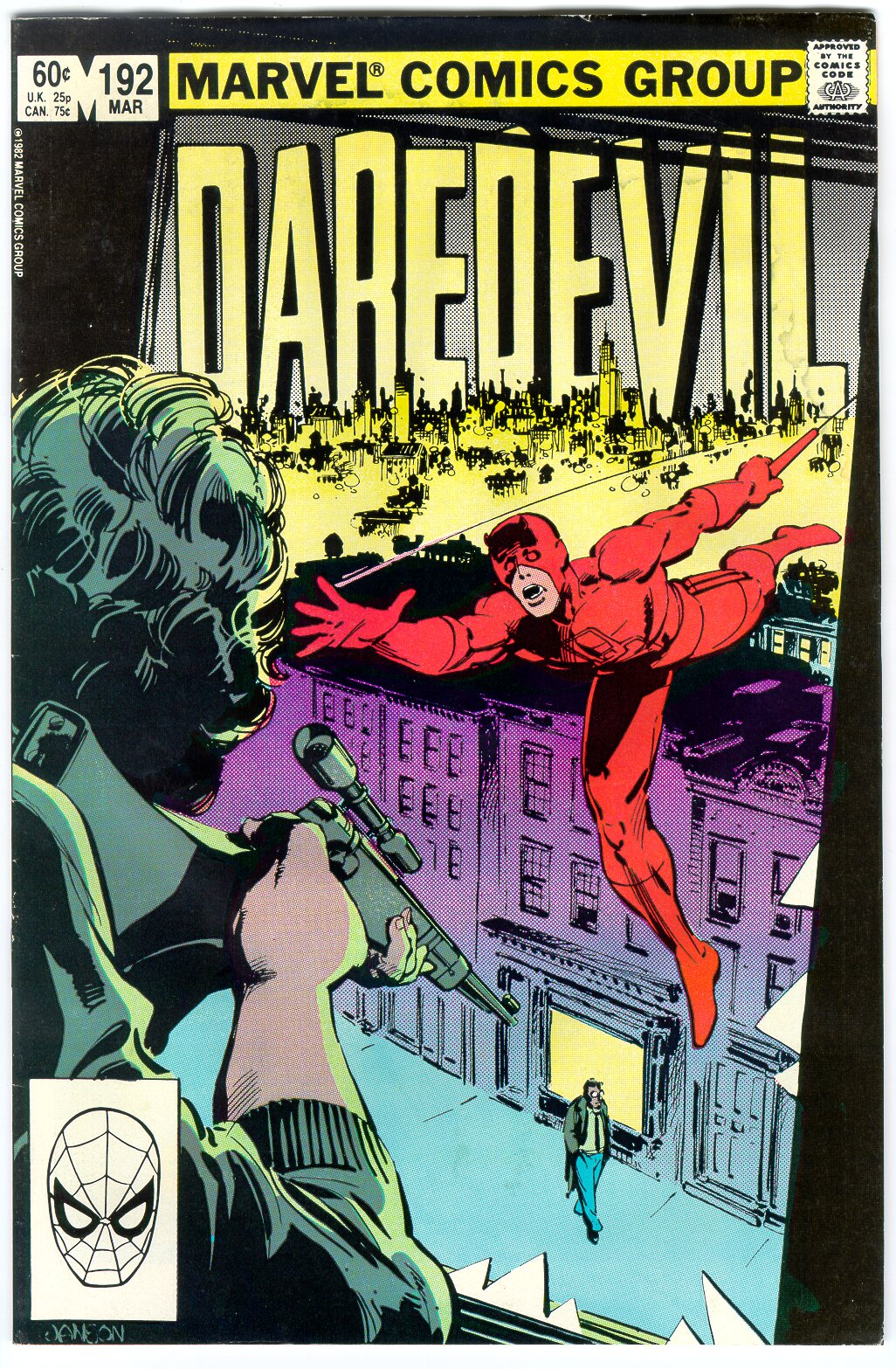


In the early 1980s, Frank Miller had a transformative run on DAREDEVIL. Starting out as only the book’s penciler, he began to shift it in tone, moving it away from the ersatz Spider-Man clone it had been towards something with a bit more of a noir sensibility to it. This process accelerated when he took over writing the series as well, and his run launched the title for perhaps the first time in its history to the forefront of popularity among the comic book fan community. There was no more electrifying and innovative series during this time than DAREDEVIL. But eventually, all things must come to an end, and Miler’s time as DAREDEVIL’s scribe and artist wrapped up with issue #191. And collectively, fans held their breaths: what was going to become of the series next?
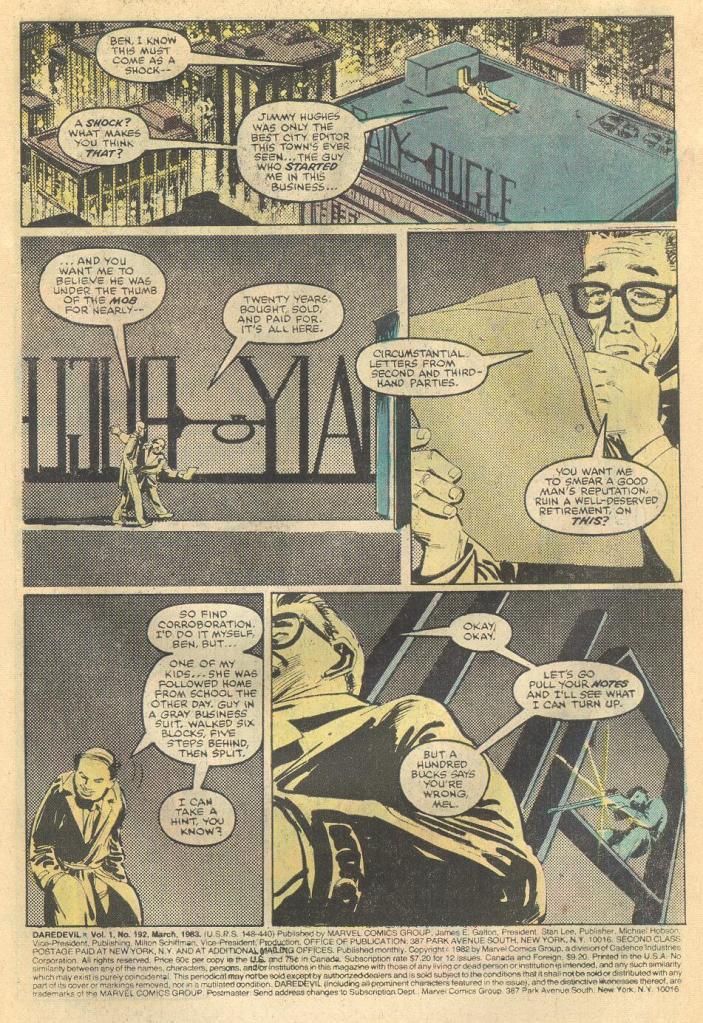
DAREDEVIL #192 brought an answer, though it was only a momentary answer, unfortunately. Speaking for myself, I was pretty jazzed that Klaus Janson, who had been taking on more and more a role in the artwork particularly during the back half of Miller’s tenure, was staying in place as the regular artist and colorist. But more crucially for me, the writer of this issue turned out to be Alan Brennert. Brennert came from the world of television, but he’d written a number of notable stories for DC prior to this, including the classic “To End A Legend” in DETECTIVE COMICS #500 as well as some ridiculously good stories in BRAVE AND THE BOLD. The idea of him inheriting DAREDEVIL was incredibly exciting to me. Unfortunately, Brennert had done no such thing. Rather, he’s been commissioned by editor Denny O’Neil to write a single issue, effectively a fill-in to hold the line until a new regular writer could be found. (Denny would wind up taking that position himself.) So that was disappointing. But for one brief issue, we got a sense as to what a Brennert-helmed DAREDEVIL series might have looked like. And it was terrific.
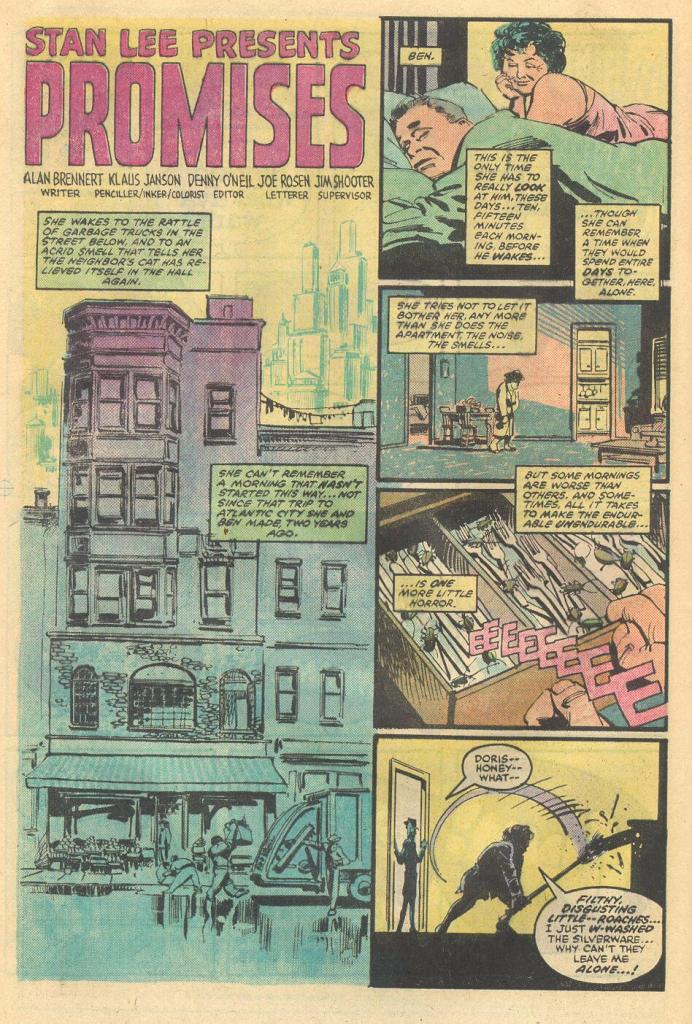
As a number of stories prior to this had done, this issue focuses very heavily on Ben Urich, a Daily Bugle reporter introduced months earlier by Miller and Roger McKenzie. Urich had worked out the secret of Daredevil’s true identity, then chose to bury that potentially prize-winning piece of investigative journalism so as to not impede all of the good that the sightless crusader was doing for the city. Thereafter, Ben had become a regular player in the book, lending it a middle class ground level perspective among all of the ninjas and crime figures and super villains. He became a popular character, and when it seemed as though his life might have been snuffed out by Elektra at the close of one issue, fans were apoplectic.
The actual story involves two parallel threads. As the issue opens, Ben is on the rooftop of the Daily Bugle, being given information by a fellow reporter that Urich’s old mentor, former editor Jimmy Hughes, had been under the thumb of the mob, killing stories that the underworld didn’t like. The situation is too hot for the other reporter, and Urich is skeptical–but he’s willing to run it to ground. He’s also on the bullseye of a rifleman, but Daredevil shows up to kibosh the attempted hit. The gunman claims that he was only hired to scare the two reporters off of following up on the story, and Daredevil’s hyper-senses confirm that he’s telling the truth. After consulting with Ben, Daredevil agrees to help Urich get to the truth.
The other story thread involves Urich’s personal life and his wife Doris. She’s been steadily growing more and more unhappy with the shabby apartment that she and Ben live in, and an early morning encounter with cockroaches in the silverware drawer provides the impetus for the pair to seek out other living accommodations, in particular a house of their own. Doris doesn’t work, so she feels trapped in their small place all day, and even though she’s proud of Ben’s accomplishments, she wants more. So the couple goes house hunting, and while they find a place that Doris loves, it’s clear that they can’t afford the downpayment. But the broker claims that he needs to sell the place and is willing to work with his bank to make it possible for Urich to take ownership. it all seems too good to be true.
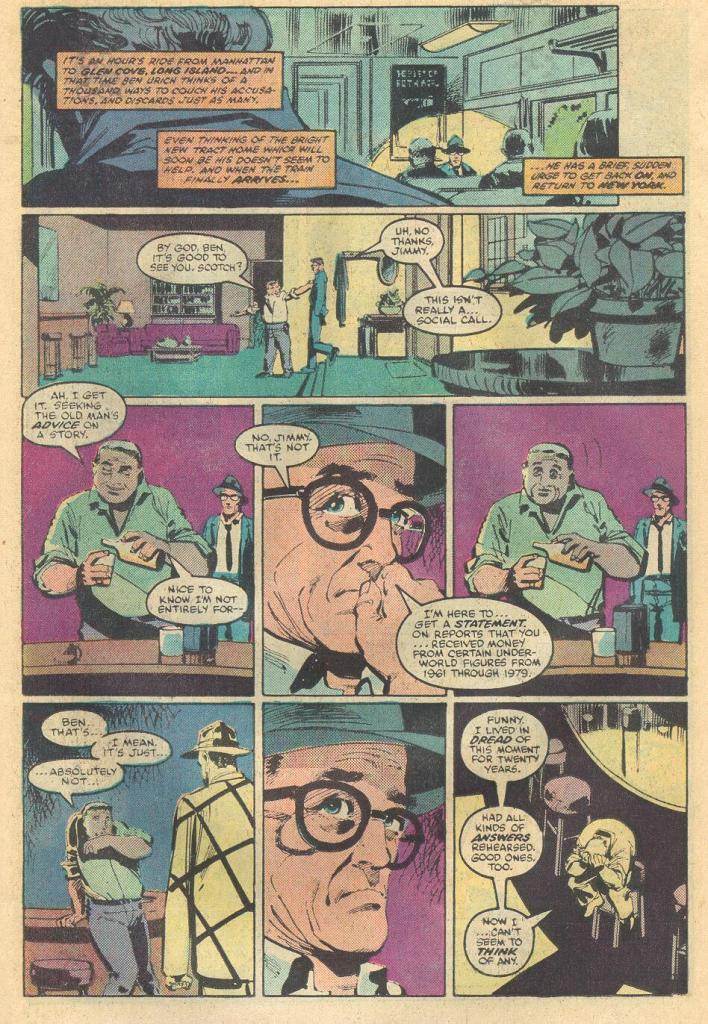
Daredevil, meanwhile, has tracked down and confirmed the evidence that Urich’s mentor Hughes was on the take. Disappointed, Urich heads over to the old man’s house to confront him with the news before he publishes it. Hughes doesn’t really even try to hide it, he just sighs forlornly and explains to Urich that it was the easiest thing in the world, just one small step after another and very soon he was in a position from which he couldn’t escape. When Urich gets on Hughes’ case about killing stories for the mob, Hughes retorts that Urich did the same thing in a recent story when his own life was threatened. So Ben realizes that he’s already a few steps down the slippery slope.
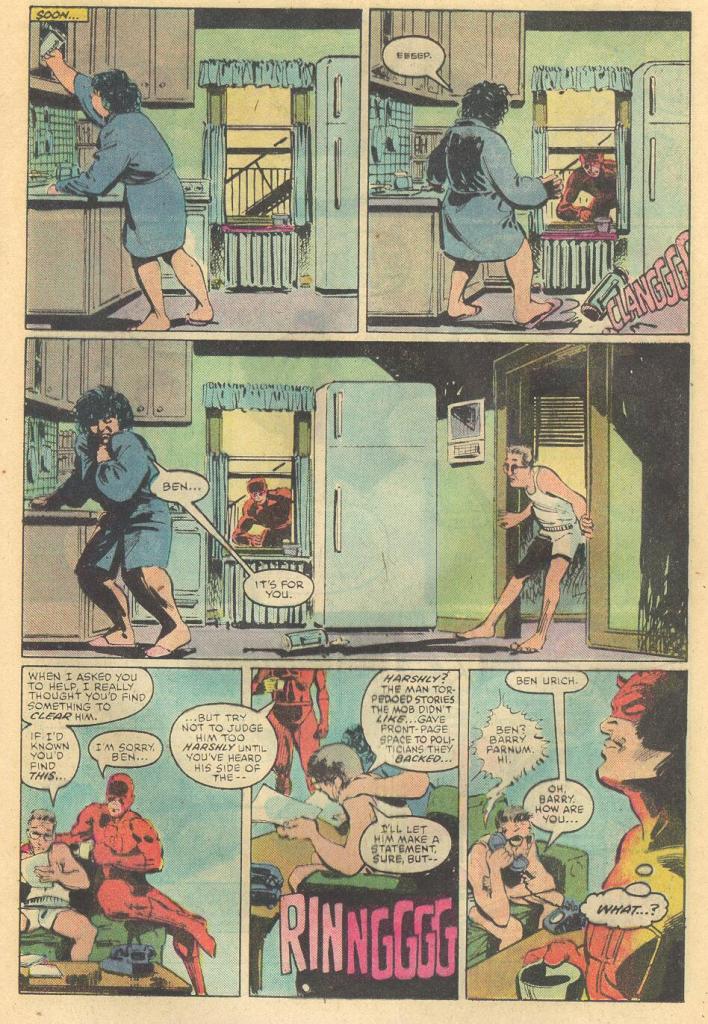
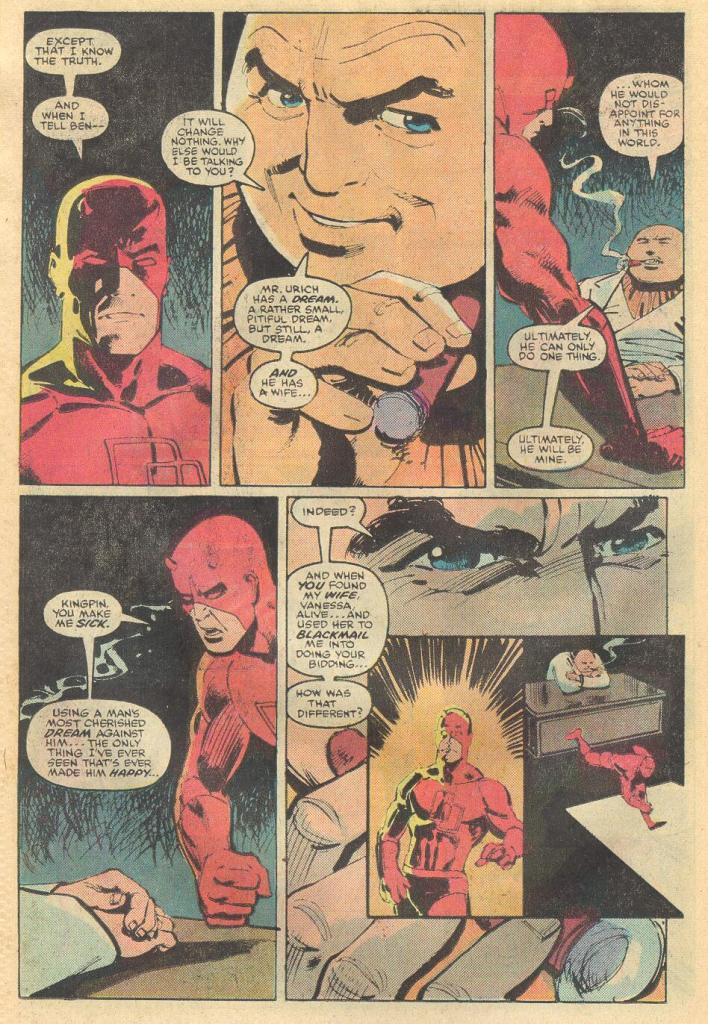
Daredevil also happens to be at the Urich apartment when the call comes in from the realtor informing Ben that he’d been able to get his financers to take a smaller down payment on the house the couple was looking at. Smelling a rat and hating himself for it, Daredevil runs down the fact that the property used to be owned by Frank Farnum, the villainous Masked Marauder, and since his demise has passed into the hands of a businessman with mob connections. He goes to confront the Kingpin about this, and Wilson Fisk tells him that it’s often easier to put such journalists under pressure than to simply kill them. Fisk knows that Urich’s wife wants that house, and that Ben will have no choice but to purchase it for her, and that will put him unknowingly in the Kingpin’s debt. Fisk tells daredevil this freely, knowing that there isn’t anything that the Man Without Fear can do to stop it. And when Daredevil looks down on the Kingpin for using a man’s wife against him, the Kingpin turns the tables on him, confronting him with the fact that Daredevil himself had used the Kingpin’s wife Vanessa as a bargaining ploy in a recent adventure. Like Urich, Daredevil is already slightly tainted, already on that same shaky slope.
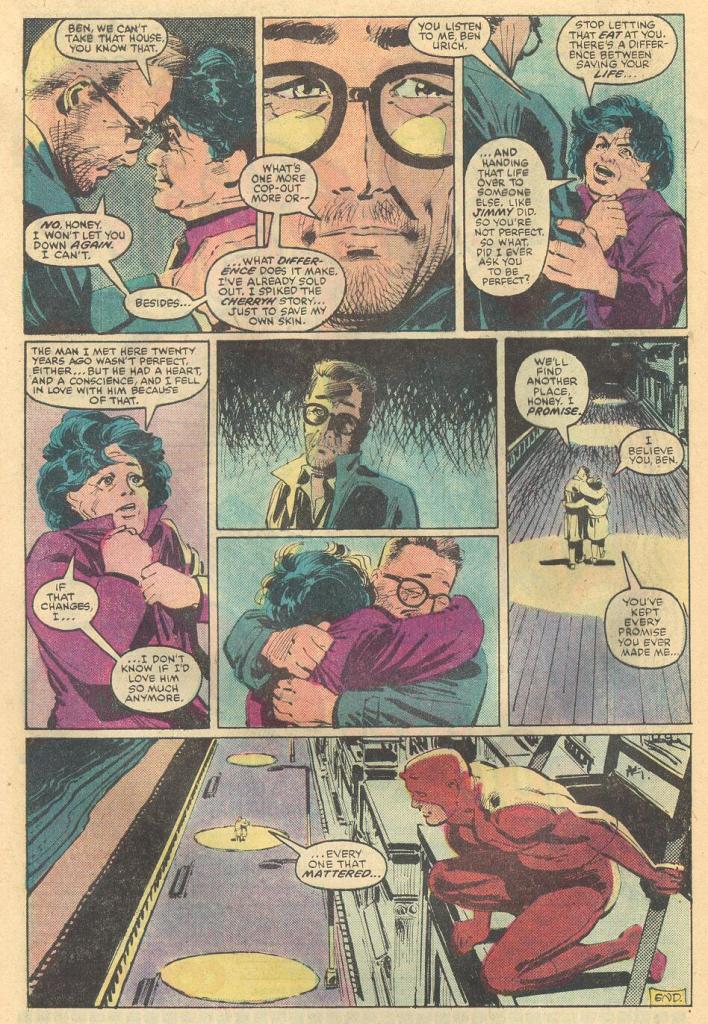
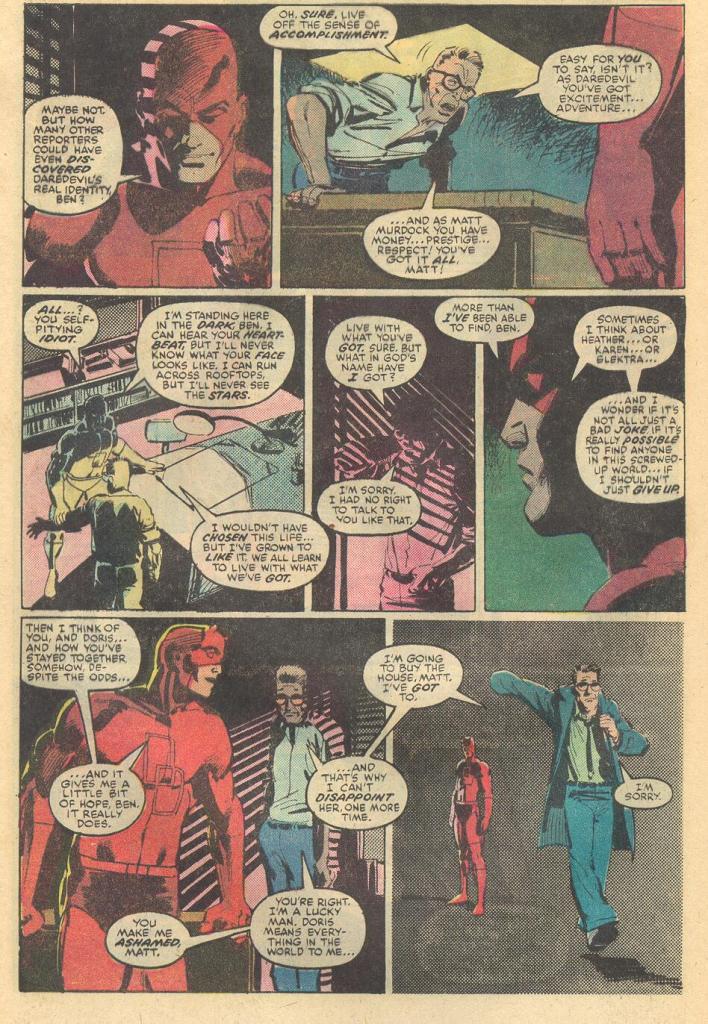
Daredevil reveals everything that he’s discovered to Ben, but as the Kingpin predicted, it isn’t enough to dissuade him. Their conversation is very pointed, as it’s clear that the very convictions that prevented Ben from revealing Daredevil’s true identity are also the things that have kept him from getting ahead in life. Ben made a promise to his wife about their future and he’s not about to break that promise, not even if it means compromising himself. So Daredevil does the only thing that he can he tells Doris about the situation, and she finds Ben out on the Coney Island pier where they first met. And she tells him that she doesn’t want him to buy that tainted house for her, that she couldn’t stand it if he wound up compromised the way Jimmy Hughes did. She’s willing to give up her own happiness if that means that Ben can live without that weight on his conscience. And that’s how the issue wraps up. It’s a great little story, not the most action-packed or super hero-oriented (the cover is just a bit of a cheat given that nobody takes a shot at Ben or anybody else from a window, but it isn’t egregious). But it’s got great character-based turns for all of the principle players, and it uses the recent history to good effect. This issue energized me for what new stories might be coming down the pike for Daredevil, and made it feel as though the book would be fine even in the wake of Frank Miller’s departure. I was more disappointed the following month when Brennert was no longer in evidence, though, and I only read perhaps another issue or so beyond that.


I think there’s quite a bit of distance ethically between Matt rescuing Vanessa and using her safe return as a chip to stop the Kingpin from murdering folks, and Kingpin devising a plan to put a journalist in his pocket. Admittedly it makes for a better moment that Kingpin shuts him up over it, but I think Matt as a lawyer would have had some valid retort.
Still a great issue though. I loved Janson’s solo take as well….and I must have thought O’Neil had a pretty good grasp of Daredevil’s character (better than he did of Tony Stark’s imo) when he took over. I think I hung around til Janson left.
LikeLiked by 3 people
Well, Matt was never a great lawyer, as the writers rarely worried about legal accuracy. Which bugs me more than medical oddities in Thor — Matt Murdock is more important as a character than Don Blake.
LikeLiked by 1 person
I only read the DD with Wolverine showing a few issues later. Although the art was nice, I wasn’t wild about O’Neil’s grasp of Matt Murdock. But yeah, even that was light years beyond what he did to Tony Stark!)
LikeLike
Had no idea Brennert did this. Will look for it on the app.
LikeLike
I think I lasted a bit longer, possibly right up to the ending of the Fall of Karen Page/End of Matt/Beginning of Red the Burger-Flipper epic which was such a perfect ending for Matt, Karen, and Foggy that I desperately wanted that to be everyone’s happy ending. Except for Fisk. Much as I loved Mrs Fisk, she was better without a man who poisoned his own life, wife’s, and son’s lives. It still feels like reading Victor Hugo novel from a more optimistic Victor Hugo.
LikeLike
Alan Brennert is definitely an amazing writer. “The Autobiography of Bruce Wayne” from The Brave and the Bold #197 is one of my all-time favorite comic book stories. I’ve often wished that Brennert would have had an extended run on a series, but I imagine television paid better. At least the handful of comic book stories we did get from him were uniformly great. Nearly all of them were for DC, so it was certainly nice when he did the Sub-Mariner: Marvels Snapshots special with Jerry Ordway in 2020. And now that I know about this one, I’ll see if I can find a copy of it.
LikeLiked by 1 person
It was a great issue but I don’t know if I noticed it was Brennert, still being a completist. O’Neil was generally one of my least favorite writers so I do remember being unhappy with much of what he did. I did love his treating Tony Stark’s alcoholism as something that deserved more than a one iss, Afterschool Special kind of treatment. That Denny knew the emotional truths of the disease firsthand is probably why that’s the only storyline he did that moved me.
LikeLiked by 1 person
I’ve always struggled with Denny O’Neil’s tenure on Iron Man. Not because he took Tony Stark through the actual ringer of what alcoholism truly means – and I would never disregard or disrespect his own experiences – but more that I don’t think he had a true grasp of who Tony Stark was as a character. I don’t believe his fall off the wagon would have played out as depicted. It would have and should been messy and disturbing. Nor did I like how he portrayed Rhodey, seeming less a well-rounded military man than just a guy in that armor. But if nothing else, that storyline was more realistic about the true impact of alcoholism.
LikeLike
In O’Neil’s Ironman most everyone spoke with a clipped style of dialogue …. “You want potatoes?” “Yep, I want potatoes.” … which I found a bit grating.
I know putting the main character through a grinder is the writer’s job, but I gotta say it was a run of very dreary comics. Tony’s dead girlfriend’s newborn baby ending up in an orphanage after she dies outside in a winter storm was a rough patch of road for a mainstream super-hero comic.
LikeLiked by 1 person
I really liked this issue too. I was young enough that I wasn’t aware of whose names were in the credits, I just knew I liked Daredevil. I’m sure I noticed on some level a shift in the book when Miller left, but for the most part I carried on, and still really liked reading it month after month. Going back over the O’Neil run, I still like a lot of what he did, expecially once David Mazzuchelli came on board. That team produced what I would consider my favourite Two-Gun Kid story, my favourite Jester story, favourite Vulture story and even my favourite Beyonder story! (although I believe Jim Shooter took charge of the writing for that one). “Fog”, from #220, is also a very moving and powerful issue.
This paricular issue was low on action, but I still really liked the character beats (I had always liked Ben). And that last look that Ben gives Doris, on the final page, before they hug, that was beautiful. Janson knocked that one out of the park.
LikeLiked by 1 person
I loved that Two-Gun Kid story [ Daredevil#215 ( February 1985 ) Daredevil finishes up a case started by Two-Gun Kid 100 years earlier back in the Wild West — comics.org. Indexer Notes — First 8 pages are the Two-Gun Kid done in grey tones with only yellow for color. This story is the first to parallel Daredevil and Two-Gun Kid — Both lawyers named Matt who became masked heroes ].
LikeLike
Two-Gun Kid Trivia: In the 1970s Two-Gun Kid and Hawkeye ( Clint Barton ) were close friends, so I’m looking at Two-Gun Kid#64 ( July 1963 ) Two-Gun Kid 1st story ( Trapped by Grizzly Grogan ) and the name of the sheriff is Brett Barton. Like DD the Two-Gun Kid fought a villain called the Smasher ( ally of the Purple Phantom ) [ Two-Gun Kid#68 ( March 1964 ) cool cover ] and in example of Stan Lee writer to many books at a time [ Two-Gun Kid#74 ( March 1965 ) Indexer Notes — The Two-Gun Kid’s alter ego starts off as Matt Hawk, per usual, but by page 6 it alternates between Matt Murdock ( i.e. Daredevil ) and Matt Hawk and remains Matt Murdock for the remainder of the story ( either Stan or Artie forgot what book they were working on )– on page 9, one “Doc Grimm” is introduced ( possible ancestor of Ben Grimm? asks comics.org. He’s also in #76 ( July 1965 ) ).
LikeLike
I thought the script for this issue was terrific, but after years of finishing Miller layouts, Klaus Janson hadn’t quite figured out how to lay out a page himself, so while the art is attractive, the word balloons are scattered all over the place, because they don’t fit in the panels Klaus drew. So they’re shoved into corners or across borders or cut up into fragments to fit them in where there’s room and lead the eye in the proper directions, and as a result the pacing is really uneven.
Klaus would solve this problem pretty soon, and he became a wonderful storyteller and page designer — BATMAN: GOTHIC is just breathtaking on that front — but here he’s still finding his sea legs as a penciler, I think.
But it’s a wonderful story, and I wish we’d gotten more Brennert DAREDEVIL.
I think there had been some discussion of him taking the book on regularly, but he ultimately decided he just couldn’t do a monthly series.
LikeLiked by 1 person
I have read almost all of Volume 1 of DD; but not this issue. An oversight i intend to correct.
These pieces are always fascinating. As a random thought: you could do a series of, ‘Runs that nearly happened. “
LikeLike