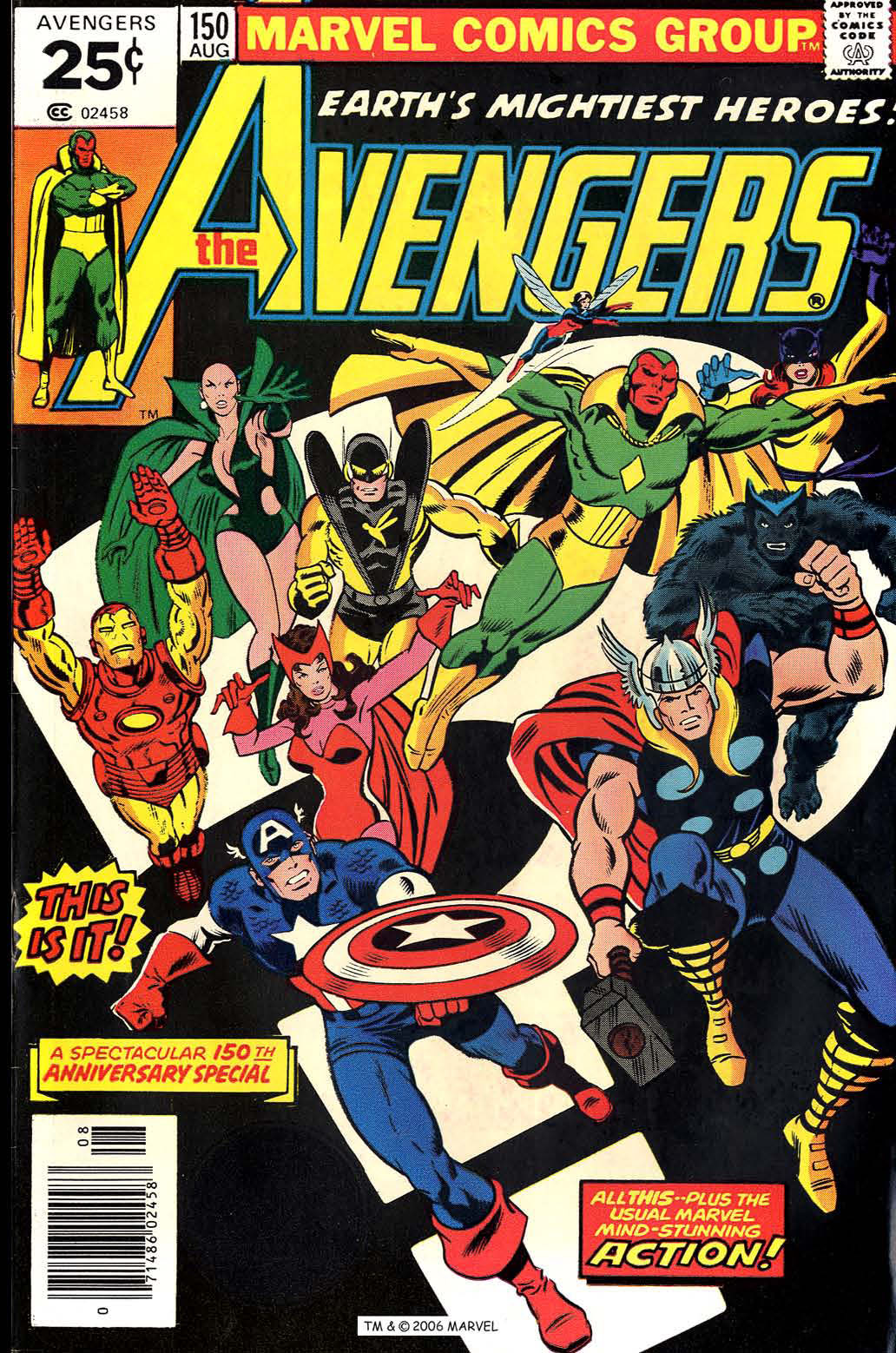


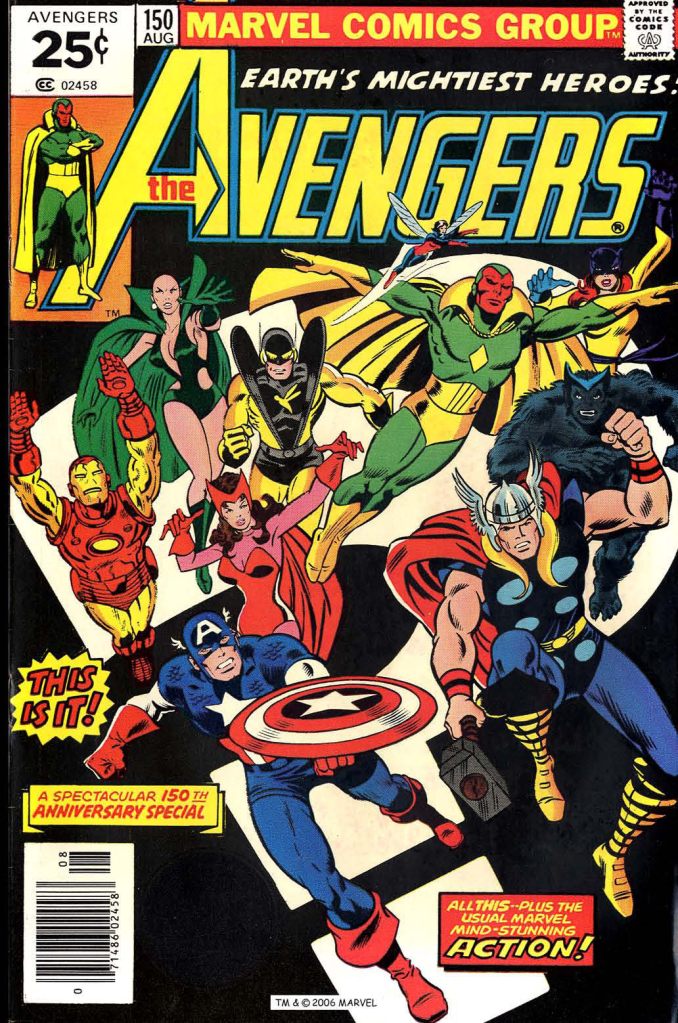
AVENGERS #150 was another book that was in the collection of my friend David Steckel, and which I borrowed from him to read at some point or another. It was a noteworthy issue for a couple of reasons, most of them not great. First off, it was one of if not the first comic book to make the point that a fiftieth issue was just as noteworthy and worth commemorating as a centennial issue. This was no doubt due to the fact that by this point, it had been proved that centennial anniversary issues tended to sell better than the ones around them, and wanting to hit that sort of jackpot without waiting every eight years or so. But the bigger point AVENGERS #150 is remembered for is the fact that half of the issue was an unannounced and unscheduled reprint, which completely undercut the planned celebration entirely. And in fact, a blurb on the cover promising the debut of a new Avengers line-up had to be removed at the last minute, though the question mark theme to the visuals couldn’t be so easily excised.
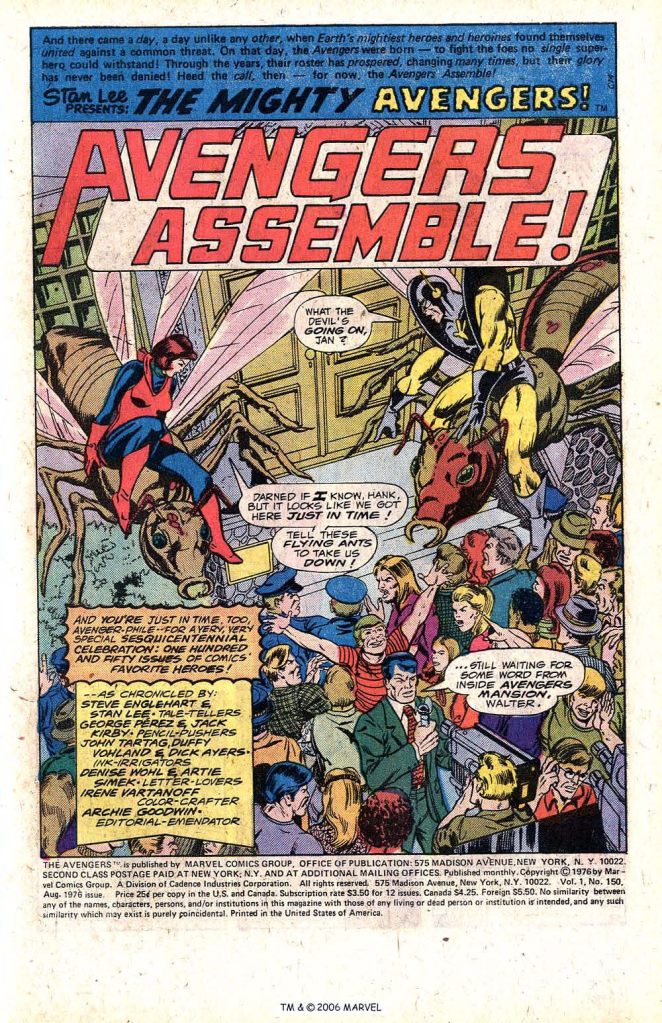
So what happened? Over on his blog, reader Alan Stewart attempted to gingerly answer that question in his own review of this issue and the next recently:
Alan tries to be even-handed and fair minded to all parties, not wanting to paint any of them as the bad guy in these events. But from what I’ve seen and what I know about how a company like Marvel operates, the person who fell down on things was writer Steve Englehart. He was late getting his material in, and when new EIC Gerry Conway informed him that a fill-in plot would have to be used instead, Steve decided to withhold his dialoguing of the back half of the issue, deciding that he’d force the company to go reprint on the issue as an act of revenge. This represented the end of Englehart’s time at Marvel in the 1970s, though he’d return a few years later in the 1980s and again later. It was an ignominious conclusion to what had been a stellar run of creativity and work, but Marvel was changing in ways that Englehart just wasn’t comfortable with.
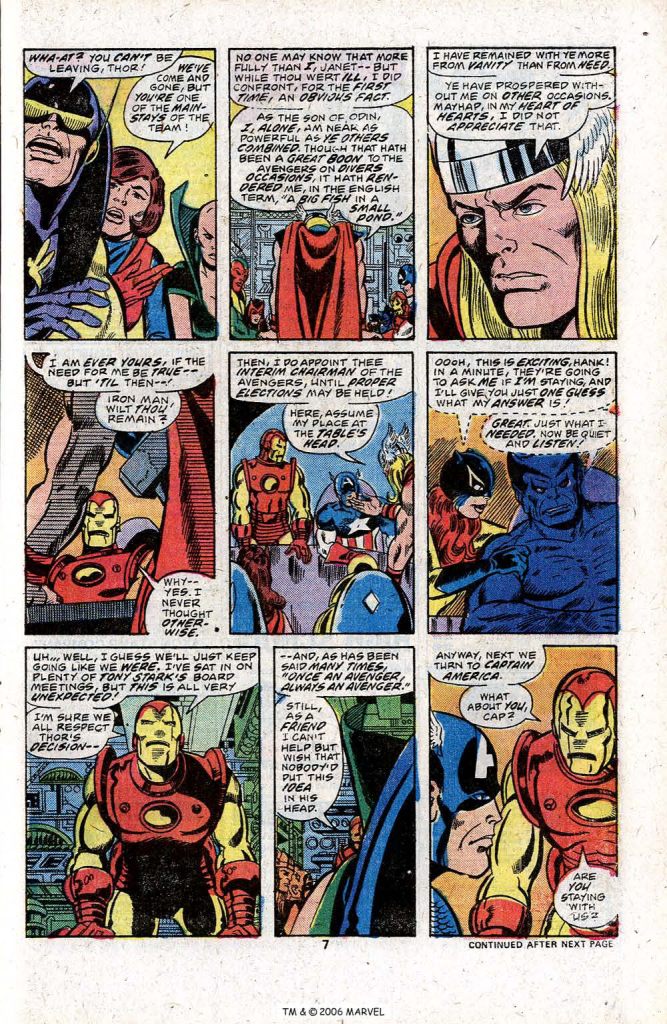
Anyway, the plot for this issue is exactly what it was supposed to say on the cover: having wrapped up a series of interlocking adventures that had taken up most of the preceding year, the Avengers were gathering together to determine their new line-up moving forward. This hadn’t happened all that often, typically individual members might come and go, but having an entire story dedicated to selecting the new team was something of a novelty–though it had precedent in the very story that was partly reprinted to fill out the page count. Right away as the discussions begin, Thor steps down as Avengers leader and goes on a leave-of-absence, passing the gavel to Iron Man as the new chairman of the group.
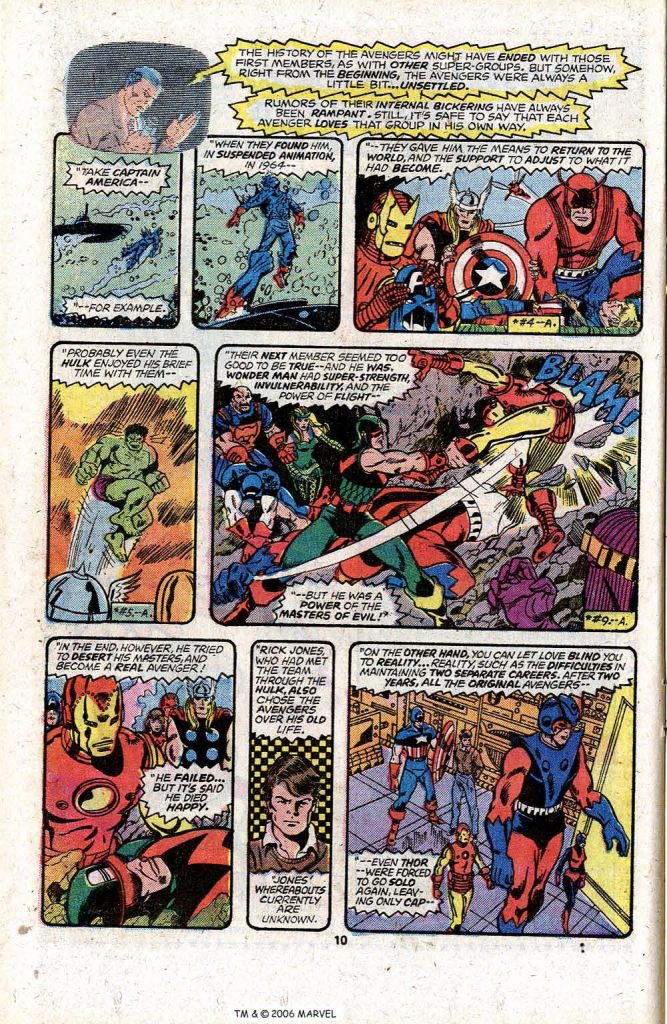
But the issue wasn’t simply a conversation about the new line-up, it was also set up as an “album issue” that would recount the storied history of the organization through extended flashbacks narrated by news broadcaster Sam Reuther. Album Issues were another concept that Marvel had pioneered, and they helped to get across the idea that each individual story and comic book was only one small piece of a larger and more important tapestry: the Marvel Universe. As a relatively new Marvel fan, I loved an Album Issue for what it would tell me about older comics that I hadn’t yet had a chance to read. Here, it also gave relative newcomer George Perez the opportunity to re-create classic moments from throughout Avengers history, something he seemed to relish. In the short time he’d been working on the book, George had already made a big splash, and he was already considered one of the best artists ever to take on the series.
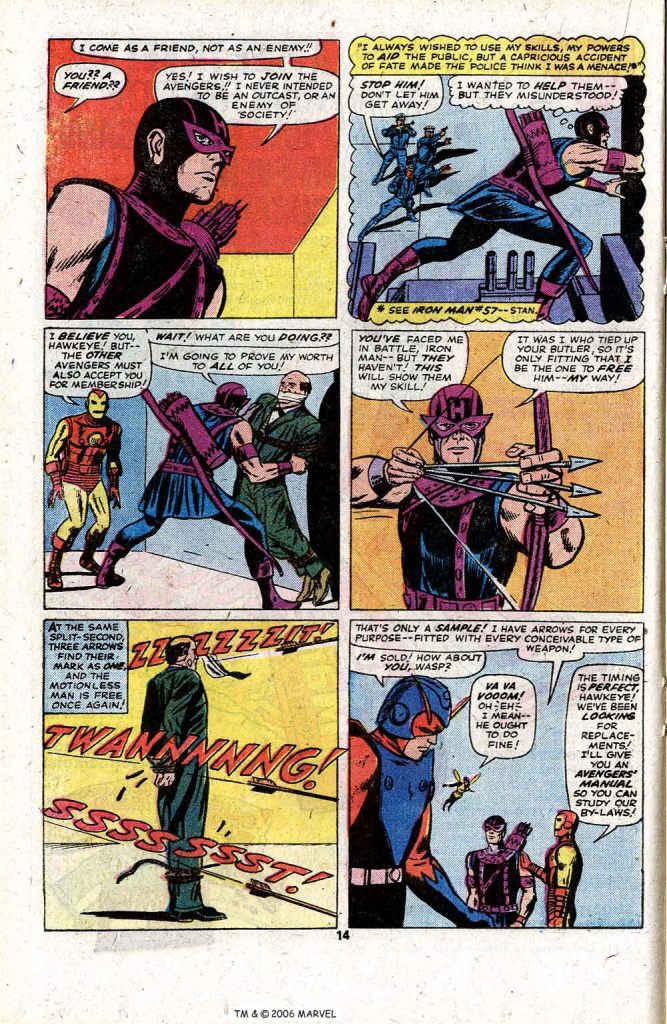
Unfortunately, even before the middle of the book, the story abruptly goes reprint, as a flashback to the very first Avengers line-up overhaul segues into an actual reprinting of the story in question. If I’m honest, as a young reader this didn’t really bother me (though, remember, I had borrowed this comic book rather than having dropped a quarter on it, so that may factor into my take here.) I was already a huge fan of Marvel’s 1960s output, and this story was one that I hadn’t yet experienced, so it made little difference to me that we were suddenly back at the point where Thor, Iron Man, Giant-Man and the Wasp gave way to Hawkeye, Quicksilver and the Scarlet Witch, with Captain America remaining the only touch-point between the two incarnations of the team. I honestly kind of enjoyed experiencing it first hand. (Decades later, I reprinted this entire two-parter in the pages of AVENGERS (Volume 3)#27, which means that, yes, I reprinted a reprint.)
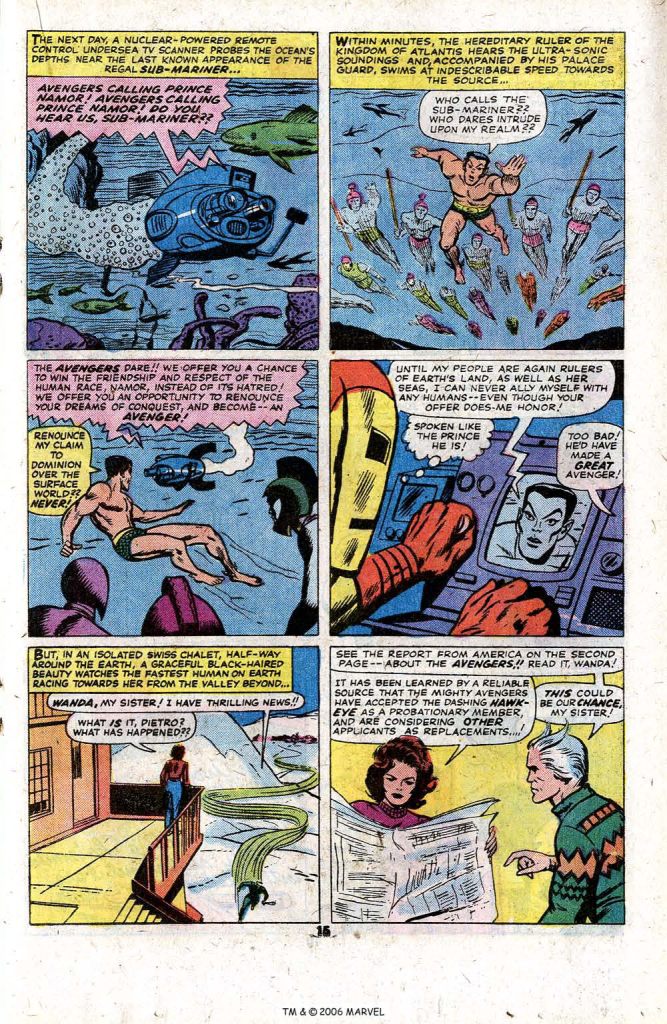
It’s also worth taking a moment to reflect on just what a brutal and unexpected move it was completely overhauling the Avengers series with this new cast of characters. Editor and scripter Stan Lee had been building the nascent Marvel Universe without entirely meaning to–he saw it primarily as a good way to promote all of the assorted titles in the company’s line. But as plotlines stretched out, often for months at a time, Lee began to receive a lot of mail from fans who questioned how, say, Iron Man could be in jeopardy in his own series yet perfectly fine in the pages of AVENGERS. Additionally, Stan had come to believe that the thing that was attracting a broader and older audience to his output was the soap opera interactions and personality conflicts between his assorted cast members. AVENGERS had relatively little of that, the group being made up of the stars of other solo series. So he instituted a sweeping change: dispatching Thor and Iron Man back to their own solo series and Giant-Man and the Wasp to temporary limbo (their initial strip had run its course after a lot of struggling to make it popular) and replacing them with a trio of characters who, while introduced as villains, had been played sympathetically: Hawkeye, Quicksilver and the Scarlet Witch. Captain America’s solo series at the time was telling tales of his adventures in World War II, so there was no conflict there. And this new team of Avengers could bicker and adapt and grow and change more in the manner of the popular Fantastic Four, which was the sauce Lee was looking for.
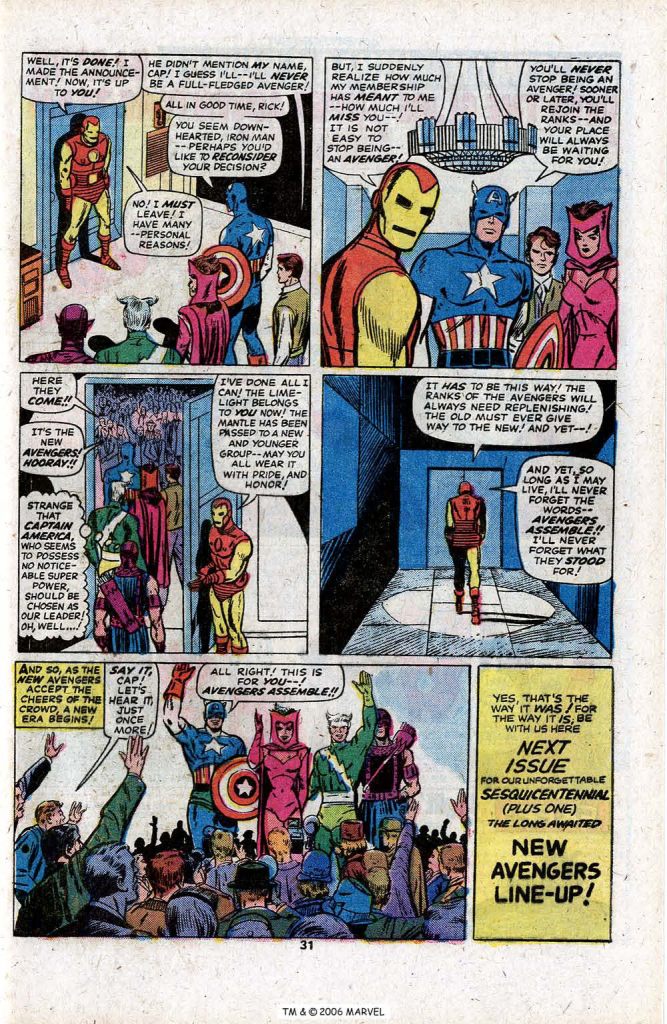
It’s likely incorrect to say that Lee saved AVENGERS with this change; the series had been popular when it featured Marvel’s assorted solo super-stars–so much so that later writers Roy Thomas and Steve Englehart worked tirelessly to bring those characters back into the mix on a regular basis. But it did serve to both steep the book more in the flavor of what Stan and his cohorts were doing that was making an impact, while also firmly establishing the idea that the roster of the group could wildly fluctuate as necessary. So this reprinted tale set the stage for the new story that Englehart and Perez and friends were telling in the present–a tale whose conclusion I wouldn’t get to read for several years, as David Steckel didn’t own the second part to this adventure.


Cap’s Kooky Quartet was the least powerful super hero team in marvel history. Unless you count Rick Jones radio peeps. I loved all of the stories featuring those four.
LikeLiked by 1 person
There’s lots of cool stuff that happen in the first 16 issues of Avengers… but the team doesn’t interact all that much unless they’re on a mission, and with the exception of the Hulk… they all get along without much personal conflict. When the team becomes Cap, Quicksilver, Hawkeye and Scarlet Witch the book becomes much more character focused and cohesive imo. There are more interesting bits that happen between the members while they hang around and train. I attribute a lot of these bits to Don Heck…. who was an underrated plotter.
The Avengers’ bickering post issue #16 is similar to the FF, but the Avengers kept it simmering way longer I think… and their conflicts were more in keeping with a workplace dynamic. When Wolverine was first introduced he seemed much more like an argumentative Hawkeye than a Ben Grimm or Johnny Storm.
The reprint in 150 didn’t bother me either since I wasn’t familiar with the original. Likewise when I eventually read issue #16 it had a fair amount of story not in the reprint. It was all good.
LikeLiked by 3 people
I was a nine year old kid when I bought this off the rack at the local 7-11. I was a huge Avengers fan having been a collector since #122. So I was a bit disappointed about the reprint but I was loyal and gladly paid 25 cents each month to get my Avengers fix. My Dad would give my brothers and me a dollar each Saturday as our allowance for conducting various household chores. By then I had started to enjoy George Perez’s art so I quickly realized it was a reprint when I didn’t recognize the artist. I did enjoy the few panels Perez drew of the early Avengers. Lastly I just loved that Perez cover, especially the Vision as he was my favorite super-hero. Ironically the following issue had Jack Kirby draw the cover and Perez the inside story, pretty much the opposite of 150. I also liked the format of the 25 cent cover price at the top left which contrasted with the previous months’ “still only 25 cents!”.
LikeLiked by 2 people
Having vented my spleen over this issue on Alan Stewart’s wonderful site, my focus today shifts more towards Tom’s explanation of why Stan Lee sent Iron Man and Thor packing. From a simple sales perspective, it never made sense to keep the “big guns” away. But I do understand the dramatic aspects. I also recall interviews with Roy Thomas about the challenges he had bringing them back to the series. Fortunately, he and Steve Englehart found a balance that maintained the Big Three as well as having enough other characters to supply the internal drama.
What I’ll add is that while “Cap’s Kooky Quartet” could dial up the soap, I did not care as much for their tenure. Villains like Power Man and Swordsman were a huge step down from Kang, Loki, Immortus and the Masters of Evil. Not wanting to incur anyone wrath, I will carefully say that I did not find Don Heck the right artist for the book at that time either.
Lastly, while I was unhappy with a reprint that I’d only recently purchased showing up in #150, I hadn’t considered that to a newer reader like Tom at that time, it would actually be an added treat. Always good to consider things from another perspective!
LikeLiked by 2 people
I think the Don Heck era of Avengers looks pretty good… especially when inked by Giacoia, Romita, or Wood. I like Don’s inking of his own stuff generally though I think he was somewhat uneven when he inked himself on Avengers for some reason. I like the first Annual inked by Roussos(?) as well.
For my money he does seem to run out of steam towards the end of his run… though I like the issue where he pops back in when the Adaptoid attacks.
There are a number of good to great issues that feature just Goliath, Panther, Wasp, and Hawkeye.. but I do agree that the book perks up a bit when the founders rejoin.
LikeLiked by 2 people
Good points, David. I’m actually less familiar with the book in the latter stages of Heck’s tenure. No question about the impact a certain inker can have and with someone who is not a natural superhero artist, that can be essential
LikeLike
I’ve seen some of Don Heck’s older comicbook work; guys in suits, women in dresses. Crime detective stuff, I think. I gained a greater appreciation for his skills. His use of ink to show light and shadow, his sheer ability to drew city blocks, cars, it wasn’t too far removed from Darwyn Cooe’s “retro” style, decades later. Less naturalistic than Al Williamson, but still impressive.
Before that, only I knew his 1970’s and 1980’s superhero stuff, and it just seemed to have run out of gas. Too bad no one thought to give him “Slam Bradley” in the 1980’s.
LikeLiked by 3 people
I don’t much care for Don’s return to Ironman in the 70’s, but I think he had a few shining moments here and there on other books. He unfortunately did the pencils for one of the worst looking books Marvel ever published imo (GS Avengers #4) and he could get saddled with inkers who didn’t suit him. His work never turned me off from a book though… and when he was cooking he could deliver solid work (Giant-Size Defenders #4)…. even when inked by Colletta.
Then there’s X-men #64 where Don inked by Palmer does a better than just passable Neal Adams. That said there must have been some ongoing frustration in the bullpen about Don’s work because I recall John Romita in an interview mentioning that they “tried to get Don to put more into it” in regards to the dynamic action in his work. John Buscema on the other hand thought Don was one of the best artists in the business.
For myself I think he was good at atmosphere, drew attractive women, and was very good with character bits. I think he generally struggled with super-hero action and power. He was more well suited for love, western, or sci-fi and horror comics. I think that if all of his super-hero work for Marvel was as well done as the origin of Ironman that his standing as an artist would be higher. He does a number of innovative things and the art looks attractive and confident throughout.
When he was at DC I think his Wonder Woman and Batgirl looked pretty good… as well as his art for Steel. A few years back I saw Don’s pencils for an unpublished issue of Steel and I can only describe them as “lush.”
Don Heck fun fact: I found out from Don’s niece that he had an above ground pool in his backyard that he stocked with goldfish. He loved fish.
LikeLiked by 3 people
From now on, this guy’s “Goldfish Donny” to me. :). Seriously, I think we’re on the same page. I liked that Defenders Annual as well as his Adams turn with Sunfire’s first appearance. As I believe I’ve mentioned before, Roy Thomas commented in an interview that superheroes were the bane of Heck’s existence as he was meant to draw Westerns. I haven’t read his DC material, but based on occasional images I come across, I would agree that it was a distinct improvement over his final tenure on Iron Man.
LikeLiked by 1 person
Speaking of other perspectives, I really should look up much more of Don Heck’s work outside of superhero comics. Whenever I think of his art, my mind immediately flashes to his final work on Iron Man back in 1971 or some of his other 70’s Marvel work.
LikeLiked by 2 people
@ Davis Plunkert, thanks very much. Interesting perspective. Good to know that John Buscema liked Don’s work. And the fish pool is notable, to say the least.
LikeLiked by 2 people
That is true. John Buscema stated that “the guy’s gotta eat” and that he thought his art was fine. Wish I could recall the source so I could share it.
LikeLiked by 1 person
Cap’s Kooky Quartet was actually my first exposure to The Avengers, via the reprints in Marvel Triple Action. I had only been on board with the then-present day Avengers off and on for about 15-20 issues at this point, so the half-reprint issue seemed unusual, but I appreciated seeing that story for the first time.
LikeLiked by 1 person
I loved Triple Action despite the title making n sense. It was the only reprint book I have ever bought faithfully.
LikeLiked by 1 person
Like Blue Is Love, Cap’s Kooky Quartet was my first Avengers, though in the original run (“When The Commissar Commands”). Probably my first Marvel period, which meant as far as I knew, the three new kids were all established legends. The found family aspect must have worked for me — it was the only Marvel book I bought semi-regularly, even though Spider-Man, in hindsight, was much better.
I hadn’t seen “the Old Order Changeth” so the reprint didn’t bother me. It fight neatly with the album aspect.
LikeLike
It took me a while to grow to appreciate Don Heck’s work. As with some of the other comments here, I developed much more of a fondness for him once I saw his art for genres outside of superheroes. For example, Heck penciled the second and third issues of the H.P. Lovecraft’s Cthulhu miniseries published by Millenium in 1992, just a few short years before he passed away, and his work on those comics honestly looked great. He was very well suited to drawing the horror genre.
Someone above mentioned Giant-Size Avengers #4. Yeah, that was a huge misfortune. Heck gets handed an incredibly complicated Steve Englehart plot to pencil in a very short amount of time, and to top it off he gets inked by John Tartaglione, whose work I never really cared for… it’s not surprising that GSA #4 looked bad. I really wish Dave Cockrum had been able to draw it as originally planned. Definitely a very disappointing conclusion to “The Celestial Madonna” storyline. But I don’t really blame Heck for it, I’m sure he did the best he could under difficult circumstances.
Anyway, I already shared my thoughts on Avengers #150 on Alan’s excellent blog post. So, I’ll just say that having been born in 1976, I first read #150-151 when Tom had them reprinted in Avengers vol 3 #27 in early 2000, so it did not especially bother me that a good chunk of the story was a reprint, but I’m sure if I was an older reader and had picked up #150 in real time it would have been very annoying.
LikeLiked by 2 people
The Tartag inks are rough on GS Avengers #4. That said… I think he might have inked a fair amount of Perez’s pencils on Avengers#150 though Duffy Yohlund is also mentioned. If Tartag inked that splash… I gotta say he did a good looking job..cause it’s a nice looking splash.
Ayers is likewise credited and I presume it’s only due to his work on the reprinted section… it’s unlikely that the splash is his work since he was already at DC I believe.
I would guess that Tartag had at least the same or bigger deadline pressures inking GS Avengers #4 as did Don Heck. To their credit they did get it done… a full Cockrum job would have probably looked better but from what I know the reason that it became a Heck/Tartag joint is that it was a killer rush job to meet a near impossible deadline, and Cockrum wasn’t the guy you called to get pages fast. Since it’s a comic with chapters in hindsight it probably would have worked better to make it a Diverse Hands effort for the pencils or the inks, or both. Later Avengers annuals did this and it was a fun game to suss out who did what.
Aside from the art….GS Avengers #4 is a dull story even though it’s a landmark issue because Wanda and Vision get married. Thor, Ironman, and Hawkeye each beat a version of Kang by themselves easier than they would Cobra, Whiplash, or some guy littering in the park.
NIce Gil Kane cover though and the end note of Kang thinking he’s finally nabbed Mantis that turns out to be the Space Phantom is the best bit in an otherwise dreary comic… that featured 2 weddings!
GS Avengers 1-3 are good to great comics. #1 has the energy of the old 60’s annuals. It’s just plain fun. #2 is just out and out fantastic. #3 is solid wrap up of a great storyline. #5 at least reprints a very good annual by Don Heck and Roy Thomas… but that was it for the Giant-size Avengers.
LikeLiked by 1 person
Cockrum wasn’t unable to draw GIANT-SIZE AVENGERS 4 — he refused to do it. On GSA 2, Steve Englehart had decided that some of Cockrum’s pages needed to flow differently, so he cut up the art physically and rearranged the panels the way he felt they needed to go.
Cockrum was so offended by this that he quit the book — he’d already drawn GSA 3 by the time he knew about it, but he walked away from the series rather than work with Steve again.
I don’t know which pages got rearranged, and I think GSA 2 came out just fine — I think it’s the single best issue of AVENGERS ever done — but it’s a handy object lesson in collaboration. If your collaborators feel disrespected, they may just walk out the door and not come back.
LikeLiked by 2 people
Thank you for the information, Kurt. I had heard about how Steve Englehart had cut up some of Dave Cockrum’s original artwork for Giant-Size Avengers #2 to rearrange the panels more to his liking, but I definitely did not know that Cockrum was unaware of this until after the fact, or that as a result of this occurring he refused to draw GSA #4 in protest. I guess Englehart really should have spoken with Cockrum beforehand.
LikeLike
apparently after his stint on GS4 they decided to have Heck pencil GS 5, which of course never came out and was broken up into the 2 part storyline vs The Asassin in the regular series
LikeLike
I bought it off the rack and don’t recall being all that disappointed. I’d already read the reprinted story elsewhere too.
LikeLike
Heck was never one of my favorites but I loved AVENGERS ANNUAL #1, for all that in 1967 I was still feeling my way through the Marvelverse. I hate to say it, because it goes against the ideal of artists doing their own thing– but I think ANNUAL #1 looks good because Lee kept bugging artists to emulate Kirby, and that Heck, who was not that strong on action, went the extra mile by staging a lot of scenes as Kirby might have. It helped that the Annual simply split the avenging dudes into separate teams, not unlike the JSA and JLA, allowing for more emphasis on action set-pieces.
LikeLike
I’m glad I was born and started reading comics long after “Cap’s Kooky Quartet”. My first “Avengers” were in the late 1970’s, when the team was stacked. Stark contract to CKQ, which seemed underpowered and far removed from being “Earth’s Mightiest Heroes”. The Masters of Evil likely roughed them up much easier. I guess it wasn’t too long before Giant-Man returned as Goliath, and then Hercules joined.
LikeLike
Cap’s Kooky Quartet ( Avengers downgrade ) made the Fantastic Four Earth Mightiest Heroes, followed by the X-Men then the Kooky Quartet.
LikeLiked by 2 people
🤣🙏😉
LikeLike
There was a fair amount of time when a 10 foot tall Goliath was considered their strongest member. Cap’s stats in those days were depicted as more inline with a regular tough human ala Daredevil, Quicksilver demonstrated no additional upper body strength though he could hit like a cannonball, Hawkeye engaged in hand to hand as much as Wanda did which was basically never.
Cap, Hawkeye, and Quicksilver were at least reliable combatants imo….the Wasp, Goliath, and Scarlet Witch often suffered from power seize ups if I recall correctly.
Their game gets upped when Goliath regains his size changing ability and Hercules joins. When the Black Panther joins he’s portrayed as an equivalent to Cap in terms of power and skill sans shield. Kind of interesting that even though they’ve both been buffed up a bit over the decades that they are still more or less physical equals.. though Panther has had a notable tech upgrade that moves him closer to Ironman.
LikeLiked by 2 people
True. I remembered (and noted) Pym’s return, & then Herc joining. Big power upgrade there. Then when you mention Wanda’s power gain…
I remember a reprint, I think, involving the Collector. And a manipulated Thor fought Iron-Man, then they crashed an evil lair to join Goliath, Wasp, Hawkeye, & maybe Wanda, too.
Cap video called them from Wakanda, with the Panther next to him, telling them he nominated T’Challa as his replacement.
Very good art by John Buscema.
LikeLike
I checked comics.org to see if there was any other characters without a series that could have been used or added to Cap’s Kooky Quartet to add power to the team and there wasn’t unless Stan reversed his Sub-Mariner rejection. Attuma [ Fantastic Four#33 ( December 1964 ) ] and his Undersea Legions take Namor place as a threat to the surface world, so there was no real reason to not make him an Avenger back in the 1960s. The Sub-Mariner would have added the power this new team needed and if not them then the 1960s X-Men ( Thor says this to the Avengers- “I ,alone, am near as powerful as ye others combined” and Namor could have said a similar thing to the X-Men back then ). ALSO, what the letter writer and Stan Lee didn’t take into consideration was that the Avengers stories weren’t a back to back/day to day stories ( there could be days or weeks between crises leaving plenty of room for series stories ). Plus wouldn’t their series stories cause the conflicts they were looking for the Avengers to have ( Where were you when we needed you? ).
LikeLiked by 2 people
I like Namor. And I like the idea. Especially on a power basis. He’s world class. But he repeatedly tried to beat up the Avengers back then, so I get any reluctance on either side. He was a powerful, noble jerk. 😉🙏
That CKQ line-up was already a buffet for therapists. Having Namor on it might’ve flipped the tables and spilled all the food.
When Cap asked him to join in the mid-1980s, The timing made sense. Namor had lost his job, his home. He’d been humbled. And finally ready to be e more of a team player. .
LikeLike
Cap’s Kooky Quartet was made up of criminals guilty of serious crimes that they never served time for: Hawkeye [ Tales of Suspense#60 ( December 1964 ) 1st story — Black Widow ( a Soviet agent ) sends Hawkeye to steal plans for Stark’s newest weapon ( espionage/treason ) and took Pepper Potts hostage ][ Tales of Suspense#57 ( September 1964 ) 1st story — attacks Iron Man at the Black Widow ( a Soviet agent )’s request ]. Quicksilver & Scarlet Witch [ The X-Men#4 ( March 1964 ) Brotherhood of Evil Mutants steal a freighter ( piracy ) and use it to take over the South American nation of Santo Marco ( Shouldn’t that get them a Interpol Red Notice? ) ] — making the Kooky Quartet 8 members short of The Dirty Dozen ( 1967 film — so Stan clearly didn’t model them after this film). Did someone write a story where Hawkeye, Quicksilver & the Scarlet Witch went on a government/UN sanctioned suicide mission to earn a pardon? Proof there are days if not weeks between stories [ The X-Men#11 ( May 1965 ) Quicksilver & Scarlet Witch leave the Brotherhood of Evil Mutants ] and [ The Avengers#16 ( May 1965 ) Quicksilver & Scarlet Witch join the Avengers ].
LikeLiked by 1 person
Stan Lee recruiting criminals to be Avengers seem like and odd choice, when Marvel could have reversed their Anti-Timely Comics policy and recruit Heroes that would be as young as Namor was during the 1960s: Namora ( never attacked the surface world ), Angel, Blue Blaze, Black Widow ( DC Comics never underestimated the intelligence of it readers to tell the Flashes apart ), Fourth Musketeer ( a ghost ), Hurricane, Jack Frost, Magar, Marvel Boy 1, Marvex, Monstro the Mighty, Rockman ( from hidden race like Namor ), Subbie, Super Slave ( a genie ), Vision & Prince of Good. Others would in the 1960s be in their 40s or 50s and others could be revealed to be long lived ( Dakor, Mantor & Monako — Marvel’s Baron Mordo was born same year as Namor ) or immortal ( Blue Diamond — diamonds are forever & Marvel Boy 2 ) ( Dynamic Man )— Like Fin, Toro, Dynaman, Human Torch, John Steele & Blazing Skull were.
LikeLiked by 1 person
Recruiting Marvel Boy would’ve nade sense.
LikeLike
Making Black Widow an official member would have a good domino effect as well.
LikeLiked by 1 person
This would be Hawkeye’s only get out of prison free card: Either shortly after meeting the Black Widow the CIA or SHIELD contacted Hawkeye and had him choose between prison or Double Agent Man.
LikeLiked by 1 person
Forgot Sun Girl ( active as early as 1920s and as late as 1950 ) and unofficial sorcerer heroes like Roko the Amazing’s younger answer to SHAZAM named Menelaos, Whitewash Jones’s sorcerer father Leander Jones and Blackfoot medicine man from Black Marvel’s origin Running Elk. Luther Robinson & Lynne Harris ( both given Atlantean abilities ) [ Marvel Mystery Comics#10-12 ( August-October 1940 ) Sub-Mariner story ]. Uncle Sam ( seen holding a flag pole but the blank flag has writing on it )[ Marvel Mystery Comics#67 ( November 1945 ) Sub-Mariner story splash page ].
LikeLiked by 1 person
I think the criminal status of Hawkeye, Scarlet Witch, and Quicksilver was addressed in the 2nd volume of an Avengers mini-series called Earth’s Mightiest Heroes that explores the various politics during the team’s early years. Some very serious charges… but they never killed anyone during a crime. If I recall correctly… Cap was considered essential to be a member of the original group so they could get their priority status… and it was essential that he remain so that he could function as leader and de facto parole officer for 3/4 of his new team. The original comics make no mention of this status. I think in the original books it was decided that they seemed like good kids who made bad choices and deserved another chance. A pretty compelling story choice in hindsight I think. Probably due to Marvel not having that deep a bench of new characters, and not wanting to bring back all the B-list golden age studs who had arguably crashed and burned.
LikeLiked by 1 person
David Plunkert, yes the Timely Comics crashed and burned because the writers back then didn’t have decades of writing under their belts ( They never even thought to imitated the JSA in 1940 and do the same with their heroes or have more than just Fire vs. Water ( Human Torch vs. Sub-Mariner, like Fire/Torch vs. Ice/Jack Frost ) or sharing villains ( only the Red Skull ( with the Young Allies ) and Python ( Angel foe: with Human Torch-Sub-Mariner & later Young Allies ) or have more team-ups ( even with the failed heroes — they owned them so use them, who knows if that could have helped them. Especially when Namor goes rogue ). Those Timely Characters had they been used had the same potential in the 1960s as brand new characters like Daredevil, Doctor Strange, wannabe hero turned villain turned hero Hawkeye. I have always seen it as doing to those Timely Comics heroes what was done with throwaway characters Wonder Man ( 1964 and brought back in 1976 ) & Impossible Man ( 1963 and 13 years later brought back ) or what Mark Gruenwald did with Marvel Man a.k.a. Quasar. They are writers they are suppose to have imaginations. A number of those Timely Heroes had counterparts or near counterparts ( in powers or abilities ) that did better and others based on Pulp Heroes.
LikeLiked by 1 person
Yeah, Hawkeye never killed anyone but in the real world then Massachusetts Air National guard member Jack Teixeira was sentenced to 15 years in a federal prison for leaking classified documents Pentagon documents –including assessments of the war in Ukraine ) into a private chat group on the gaming platform Discord to impress his friends. Then there was Chelsea Manning leaked nearly 750,000 classified military and diplomatic documents to WikiLeaks ( Imprisoned from 2010 until 2017 ). Don’t know under whose flag that freighter was under so I can’t say how many year Quicksilver & the Scarlet Witch would have gotten for Maritime Piracy ( In the U.S. up to life in federal prison ) or what they would have gotten for trying to overthrow a foreign government and seize control. Looks to me like the writer whitewashed their crimes and didn’t bother to look up what charges in the real world they would have gotten. I know Hercules doesn’t make his modern Marvel first appearance till Journey into Mystery Annual#1 ( August 1965 ) but his Timely Comics first appearance was Young Allies Comics#16 ( Summer 1945 ) Tommy Tyme story -“Battle of the Giants!” where for some odd reason he is made as giant sized as Antaeus ] but he could have taken Thor’s place on the Avengers then. Sampson ( Samson ) [ Venus#4 ( April 1949 ) Venus 1st story – Whom the Gods Would Destroy! ] could also have taken Thor’s place. As for using one’s imagination, well there is replacing Hawkeye, Quicksilver and Scarlet Witch in Cap’s Kooky Quartet with Timely Comics characters — Widjit the Witch ( who Jess Nevin’s Golden age Heroes site says joins the WACs, so identifying her mainstream Timely Comics self among one of the WACs Lt. Betty Ross was a member of or one of the 3 WACs seen on the first page of the WW2 era Captain Daring ( 2nd hero using that name ) ), Whizzer and one of the Blackfoot archers in Black Marvel’s origin. I could do the same with the Original Champions ( Sampson or Hercules ( Zeus’ son not Doctor David’s son Varen David/Hercules ), Silver Scorpion/Spider Queen ( Black Widow 1960s ), Jack Frost ( Ice Man ), Red Raven ( Angel 1960s ), Blazing Skull ( Ghost Rider 1970s ). The 2011 Justice League ( Superman, Batman, Wonder Woman, Flash, Green Lantern, Aquaman & Cyborg ) with Dynamic Man, Moon Man, Miss America, Whizzer, Blazing Skull ( Johnny Blaze’s Ghost Rider could make a motorcycle out of Hellfire, why not other things and why not give Blazing Skull that power? ), Sub-Mariner & Marvex the Super-Robot. Young All-Stars ( Iron Munro, Flying Fox, Fury, Tsunami, Neptune Perkins & Dyna-Mite ) with John Steele, Running Elk ( Black Marvel’s origin ), Unnamed Woman in Fiery Mask’s origin ( could have gained powers too by that blast ), Lynne Harris ( minus Tsunami’s control over water ), Luther Robinson, & one of the missing men in Fiery Mask’s origin could be the hero Captain Flame ( who has explosive powers ). Working on doing the same with a Timely Comics heroes replacing some of the WW2 era Justice Society of America ( With Prince of Good taking the Specter’s place ).
LikeLiked by 1 person
My Avengers collection started with issue 104, Thomas’ last as regular writer. I also started getting the MTA reprints as well, including that in which Immortus made his debut.
LikeLiked by 2 people
Well according to comics.org Iron Man’s Mark V armour makes its first appearance in this issue.
LikeLiked by 1 person
“Hi, gang! Just dropped in to show off my spiffy new armor. Oh, and to officially go on reserve status! But my employer, Mr. Anthony Stark, assured me your funding will contine! No evictions, and Jarvis stays on! Good luck without the Golden Avenger! And sans the Norse Thunder God. Oh, And no Wondrous Wasp and Giant-Man!”. 😉
LikeLiked by 2 people
Avengers #104 would have been around the same time as Ironman #51 or 52. If he made a new suit it wasn’t in his book if I remember correctly.
That said… Ironman had too many suit upgrades to only be at Mark 4 by Avengers #104 circa 1972 by my calculation.
If we lump the grey and gold version as one, and the first red and gold version at two, and ignore various upgrades and visual changes that happen throughout his very first series…. he definitely builds an all-new improved suit to fight the Mandarin in Tales of Suspense # 84-85 and another distinctly upgraded suit in Ironman # 3 in 1968. By my calculation he’s already been in a mark 4, 5, or 6 version for years by the time Avengers #104 rolls around. Or more depending on what is considered a significant change or rebuild.
BTW… the suit he builds with the nose in Ironman #68 is significant because that’s the first suit he can control cybernetically without buttons at his belt. That suit is in use through a good chunk of the Englehart Avengers and doesn’t get upgraded until Ironman #85/Avengers#150.
LikeLiked by 1 person
Sent the above before finishing my intended comments! Anyhow, aside from the final battle with Baron Zemo I, and the Masters of Evil, the last few issues with the old guard Avengers weren’t all that great, IMO, and I think Lee made the right choice in making the first truly dramatic line-up change. Oh, sure there was plenty of drama with the Hulk’s exit, then teaming up with Namor to try to take down his former partners, and then just happening to find Cap floating in the ocean. But after that all settled down, everyone seemed a bit stuffy and self-congratulatory and the internal disputes seemed ridiculously contrived. Oh, Iron Man missed a meeting so we gotta put him on detention without making any determination as to whether he had a very good reason to do so rather than just shirking his duties to the group. Even if the new group hardly qualified as “Earth’s Mightiest Heroes”, and the threats were hardly cosmic, I think overall the quality of the stories improved. And Heck’s art in those days was much better than most of what I saw by him in the 1970s.
LikeLiked by 2 people
Detention without established good reason? School kids could relate! Trust no one over 25! (Unless they’re the ones making comicbooks.). 😉🙏
LikeLiked by 1 person
As Ben Herman touched on “Why did Don Heck get stuck with a rep for bad art despite so much evidence to the contrary?” There were at least two causes – neither of which had anything to do with Don’s skill and talent.
The first was a joke in a late and dearly missed fanzine which spoofed all of comics and fandom even more. A MAD type ad spoof took the name “Heck” for the title of a fictitious art portfolio and played Don’s name synonymous with bad art. I don’t think anyone intended it to be taken seriously, but the mid-70s through the 80s were an unfriendly time.
But the clincher was that Don Heck was VERY successful when other artists’ art was lost in the mail – disturbingly often then – or overbooked artists missed deadlines. Don could pencil, for instance, Giant-Sized Avengers’ final chapter in the Mantis Marries a Tree epic almost overnight!
His pencils were rushed and Marvel’s inkers were even more rushed.
Unfannish fans were quick to demean Don. His spirits were crushed.
LikeLiked by 2 people
That actually made me sad. The guy pulls of a miracle labor. I admit in my teens I dismissed his art. But having since seen his earlier work, the dude was excellent. I knew nothing then, and only know a little more now; enough to know I was wrong.
LikeLiked by 1 person
They are hating on Don Heck because they have never seen his Cliff Mason [ Jungle Tales#6-7 ( July – September 1955 ) ][ Jann of the Jungle#8-11 ( November-May 1955-1956 ), 13 -17 ( September-June 1956-1957 ) — inked himself, no wonder it looks good ].
LikeLiked by 2 people
🙏Thanks!
LikeLike
There was also a Comics Journal interview where Harlan Ellison was cojoled into naming Don Heck as the worst artist in comics due largely to his work ethic. Getting the stuff done on time is a pretty big point of being a freelancer in the realm of print.
Don sold way more comics than Neal Adams and Neal would probably happily concede that point. He held Don’s work in very high regard.
LikeLiked by 3 people
I really disliked Heck’s work at first exposure and that lasted years. Somehow I never noticed that Heck on a book never had me skipping it like other, more well regarded artists. It was after he was gone and reread some of his stuff that I grew to love it. The problem hadn’t been Heck but rather my own taste had not matured fully. Thank god I was never a letter col guy because I would have been mortified after my epiphany if I haad public said bad things about Heck’s art.
LikeLiked by 1 person
In re John Buscema and Don Heck, John completed AVENGERS #110 when Don was unable to (illness?) after the first three pages and took no credit for it.
LikeLiked by 2 people
So to recap:
1. Englehart is fired off Avengers because of the shenanigans outlined here.
2. He creates a character mocking Tom DeFalco on Silver Surfer.
https://www.cbr.com/silver-surfer-steve-englehart-tom-defalco-parody/
3. He takes his name off the last issues of his Fantastic Four run and his West Coast Avengers run because of problems with Marvel editorial.
And he still got work from Marvel after that! That’s some strange, strange stuff.
LikeLiked by 2 people
It was/is a revolving door. You’d probably have to do the bad things that people do today to get the permanent boot.
For example, I’d read all this Ditko Spider-Man stuff but sure enough Ditko came back to Marvel and sure there were caveats but he still worked for Marvel.
There didn’t/doesn’t seem to be any loyalty and for a time that bothered me but basically everyone went and worked for the competition.
I do like Perez art…and let’s not forget the Whizzer. On my Marvel planet, Whizzer (worst name ever) and Miss America are the parents.
LikeLiked by 1 person
This cover is routinely credited to George Perez, alone. I’ve never believe he inked this himself and even the layout looks like clip art and turnarounds, rather than the composed group shots he would be known for, just a few years later. Does anyone have any further information on the cover credits?
LikeLiked by 1 person
The GCD entry for Avengers #150 has the following note:
“Romita either inked the cover or altered several figures, including Thor and Captain America. Adkins inking is also a possibility.”
GCD :: Issue :: The Avengers (Marvel, 1963 series) #150 [25¢]
LikeLiked by 1 person
IMO by 1964 Stan Lee, who had admired Everett’s Namor in the 40s, had decided that “outlaw status,” or its possibility, was key to the success of many though not all Marvel heroes.
LikeLike