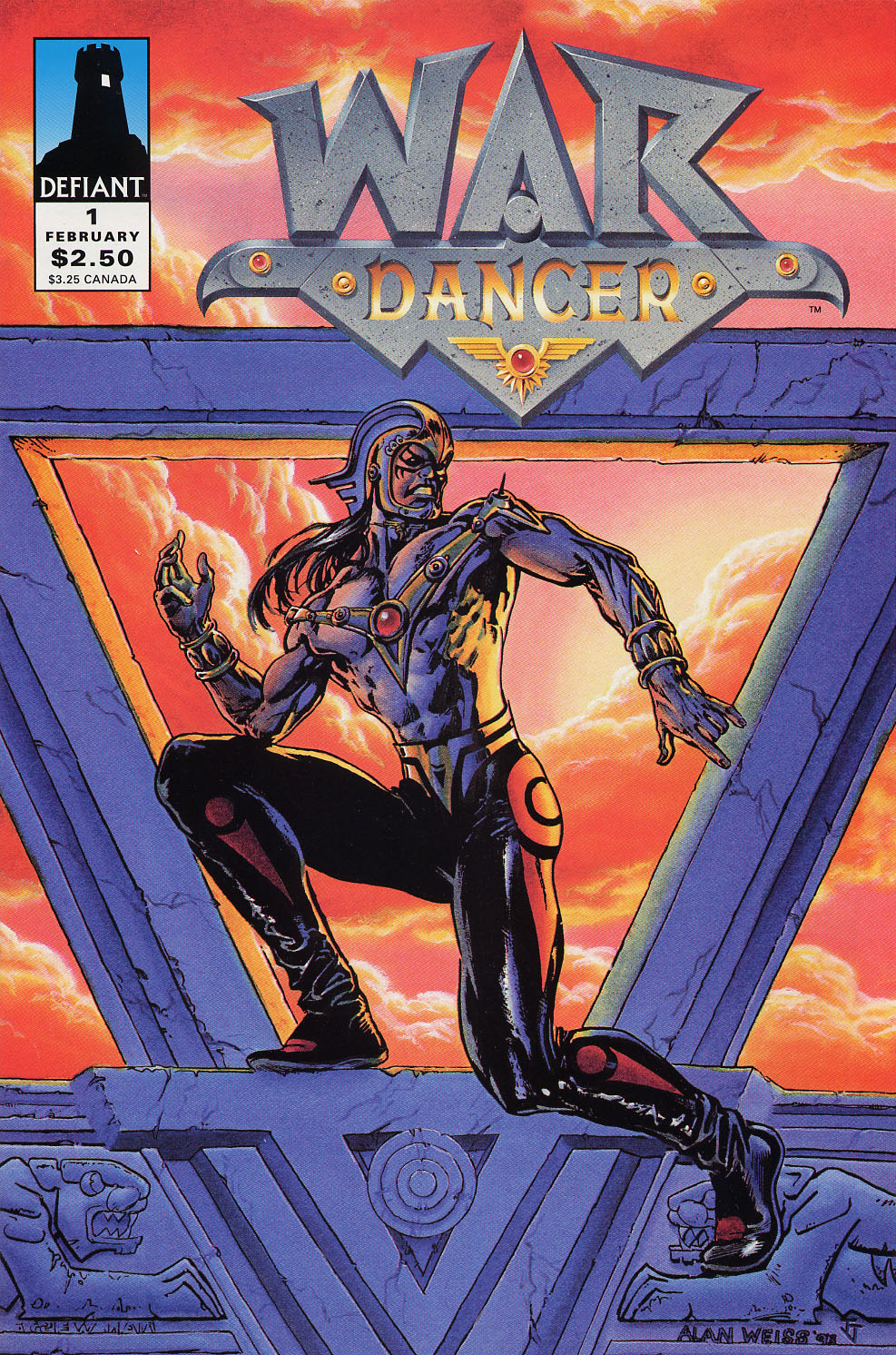


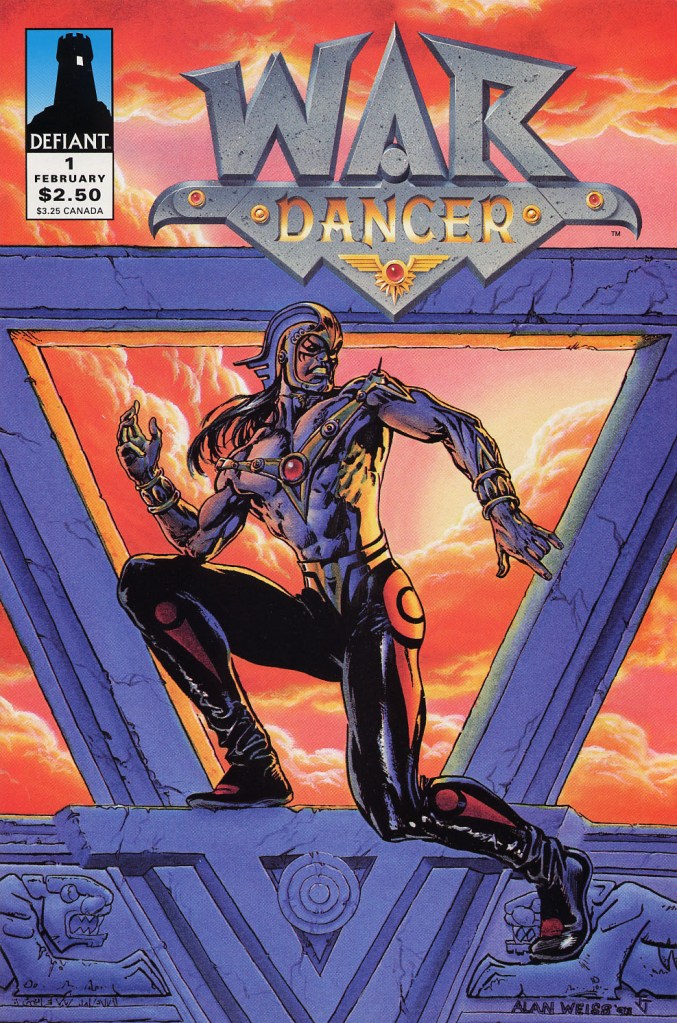
The next title that Jim Shooter’s post-Valiant start-up DEFIANT issued was perhaps the strangest series in their line–and that’s saying something. You can’t say that Jim wasn’t trying to chart new ground here. The book was called WAR DANCER, and it was largely the creation of Shooter’s longtime friend artist Alan Weiss. Weiss had been operating around the edges of the field for two decades by this point. He’d done a bunch of work in that time, but he wasn’t fast enough as an artist to get on a lengthy run. So despite the fact that his artwork was beautiful and distinctive, he wasn’t quite able to break out from the pack in the manner of most of his peers. He was ubiquitous, in that there’d relatively regularly be work from him appearing in print, but he never stayed in one place enough to make a major impression.
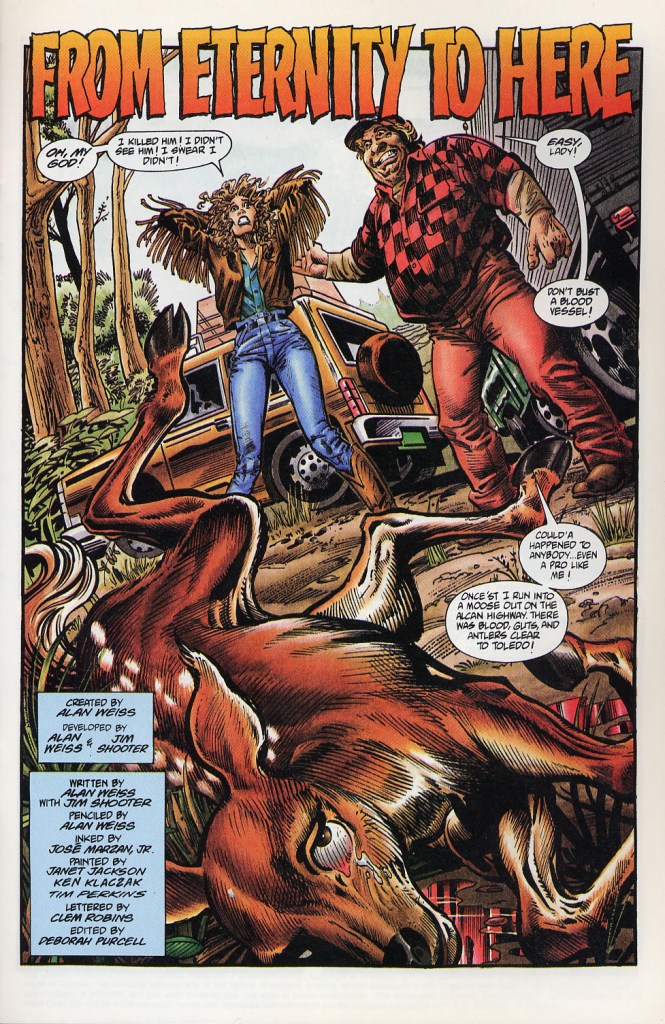
WAR DANCER is a profoundly strange choice to be one of the centerpieces of a new super hero universe. It’s got a strong 1970s flavor to it–it reminds me in some ways of the work of Steve Gerber on HOWARD THE DUCK and VOID INDIGO. There certainly wasn’t another comic book anything like it when it came out in 1994, but whether that was ultimately a good thing or a bad thing is up for individual interpretation. Either way, it made an impression. The lead character is Sally Throckmorton, who had once been a popular model under the name Sally Thornton until she suffered a mental breakdown. In the months since, she’s been unable to return to work, instead spending all of her time painting impressionistic canvases in-between trips to her analyst.
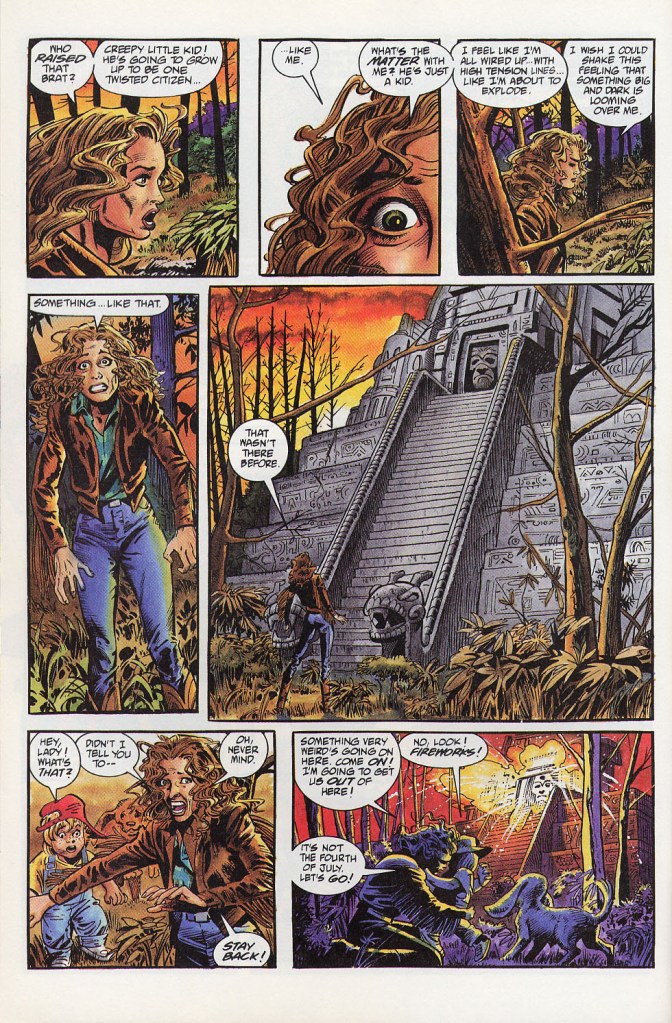
Sally’s day begins to get strange when a young boy, Willie, and his dog Happy show up at her home. They claim to be lost, but despite Sally’s best efforts, she can’t locate Willie’s parents or family. A call to the police brings no help, as the local cops are all tied up running down teenagers said to be wilding in the woods. Sally heads out back of her home for a smoke break to calm herself down, only to discover that an Aztec temple has appeared on her property. As Sally and Willie look on, a strange muscled figure comes into existence on the steps to the temple. The Aztec figure seems confused, indicating that he may be in the wrong place. Sally, for her part, goes along with this weirdness.
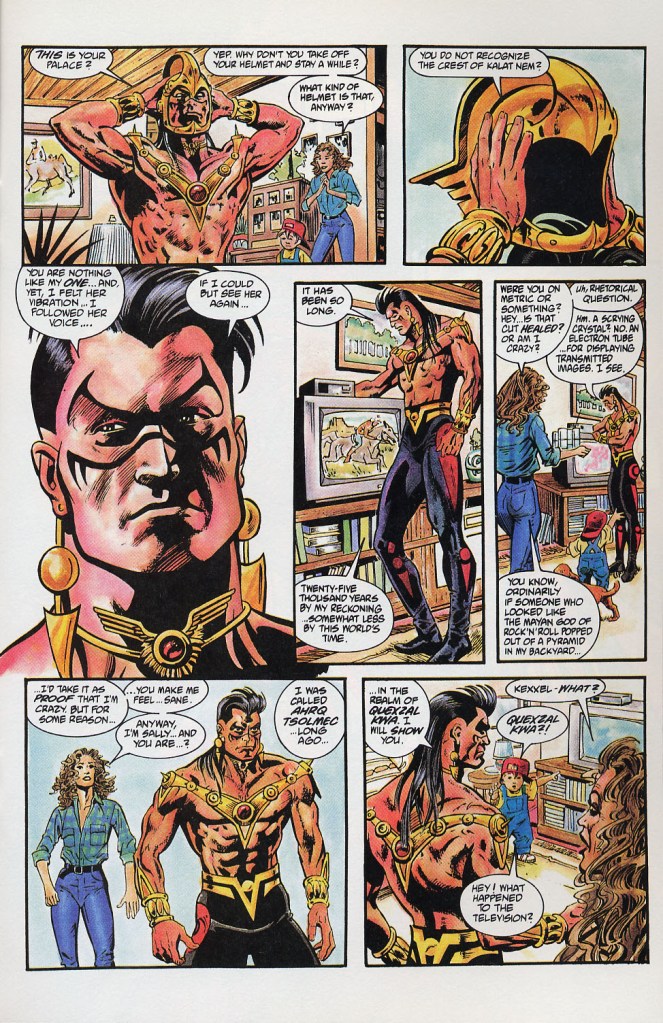
As Sally tries to keep her grip on her sanity and work out what’s going on, a bunch of the local rednecks show up. They immediately begin to make fun of the Aztec figure’s dress sense and picking a fight. The Aztec warrior dodges the first few blows from his attacker, his words indicating that he’s getting used to being made of matter and having mass once again. Eventually, humiliated by not being able to tag his opponent, the goon pulls a knife and slashes the Aztec in the arm before withdrawing. Sally takes the man back to her place to fix him up, and it’s there that he finally introduces himself as Ahrq Tsolmec of the Realm of Quexzal Kwa. It’s a name that rolls right off the tongue, so sally takes to calling him Ark.
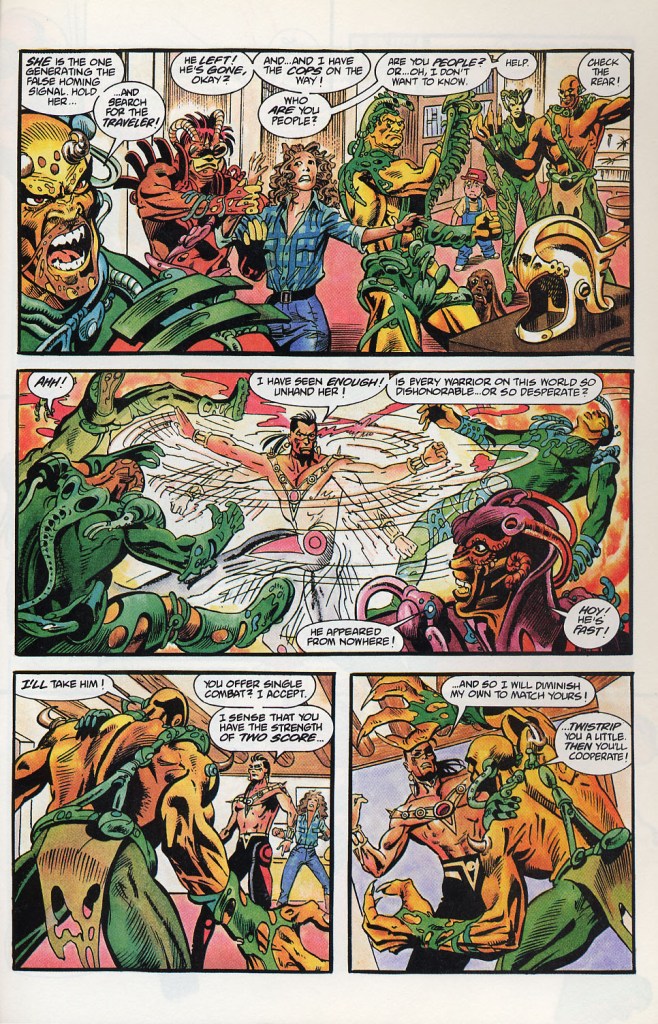
Ark begins to tell Sally about the world he comes from, where he had been a prince. Now, his goal is to search for his missing princess. Sally is a bit rocked by this revelation, as the images that Ark projects onto her television screen are identical to the ones that she’s been painting since her breakdown. But before this connection can be explored any more deeply, there’s a knock on the door, which turns out to be an entire band of warriors from Plasm, the central series in the DEFIANT universe. Absolutely no consideration is given to introducing any of the characters or even the concept of Plasm, so these guys show up unexplained out of nowhere. They’ve been drawn to the house by a false homing signal somehow emanating from Sally, but as they go to grab her, Ark springs into action and begins dancing at furious velocity, which permits him to become invisible and intangible. But as a fight breaks out, Ark diminishes his own innate power so that the battle can be an equal one, an expression of the honor-system of his culture.
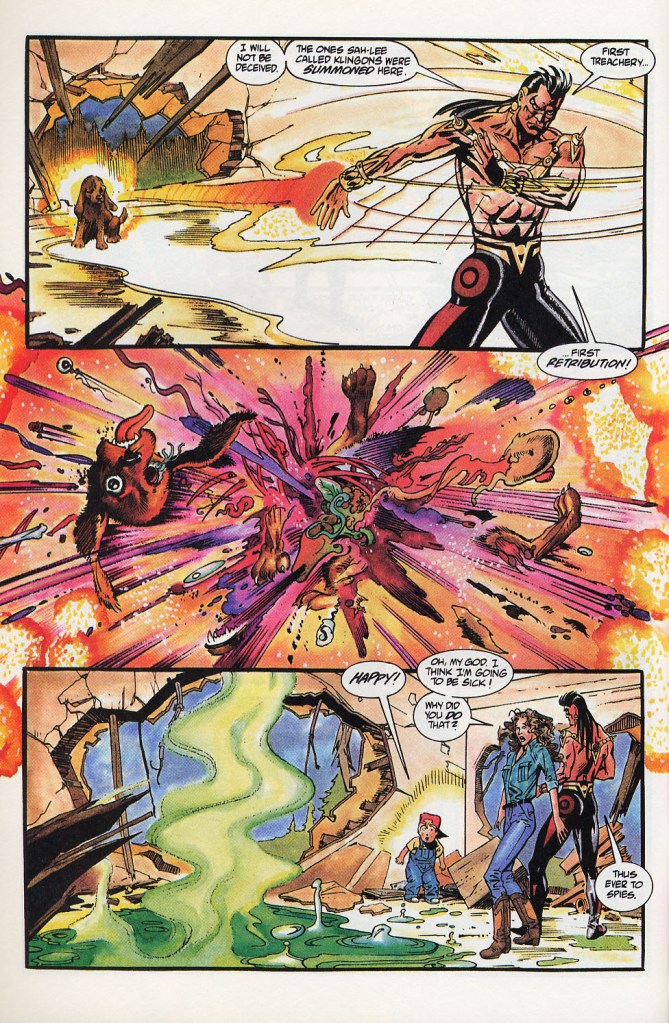
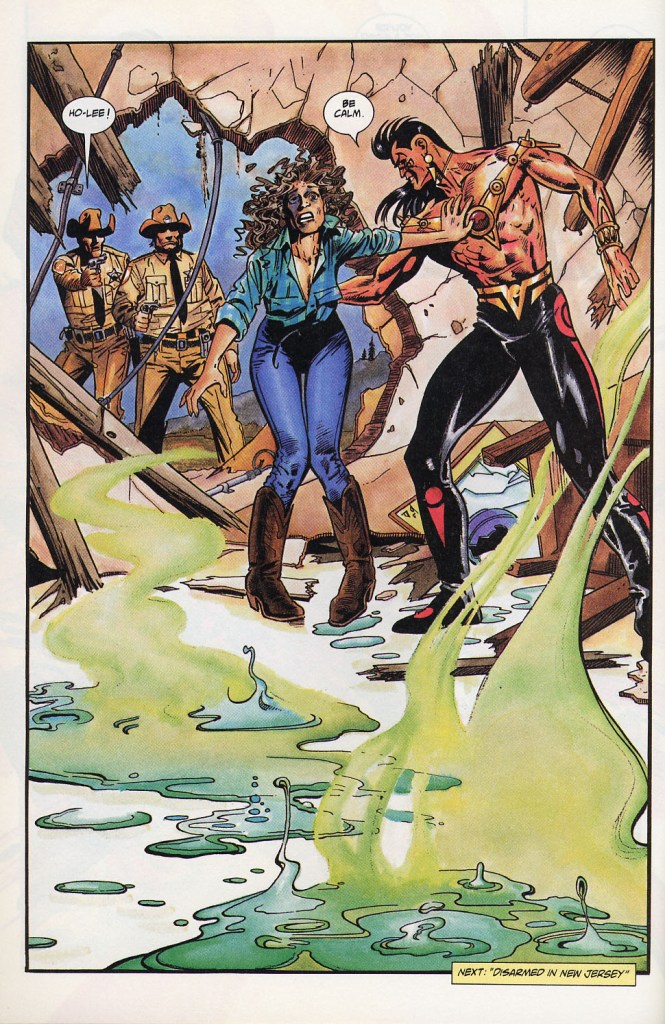
So what we get here is an extended fight scene, as Ahrq dances among the Plasm guys, striking them from afar and pummeling them into submission. Sally momentarily gets into the act, but she’s not built for a fight and gets clobbered. But it doesn’t matter. Ark’s assault is enough to send these soldiers of Plasm into a hasty retreat. In the aftermath, though, Ark has realized something about Willie and Happy–that they are somehow responsible for the signal that summoned the Plasm guys. Having realized this treachery, and in gruesome fashion, Ark proceeds to blow Happy into a million gory pieces, on panel. If you want to keep sympathy with a protagonist, having him kill a dog (even if it’s just something that looks like a dog) isn’t a great way to go about it. To compound the problem, on the very next page Ark does the same thing to Willie. Again this is depicted on frame in gory detail, with organs and entrails flying. Ouch. And that’s where this issue is To Be Continued, as the cops finally arrive in response to Sally’s earlier call.
WAR DANCER was intended to be a central series in the cosmology of Shooter’s new universe, and his seemingly mystic powers instead stemmed from quantum mechanics theory, as did pretty much all of the other powers featured in the line. Ahrq’s role was to be something of a spoiler, a figure attempting to hasten the end of the world so as to complete the cycle of life and death and bring back his lost love Zahn Ree. Weiss would remain the primary creative driver all throughout the short run, though other artist would quickly be brought on board to keep the series on track–Weiss hadn’t gotten any faster with his work over the years. The series also had a strong connection to DEFIANT’s next title CHARLEMAGNE, which will cover shortly.


Yuck! No disrespect to either Jim Shooter or Alan Weiss, but what the eff were they thinking? Under what conditions does the graphic destruction of a pet appeal to most potential comic book buyers? Killing young children in an equally vivid manner doesn’t seem any wiser a move in terms of audience building. I recall the 90’s as being rather harsh with violence and gore in it’s comics, but still, absent a “mature” label on the cover, the step-parent in me wouldn’t have been happy with a younger buyer bringing this home. I suppose I can be pleased that this one was a short-lived title.
LikeLiked by 1 person
On Buffy the Vampire Slayer the Anointed One was killed by sunlight off screen by Spike; the immortal little boy Kenneth/Kenny ( 10 or 11 years old but really roughly 800 years old — Highlander: The Series -“The Lamb” & “Reunion”) escaped justice ( He survives the Game by weaponizing his appearance — playing on the protective instincts of older immortals to take them in, only to betray and behead them when their guard is down ( Google AI for the words ) — hated that character ) and that evil little boy in Angel ( Buffy the Vampire Slayer spin-off –season 1, episode 14 “I’ve Got You Under My Skin” ) who was possessed by a demon that was actually terrified of the boy’s own extreme, innate psychopathic nature ( Social Services took him away for evaluation ).
LikeLike
Never heard of this book and can’t say I’m sorry about that after reading this review.
LikeLiked by 1 person
I remember the Defiant logo, and I may have bought the first issue of Plasm (it was vaguely familiar to me). However, thankfully, I didn’t buy or read this title.
LikeLiked by 1 person
That’s really nice-looking art. I don’t think I ever read an issue of this.
LikeLike
I loved Weiss’ work when I first read it in the issue of Captain America featuring Nightshade’s debt and I’ve been reminded he was involved in Starlin’s Warlock but most of what he drew didn’t appeal story wise. I just checked his bibliography and there were fifteen other stories I read. Shame too ’cause I can see the panels that captivated me in that first story.
LikeLiked by 1 person
If the Peter Gillis DEFENDERS — or heck, the J.M. deMatteis version — had art like this, it might have been a major hit.
I mean, not that it would have come out on time, but still.
LikeLike
Other than doing Namorita in the original Official Handbook as far as I know Sub-Mariner#54 ( October 1972 — cover and second story — The Mer-Mutants ) is the only books I remember at the top of my head that have with Alan Weiss’ work ( but wikipedia says his work appears in #3, 8-10 of the original handbook & #3 & 9 of the Deluxe edition; Heroes for Hope#1 ( starring the X-Men ), The Avengers#215 ( January 1982 –Molecule Man & Silver Surfer ), The Spectacular Spider-Man Annual#3 ( 1981 –Man-Wolf ), Iron Man#136 ( July 1980 –Endotherm who I liked ( might be the Captain Cold vibe ), hated that they later put him in armour instead of giving him to another hero ) and Power Man and Iron Fist#69 ( May 1981 ) ). With Dennis O’Neil he co-created Calypso in The Amazing Spider-Man#209 ( October 1980 ) — wikipedia.org ( Joe Rubinstein had nice thing to say about him –“the most difficult guy in the business to ink, without exception.” He added that this also made him one of his favorite artists to ink, because Weiss’s work was so intricate that he couldn’t tell what the final art would look like until he had finished inking it. ). But I never heard or remember seeing War Dancer.
LikeLiked by 1 person
I forgot this Weiss fill-in.. I think the Weiss/Wiacek(?) art on Ironman 136 was alright but visually I thought the cover was more compelling. Ironman already has a long running cold villain (Blizzard) that he deals with pretty handily… and I think Mandarin can freeze him also. It’s like having a second guy showing up with metal tentacles to fight Spider-man.
LikeLiked by 1 person
I’m not that familiar with Weiss’s work other than a Master of Kung fu story and 2 fill-in issues of the Avengers that I like quite a bit. I can’t say I like the look of this at all… and the coloring does it no favors. So many odd creative choices that push boundaries, but don’t add up to anything compelling… was it bad taste for the sake of bad taste month or something?
LikeLike
Does Sally ever change facial expression in this book, or is she permanently lock-kneed and terrified?
LikeLike
This was around the time I was dead broke, so no wonder I didn’t bother looking at this.
It’s not just that he kills a dog, there’s nothing to show us that was necessary or that the dog was really the threat. Maybe #2 would have explained that but as a cliffhanger … bad call.
And I agree with jbacardi, Sally’s constant panicked grimace gets ridiculous.
LikeLiked by 1 person
I’m pretty sure I bought a copy of this for $1 at a book store across the street from the Long Beach Convention Center during one of their conventions. I never read the comic, though.
I’m also pretty sure I bought Charlemagne too.
And I definitely bought Plasm – I though that one had promise.
LikeLike
I liked Defiant, but I have no memory of this book. Thanks for highlighting it.
LikeLike