


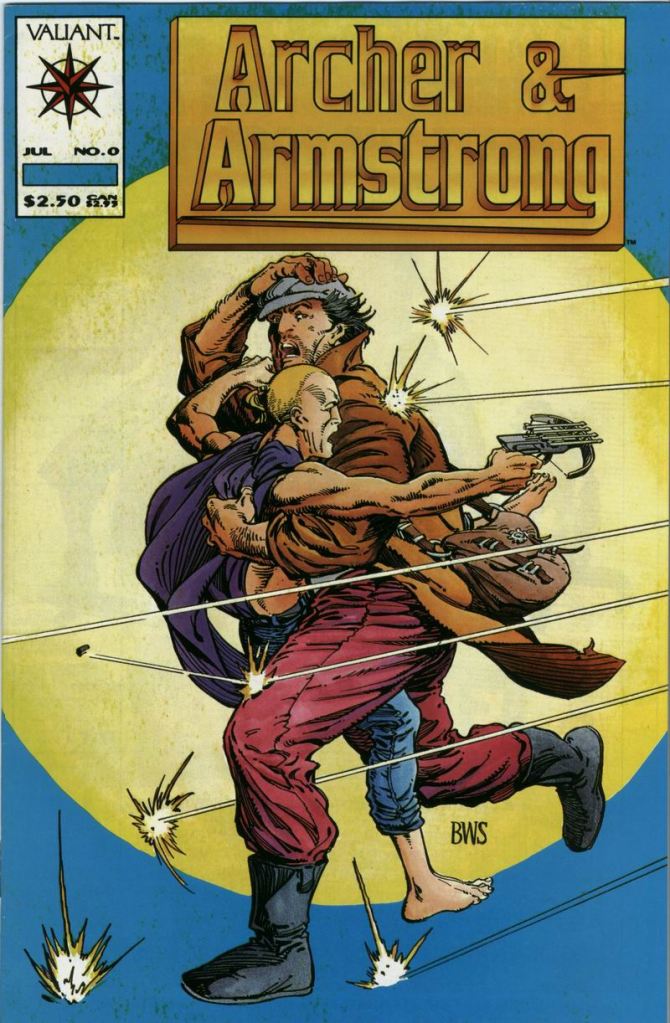
Valiant’s next series was one of its more unique and distinctive. It was barely a super hero series at all, though its events took place in the same continuum as the other Valiant super hero titles. This was ARCHER & ARMSTRONG, and it debuted with a #0 issue for some reason. The story in this issue provides the origin of the partnership between the two titular leads and puts them into position to enter UNITY, the grand, sweeping crossover series that would run through all of the Valiant titles for the following two months, bringing all of the newly-introduced characters together. The series was the brainchild of popular creator Barry Windsor-Smith, who worked on much of the run. But this kickoff issue was plotted by Bob Layton and Jim Shooter and dialogued by Shooter, presumably in an effort to reconcile Smith’s offbeat concept with the tenets of the Valiant cosmology as had been previously worked out.
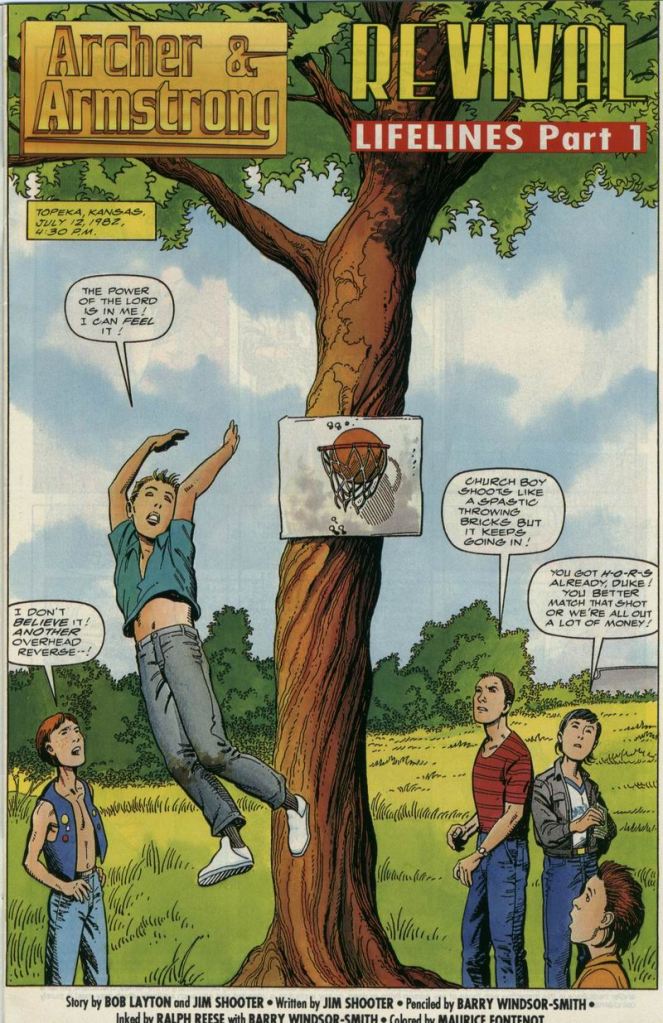
The best way to describe ARCHER & ARMSTRONG is that it’s an odd couple buddy comedy-adventure series. Its two principle characters are Obadiah Archer, a young man raised by a religious cult and who possesses uncanny martial skills, particularly with a crossbow; and Aram Anni-Padda, an immortal who has lived for thousands of years and who had devoted himself to pleasures of the flesh, drink and food and sex. The fun comes as these two disparate personalities come together and bounce off of one another while on a never-ending road trip into new adventures.
The real show here, of course, was Barry Windor-Smith, whose artwork and outlook permeates the characters and the project. While the artwork in this debut issue feels a little bit haphazard and rushed, and not entirely well-inked by Ralph Reese (Smith apparently went in at the last minute and re-inked portions of pages that he simply couldn’t live with) both narratively and visually, this was Smith’s concept all the way, and he’s the person that made this work. Smith wrote and drew issues #3-12 after serving as illustrator and uncredited co-plotter on #1-2 and this opening #0 issue. Thereafter, the strip was taken over by writer Mike Baron, who was a good fit in terms of being able to maintain its flavor. Artists Andrew Wenzel and Mike Vosburg kept it going up through its final original series issue, #26.
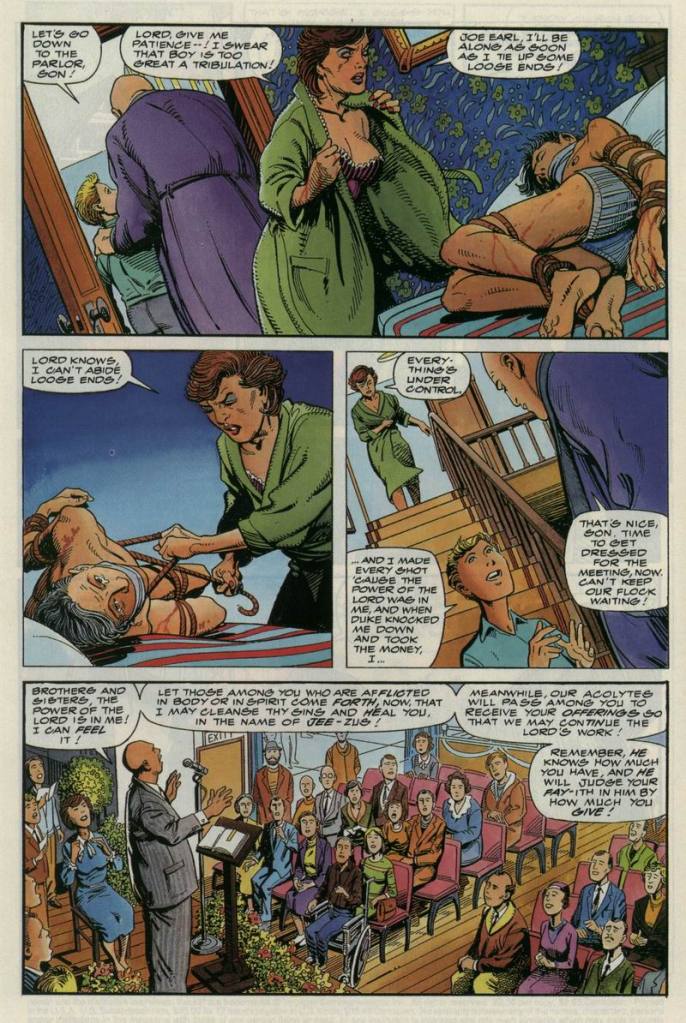
It has to be said: this series is weird, in particular this opening issue. We start out in Topeka, Kansas, honing in on young Obadiah Archer, who can sink a basketball at will. He’s the straightlaced son of two revivalist minsters, who it turns out are killing and mutilating children while also holding religious services where they take in charitable contributions from the faithful. But when Obie accidentally walks in on his parents mid-ritual, they decide it’s time to move on, and they leave him to die as they set their home ablaze. Obadiah promises God that he’ll punish his parents if the Lord allows him to live, and indeed, firefighters pull him out of the burning building before he can expire. Waking in a hospital, Obie runs away through a convenient window before his folks can finish him off, heading out homeless onto the streets.
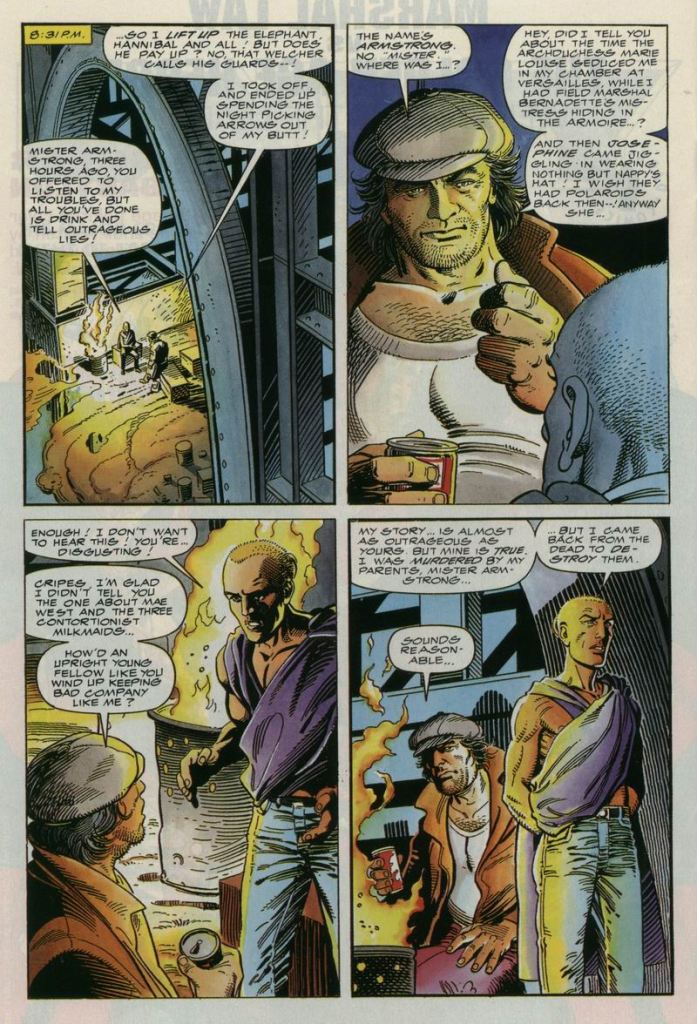
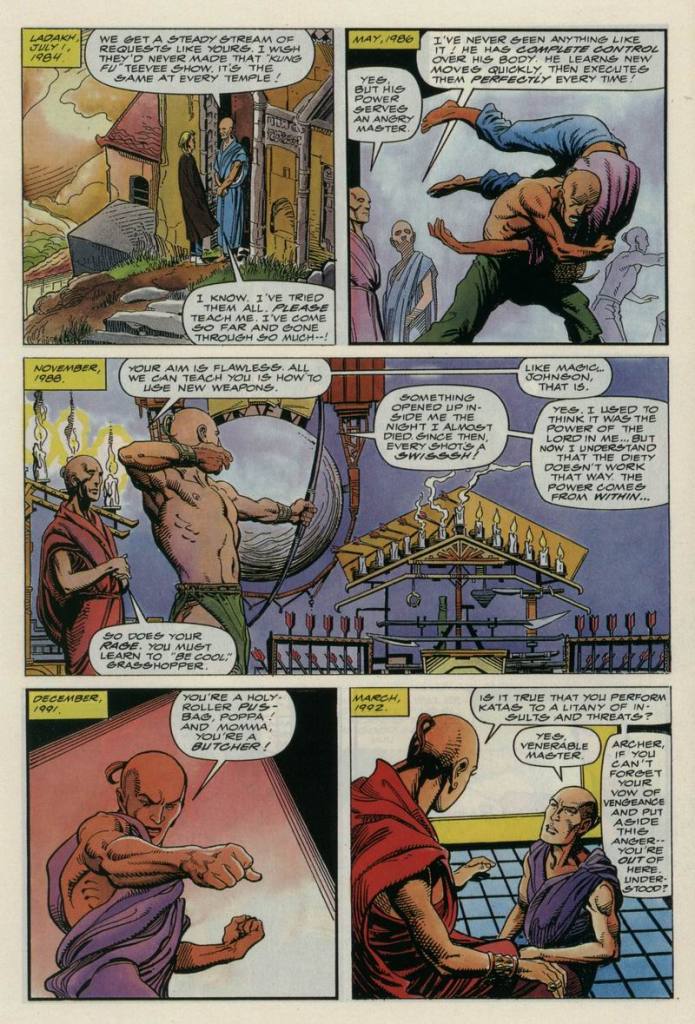
Obie’s journeys carry him to Hong Kong, where he’s taken in by a monastery of monks. The monks hone his mind and body, and are incredulous about the degree of perfect control Obadiah evidences over his own physical form. He’s a perfect marksman, with a handheld crossbow becoming his weapon of choice. The monks try to teach Obie to put aside his anger, but he’s motivated by what he sees as a holy quest to fulfill the vow he made to God when his life was spared to bring down his parents. Eventually, he migrates back to Los Angeles in the service of this goal, and he runs into a beggar on the street. When Obie gives the man his last five dollars, the beggar wants to repay him by helping him out, and the two share their stories with one another.
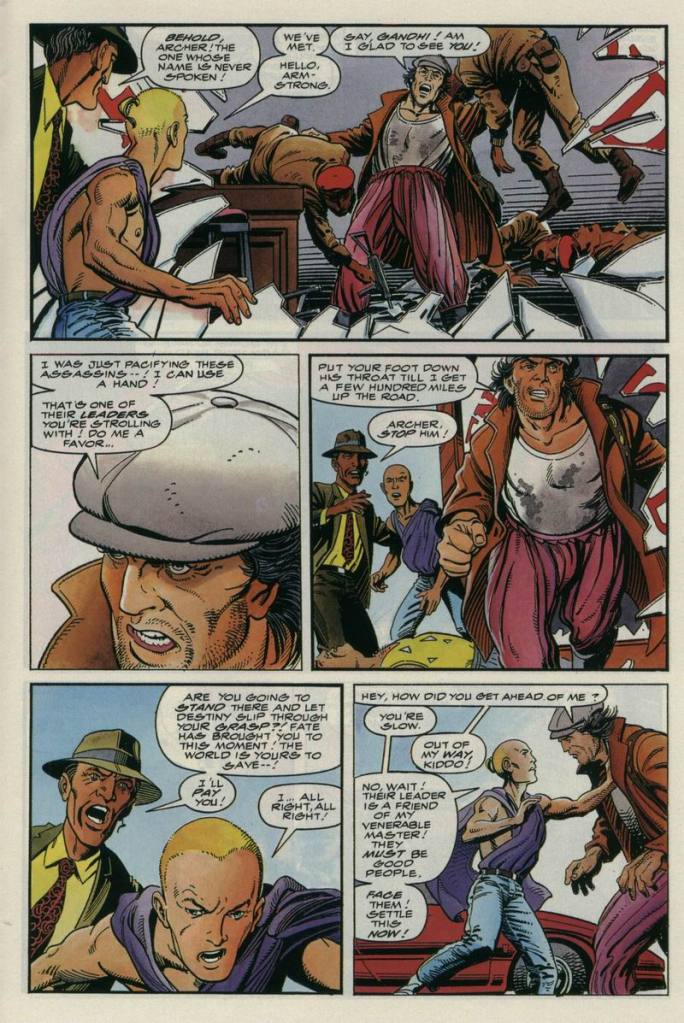
The man introduces himself as Armstrong, and he tells wildly outrageous stories while he drinks about adventures spanning hundreds of years. Obie shares his own story, including the fact that his parents were arrested and incarcerated only months after he left the country–so his vow is no longer achievable. He wants to turn his skills towards battling injustice, but he doesn’t really know where to begin. The next day, Obadiah tries to find himself a job, but he’s thrown out of a bar in which he applies to be a bouncer, and he’s accosted by street toughs when he’s too good in a basketball bet. Eventually, though, he’s approached by Mahmud, who introduces himself as a friend of Obie’s temple master. He and his fellows in the Sect have been pursuing a great evil across the land for 250 years, and he wants to hire Archer to help finish off this demon. The demon in question, of course, turns out to be Armstrong.
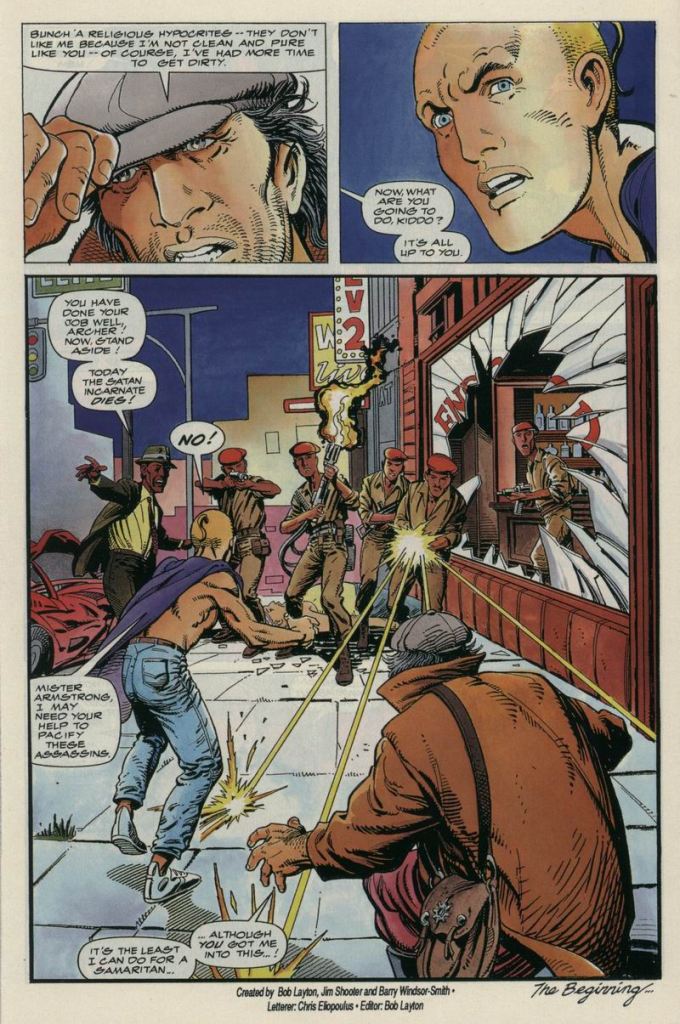
Archer doesn’t quite understand what’s going on, but when Armstrong makes to bolt, he intercedes, and the two tussle for a few pages. Ultimately, though, Armstrong doesn’t take advantage of his great strength to pulverize Archer, and this gets the kid to listen to him for a few seconds. But in that time, Mahmud has been joined by a crew of Sect assassins with high-tech weapons and they move in to try to finish off Armstrong. Now siding with his burly friend, Archer prepares to enter the fray himself–and that’s where this first zero issue wraps up. The story doesn’t so much conclude as it stops, runs out of pages. The pacing on a number of these early Valiant books is really strange, but that’s one of the things that gave them their unique charm. If nothing else, it was often difficult to work out where the stories were going ahead of time, because they took such unlikely turns along the way. Anyway, this set the pair up for their inclusion in UNITY as well as foreshadowing the first appearance of Armstrong’s brother Gilead, who would be introduced shortly as the Eternal Warrior.


It was always puzzling to me that Shooter had a legendary talent like Windsor-Smith working at Valiant, and still forced that boring, mid-range style of storytelling on him. Nothing about this book allows for his art style to shine. It didn’t matter if it was Perlin, Hall, Lapham, Windsor-Smith, etc. All the books looked generic to me.
LikeLike
Seems like much more Layton than Shooter, and as noted bother others it really was a riff on Power Man and Iron Fist. Still I loved the early issues at the time they hit the comic shops.
LikeLiked by 1 person
I don’t know that BWS was “forced” into anything. He has said the Archer and Armstrong characters were rooted in ones he’d come up with years before (and were repurposed in the “Freebooters” series in the STORYTELLER project). He’s also said that he always saw the feature in terms of the stories. That meant subordinating the visuals in terms of the story. As he put in his interview in THE COMICS JOURNAL #190 (boldface added):
“And yet, it’s very rare, if not perhaps unknown, that I can read a comic book, including my own that’ve been scripted by others, where I felt that there was an utter complete unison between image and word. The balance I’ve always dreamed of having is where you can make it flow so easily — and this really to me is the Grail for me — where I can make my reader forget they’re reading a comic book. That’s what I aim for all the time … y’know, like in the movies — if you notice the architecture of the theater during the film then the story didn’t take you away. If I do something too flash with my visuals, I will chuck it out and do something less flash, because I don’t want anybody to say, ‘Wow, look at that cool drawing, man!” I want it all to balance. There’s a word I’m looking for, I can’t bleedin’ think of it. It’s some word about perfect balance.”
If the art was low-key, perhaps it was intentional.
LikeLike
Thanks for sharing that, and I can agree that he probably didn’t want his art to be distracting. My biggest complaint with Valiant is that ALL the books looked the same, and I wish Windsor-Smith had a chance to flex his strengths a bit more.
LikeLike
I’m only familiar with the Van Lente-written revival so this was informative.
LikeLike
I read none of the original Valiant books but I did really enjoy one of the reboots. I think it was the 2012 one. Are we sure Shooter wrote this? His dialog would routinely swing from sublime to very, very awkward but the dialog in the scans seems bad for even Shooter’s lower levels.
LikeLike
Archer & Armstrong was the first Valiant series I followed regularly from the very beginning, so I will always have a bit of a soft spot for it. I thought it was pretty fun, with really nice artwork. Barry-Windsor Smith left the series after issue #12. I continued reading it until #16, but it just wasn’t the same without BWS, so I dropped it. I guess a lot of other readers felt the same way, since as Tom says in his post, the series was cancelled with #26. I seem to recall that at the end of The Chaos Effect crossover Archer & Armstrong were lost in time, or limbo, or something, never to be seen again, which I definitely felt was a sad ending for a once-great series. I’ve never picked up any of the reboots published by the various revivals of Valiant.
LikeLike
It always seemed to me that Bob Layton must have had input into the creation of the series, though of course it may have been entirely coincidental. But the mismatched-buddy combo of a strong guy and a naive martial artist felt a lot like POWER MAN & IRON FIST, which Bob had contributed to in the past and had at one point been slated to write the series and must have had ideas for it — and Armstrong himself had a fair amount in common with Marvel’s Hercules, a favorite of Bob’s.
I liked the setup of the series and kept reading it for a while, as long as Barry Windsor-Smith was working on it.
I liked the art — even in straightforward-storytelling mode, Smith’s art is fluid, elegant and textured, full of life and dynamic motion. But I don’t remember the stories really going anywhere. The journey was pleasant but there wasn’t much of a destination. And the more it was entangled with worldbuilding for other series and the larger Valiant universe, the more my interest faded.
Still, it was my favorite Valiant book during the time I was reading any of them.
LikeLike
This was the only Valiant book I bought on the regular, most for the BWS art but I remember it as being a lot of fun. Gave up sometime during the Mike Baron era. I liked Barons’s Nexus quite a bit, but this didn’t work for me.
LikeLike