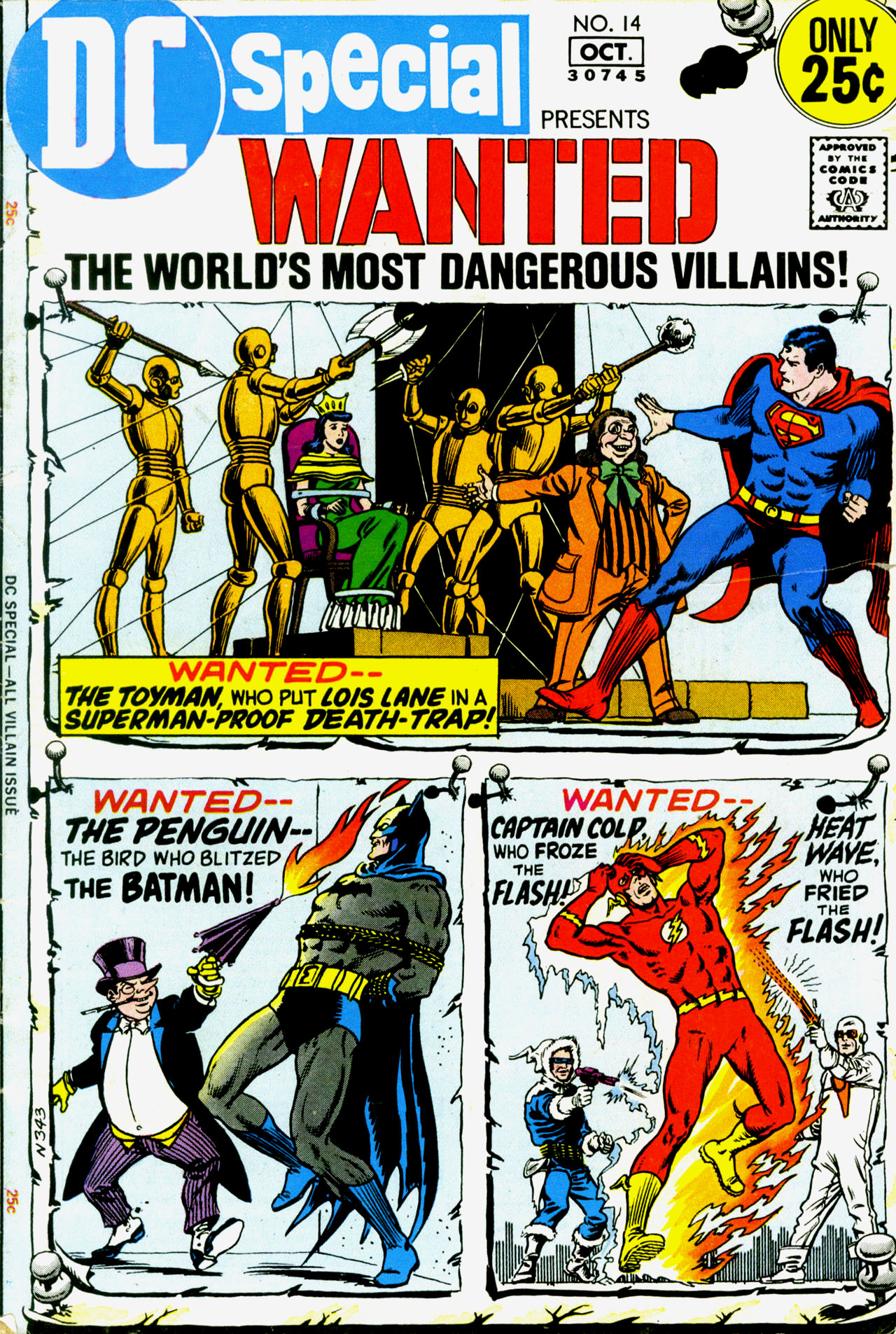


The last book that I picked up on that bike visit to Ed’s Coins & Stamps in the Sun-Vet Mall was this issue of DC SPECIAL, a reprint title. And I would guess that the reason why I purchased this issue was that it was cheap. For all that i was flush with cash after my grade school graduation, I wasn’t looking to blow it all at once. So finding a book like this one that I likely paid about a dollar for was a good deal, particularly since it includes a Flash story that I hadn’t yet read. This was the sort of calculus that I did on back issue shopping trips, working to maximize my return on expenditure while still walking away with some good new material.
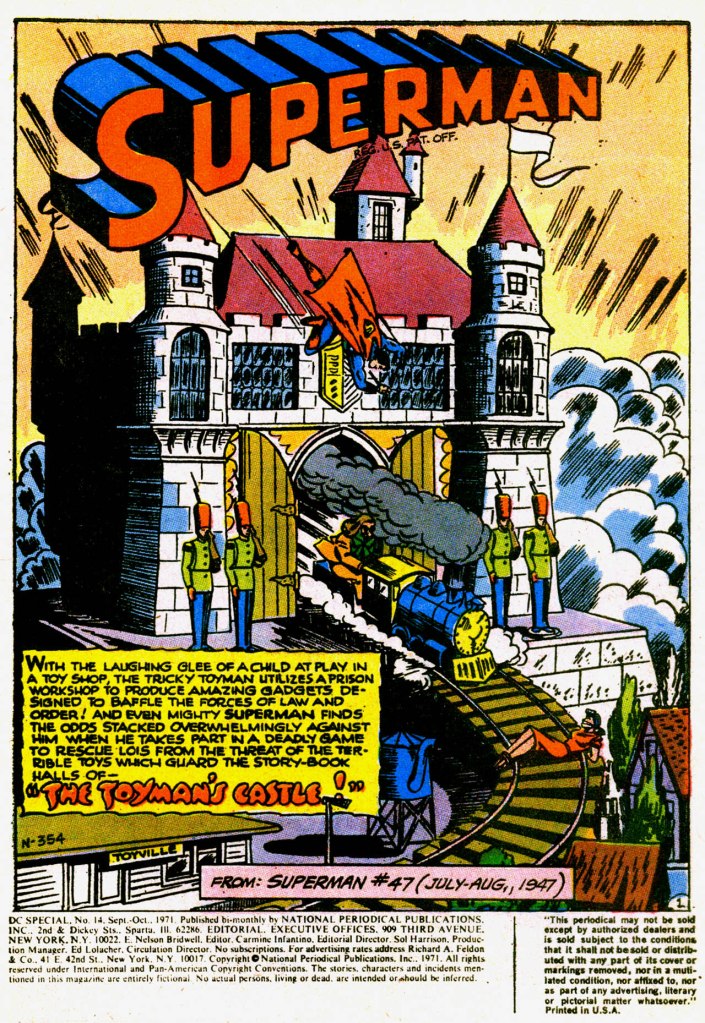
This issue of DC SPECIAL reprinted three stories in total. This first one was a Golden Age Superman adventure, and the reproduction on it is pretty shaky. This was the difficulty with reprinting stories of this vintage, the technology just wasn’t there yet to affordably be able to reproduce these old stories well, but the growing interest in nostalgia meant that there was an audience hungry to read them. So you got compromises such as this one. Of course, the big thing that was changed was the removal of the Jerry Siegel & Joe Shuster byline on this tale. They’d been stricken from DC history ever since they sued in 1948 to attempt to reclaim the rights to Superman, and ever since, they’d been washed away from such reprinted stories. Or course, neither man actually worked on this particular adventure, but they were still receiving the byline regardless.
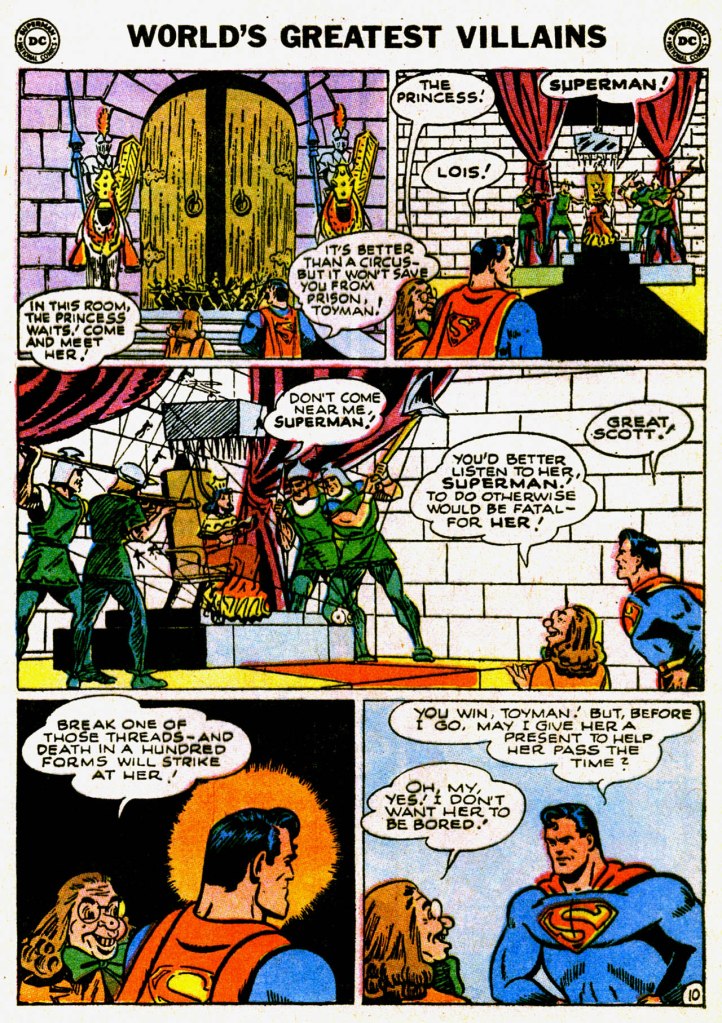
The actual creative team for this story was writer Don Cameron and artist Ira Yarbrough, both of whom ghosted a bunch of Superman stories in this postwar period. It features the Toyman, a criminal who had achieved a certain degree of popularity in the strip for a time, but who gradually appeared less and less often. As his name implies, he used gimmicked children’s toys to commit crimes. In this adventure, the Toyman attempts to use gullible rich dowager Mrs. Thwart as a proxy to gather up the signatures of Metropolis’ wealthiest citizens which he will then use to forge checks and so forth. Sounds like a job for Superman, right? To prevent the Man of Steel from interfering, the Toyman places Lois Lane in a crazy deathtrap. But Superman saves her by simply plunging in and taking all of the would-have-been-fatal-to-her attacks on his own indestructible body.
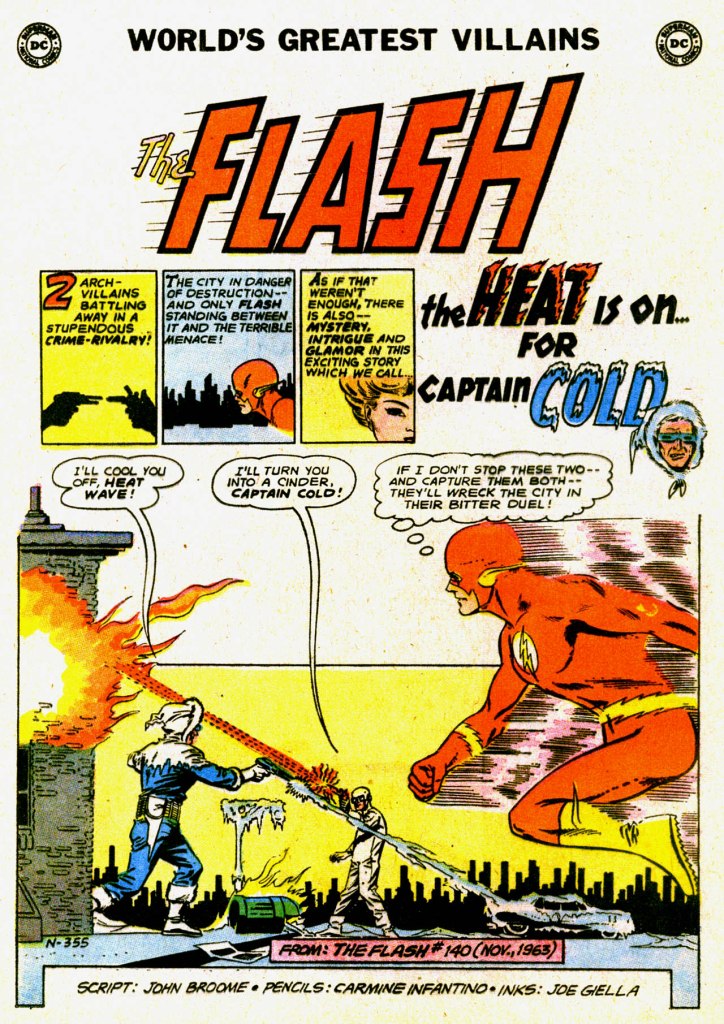
The next reprinted story is really what I’d bought this issue for. It was an adventure of the Flash, my favorite super hero, written by his usual author of the Silver Age, John Broome, and illustrated by Carmine Infantino and Joe Giella. This was the story that introduced one of the Scarlet Speedster’s recurring foes, Heat-Wave, who was to fire what Captain Cold was to ice. And in fact, the two arch-villains had an ongoing rivalry which began in this first story and defined their relationship. I’d already seen a couple of Heat-Wave stories, so I knew the gist of the character. And as usual, Broome’s script was playful and fun, and Infantino’s artwork was expansive and design-oriented. The strip had a quintessential quality to it that really appealed to me.
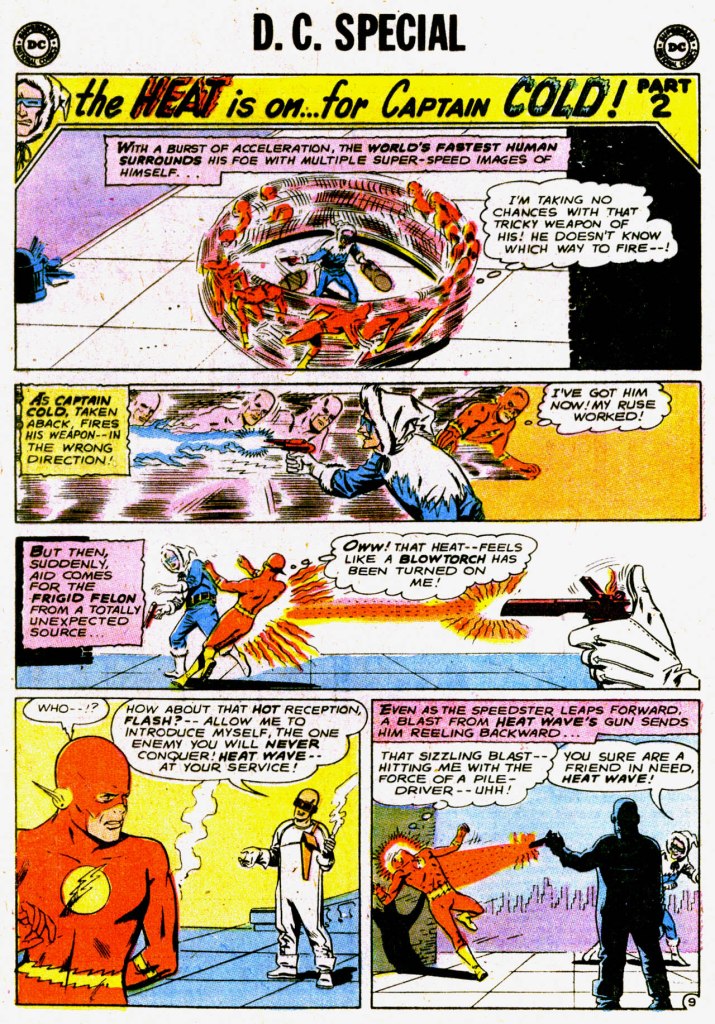
One of the recurring motifs surrounding Captain Cold in his earliest stories is that he would become infatuated with some new woman that he’d attempt to win over by committing spectacular crimes. In this story, the object of his affections is a celebrity known only as Dream Girl. Unfortunately for him, the newly-minted rogue Heat-Wave is also stuck on Dream Girl, causing the two felons to turn on one another in an attempt to show up the Flash and win her heart. This makes Flash’s job a bit easy, as he’s able to play the two against one another to take them out. Along the way, he’s also able to connect Dream Girl with a missing heiress, Priscilla Varner, insuring that she receive her inheritance, which also guarantees a large charitable donation to aid the poor of Central City. It isn’t the greatest Flash story ever produced, but it runs the bases well and is entertainingly executed.
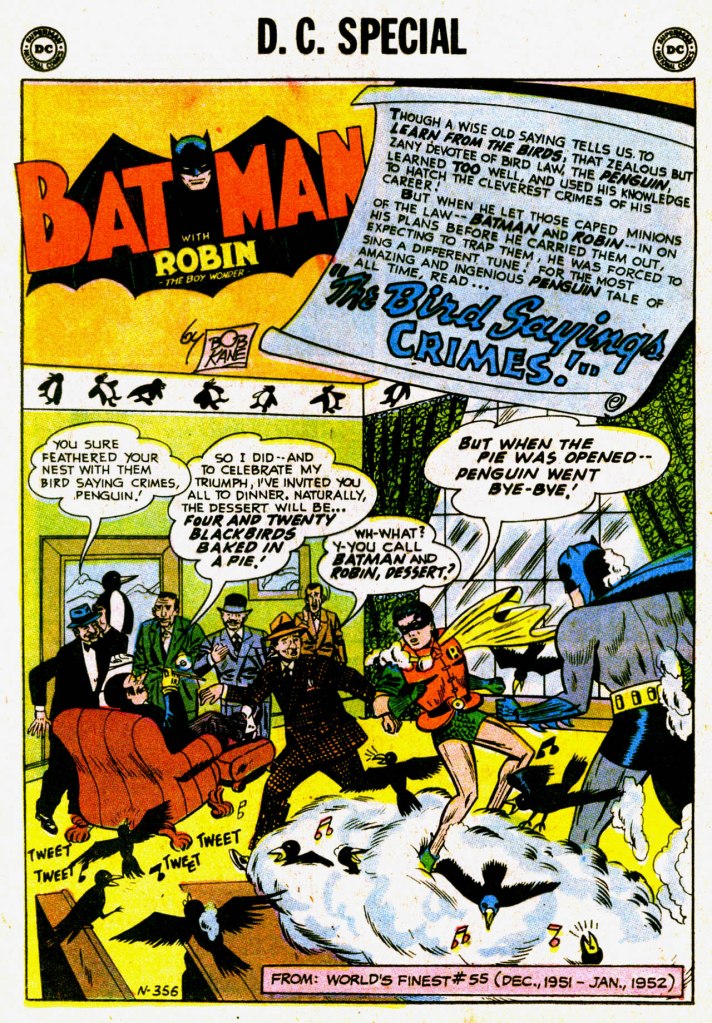
The third story in this issue comes from a third decade, the 1950s in this instance. It’s a Batman tale focusing on the Penguin, a villain who had grown to greater notoriety in then-recent years thanks to the portrayal of actor Burgess Meredith as the character on the live action BATMAN television show. Like the Toyman, the Penguin had been popular in the 1940s and early 1950s but had fallen out of favor somewhat and appeared less and less as time went on. He was something of an odd concoction, theming his crimes around birds and carrying gimmicked umbrellas–reportedly, his creation was inspired by a popular product mascot of the era who was similarly dapper. Here, having been mocked by his fellow criminals, the Penguin embarks on a campaign to make them eat their words by pulling off a series of spectacular heists based around popular bird-themed sayings, such as “A bird in the hand is worth two in the bush.”
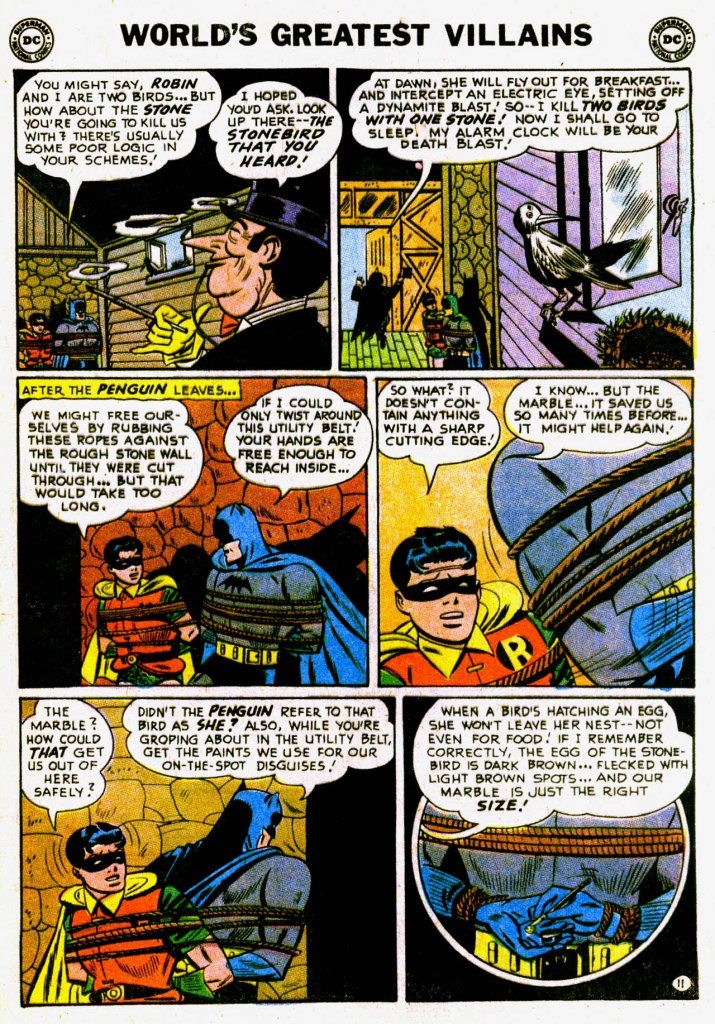
The centerpiece of this story is an obtuse death trap that the Penguin leaves the Dynamic Duo in. It’s almost exactly as ridiculous and ill-considered as the ones that closed out the first halves of the two-part TV show adventures. As is the way Batman is able to extricate himself and Robin from it–people who felt that the TV series was making a mockery of the character hadn’t read stories such as this one. The byline on this story was given, as it always was by contractual necessity, to Bob Kane. But I’m told that it was actually written by Bill Woolfolk and drawn by Lew Sayre Schwartz ghosting for Kane. (Some accounts indicate that Kane may have penciled the Batman and Robin figures in this story, but I don’t know how likely that really is.)


The Bottom tier (2 panels) of this Murphy Anderson Cover are especially nice!
LikeLiked by 1 person
Having finished Tom’s delightful review of those three old comics, I’m looking to be proven wrong. My thought is that both Batman and The Flash have a deeper and more impressive Rogue’s Gallery than Superman. Once you’ve gotten past Lex Luthor and Brainiac, it seems to veer into sillier villains like Mr. Mxyzptlk, Bizarro and this issue’s baddie, The Toyman. Not that I’m complaining. And I’m ready for that plate of crow to prove me so very wrong.
LikeLike
A delightfully fun review which left me with one thought. Is Superman’s Rogues Gallery that much less impressive and deep than both Batman and The Flash? Once you get past Lex Luthor and Brainiac, his list of baddies seems to veer into sillier (but still fun) opponents like Mister Mxyzptlk, Bizarro and this issue’s baddie, The Toyman. I know I’m asking for it and am will down that plate of crow! ☺️
LikeLike
Len Wein ( Galactic Golem on List of Superman Enemies – click on Galactic Golem says the problem with Superman’s rogues’ gallery was, they were all thinkers…they were scientist, or guys who built toys. With the Golem, he could hit Superman, and Superman could hit him back ). ( ME only focusing on Pre-Crisis foes ) For an excessively powerful hero, they give Superman a number of Batman/Green Arrow/Hawkman class foes ( Puzzler, Prankster, Master Jailer, Terra-Man ), but you forgot Parasite, Solomon Grundy, Mongul, the Four-Armed Terror, Galactic Golem ( I like the look of the second one created by Kurt Busiek, Renato Guedes & Jorge Correa, Jr. ), the Planeteer ( Superman’s Doctor Polaris ), Thing from 40,000 A.D.( Clayface who duplicated his form and powers too in the Pre-Crisis & Byth did it in the Post Crisis ), Kryptonian Phantom Zone Criminals & any JLA foes other than Paragon that I can’t remember right now,
LikeLiked by 1 person
Thanks, John. Y’know, the moment I hit send, I immediately thought of Mongol and Parasite as well as the Phantom Zone guys. And yes, my knowledge of the Big Guy’s pretty limited after 1993. For what it’s worth, isn’t Solomon Grundy a Batman villain?
LikeLike
Thanks, John. Have to confess that the second after hitting the button, I thought of the Phantom Zone villains, Parasite and Mongul. I also confess that my knowledge of the Big Guy is sketchy past 1993. For what it’s worth, isn’t Solomon Grundy a Batman villain?
LikeLike
As a Terra-Man fan, classing him with Puzzler and Prankster is daft. With his alien tech he went toe-to-toe with Superman on a regular basis.
Yes, I’m a fan.
LikeLiked by 2 people
Solomon Grundy gets around: Earth-2 one in Superman#301 ( July 1976 ) and a Earth-1 duplicate in Superman#319-320 ( January-February 1978 ). DC Comics Presents#8 ( April 1979 ), Justice League of America#46-47 ( August-September 1966 ) and JLA#91-92 ( August-September 1971 ).
LikeLiked by 1 person
Mr Mxyzptlk and Bizarro are often played for sillier stories – but they are powerhouses as opponents. Bizarro tends to have the same power-level as Superman. And Mxy has even greater power. Also, Mxy has a nasty because-I-can type aspect of being an arrogant bully, even if it’s typically played for laughs.
I think it adds depth to a Rogues Gallery to have more motivations than kill/rule the world, or kill Superman. The story of preventing a disaster from some not quite mentally balanced foe, has its place.
LikeLiked by 2 people
You make a solid point, Seth. That’s part of the fun with my question. I’ve enjoyed the information and perspective of you, John and Frasersherman. Thanks!
LikeLike
“Wanted” was an inspired bit of marketing. It’s really three random stories of three superheroes but by framing it as about the villains it became much more interesting. As witness two DC Specials, then nine issues of reprints.
LikeLike
Of the 3 stories here the Flash story is the only one that would have interested me, but the problem I have with Captain Cold & Heat Wave as Flash foes and Terra-Man as a Superman foe is that because of how fast the 2 heroes can move ( faster than the human eye can see ) those villains could be disarmed and tied up before they even noticed the heroes move. Maybe if they had dressed Terra-Man like Jack Palance’s character in Shane he would look more impressive. Over at Marvel it would be Boomerang and later the Constrictor biting off more than they can chew going up against the Hulk.
LikeLike
That’s true of anyone Supes and Flash fight. It’s one of the many things about superhero comics I choose to ignore. In Terra-Man’s case, his tech is advanced enough I imagine he has counter moves.
The first appearance of Boomerang is nuts. He uses one Boomerang in the story, the rest of the time he throws little rings. Given boomerangs are one of the world’s most distinctive weapons, it’s … an artistic decision.
LikeLike