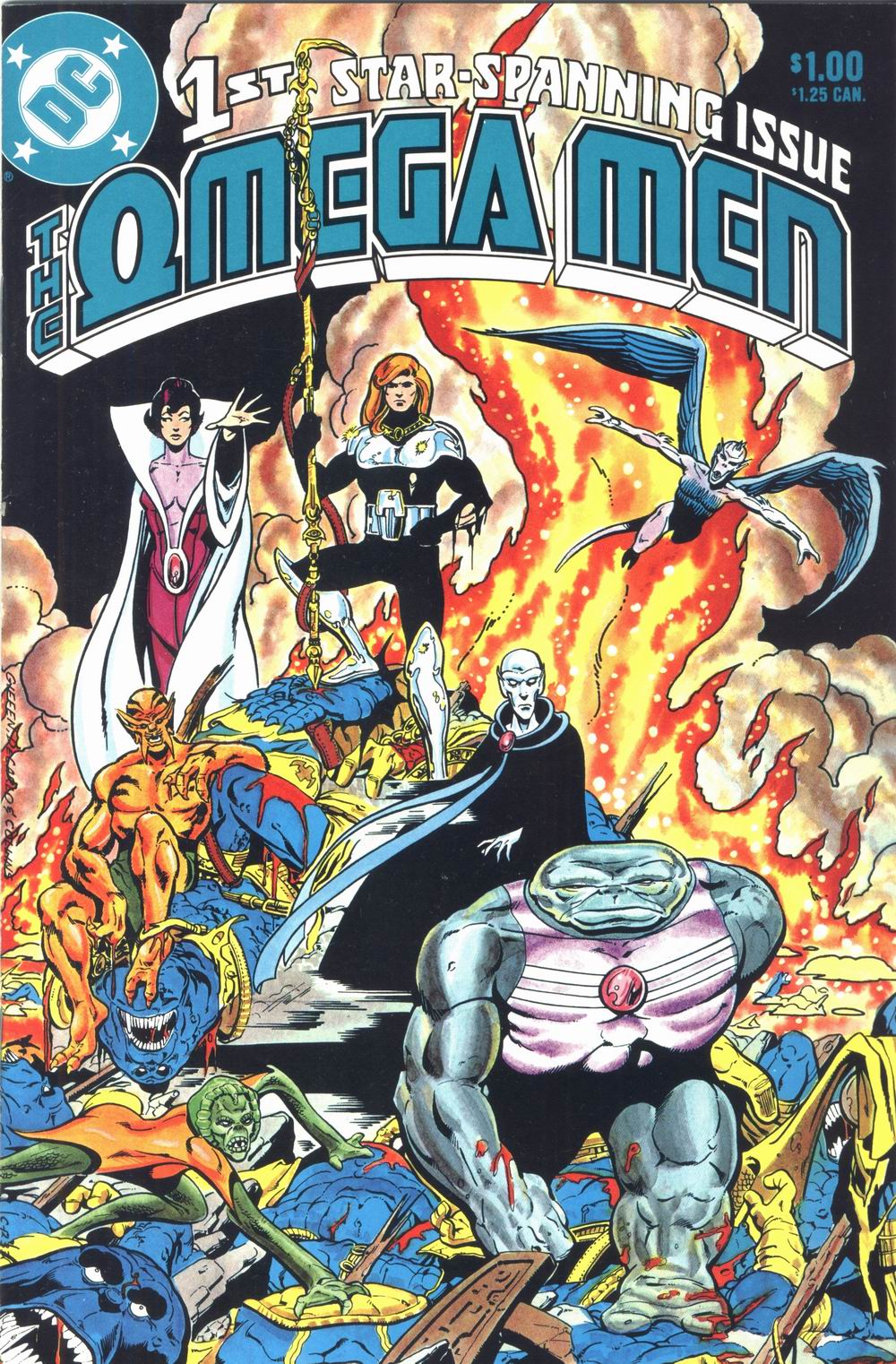


At the beginning of the 1980s, after a number of rough years, DC really began to get its act together and to modernize its approach to doing comic books. The primary instigator of this change was new publisher Jenette Kahn and the vehicle through which it became viable was the emerging Direct Sales marketplace of comic book specialty stores. DC’s sales were lagging well behind Marvel’s, especially in this new market, and so DC’s new leadership made a concerted effort to craft new projects aimed at capturing an ever-growing segment of that new marketplace. One of these new titles was OMEGA MEN, the creation of Marv Wolfman and Joe Staton. They had introduced the characters and the concept during their GREEN LANTERN run, them Marv reinforced it by using them in both NEW TEEN TITANS and ACTION COMICS, the two other series that he was writing at the time. This led to enough interest where the concept was launched into a high-end series–high-end because it was printed on better paper stock than the typical newsprint and also carried a higher cover price as a result.
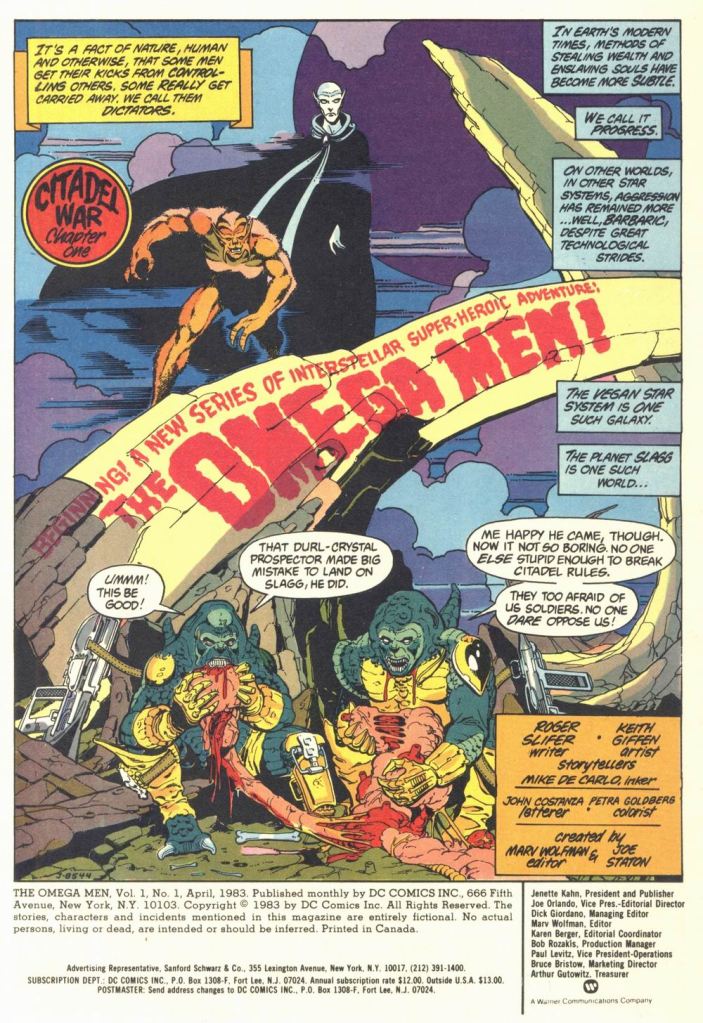
I had been pretty intrigued by the Omega Men in their prior appearances–I was following pretty much everything that Marv wrote religiously at this time. So I was intrigued about the new book. I seem to recall that I first found out about it in the pages of an issue of COMICS SCENE, a short-lived newsstand magazine dedicated to comic books that was a spin-off of the long-running STARLOG. COMIC SCENE only lasted 11 issues then, but it made a comeback at the end of the decade that had a bit more legs to it. In any event, the big surprise to me was that the new book wasn’t going to be written by its creator at all, but rather placed in the hands of Roger Slifer. This was, from what I can tell, simply a matter of Marv having reached his limit in terms of workload and not wanting to give up any of his current assignments to do OMEGA MEN. But it did mean that the book was operating under a bit of a cloud for me right from the start.
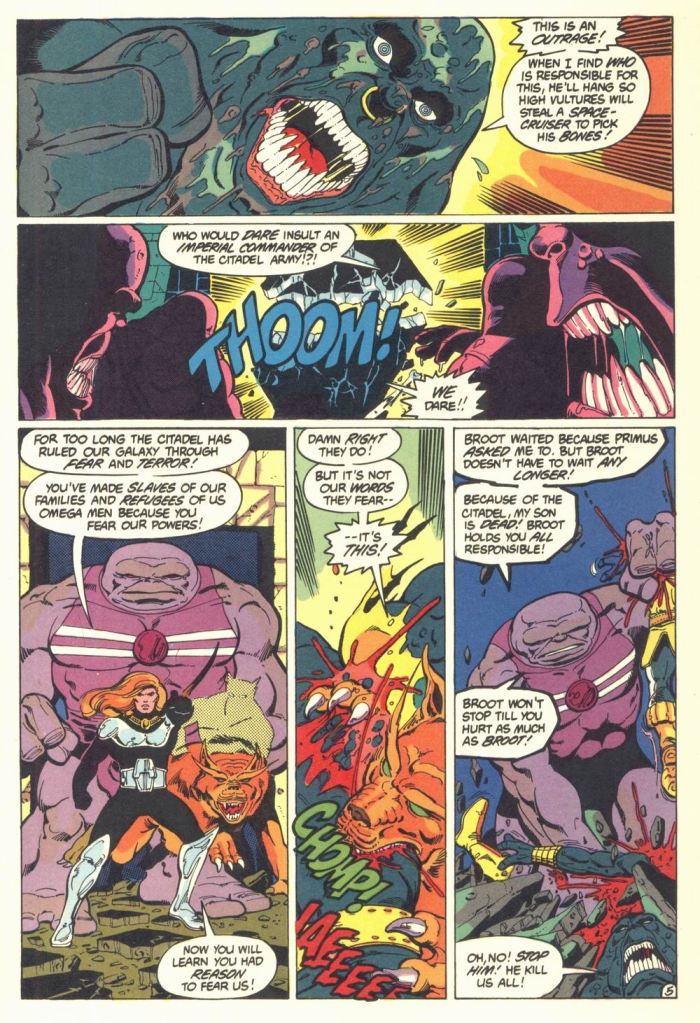
The real appeal of these early issues of OMEGA MEN lay in the artwork, which was delivered by Keith Giffen. After a few tumultuous years, Giffen’s star had risen to prominence working on LEGION OF SUPER-HEROES, which he and Paul Levitz made into a massive hit, at least for a time. So his presence on OMEGA MEN promised a high level of visual panache. Additionally, Giffen was a font of crazy ideas, and he was typically an equal partner in plotting the books on which he labored. Another aspect of OMEGA MEN that ought to be mentioned is that it was a series set within the mainstream DC cosmology but which wasn’t restricted by the Comics Code since it didn’t sell through mainstream newsstand outlets. That meant that the book’s creators could be a bit more liberal in their use of blood and sex, as on the page above. These more liberal restrictions weren’t used to any great benefit, but the comic book field was straining at this point to produce more sophisticated adult material, and being able to experiment in this manner led to the advances that would help to move the medium forward. Still, it was all pretty gratuitous in this issue.
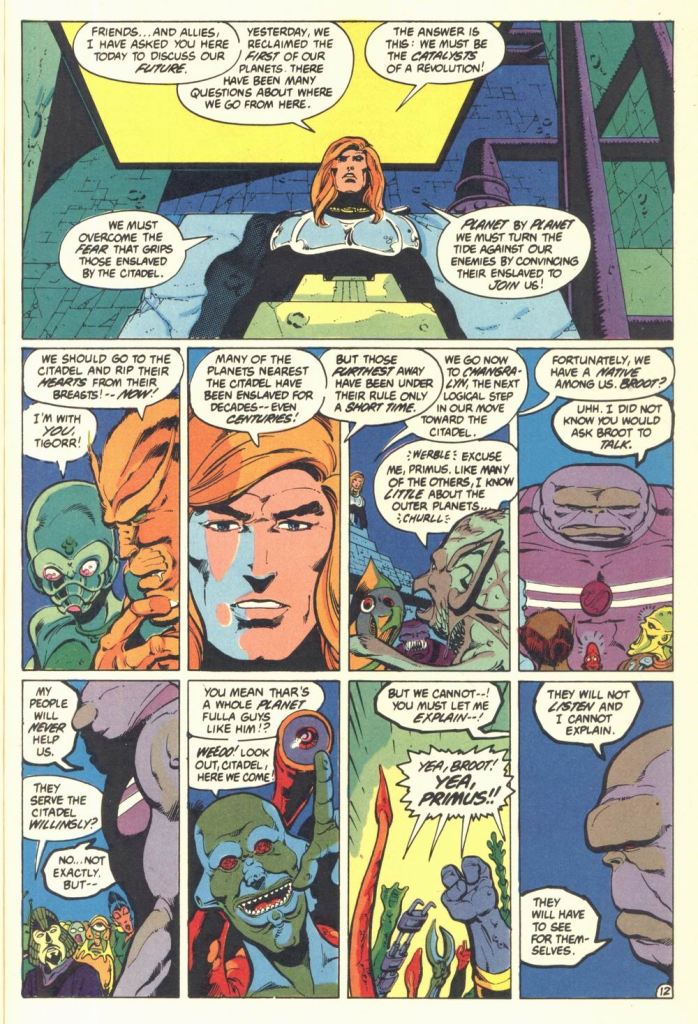
Looking back at it, it seems quite clear to me that in coming up with the Omega Men, Marv was thinking about Marvel’s Inhumans and the role they filled in FANTASTIC FOUR. Along similar lines, the Omega Men were a massive cadre of displaced aliens who were involved in an ongoing outer space conflict with the Citadel, a power base that Marv had set up in TITANS and GREEN LANTERN. Like the Inhumans, there was a core crew of Omega Men who carried the action along the lines of the Inhumans’ royal family. This included the noble leader Primus and his sorcerous wife Kalista, savage Tigorr, sad sack Broot, spooky Nimbus, traitorous Demonia and bloodthirsty Harpis. They all map against the Inhuman royal family relatively directly, at least as this first issue gets under way. And like the Inhumans, there were no end to the other potential characters who could pop out at any given moment. The book also had the same problem that Inhumans had long-term, which is to say that it was set in a completely separate culture about which it was difficult for the average reader to care. When the Omega Men had been on Earth hanging out with Green Lantern and Superman you had those characters to carry you through. But on their own, there wasn’t as much to get a toehold into.
The opening of this issue introduces our main cast and sets up the situation. It begins with the Omega Men fighting to liberate the enslaved planet of Slagg from its Citadel overlords. This opening action sequence lets all of the principles display their powers and personalities in textbook fashion. In the aftermath of their victory, the Omega Men discuss their strategy, as some among their number, in particular Tigorr, are unhappy that the crew is picking around the edges of the Citadel’s empire rather than heading straight to the heart of it. But Primus indicates that they wouldn’t stand a chance against the Citadel, not without sufficient numbers, and so liberating the outer worlds and adding their forces to their legions is the only path forward that makes sense. And the group’s next target for liberation will be Changralyn, the homeworld of one of their number, Broot. Broot insists, however, that his people will never help them, but can do nothing to dissuade the Omega Men from this course of action.
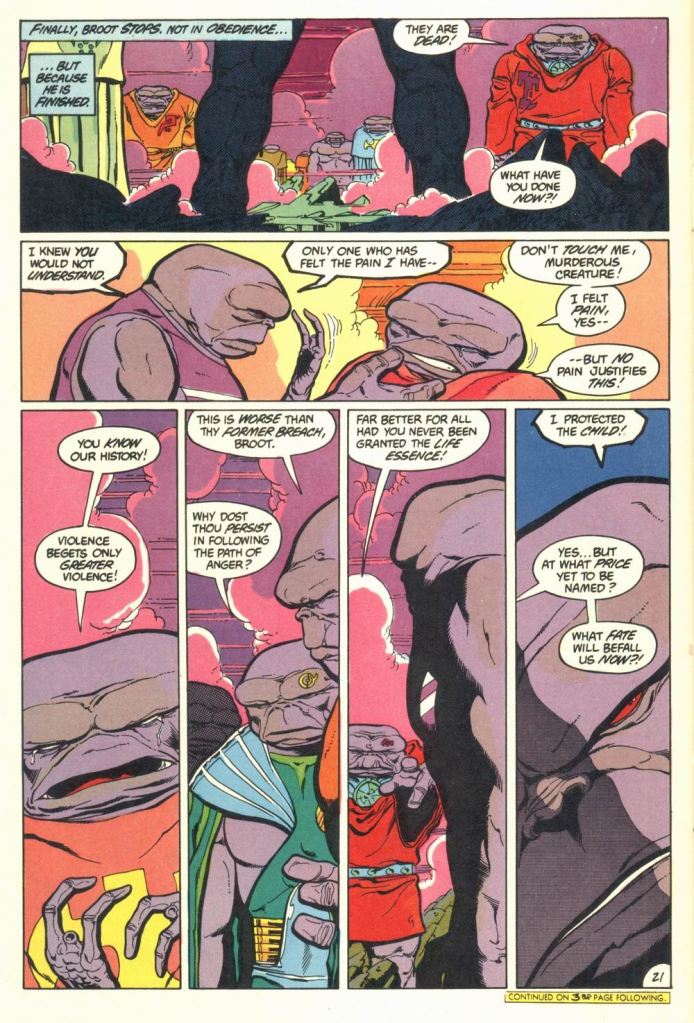
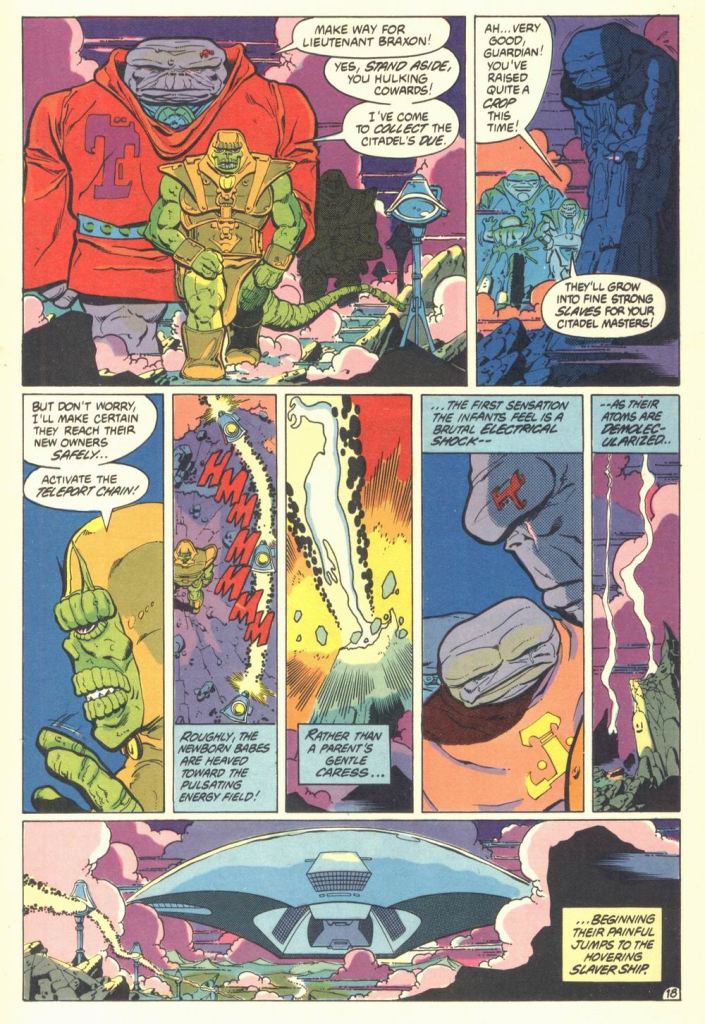
On Changralyn, the Omega Men begin to learn the truth of the situation. The planet is largely barren of resources, and so its people have brokered an uneasy peace with the Citadel. But part of that deal is turning over a certain number of newborn babies each cycle to be transported off-world, where they’ll be used as slave labor. This fate befell bot Broot and his wife, from whom he’s been separated for years. What’s more, their race embraces a strong code of non-violence after having almost destroyed itself decades earlier, and so Broot, who as turned to violence after the death of his child and the enslavement of himself and his wife, is not welcome in their land. When the Gordanians arrive to pick up the slaves for the Citadel, Broot opposes them, ripping them limb from limb. This further cements his disgrace, and he’s admonished by the race’s leaders that now there will be a more terrible price to pay.
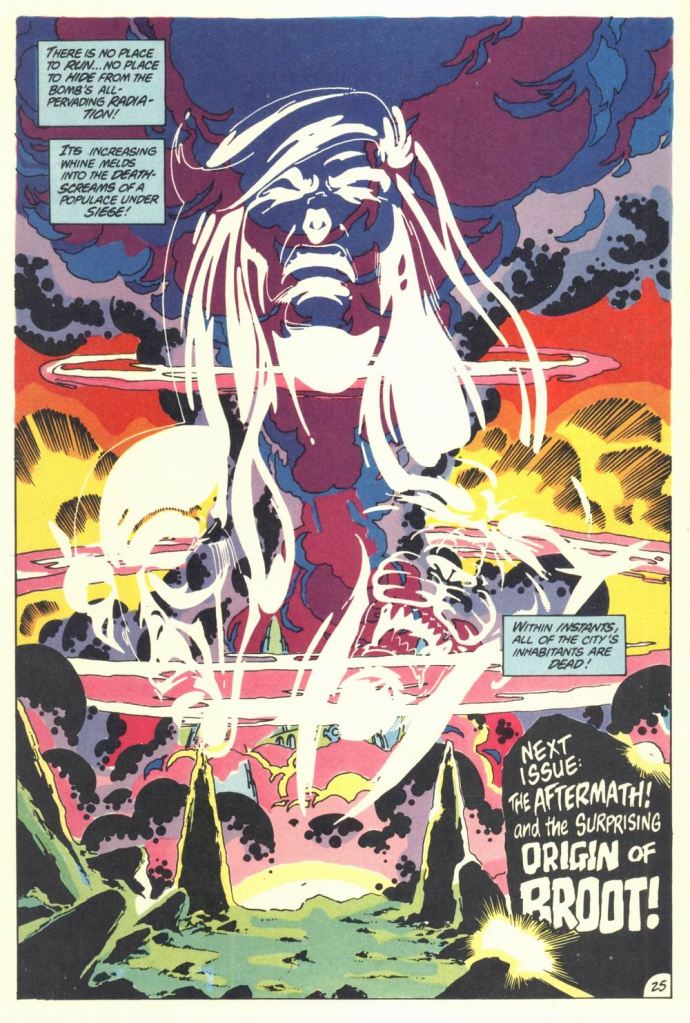
And a terrible price is in fact enacted, as the Citadel decides to nuke-bomb an entire city in retribution for their fallen Gordanian soldiers. That’s the note on which this first issue goes out, with Primus, Broot and the Omega Men realizing that their actions have inadvertently led to the destruction of untold millions. But, hey, war is hell, right? The trick with OMEGA MEN was that it was trying to maintain the illusion of being a super hero series while not really conforming to the conventions of the genre. It was more of a space-war saga, had more in common with something like STAR WARS than any typical super hero book. And that, I think ,is partly what doomed it. I know for myself, I only lasted around four issues or so before I bailed on it, as it wasn’t giving me the kind of reading experience it seemed to have been promising, and I wasn’t all that enamored of what it was actually doing. I didn’t really need or want more blood and more sex in my comics, so those aspects weren’t seen by me as a plus, but rather as a negative. Nevertheless, OMEGA MEN represented another small step forward towards what DC ultimately became in the middle part of the decade.


I was a huge fan of the Roger Slifer OMEGA MEN issues; #1-13. For whatever reason, Slifer left the series after #13 and IMO, the book lost its way. I consider the first seven issues, which is the Citadel War, to be some of the best DC-outer-space focused stories.
LikeLiked by 2 people
Roger Slifer quit because he was making a significantly lower page rate than Mike W. Barr for scripting CAMELOT 3000. The sales, at least for the early issues, were comparable, and Slifer didn’t think it was fair. He went public with the complaint while still on-staff as an editor at DC, and Dick Giordano fired him from the company.
LikeLiked by 4 people
Thanks for the info. I posted below wondering about Slifer’s abrupt exit form this series. I appreciate you answering my question.
LikeLiked by 2 people
This was a book I enjoyed, but not a lot. Enough to keep buying. I was constantly annoyed that Slifer assumes being a pacifist means being a wimp and collaborator, particularly in one story where the star-powered Nimbus refuses to do anything because he can’t hurt people. He has a lot of power. There are ways to oppose the bad guys without violence (Gardner Fox played with that idea more than two decades earlier in “Ray-Gun in the Sky”).
LikeLiked by 4 people
Agreed with you on the criticism of Slifer’s depiction of pacifism.
The best use of a pacifist character I’ve ever seen in comic books was by Larry Hama in G.I. Joe Special Missions #4. The medic Lifeline refuses to carry a gun, but when push came to shove, when attacked the character did defend himself utilized aikido, which Hama described as “a zen martial art with no offensive moves.”
LikeLike
Dove did a fair amount of that in the original Hawk and Dove run.
LikeLike
I was 11 when this came out. No regular access to comics shop. And the “new format” comics weren’t at newsstands or in convenience stores or supermarkets, where I could find some comics. I wouldn’t hear about the Omega Men until their “Who’s Who” entry a few years later. By then, I think Tigorr was the team’s boss. I don’t think I’d heard of Primus until just now. He seems pretty generic, and a hold-over from the 1970’s space stories.
I gotta wonder if Jim Starlin ever weighed in on the book, either with a public opinion or if he ever actually handled any of the characters, just because of his extensive space opera stuff for Marvel (and later their Epic line).
LikeLiked by 1 person
I was in and out of the early issues before I stopped too. I remember when the Omega Men appeared in The New Teen Titans thinking of them as DC’s Inhumans too ( Not in terms of powers but that was just the vibe I got ). I would think that this series would work like the Legion of Super Heroes does( The LSH might be set on Earth of the future, but that Earth is as alien as any in this series ).
LikeLiked by 2 people
I had much the same reaction you did, Tom — the Omega Men, in Marv’s hands, felt very much like the Inhumans to me, and the Slifer/Giffen take on them somehow didn’t. I don’t remember the details, all these years later, but it did feel like STAR WARS…just an unfocused STAR WARS with uninteresting characters.
I liked Marv’s version, and I wanted to like this, but it just did grip me.
I felt like it could have been done better — that where MICRONAUTS had a cohesion and a spark that kept things going (not to mention an even stronger Star Wars influence and regular guest appearances from Marvel stalwarts), and Goodwin’s STAR WARS had the actual characters and masterful writing, OMEGA MEN needed more snap, more personality (for both heroes and villains), and more of a sense of inter-group dynamics, exploring their bonds in addition to their worlds.
I dropped out of the series very early, but read what I’d missed later, when Doug Moench left as writer and Marv left as editor, and new editor Alan Gold was soliciting pitches from possible new writers. As I recall, my pitch kind of tried to turn it into TERRY AND THE PIRATES in space, which I doubt would have worked, but it was the best I could come up with at the speed Alan needs the pitch.
I think the fact that it was so disconnected from the rest of the DC line was a problem, but even within that, I didn’t feel like it had a center, an engine that would drive not just stories but the kind of character drama that would make more readers care and want to see more. But it’s many years since then, and I couldn’t tell you the details with a gun to my head.
That may be my faulty memory, or it may be that the series didn’t have a core that was memorable enough. I couldn’t say.
LikeLiked by 4 people
The comparison to Micronauts is spot on. Arcoyear and Broot are sides of the same coin.
LikeLiked by 1 person
I bought the first issue of this without knowing any of the characters because it was a good looking book… but it didn’t do enough for me to come back for #2. I think I had the same reaction to Starlin’s Dreadstar. Nice art… but the story and characters didn’t do it for me at the get go.
I don’t recall if economics were a factor, but they might have been… the nicer production values are enticing, but don’t add much additional value if the whole package doesn’t knock ones socks off.
LikeLiked by 1 person
Fascinating comments from everyone on a series that never got past a quick scan and pass from me at a comic shop. Since I’d only read one issue of them in the New Teen Titans, my lack of familiarity did not connect them to Marvel’s Inhumans, but it also leads to my point. Whether we’re talking about the Omega Men or Black Bolt’s family, absent a stronger anchor with the known universe, such series seemed doomed to lesser sales and eventual cancellation.
While I also understand the rationale of launching this series into the Direct Market, I also wonder what would have happened had it been a Batman series that was allowed the increased latitude with sex and violence.
LikeLiked by 1 person
When I got serious about comics again in late 1983, this was a title my friends ranted and raved about. So I dutifully bought the back issues and was stunned by the general blandness of it all. Especially appalling/humorous to me was the characters’ names, which just screamed their personas like fingernails down a chalkboard. (I enjoyed tweeking my pals by referring to them by even blander names, such as Leaderman and Cat Person) I remember the stories as being a bit a clichéfest as well, with the characters just working those names like a suit. IIRC I jumped out fairly quickly but was back by Crisis (The money I spent on Crisis crossovers!) I remember really liking Shawn McManus’s art and the new characters but the writing was already on the wall by then.
LikeLiked by 1 person
The names are pretty damn obvious, aren’t they?
LikeLiked by 1 person
I seem to be the only one reading this blog that loved every issue of this title. I mourned when they made Lobo a joke character (even if the costuming was better) and how the cast was cannon fodder in Invasion. The McManus run was my favorite but I was never unhappy after reading any issue.
Oh and wasn’t Barr a bigger draw even then than Slifer? Even if he wasn’t, you’re not owed the same pay as anyone else. It’s a shame he threw away his job complaining publicly. I’m sure he would have been an somewhere else in the line considering what he’d already done.
LikeLiked by 1 person
IIRC Batman & The Outsiders was DC’s second best selling title after New Teen Titans.
LikeLike
I hear ya, and yet: it was so unlike anything that DC was doing with its mainstream ongoing titles at the time that it hooked me, along with too few others, obviously, as something clearly different and therefore intrinsically interesting among its usual monthly offerings. It felt (but wasn’t really) edgy and new, and that appealed to me probably far past its use by date. (To wit: I consider Lobo one of the weakest additions to the canon—is there still a canon?—since Mopee, despite some could use by Stern, Waid, and Peyer.
Anyhoo: it felt like it was trying to stake out new cosmic territory for DC, which hadn’t been a real, ongoing thing, ever, unless you count Adam Strange.
Might have been better and more productive if DC could have lured Jim Starlin to it.
What If?
LikeLiked by 1 person
I started following comic books regularly in 1989, so I missed Omega Men when it first came out. My first exposure to the series was when I bought as a back issue Omega Men #3, the debut of the ultra-violent bounty hunter Lobo, who of course in the early 1990s was red hot. I was pretty confused by the story. However, I then soon after also got Green Lantern #143 at a comic con, and that issue prominently featured the Omega Men, so they started to make a bit more sense.
I ended up picking up the entirety of Roger Slifer’s run on Omega Men, which was the first 13 issues. In the lettercol of #13 he wrote “Because of irreconcilable differences between myself and DC, this will be the last issue of The Omega Men written by me.” No idea what those “irreconcilable differences” were. Has Marv Wolfman, who did stay connected to the characters by editing this series, ever commented Slifer’s departure? I’ve also made a sort of casual attempt to put together the rest of the series’ run. It ended up lasting 38 issues, plus two annuals.
Eventually I got my copy of the first issue s=autographed by Keith Giffen and Mike DeCarlo.
After Slifer passed away in 2015, I put together a two-part retrospective of his Omega Men work on my blog. I enjoyed it for the most part, although there was an element of it that I feel had not aged at all well, namely the graphic sexual assault that was part of the origin of the goddess X’Hal. Here’s a link to the first half…
LikeLike
Another title I passed on when it was published, but the first DC one that Tom’s posted about since I satrted reading his musings. I also have no recollection of them in The New Teen Titans, a title read as soon as each issue came out. Havingjust rad the first two issues, I have to say it really doesn’t interest me. The artwork is good, but I have no contection to any of the characters. It’s obiouvs to me (I have no idea if it would have been obvious to my younger self – I hope so) that the first issue is highlighting the folly of blindly following a religion and the futility of pacifism no matter the cost. I’ll keep the title on my to read list, but I have years worth of DC and Marvel titles ahead of it.
LikeLike
Did not like this title no matter who did it.
LikeLike