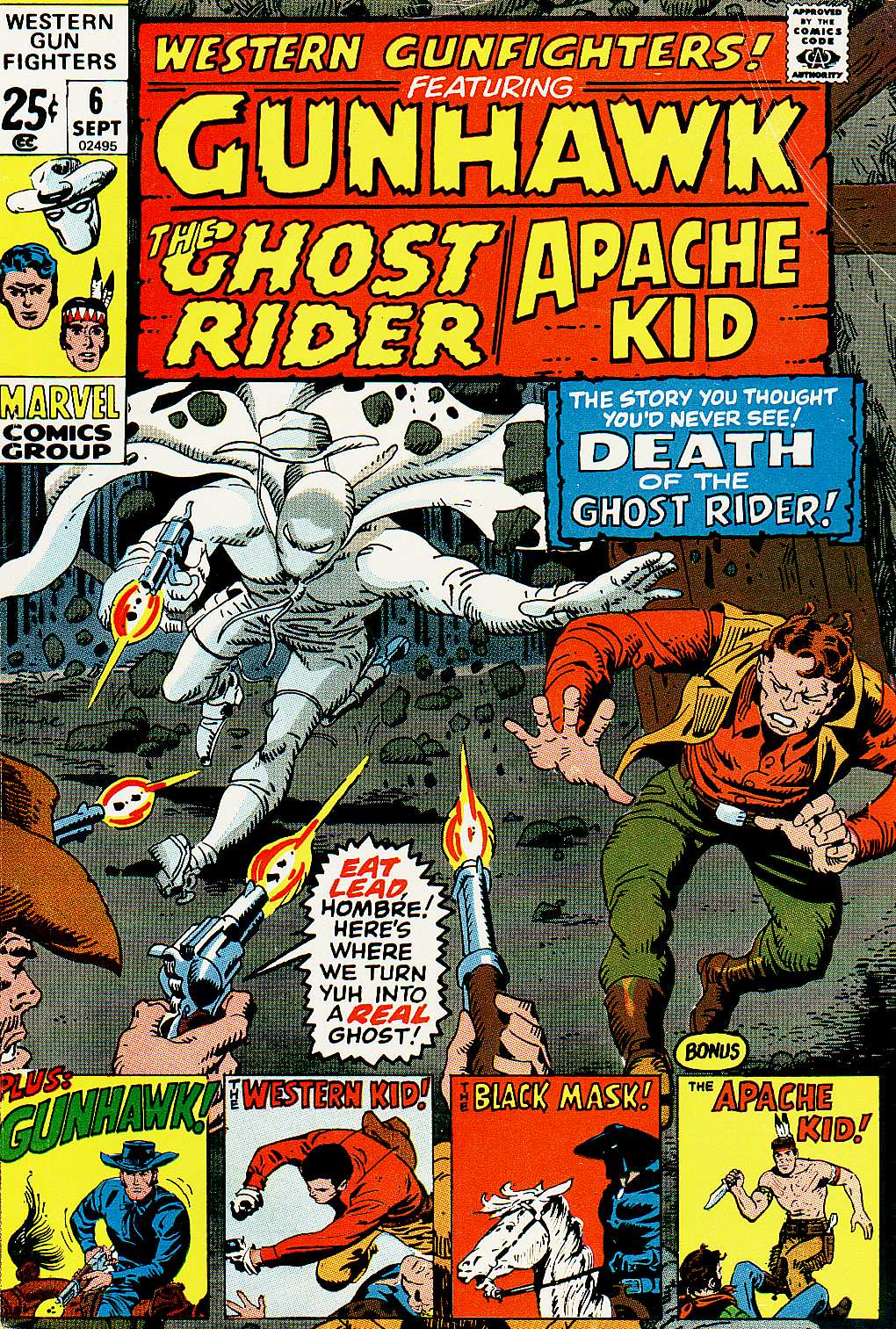


By 1970, the super hero boom in popular culture set off by the arrival of the 1966 BATMAN television program had run its course, causing a significant contraction in the marketplace for super hero titles. This was the period in which long-running and seemingly popular series such as X-MEN, DOOM PATROL, THE ATOM, HAWKMAN and others fell by the wayside. This was nothing new to the major players in the field; they’d all lived through the original Superman fad of boom-then-bust in the pre-War period. And like the postwar era, the hunt was suddenly on for new or resurging genres to tap into–speculating on what the hot new trend might be. This resulted in Marvel expanding back into the realm of supernatural (referred to colloquially as “mystery” title), romance and teen humor strips as well as testing out sword and sorcery as a category. There was also a momentary renewed focus on westerns.
Westerns as a genre had never entirely gone away, but while they had been a dominant force throughout the late 1940s and all through the 1950s, by the 1960s they weren’t so much in favor any longer. Just as the hunger for western programing on television seemed to diminish over the decade, so too did western comic become something of an afterthought. In an attempt to build out a new success in this area (at a time when his distribution deal with Independent News prevented him from launching any further super hero books) Marvel publisher Martin Goodman revived (or, more accurately, purloined) a popular character from the 40s and 50s, the Ghost Rider. The strip was a quasi-super hero titles similar in a way to the Two-Gun Kid (and, indeed, at one point the Kid had battled a villainous knock-off of the Ghost Rider called the Purple Phantom), but as a western, Goodman was able to get the okay to launch the series in its own book. Unfortunately, that book didn’t do enough business and was cancelled in relatively short order.
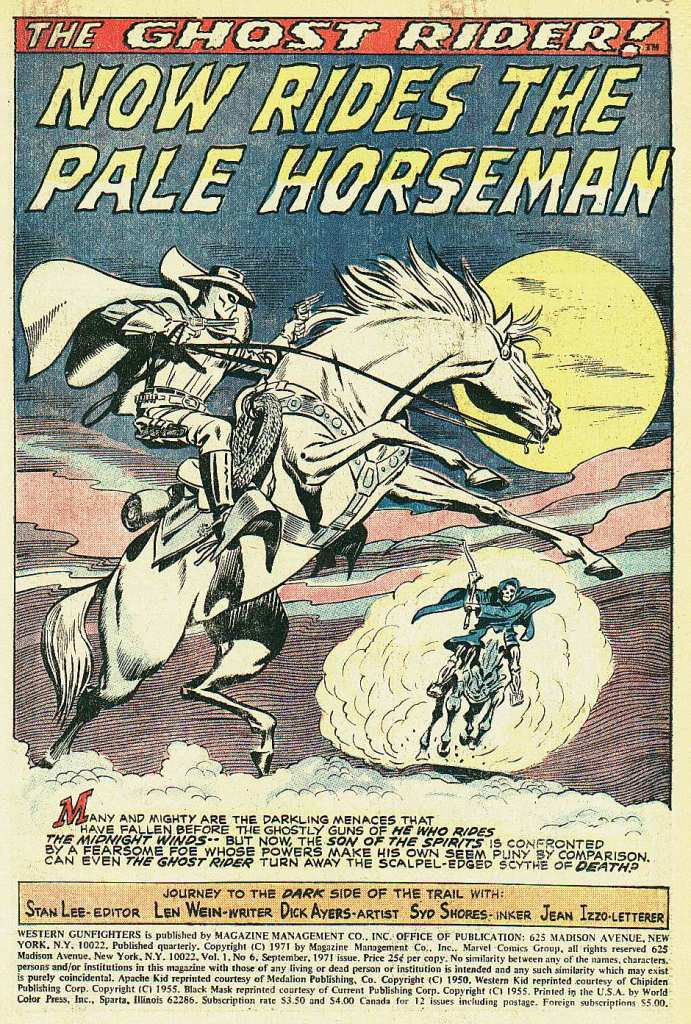
The original Ghost Rider had been originated and worked on by Dick Ayers, who was something of a Marvel mainstay, and he very well may have been the person who suggested bringing the character back. We took a look at the first GHOST RIDER story here:
The 1940s version was an outgrowth of an earlier strip, REX FURY, but for the Marvel incarnation, those past adventures were ignored. The new original Ghost Rider was schoolteacher Carter Slade who used a luminescent white outfit and some basic magician’s conjuring tricks to convince the outlaws he hunted after that he was genuinely a spirit from the afterlife. It was a pretty basic gimmick cowboy series, but not without its charm. And given that the main character wore a full costume, with a Spider-Man-like full face mask that concealed his identity, the notion that it might have drawn in some super hero readers seems to have merit.
But in 1969, director Sam Peckinpah made a splash with his violent and morally-complex film THE WILD BUNCH, which took home the Academy award. Suddenly, it looked as though there might be some life left in the western genre after all, and comic book publishers moved to find a way to take advantage of this new interest. Over at DC, this effort resulted in the creation of one of that company’s most storied characters, Jonah Hex. And at Marvel, it resulted in a bit of experimentation. Since the end of his solo series, the Ghost Rider had been filling pages in WESTERN GUNFIGHTERS, a mostly-reprint title where a few stories started for the aborted GHOST RIDER series wound up seeing print. By this time, young writer Len Wein was at the helm of the series, with the artwork continuing to be the effort of Dick Ayers.
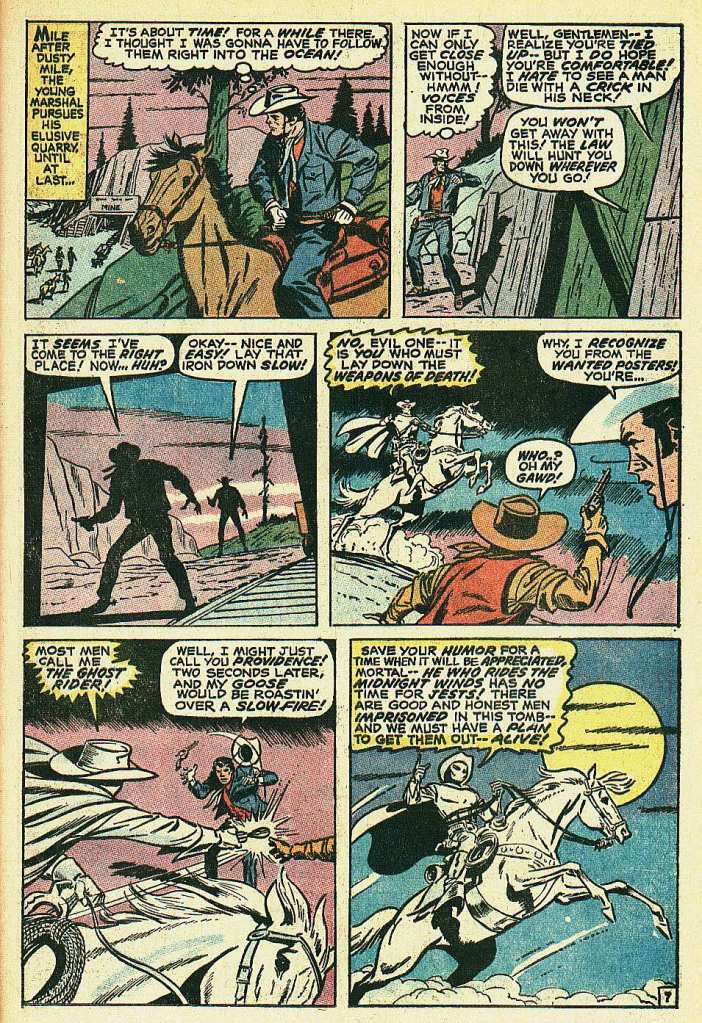
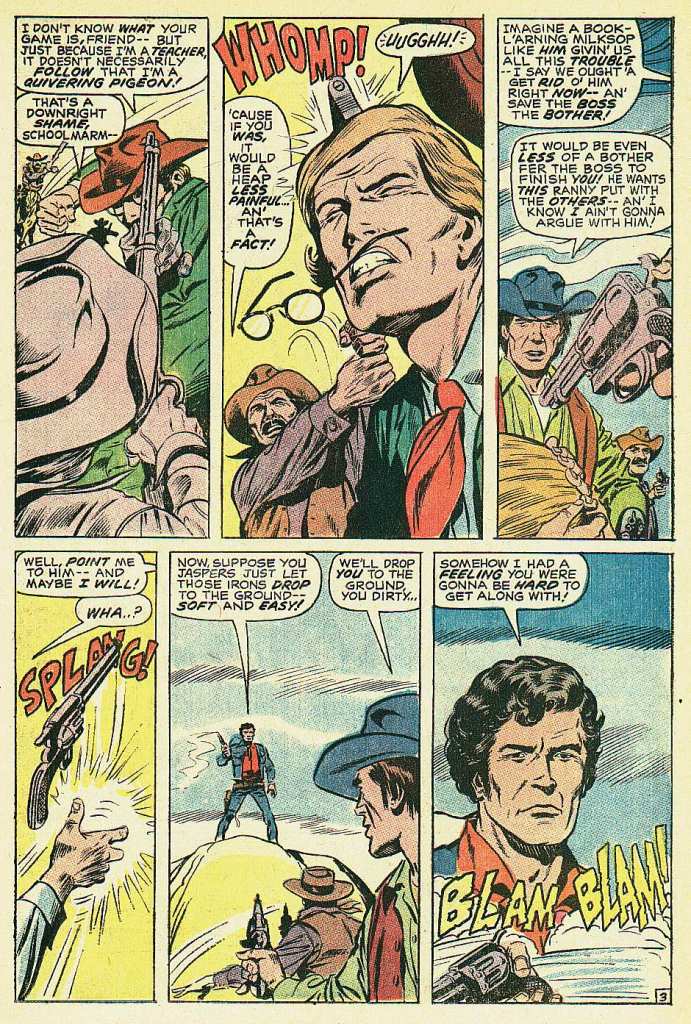
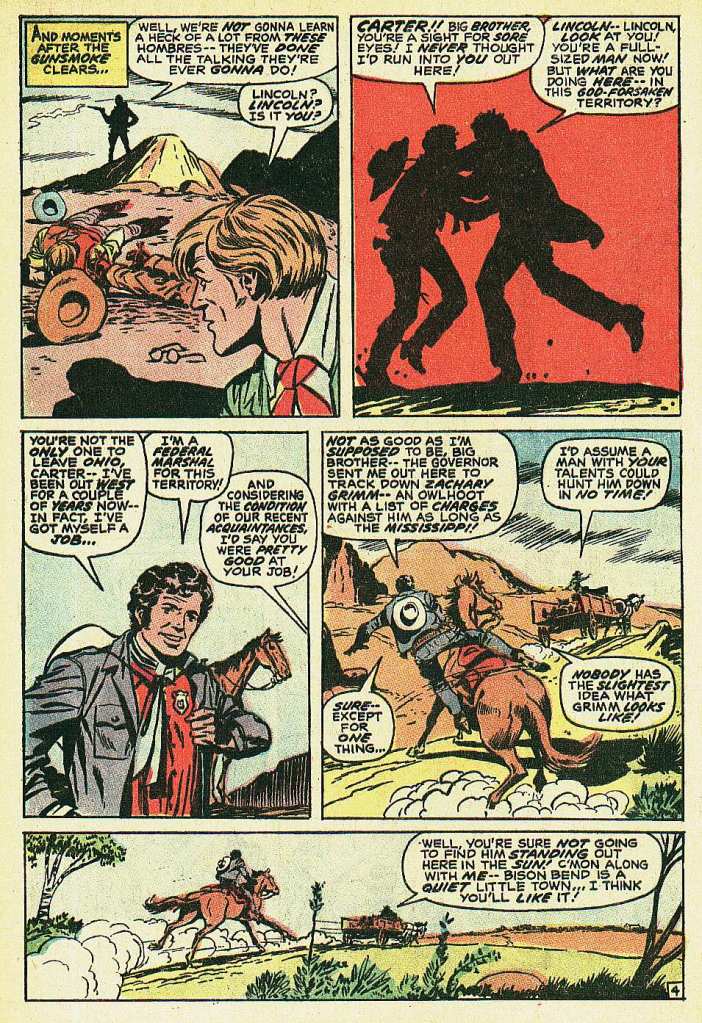
It’s impossible to say at this point whether the idea of retooling the Ghost rider feature was Len’s idea or whether it was an assignment handed to him by Stan Lee or Roy Thomas. But either way, in the sixth issue of WESTERN GUNFIGHTERS, Len went about making some dramatic changes. As the issue opens, the Ghost Rider is returning from an evening’s activities. He becomes Carter Slade again and makes his way back towards town, but he’s set upon by a group of outlaws who are attempting to take over Carter’s hometown of Bison Bend. Carter, though, is saved by the sudden appearance of his younger brother, Lincoln Carter, who is now both fully grown and a United States Marshal with a steely quick gun. If Carter is an old school western hero in the Jimmy Stewart mold, then Lincoln is reflected of the new darker-edged era. Anyway, the two Carter brothers head back into town, where they learn that most of Bison Bend’s leaders have all gone missing. As a Marshal, Lincoln sets out to find out what has happened to them.
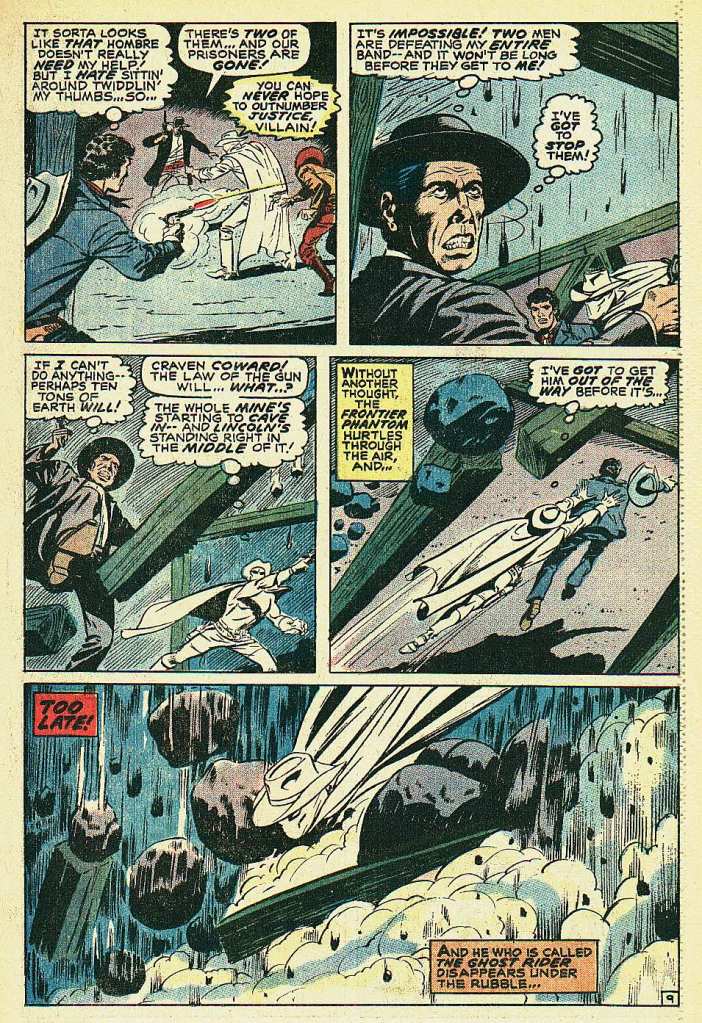
Carter, though, becomes the Ghost Rider and takes up the pursuit as well. Lincoln predicts that the town parson, Reverend Reaper, will be the next target, so he stakes out the Reverend’s place and when men come to take him away, Lincoln follows. The trail leads out to an old mine where the bad guys have the rest of the town leaders imprisoned–and with a name like Reverend Reaper, it’s no great surprise when it turns out that he’s the leader of this gang and behind it all. The Ghost Rider saves Lincoln from ambush, and the two men attempt to save the captive townsfolk, with the Ghost Rider using his usual tricks to pose as a phantom. But with events turning against him, Reverend Reaper kicks out a load-bearing support beam that causes a cave-in. The Ghost Rider pushes Lincoln to safety, but he himself is caught in the collapse and buried by it.
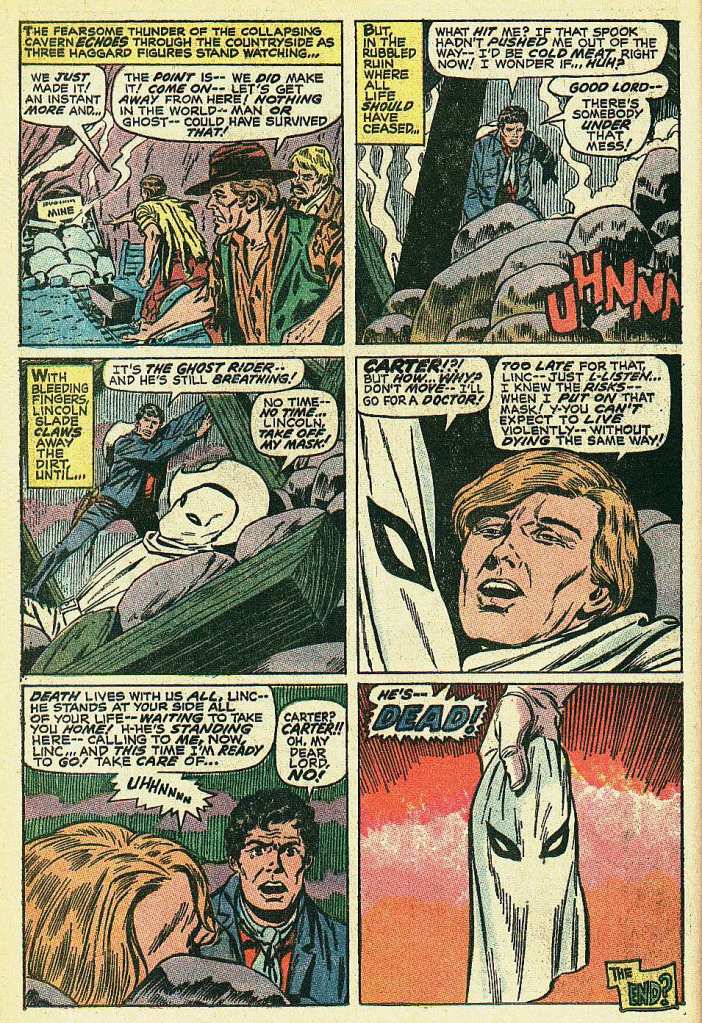
In the aftermath, the town leaders have been saved, as has Lincoln, but the Ghost Rider is finished. Lincoln approaches him and unmasks him as his brother Carter, and is witness to his final words. And that’s where the story ends, with simply a THE END? to mark its finish. I wouldn’t be at all surprised if there were readers that thought this was the end of the story, especially considering that WESTERN GUNFIGHTERS was being published quarterly. That said, the continuation is relatively obvious even from just this chapter. It’s clear that Lincoln is going to be the one to take up his brother’s mantle as the Ghost Rider, and that there’s going to be a showdown to come with Zachary Grimm, the mysterious outlaw whom Lincoln had been pursuing. But that wouldn’t be picked up upon for another three months yet. All told, it’s a pretty inconsequential final adventure for Carter Slade, and yet one that carried just a little hair of realism to it. As Carter himself says, one can’t expect to live violently without dying the same way.

