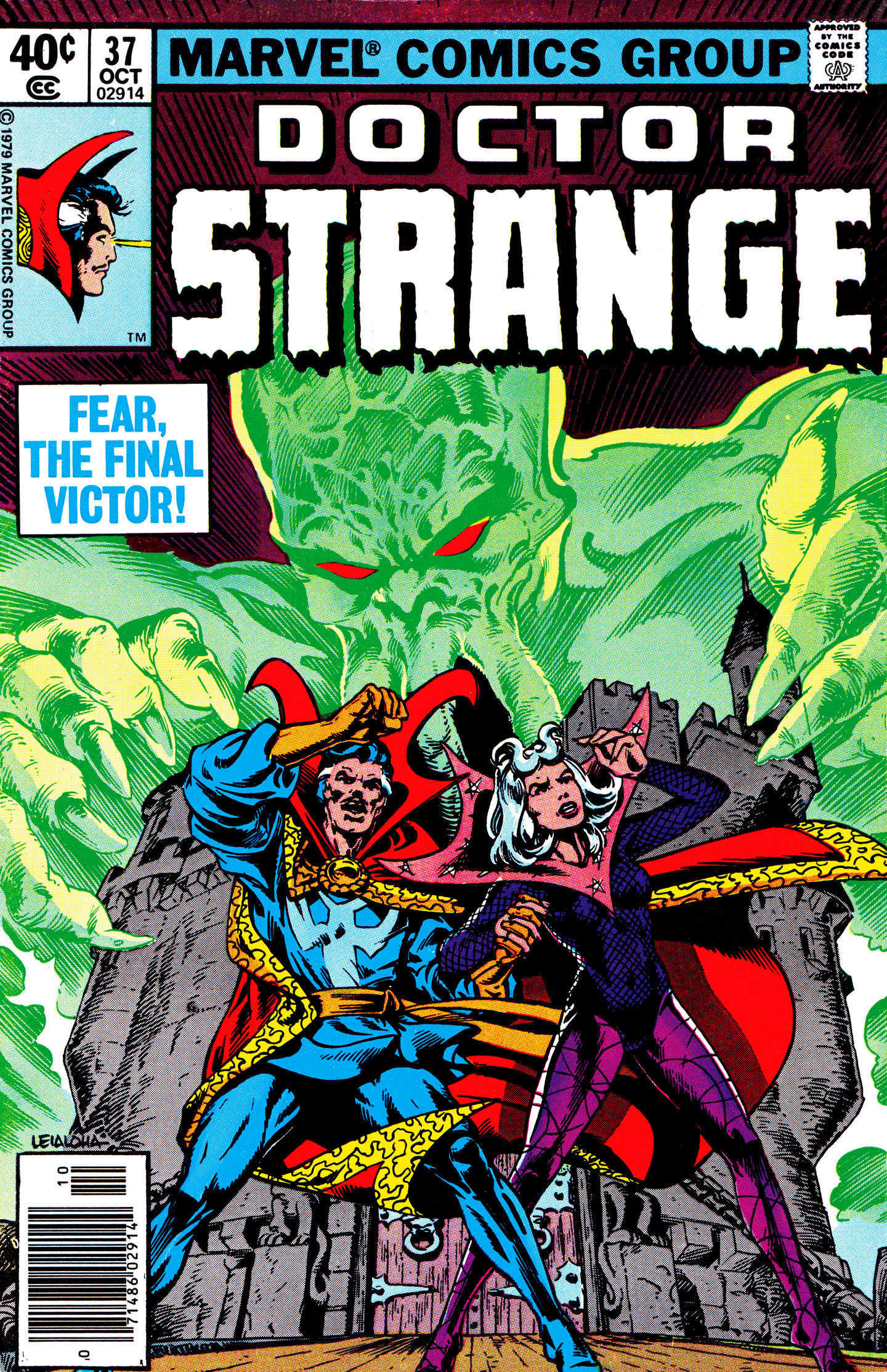


So I wasn’t really a huge fan of DOCTOR STRANGE in the 1970s, but that didn’t stop me from picking up the series more often than not. Much of that was due to the fact that I had found that really liked the early original Stan Lee and Steve Ditko Doctor Strange stories, and the other part was that it was a Marvel super hero book and I had been programmed to think that all such books were important to one another. DOCTOR STRANGE typically got picked up when I happened to have some extra pocket change that particular week, but it happened with relative regularity. I’d skip an issue or two here or there, then get drawn back in for no particular reason apart from the fact that the book was available and I had the resources to purchase it.
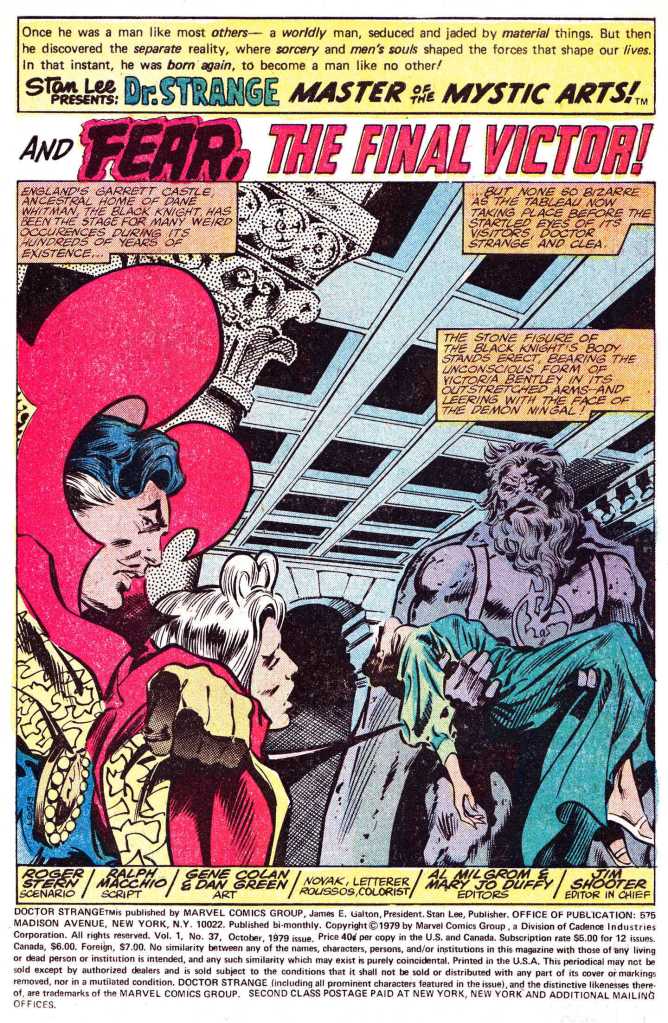
And the truth is, for much of this period, the series was floating, rotating between different short-term creative teams and lacking in a clear vision or direction. Ever since Steve Englehart had dropped off, the book had been doing riffs on the sorts of stories that he had done, but to diminishing returns. Eventually, the plotter of this issue, Roger Stern, alongside artist Marshall Rogers and later Paul Smith, would breathe some new life into the series. Roger had a good handle on the character, but as he wound up just filling in here (and with the finished dialogue being prepared by Ralph Macchio, himself a great Doctor Strange fan) he wasn’t yet in a position to make a meaningful impact on the book.
The story here is the second part of an adventure that began in the prior issue, one that brought back an obscure character from a one-off mystery story, Murdoch Adams. This kind of things was very much de rigeur at the time, and helped to give the impression that the Marvel Universe was a broad tapestry in which even a throwaway story might hold hidden relevance. My guess is that Roger just liked that story and saw something in it that he might be able to tap into. At the close of the preceding issue, Ningal, a demonic entity that had been set upon Doctor Strange by the mysterious Dweller In Darkness had inhabited the petrified body of the Black Knight to continue his campaign against the Sorcerer Supreme. If that sounds complicated to you, rest assured that it was. There were a whole lot of callbacks to other stories in this two-parter, perhaps attempting to conceal the fact that there really wasn’t much to it apart from those references.
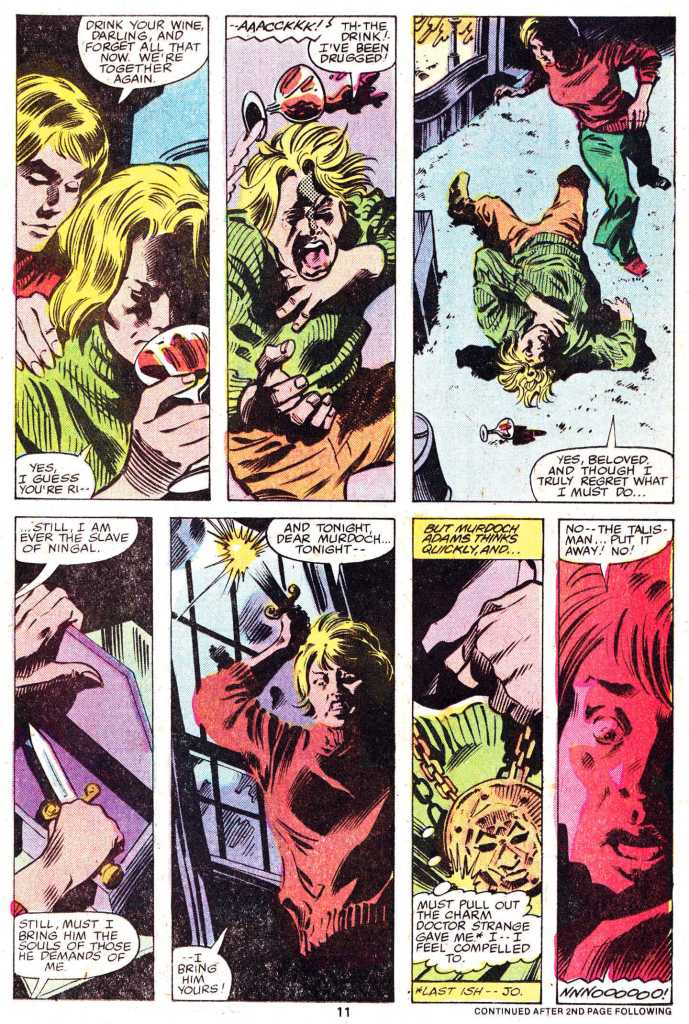
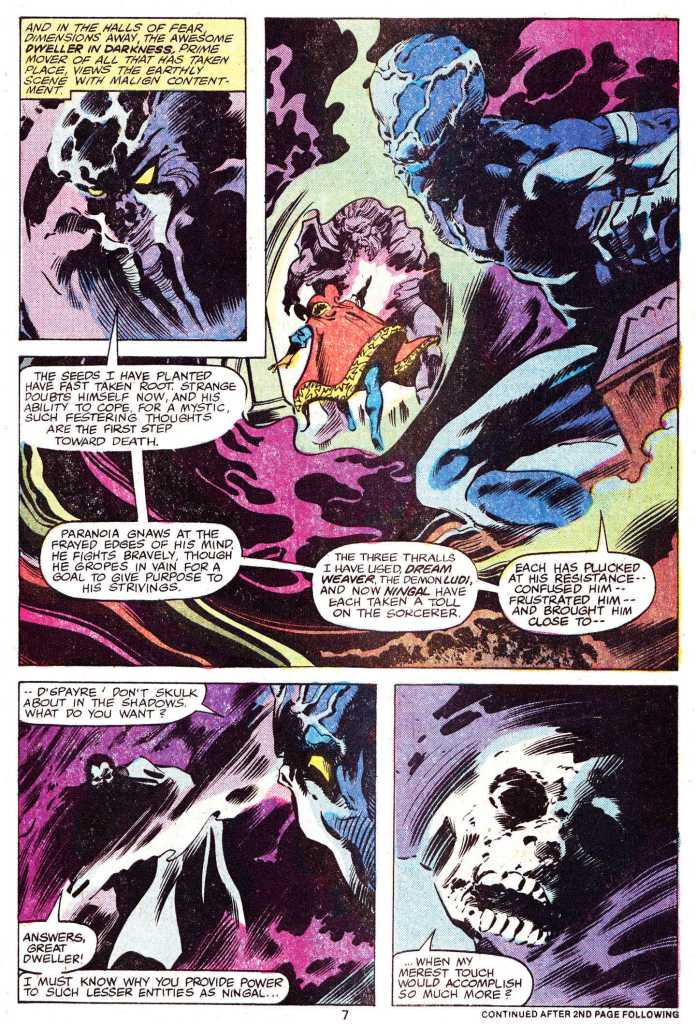
So as the issue opens, Strange and Clea are confronting Ningal in the Knight’s body, who has already lain low their host, Victoria Bentley. Strange makes the first move, blowing the Knight’s body to pieces with a spell of elemental dissolution. But Ningal is able to reconstitute his form with his own sorcery, and he catches Strange by surprise, forcing the sorcerer to erect a hastily-conjured barrier to protect himself and his friends. From afar, the Dweller In Darkness observes these events, and he is visited by D’Spayre–who is really there to allow the Dweller to explain his plans out loud. Elsewhere, Murdock Adams is enjoying an evening with his lover Marcia Trent. But Trent, it turns out, has been turned by the Dweller, and she attempts to poison and kill Adams. Adams is able to save himself by pulling out an amulet given to him by Doctor Strange previously, but Marcia perishes–though with her dying breath, she tells Adams that she’s at last free of the Dweller’s influence. Small comfort, that.
Meanwhile, Ningal has been pressing his attack upon Strange, while Clea stands around and helpfully does nothing, which seems odd to me. Victoria Bentley finds it a bit odd, too, but when she urges Clea to help Strange, Clea mystically gags her–Clea has felt jealous about the attention Victoria has been showing Strange since the start of this storyline, but this feels like a wild overreaction. It might make sense were Clea possessed like Marcia had been, but I have no recollection of that being the case. Anyway, women aren’t served very well in this issue is the point.
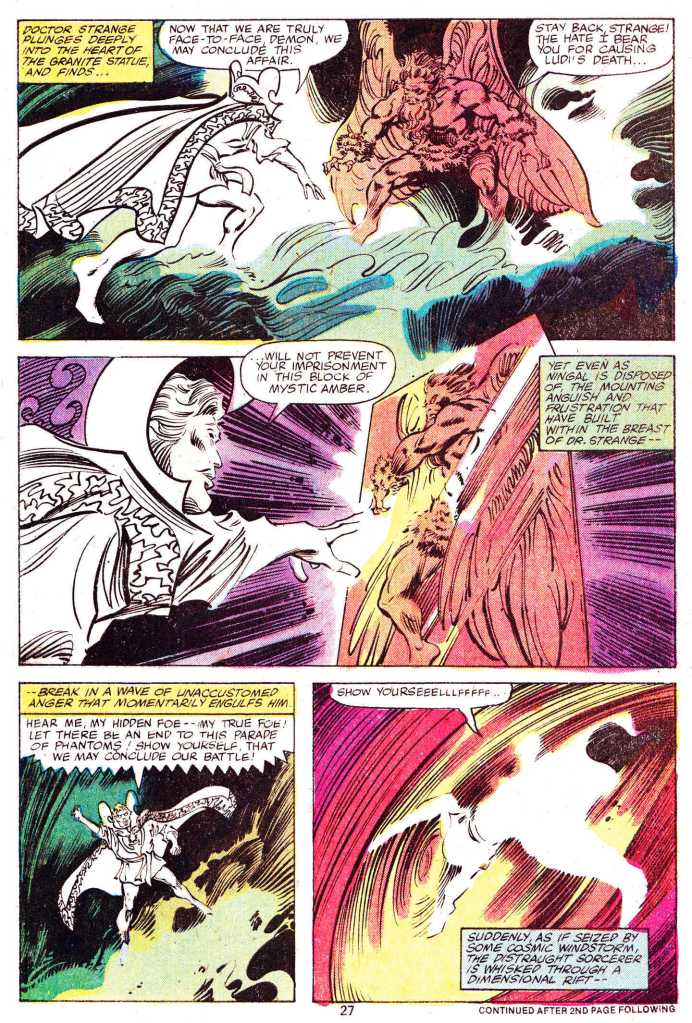
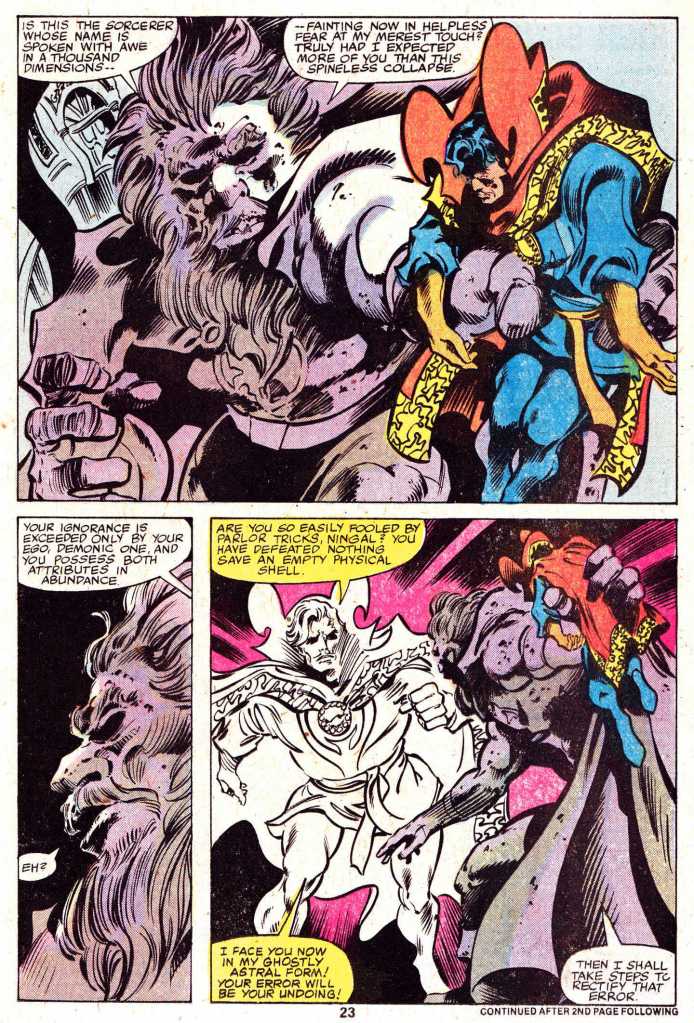
As the fight rages on, Strange chooses to escape his physical body and attack in his astral form–which also seems like a weird choice given that Ningal is holding Strange’s physical body in a gigantic stone hand. But the demon doesn’t crush Strange, leaving his astral self no place to return to. Instead, the two duke it out directly, with Strange winning the day by striking Ningal with the All-Consuming Maestrom of Madness. But Ningal won’t disclose who put him up to this attack–Strange has sensed that there was a hand here beyond Ningal’s, so he sends his astral self into Ningal’s body, attempting to ferret out the true culprit. But before he can do so, his astral form is forced through a dimensional rift back to the real world. With Ningal finished, the Black Knight’s stony body crumbles into dust, taking care of that ling-lingering loose end.
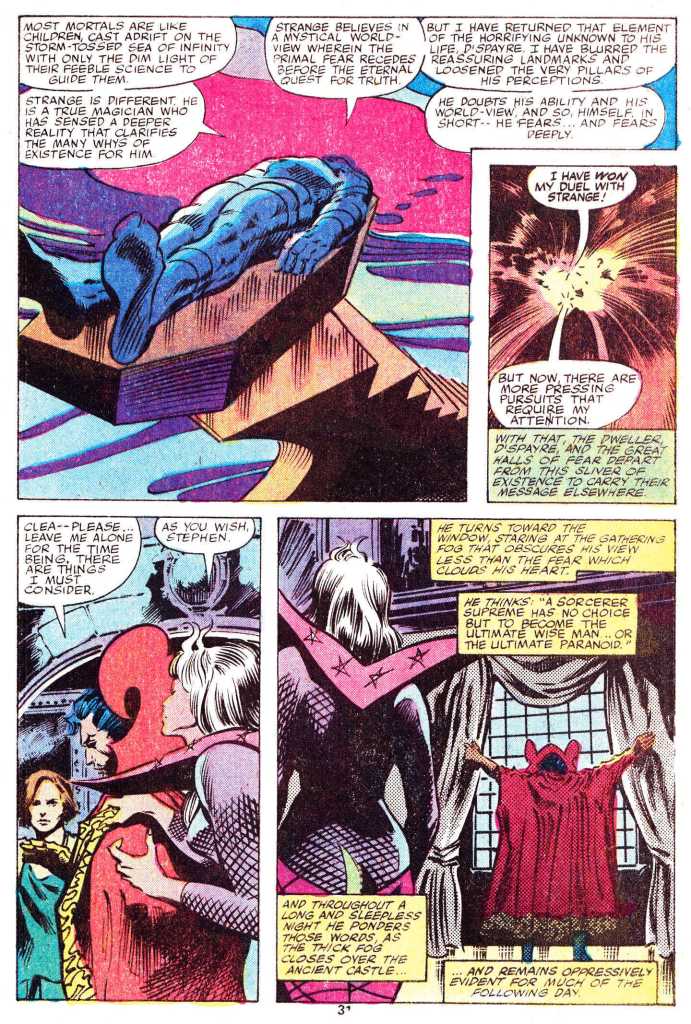
As the issue wraps up, the Dweller In Darkness tells D’Spayre that he’s won his duel with Doctor Strange and gotten out of it what he wanted, even though that doesn’t seem on the surface of things to be what we just witnessed. But the Dweller reveals that his assorted attacks have been intended to reawaken the element of the horrifying unknown in Strange’s mind. Having done so, Strange will not be able to make a move against the Dweller. And then the Dweller takes off. It was resolutions such as this one that frustrated me about DOCTOR STRANGE. After a bunch of issues, it was as though the characters (or the creators) had grown bored with the story they were telling, and thus ended it with some off-handed hand-waving. And that hand-waving counted as an L for the lead hero. (There’s clearly a bit of relettering at work on the last page, which makes me wonder if the climax may have been changed by the editors in some fashion. ) So I found the entire thing very unsatisfying. Enough so that this was the last issue of the title that I picked up for the next few months.

