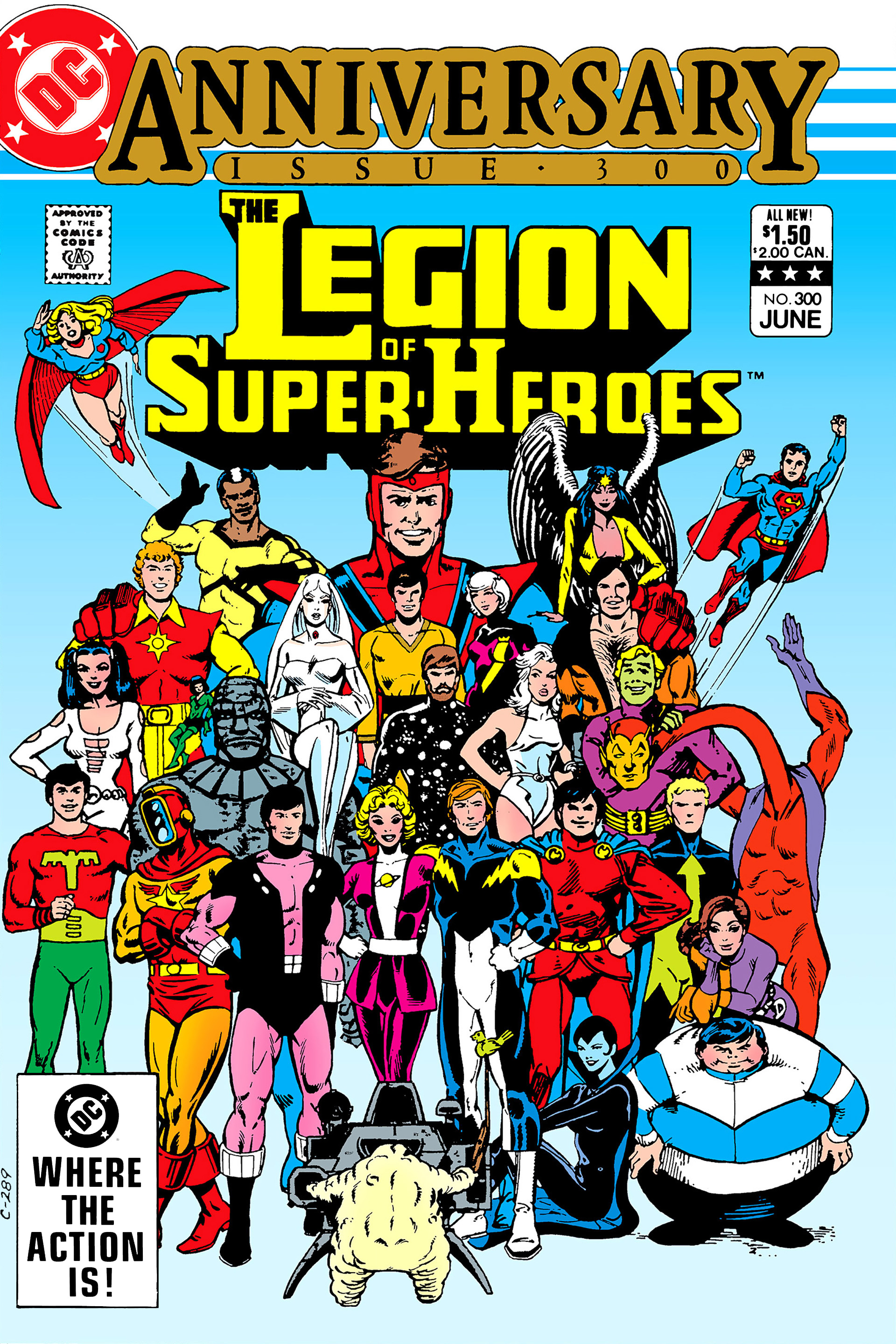


The anniversary centennial issue had really come into its own at this point, and both Marvel but especially DC had become adept at making such occasions truly memorable. So LEGION OF SUPER-HEROES #300 was a triumphant celebration of the history of the series going all the way back to its beginnings while at the same time unshackling it from a past story decision that had curtailed some of its potential possibilities. It was also a powerhouse jam issue featuring creators past and present, and while it wasn’t quite up to the never-equaled standards of SUPERMAN #400, it got itself into the ballpark at least. The cover above, for example, is a massive jam piece with a different artistic team illustrating each of the 34 Legionnaires depicted on it. In fact, puzzling out who did what became a contest on the book’s letters page.
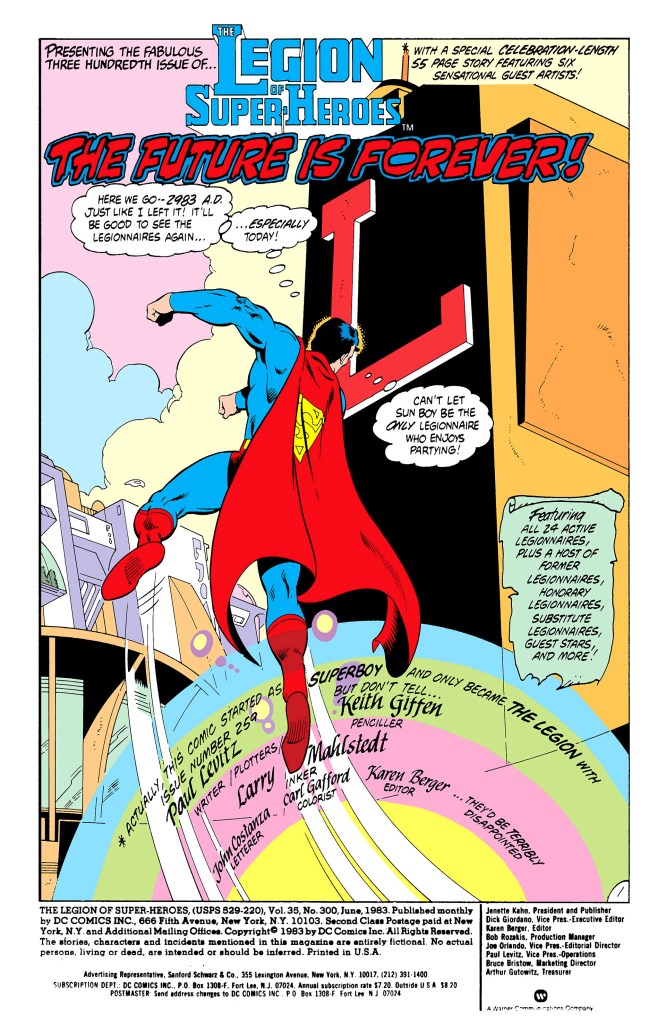
In recent months, the powerhouse creative team of writer Paul Levitz and artist (and often co-plotter) Keith Giffen had brought the series to perhaps its greatest levels of popularity. “The Great Darkness Saga” in which the heroes had done battle with the still-living 30th Century incarnation of Darkseid helped to put that villain back on the canvas as a major threat within the DC Universe. It also made the book a favorite with new fans who were coming to it for the first time, drawn in by Giffen’s sharp futuristic visuals and captivated by Levitz’s strong plots and characterization. It was a book that was firing on all cylinders as #300 beckoned. And so, Levitz decided for the occasion to tackle the Adult Legion stories, which had laid out future fates for many of the members of the cast, and which writers since their time of publication had been holding to.
It’s probably worth me explaining what the Adult Legion stories were for those who are unfamiliar. Legion of Super-Heroes grew out of the Superboy strip: they were initially a team of teen heroes from the future who came back in time to recruit the Boy of Steel, who had been their inspiration, to join their ranks. So the typical Legion story had Superboy breaking the time barrier and venturing to the 30th Century to hang out with his buddies and battle future threats. At a certain point, editor Mort Weisinger and writer Jim Shooter produced a pair of stories in which a grown-up Superman went to the 30th Century and teamed up with the adult versions of his old friends to battle the Legion of Super-Villains and their pawn, the brother of recently-deceased Legion member Ferro Lad, who possessed similar powers to those of his sibling. Those stories were cool because they revealed who had died, who got married, who had retired, and what else had become of the Legionnaires over those years. It also introduced a bunch of characters in the Legion’s Hall of the Dead who hadn’t been introduced yet in the present. This included Shadow Lass, who was supposedly fated to die defending the Science Asteroid Talok VIII. Up to this point in the series, the writers who followed Shooter held to the fates he’d laid out in those stories. But Levitz didn’t want to kill off Shadow Lass, who was an important player in the series.
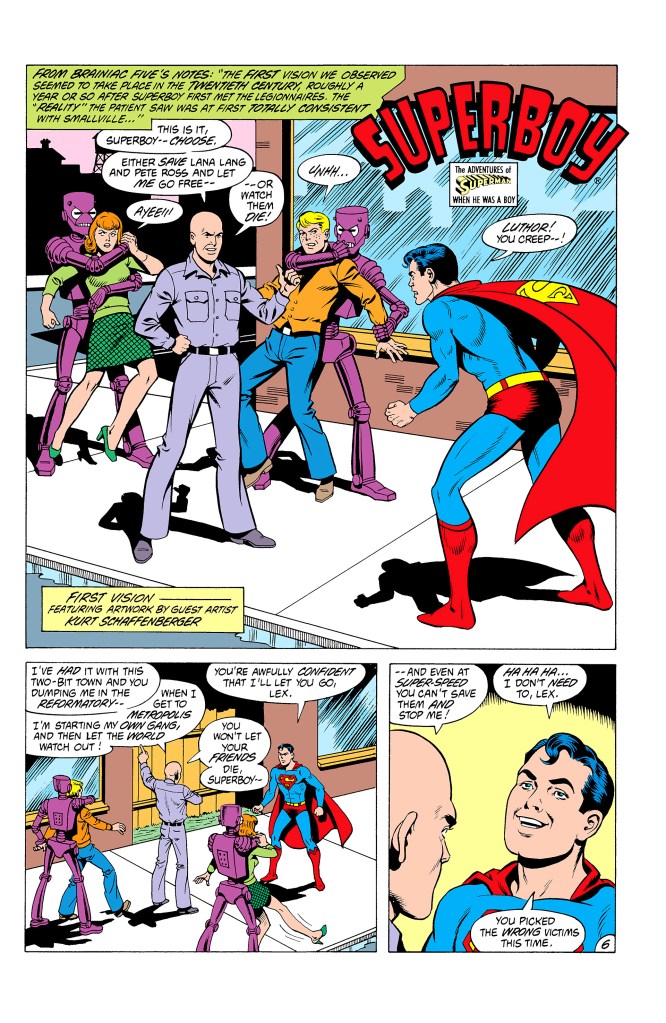
So as this issue opens, the Legionnaires are all assembling at their headquarters for a celebration of the anniversary of the Legion’s founding. However, Brainiac 5 has been called away to the Time Institute to consult on the condition of a very special patient there. Honorary Legionnaire Rond Vidar has been looking after the patient, whose condition allows him to see into other worlds, other timelines, gradually driving him mad. Now, the Time Institute has developed the technology to let them see what the patient sees, and the hope is that this will permit them to cure his condition. What it also does is to let Levitz and a series of guest-star artists produce chapters in the styles of the major Legion of Super-Heroes eras of the past. The first is illustrated by Kurt Schaffenberger and is set up like a typical Superboy tale in which the Legion members help out the young hero. But at the end of the adventure, Superboy announces that the time has come for him to resign from the Legion, as he’s off to Metropolis to become Superman. It isn’t the way things happened historically, it’s more of a might-have-been version, an alternate history that the patient taps into.
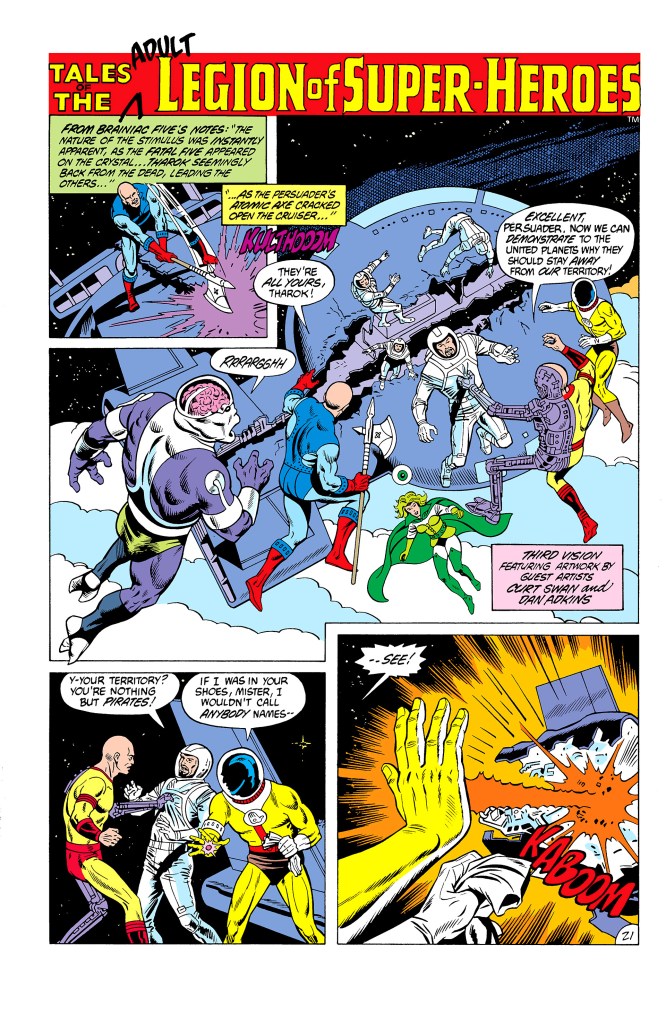
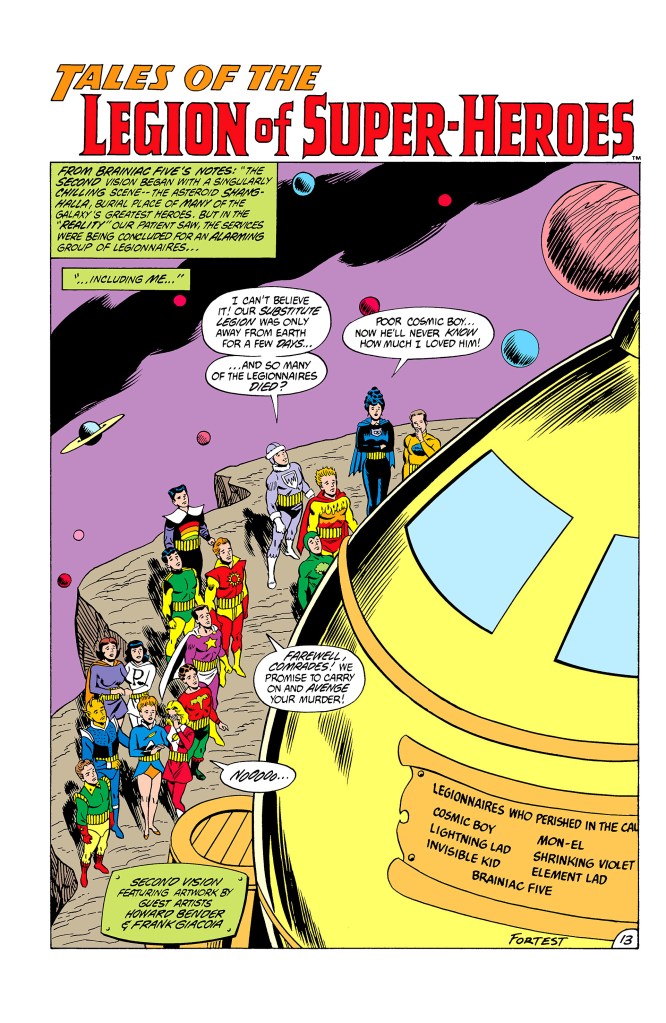
Howard Bender illustrates the next chapter, channeling the style and the spirit of early Legion artist John Forte. In this timeline, Computo the mad thinking machine isn’t defeated by the Legion, and he teams up with the Legion of Super-Villains and winds up killing off a swath of the Legionnaires as well as members of the Legion of Substitute Heroes. It’s quite a bloodbath for a strip that’s drawn so clinically. Elsewhere, on Talok VIII, Shadow Lass is modeling a costume and body-makeup that makes her resemble the version of herself that is fated to die. And it seems as though this prophesy will come true, as the Science Asteroid is attacked by a humanoid starship piloted by the warlike Khunds. Back at the Time Institute, Cur Swan illustrates the next chapter, which is a follow-up to the original Adult Legion stories he worked on decades earlier. In this one, the team battles the Fatal Five, after which Sun Man stops in the Legion’s Hall of the Dead before the statue of Ferro Lad, who gave his life to stop the Sun-Eater during the team’s first encounter with the Fatal Five. We learn that Ferro Lad’s brother has been in a mental institution ever since the aftermath of those original stories. We also get another glimpse of Shadow Woman’s statue in the same hall in this chapter as well.
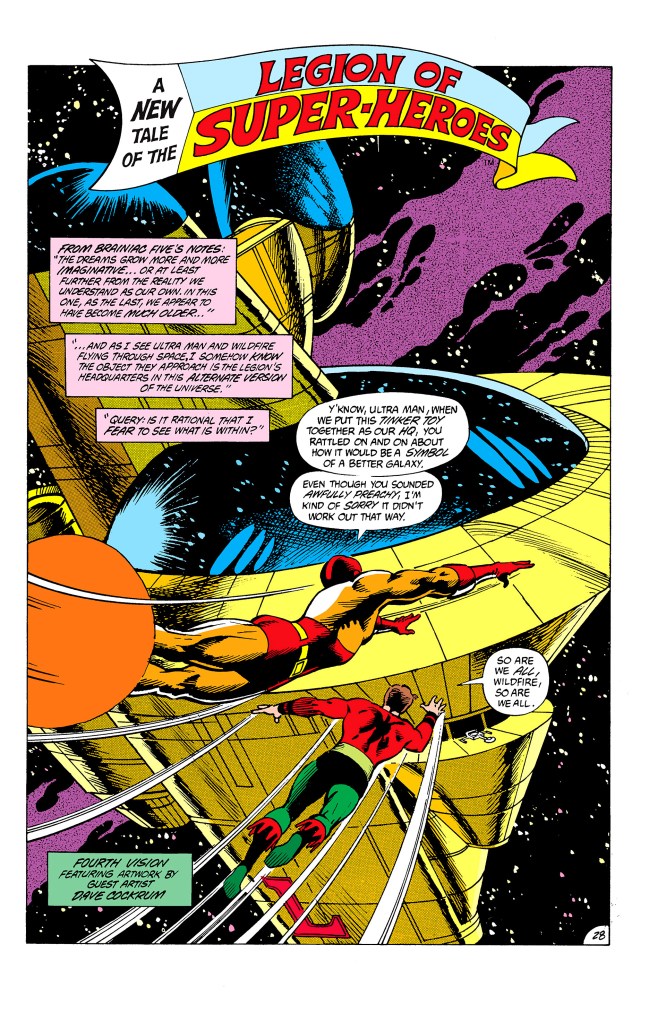
Dave Cockrum, the artist who modernized the Legion back in the 1970s and helped to bring them out of limbo and back into prominence illustrates the next chapter, which reflects his tenure on the series. It’s another Adult Legion story, one in which the Legion is forced to set aside its previous Code against Killing as the United Planets are at war with the Khunds. Superboy refuses to compromise his ethics and takes his leave, but the other Legionnaires fight on the front lines, and gradually become more bloodthirsty as a result of the tension, their former ideals cast aside by the needs of the moment. Star Man and Dream Woman, who have been retired from active duty, lament the loss of the Legion’s values. Back in reality, Shadow Lass and Mon-El engage the Khund warship, but the battle goes poorly and the Science Asteroid is damaged.
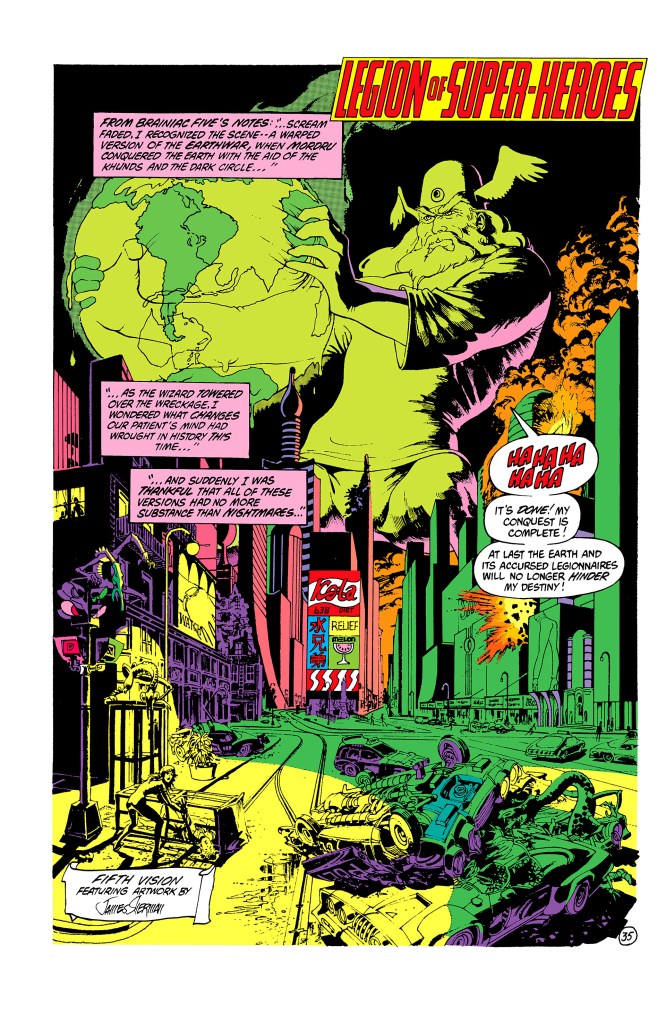
This structure continues to play out further as James Sherman, an artist who was only on LEGION for a short time but whose artwork was remembered as something of a high water mark returns for the next chapter, which hearkens back to that era. In it, the evil sorcerer Mordru has won the Earthwar, and the remnants of the Legion are on the run and overwhelmed. But members of the resistance organized around Dream Girl’s sister the White Witch cast a spell that destroys all magic, leaving Mordru powerless but only at the cost of several heroes’ lives. After a brief break in the present in which Brainaic 5 laments ever having created the Time Beacon that allows them to look through the past, the patient’s dreams start up again, and he and Rond return to monitor them.
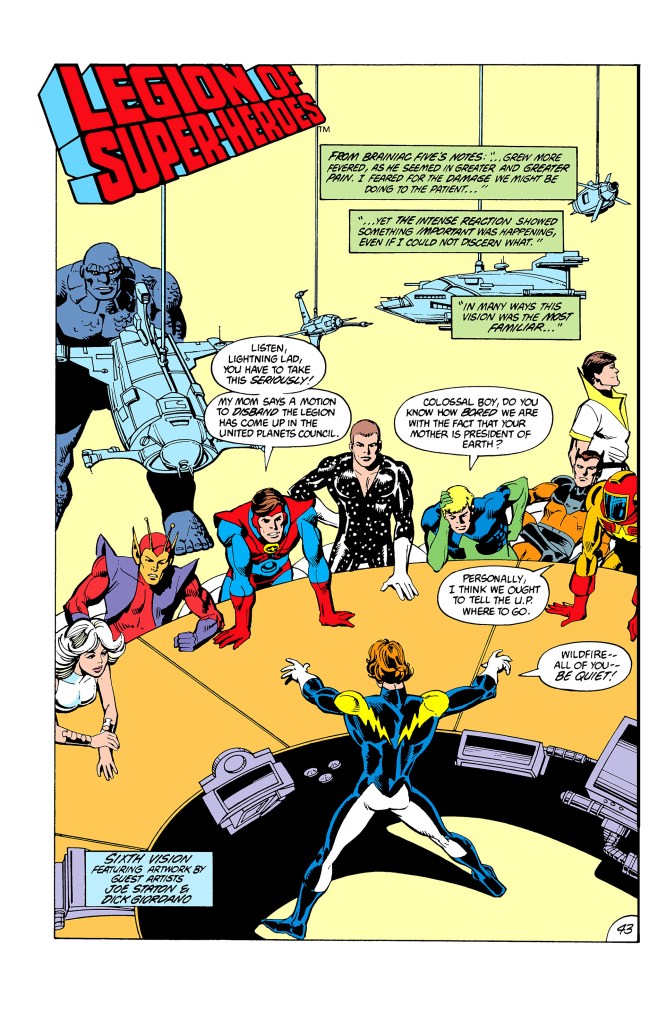
The final flashback chapter is illustrated by Joe Staton and is reflective of the relatively near past of the series. In this one, internal strife has the Legion members snapping at one another, allowing Blok, who had joined the Legion as an underling of the evil Dark Man, to plant an explosive inside their headquarters that destroys the Legion completely. And somehow, this is what gives Brainiac 5 the key to puzzling out what the patient is looking for. The story reveals that the patient is the present day version of Ferro Lad’s brother Douglas, who shared a twin’s connection with his brother as well as his powers, and who had been traumatized by his sibling’s death. He’s been seeking out another universe in which he could survive, and Brainiac 5 helps him to find one–a world in which Douglas succeeds his brother Andrew as Ferro Lad following Andrew’s heroic sacrifice. The real Douglas disappears, vanishing into this other world, his trauma lifted.
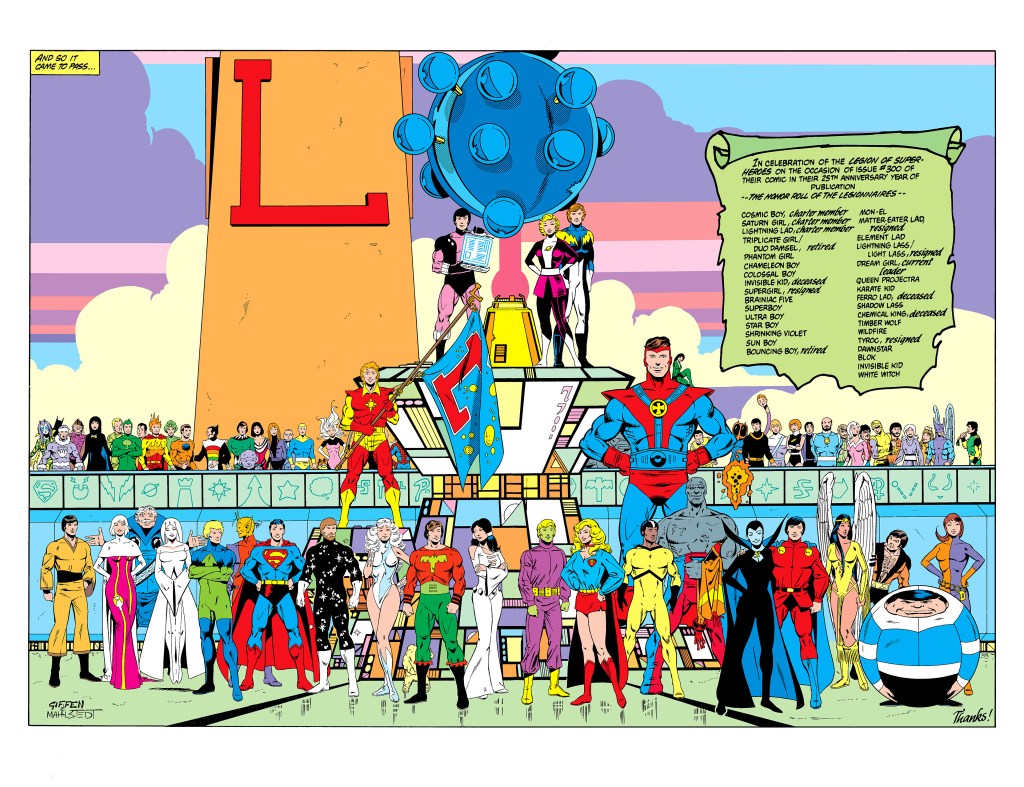
Which leaves just one aspect of the story to be resolved. At Talok VII, Shadow Lass ventures into the Science Asteroid in an attempt to shut down its now damaged and out of control reactor before it can detonate. But at a key moment, it looks like Shadow Lass is incinerated in the detonation of the asteroid–but this turns out to be a feint, and a page later we learn that Mon-El had thrown the generator at the Khund ship before it exploded, saving Shadow Lass and destroying the attackers. So now the events predicted in the Adult Legion stories are considered non-canonical, visions of an alternate timeline that don’t necessarily hold any bearing on what happens in the main DC Universe.

