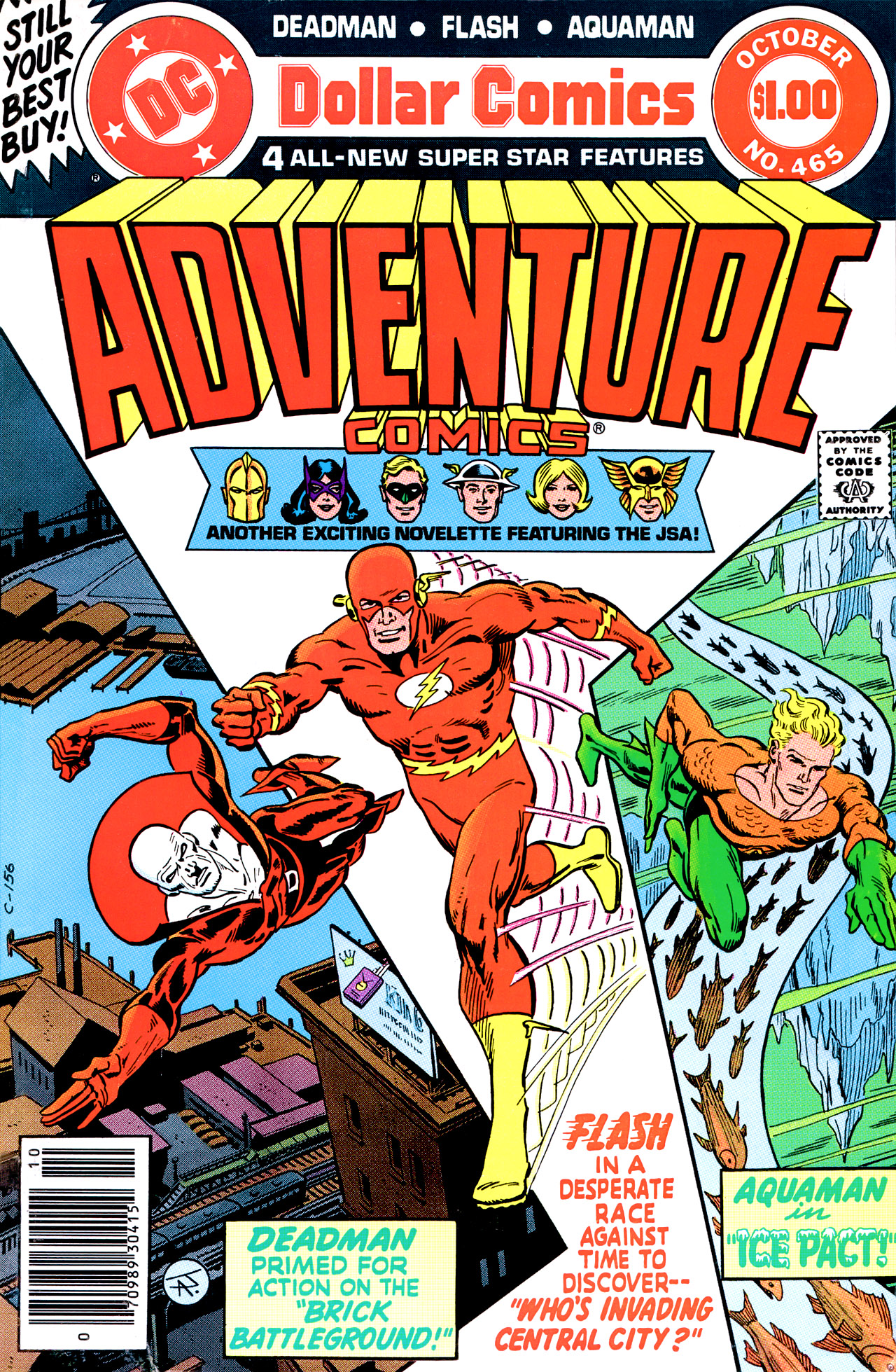


The one real immediate benefit of finding my new Stationery Store source for new comic book purchases is that suddenly all of the thicker books that my 7-11 had quietly stopped carrying at some point in the past were now readily available to me. Case in point: ADVENTURE COMICS. I would have been interested in sampling the series ever since it moved into the Dollar Comic format given the strips that it was headlining. But I never saw a copy of the Dollar Comic ADVENTURE COMICS before this issue showed up at the Stationery Store. By this point, page count reductions were already beginning to have an effect, and the book’s five features had been reduced to four. But given that two of those features were the Flash and the Justice Society of America, I was definitely going to purchase this issue once I saw it.
For whatever reason, ADVENTURE COMICS had a tougher time attracting an audience than the other stories anthologies such as ACTION or DETECTIVE. And that really boils down to it not being able to field a star character on the level of a Superman or a Batman. Superboy had anchored the title throughout much of the 1940s, 50s and 60s (with the Legion of Super-Heroes buoying his position there towards the end) and thereafter Supergirl took over the lead spot. But after she moved into her own short-lived series, ADVENTURE couldn’t quite land on a headline act that brought readers in consistently–the Spectre, Aquaman, and a return engagement for Superboy hadn’t done the trick. And the Dollar Comic assortment approach wouldn’t either–only two issues after this, the book would return to being a regular-sized comic, with Starman and Plastic Man as the split-book leads. The Dollar Comic approach worked on me but apparently there weren’t enough other like-minded readers to keep it afloat in this format long-term.
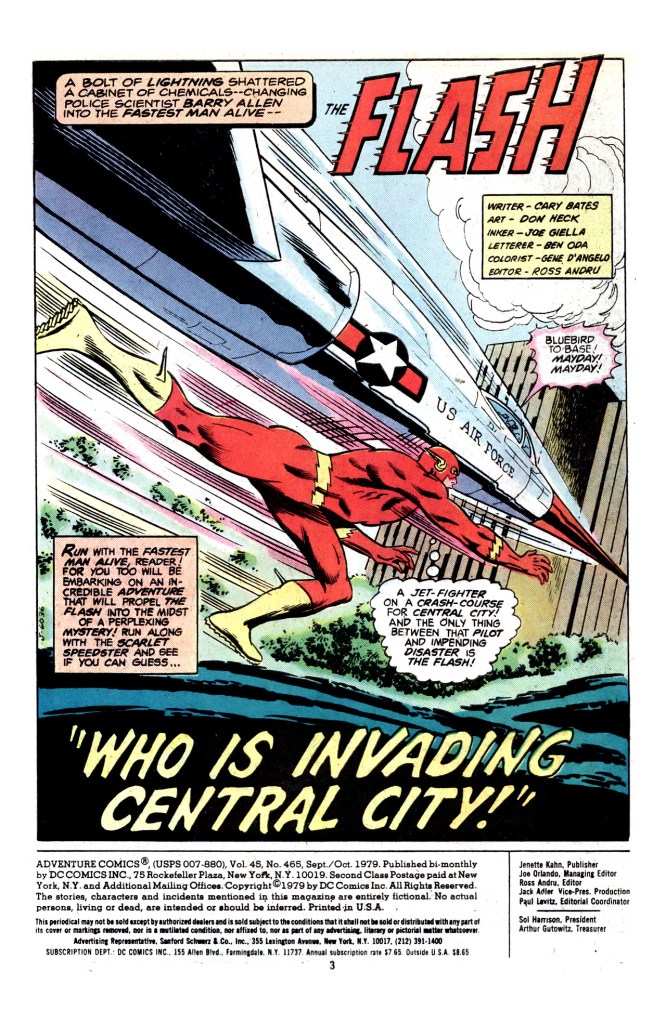
The book opens with a short stand-alone adventure of the Flash, written by the Scarlet Speedster’s regular scribe Cary Bates and illustrated by veteran Don Heck. Heck would soon rotate onto the Flash’s ongoing series as the regular artist, replacing the green Alex Saviuk in those pages. The story’s a trifle, suggesting the sort of gimmicky one-offs that editor Julie Schwartz had often overseen for the character. In this one, after having been forced to generate a sonic boom of his own to counteract one generated by a low-flying jet aircraft in distress, Barry Allen’s hearing is rattled, and he begins to hear voices from nowhere that are terrified about an impending invasion. After some frantic investigation, the Crimson Comet deduces that what he’s actually hearing are the thoughts of the dolphins in the Central City Aquarium, who are distressed because a band of criminals keeps stashing their loot at the bottom of their habitat. The flash shuts the bad guys down with the help of the dolphins, and all is well.
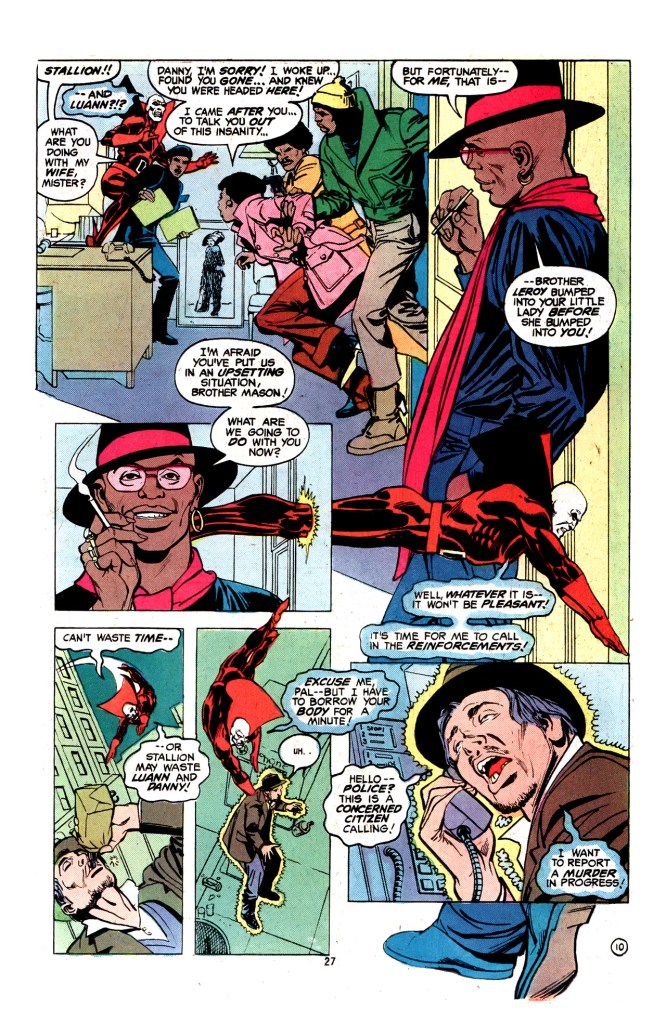
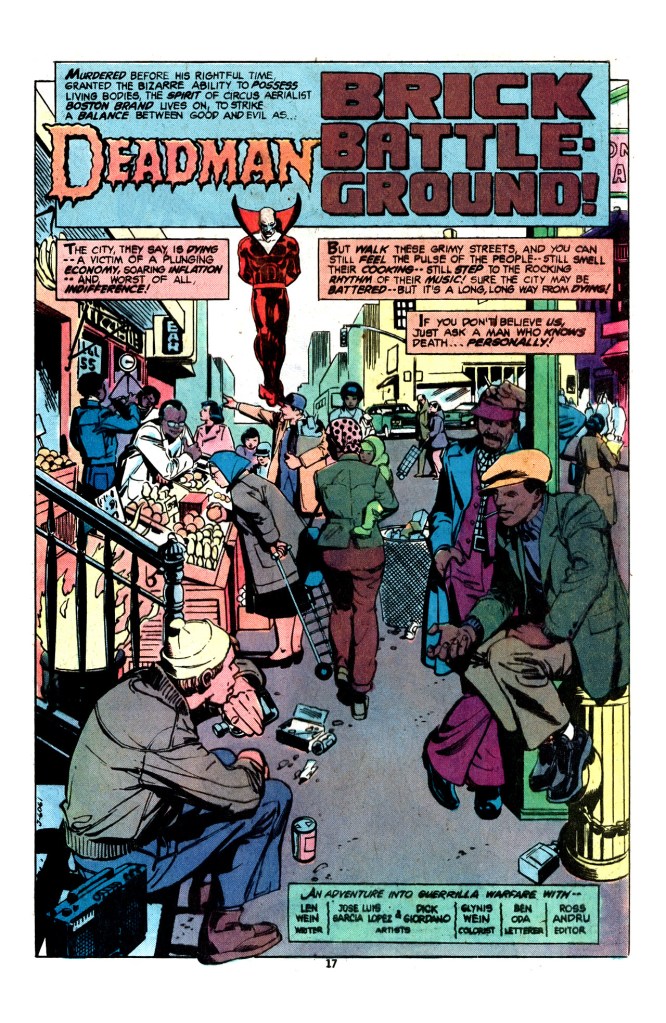
The next story is a Deadman adventure produced by Len Wein an Jose Luis Garcia Lopez, the team that would soon thereafter pair up on the BATMAN VS THE INCREDIBLE HULK inter-company crossover book. Deadman was a character that wasn’t hugely appealing to me, particularly after he’d sorted out the question of his own murder and instead wound up just flitting around and getting involved in the lives of regular random people. As you’d expect, this story is incredibly well drawn, despite some unfortunate period stereotypes. In it, Boston Brand helps the members of an urban community get out from under the criminal protection racket that is bleeding them dry. he does so by leaping into different people and fighting, mostly, when you’d think it would be the simplest thing to leap into the criminals themselves and make them turn themselves in with all the evidence needed to convict them. But I guess if Deadman did that sort of thing, the strip wouldn’t be very exciting. Not that there was ever all that much jeopardy given that the titular star is already himself demised, so nothing truly bad is ever going to be able to happen to him.
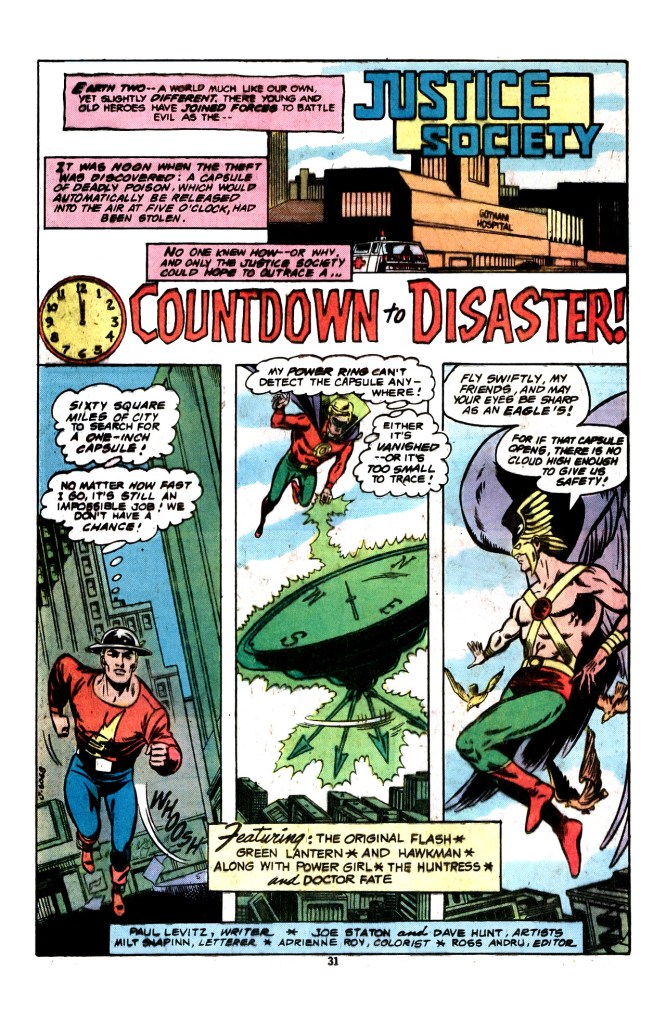
As we’ve covered in the past at length, I had a real love for the Justice Society of America, the original formative super heroes from the Golden Age of Comics. I ad followed their strip in ALL-STAR COMICS religiously up until the point where it ceased showing up at my local 7-11. So the tale in this issue was my first check-in with the team in several months. it was produced by the same creators who had been working on the strip when last I was able to read it, Paul Levitz and Joe Staton. By this point, the Huntress, who was in the process of being introduced at the point where I was forced to check out, had been added to the ongoing team roster, but otherwise the series was materially unchanged. it was still set in the parallel reality of Earth-2 where all of the formative versions of DC’s heroes resided, their ages reflecting at least somewhat the passing of time since that halcyon era.
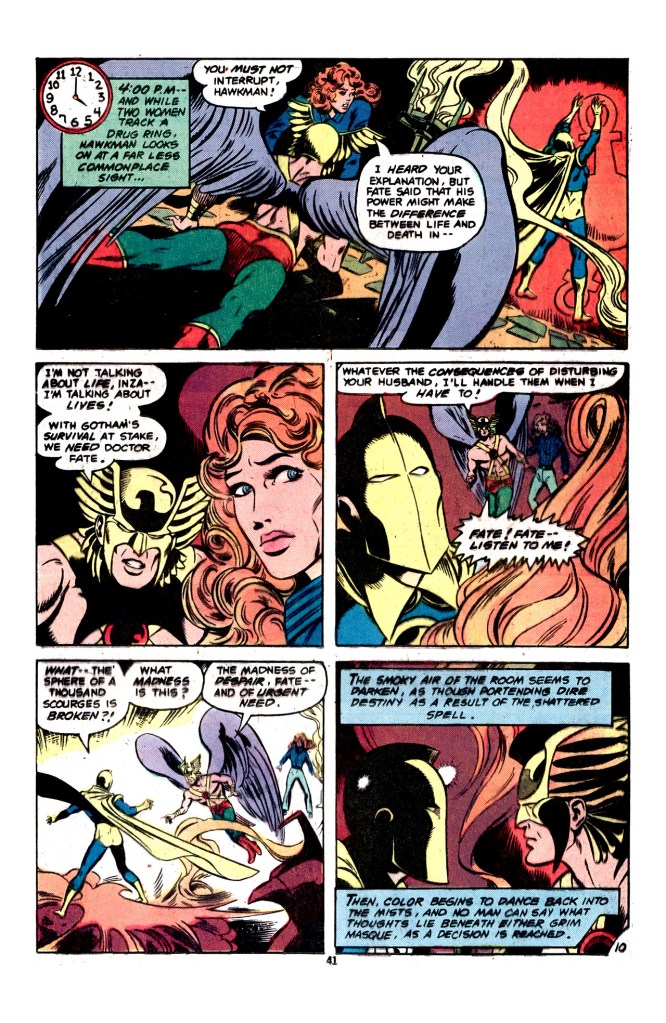
This time out, the JSA isn’t dealing with some would-be dictator or crazed super-villain. It’s got a much more mundane, though no less lethal, situation to deal with. A capsule containing a powerful and potent poisonous element has been stolen and will crack open in five hours, killing people for miles around. So the JAS heroes scour Gotham City, attempting to track down the purloined capsule before it triggers and wipes out everybody. At a certain point, with options running out, Hawkman journeys to Salem to beg the assistance of doctor Fate in their search. Fate, though has his own pressing business and has to beg off, much to the consternation of the Winged Wonder. But in the end, Fate does turn up in the eleventh hour when, having located the capsule, the assembled JSA members aren’t sure what to do with it as it begins to crack open. Fate is able to banish it to another dimension, fortunately, saving Gotham City. At the end of this story there’s a brief one-page lead-in to this year’s JLA/JSA crossover adventure, which would begin in the next issue of JUSTICE LEAGUE OF AMERICA. So the cross-continuity, at least, was on point.
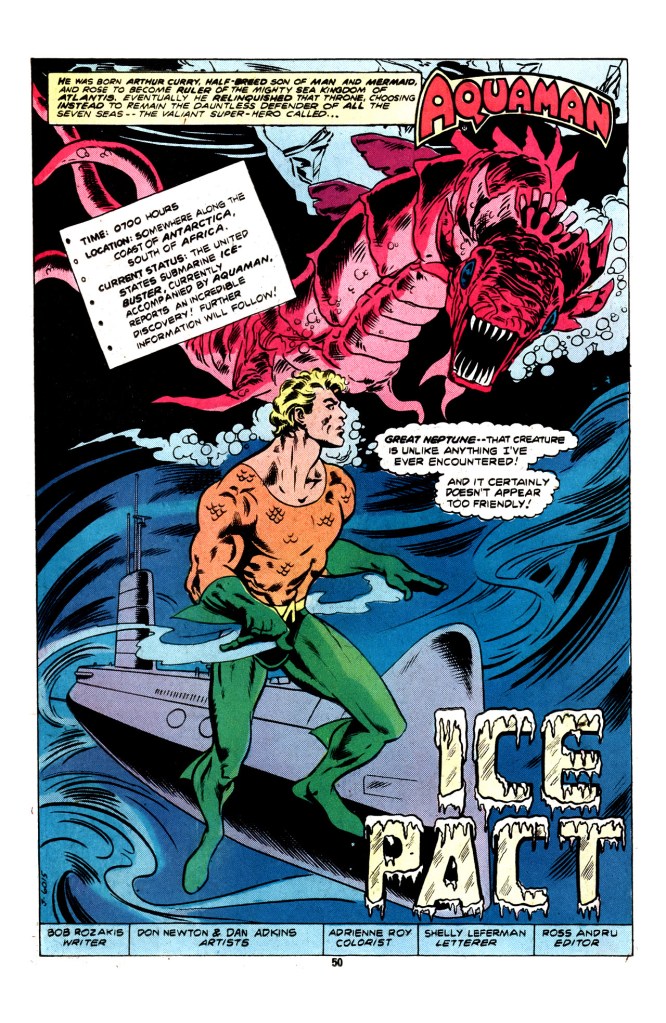
The final story in the issue, an Aquaman adventure, was also very well drawn, in this instance by the late Don Newton. Newton is one of the undersung creators of this period. he started out as a popular fan cartoonist then made the transition to being a pro, where his somewhat Gene Colan-esque approach made a big splash with readers of the time. In Bob Rozakis’s story, while playing escort to a submarine, Aquaman stumbles across an oceanic colony set up by Adolf Hitler and the Nazis. While the people appear to be friendly at first, a Nazi is always going to be a Nazi, and it’s no time at all before they want to use the Sea King to annex Atlantis. There’s some fighting and running around, and eventually the main Nazis are all blown up. So the whole thing isn’t especially memorable, but it is really nicely illustrated.


This is a fun book. Very inventive featuring great characters. Even though I was really a Marvel fan back then I enjoyed the Flash and his dynamic with Iris West. Flash the fastest man alive would arrive late for a date with his wife. Very clever.
LikeLiked by 1 person
Can someone pass the salt?
I’m getting ready to eat a little crow because Don Heck’s splash page on that Flash story actually looks rather sharp and I’ve been known to offer on more than one occasion critiques that weren’t always favorable of his talents. Hence, the ebony bird on the plate in front of me.
Seriously, this comic does look like a lot of fun. I mean how many issues have talking dolphins, evil nazis, poison pills and a dead guy running around in a costume I wouldn’t be caught dead wearing? I agree that it was a shame this version of Adventure Comics didn’t catch a little more fire.
And any issue with Jose Luis Garcia Lopez’s art is a winner in my book!
Last request – anything to serve with this crow. It is really dry!
LikeLiked by 2 people
Joe Giella was an old pro and his inks really work well with Heck. Don was not usually well served by the inkers he was given by editorial.
For his JLA run he was paired with Tanghal or Breeding to good effect, especially the latter.
LikeLiked by 3 people
I have always felt that Joe Giella was underrated. I know some people really do not like his inking. But I find his work to be solid.
The late, great Jackson “Butch” Guice posted an appreciation on Instagram after Giella passed away in 2023. Guice had this to say:
“Mr. Giella’s slick fluid ink lines graced many a favorite comic story from my youth, including a fond series of Batgirl stories (with pencilers Jose Delbo and Don Heck) he lent his inking skills in helping produce… He was still very active when I started reading and collecting comics in the early seventies, and I always enjoyed his work.”
LikeLiked by 2 people
What does the “C-156” on the cover indicate?
LikeLiked by 1 person
That’s a “job number” — part of DC’s bookkeeping system, their way of tracking each piece of the comic as it goes through the various steps of production. You’ll notice there’s one on each splash page as well.
LikeLiked by 3 people
Thanks! I’ve often wondered about this. I figured it was some internal business designation, and used on the majority if not all the covers back then. Sometimes it was more easily spotted than the signature of the artist.
LikeLike
My taste hadn’t matured enough to enjoy Heck’s art so the short look here illustrates how wrong young me was. Deadaman is not a character who should star solo. He’s better off as a guest star or starring in a short mini. Ideally, eight page adventures in House Of Mystery would have been better. Solving his murder took away ongoing plots otherwise. I also didn’t like Giordano as artist or inker and that hasn’t changed. He sanded off too many rough edges that made artists distinct as an inker and his pencils just look hollow to me. JSA? Nothing at all wrong with art or story. I wish DC would revive Earth 2 and put the JSA back where they belong. I’d rather have the heroes middle aged in the 70s than over one hundred and still active. As to Adventure Comics, they should have done what they did to save Detective Comics. DC Comics Presents was around, right? Canceling it and moving the Superman team ups over would have done the trick. Down the line they could have made it the fourth Superman book instea dof creating a new title.
LikeLike
I agree with you that Deadman isn’t popular enough to have an ongoing series of his own. But it seems to me that sharing an anthology book would have been a happy medium for him (pun unintended). I think he has plenty of aspects which would support a strong second-tier presence, though no writer seems to have gotten the formula right. Fundamentally, he’s scary – his major power is possessing someone’s body. That’s horror. At the same time, when he does this, he’s reminded of his basic angst – he’s a dead, he’s a ghost, he doesn’t have a body. Maybe stories could be driven by the idea that he tries to help people because that makes him feel alive (pun intended).
LikeLiked by 3 people
The Steve Who Is Always Right it wasn’t until I went offline last night I realized that I should have seconded your wish about DC bringing back the original Earth-2 ( which I believe they hinted at in Justice League of America#0 ( September 2006 — the Flash discovered a second Earth in their universe vibrating at a different speed — dc.fandom.com ).
LikeLike
I know I bought ADVENTURE intermittently in this era, but I don’t think I had this particular issue. All the stories look solid, but yes, an anthology title in this era really needed a strong anchor, and Flash unfortunately wasn’t it. DC in those days really was “Superman, Batman, and Everyone Else”.
I can’t put my finger on why, but I never liked that particular helmet on Hawkman. Too modern-looking for a vintage hero, maybe. The classic version is best, of course, but I would’ve even preferred the plain cloth cowl to this one.
LikeLiked by 1 person
Adventure comics eventually became a digest-sized book that was very enjoyable. That was where I discovered Zatanna by Gray Morrow and Murphy Anderson. A gorgeous strip. My favourite DC character. Also Ross Andru and Dick Giordano’s covers in the 70s are full of wonder masterpieces.
LikeLiked by 1 person
The DC Dollars books like Adventure and Superman Family were nice dependable fun. Cost was a factor to child like me so I had very few of them. Most I did have were released in the summer and I’d get them visiting my Grams. She encouraged reading in all it’s forms.
LikeLiked by 1 person
I absolutely loved this era of Deadman stories — Len’s human-interest tales worked so well with Garcia-Lopez’s and Aparo’s art. And I’m always up for Bates/Heck Flash, though I still don’t like Joe Giella’s work one bit.
The JSA, I enjoyed, but I think they were wrapping up and I knew it. And I never liked Dave Hunt’s inks over Staton. And Aquaman, well, Aquaman was just there.
Pretty good batting average overall. I do think ADVENTURE COMICS’s problem was that it didn’t have Superman or Batman (except to the extent that their Earth-2 selves showed up in JLA stories, but of course Batman wasn’t available for those any more). SUPERMAN FAMILY had Superman, BATMAN FAMILY (and then DETECTIVE featuring BatFam) had Batman, and WORLD’S FINEST had both — often in terrible stories, but they clearly supported the book more than then non-Top Two heroes supported ADVENTURE.
I think the idea of moving DCCP into ADVENTURE the way BATFAM moved into ‘TEC is an interesting one. It’s not quite the same move, but it’d be interesting, and it would feel appropriate for a series where the lead feature was Superman-and-friend to have backup features featuring other superheroes.
I wonder, sometimes, if the best answer might not have been to not bother making ADVENTURE a Dollar Comic at all, but instead doing it to one of the other DC books that featured Superman and Batman — JUSTICE LEAGUE or SUPER FRIENDS.
A JLA Dollar Comic could have a regular-length (or extra-length) JLA adventure up front, and tales of JLA members without their own books in the back, maybe accentuating their League ties by showing them using the satellite or hanging out with other Leaguers in the stories. And a SUPER FRIENDS Dollar Comics could have been backed with other DC features that had been on tv: fellow Friends Wonder Woman and Aquaman, Shazam and maybe Isis, maybe Zan/Jayna stories, a “Meet another DC star!” spotlight story, whatever. Or a feature DC was marketing as a TV possibility at the time, like Plastic Man. Or it could have been stuff appealing to younger reads: Shazam, Kamandi and…I don’t know what else, necessarily. Something with dinosaurs?
Or make SUPERBOY/LEGION a Dollar book, and back it up with solo Legion stories and tales of 30th century allies. That’d be fun, with the right creators.
That of course leaves open the question of what do do with ADVENTURE, and since it never really seemed to work without a Super-lead, maybe that’d be an existential problem, unless you can strike lightning with a Star Wars-like series or a sword-and-sorcery title that had more juice than most of what they’d tried. Or something with dinosaurs!
Ah well. Times gone by.
LikeLiked by 4 people
For me Adventure was a chance to read about lesser known characters. Pasko/Statons Plastic Man and Levitz/ Ditko’s Starman. Hugely enjoyable. Dick Giordano’s Aquaman was great as well. A superior artist.
LikeLiked by 2 people
The artwork on that Deadman story is gorgeous. Garcia-Lopez & Giordano made a great team.
LikeLiked by 2 people
The Batman and The Hulk crossover by Garcia- Lopez is a beautiful book. Especially when the Joker makes the world go mad. And his Batman is second to none. For Garcia-Lopez at his best check out the Atari Force comic from the 80s. The alien designs give George Lucas a run for his money. Also the Star Raiders graphic novel where he did his own colouring. My favourite was Hukka the little alien.
LikeLiked by 2 people
I’ve wanted to read Atari Force for a long time, but back issues are difficult to find, and DC has never collected it because they don’t have the rights any longer. It’s really too bad. But I did think some of JLGL’s best work was on the Deadman miniseries he did in 1986. I have the trade paperback of that. Still have to read the Batman / Hulk story, though. Maybe next time DC and Marvel reprint it.
LikeLiked by 2 people
The Atari-Force books are available very cheaply on E-bay if your interested.
LikeLike
I wasn’t reading many new comics at this time as I was instead focusing on buying silver (and some golden) age DC comics instead. I do recall buying the occasionally new issues of the Superman line of titles, but I don’t recall buying Adventure Comics, despite my liking the Flash, Aquaman, the JSA, Dr. Fate, and Hawkman (not so much Deadman, although I did buy the ’85 and ’86 min-series). So, this issue was new to me
I enjoyed the Flash story, slight as it was. Moreso, I enjoyed the artwork, despite my not really liking Don Heck’s pencils on the DC comics of the time that I read. Without detailed checking I’m guessing that Joe Giella’s inks are part of the reason why I like Dan’s pencils for this story.
The Deadman story was OK, and I also liked the artwork. However, I’m not a fan of comic stories that tackle real world problems. And while I like the JSA and many of its members, I did cringe at how casually drug users were seen as not worth saving.
The Aquaman story is another slight, but fun story. It’s interesting to note that even after 35 years, and the intervening Cold War, Nazis were still used as the villains (was this under Antarctica Nazi hideout ever seen again the DC universe?). And as I’m a Mera fan, I enjoyed her cameo. I don’t particularly like the artwork, but it’s decent.
LikeLiked by 1 person
I didn’t have access to the lager Dollar Comics format “Adventure Comics” or the similarly formatted “World’s Finest”. I was 7 when this issue was published. Though I’ve read many issues decades later. Some of the back-up features traded from one series to the other. Maybe the redundancy hurt sales of “Adventure” more than “WF”, since “WF” had Superman & Batman in the lead feature.
I like the idea of an anthology series, though. There are so many great characters who aren’t seen enough. There are also many artists who could use the work. Some newer, some older. Maybe a short, regular feature is just what they need. Either to jump start a career or to curb back on a longer career without ending it completely. There are some established pro’s to might not mind a few pages a month. And whose readers would still enjoy seeing.
Rather than the current monthly “Detective” being a 3-hero team-up each issue with Batman, Black Canary, & Green Arrow, I’d be more interested in seeing them each having shorter solo stories each issue, with occasional team ups. Rotate in other “street” level and/or “Bat-family” characters in solo stories.
As for this 47-year old issue, it’s a bit of quaint, enjoyable nostalgia. The Jose Luis Garcia-Lopez art is still a stand out. He did a handful of these “Deadman” stories in consecutive “Adventure” issues. I disagree with the assertion of Giordando’s “grinding down” the drawing of other artists that he inked over. That’d be Vince Colletta. 😉 But to each their own. I found that Giordano’s inks made work by artist like Rich Buckler and Ross Andru among the best of their careers.
As for Deadman, I get the appeal and how he lends himself to “human interest” stories. I like those kinds of stories. But as a guy towards the end of his “middle age”, the lack of “free will” caused by Deadman’s “possessing” other characters is very problematic. I mean, it’s convenient. Possessing abusive crooks and even dictators to correct their actions looks pretty attractive. Did Deadman have an opposite “doppelganger” who possessed people to harm others and/or commit crimes or de facto (albeit imaginary) atrocities? Then that fight between Deadman and this evil spirit counterpart would be less troublesome to read.
Like several others on here, my respect for Don Heck’s work has increased many fold over the last few decades. And I agree the inker makes a difference when handling “superheroes”. I’ve said before I wish he’d have been able to draw a more noir-like Slam Bradly feature, maybe appropriately as a back-up in “Detective Comics”. Despite being created by Seigle and Shuster, and the Superman connection with that pedigree.
As for the JSA, those other dimensions really would be easier to use for disposing toxic waste, unless of course those other dimensions have life that could be harmed, too. But then why did the people who created the waste think about the harmful effects on life here? ($$$$$) Too bad Giordano didn’t have time to ink Joe Staton’s drawings for this story, too. Hunt’s inks are better on other artists. Keith Giffen, for one. The spotting blacks meshed better with Keith’s more open style.
Don Newton has become one of my favorite artists. Sadly, it took around 30 years after his tragic death for me to see enough of it to come to that realization. This splash page isn’t a good example of his powerful, naturalistic, and elegant work. It looks rushed, and slightly out of proportion. Don drew Aquaman in multiple issues of “Adventure Comics”, “World’s Finest”, and I think the last 2 issues or so of Aquaman’s solo monthly book. With inkers like frequent collaborator Dan Adkins, the seasoned and accomplished pro Bob Mcleod, the aforementioned and another seasoned pro Dave Hunt. But my favorite inker for Don, on Aquaman or anything else (“The Brave the Bold”, Red Tornado and also Dr. Fate), was Bob Smith.
I see Tom’s comparison of Don Newton’s drawing to Gene Colan’s. The figures and faces often seemed as fluid and kinetic as Gene’s drawings. And I like both of their work very much. But Gene’s “Colanatomy” (thank you) 😉 was a bit more distortedly stylized. Maybe closer to other artists I like, like Alex Nino and John McCrea. At his best, Don Newton’s work was more naturalistic, without the beautifully sculpted rigidity of a Jose Luiz Garcia-Lopez.
I first read Don’s name in a tribute for him in a letters column written by Roy Thomas. Then a year or two later (1987?) at a comics show outside of Philly, off I-95 in DelCo, PA, a back issue dealer lamented the loss of Don, who he said was his 2nd favorite Batman artist, after Neal Adams. That piqued my interest. It wasn’t until a decade later I realized I HAD seen some of Don’s work on Batman in “Detective Comics”, smothered by Alfredo Alcala’s inks. I like Alcala inking his own drawing. But he could really overpower other artists, often killing their own work’s identifying features.
Anyway, sorry for the diatribe. Thanks for this column on this issue of “Adenture Comics”.
LikeLike
Forgot to mention, Bob Rozakis. I think he became DC’s Production Manager or something similar sometime in the mid 1980’s. But he wrote several surprisingly good features in multiple titles. I liked his Batman in “Detective”, this Aquaman story. His work seemed sporadic throughout the DC line, and for many characters, but I found his stories enjoyable. Far mor than his “Answer Man” replies, which maybe 60% annoyed the crap outta me. Saying Superman could lift the same amount of weight any of his body parts. I’m nuts for arguing about a fictional character’s “physical strength”. But if real people can’t do it, if some body parts are inherently stronger or just better suited for that kind of task, than Superman’s body would proportionately follow suit. 😉 Maybe an episode of “M*A*S*H” or “Rockford Files” was about to start on TV, so Bob had to hurry up and finish his column. 😉
LikeLiked by 1 person
All this talk of the talk about AC moved me to check out the series’ last stand as a regular newsstand book. I knew that JM de Matteis began the Aquaman series in AC, but not that it was picking up threads from an Aqua-series in WF. specifically a thread from Bob Rozakis in which the Sea King meets his aunt Atlena. OK, she isn’t said to be his aunt in WF, but come on: Rozakis gave her a name nearly identical to that of AquaDude’s mother; SOME relation must have been intended. Then the ADVENTURE run under de Matteis starts and the main plot is “new evil mastermind on the block.” De Matteis starts out OK but the run soon goes downhill, partly through revealing that the Big Bad is Aqua-Mom Atlanna, who’s gone nuts and has enlisted Ocean Master and a bunch of robots to make Arthur’s life miserable. The weirdest thing is that when the DeMatteis plotline gets wrapped up in ACTION COMICS– curiously, with the last two scripts credited to Len Wein and Bob Rozakis, writing to the deMatteis plotline– Ocean Master’s much more affected by the return of Atlanna than her actual son is. It ‘s probably fortunate this continuity was scrubbed by CRISIS.
Not much to say about Plastic Man but the Levitz-Ditko Starman was underwhelming. It’s mostly interesting that Ditko is credited as “penciller/designer.” Has Ditko or anyone else ever been credited as “designer?” The series is so routine, I could believe Levitz conceived the series just to give Ditko work.
LikeLike