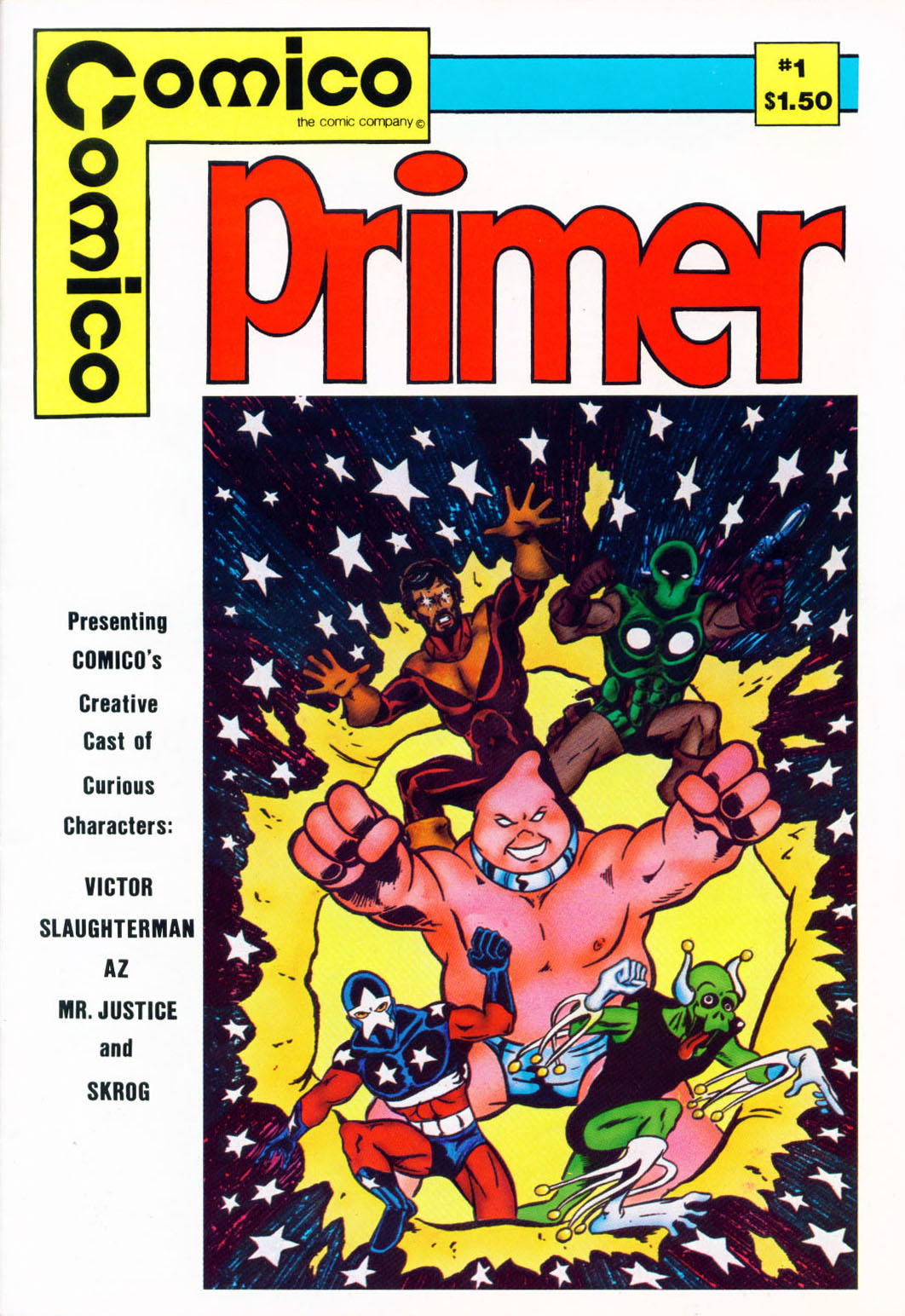


By 1980, I started to attend comic book conventions in New York City. My father would take myself and occasionally a comic book reading friend or two on the Long Island Railroad into New York City and give us a couple of hours inside one of the cons that were going on there. These were mostly Creation conventions, which tended to be primarily dealer-focused, though they did have an assortment of programming. It was at one of these around 1980 that I met Gerry Giovinco in Artist’s Alley and first became aware of Comico, the Comic Company. Gerry was a college student attending art school in the Philadelphia area, and along with a few of his art school buddies they’d decided to put out a comic book. I somehow struck up a correspondence with Giovinco, who was clearly a way better artist than I was, and was an early backer of his publication plans. For years I had the small Comico Portfolio plates framed on a wall in my room–this was all before the group’s initial publication, COMICO PRIMER, first came out. By the time that happened, I had already relocated with my family to Delaware.
This first issue of COMICO PRIMER is pretty amateurish. For all of the obvious enthusiasm expended upon it, it looks and reads more like a fanzine than a professional publication. But such was the expanding Direct Sales marketplace of the early 1980s that even such humble beginnings could grow into something noteworthy, and Comico became a solid player in the field throughout that decade and into the early 1990s. The original plan for the company had been to publish comics based on the properties created by the group’s founders, but at some point the decision was made to start off with a sampler of everybody’s work: a Primer, if you will. And that’s what arrived in comic shops first.
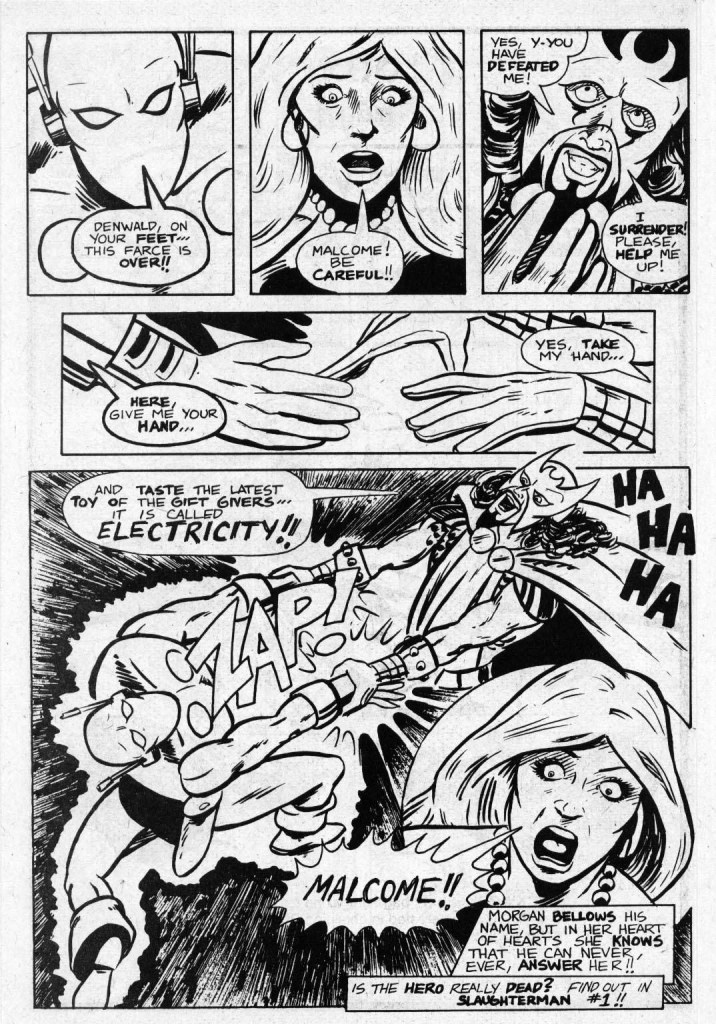
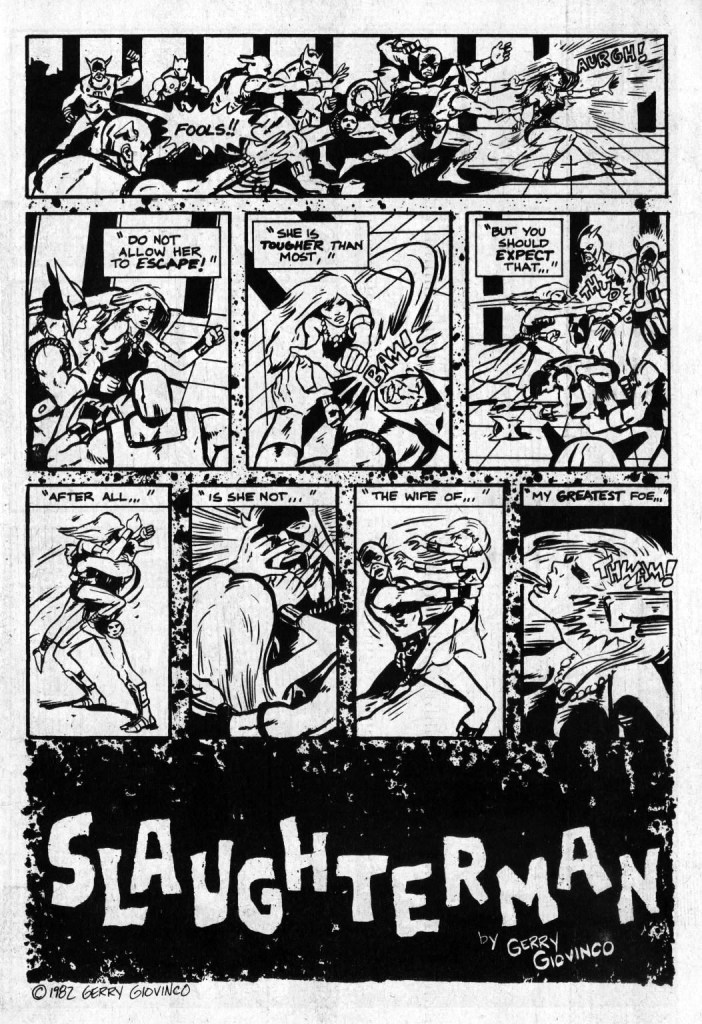
The opening strip in COMICO PRIMER #1 was Slaughterman by the aforementioned Gerry Giovinco. Gerry had actually produced the first issue of his series first, and then had to come up with an appropriate lead-in story to it for this sampler. Which is why this tale doesn’t really showcase the main shtick of the series: Slaughterman is actually a woman, Morgan, who is the wife of the dead armored hero and who takes up his mantle unbeknownst to anyone. So this short 6-page adventure sets the table, introducing both Morgan and her husband Malcolm and the strange sword-and-sorcery-but-with-technology-too world Bolta they live in. By the story’s end, Malcome is electrocuted by his nemesis Denwald, an almost Skeletor-level scenery-chewer of a villain. It’s not precision work–the inking in particular is heavy and oppressive. But it’s got some ideas in it and might have eventually grown into something. Alas, only two issues of SLAUGHTERMAN would ever reach the stands.
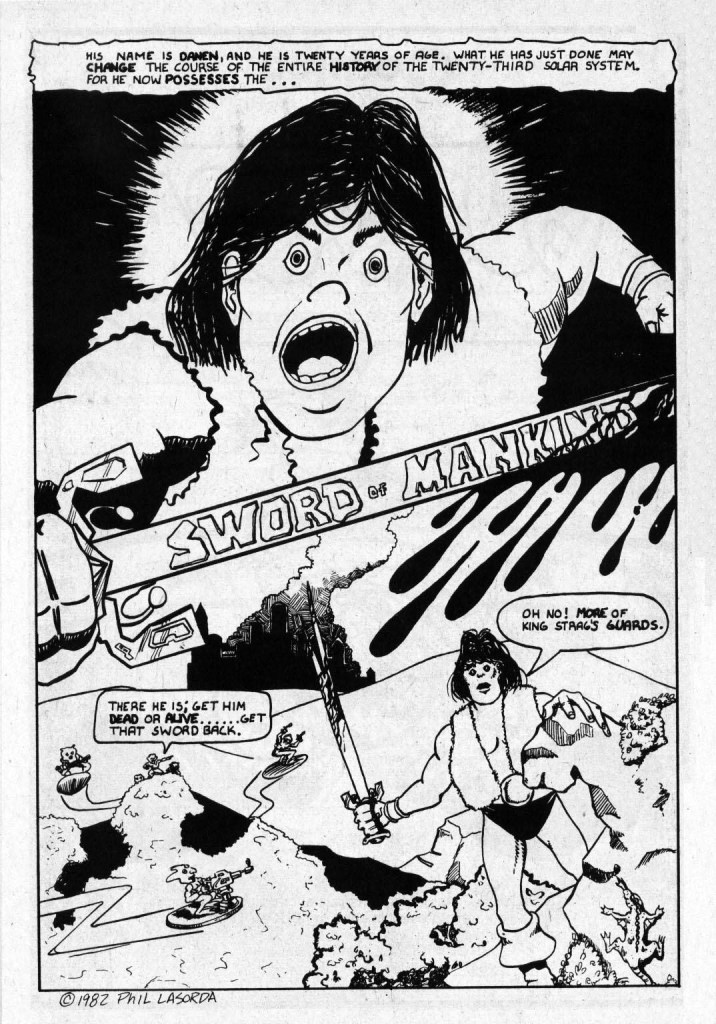
The next story is a bit of a step down in terms of quality. It introduces Phil Lasorda’s strange character Az, a huge gumby-shaped alien being of some sort with a Hershey’s Kiss-shaped head. This one’s also set in a sword-and-sorcery realm, a clear indication of just how popular the genre was in the 1970s and beyond. The story in volves Az being recruited by a hapless young guy to help him deliver an enchanted sword to a witch, Asmodeus, that holds his sister hostage upon the delivery of the weapon. Az does so, killing Asmodeus with the sword along the way, but the guy and his sister both die as well, and so Az is left feeling depressed. The writing is basic and the artwork crude, but despite that (and possibly because Lasorda and his brother were the main financial backers of the Comico enterprise initially) AZ ran for two issues and never really got much better than this kickoff story.
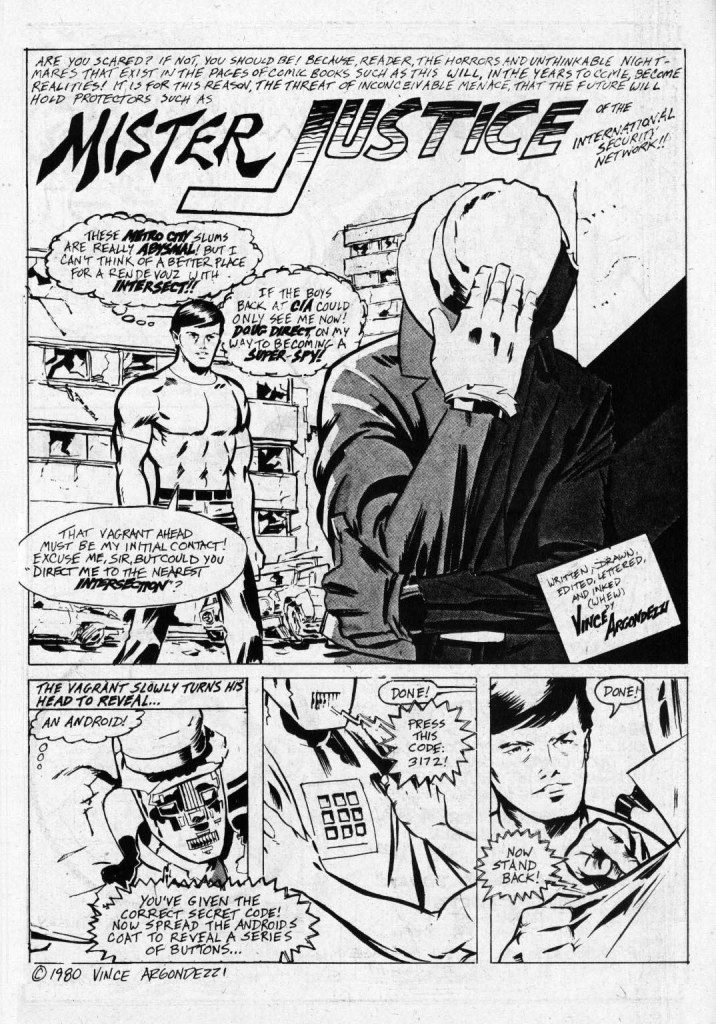
The third story, Mister Justice, I wrote about at length previously:
But it’s in essence a pastiche of Jack Kirby’s tone and style, right down to including a character, Jack Pizzano, based in Kirby. Mister Justice is a would-be agent of the world peacekeeping organization Intersect who is given a gadget-laden costume and put through a bunch of tests to judge his worthiness for the role. Its creator, Vince Argondezzi, was the most accomplished of the Comico founders, and the one to go on to have a legitimate career in mainstream comics. But his work here is still incredibly crude, especially his unfinished-looking inking. He can’t quite yet pull off what he’s trying to do. This wound up being the only Mister Justice story produced.
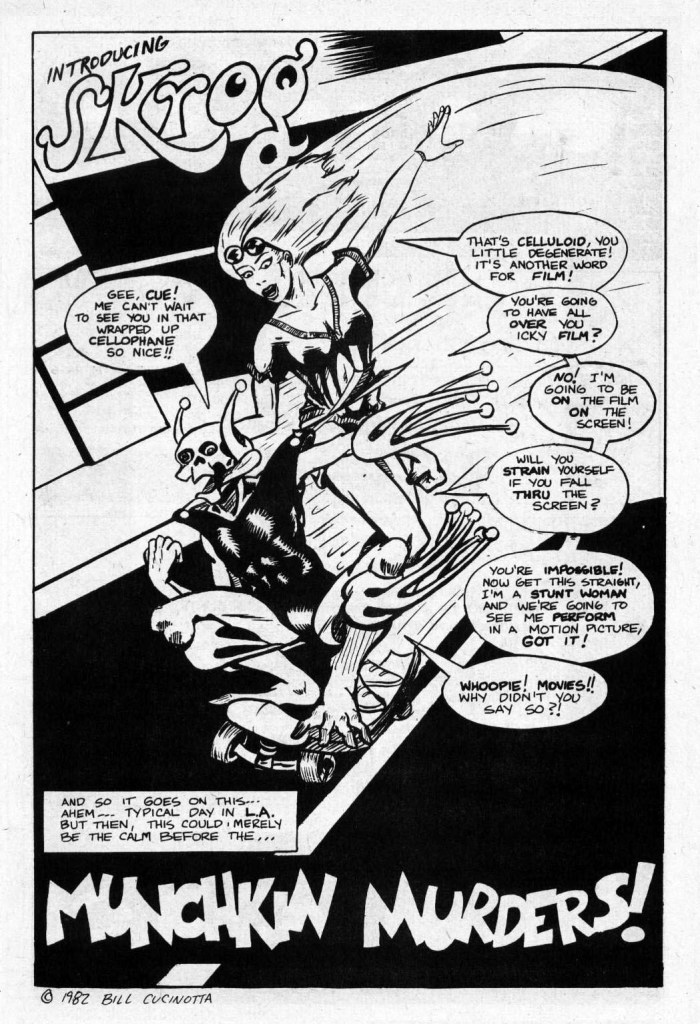
The final story in this anthology featured Skrog, a demented sort of skull-faced demon-thing with a dangling tongue who hangs around with a hot girl named Cue. It’s the work of Bill Cucinotta whose work is on a par with the rest of the contributors, though his dialogue is in general better. But the story is werid and a big nonsensical, involving Skrog being targeted by a killer from another dimension who has designs on Cue. The whole thing doesn’t really add up, but it’s got a strange dreamlike quality to it. Like SLAUGHTERMAN and AZ, SKROG put out two issues under the Comico banner, then a third one-shot from some other fly-by-night publisher a couple of years after that. So it’s the unlikely winner of this inaugural issue if we’re judging by number of appearances made.
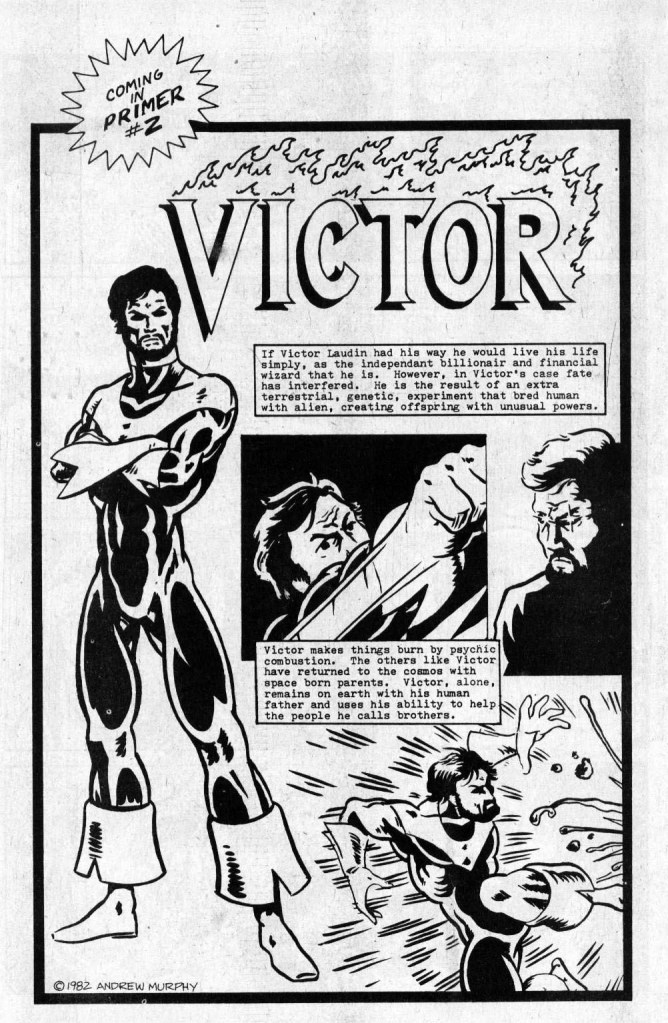
The cover also showcased Andrew Murphy’s character Victor, though he only got to show up in this first issue for a promotional page, making his actual debut in #2. More crucially, issue #2 also introduced both Matt Wagner and his creation Grendel to the world, a series that’s still running today. Wagner was the earliest break-out hit of COMICO PRIMER, but in its run it’d also showcase work by Sam Keith and introduce Chuck Dixon and Judith Hunt’s series EVANGELINE which had some legs to it.
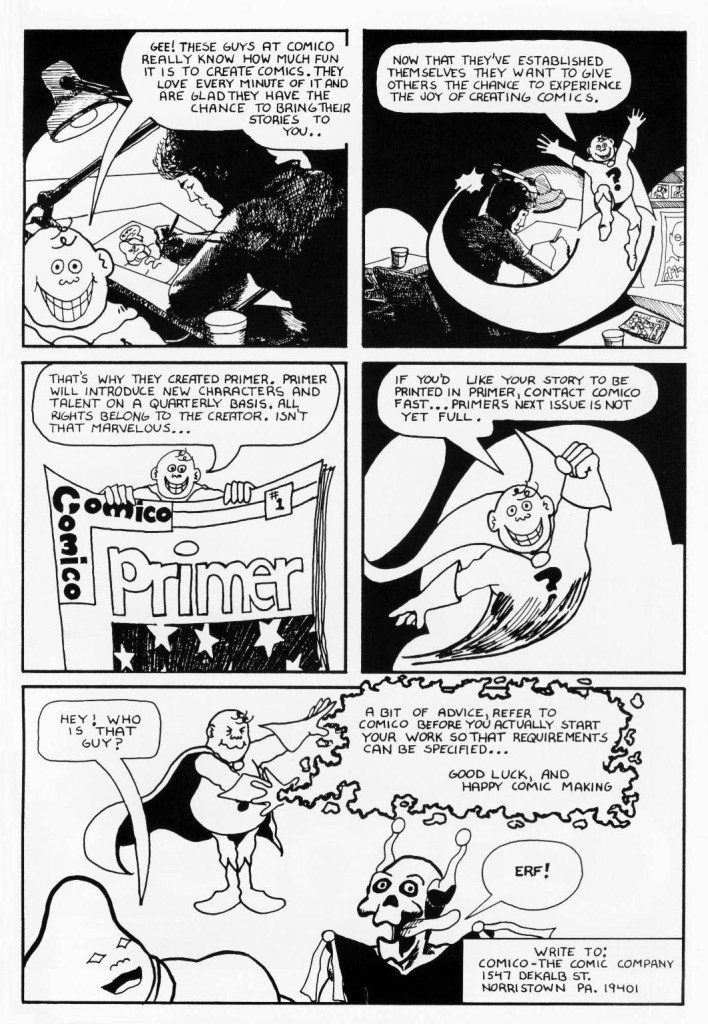
But the big thing about COMICO PRIMER was that it was set up to be a showcase of the work of other creators, and by 1980 that’s what I wanted to be. So I corresponded with Giovinco for a few years, and my friend Israel Litwack and I put together a strip that we hoped might make it into the magazine. It was Vince Argondezzi rather than Gerry who sent it back to us with a critique, which was a hard blow to take though everything that he had to say about our writing and artwork at that point was 100% on point. We weren’t yet even at the level of the stories in tis first COMICO PRIMER issue (and really never would be.)


Being a fan of Hanna-Barbara cartoons, I quickly signed on for Comico’s “Jonny Quest” series in the mid-80’s. This include the Jade mini-series with art from Andy Kubert. My inner geek reach near nirvana with their Space Ghost graphic novel – gorgeously illustrated by Steve Rude. That led me to the crazed notion to submit a story idea for a Herculoids comic. My “Hail Mary” netted a response letter, politely telling me that they already had a Herculoids story in mind. Sadly, about three months later, financial challenges shut down much of their line, including Jonny Quest.
Just think. Had that story been accepted, I could have gone to being rejected by Tom and other comic professionals. 🙂
LikeLiked by 3 people
Messier-Loeb’s Jonny Quest was a delight. I should try to pick up the tail end of the series — money problems forced me to drop it.
LikeLiked by 2 people
I hear you! Not sure how I afforded it at the time.
LikeLiked by 1 person
Some great stuff in the “Jonny Quest” series. The Kubert brother decades before they were influenced by Jim Lee. Had more of their father’s influence then, but a lighter ink stroke. Those Dough Wildey covers were amazing. The great Steve Rude also contributed art to that series. By the time Marc Wheatly and I think Mark Hempel were on the book, I’d moved on.
Steve’s Space Ghost was pitch perfect. I think Mark Evanier wrote that. They’ve done some beautiful work together. Some Kirby 4th World and New Gods stuff in 2 separate issues of the 1990’s (?)”Legends of the DCU”. The “Mr. Miracle” special in the mid 1980’s.
LikeLiked by 1 person
Unlocked memory! I brought that Johnny Quest issue and that Space Ghost was my first graphic novel purchase! Comico’s Justice Machine & Elementals crossover was my first foray into indie comics and pretty soon after that I was exclusively buying Indies and foreign graphic novels. By ’89 I was done with DC and Marvel and not even Vertigo could bring me back!
LikeLike
I never got this. I think the first Comico book I picked up was MAGE 1 — and idiot me, I didn’t like it. I didn’t buy a Comico book regularly until JONNY QUEST. Which was, coincidentally, about the time I started making enough money not to be sweating the rent every month.
But I like that “Mister Justice” page a lot. If there’d been more, I’d happily hunt it up.
LikeLiked by 3 people
This would not have inspired me to look for more Comico stuff. Glad they got better.
LikeLiked by 1 person
Yeah, this is all very rough material here… although it’s still far, far better than anything I could ever manage to draw! I guess I can appreciate the ambition of these various young creators.
Vince Argondezzi eventually grew into a solid artist. He had the absolutely unenviable task of following Todd McFarlane on the art chores for Infinity Inc, and all things considered he did a good job on that series. I looked on the GCD to see what Argondezzi did after Infinity Inc but other than some issues of Racer X for Now Comics there’s not much else. Sorry to have learned that he passed away in 2018 at the relatively young age of 58.
LikeLiked by 1 person
I have this issue. Amateurish indeed — even my own ‘Komos & Goldie’ comic doesn’t look so bad alongside it –and yet encouraging, in that not long afterwards Comico was publishing professional and entertaining titles.
LikeLike