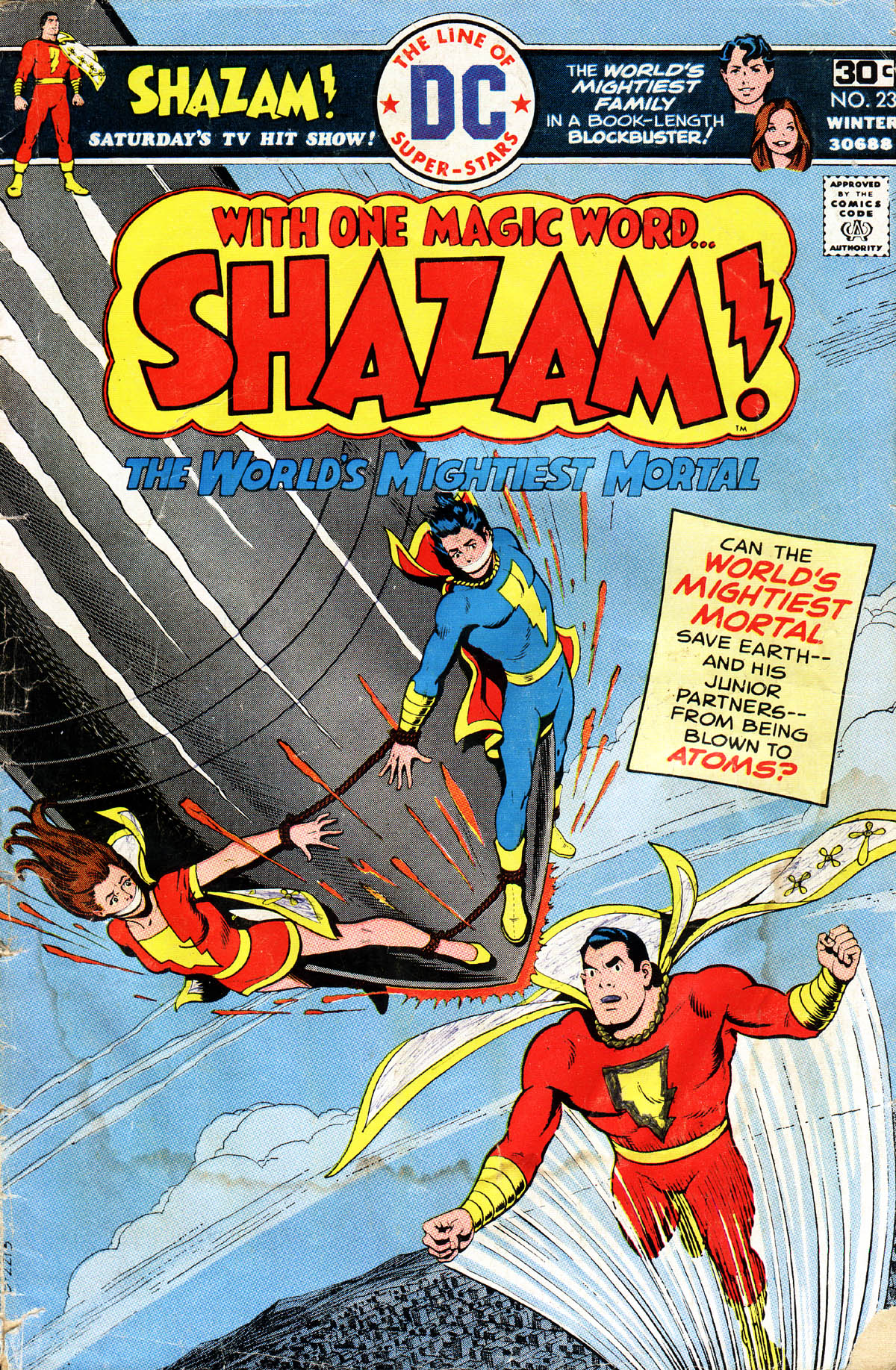


I was continuing to work my way through the complete run of SHAZAM that had been lent to me by my grade school friend Donald Sims, and I was up to issue #23. As the cover indicates, by this point the character was the star of a popular Saturday morning live action series, which is the only thing that kept the title from immediate cancellation. But it was performing so poorly that it had been relegated to only running reprints and was being released quarterly, an almost unheard-of thing in the 1970s. Better days were coming, but they were still in the future at the point where this issue came out.
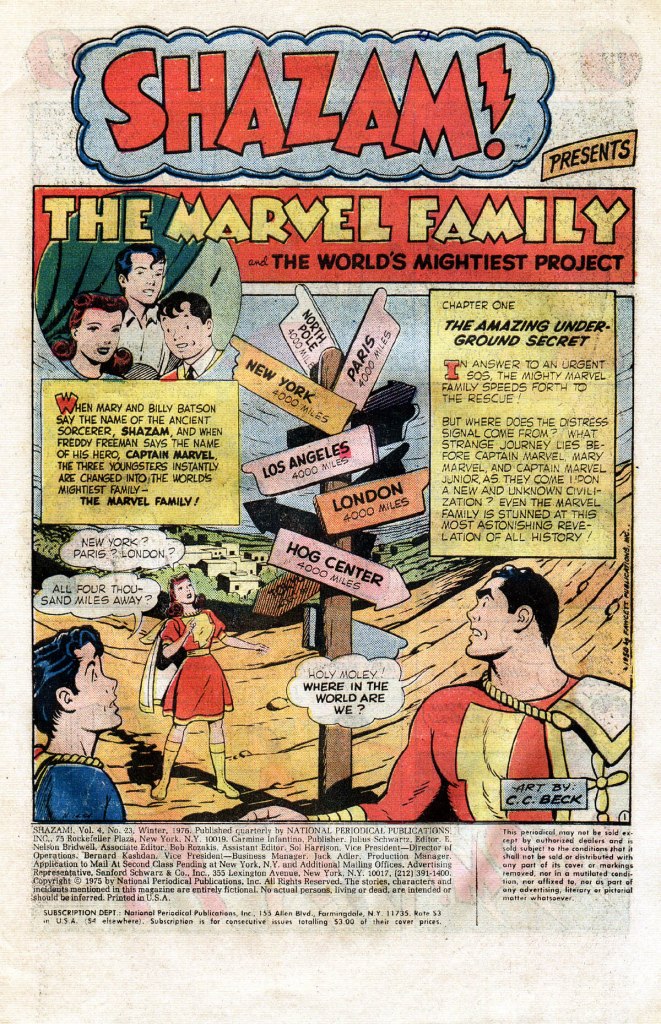
Making SHAZAM into a reprint series had one benefit, and that’s the fact that the best stories in the magazine had always been the reprinted material from the character’s Golden Age days. This particular issue reprints a full-length Marvel Family adventure that’s quite good. It was the work of writer Otto Binder, who wrote over half of all of the Marvel adventures done in the character’s initial run, and artist C.C. Beck, here working twice-up rather than 1 1/2 times up as contemporary comics were being done, so his artwork appeared crisper and more fully realized.
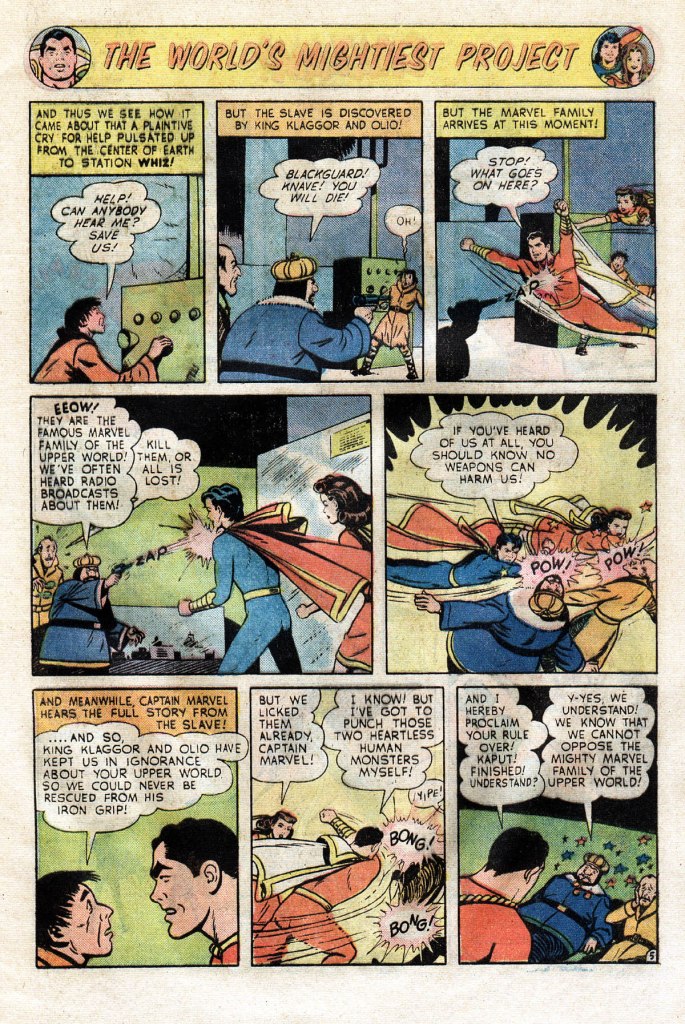
The story is a good example of the whimsical fantasy that was embodied in the best of the series. it opens with the Marvel Family receiving an urgent distress call from the center of the Earth. Burrowing through the ground to reach it, they discover an expansive underworld civilization a billion people large, being ruled over by the tyrannical King Klaggor. The Marvels swiftly put an end to the King’s rein, but they find they now have another problem: the people of this civilization used to live on the surface, and they’ve been kept down here so that Klaggor could maintain his power over them. They want to return to the surface, but there’s so many of them that they would overpopulate the globe!
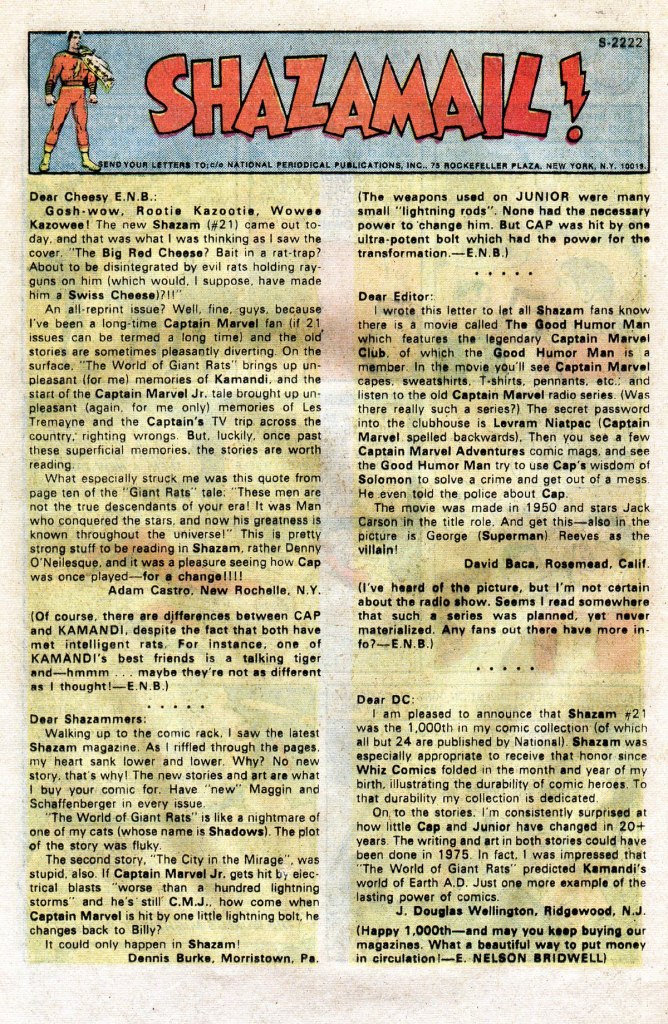
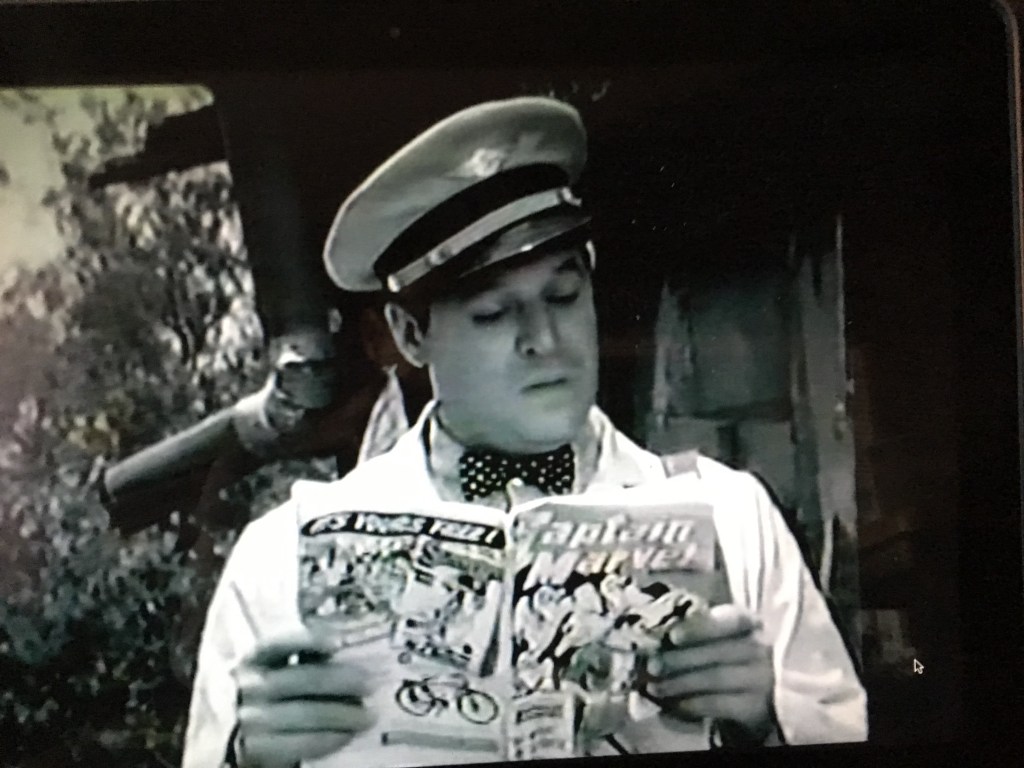
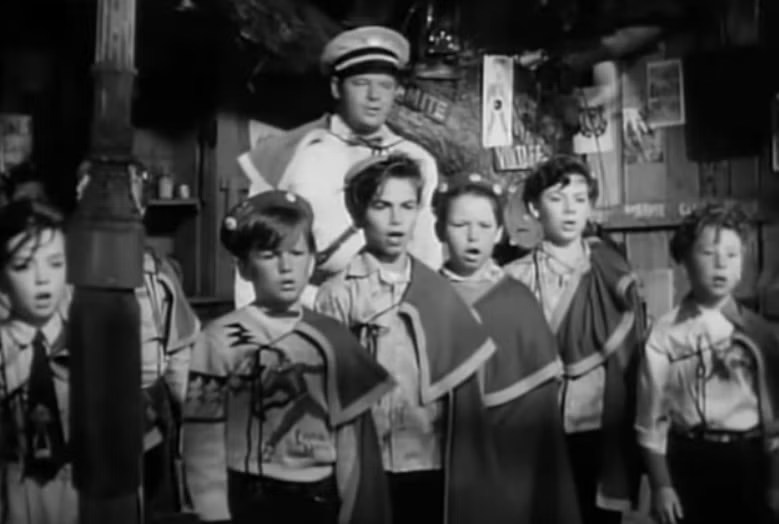
A swift pause here for this issue’s SHAZAMAIL letters page, which features opening remarks from future science fiction author and comic book writer Adam Troy Castro. It also features a separate letter talking about the 1950 movie “The Good Humor Man”, which features references to Captain Marvel aplenty.
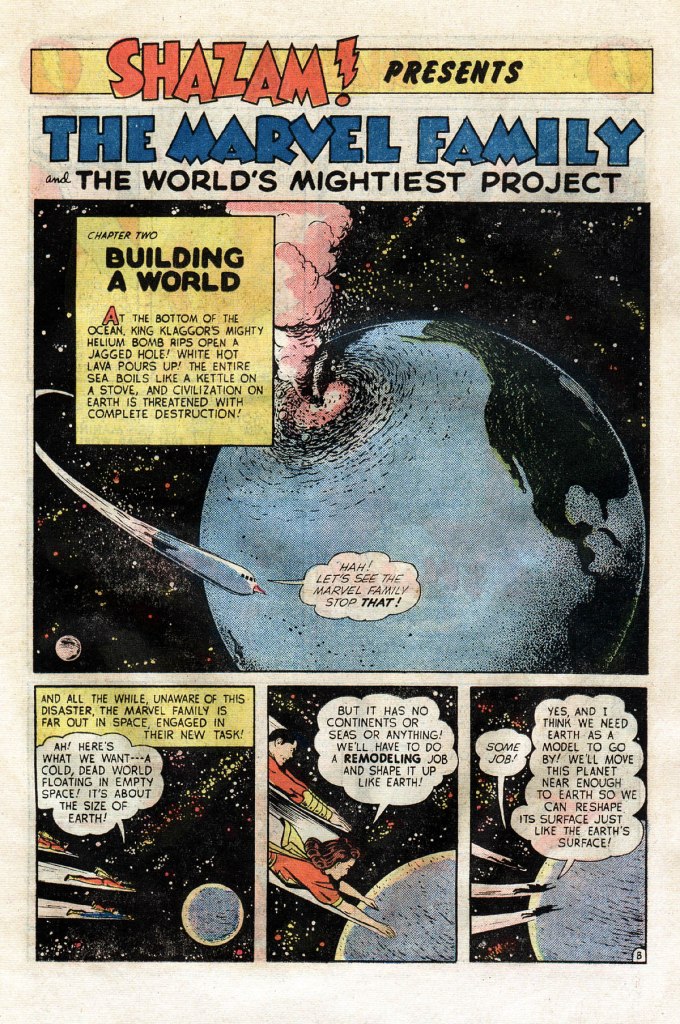
After considering the possibility of relocating the underground inhabitants to either Mars or Venus and deciding that the conditions there would be too inhospitable for them, the Marvels resolve to build them another Earthlike planet to live on. They head out into space, seeking out a lifeless world that they can transform–the “World’s Mightiest Project” of the title. In the meantime, the vengeful King Klaggor, who was able to escape with his Prime Minister Olo detonates a Helium Bomb in the ocean as an act of revenge, causing lava to burble up into the waters, causing an environmental disaster. However, it’s a disaster that the Marvel Family copes with in under a page, much to Klaggor’s frustration.
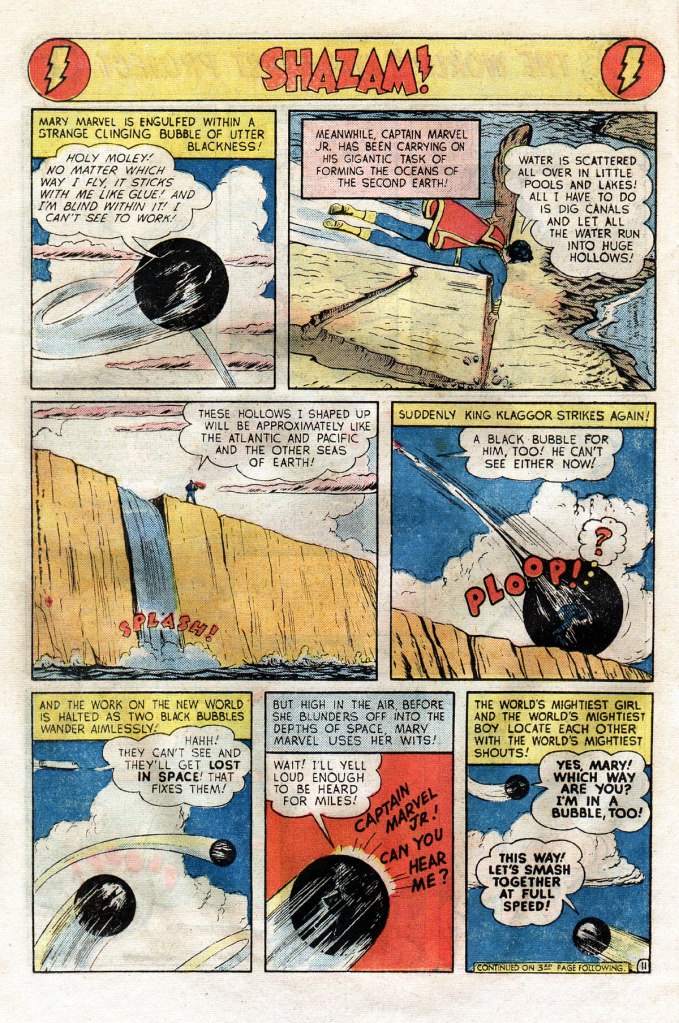
Klaggor learns that the Marvel Family is creating a second Earth for the underground population to emigrate to, and he resolves to stop the project. The Marvels moved this planet into our solar system so that they could use the genuine Earth as its model, so while Cap builds a massive space ark to carry he citizenry to the new world, Mary and Junior work to reshape its land masses and seas into a duplicate of the actual Earth. Klaggor tries to stop them by enveloping Mary and Junior individually in spheres of utter blackness, in which they cannot see. But the two young Marvels foil this by calling out to one another and ramming the two globes together at incredible velocity, destroying them both.
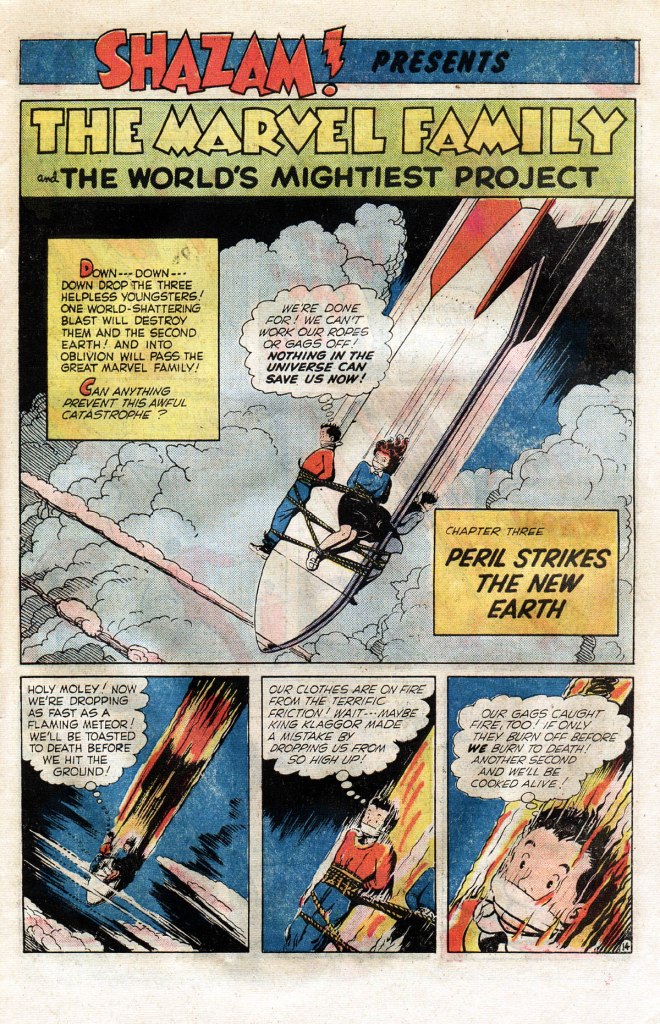
With the new planet ready for colonization, the Marvels resume their human forms to christen the space ark at the debarkation ceremony. But this gives King Klaggor the opportunity he needs. He clobbers the three kids, then ties them all to another gigantic Helium Bomb which he launches at the new Earth, intending to destroy it completely before his subjects can migrate there. Fortunately, the friction from entry into the New Earth atmosphere burns away the kids’ gags and they’re able to resume their superhuman identities in time to catch the falling Helium Bomb and send it instead hurtling out into space, where it can explode harmlessly.
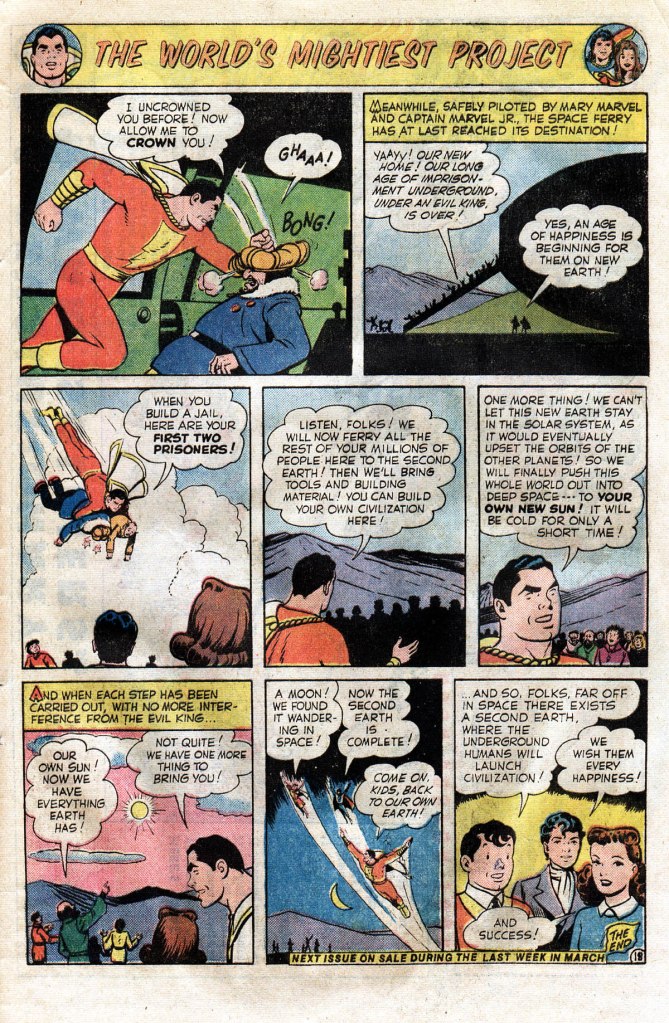
But now it’s time to take the space ark to the new planet. The thing is so massive that it doesn’t have any built-in engines. Rather, the Marvels themselves propel it through space. King Klaggor makes one final attempt to disrupt this voyage, surrounding a massive meteor with a black sphere so it can’t be seen and sending it hurtling at the ship. But Captain Marvel notices the impending danger and destroys the meteor–and thereafter crashes through Klaggor’s fleeing ship to put a final stop to his shenanigans. With the undergrounders now safely on their new home, the Marvels tell them that their final act will be to push the new planet back to another solar system (!!!) so that it doesn’t interfere with the balance of ours, and not to worry–it will only be cold for a short time. This is literally accomplished between panels, despite being perhaps the most impressive and unlikely thing to take place in this tale. But that brings the adventure to an end, with the undergrounders now happily on their new home and the situation resolved.


The Marvel Family#56 ( February 1951 ) reprinted in this issue of Shazam! ( Marvel Family moved a planet first and altered it which is something the LSH had to do for Daxam after The Great Darkness Saga ): According to Google AI Overview the first time Superman moved a planet was as Superboy in Superboy#140 ( July 1967 — written by a 15 year-old Jim Shooter ): the opening splash page famously depicted a teenage Superman towing a long line of connected planets through apace using a massive chain. Two years later, he first pushed a planet with his bare hands in Superman#220 ( October 1969 — written by Jim Shooter ), when he helped move the Earth out of its orbit to avoid a cosmic seed. The Marvel Family like Superboy/Superman acting like those rockets/thrusters Galactus attached to Ego the Living Planet’s south pole [ Thor#228 ( October 1974 ) marvel.fandom.com ] — so not strength moving those planets. What’s keeping them together?
LikeLike
I’m old enough to remember watching the live TV show and buying this comic off the stands. While watching the TV show, I had hoped to see some of the villains like Mr. MIND or Dr. Silvana show up. Later Filmation did just that with the Shazam cartoons as part of an original cartoon Superhero High (?) which made up for the live action TV shows lack of supervillians and threw in the entire Shazam Family. The comics were simple and geared for a younger entry-level comic book reader (the Fawcett reprints were better than the new stuff, of course not knowing the reprints were reprints to me was ok). The Shazam feature got much better when it became a backup of the World’s Finest Comics “Dollar sized” (68 pages of new features) featuring E. Bridwell and Don Newton as a creative team putting more serious art to fun tongue-in-cheek stories. In fact, the only reason I bought World’s Finest Comics and the Adventure Comics Digest during this period was for the Shazam feature.
LikeLike
I’m old enough to remember watching the live TV show and buying this comic off the stands. While watching the TV show, I had hoped to see some of the villains like Mr. MIND or Dr. Silvana show up. Later Filmation did just that with the Shazam cartoons as part of an original cartoon Superhero High (?) which made up for the live action TV shows lack of supervillians and threw in the entire Shazam Family. The comics were simple and geared for a younger entry-level comic book reader (the Fawcett reprints were better than the new stuff, of course not knowing the reprints were reprints to me was ok). The Shazam feature got much better when it became a backup of the World’s Finest Comics “Dollar sized” (68 pages of new features) featuring E. Bridwell and Don Newton as a creative team putting more serious art to fun tongue-in-cheek stories. In fact, the only reason I bought World’s Finest Comics and the Adventure Comics Digest during this period was for the Shazam feature.
LikeLike
I’m old enough to remember watching the live TV show and buying this comic off the stands. While watching the TV show, I had hoped to see some of the villains like Mr. MIND or Dr. Silvana show up. Later Filmation did just that with the Shazam cartoons as part of an original cartoon Superhero High (?) which made up for the live action TV shows lack of supervillians and threw in the entire Shazam Family. The comics were simple and geared for a younger entry-level comic book reader (the Fawcett reprints were better than the new stuff, of course not knowing the reprints were reprints to me was ok). The Shazam feature got much better when it became a backup of the World’s Finest Comics “Dollar sized” (68 pages of new features) featuring E. Bridwell and Don Newton as a creative team putting more serious art to fun tongue-in-cheek stories. In fact, the only reason I bought World’s Finest Comics and the Adventure Comics Digest during this period was for the Shazam feature.
LikeLike
Those Adventure Comics Digest were great fun!
It was my first exposure to 60’s Spectre by Murphy Anderson and I recall one of the Neal Adams issues being reprinted.
They also contained Legion and other reprints. They were were a solid deal at .95 cents
The new Shazam stories were icing on the cake.
LikeLike
You would think the Wisdom of Solomon would keep them from changing back to their normal forms until the mission was over and they were back home or with friends or work or school.
LikeLike
I have no idea why I was so anti-reprint back then, but even when buying back issues, I didn’t want reprints, I wanted new material produced in the 70s. These days, I recognize that the reprints were actually better stuff, but back then I wanted the contents of my comics to be new, modern, forward-looking.
I mean, I also wanted them to be good. But new-good. Not that old-good stuff.
Maybe it was the way Marvel cut pages from their reprints. Maybe it was that I had access to back issues, and in many cases (not here, but with other books) I could buy the original issues and spurn the 70s reprints. I don’t know.
But I missed out on some good stuff.
LikeLike
One thing I’ve learned from online discussion with older fans is that you weren’t unique. I loved the reprints but other people hated them with a passion.
LikeLike
I only hated them when they were used in place of a new story.
LikeLike
I can understand why I was opposed to some reprints — I didn’t like Marvel’s habit of cutting pages from them, and a lot of DC’s Golden Age reprints were poorly written and crudely drawn (or, in some cases, I didn’t have the aesthetic education yet to appreciate them).
But why I would dislike 1940s-50s Fawcett reprints, which were well-drawn and well-written — that I don’t get.
Teenagers, whaddayagonnado?
LikeLiked by 1 person
As a kid, my first reaction to Neal Adams’ art was “Ick!” I fully understand that in our youth we do not always have the best aesthetic sense.
LikeLike
You grew to like it? I’m still waiting.
LikeLike
For me Captain Marvel (Shazam not the Kree Wannabee) is the best superhero ever! Some of the plots are genius. Mr Mind, the Sivana family. Wonderful characters. A book with a fairy-tale style and humour. I own the Showcase b/w collection of the 70’s CM books and I personally love It. Amazing work from CC Beck & Kurt Schaffenberger! Apparently Thor’s origin was based on CM’s. Whose the strongest CM or Superman? Difficult call that. But I think somebody who can take both those characters is Lucy from Peanuts!
LikeLike