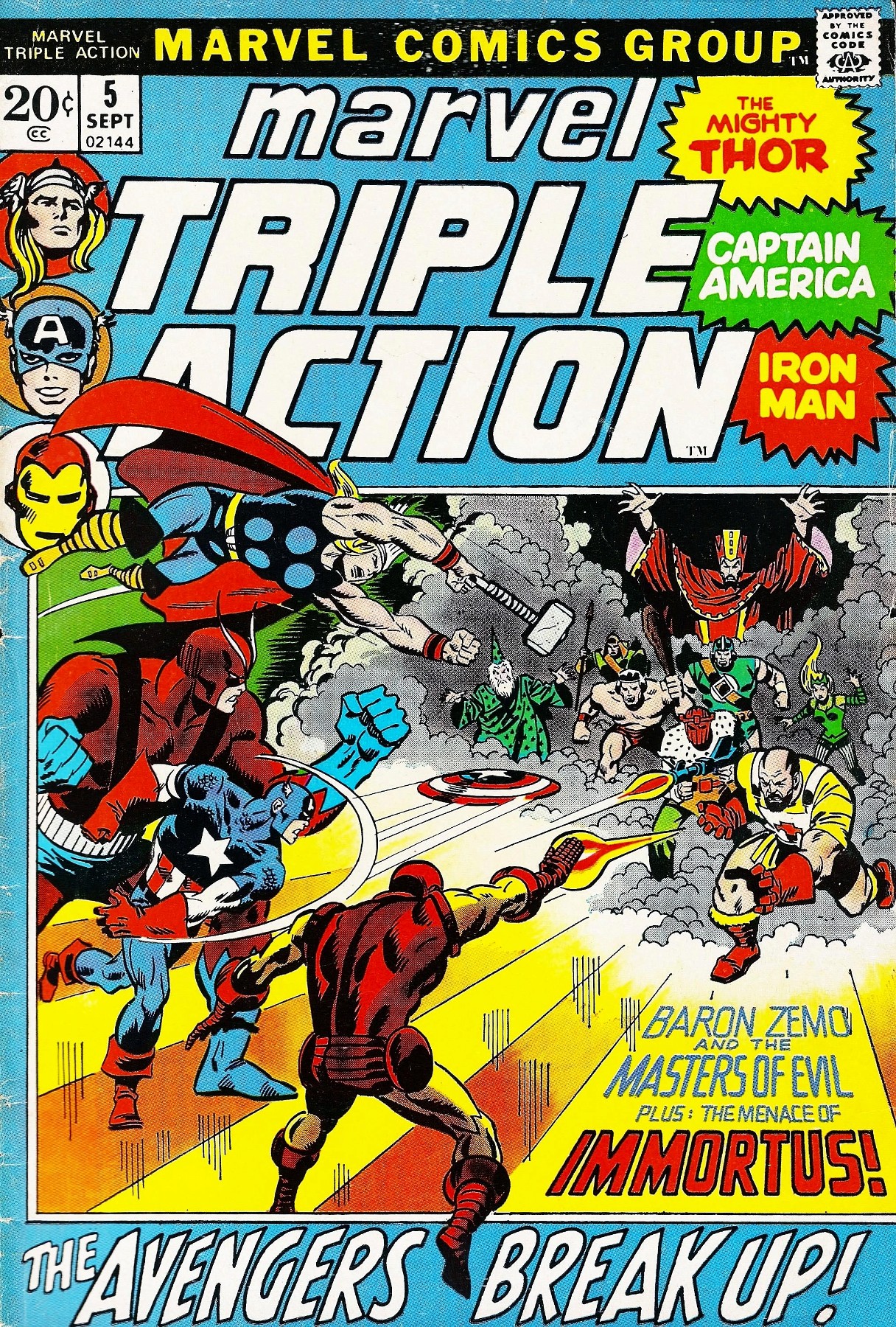


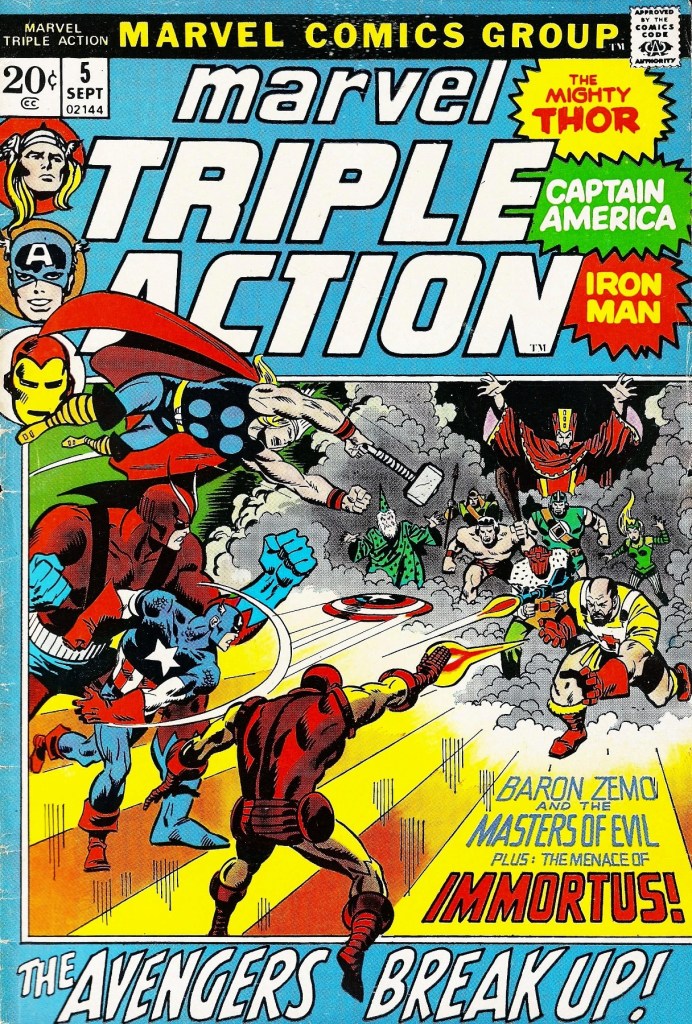
MARVEL TRIPLE ACTION was a bit of a weird series. It was launched as a Fantastic Four reprint series, despite the fact that Fantastic Four reprints were already headlining MARVEL’S GREATEST COMICS. So the decision to add another such book, one that was pulling from pretty much the exact same period, is a bit of a baffler. Anyway, somebody at Marvel worked out the problem with it before too long, and with this fifth issue, the series switched over to reprinting classic AVENGERS tales. (Neither source really justified the title MARVEL TRIPLE ACTION, but I assume that somebody just thought it sounded good and dramatic.) My buddy David Steckel had a couple of the early issues, which meant that I got to borrow and read them, this one among them. This Sal Buscema may be the best thing about it.
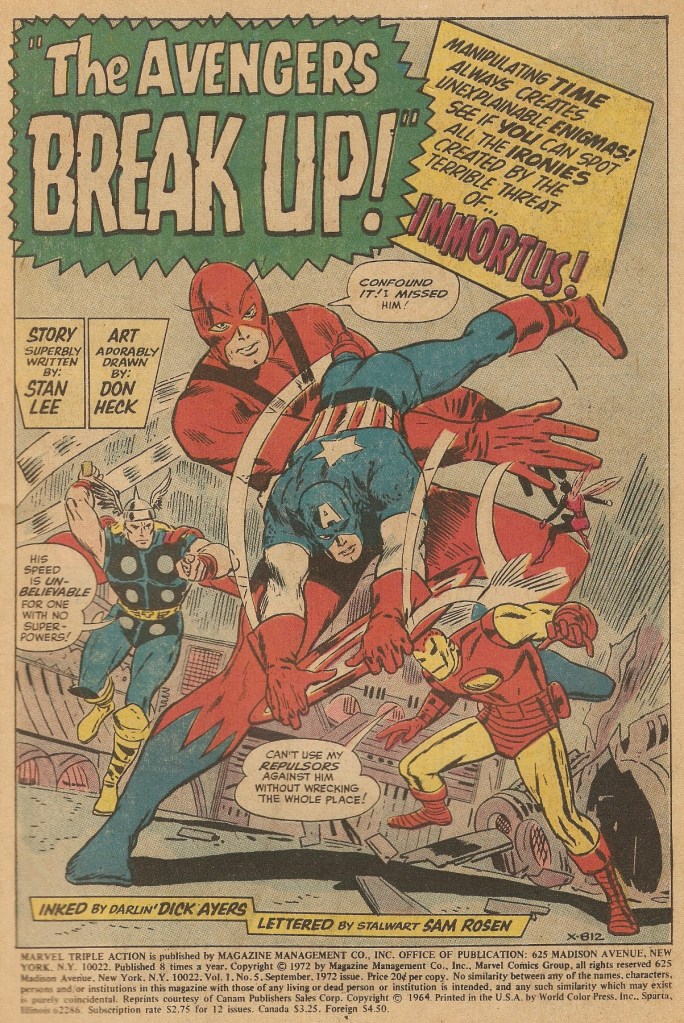
Reading this story, you can see straight away that AVENGERS was a book that was floundering after the departure of co-creator Jack Kirby. Artist Don Heck did a solid enough job on the visuals, but he couldn’t match Kirby’s vitality, nor could he plot the way the King could. It’s no wonder that in half-a-dozen installments, editor Lee decided to reinvent the series, dumping most of the headliner characters in favor of a trip of fan-popular villains-turned-heroes, who allowed him to focus more on characterization and interpersonal squabbles, the stuff Lee liked best. I mean, right away, this issue introduces Immortus, the second time travel villain the Avengers will have faced in three issues. (Eventually, of course, Steve Englehart would decide that Kang and Immortus were actually the same time travel villain–but that was still years away.)
The story in this issue is staggeringly stupid. it opens with the Avengers sparring with Captain America so as to get some action in up front. Afterwards, at the regular meeting, Iron Man suggests they make Rick Jones an official Avenger. But Captain America balks at this–he’s still smarting from the loss of Bucky in the war and doesn’t want to endanger another young partner. (In a sign of the times, the Avengers equate Rick’s induction to that of the Wasp, who apparently isn’t seen as a full-fledged hero by this crew.) Meanwhile, the Masters of Evil, who have been trying for issues to get one over on the Avengers, are suddenly contacted from afar by Immortus. He offers to join up with the Masters, and he pulls Paul Bunyan out of history to spar with the Executioner to prove his power–this despite the fact that Paul Bunyan was a fictitious character. Still, it’s impressive, and the Masters go along with Immortus’ plans.
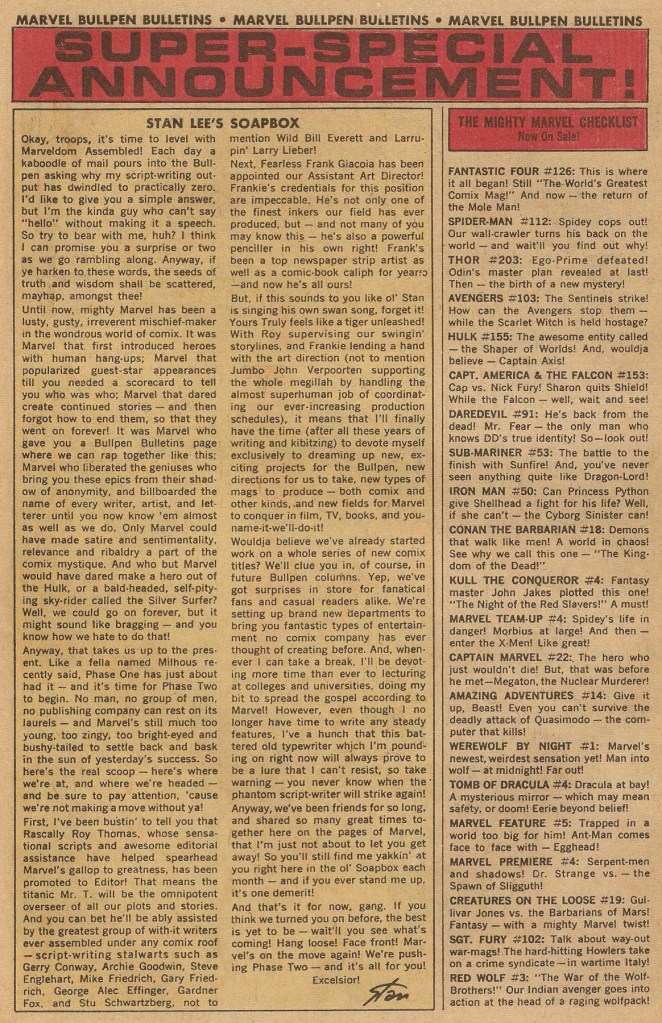
A quick pause here for the issue’s Bullpen Bulletins, which runs way up front this month. This was the month that stan Lee was kicked upstairs, becoming publisher and president rather than merely editor. The editor post, it is announced, will be passing into the hands of Roy Thomas, Lee’s protege, whereas Frank Giacoia has been brought on as art director (a post that he won’t hold for long.) So this was a legitimate moment of transition for the firm, one that set the stage for everything that was to follow throughout the 1970s.
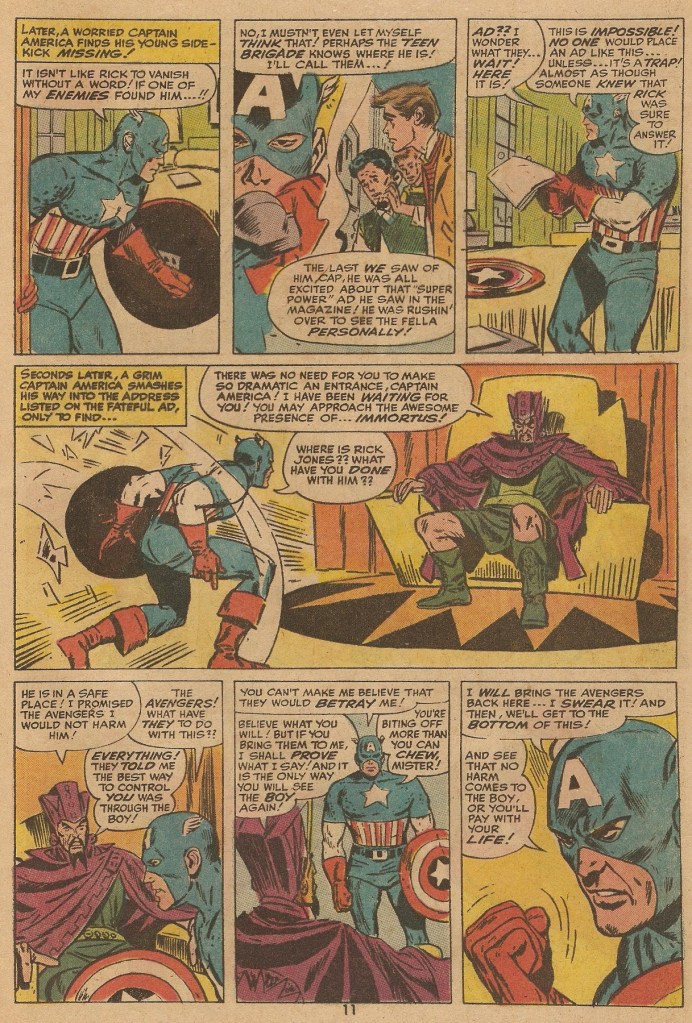
Immortus’ plan, believe it or not, involves taking out a back cover ad on the new comic books promising to give people super-powers, no strings attached. Rick Jones is so agog at the prospect that he doesn’t bother sending in the response form, he hustles right over to the address–where he’s promptly captured by Immortus. (Spare a moment, dear reader, for the many comic book fans who sent in their response coupons and waited, day after day, week after week, for a response from Immortus’ fly-by-night company. Truly, there’s no such thing as a free lunch.) Anyway, when Cap discovers that Rick is missing, the Teen Brigade points him in the direction of Immortus. Confronting the villain, Immortus tells Cap that he captured Rick because the Avengers told him to. Maybe Cap’s brain hasn’t quite thawed out completely yet, but this sends him back to Avengers Mansion where he attacks his partners and they go a few rounds.
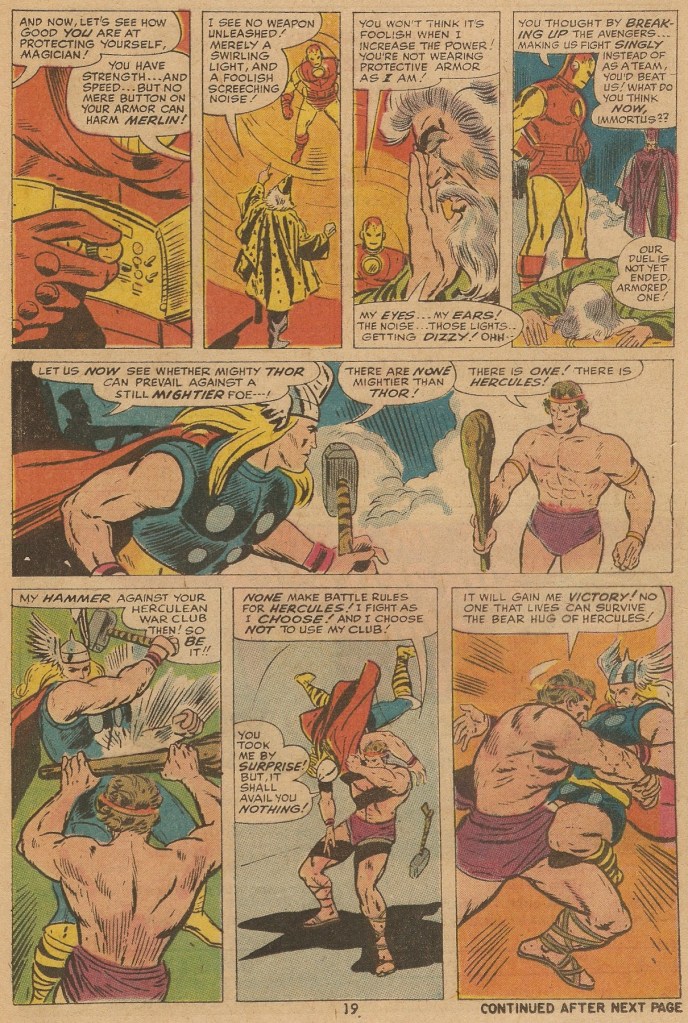
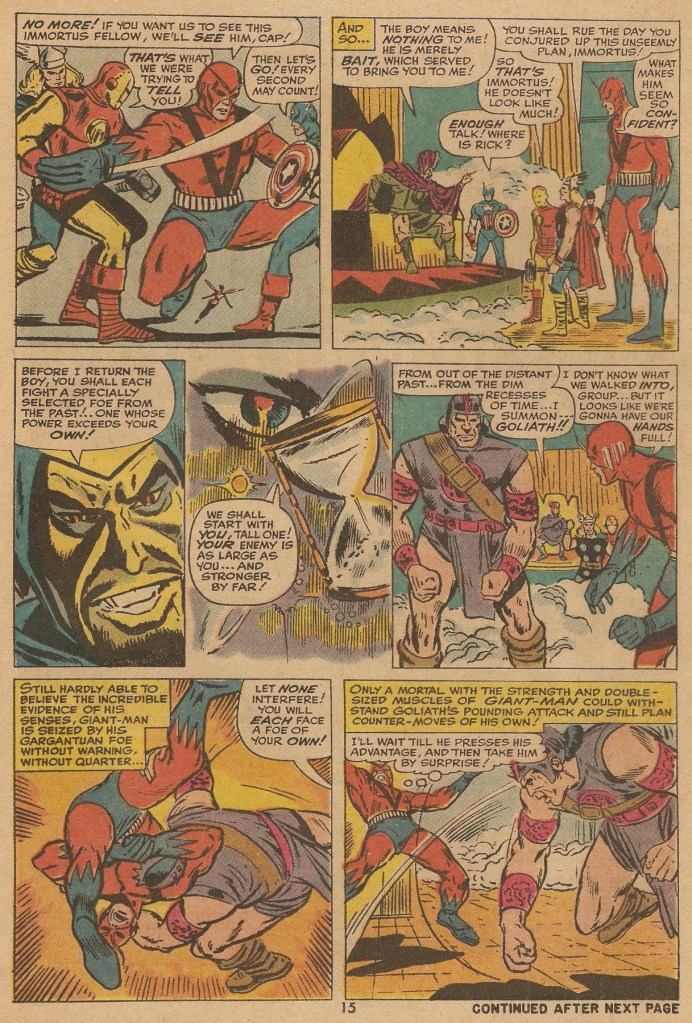
After the pitched battle reaches a pause, everybody decides to head back over to Immortus’ address and confront him (It took our heroes two-and-a-half pages to come up with this.) When they get there, Immortus tells the Avengers that in order to secure Rick’s freedom, each Avenger must dues a champion of Immortus’ choosing. So it is that Giant-Man does battle with the mythological Goliath, Iron Man duels with Merlin, and Thor does battle with Hercules (this was before the actual Marvel Hercules had been introduced in Thor’s own strip, which makes this sequence a bit difficult to reconcile.) The Avengers triumph each time, and Immortus, fed up with losing, takes off into the past with Captain America, leaving the rest of the team stymied. Cap is challenged to fight his way to Rick in the heavily-guarded tower in which he’s been imprisoned.
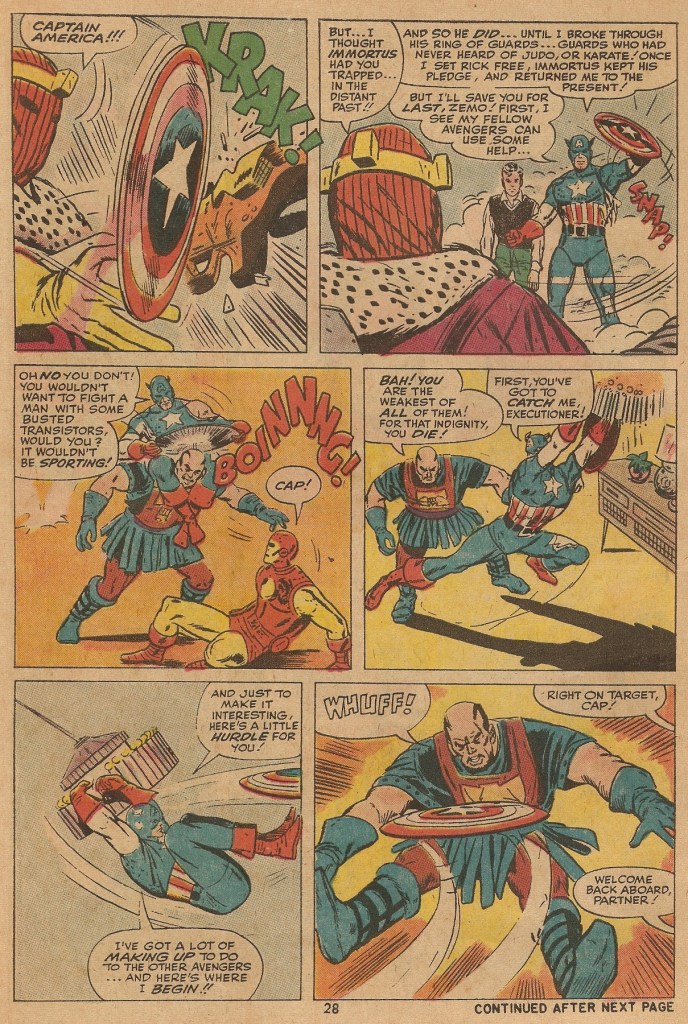
The Masters of Evil pick this moment to attack the Avengers. The heroes are demoralized by the loss of Cap–a man who only hours earlier though they had turned over a hapless teenager to an amoral villain. Consequently, they aren’t really at their fighting best, though they do gamely hold off the Masters. But then a commanding voice rings out–it’s Captain America, back from the past with Rick. In the space of a word balloon, he explains that his knowledge of modern fighting tactics such as judo allowed him to overcome all of Immortus’ guards, and that the Master of Time was as good as his word and let both Cap and Rick return to the present. Cap rallies the Avengers, and the tide begins to turn against the outnumbered Masters of Evil.
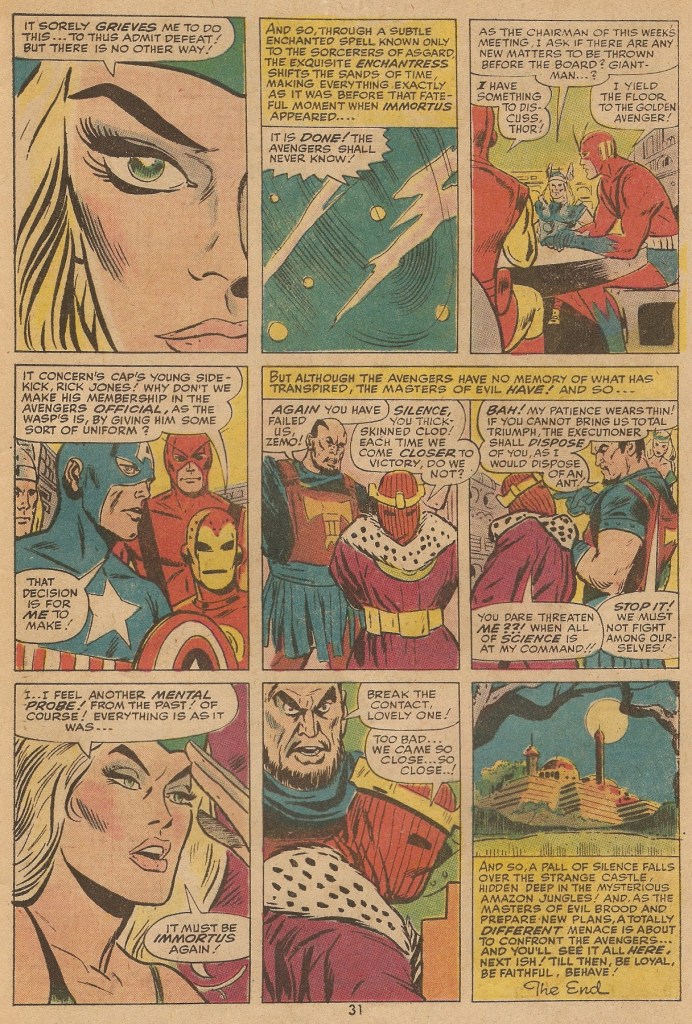
At this point, staring down total defeat, the Enchantress unleashes a potent spell that turns back time, rewinding events to the very beginning of this story. This is really the ultimate cheat, as none of the events that we just read happened any longer. In this new arrangement of history, Immortus reaches out to contact the Masters of Evil and they in effect hang up on him. You wouldn’t think that would be enough to put Immortus off, but it apparently was. He wouldn’t resurface for a decade, not until Steve Englehart put him into context with Kang the Conqueror–though theoretically, Immortus never battled the Avengers in the past as a result of this lame ending.

