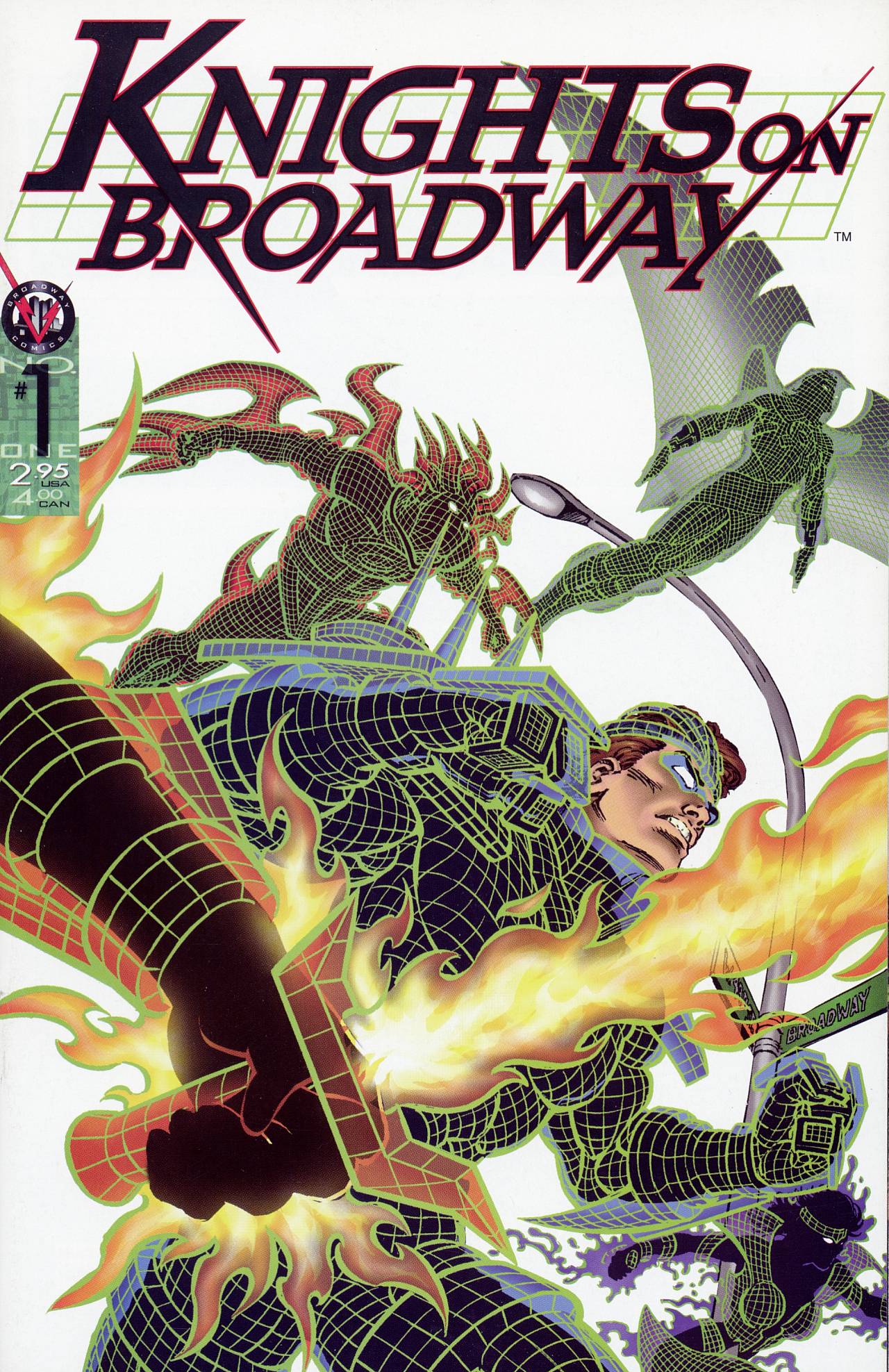


By the time a short while later that KNIGHTS ON BROADWAY #1 was launched, the bloom was already off the rose at Broadway Comics, Jim Shooter’s latest and last attempt to start up another successful comic book publishing company. Jim had been ousted from first Marvel and then Valiant, and his attempt to build Defiant was besieged from all sides. When that venture ran out of capital, Shooter managed to secure an agreement with Lorne Michaels’ Broadway Video operation to finance a new line of comics. But in 1996 when these new releases were coming out, the comic book market was in a sharp retraction, and companies and stores were going out of business left and right–the speculator boom that had brough tons of money into the hobby having burst as buyers moved to flip their sure-to-be-valuable purchases and found no takers for them. The bottom dropped out almost overnight, and in the cascade of crashing sales trends, there was little room for a new outfit to make a splash. As much as anything, this is why Broadway Comics is virtually forgotten today.
I suspect that the other reason why Broadway’s output has fallen into obscurity is that Shooter himself must have been growing a bit bored with doing the same old thing over and over again. The Broadway titles are weird, even more so than the Defiant books (which themselves were pretty esoteric.) It’s hard to really say exactly who Shooter and his crew thought their prospective audience was going to be. Each series was a heroic fantasy of some sort, with a nod towards costumes and always some degree of superhuman powers. But none of them were what could be easily quantified as straight up super hero titles. In several cases, they defy description altogether. So it was great that Shooter was pushing the boundaries and trying new things. The problem may have been which boundaries he was pushing and why he was pushing them. The work doesn’t seem to be in service to anything that was likely to turn into a commercial hit.
That all aside, KNIGHTS ON BROADWAY was the Broadway title that I followed the longest (even though that didn’t turn out to be very long ultimately.) And what I think I liked about it more than anythiing else was how utterly unquantifiable it all was. While the series had been conceived by the usual Shooter Broadway braintrust including himself, Janet Jackson and Pauline Weiss, this first issue was actually written by Joe James. The artwork was delivered by Geof Isherwood, who had been a regular in the field for some time. Consequently, it looks a bit better put together than the average Broadway release–the company tended to have been forced to use either newcomers or older veterans who were towards the ends of their careers, and it showed in the finished product.
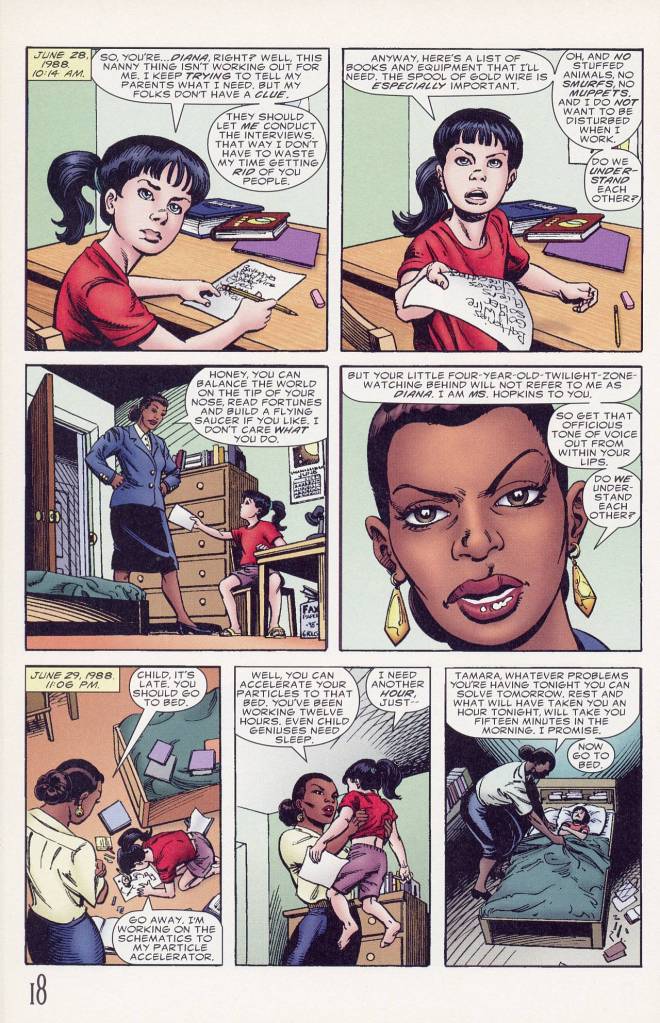
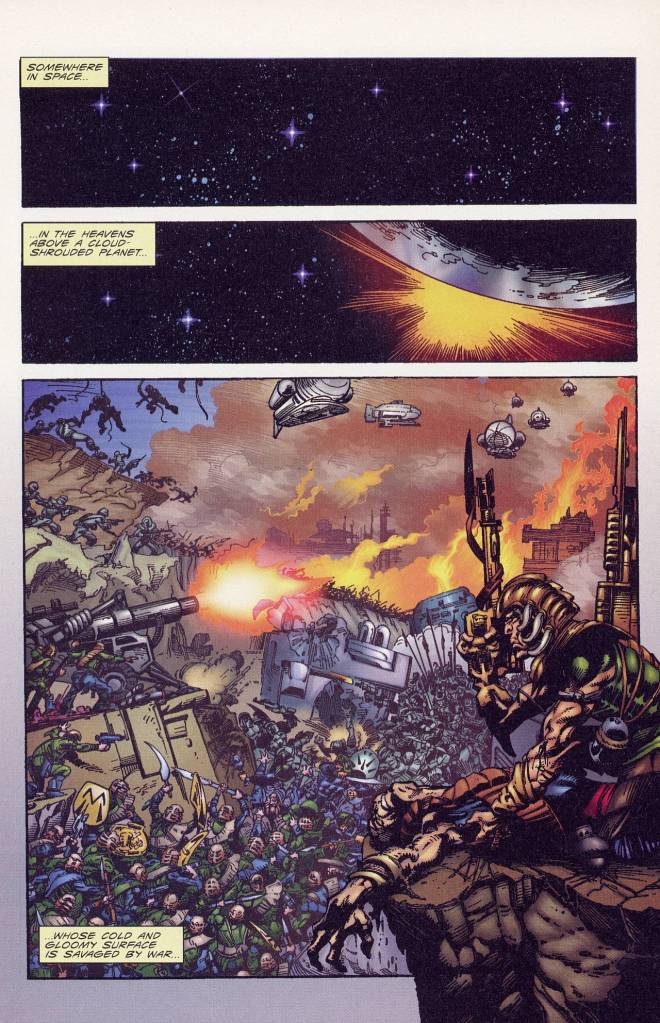
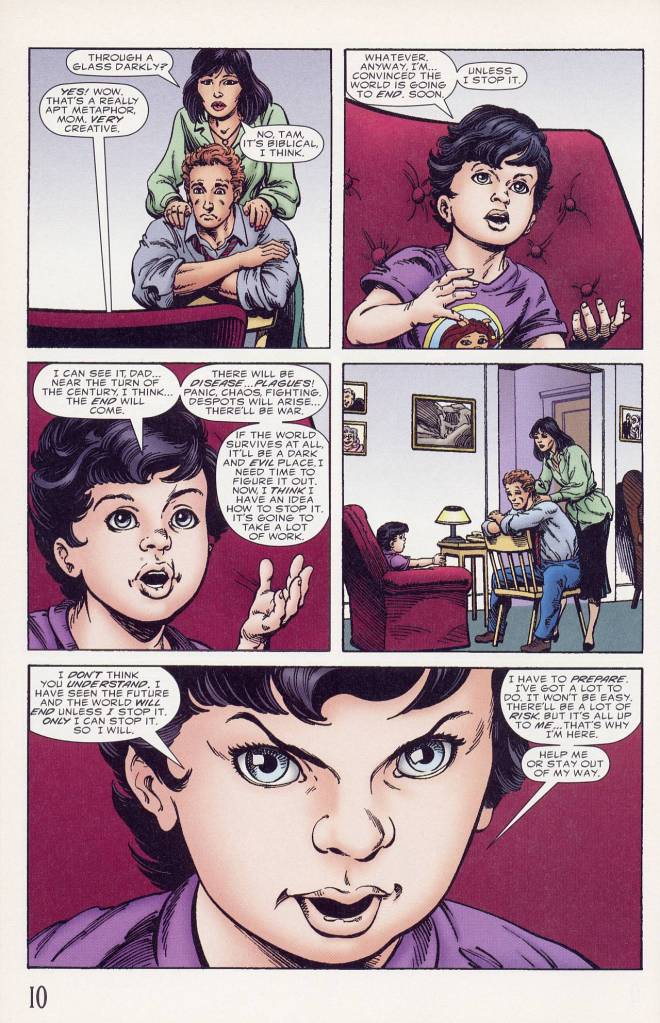
After a prologue in which we witness an alien planet get utterly destroyed by a point singularity that appears in its atmosphere, the scene switches to Earth and the Christening of infant Tamara Bryn Neil. We follow Tamara’s early years, skipping forward in time in a couple of instances, and learn that she’s an incredibly smart and aware child for her age–far greater than any natural intellect. It’s disconcerting to her parents Jennifer and Dan when she starts speaking before the age of two, and with a vocabulary beyond their own. What’s more, Tamara indicates that she can see glimpses of the future, and of an impending catastrophe that will destroy the world at the turn of the century. Tamara, however, intends to prevent her visions from coming through–and to that end, she need all manner of scientific equipment. Her parents aren’t quite sure what to make of her dizzying intellect, but coupled with it is a streak of sociopathy that has Tamara eliminating any obstacles to her goals: such as planting evidence to prove that her restrictive nanny is a raging drunkard.
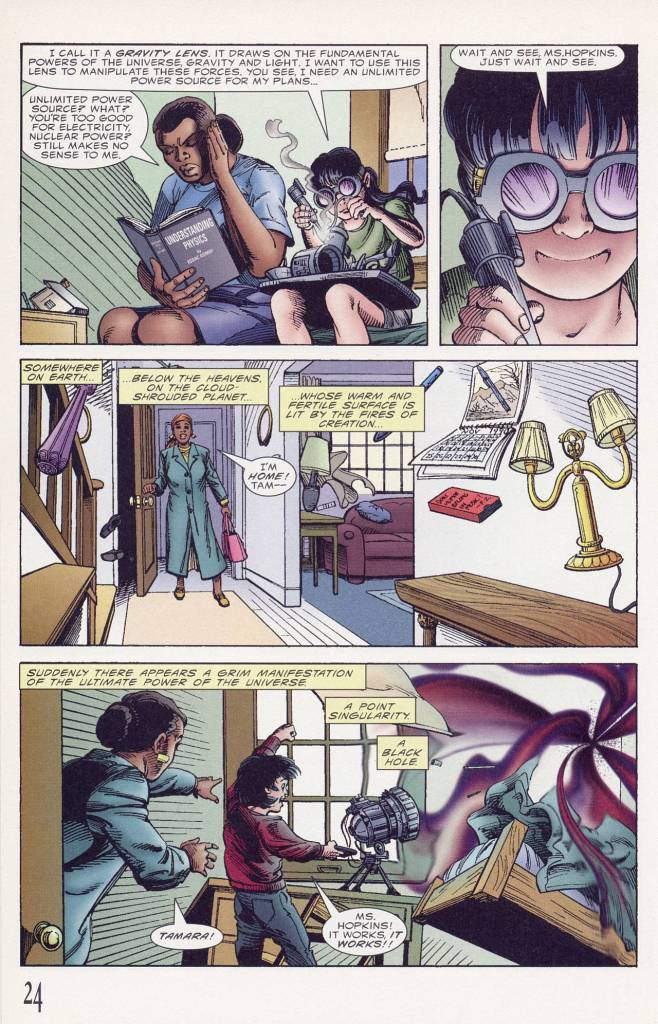
Frustrated and unable to adequately control or even deal with their super-genius daughter, Dan and Jennifer attempt to locate a Nanny for her who can. That Nanny turns out to be Diana Hopkins, who’s a no-nonsense hard ass that nevertheless listens to what Tamara tells her about her visions and believes at least that Tamara believes in them. She becomes a co-conspirator in Tamara’s experiments to harness the fundamental forces of the universe, getting her the tools and equipment and resources she needs to construct a makeshift Gravity Lens. Unfortunately, when Tamara activates the Lens, it momentarily forms a Point Singularity that consumes the family’s entire house in the brief instant that it’s open. Diana is aghast at the damage, but Tamara sees only the possibilities. She stares into a bit of broken glass and imagines the possibilities–and then the narrative jumps sharply into the future.
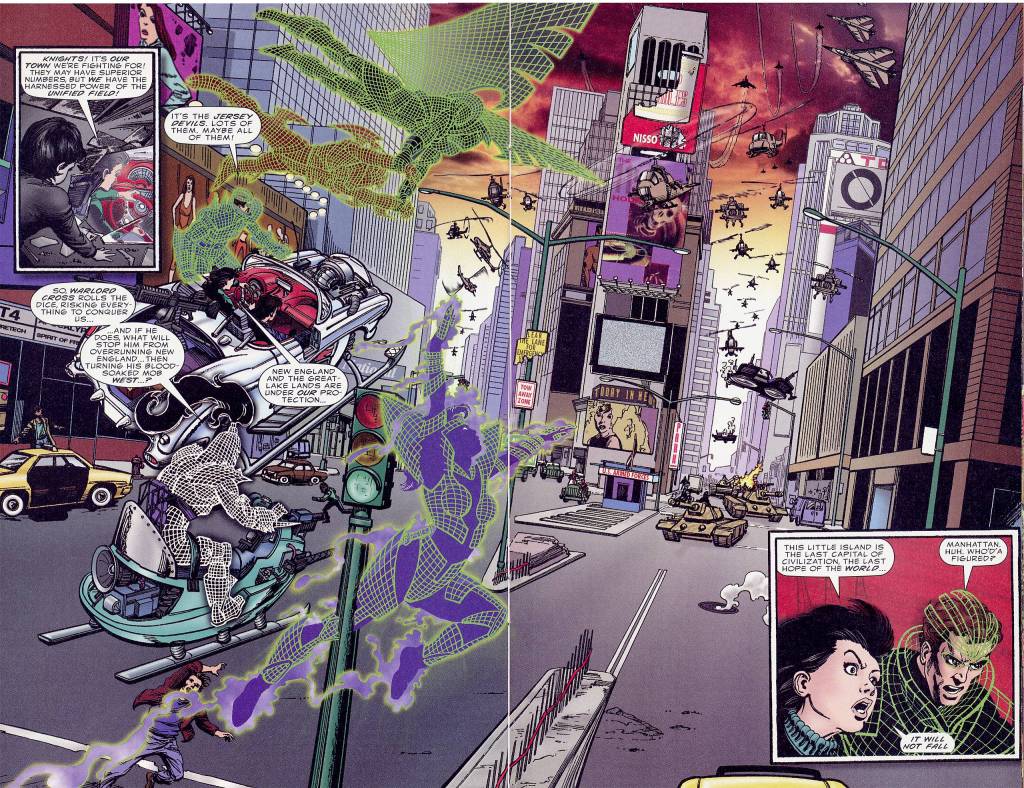
As Tamara sees what is to come, we enter the world of her vision for a firsthand look. Many years later, she’s leading a team of Knights clad in strange biotech armor against an incursion by the Jersey Devils gang–in the future, Manhattan is the last stronghold of civilization in a world gone to ruin. The Knights include the fiery Sizz, the commanding Choo-Choo, rapper and blade knight Ron-Ko, Shady the ghost knight, Flapper the flier and the axe-wielding Blackwhite. As a combat team, they’re able to drive the Jersey Devils back and to prevent them from dropping a Bio-Bomb on Manhattan. In this future time, Tamara is the group’s leader, their Seer. As code-names go, it’s all a bit of a bust, really.
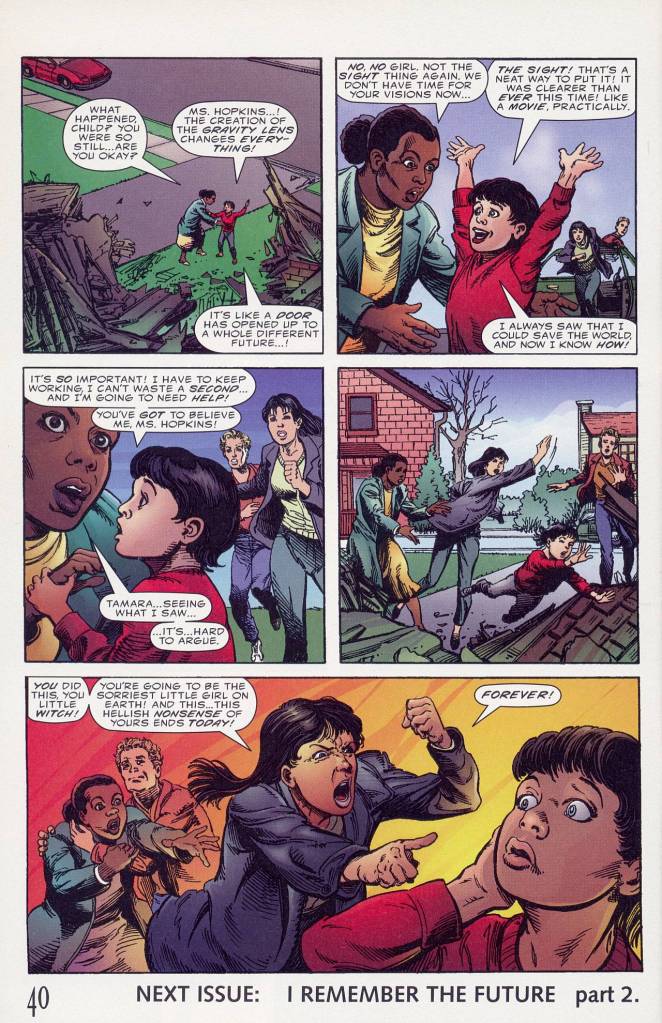
And as this first issue wraps up, we segue back to the present, where Tamara comes out of her fugue state excited about the possibilities that the application of her Gravity Lens could bring about. But it’s at this point that Tamara’s parents arrive home–or at least where their home used to be–to find only an empty lot and some wreckage where their house once stood. Jennifer flips out and slaps Tamara, telling her daughter that she’s going to be sorry for what she’s done, and that she’s being cut off from working on her science henceforth. To Be Continued! The whole story is weird, but not uninteresting, and even though its events don’t add up to a whole lot–the flash-forward to the future was clearly a way of getting some super hero action into what otherwise had been a relatively quiet tale about raising a genius girl–it was all off-beat enough that I wanted to see where it would all go. Shooter’s editorial page in this issue indicated that the story was five parts in all, but only three issues of KNIGHTS ON BROADWAY were ever published. So I suppose Tamara’s visions were accurate and the end came at the turn of the century, for Broadway Comics at least.


I’m definitely a fan of Geof Isherwood’s art, but if you hadn’t told me this was his work I would not have known. Looks totally different than his usual stuff. Maybe because of the inker? Oh, well, it still looks nice. And the cover is definitely better than any of the other issues from Broadway Comics that you’ve previously spotlighted.
LikeLiked by 1 person
My second-favourite comic series named after a Bee Gees song, after GIANT-SIZE NEW YORK MINING DISASTER.
LikeLiked by 1 person
Did you the premiere issues of the horror title SPIRITS HAVING FLOWN and survivalist series, STAYING ALIVE?
LikeLike