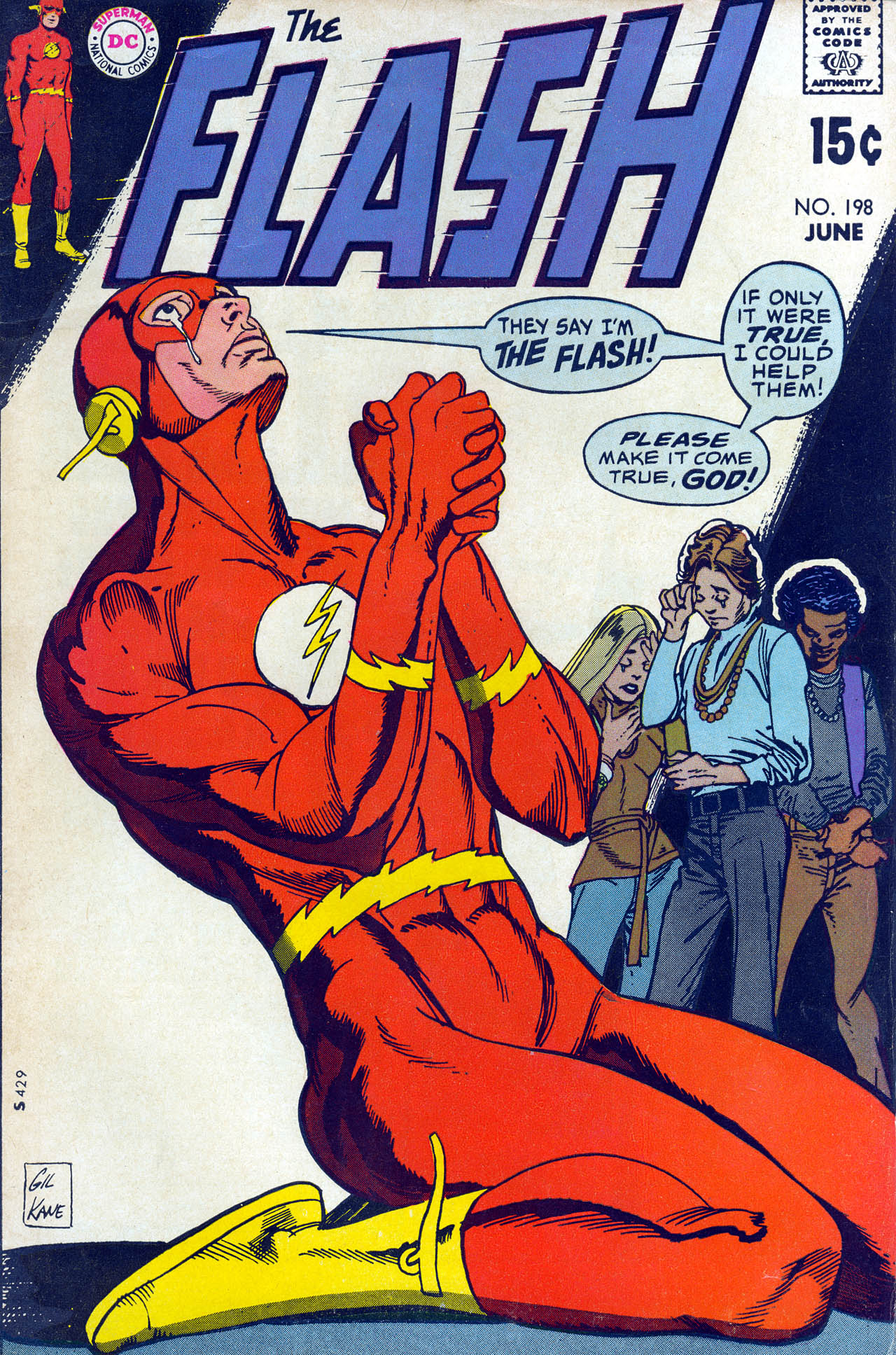


It was the summer, so it wasn’t all that difficult to convince my grandparents to take me on another buying trip to the Sun-Vet Mall not far from our home wherein Ed’s Coins and Stamps, a collectables shop, could be found. My grandparents lived about an hour away from our home, and they would come out to our house regularly every Saturday to visit my Mom and Dad and the family. They were fine people, albeit from another generation, so while they didn’t understand my obsession with comics (My grandmother would often intone, “Why do you need so many books?”) they were still a relatively easy touch–far easier than my Dad. And so, on the next Saturday, we went out to that store and I picked up a bunch of assorted back issues including this issue of THE FLASH. I bought it solely because I was intrigued by its cover–though even then, I thought Gil Kane’s depiction of Flash’s right arm looked as though it had been twisted up, like a rubber figure whose limb had been wound around. But something about the character’s emotional plea got me to take home the issue, so Gil had the last laugh there.
At the time when this issue was first published, the 1960s and the Silver Age of Comics had given way to whatever was going to come next. Super hero comics were on the wane, and while a bunch of titles managed to hang on, there was a bit of a feeling of desperation to be found in their pages as writers, artists and editors thrashed vainly around to find something that would connect with an audience in 1970. The big push at the moment, based off of a couple of stories written by Denny O’Neil that had gotten some small media pick-up, was for relevance: tales in which the super heroes grappled with real world issues. Unfortunately, when it came to understanding the issues that the youth culture of the era were dealing with, the creators at DC were still largely middle aged white men who didn’t have the understanding of the changes that were happening in culture, and indeed were often frightened by them. This meant that the messages in these comics often felt phony and patronizing. I don’t know that the Flash is the best character to be dealing with contemporary issues in the first place, given his world. But it was an approach that showed a spark of life, and so DC went full bore in that direction for a couple of years before the trend burned itself out.
The other thing happening at DC at the time was a changing-of-the-guard creatively. A parcel of DC’s established writers had been let go after they attempted to bargain collectively for benefits such as health insurance. This led to a creative shake-up on all of the titles, and an opportunity for some new young voices to come in. But that isn’t what happened on THE FLASH. Here, the title’s mainstay writer John Broome had relocated to Japan, putting his life as a comic book writer behind him. After a period of time during which editor Julie Schwartz tried out a rotating cast of different writers, he eventually settled on giving the series to his office-mate Robert Kanigher. Kanigher had written the very first Barry Allen story in SHOWCASE #4 back in 1956, so he had a familiarity. But Kanigher’s heart was never really into working on super hero comics–you get a sense that he thought they were beneath him. And so his FLASH stories carry a veneer of artificiality to them. What’s more, he moved the strip away from colorful super-villains and science fiction plots and more towards emotional fare that didn’t entirely connect. This is really a slump period for the title.
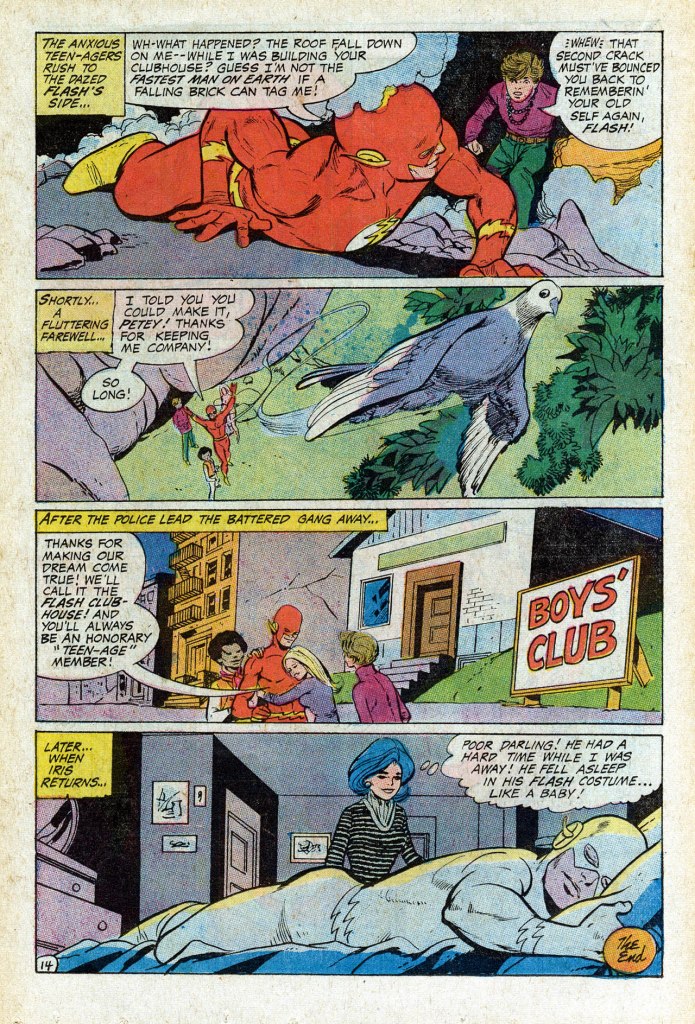
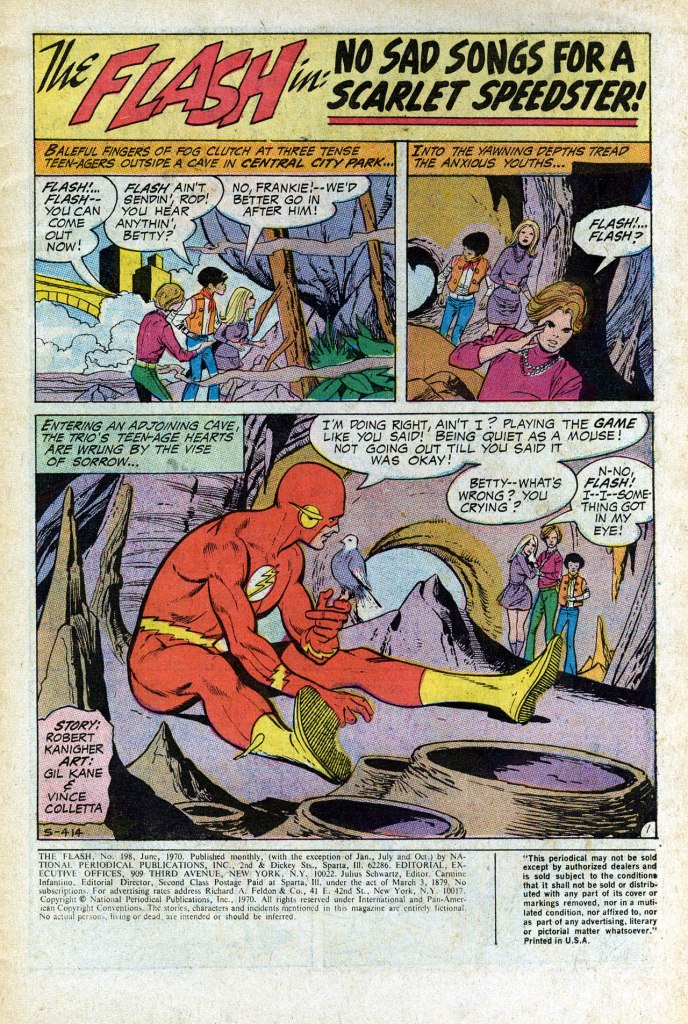
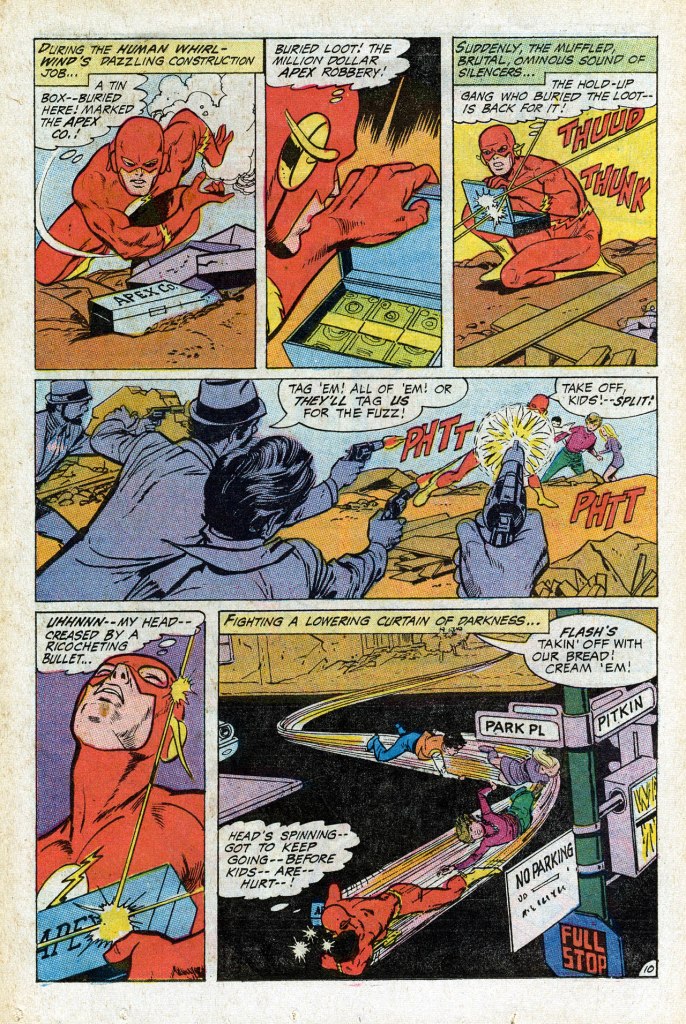
This opening story is illustrated by Gil Kane and Vince Colletta–not my favorite pairing, but Vince does decent enough work here. The story is pure Kanigher: Flash is performing at an orphanage, but a trio of kids who seem to directly be inspired by the then-contemporary Mod Squad, don’t dig his antics–he can’t understand their problems, man. In trying to win them over, Flash volunteers to build them a rec center club house in the slum they call home–but in digging the foundation, he comes upon stolen loot that’s been stashed there by criminals. The bad guys show up and Flash’s nogging is creased by a bullet, giving him amnesia and making him believe that he’s eight-year-old Barry Allen. The three kids need to look after the memoryless Scarlet Speedster and keep him safe from their attackers. In the end, they convince young Barry that he’s the Flash, he wipes up on the crooks, he takes another blow to the cranium that restores his memory, and the kids get their clubhouse and have learned that the old square is all right and an “honorary teen-ager.” It’s all a bunch of convenient nonsense, and it tries its best to tug on the heartstrings. But it ultimately failed for me.
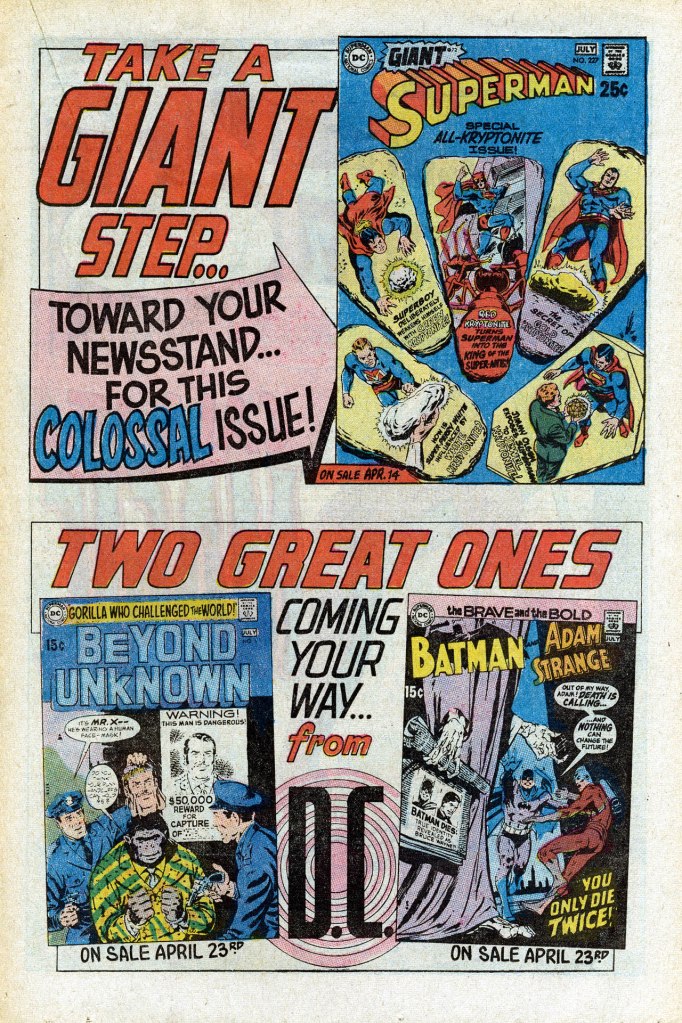
THE FLASH was still most often featuring two stories each issue during this period. Between them, this House Ad ran, which helps to give a sense of the time period as well. It’s a bit more bombastic than the DC House Ads of the 1960s, channeling just a hint of the Marvel approach in its copy. Of the three titles showcased, two of them are reprint books, though they’ve been plussed up by carrying new contemporary covers. So there’s a lot of intrigue to be had here for an interested reader of the age.
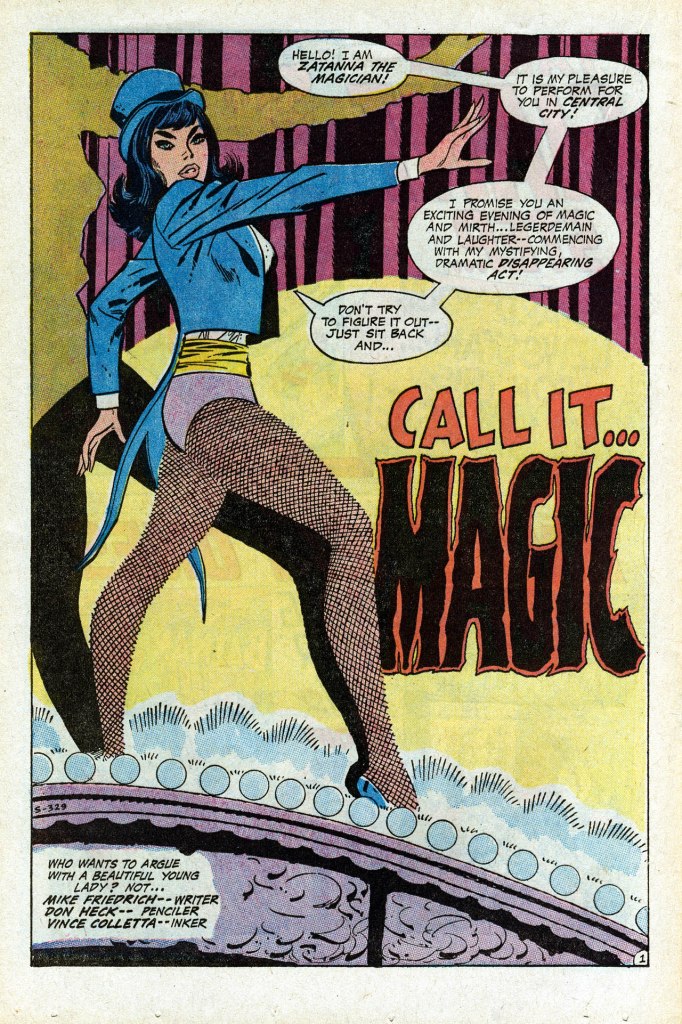
The back-up story in this issue was written by one of the newcomer writers who stepped into the space left open by the exodus of so much of DC’s established writing talent. This was Mike Friedrich, who had started out as a regular letter writer to editor Julie Schwartz’s titles. At a certain point, Julie apparently invited him to pitch some stories, and bought a bunch of them. Friedrich became a regular writer for both DC and Marvel throughout the 1970s, and was one of the pioneers of the “ground level” comic book movement that came about in the earliest days of the emerging Direct Sales market. Here, he’s matched with Don Heck, who had migrated to DC when work began to dry up for him at Marvel. He too is inked on this story by Vince Colletta, but again here, Vince does a credible job with it–although Zatanna’s face on this splash page looks rather lifeless and dolllike.
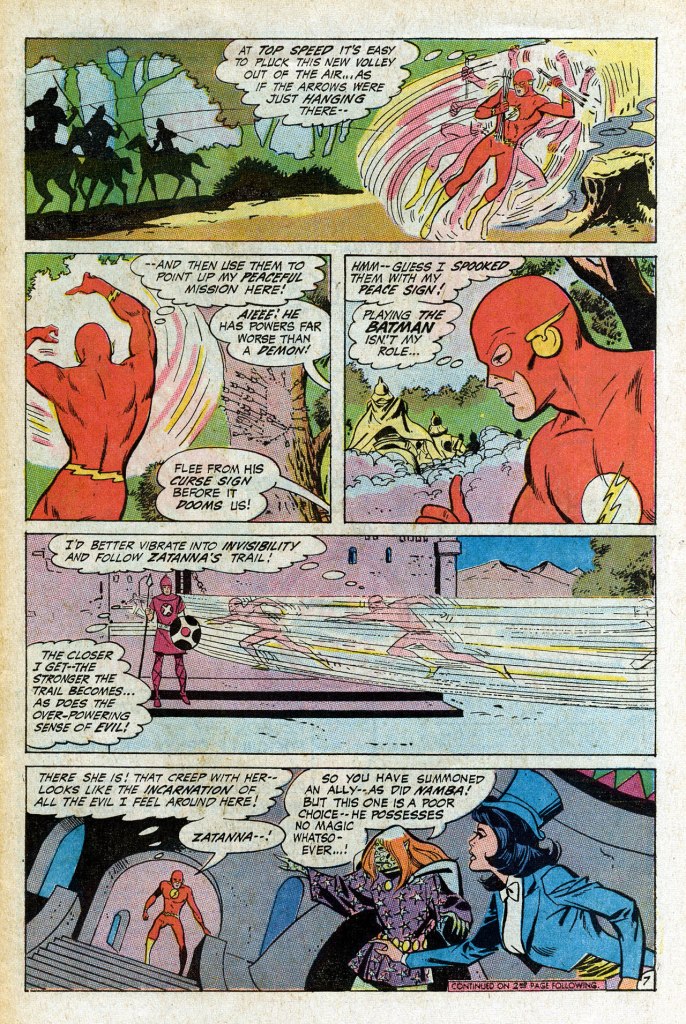
The story opens with Barry and Iris Allen attending a magic performance being put on by Zatanna, a character who had bounced around in the Schwartz books for several years and who was something of a fan favorite–largely due to her attire. As Zatanna is performing a trick with Barry, she suddenly vanishes, drawn away to another magical realm. She’s been summoned to help the magician Namba, who has been possessed by his arch-rival Xarkon. In the instant that she disappeared, Flash goes after Zatanna using his Cosmic Treadmill–there’s some nonsense about Zatanna having left behind certain vibrational frequencies that Flash can track, but it’s completely implausible and hand-wavey. Arriving in the fantasy setting, Flash is set upon by guards on horseback dedicated to Xarkon’s cause. But he’s able to easily overcome them with his super-speed.
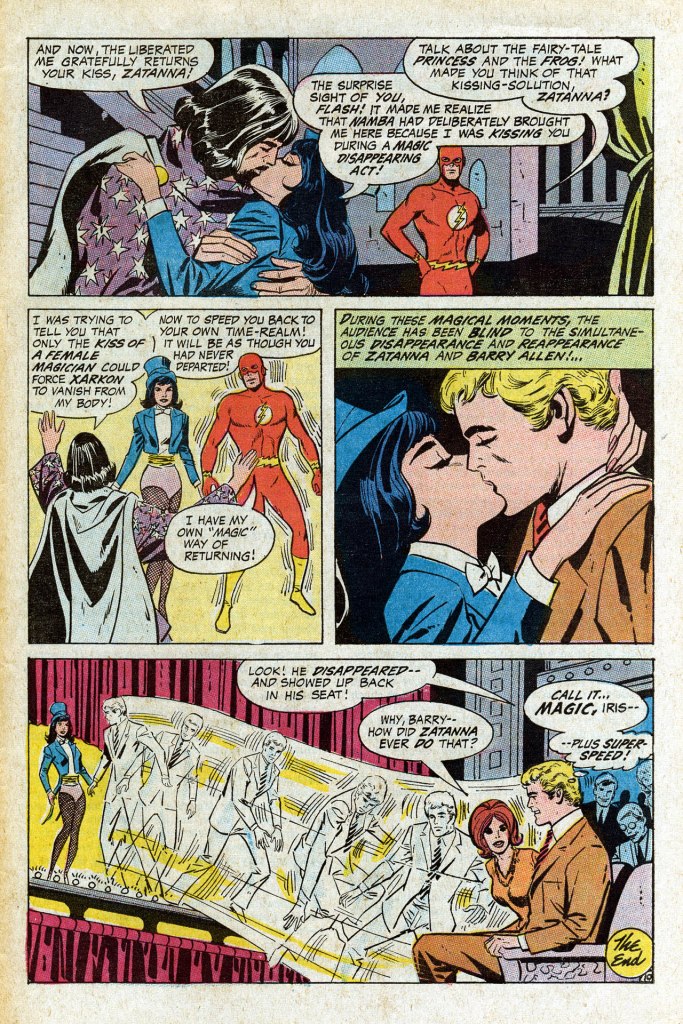
Xarkon, though, is mightier than his minions and he’s able to freeze Flash in his tracks, holding him immobile. Unable to separate Xarkon from Namba with her magic, Zatanna instead tries kissing him –and that does the trick, exiling Xarkon back to whatever nameless realm he escaped from. Turns out that this is why Namba brought Zatanna here in the first place. With the adventure over, both Barry and Zatanna are transported back to the stage, with only an instant having transpired for them, and so they’re able to continue on with the performance with the audience unaware that they were ever gone. As a bit of an overbearing motif throughout this story, Friedrich has various characters express variations on the line “Call it magic”, which was also the story’s title. This one was a bit better than the opener, but it’s really a Zatanna story that the Flash happens to coincidentally be in for a bit, so it’s not truly satisfying from the point of view of the book’s lead character.
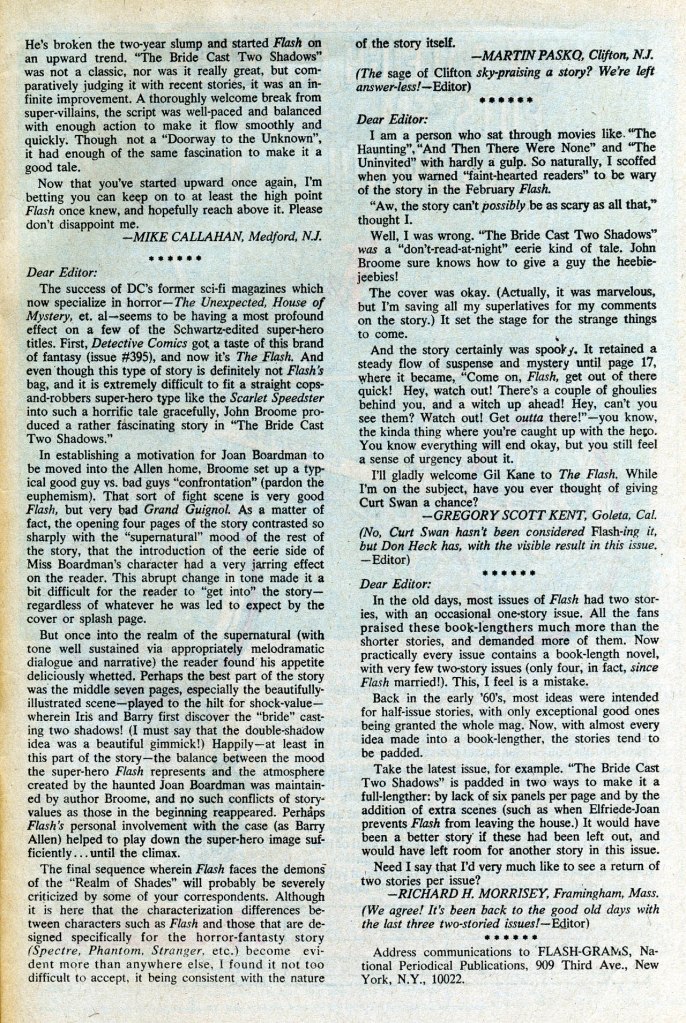
The book’s two-page FLASH GRAMS letters page included a communication from another letter writer who would transition to working for DC in the months to come: Marty Pasko. At this time, Marty had been nicknamed “Pesky” Pasko due to his penchant for pointing out logical fallacies and flubs in the stories Julie and his team were putting out. But his brickbats were written well enough that Schwartz took a chance on him as an author as well.


Denny O’Neil got the headlines but Friedrich was doing relevance even sooner, I think.
I’m not a fan of Friedrich’s work but I find his Flash stories appeal to me. The Zatanna story worked for me; it was also her first appearance in three years.
LikeLiked by 2 people
There was a time where my then girlfriend (eventually my wife) and I were obsessed with buying Flash comics where he was particularly distressed / menaced on the cover and this was one of the ones that made the cut
LikeLiked by 2 people
It’s remarkable how many DC covers of the time showed the heroes “particularly distressed,” with emotional scenes of defeat, betrayal, humiliation and reproach. (And lines of cover dialogue like “The man who could have saved the world is DEAD… and I KILLED HIM!”) They also tended not to be much related to the stories inside.
LikeLiked by 1 person
I’m sure a kiss from Zatanna could cure lots of things
LikeLiked by 2 people
It would certainly help cure my relative lack of interest in this comic book.
LikeLiked by 1 person
I just read this and I found neither story interesting. I did find the Mod Squad teenagers (that’s a TV show I hadn’t thought about in decades) unrealistic as they go from not interested in Flash to Flash is great (when he builds them a club house) to we have to protect Flash. Also, what’s up with the pigeon? It seems like it can fly, but it returns to Flash and stays with him for the duration. And what’s with building the clubhouse in the slums? Who’s it for? Finally, the last line made be think of U2’s song Sleep Like a Baby Tonight.
As for the backup story, I’m not a Zatanna fan, and the Flash is just a supporting player in it. I my opinion the whole story is just an excuse to make the Princess and the Frog reference.
LikeLike
Say what you will about Carmine Infantino’s stint at DC, that house ad page is still pretty awesome.
LikeLiked by 1 person
Good memories of grandparents and comics. Through middle school and high school I’d spend 2 weeks in the summer at my grandmothers’ in rural PA. I’d do chores for her. Mow the lawn (just under 2 acres), sweep out the garage, run the vacuum in the house. She’d offer to pay as I entered my teens, but i didn’t accept it. But there was a comicbook store in town, on the same street as one of her favorite lunch cafes. So once a week during those 2 weeks, she’d treat me to comics. She was a great cook, too. And baker. Homemade pies, often with berries we’d pick ourselves.
Gil Kane’s art is clear & crisp in this. Dynamic figures and emotive faces. A decade or so later he’d get too detailed for me. Too cluttered. Maybe Vince Colletta was a factor, but nothing seems missing. 😉. No “Collettaral damage” we’d see much more of in the coming decades. Especially over Kirby’s work.
No harm done to Don Heck’s drawings here, either. All those fishnets accounted for. Funny Tom said Zatanna looked “lifeless and doll-like” in that opening page. The drawing reminded me of actress Megan Fox in her heyday. “Lifeless” wouldn’t apply…
LikeLiked by 2 people
Since when are babies known for falling asleep in Flash costumes?
LikeLiked by 1 person
Gil Kane was famously dismissive of Vince Colletta’s inking, so I’m sure he was anything but thrilled at being inked by him on this story. There’s an anecdote (I don’t know if it’s true or not) about how Kane once stated that Colletta was his second favorite inker, and when then asked who his first favorite inker was Kane answered “Anybody else.”
I do wonder if this is one of those cases where editor Julius Schwartz came up with the cover concept first and then had the writer devise a story to go with it.
I’m a bit more forgiving of Colletta’s inking of Don Heck’s pencils on the second story, because Colletta seemed to put in more effort when given a story with a pretty girl, and Zatanna as drawn by Heck is indeed sexy. I’ve always said Heck was good at drawing beautiful women.
LikeLiked by 2 people
Never heard of this issue before and also never knew Kane had ever drawn Barry or Heck had done so before the wrongheaded temporary case of death Iris came down with. Colletta was better than usual here, I agree, and we can’t credit solely the caliber of the artists since he’d destroyed their efforts elsewhere. Maybe he’d had a lottery win and could take the time to ink instead of erase?
LikeLiked by 1 person
I take it you mean that you never knew that Gil Kane drew the Flash in his comic and not in Green Lantern#13, 20 and 43? I decided to check if Gil drew an issue of Wonder Woman and the answer is no ( Action Comics, Superman, Batman, Detective Comics, Metal Men, Teen Titans ( vol.1 & 2 ), Strange Adventures ( Adam Strange –#222 ), The Flash, #195, 197-199 to name a few series ).
LikeLike
Yes, I meant the series. That’s the trouble with titles that are the just the character’s name.
LikeLike
This is why I capitalize titles. You’re not gonna confuse Flash and FLASH.
Of course, here we can italicize words, some we could refer to Action Comics, Amazing Spider-Man and, of course, Flash — but lots of places online don’t have that option, so I’ve learned to use caps reflexively.
LikeLike
That’s a good system but my anal retentiveness would never allow it unfortunately.
LikeLike
While I understand the economic need to maintain readers, the only thing worse than disregarding changing tastes would patronizing them. Of which, the heavy handed and disingenuous lead story does so in embarrassing fashion. While I didn’t mind the art at all – actually in either story – Kanigher’s distain for what he’s doing comes through gongingly clear.
While I freely admit that my knowledge of Robert Kanigher’s work is minimal, when I see his name, I’m immediately drawn to the particularly dreadful Iron Man #44 where he had one half issue to write and even that he badly botched with his pretentiousness. (Review: Iron Man #44)
On a more positive, but embarrassingly shallow note, Tom is spot on about Zatanna in that between her cute top hat and those fishnet stockings, I would’ve been fine with her simply devoting those pages to her reading the ingredients from a soup label.
LikeLiked by 1 person
Silver Age Boomer writers had Zatanna and Black Canary in the ’70s – ’80s looking like Las Vegas showgirls!!
LikeLiked by 1 person
At least Zatanna dressed like she was onstage in Vegas, which was true to the character. Canary always looks like she just got off work waitressing and had no time to change clothes.
LikeLike
The Black Canary’s classic costume is also based on a nightclub performer’s — but in her case, a late-1940s singer rather than a magician’s assistant.
LikeLike
I liked when it got a punkier feel to it. It sounds like it has similar origins to Superman’s trunks.
LikeLike
Enjoyed the insights as usual, and I’d completely forgotten about Kane’s run on the title.
That said, I found the reference to “largely middle-aged white men” at DC, who supposedly lacked an understanding of the cultural changes taking place, a little jarring.
The reference to age is certainly worth making. The ‘generation gap’ is something most of us will experience to some extent, despite our best efforts to keep up with the times. But the fact that DC’s staff were predominantly ‘white’ and ‘male’ seems far less relevant to the point being made, IMO. It almost feels as though the phrase has been trotted out automatically — all the more so given that it appeared so soon after the reference to Denny O’Neil.
LikeLiked by 1 person
Yeah, Colletta did a better-than-usual job on the stories here — though I’d bet that on page 7, panel 1 of the Heck story, those silhouetted mounted archers were not silhouettes in the pencils. The strengths of the pencilers comes through and Vinnie’s textures add an interesting flavor. I wouldn’t want it every issue, but it works well enough here.
It probably helps that so much of Kane is in the structure, and that Heck, like Tuska, survives Vinnie better than most. I think their styles mesh with Vinnie’s sensibilities enough that he enjoyed inking them, and works with the pencils rather than burying them.
As for the stories, well, they can’t all be winners.
LikeLike
I take it no one working during this period at DC Comics had kids or younger siblings or relatives in this age group to ask questions, gain knowledge?
LikeLike
Mike Gold has a story about Murray Boltinoff in the early 1980s still looking at Marvel as a fad. If true, maybe the older men didn’t think they needed any input.
LikeLike
The cover is great and it could have been a great comic if the writers could have made it so. I would not have enjoyed this as a kid, I can honestly say that I wouldn’t have enjoyed it ever.
It reminds me of the cartoons. I was so thrilled to see these DC characters on tv and the writing was so disappointing. I recall a friend at the time — we would write parodies and our conversations would actively mock scenes from the episodes.
Our take on this cover would have been to replace the Flash with ourselves praying that we would finally get an enjoyable Flash story…
LikeLiked by 1 person
Well, Cary Bates took over before too long so I’d say the prayers worked.
LikeLiked by 1 person
Serinda Swan was channeling Zatanna in Detective Comics#336 ( February 1965 ) Batman and Robin cross paths with a strange, mystical witch. JLofA#51( February 1967 ) Zatanna explains her early adventures ( retcon reveal ). She reveals that the “Witch” Batman and Robin had fought back in Detective Comics#336 was actually Zatanna in disguise: On Serinda Swan’s Instagram Stories she and one of her friends were dressed as Witches.
LikeLiked by 1 person
The borderless inking on Zatanna’s stockings is a Colletta trademark that most inkers wouldn’t spend time on – or didn’t have the chops for.
LikeLike
Zatanna is one of the best characters in the DC books. Paul Dinis run was a highlight for me a few years ago. He really loves the character and it shows.
LikeLike
Isn’t his wife a stage magician? I’m too lazy right now to Google..
LikeLike
Yes your right. I just googled it her name is Misty Lee. Life imitating art!
LikeLike
Some of Vince Colletta’s work looks rushed some of It is very good. I particularly like his runs on Marvel Team-Up and Defenders.
LikeLike
I see that this is a 15 cent comic book. I remember how angry I was when the price went up from 12 cents-Lol! I stopped buying books for years as I was also now a teenager. I went back to buying books in the mid 1980s around the time the comic explosion was happening. They were 75 cents then but by then I had a job and could buy books with relatively little problem. They’re now going for 5 dollars and I’m still buying 👍
LikeLiked by 1 person