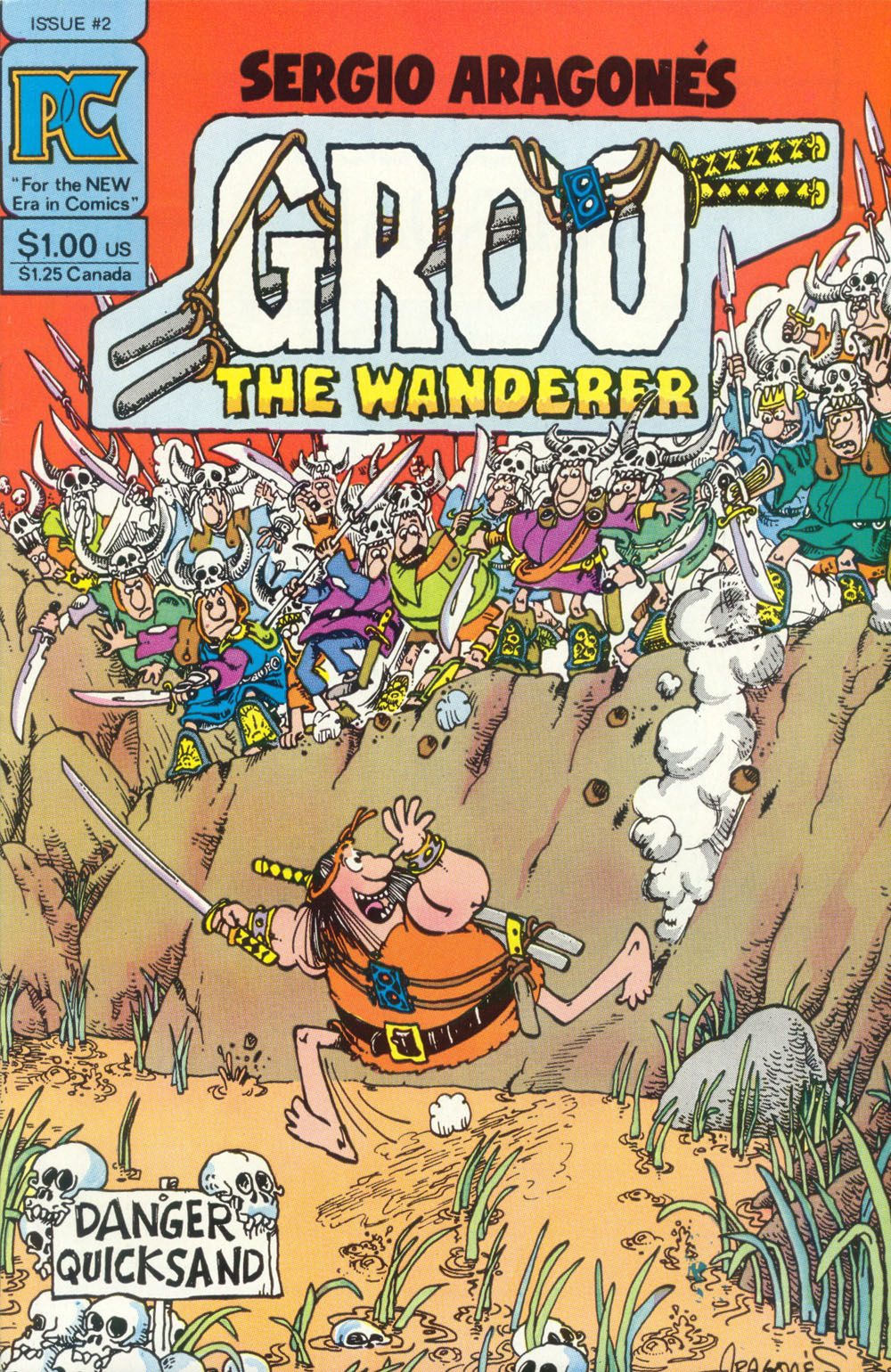


As I’ve talked about in the past, I was completely invested in the new comic book companies that started to appear once the Direct Sales marketplace had developed enough to make such entities a potentially-profitable concern. In particular, I was a stalwart supporter of Pacific Comics, the firm that had started putting out new series in the regulation comic book format (as opposed to magazine sized, like so many early Direct Market publishers) such as CAPTAIN VICTORY and STARSLAYER. I had convinced myself that this might very well be akin to having been around at the start of the Marvel Age in the early 1960s, and so I bought every title that came out. Yet somehow, I missed GROO THE WANDERER #1. I don’t know exactly how, it simply slipped past me at some point. I don’t think I was even aware of this mishap until #2 turned up.
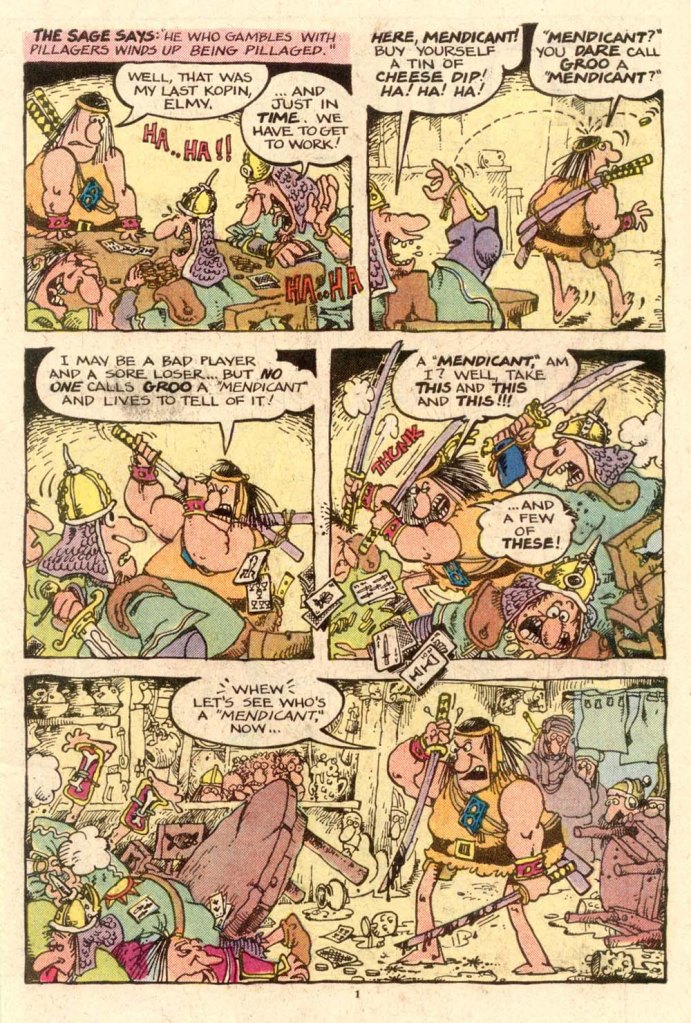
And to be honest, I wasn’t too broken up about it in either case. You see, GROO THE WANDERER had a few things going against it in my eyes. The first was that it was a barbarian comic book, like CONAN. I’d tried such things over my years of reading but hadn’t found any of them to my liking. I simply wasn’t interested in the primitive world the characters inhabited, nor the machismo of the might-makes-right code of ethics that they often seemed to embody. The second strike against GROO was that it was a comedy. Again here, comic books were serious business to me at this age, and so I wasn’t as attracted to a series that was deliberately attempting to be funny. I wasn’t against funny, it simply wasn’t a sales point for me. (I’d also encountered relatively few comics in my time that were genuinely funny; most humor comics tried and failed to elicit laughs from me.)
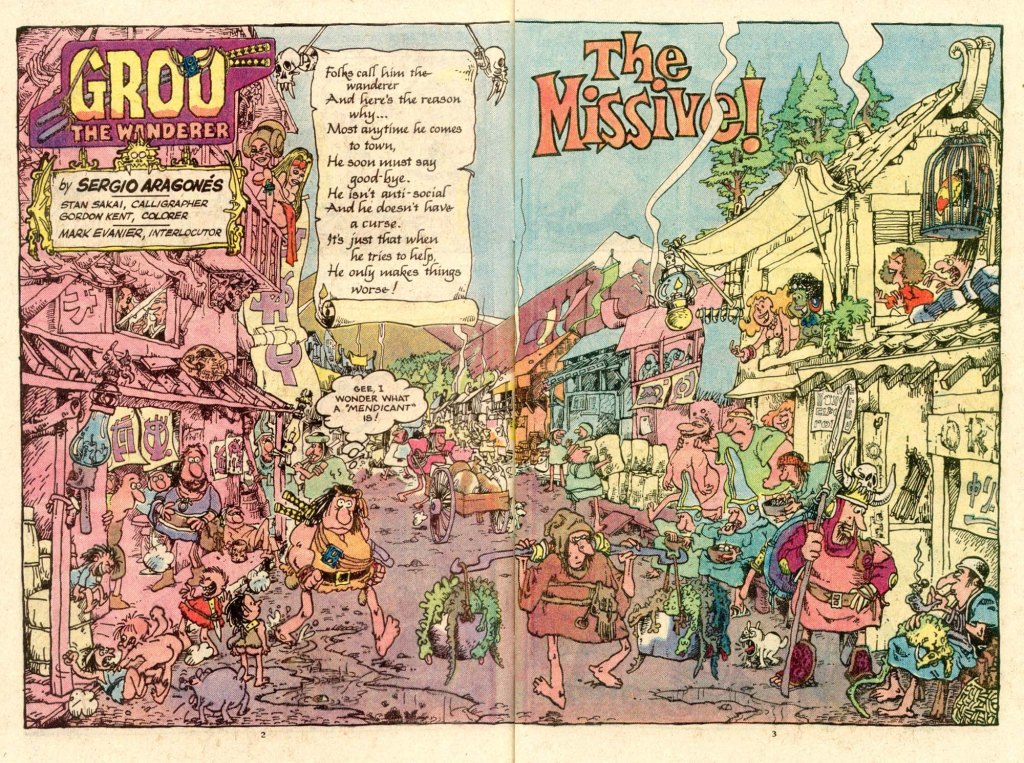
This is all somewhat ironic from the vantage point of today, where I see GROO THE WANDERER as one of the great long-term comic book series of all time. Even today, creator and artist Sergio Aragones and word-provider Mark Evanier continue to release new Groo stories on a regular basis, always at a high quality, always containing a number of good laughs. It’s a great strip, albeit one whose world-building was only just beginning at the point where I came in here. To skip to the end, I didn’t wind up following GROO THE WANDERER at this point. Instead, I wound up connecting with the strip when I got hired on by Marvel and new issues would show up in my comp bundle every month. My arrival coincided with the introduction of Groo’s faithful dog Rufferto, who always seemed to me like the last essential piece of the series falling into place. I thereafter scooped up all of the assorted prior GROO trade paperback collections to get caught up.
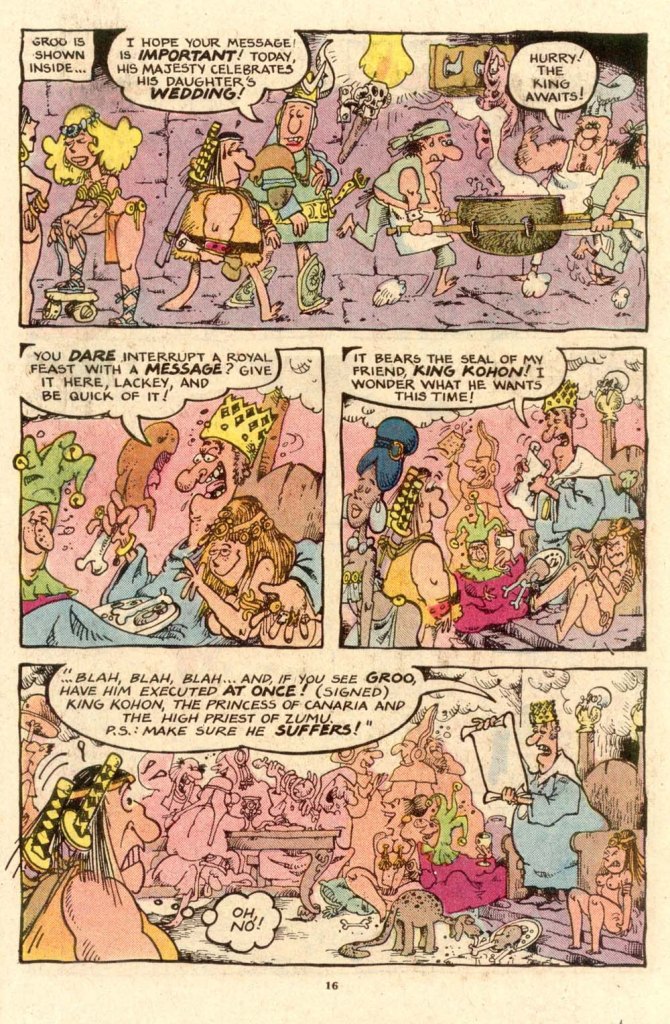
But even in these early days, GROO THE WANDERER is accomplished cartooning. By this time, Sergio Aragones had become a long-established presence in MAD Magazine, contributing to every single issue for a period of decades. Conceiving Groo was his attempt to produce something more substantial, something that he would own. It apparently took a while for Aragones to find a publisher that would permit him to keep the rights to his creation, but Pacific Comics was the first of many who would publish the series. It went on to Eclipse, Marvel/Epic comics, Image and Dark Horse among others over the span of its forty-year existence.
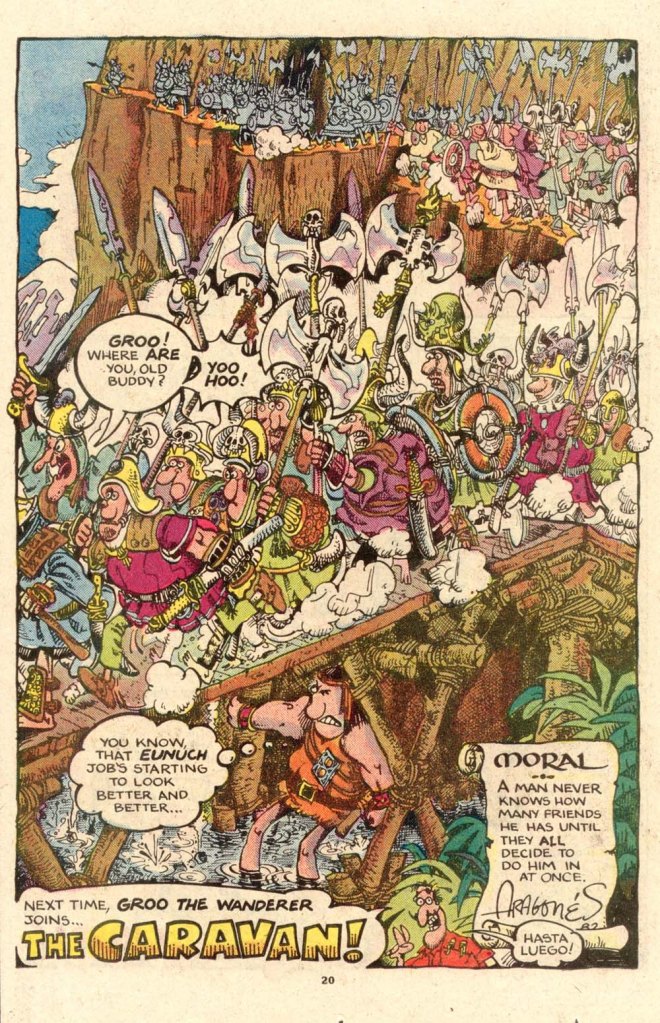
The story in this second issue is straightforward and masterful: it opens with Groo slaying a quintet of royal guards after an argument in a tavern. He winds up taking their place as the bodyguard to the Messenger for the Lord of Michokan. Despite making a mess of everything and ultimately causing his own caravan to be wiped out, Groo does manage to deliver the Messenger’s missive to its intended recipient, the King. Unfortunately, the message is a warning telling the King that should he ever encounter Groo, he should make sure that the wanderer dies painfully. There’s a bit more to it, of course, and a lot of wonderful, detailed cartooning, but that’s the gist of things. Plot isn’t ever really the important thing in a Groo story, it’s always a structure upon which to layer the jokes.
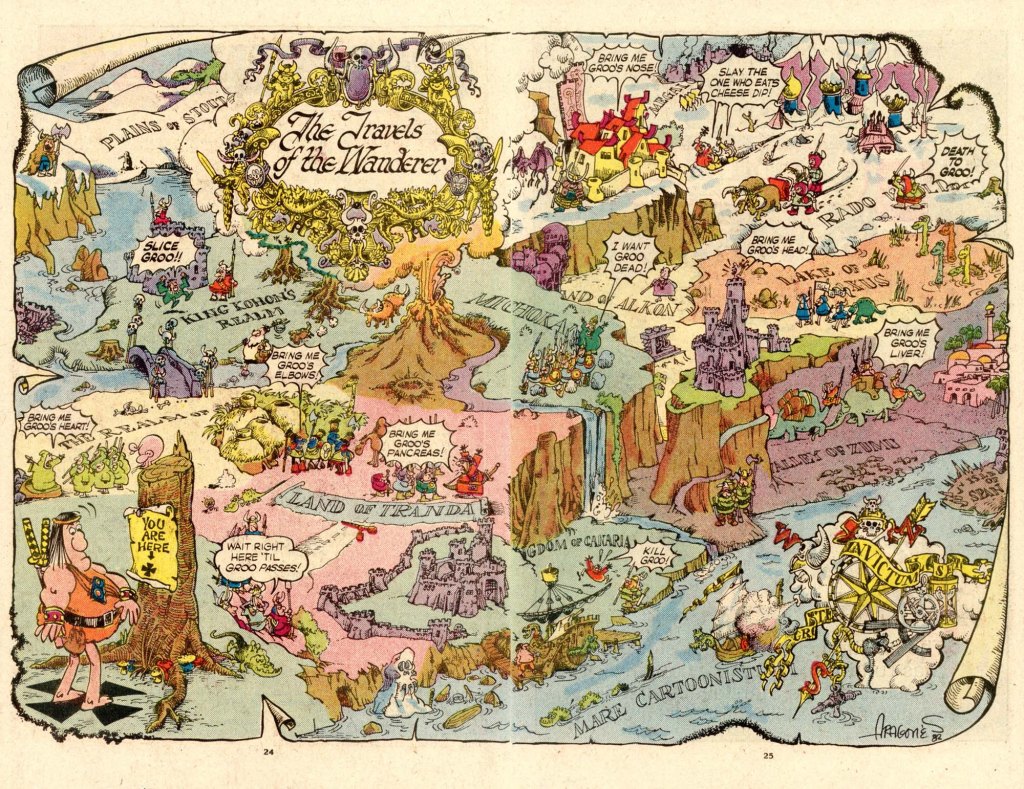
And the cartooning in this series truly is a tour-de-force, as Aragones packs every panel with detail to the degree that the world he’s creating feels genuinely lived in. His background players all have personality, even if they aren’t the focus of any particular comedic moment, and his environments are convincing and lovingly rendered. And all of it he whips out at lightning speed. There’s always something in every image worth lingering over; Aragones never skimps.
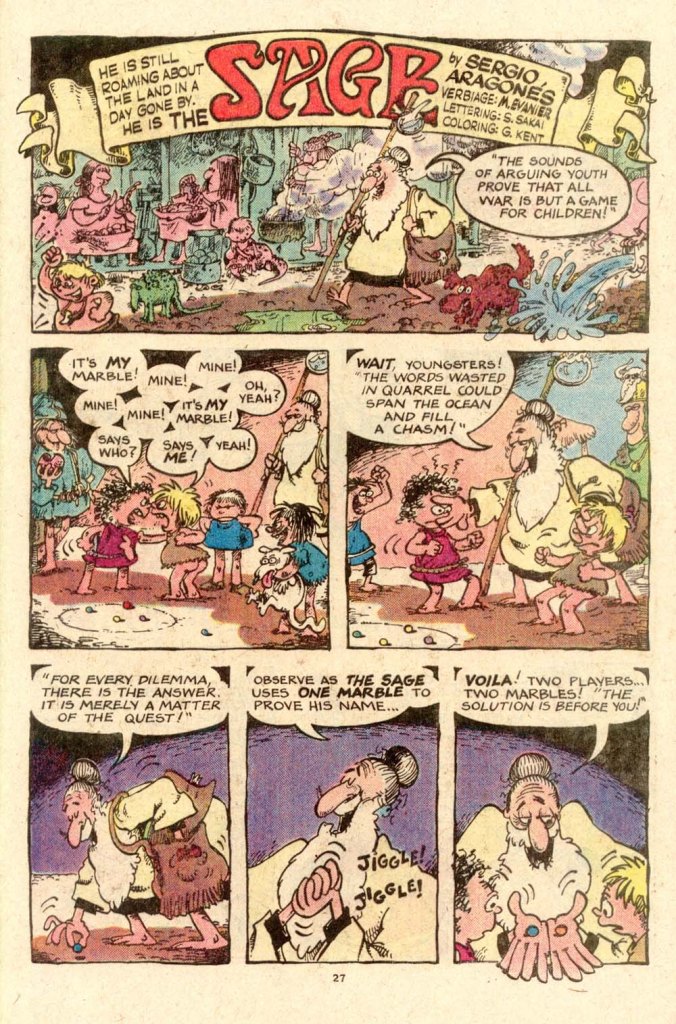
The back-up story in this issue focuses on a supporting player from the world of Groo, the wizened Sage. While Groo is a force of impending destruction, the Sage makes his way through the world through cleverness. in this short tale, he’s mistaken for a wizard and recruited by a King that faces an insurmountable problem: both of his sons are in love with the same woman and neither will relent. The King wants heirs, and yet despite all of the Sage’s suggestions for how to break this deadlock, nothing can be done. At this point, Groo wanders into the story, and the Sage sees his way out. He convinces Groo that one of the two Princes has insulted him, resulting in Groo slaying that Prince, thus leaving the other to wed his beloved. Of course, Groo is now pursued by the King’s armies, but that seems a small price to pay for the Sage. As he says at the end, “Better him than me!”


I found my way to Pacific via Elric, but never got beyond that and the Rocketeer and Vanguard before they collapsed.
LikeLiked by 1 person
My first humor comic was Inferior Five, followed by … Captain Carrot, maybe? Then Groo, which I think I encountered when it was at Marvel. Wonderful fun and amazing artistically. Had no idea it was still coming out.
LikeLiked by 1 person
Aragones crammed in a lot of detail and wit. That map is pretty funny. And he could tell his stories really well. I wasn’t old enough to read his stuff in “Mad” until maybe 1980. But it was always a highlight in a magazine that made me laugh pretty regularly.
And I have a lot of respect for Evanier’s writing. “DNAgents”, “Crossfire”, A (too) few issues of “Legends of the DC Universe” (with Steve Rude!). And his “Dungeons & Dragons” TV scripts.
LikeLiked by 1 person
Only a mendicant does not like Groo.
With that said I will return to mulching.
LikeLike
Mendicant must mean good looking and very intelligent since while I didn’t dislike Groo, I can’t say I liked it. Comedy in comics is just not my thing and I’ve bought more than issue of very few barbarian comics.
LikeLike
I’m not sure I got all of the Pacific run of GROO, but I’d gotten DESTROYER DUCK, where he debuted. It took me a little while to get hooked by the series, but I think I was by the time of the Eclipse GROO Special, and once the series moved to Marvel-Epic, I was getting it consistently.
The more recurring characters Sergio and Mark introduced, the more fleshed-out the world felt, and the more I looked forward to it. A good repertory cast is a fine thing.
LikeLiked by 1 person
Have loved this series for decades. I was a huge Sergio fan from MAD (including all the paperbacks), so I was waiting for Groo #1 to come out, though I think I somehow managed to miss Destroyer Duck.
I hadn’t really thought of it as world-building, but he and Mark really did a great job of creating that kind of environment, and making everything feel interconnected.
I disagree with the idea of the plot not mattering, though. While that may be true of some of the stories. Sergio and Mark also did some great stories about economics, the entertainment industry and ecosystems among other things, not to mention when Groo learned to read.
LikeLike