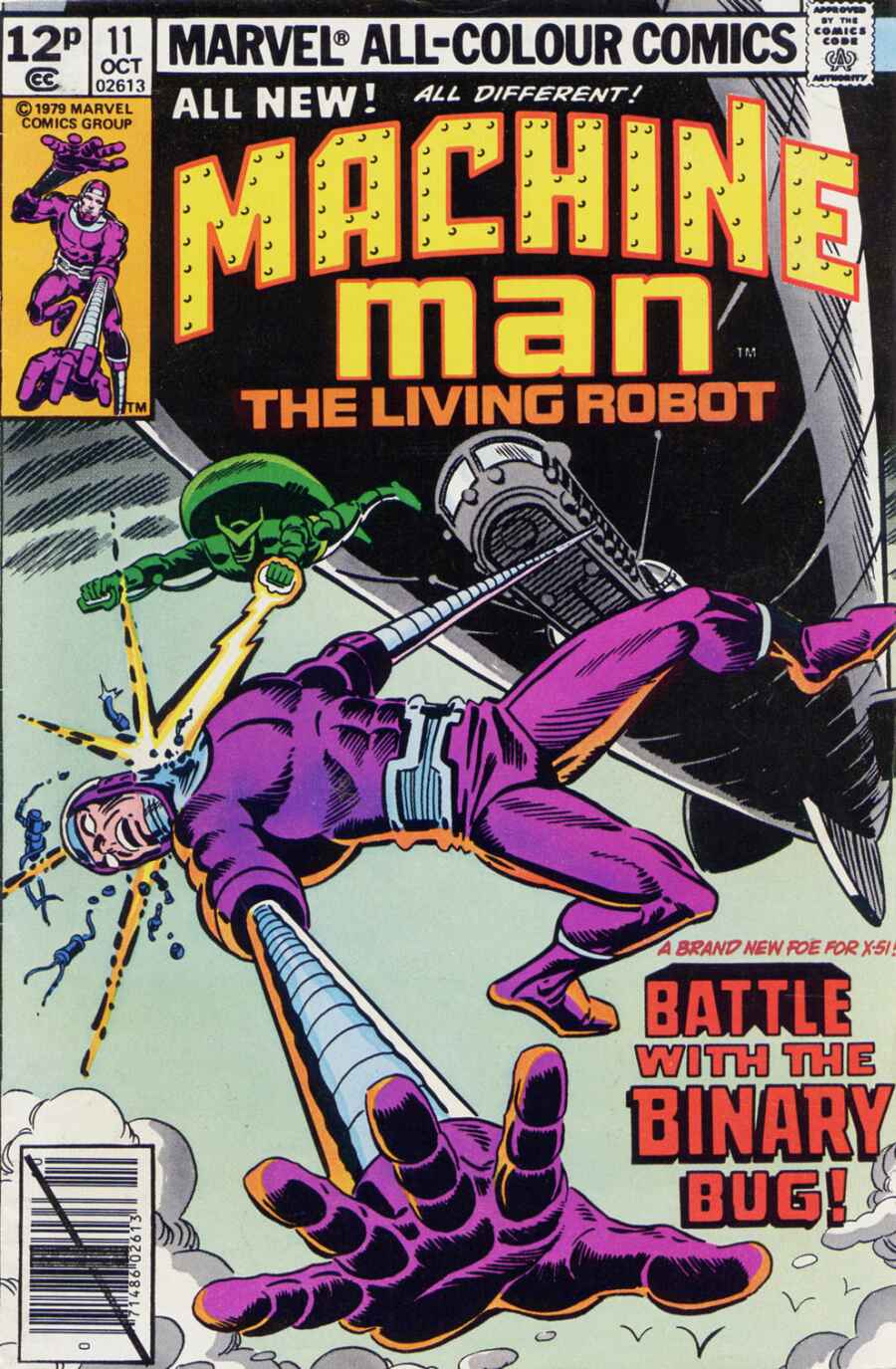


In addition to now being able to regularly get my hands on Annuals and other oversized comics such as Anniversary issues or WHAT IF and the like, my new Stationery Store outlet also gave me access to titles that I didn’t even know existed, such as this revival of MACHINE MAN. I had sampled one early Jack Kirby issue of the book that I’d gotten off of a spinner rack in far-off Ronkonkoma, but I knew the series had been discontinued. So it was a surprise to find this issue, #11, among the new releases that week. My experience with the prior issue wasn’t all that wonderful, for all that it still had that strange mesmeric power that all of Kirby’s work held for me in this time period. So I think I waited a week or two before risking my 40 cents on this issue. But buy it I eventually did.
MACHINE MAN was a strange series and a strange character. The lead character, X-51, sometimes known as Aaron Stack, had made his debut as Mister Machine in the pages of the final three issues of Kirby’s ongoing 2001: A SPACE ODYSSEY series, which itself was a bizarre little title. It appeared to be a way of introducing a recurring regular lead into a series that had up to that point been more anthology than anything. Marvel’s licensing deal for 2001 A SPACE ODYSSEY ran out, but rather than abandon the idea, the firm simply had Jack continue on with his narrative in a new series, MACHINE MAN. This only lasted for nine issues–distribution of new titles was spotty in those days, at least in my neck of the woods, so it was really hard to make a running success out of something new. But somebody had really liked MACHINE MAN, and so only a year or so later, the book was picked up again.
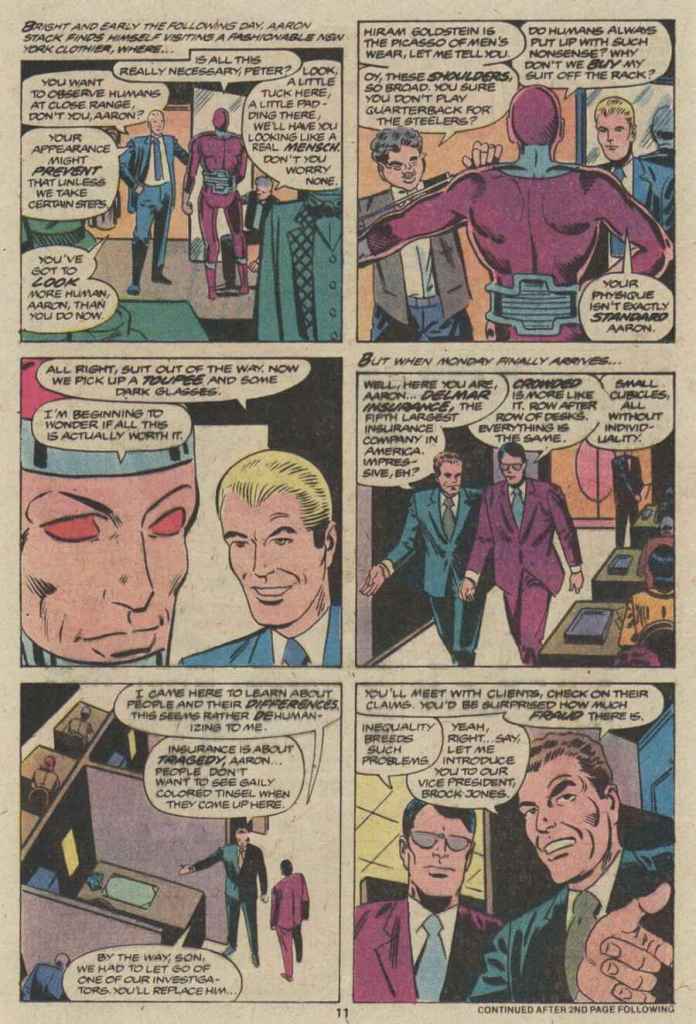
That somebody was writer/editor Marv Wolfman, who saw potential in the character. With Kirby unavailable to continue (not that Jack would have wanted o work with another writer in the first place) Marv instead recruited the other big powerhouse Marvel creator of the 1960s, Steve Ditko, to work on the revived series. This gives MACHINE MAN a strange pedigree, in that it’s the only new concept that both artists worked on in the 1970s and beyond. Looking at this issue, it certainly seems as though Ditko had a strong hand in the plotting as well, though that could simply be the Marvel approach at work, where the artist would draw the book from a written plot and then the writer would come back afterwards and add the copy to the finished art. This put much of the responsibility for the pacing and the specifics of the storytelling into the hands of the artist, which led in at least certain instances to better, more visually striking comic book stories.
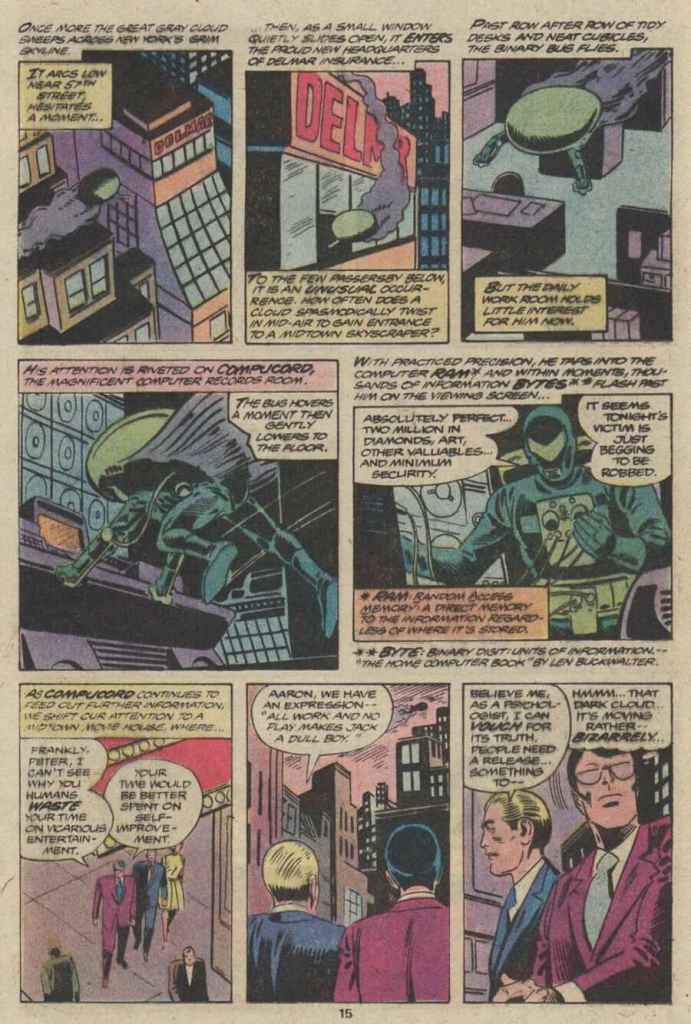
Whereas Jack Kirby’s version of MACHINE MAN was more overtly a science fiction adventure series, Wolfman and Ditko’s version was recast in more of a traditional super hero mold. I’m sure this was to make it more appealing to Marvel’s core audience, and it seemed to work, at least for a short while. (The series ran through #19, just slightly longer than the Kirby version) But it meant that Machine Man was put up against super-villains rather than alien menaces and the like, and that he began to have secret identity concerns and attract a cast of supporting players around him. Much in the way that Ditko had refined the concept of the Incredible Hulk to make it more appealing, here Wolfman and Ditko were attempting to do the same thing with Aaron Stack. Stack was also emblematic of the sorts of characters that Ditko wanted to work on at that point, an uncomplicated all-good hero with a lack of the typical Marvel self-doubts or weaknesses. On that level, an artificial, robotic man was a good fit.
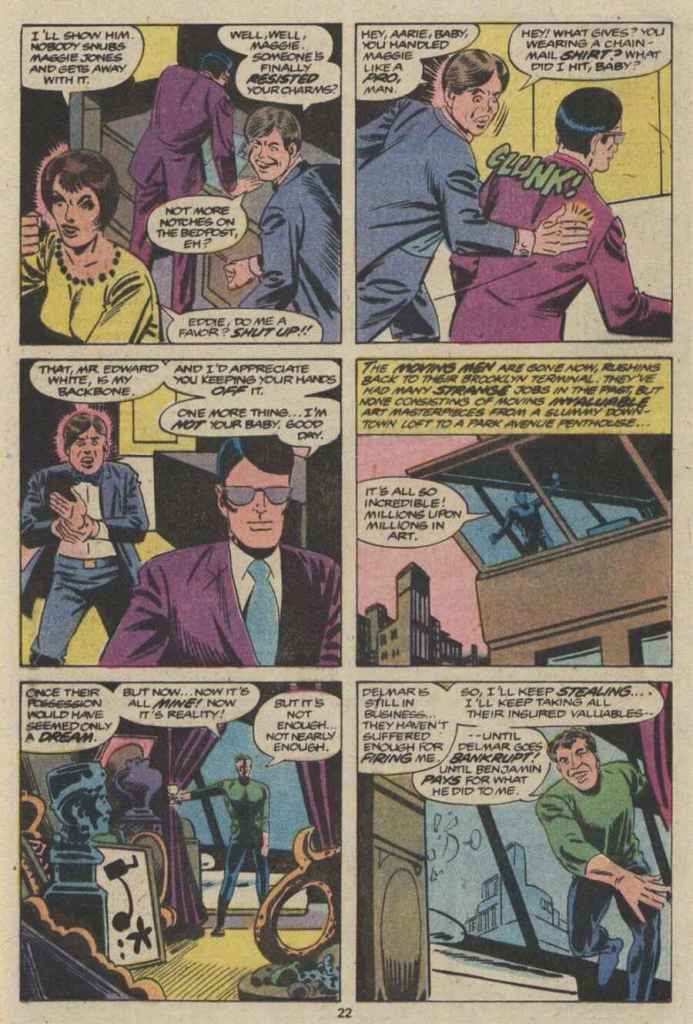
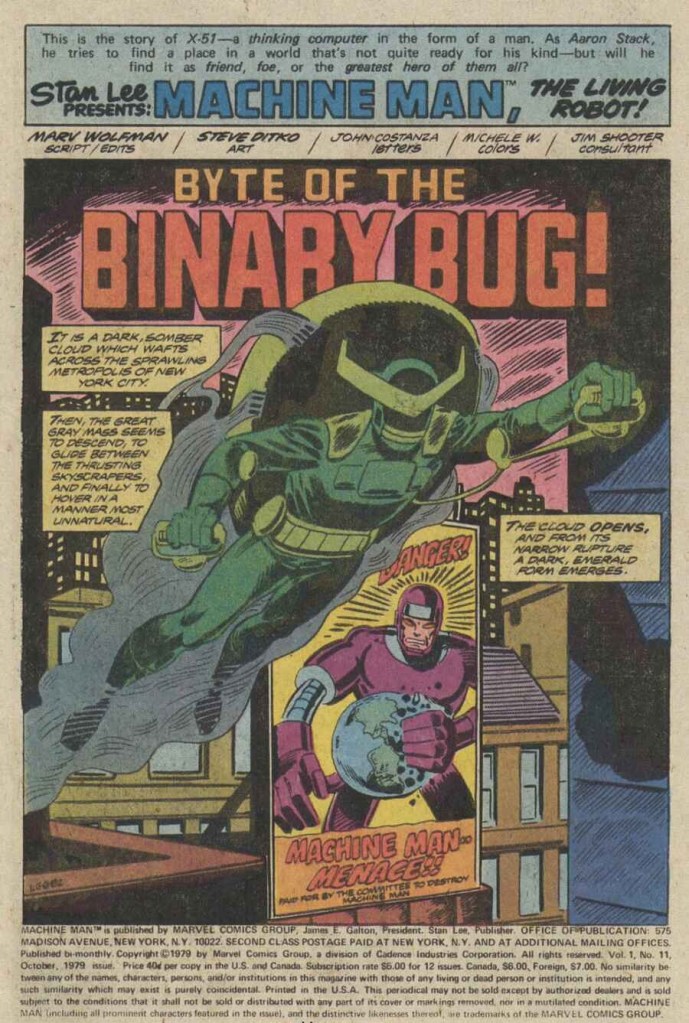
The issue opens with a strange flying green figure that the title identifies as the Binary Bug breaking in to rob a millionaire’s penthouse. He’s a high-tech felon loaded with gimmicks, and the regular security forces cannot stop him. Fortunately, Aaron Stack and his friend Peter Spaulding have come seeking the millionaire’s aid, and so Machine Man launches himself against the criminal Bug. He’s unable to prevent the felon from escaping but he does save the bearer bonds the Bug had been targeting, which means the millionaire owes him a favor. What Stack is looking for is employment so that he can live among regular human beings as one of them. Consequently, his new benefactor sets him up as an Insurance Investigator at Delmar Insurance, which he has a stake in. Elsewhere, X-51’s recurring nemesis Senator Miles Brickman fumes that somebody else has begun a public relations campaign proclaiming Machine Man to be dangerous, as that’s been Brickman’s political meal ticket up to this point.
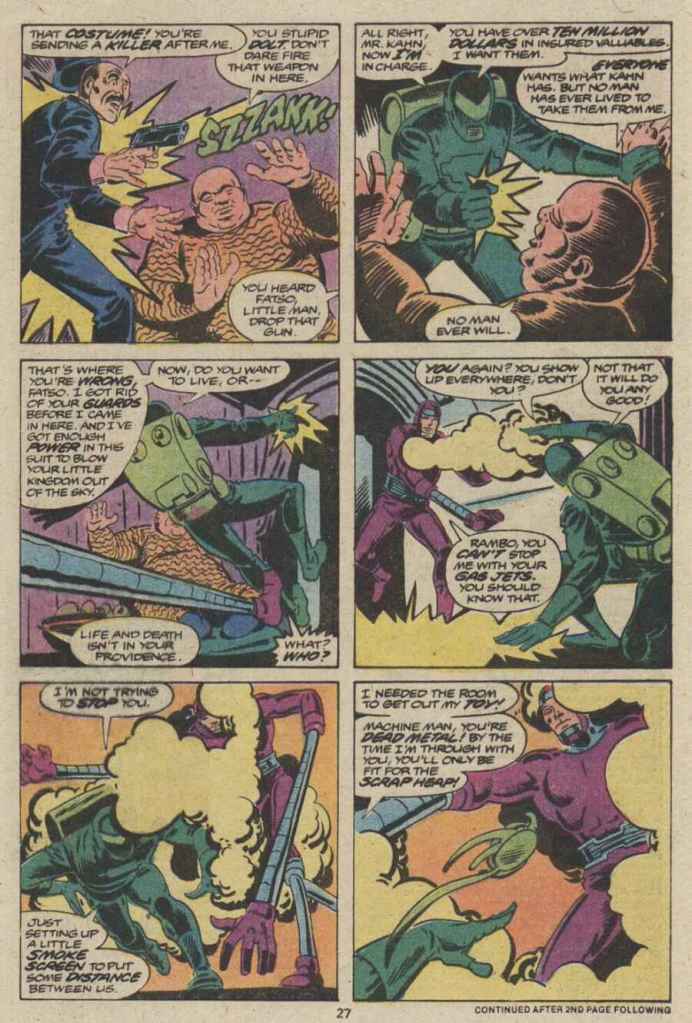
Aaron Stack makes a typically Ditko impression on his Delmar co-workers: he’s dismissive of office vamp Maggie Jones and contemptuous of office joker Edward White. He’s entirely focused on figuring out where the Binary Bug will strike next. All of the Bug’s robberies are of clients of Delmar, so there’s clearly a connection. We learn that the Bug is actually the man that Aaron Stack replaced, former Insurance Investigator Joseph Rambo, who’s been using his knowledge of Delmar’s clients to enrich himself while damaging the employer who fired him. His tech was provided by the Spider-Man foe, the Tinkerer, something that Wolfman adds in the dialogue that I’m guessing Ditko knew nothing about. Anyway, the Bug goes after his biggest score, wealth held by the crimelord known only as Khan of Xanadu whom Machine Man had encountered in the previous issue. Khan isn’t intimidated by the Bug in the slightest, but he doesn’t have to take action himself as it’s at this point that Machine Man shows up and launches into the fight.
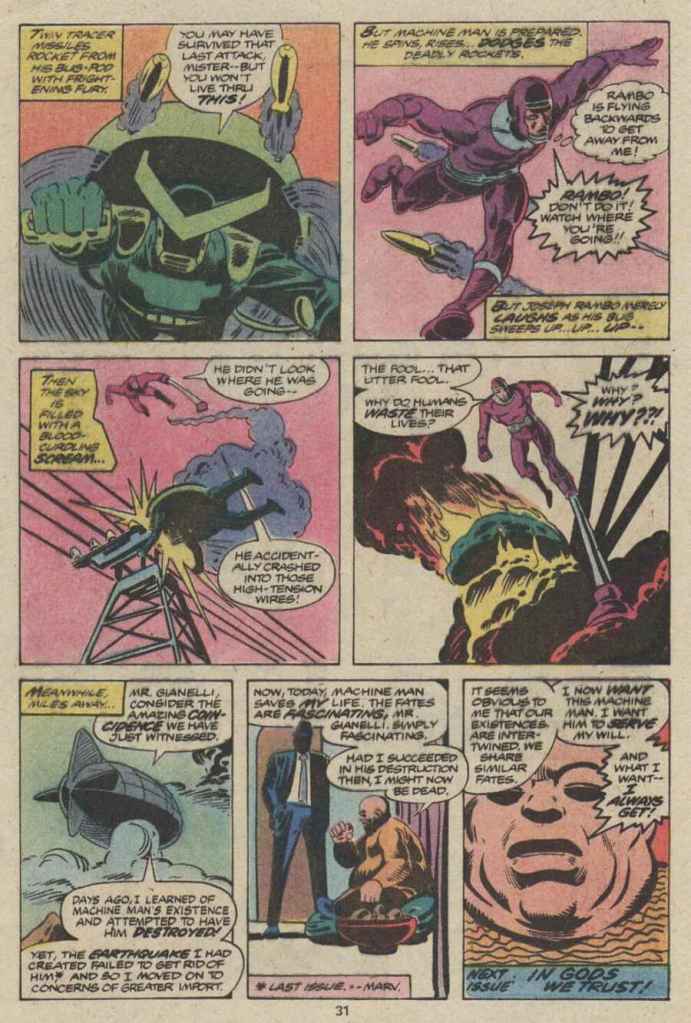
The battle continues beyond the confines of Kahn’s dirigible headquarters and into the skies, with Machine Man able to counter every attack that the Bug makes against him. In the end, however, the criminal loses track of his surroundings and flies directly into some high-tension power lines, electrocuting himself. Khan, meanwhile, has now developed a greater interest in Machine Man. And that’s where the story ends. I can remember as a reader being underwhelmed by this issue. It was completely different from the Kirby one I had sampled, but different wasn’t necessarily better. All of the characters felt a bit stock to me, lifeless, for all that the Ditko artwork held some appeal. Consequently, I skipped the next two issues of the series, though I contemplated each one when it arrived at my Stationery Store. It was only at a point where I had some spare coinage that I wound up coming back for #14.


If no one minds, I’m going to borrow Tom’s use of “underwhelmed” to describe my impressions of this issue as well. The reason for that stems primarily from the combination of a simplistic story and Steve Ditko’s incredibly stiff and dated artwork. Hear me out. I take nothing away from his groundbreaking work in laying the foundation of Marvel Comics in the early 60’s. I also still enjoy his work with the “monster” comics that preceded Marvel’s return to superheroes. Unfortunately, comic books had moved away from his style of stories and art, making all of this incredibly out of place by the time it popped up on the newsstands. Bear in mind, after watching my beloved Oregon Ducks lose to an unranked team last week, I’m numb to any pain that your comments could inflict upon me. 😉
LikeLiked by 1 person
Fully share your feelings about this, Rick. By 1979, I had a somewhat better understanding of Ditko’s prominence at Marvel from 1961 – ’66 than I’d had when I started regularly collecting comics regularly in 1973. Still, the only samplings I had of his work from his glory days was from the stories reprinted in the Origins books and in the Pocketbook collections of ASM and Dr. Strange, as well as the few reprints of his suspense/horror/weird stories I had at the time. All of which I enjoyed, but what I saw of his then current work in the late ’70s and into the ’80s, struck me as much more primitive and stiff than what I’d seen of his work from the early ’60s. Kirby’s ’70s work also didn’t look nearly as good to me as the best of his ’60s work, of which I’d gotten plenty of reprints during the ’70s, but it was still very dynamic and intense. Ditko’s newer work, however, just seemed very blah, as if he had no genuine interest in what he was drawing. Oh, sure, it’s still professional, and I wasn’t put off enough to stop collecting (such was my mindset at the time), but it wasn’t the sort of thing that really excited me in any way. From my current perspective, it strikes me as odd, realizing that Ditko was certainly capable of doing much better artwork but due to his own mindset as a staunch Objectivist, it appears he was doing just any work for others by rote simply to earn the greater pay than what he could get from screeds pushing his philosophical outlook which was his heart’s desire but was too offputting to do well in the marketplace.
LikeLiked by 1 person
I will never forget how awful a story drawn by him was in Legion.
LikeLiked by 1 person
I think Shade the Changing Man was outstanding, otherwise, I agree.
I was underwhelmed by Kirby’s Machine Man but I figured Wolfman might do something better with the book. he didn’t.
LikeLike
Machine Man went from a robot replacement of the Incredible Hulk being hunted by the military with its latest Captain Ahab of a General to Delmar Insurance’s Clark Kent/Superman.
LikeLiked by 1 person
This issue of Machine Man was the first backup strip in the UK Transformers comic in 1984. I didn’t really like it much, but then it was split into parts and spread over three fortnightly issues, and partly in black and white. I don’t think it’s all that great in the original, though…
LikeLike
The Kirby issues were a bit before my time, but a child I really liked Issue #10 the first of the revival. It pretty much picked up where Hulk 237 ended. I had hoped Tom would review #10 but now I see not in the cards.
Most of the other issues like #11 were OK but none of them appealed to me as #10 did. Still I stuck with the revival until it was cancelled
LikeLike
The stories on this relaunch went above mediocre but I bought them for the Ditko artwork that I found appealing despite it being odd by the standards of 1979. I don’t think it was an improvement over the Kirby version… which was bonkers but in a good way.
I remember reading this around the same time as X-men 125 and and thinking that it seemed like it was 15 or 20 years out of date. The insurance company set up was hella dull and all of his co-workers were unlikeable. The boss knowing his secret ID was an odd choice.
LikeLiked by 1 person
Correction: meant to say “never went above mediocre”
LikeLike
Since Marvel saw fit to make this available on Marvel Unlimited I gave it a read. Sadly, I think it’s a pretty poor all around. The plot is quite dull and selectling an insurance company for Aaron to work seems odd to me (that said, I worked for an insurance comapny in IT for 17 years). And it’s conveinent that he starts working there just as this revenge/crime spree starts. On the other hand, insurance companies, starting with Met Life, which bought and installed a UNIVAC in 1954, were some of the earliest computer mainframe adopters (but were slow to replace them, which lead to major W2K issues that needed to be resolved). So, from that perspective, an insurance company does make sense.
I also don’t like Ditko’s artwork at all, as I find it plain boring. In my opinion it looks like we was just doing the bare minimum on this issue. I also took a quick look at a few Kirby issues and they look so much better.
LikeLiked by 1 person
I’ve never liked Ditko either and very few Kirby runs but I bought every issue of Machine Man despite not reading the series that spawned him. I agree they were simplistic but I’ve always liked the character, before and after his weirdification (which is a word in spell check?).
LikeLike
I know that at some point, Ditko started demanding full scripts, refusing to work plot-style any more. But I don’t know when it started.
These pages look like they’d have been done plot-style, but who knows?
In any case, I think the art’s pretty darn solid — these issues, the Captain Universe stories he did; Ditko was still doing impressive work. I just didn’t much like the characters stuff — Kirby’s Machine Man was quirky but affable, open to human experience rather than being a Vision-like introvert. Marv’s Machine Man feels very like other Ditko leads of the time, as you note; curt to the point of near-rudeness, with little interest in anything but the plot in front of him.
Kirby’s version hadn’t worked, so I can’t argue with changing him, but that’s not the personality I wanted to see. Plus, Marv and Ditko got rid of the hand-weapons system, which MM had seemed very proud of. Maybe that’s why he was acting like that; he was feeling emasculated, and was introverted out of shame.
LikeLiked by 1 person
Funny considering that in the last year of Ditko’s run on Amazing Spider-Man, Peter Parker was also becoming increasingly curt to the point of rudeness, even if somewhat understandable in Master Planner Trilogy when Peter was so concerned about Aunt May’s health. That aspect of Peter’s personality was softened considerably in the first Romita issue. Ditko made significant contributions to the Spider-Man mythos but his popularity might have stalled if he’d been more fully transformed into the Objectivist Spider-Man, boring his opponents to death by webbing them down and forcing them to listen to him recite multiple pages from Ayn Rand novels.
LikeLiked by 3 people
Yeah…the co-workers are terrible, Aaron is dismissive of them… and I don’t think that dynamic changes much if I recall. It’s a beat that’s reflected in Ditko’s work moving forward that makes his work difficult to enjoy on a story level. For all that… I think he was a compelling artist, but the rigidness of the character interactions becomes trying since there’s always a moral lesson hidden in their behavior. I’m kind of surprised that Wolfman allowed the supporting cast to just be “types.”
LikeLiked by 1 person
Fred, wouldn’t have Stan been ultimately responsible for his curt dialog? Maybe his unhappiness with how things had devolved with Ditko creeped into the scripting.
LikeLiked by 1 person
i don’t think EVERY Ditko feature suffered from excessive stodginess (though a while back I did pass comment here on the STARMAN feature as being pretty dull in the character department). It’s true that SD really liked the “tortured loner” thing, which probably accounts for Parker’s college years– but there were times Ditko would loosen up and emphasize humor over grim resolve, like both SPEEDBALL and the second CREEPER series. (Not to say that either of those was stellar plotting; his best pure humor strip was probably the 2 appearances of KILLJOY.) After the ’66 departure Ditko did seem to lose interest in continuing soap-operatic melodrama for the most part– though SHADE was a return to that territory for him. I’ve thought it a shame that it wasn’t conceived/executed in the era of the mini-series. SHADE didn’t have the stuff to be an ongoing series, but it would have made a better 12-issue series that a lot of the stuff DC greenlighted.
LikeLiked by 2 people
I forgot Captain Universe. Agreed, he did some good work on ’em.
LikeLike
I remember being a kid and so happy to see Ditko back at Marvel. High hopes
LikeLike
I can appreciate Ditko’s contributions to the world of comics but I was never really a fan of his artwork. In the 70’s I was too young to really pay attention to the names of the artists and writers in comic series, but I could recognize Ditko’s work even if I didn’t know his name. It just kept popping up in random stories and series at both Marvel and DC. And every time I saw it, I felt the story was wasted with his art. Why couldn’t Neal Adams just draw every story in every comic for every company – was that too much to ask?
LikeLiked by 1 person
Lee certainly had final say on the dialog but it was still based on what Ditko was plotting and drawing and I didn’t see much of a disconnect between the art and the script in regards to Peter’s behavior, although the thought balloons occasionally showed Peter internally recognizing he was being a dick and that was more likely contrary to Ditko’s intent, which was that Peter was entirely justified in his behavior and that everyone else was simply wrong and Peter had no reason to justify how he behaved to anyone. Of course, that’s all based on what I’ve read of Ditko’s later works, as well as the about-face in Peter’s behavior post-Ditko. Peter still occasionally behaved in ways that were entirely contrary to his social well-being but not nearly as extreme as was the case in the last third of Ditko’s run. On the other hand, Ditko also began the process of making Flash Thompson appear less of a jerk, as entirely of his own accord, he told the high school principal what really happened after hearing Peter take full blame for a fight. It took a few years into Romita’s run for he and Lee to further build on making Flash a more balanced character, although it was Conway who took the extra step of having them actually become friends after having been antagonistic towards one another for so long. I wonder if Ditko may have done that if he had continued on the mag, or would he have made Peter that much more of a loner, with no genuine friends and trusting of no one except himself.
LikeLiked by 1 person
The oddest bit of dialog (as witness it sticks with me) is when a student invites Peter to a party and tells him she’s excited to have a smart guy around instead of all jocks. He stalks off because he doesn’t want to be desired for his brains …I think Peter would love that she’s into his intellect.
LikeLiked by 2 people
A prime example of Peter being a social moron despite his intellect.
LikeLike
X-35 [ Machine Man#10 ( August 1979 ) created by Marv Wolfman and Steve Ditko —Jack Kirby never showed any other X-series robots ]: to bad no one that to do a Data-Lore with X-51 ( Aaron Stack ) and X-35 ( or X-15 — the reverse of 51 ).
LikeLike
And if the decide to do a hard reset of Machine Man to undo the creepy persona Ellis gave him, just reveal we’ve been reading about X-68 (I like my number better) after someone finds and frees X-51.
LikeLike
In reference to “only new concept that both artists worked on in the 1970s”, didn’t Ditko do some Demon work around this time, or was that prior to these issues?
LikeLike
Ditko’s work on the Demon was a little earlier that same year, in DETECTIVE COMICS 483-485.
LikeLiked by 1 person