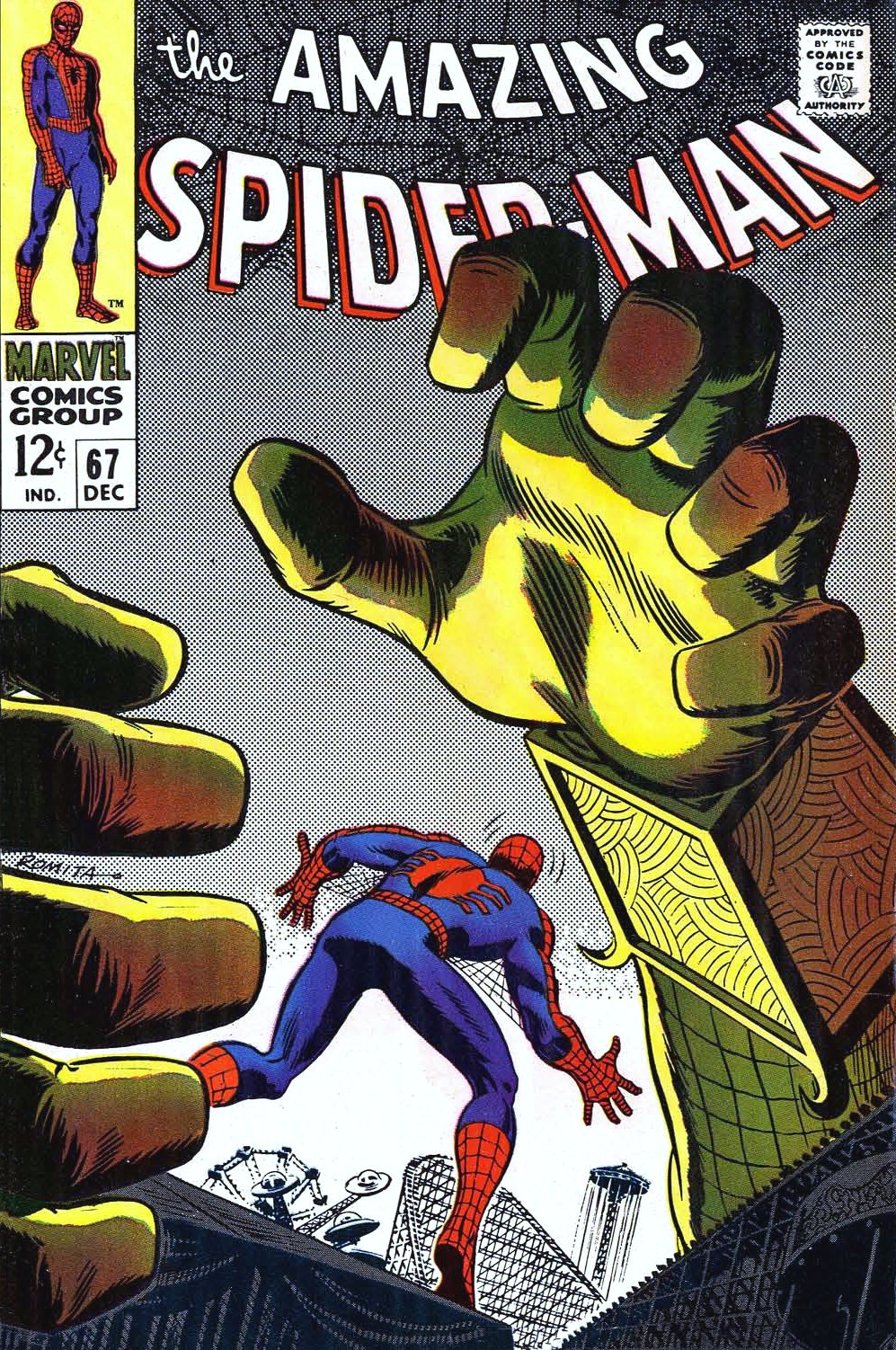


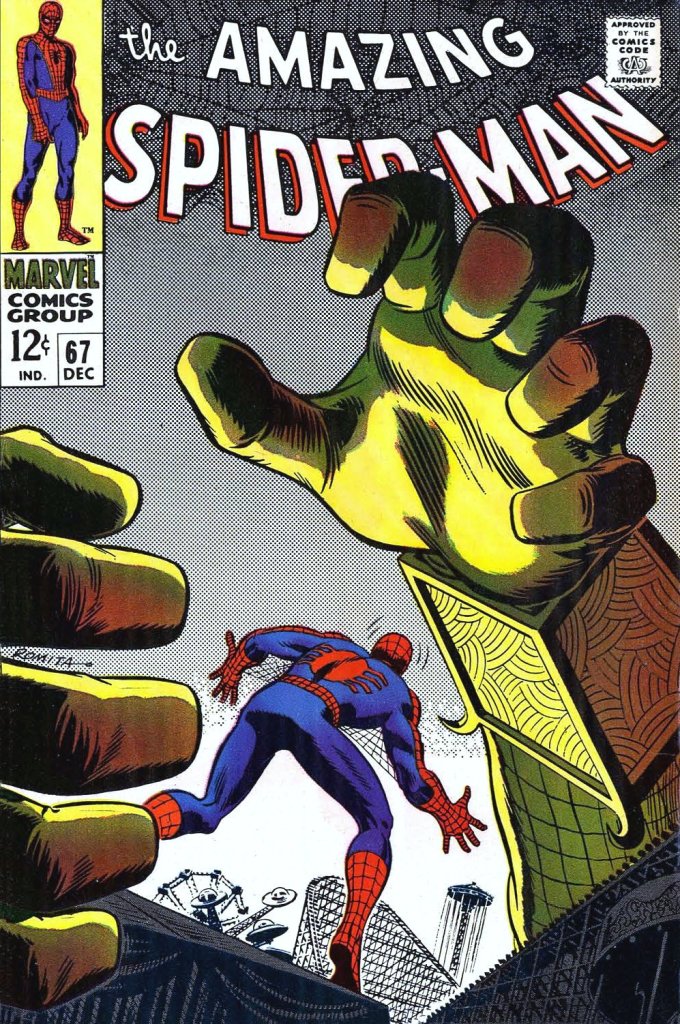
As I’ve mentioned before, my friend David Steckel had inherited a chunk of his comic book collection from older cousins who had outgrown comics, so he owned a handful of issues that dated back to the 1960s. He didn’t have many of them, and they were a bit scattered, but they represented a bit of a gold mine in terms of me getting to experience these classic books. So at a certain point, David loaned me this issue of AMAZING SPIDER-MAN from 1968. John Romita’s use of zip-a-tone on this cover image is a clear tip to when it was produced–after Jim Steranko began employing such things, they swept through the industry of the time. This is a rare cover from the era that didn’t carry any cover copy whatsoever–typically, a Marvel book of this period would at least blurb he story title of the issue or something similar. But this image is dramatic and cool enough that it really doesn’t need it.
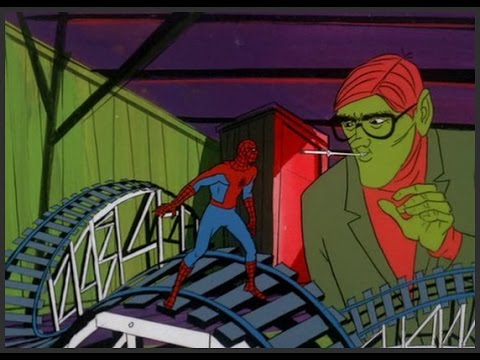
The story is the second part of a two-part adventure, one that I was already familiar with from an unlikely source. Because right after these issues saw print, producer Ralph Bakshi adapted the story for an episode of the Spider-Man Saturday morning cartoon series, which was still running in syndication in the afternoons in the 1970s. For some strange reason (and despite the character having shown up earlier in the series), Bakshi decided to depict the villainous Mysterio not as a costumed figure with a domelike helmet but rather a bespectacled green-skinned movie producer type with a cigarette holder. Weird choice.
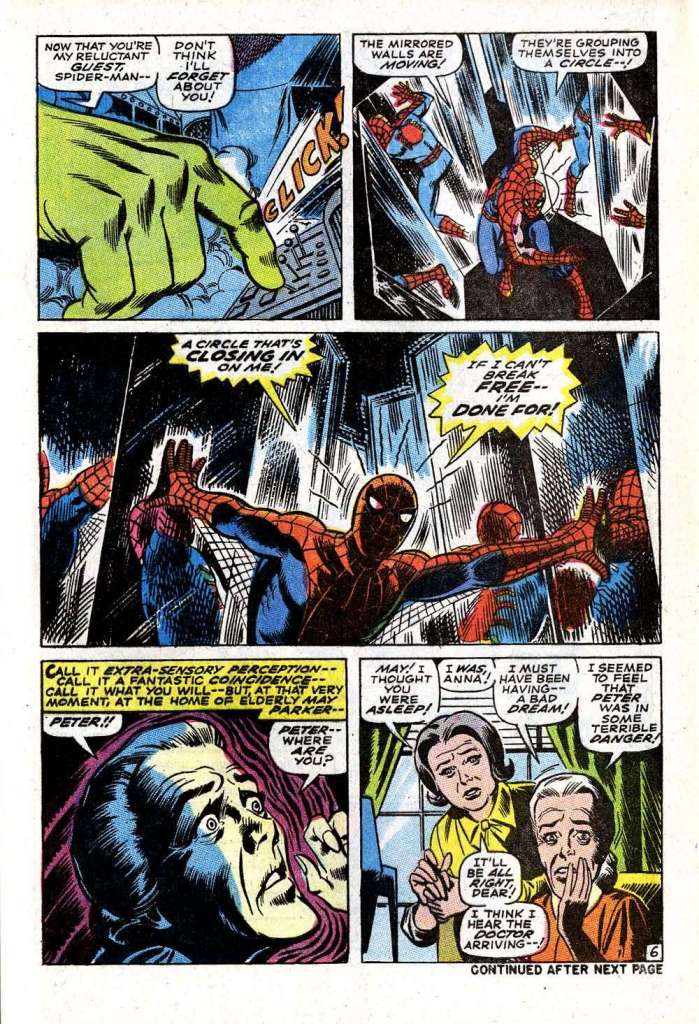
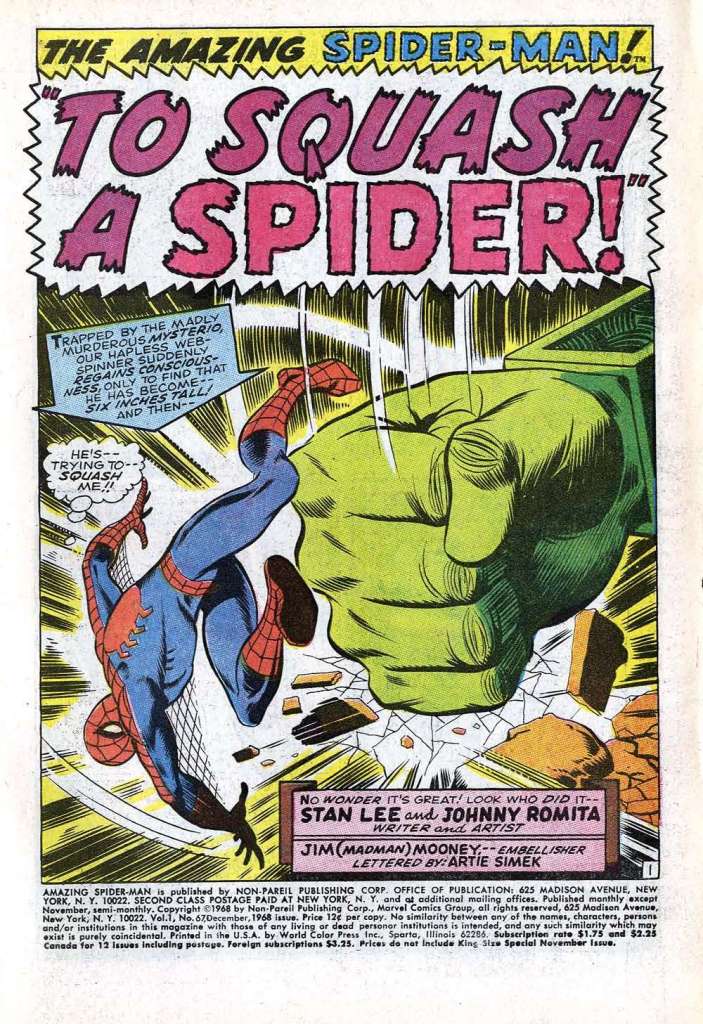
Anyway, last issue Mysterio had lured Spider-Man out to his hideout, where the master of illusions promptly miniaturized his web-slinging foe, imprisoning him inside a table-top model of an amusement part that was on his desk. As this issue opens, Spidey is on the run, dodging blows from his much larger adversary and attempting to stay one step ahead of him. He can’t quite understand why the colossal Mysterio doesn’t go ahead and finish him off, but he’s so focused on staying alive that he can’t really stop and consider the situation too heavily. The artwork on this issue by the combination of John Romita and Jim Mooney is quite excellent. Mooney maintains the beauty of John’s drawings while giving the strip a bit more atmosphere and texture. It’s a really nice combination, especially here where John was providing more than merely simple layouts, a situation that wouldn’t remain that way.
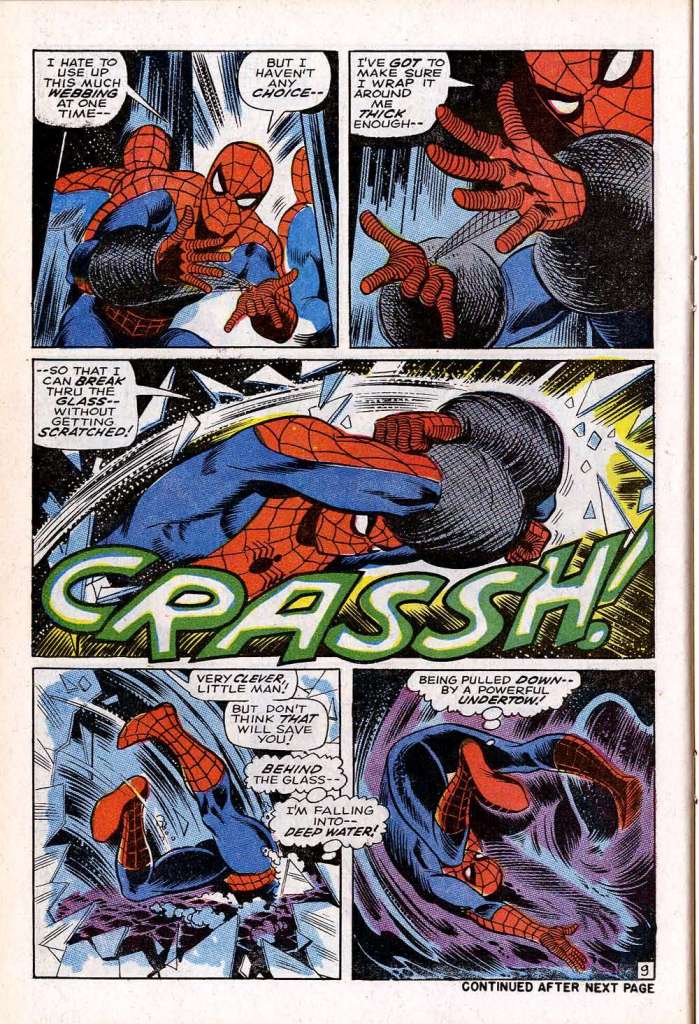
In an effort to elude his pursuer, Spider-Man heads deeper into the amusement park. But this turns out to be a bad instinct, as Mysterio has tricked the whole place out with a gauntlet of deadly traps. The plot is pretty much simply fast-moving action as Spidey finds himself in one dire situation after another, forces to improvise his way out of them and keep going. Along the way, we also check in on the always-ailing Aunt May and the always-blustering J. Jonah Jameson and the Daily Bugle staff. But this is an action story first and foremost.
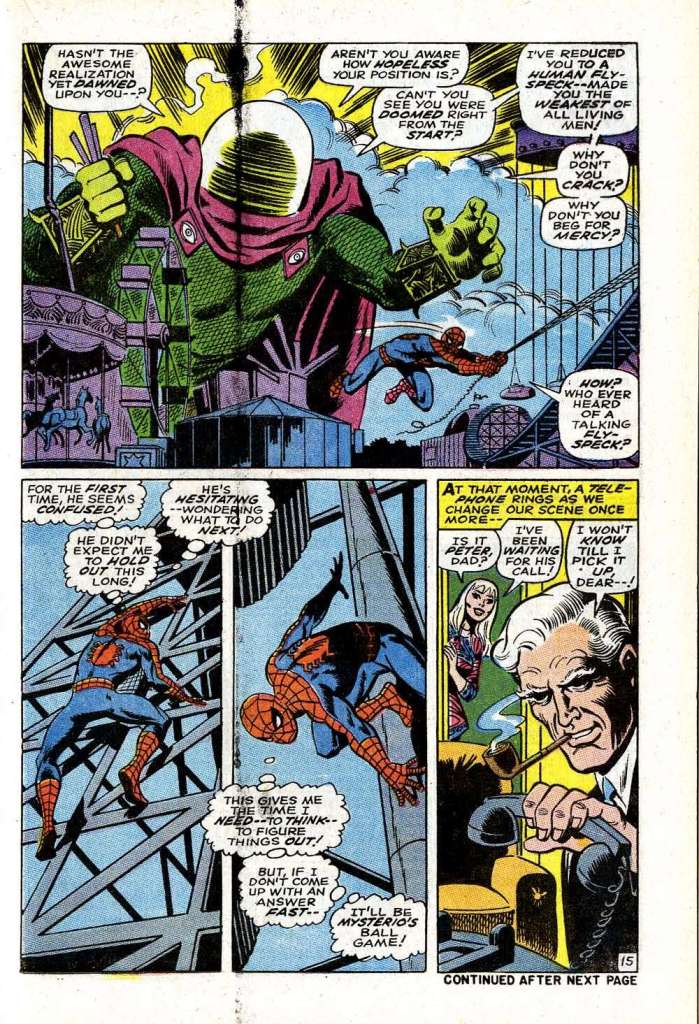
There’s really not a whole lot more to say about the plot, but the execution by Romita is beautifully paced. And Lee is at this point expert in adding dialogue and copy that captures the characters and the drama and also provides an occasional laugh along the way. It’s a polished production, and it’s easy to see why Spider-Man became the most popular title in the Marvel line during this period. Anyway, Spidey outfights and outthinks situation after situation, and he gets the sense that Mysterio didn’t expect him to hold out this long. As he’s getting his second wind, he’s beginning to suspect that something isn’t right at all with this set-up.
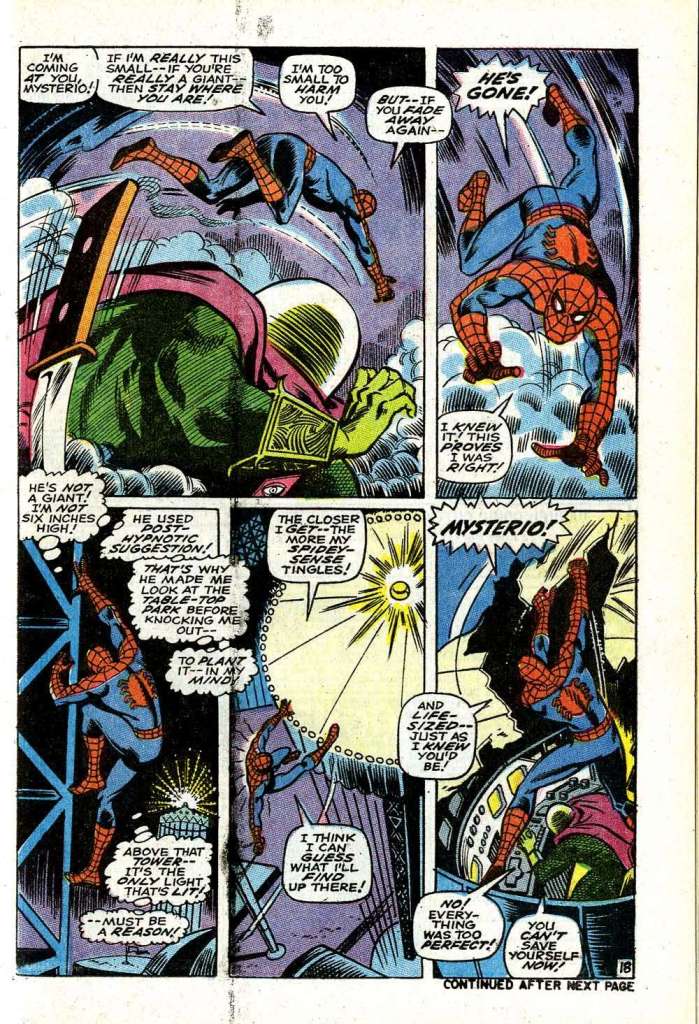
So the web-slinger taunts Mysterio, causing the giant to stab down at him with a massive knife that appears to be entirely legitimate and real. But using it as a springboard, Spidey is able to leap up towards his enemy–and right on cue, Mysterio disappears in a cloud of smoke. Not Spidey knows he’s on the right track–he hasn’t been shrunk down at all, that was all misdirection to disorient him. His spider-sense guides him to a tower at the heart of the amusement park, and breaking into it, he comes upon Mysterio at the controls of the entire set-up.
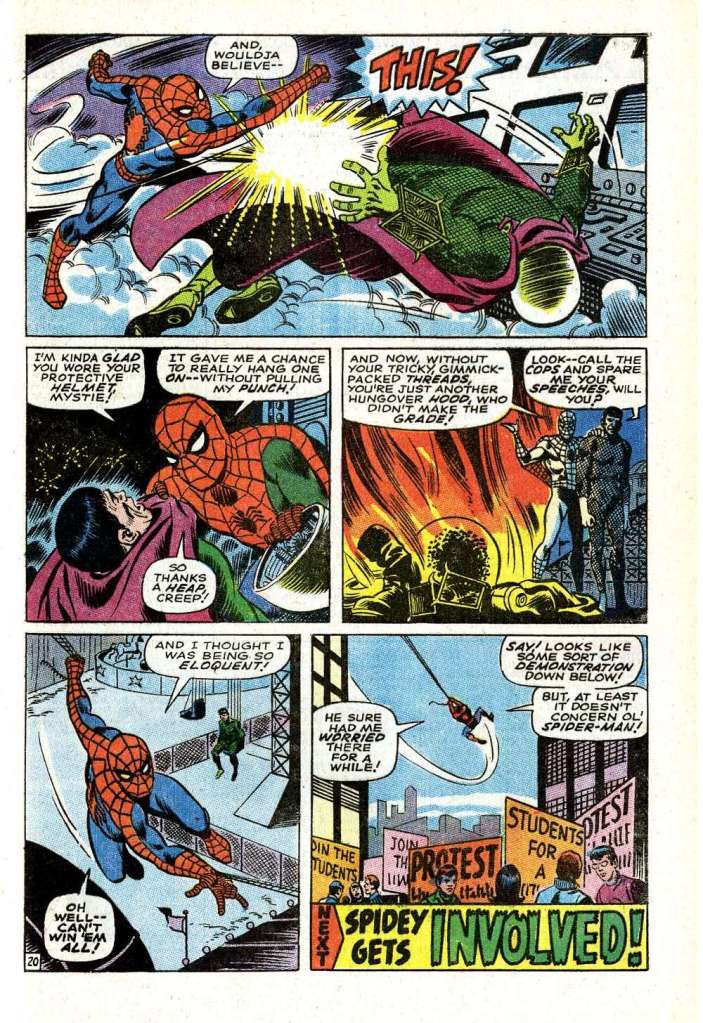
And that’s the wrap-up. Without his tricks and illusions, Mysterio is just a washed-up special effects wizard, and Spidey lays him out with a single punch. The wall-crawler leaves his opponent webbed up for the cops, then swings back towards Empire State University. I’ve always found this final panel to be a bit discordant. It’s clear that Romita was looking to tease the protest storyline that would begin in the following issue, but Lee’s dialogue doesn’t’ do any of the table-setting, so it comes across as an odd note right at the end. But regardless, this was a very entertaining, very fast-paced adventure that, while it wasn’t especially deep, provided the required number of thrills and chills along the way.
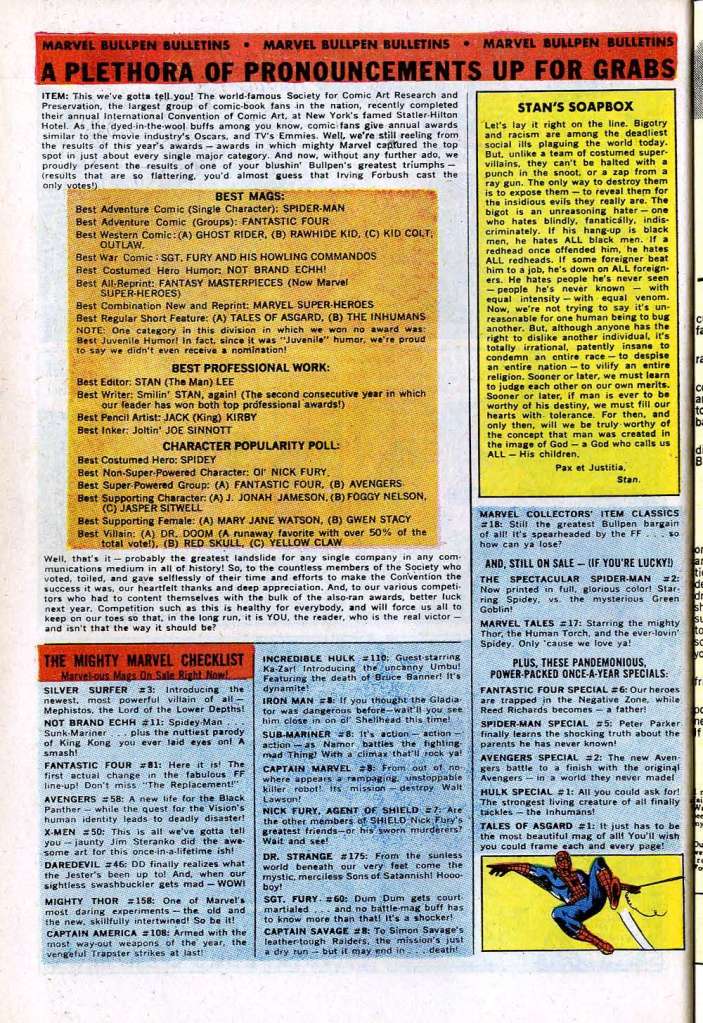
The issue also included an edition of the Marvel Bullpen Bulletins page, which was always a great way to see what else was going on at Marvel and throughout the world at the moment when this comic first came out. Here, Stan devotes a lot of space to the fact that the Marvel line and its characters and creators came out on top in most categories in a recent set of award given out by SCARP at a New York convention. Stan writes about this as though it was akin to getting an Academy Award, but this would have been no more than a few hundred dedicated comic book fans voting here. But it’s all a part of how Stan was able to make reading Marvel comics feel like entering a larger world. This page also includes the much-reprinted Soapbox column in which Lee preaches against bigotry. I tend to think that Stan was sincere in his thoughts here, though he was definitely being influenced by the crowds of young people he was being exposed to when he’d give college lectures and the like. In 1968, people were looking to make a difference and there was a ton of strife in the world and in the community, so it’s kind of amazing that Stan put himself out there even this much .
 The Tom Brevoort Experience
As time and generations move on, Romita, Sr seems to get less praise than he used to. I’ve seen a majority of comments on several hats where Ross Andru is ranked higher, and Romita, Sr isn’t even in some conversations. I see these pages and think Andru wouldn’t have had this as a reference, a starting point, if Romita hadn’t had his own great run. I know Andru drew fine figures, except sometimes the knees could get knobby, and also very impressive cityscapes. But I think he took a lot from Romita, Sr.
I also prefer Romita’s lighting. His clean but heavy lines. I know Jim Mooney inked this, and Monney’s good, but it looks pretty faithful to Romita’s drawings. There’s a tension, an urgency to the action and facial expressions, in part due to the lighting. He drew a definitive Spidey, and the whole cast, making Peter look cooler than he had, which makes sense since Peter was slowly aging. And that was on the heels of another, the original, definitive version by the character’s co-creator.
Romita, Sr.’s work continues to deserve to be praised, and held up for as great as it is.
LikeLiked by 2 people
You’ll never hear me utter a harsh word about John Romita Sr’s art. I’ve said it before in these comments, but it’s my belief that had he not become penciller for this book, Spider-Man would never have achieved the heights in popularity and sales he reached in the 60’s. That’s not a knock on Steve Ditko,but a compliment on how Romita Sr built on the foundation forged by his predecessor.
LikeLiked by 2 people
I wonder if this issue and Mysterio’s amusement park death traps inspired Arcade and Murder World [ Marvel Team-Up#65-66 ( January-February 1978 ) ]?
LikeLiked by 3 people