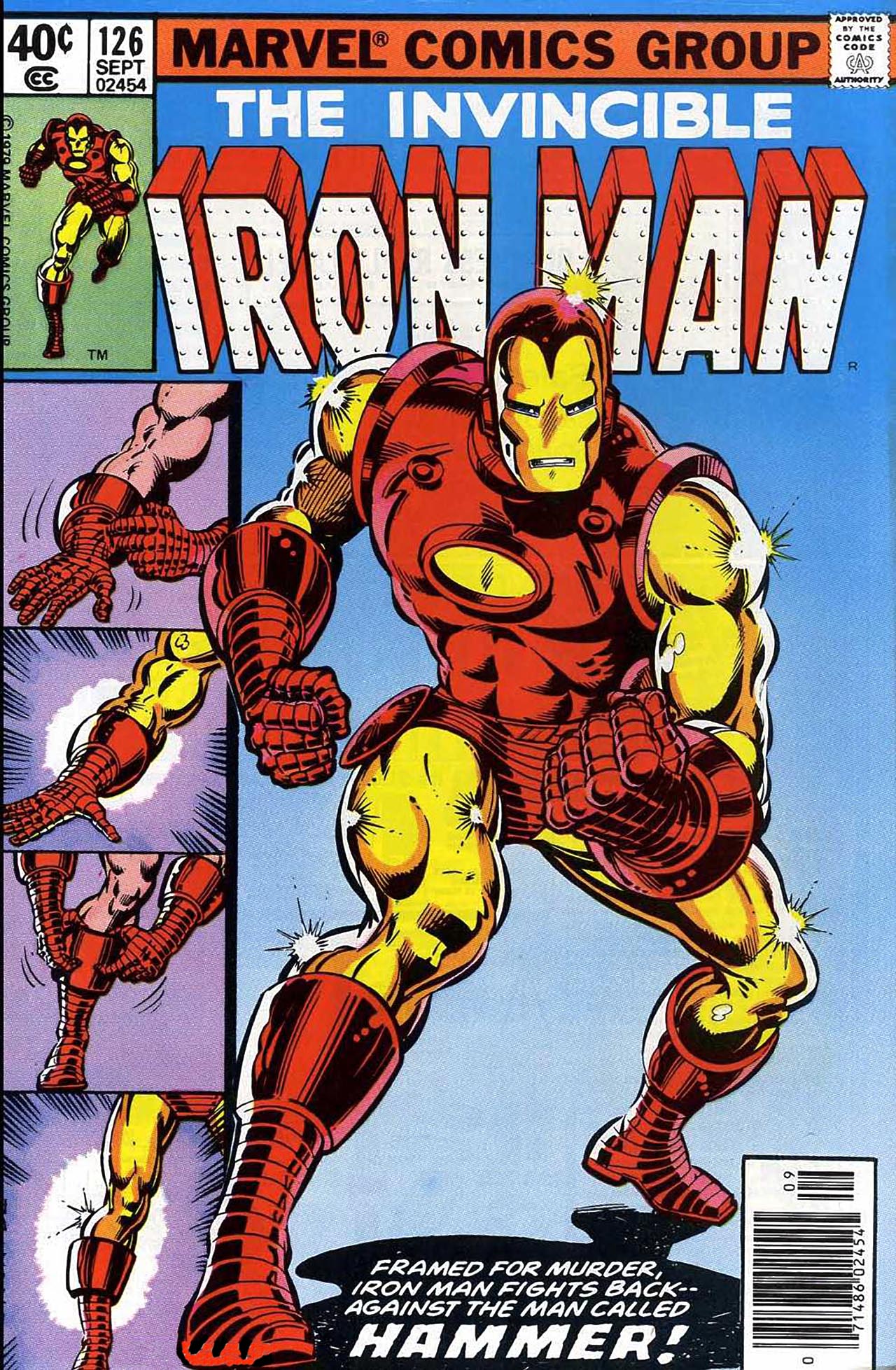


Quietly and without fanfare, IRON MAN had become one of the most reliably entertaining comics in the Marvel line. This was all down to the efforts of the creative team, writer David Michelinie, penciler John Romita Jr., and inker and co-plotter Bob Layton. It was also a reflection of the changing times; Micheline and Layton tapped into the growing zeitgeist of the approaching 1980s, the “Me decade” in which greed was declared to be good. In that environment, it was easier for readers to embrace the wealthy and hedonistic Tony Stark as an aspirational figure. The team also upgraded Stark’s world, pushing it further in the direction of a 007 movie, with larger-than-life corporate villains and plenty of espionage and intrigue atop the super heroics. Perhaps more centrally, they immediately began showcasing their lead character as a powerhouse, as unstoppable as his descriptor “invincible’ had previously only implied. Up to this point, most creators had spotlighted the vulnerability of Tony Stark, with his weak heart and dependency on gadgetry to get things done. These creators instead emphasized Tony’s intelligence and can-do spirit–in particular in this multi-part storyline.
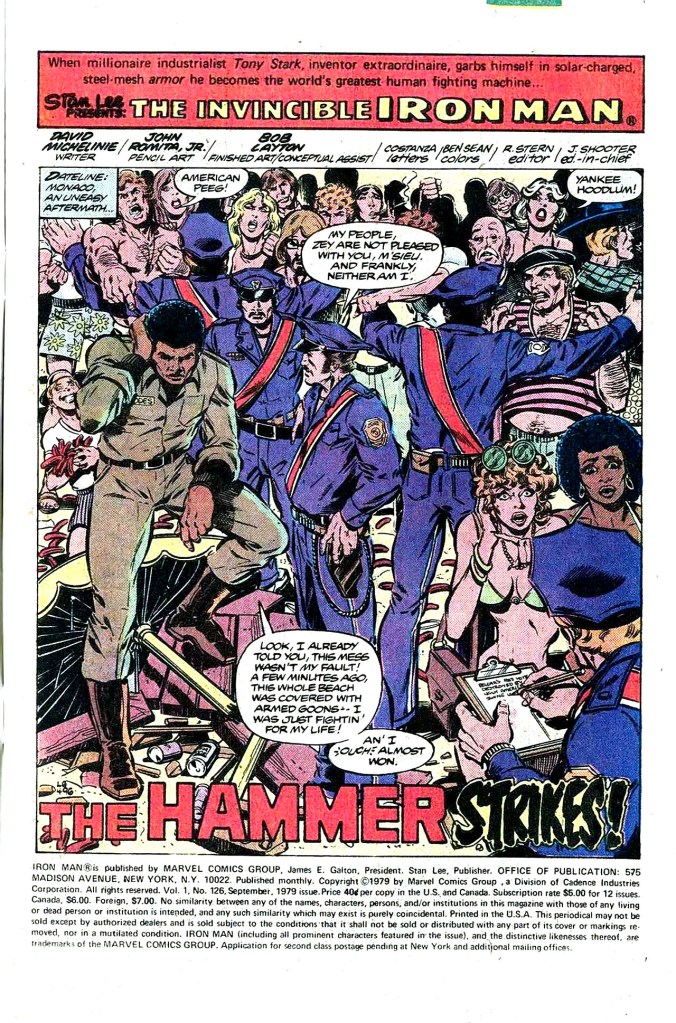
As we saw last issue, Iron Man’s armor had been impounded by the authorities after a deliberate outside influence had caused its repulsor rays to fire during a photo-op, killing the ambassador of Carnelia and framing the Armored Avenger for the crime. On his own, Tony Stark trained up on self-defense with Captain America, and then he and his buddy pilot Jim Rhodes set out to track down the culprit responsible for compromising his Iron man armor. So the book had suddenly veered into being akin to one of the buddy comedy cop movies that proliferated the 1980s, which was pretty fun. At the close of last issue, having come close to locating the party responsible, Stark and Rhodes were overwhelmed by the mercenary squad employed by the mysterious “Hammer”. As this issue open, we learn that Rhodey has been left behind, while Hammer’s men have made off with Tony Stark himself.
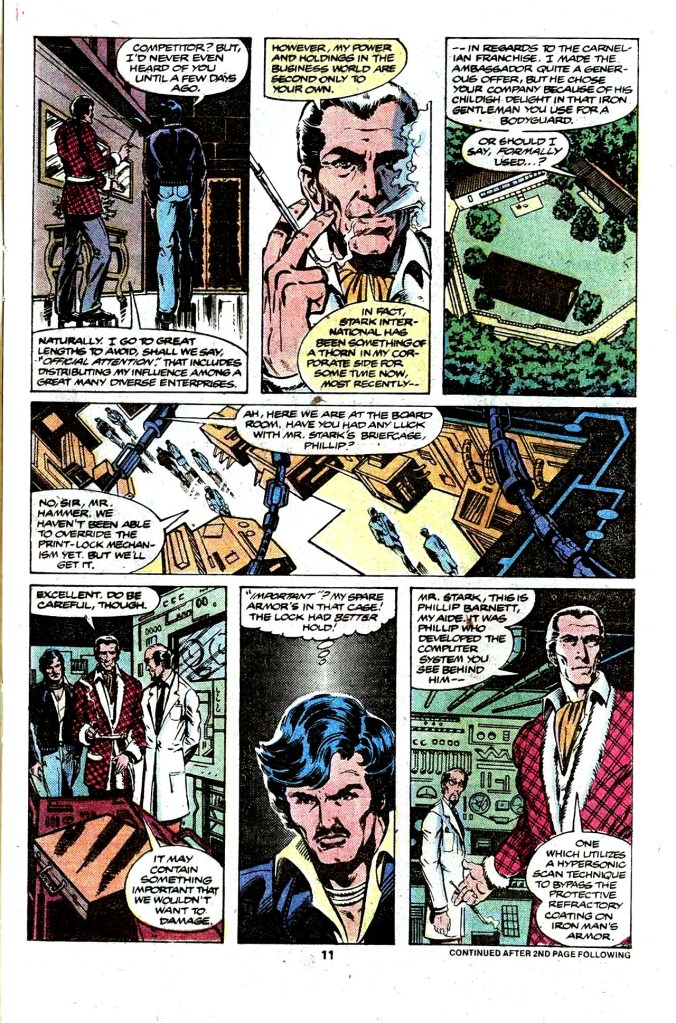
And in fact, the issue kills three pages on an extended recap of the events of prior issues that have brought the story to this point. I don’t know that eating up so much territory was warranted–possibly the creators felt like new readers were jumping aboard mid-stream and wanted to give them a fighting chance of understanding what was going on–but it did allow for some visuals of Iron man in action in an issue that was otherwise almost entirely focused on Tony Stark unarmored. When we do cut back to Tony, he’s been ushered into the office of Justin Hammer, the architect of his recent troubles, who introduces himself as Stark’s secret competitor. Hammer has corporate holdings all over the world, and little concern for international law. Hammer shows off his operation to the captive Stark, admitting that his massive computer systems were able to override Iron Man’s control systems on multiple occasions. The death of the Carnelian ambassador has allowed Hammer’s holdings to take possession of an important development contract in Carnelia that was meant to go to Stark International.
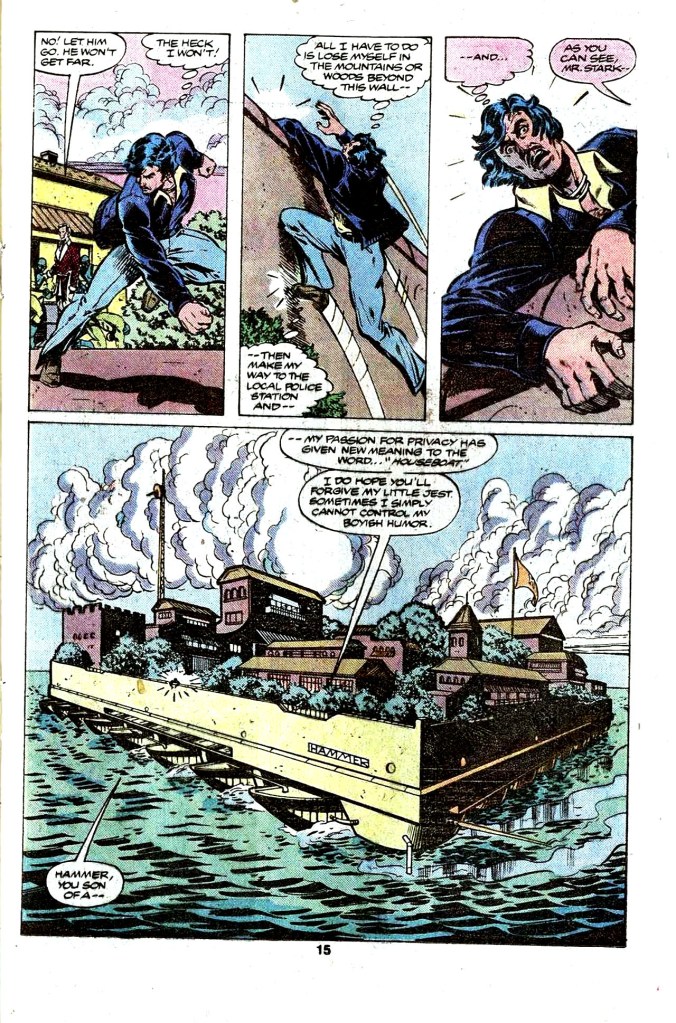
Hammer’s goon squad also relieve Stark of his locked briefcase, in which he’s been carrying his spare suit of Iron Man armor. So far, they haven’t been able to override the locking mechanism and gain access to the contents of the case, but it’s only a matter of time. At an opportune moment, using the self-defense techniques that Captain America schooled him in, Stark breaks a guard’s clavicle and makes a run for the outskirts of Hammer’s compound, in tending to lose himself in the woods beyond. But climbing the retaining wall, Tony is stunned to learn that the compound isn’t on dry land at all. Rather, it’s an enormous ship, practically a floating island, and far removed from any nearby land. There isn’t anywhere that he can escape to.
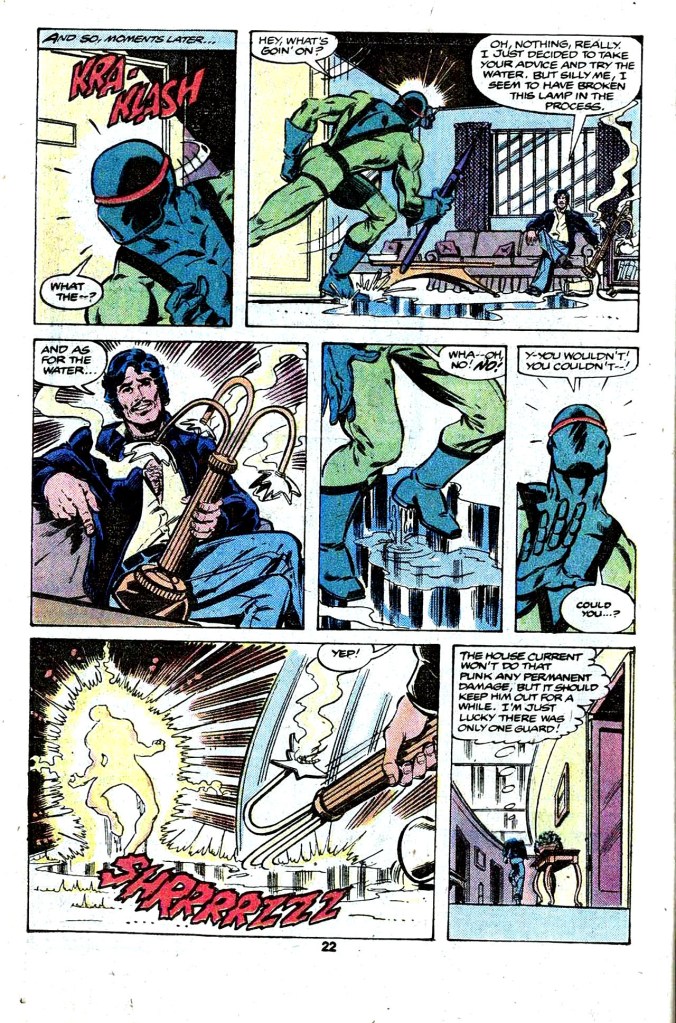
After a brief interlude with love interest Bethany Cabe, we return to Tony, who’s been imprisoned in a high class cell. He’s suffering what we’ll come to know in a few short issues as an alcoholic’s cravings, but his guard tells him that he’s not permitted any booze–that Hammer wants him sobered up. Tony has been provided with a pitcher of water to quench his thirst, though–and he uses it to put together a makeshift trap using a broken table lamp. Luring his guard into the room, Tony electrocutes him with current carried through the water and makes a break for it again.
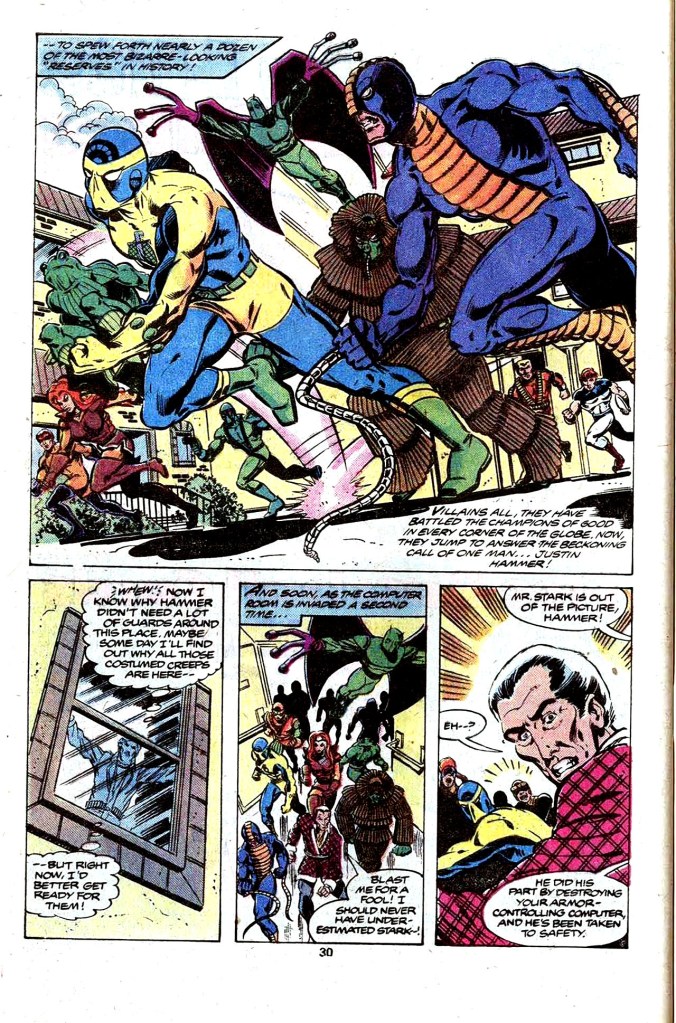
Stark makes his way back to the room containing the computer system that compromised his armor’s control, which also happens to be where his briefcase is being kept. Using some basic 007-style gadgetry and his own courage and fighting spirit, Tony breaks into the room and dispatches the couple of guards and scientists stationed there. Then he blows up the computer. In the meantime, we also learn that Hammer has been financing the activities of any number of super-villains, providing them with tech support and infrastructure in exchange for a share of their take. So there’s a small army of super-villains on the island base, all of whom Hammer sends to check out the source of the computer explosion along with his own security force. Tony Stark is clearly outnumbered and outguned.
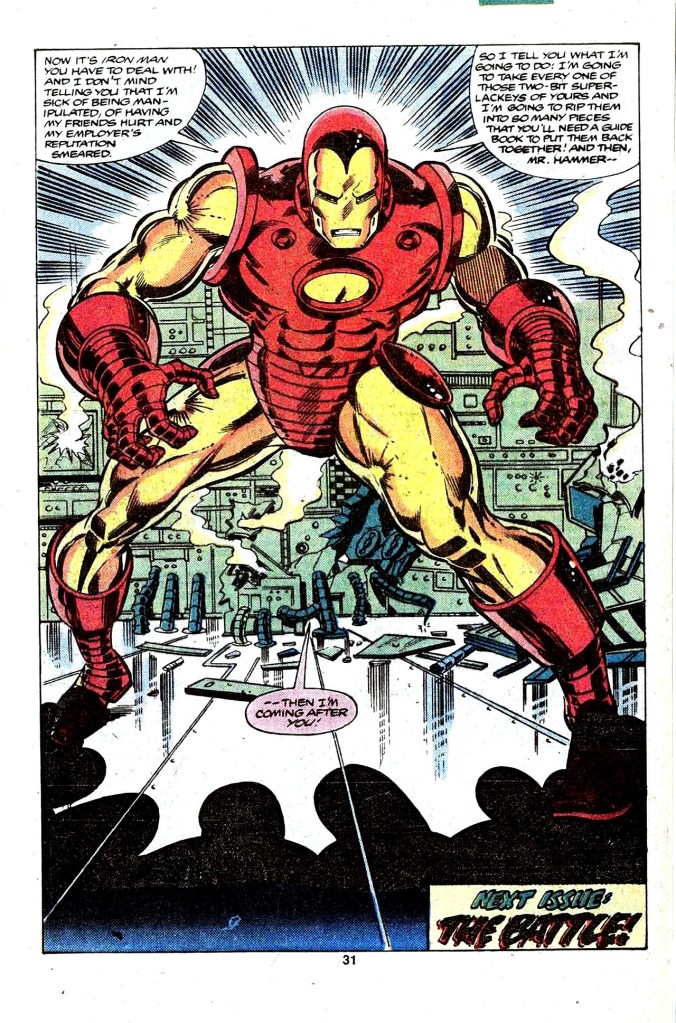
Which leads us into this great final moment of the issue. Tony’s taken the opportunity to don his spare set of armor, and when Hammer and his army of thugs and villains arrive at the lab, Iron Man dramatically explains that he’s already gotten Stark to safety and destroyed Hammer’s ability to compromise his technology. And now he’s going to beat the ever-lovin’ crap out of every last one of the bad guys Hammer has brought with him, before finally turning his attention to Hammer himself. It’s a dramatic declaration, and one that Shell-head will make good on in the next issue. But even here, the sense of confidence with which this moment is delivered sends a very clear signal: this isn’t the Iron Man who would often run out of power or be stricken with heart palpitations in the midst of a conflict. This is a very different, much more kick-ass Iron Man, who is more than a match for anything the world can throw up against him. The stand-off here was undeniably cool and made readers salivate for the payoff next month. Romita and Layton are in perfect synch here visually as well, and Iron Man had rarely looked this sleek and metallic and just plain cool.
 The Tom Brevoort Experience
Bob Layton’s inks remain some of the best. I know he’s had success with writing and drawing. I personally don’t rank him above my faves in those jobs. But as an inker, he’s not alone at the top of my list, but he is definitely one of those few up there. .
LikeLiked by 1 person
We’re on the same page. Although I’ve not read enough of Bob Layton’s writing to offer any judgement, I never cared near as much for his pencils as I did his inking. And with Iron Man, those inks do indeed rank high on my list.
LikeLiked by 1 person
I’ve read most of the Michelinie & Layton Iron Man run via back issues and trade paperbacks, and I really enjoyed it. So, I can only imagine how much greater an impact it would have been to be reading this series month by month in the late 1970s when these were first being published. Really must have felt like a breath of fresh air and genuinely groundbreaking after so many years of Iron Man being a B-list book. And no offense to longtime 1970s Iron Man penciler George Tuska, but the art on Michelinie & Layton’s run, with several talented young pencilers matched with Layton’s slick inks, resulted in some genuinely great artwork.
Also, I’ve always liked how Michelinie & Layton modeled Justin Hammer on veteran British actor Peter Cushing, with his last name being a nod to Hammer Film Productions, where he made some of his most famous movies.
LikeLiked by 2 people
Oh man, I thought he looked like Christopher Lee. But to my research…
LikeLiked by 1 person
I was just thinking of Christopher Lee as a Justin Hammer type and wondering who else could have played the character. Cause I noticed that in Iron Man 2 film they did the same thing with Justin Hammer that in Spider-Man 3 film they did with Eddie Brock, picked an actor more like the actor playing the hero ( Tobey Maguire & Robert Downey Jr. ) with an actor near the same age and build to play villain ( Topher Grace & Sam Rockwell ) instead of actors who look similar to the comic book villains. I guess they were thinking Mirror Universe within the same universe.
LikeLiked by 2 people
There is a letter printed in a subsequent issue, where the writer compares Justin Hammer to both Peter Cushing and Christopher Lee. The editor doesn’t definitively admit to either, though he does acknowledge the homage generally. Personally, I think Hammer is 100% Cushing, but with some of Lee’s height and build. I really wish the Hammer in the MCU had been cast to be more like either of these gentlemen, an urbane, Machiavellian presence, rather than a buffoon (as much as I like Sam Rockwell generally).
LikeLike
I’m looking at Peter Cushing photos now and Justin Hammer does resemble him.
LikeLiked by 2 people
Well, darn. Who is Hammer based on? Christopher Lee or Peter Cushing? I’m going need to know before I can properly review this issue…in about a year. 😀
LikeLiked by 2 people
Say that different sources claim one or the other.
LikeLike
Crushing the Cushing homage.
LikeLike
He looks like Cushing.
LikeLiked by 1 person
While I wasn’t a regular Iron Man reader back then, I remember this issue clearly. I haven’t read it in years, but recognize all those pages linked above. I thought Hammer was intriguing, loved the assortment of hired super-goons and thought that cliffhanger was great. I thought the art was so sharp. Since I hadn’t read most of the earlier issues, this was the only Stark/Iron Man persona that I’d known. I probably wasn’t aware of the shift in characterization.
Despite my fondness for this issue, I can’t even remember if I own or read the next issue payoff. I might have to go track it down!
LikeLiked by 1 person
Yes. Track it down immediately. It does not disappoint.
LikeLiked by 1 person
I guess I was the reader who didn’t embrace Tony Stark’s wealthy and hedonistic life style, but only Iron Man ( Not just the armour. 24 issues after this one get to see that it is the MAN and not the suit that makes HIM IRON MAN, like Peter Parker is as much Spider-Man as his Spider-Powers —the scientists, inventors & geniuses. I have always liked smart characters ).
LikeLiked by 2 people
Of the super-villains in this issue, Blizzard ( Gregor Shapanka ),Man-Killer, Melter, Porcupine and Spymaster are dead. Leap-Frog and Beetle are retired ( In Beetle’s case only as a villain becoming the hero Mach-1 to Mach-X ), Water Wizard and Whiplash got new names Aqueduct and Blacklash, Constrictor, Discus and Stiletto are still alive.
LikeLike
Constrictor had a spell being more heroic as well.
LikeLike
I wonder if Justin Hammer was a member or if he was inspired by the Organizers [ Marvel Knights: Spider-Man#9 ( February 2005 ) a secret cabal ( of 1940s to present ) business people who feared the coming of superheroes, so they funded various supervillains –see marvunapp.com – Asbestos Lady ]?
LikeLike
(Deep breath, Rick. They’re talking about Iron Man. Your favorite hero. One you write a blog about. Don’t geek out and embarrass yourself.)
IrnMnroxshinykuhlsuit!!!!
(Damn! Another deep breath and try again)
For someone who endured years and years of Iron Man succumbing to everything from a bum ticker to Princess Python’s snake, no question that the Michelinie, JR JR & Layton issues seemed like manna from Heaven above.
And their formula for success seemed so simple. Let Tony Stark be smart, handsome, rich and cool. Everything he already was. Oh and let him act like the second most powerful Avenger which meant putting the hurt on much of his lame rogues gallery.
Having started my blog with Iron Man #30, it’s safe to say that those were indeed rough waters for the good-ship Golden Avenger with it nearly going under a few times. In reviewing so many of those dreadful issues, I could not wait until I started reading about this team. Yet, while they are light years above much of what preceded them, I will cautiously add that as I’m now reading those issues, there are a couple factors that dim the luster just a tad. One is that there seemed a fair number of fill-in issues between major stories and a tendency to occasionally take the easy way out. Case in point, the entire SHIELD buy-out of SI was resolved in a few pages of #129. Nor was I wild about how Whitney Frost turned out during their tenure.
But again, compared to what so many of us endured for so long on this title, this was a Marvel-ous time to be an Iron Man fan.
LikeLiked by 2 people
Ironman had been on a bit of an upswing for about a year before Michelinie/Romita/Layton* came on board…. the Mantlo/Pollard run is pretty solid… but they* definitely changed the vibe and the game. These were exciting comics all in all… though I think they over corrected Stark from rich and sometimes stuffy to rich and sometimes sleazy.
I think Hammer whould have tried coercing Stark to open his briefcase. That said… great last panel and the next issue is a banger.
LikeLiked by 2 people
john romita jr may have been working out some kinks in panel to panel, shot angles kinda storytelling stuff, but he and layton were a helluva team, manalive, that opening splash page is fantastic, the body language, the textures, there’s a feel like its alive. jrjr’s evolution is endlessly fascinating, too, guy is a master
LikeLiked by 1 person
You may all step back and stare at me with envy. This issue was my introduction to the character of Iron Man in July of 1979 — and what an introduction. My only previous exposure to him was a tiny image in a Starlog magazine of a John Buscema poster featuring the popular Marvel characters of the day. I had no clue who the little red and yellow robot man was, but he looked interesting. Seeing this comic on the spinner rack a few weeks later made me want to satisfy my curiosity.
What a FANTASTIC issue with which to discover Iron Man. Precisely because Iron Man isn’t in it much! I got to know this Tony Stark guy thoroughly first. And what a guy! Resourceful, cool under pressure, wryly funny, charming, and a dab hand with the ladies. The art was amazing. Clean and precise! And that final page had me panting for the next issue. I instantly not only became an Iron Man fan, but I credit this issue as the reason I started buying and collecting comics in general. Proof that every comic could be someone’s first comic.
I love this issue so much, I bought the original art for page 11 pictured in Tom’s article when it came up on eBay a couple of decades ago. One of my prized possessions. It’s framed and hanging in my studio.
I’ve collected every issue of Tales of Suspense and Iron Man up through the early 2000s. The Michelinie/JRJr/Layton run is certainly when Iron Man came into his own. The ’70s issues were particularly uneven-to-floundering-to-dreadful. Those three creators showed what had been lurking within the character all along — a cutting edge adventurer and powerhouse, who could anchor great stories. I did a read-through of the entire collection many years ago, and when that creative team appears (and I already knew they were coming), it was like when the Impressionists had their first exhibition in 1874 — such a breathtaking departure from what had preceded it.
The next issue is a real banger too! Great cover, and a slugfest with a slew of second-string super goons that delivers fun dialog along with the high tech punches.
LikeLiked by 4 people
It was a great change of pace to see Tony as a greater hero but I would have loved to see Michelinie do it with Tuska. Am I the minority that thinks the series survived the crap years because Tuska made every issue better than the scripts called for? I was a bit of a fan of JRJR at first but the Janson years (where it looks like very rough layouts inked by a Sharpie) has me rethinking even that. Layton turned me off as did any inker who made every peniciler they inked look the same by an overwhelming job done on them.
LikeLiked by 2 people
IMHO, while George Tuska did solid work putting together some truly horrid stories – anyone remember Mikas or Demetrius? – the quality of his work seemed to lessen over the years. I know that Mike Esposito did him absolutely no favor with the inks. But when I think of GT’s art with Vince Coletta during #40-early 50’s compared to his final issues after #100, the decline seemed clear to me. In Tuska’s defense, it’s my understanding that there were notable health and age-related issues around that time.
LikeLiked by 1 person
One of my favorite arcs of all time. Tony was finally invincible for a change. Loved all these villains they assembled against him. He wiped the floor with them. The next issue was awesome. This was the Invincible Iron Man at his finest. Demon in a bottle was a defining moment for Tony.
LikeLiked by 2 people
“This was all down to the efforts of the creative team, writer David Michelinie, penciler John Romita Jr., and inker and co-plotter Bob Layton.”
For all that “creators get the credit, editors get the blame,” I’d also extend credit to editor Roger Stern, whose line of books — which included, at the time, MARVEL TWO-IN-ONE (Gruenwald/Macchio/Byrne/Perez), SPIDER-WOMAN (Gruenwald/Infantino), AVENGERS (Michelinie/Byrne), X-MEN, MASTER OF KUNG FU (Moench/Zeck) and POWER MAN/IRON FIST (Jo Duffy) — was remarkably solid and consistent.
Not everything Roger edited was in wonderful shape — GHOST RIDER was dull and CAPTAIN AMERICA was entering a morass of fill-ins — but overall, his record was really, really good. Individual editors had just started getting credits at Marvel a year earlier, and I’d already come to recognize the Stern name as a mark of quality, as I had with Paul Levitz over at DC.
LikeLiked by 5 people
I 100% concur. I started reading comics about this time, and only in retrospect did I realize that Roger Stern was not only an excellent writer (love his Cap, Dr. Strange, and Spider-Man work around this time), but an excellent editor.
LikeLike
Only makes sense to me not to show your lead character fail too much. Vulnerable is fine, high stakes are compelling. But we aren’t paying to see our hero get beat up too frequently. We’ve got real life for that. As long as the emotions and interactions in the story feel real.
We’ve seen titles fail because we’re repeatedly told by the storytellers the lead is a failure. The mid-1980’s JLA is a good example. Gerry Conway kept showing us this team of misfits wasnt up to the job. (They could’ve been.). Contrast that with the scrappy, but often victorious ( often at a high price) underdog X-Men of those same times.
Superman in the 1990’s, too. The writers or editors were too concerned he was too powerful to be interesting, that Supes seemed to whine a lot.
So if Tony’s confident, we believe him. We’ll follow him. Bendis played with his conceit and hubris. Making him the villain in “Civil War” was a risk, too
But the shallower “greed is good” is better left to the villains. Bruce Wayne handled his wealth differently. And he didn’t have all the “personal protective equipment” Tony made. Batman was more exposed to immediate danger. So I admired him more. I respected Tony, though. Though he came off a bit wooden back then.
LikeLiked by 1 person
Contrast that with the Batman of today who is essentially above PhD in everything. Superman Unlimited saw him, not Mister Terrific, either Atom or Steel, or Blue Beetle create a one time way to transmute one color Kryptonite into another.
LikeLiked by 1 person
That’s a mistake on the part of DC. In the 90s and even into the 2000’s, we did see Batman lean on science heroes (my apologies to the esteemed Mr. Alan Moore) that you named. And also especially Ray Palmer, Barry Allen.
I don’t know if it became a corporate mandate that Batman had to know and could do everything. But that gets boring (for me), too.
LikeLiked by 1 person
There’s a JLA scene in Conway’s tenure where Flash reminds Atom that sure, Bruce knows science, but he’s an amateur and they’re professionals. Nobody would say that today.
LikeLike
I was a life long DC fan but when the DC Implosion left with me with more coin than comics to buy, I turned to Marvel and this run of Iron-Man by David Michelinie, John Romita Jr., and Bob Layton caught my attention and blew me away. I was amazed by this series in a way that DC’s output at the time failed to do. Iron-Man#126 particularly captivated me. I didn’t realize until the big reveal at the end that Shellhead was missing and it was all Tony Stark. A very clever and exciting issue.
LikeLiked by 2 people
I came on board shortly before this issue and for the first time I got hooked on Iron Man. I hadn’t thought at the time about them portraying him as more powerful but I’m rereading Gerry Conway’s run right now and yeah, his Iron Man is way ineffective
Had no idea this was Romita Jr. Usually I can’t stand his stuff.
Minor point, Stiletto and Discus were both vigilante crook-killers. They must have hated having to work alongside men they considered real villains.
LikeLiked by 1 person
Which Conway run are you rereading? #36-43 or #92-96? I wasn’t a fan of either, but I thought that first run was a particular low point for the series. However, in Conway’s defense, I believe Iron Man was his first series and he was 18 at the time.
That’s also an interesting point about Stiletto & Discus that I never considered.
LikeLike
The first run. Conway started it maybe a month after becoming Daredevil’s writer. I’m in the middle of the “Mr. Kline” arc criss-crossing between both.
LikeLiked by 1 person
Don’t say “Mr. Kline” three times or he’ll come back! Seriously, Alan Stewart put together an outstanding summary on that storyline on his blog.
LikeLiked by 1 person
Alan Stewart possesses the genuinely great ability to write informative, entertaining blog posts about underwhelming Bronze Age comic books.
LikeLike
I’ve read that one and it is good. But as I’ve been slowly rereading the Silver Age now early Bronze Age DC/Marvel stuff over the past few years I shall soldier on through it
LikeLike
IIRC, Iron Man was some of JR Jr’s first work, and he was still sort of drawing in the style of his dad. It wasn’t till a few years later that he developed the style he’s known for now. I admire an artist for pushing himself and for developing his own style, but I do like JR Jr’s early work more than his later work.
LikeLike
Love Romita Jr circa 1978-1981 after that, around the time he took over X-Men, no so much. His work evolved in a way that was not my cup of tea, but the greatness of Iron Man work during that time can not be denied.
Of course Layton deserve huge credit as well for IM’s look during that time.
For me “Demon In A Bottle” era Iron Man exceeds “Dark Phoenix” era X-Men even if I am in the minority with that opinion.
LikeLike
I started reading comics with this issue of Iron Man, and though I love the Claremont/Byrne run on X-Men, the first Layton/Michelinie run on Iron Man will always be my sentimental favorite run on any comic book. It was the gateway drug for me, and showed me that comics aren’t risible kiddie stuff.
LikeLiked by 1 person