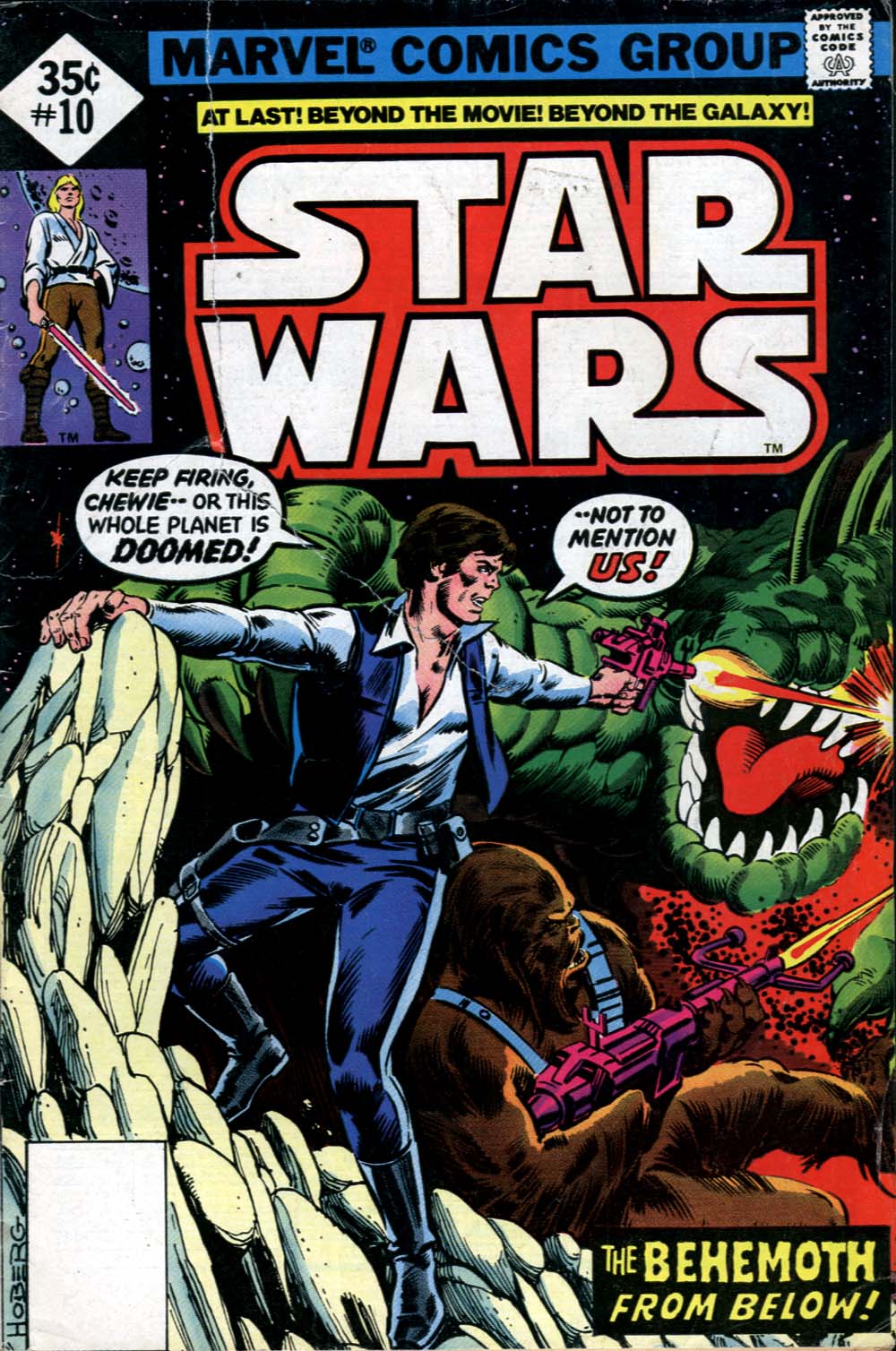


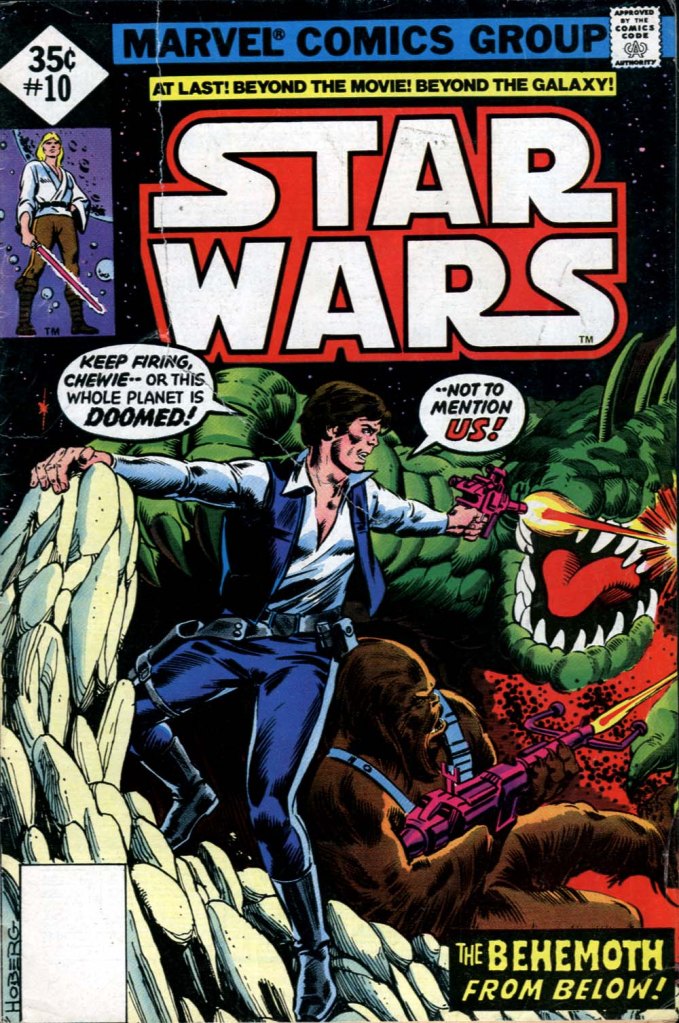
Just as he was an enormous fan of BATTLESTAR GALACTICA, my friend David Steckel was also a hardcore acolyte of STAR WARS, and he purchased each monthly issue of the Marvel comic based upon that storied film with almost religious zeal. It’s a bit alien to think of from the vantage point of today, but apart from the eventual release of the “Splinter of the Mind’s Eye” novel, the monthly Marvel STAR WARS comic was the only place one could turn to find additional adventures of Luke Skywalker and Han Solo and company (at least until the newspaper strip launched.) I wasn’t as enamored of STAR WARS at the time, though my younger brother Ken certainly was. But this didn’t stop David from loaning me the run of comics that he’d collected in the hopes of turning me into a convert. As I’d already read the first nine issues from copies my brother had scored in the 3-Bags that had proliferated ever since the movie turned out to be a massive blockbuster, issue #10 was the first one that was new to me.
Famously, it was editor Roy Thomas who brokered the deal for Marvel to adapt STAR WARS. Publisher Stan Lee wasn’t really all that interested at first, but Roy wore him down. And a good thing, too, since the sales of the STAR WARS comic in all of its multiple reprintings and editions were staggering, and may have single-handedly kept the company afloat during a sales downturn. Both Roy and artist Howard Chaykin had been personally requested by George Lucas–Roy due to his adeptness in adapting the work of Robert E. Howard and Chaykin thanks to his own science fiction work such as IRON WOLF and CODY STARBUCK. The adaptation ran for six issue, after which new stories had to be devised. But at this point, the only canon was that very first film. So Roy did what he did and just started to make up a bunch of new stuff.
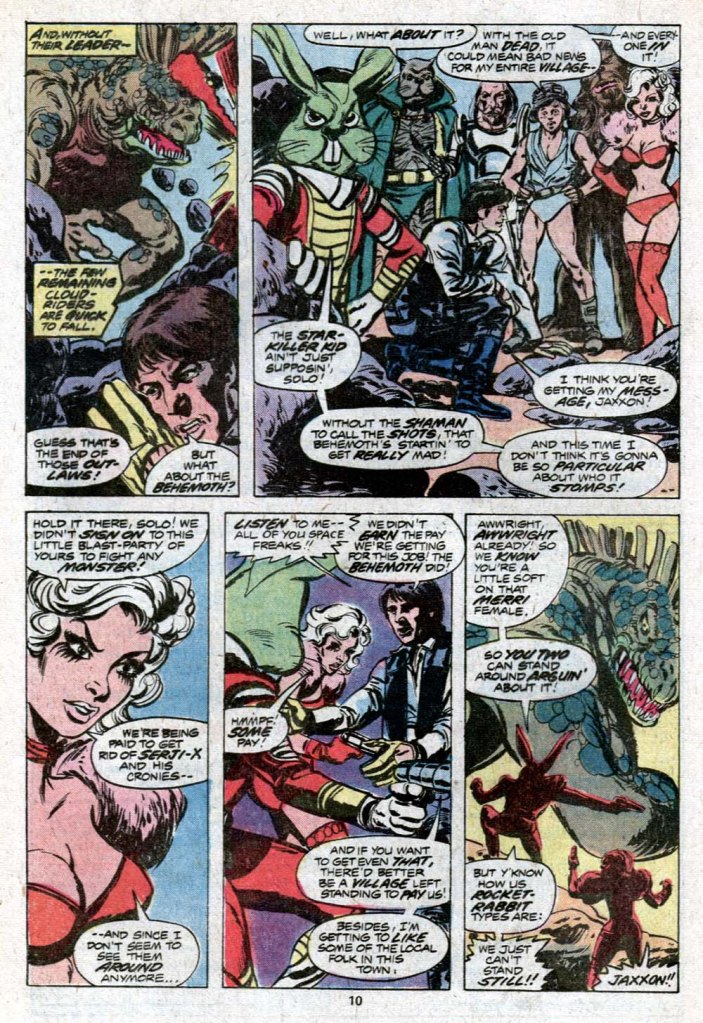
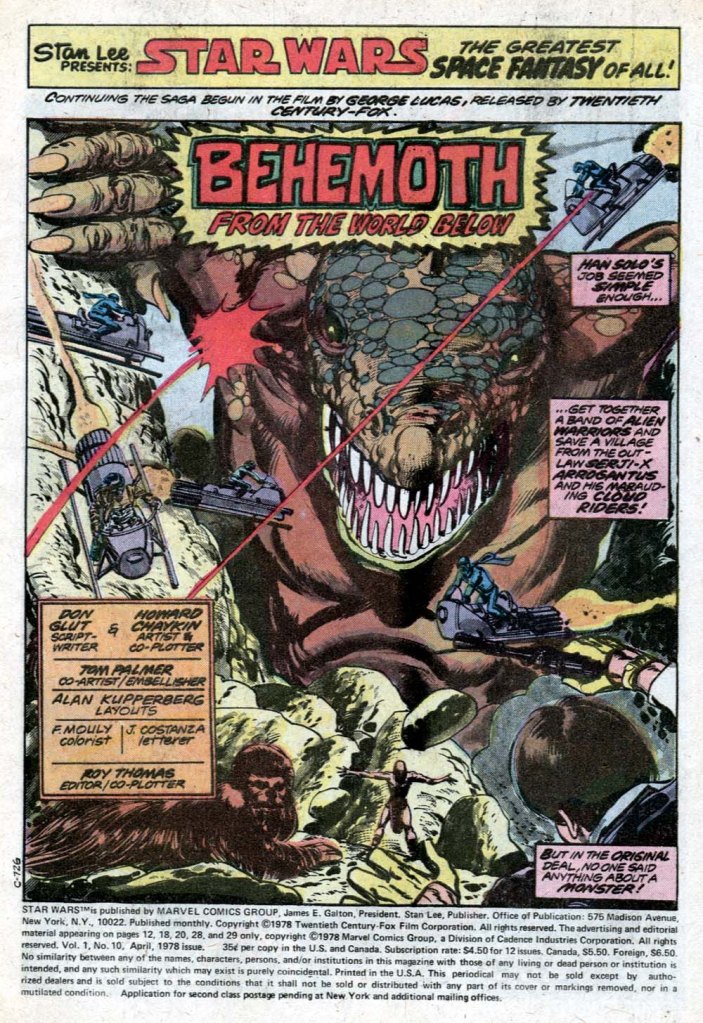
Roy decided to pretty much lift the plot of the Magnificent Seven/Seven Samurai whole cloth for the first new story. The plot involved Han Solo and Chewbacca being hired on to protect a village under siege by Cloud Raiders. Solo subcontracts the job, assembling a team of additional mercenaries including anthromorphic green rabbit-alien Jaxxon, a faux Jedi called Don-Wan Kihotay and a boy who calls himself the Starkiller Kid, all of whom were riffs on other established characters. The leader of the Cloud Raiders was named Serji-X Arrogantus, who was a broad parody of MAD and future GROO creator Sergio Aragones. It was a weird mix of elements, and by this tenth issue, both Roy and Chaykin seem as though they’ve had enough. They weren’t yet earning any royalties from the sales of the book (or they might have stuck around longer) and there were other things that they wanted to do with their time. So Roy turned the scripting over to his novelist friend Don Glut, and Chaykin limited his involvement to breakdowns which were finished by Tom Palmer.
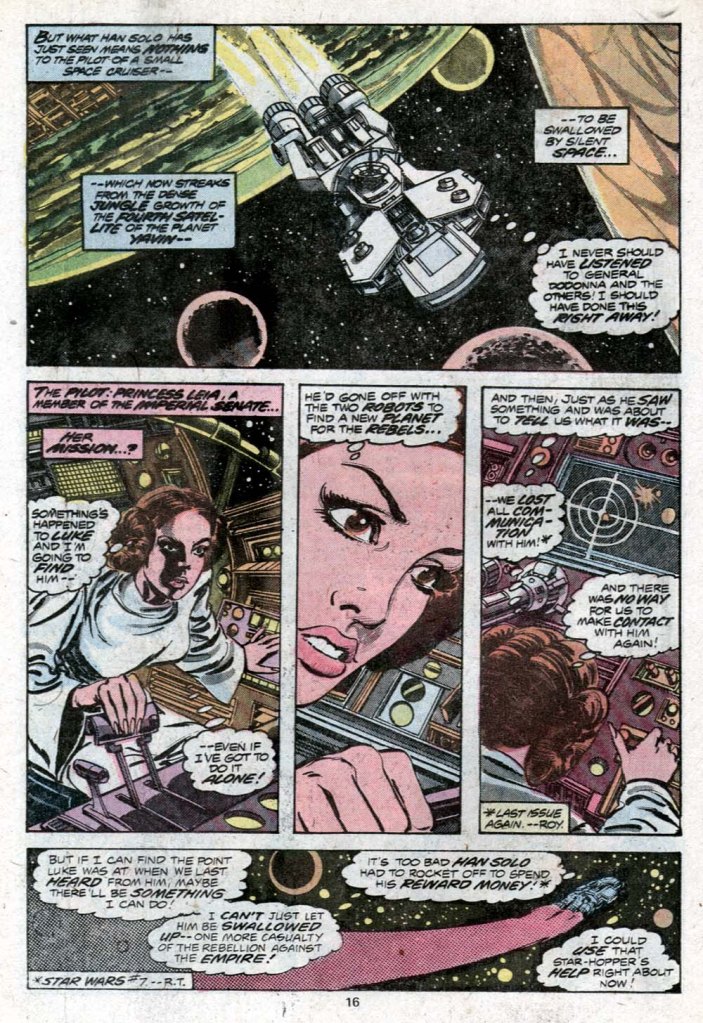
The whole adventure feels less like STAR WARS than one of the many knock-offs that proliferated in the wake of the movie’s massive success, such as BATTLE BEYOND THE STARS. There is one page that feels a bit more like the film, a subplot page in which Princess Leia pilots a spacecraft in the hopes of locating the missing Luke Skywalker, who vanished while on a mission the previous issue. Otherwise, this story is a straight-up space western, albeit one with giant monsters to fight as well as black-hatted bad guys. And I have to say, as a reader I liked it a lot more than typical STAR WARS shenanigans. It didn’t hurt, I expect, that Solo’s crew of mercenaries felt like a super hero team, each one having specific traits or powers. That was more my idiom at this point.
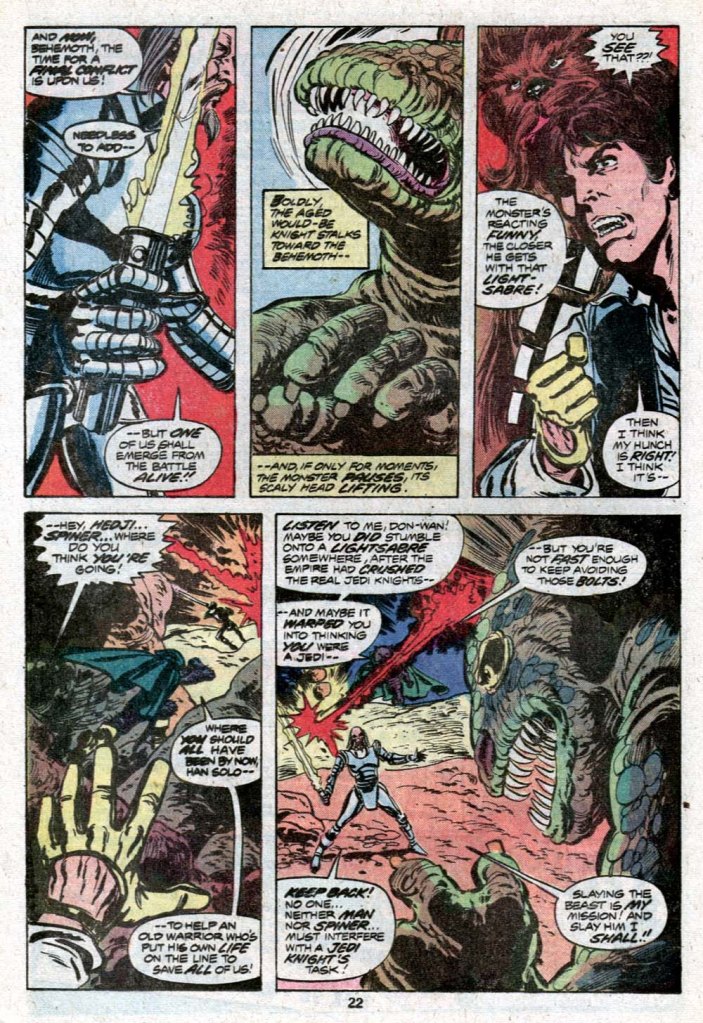
As this concluding chapter gets under way, the old Shaman of the village has succeeded in awakening the colossal behemoth that legends say has slept underneath the town for generations, hoping that it will wipe out their oppressors. Which it probably will–but not without taking the rest of the town to say nothing of Solo and his crew with them. So for the moment, all hands turn in unison to battle the enormous creature, but with only limited results. Looking for a way out, Serji-X figures that if he kills the old Shaman that might stop the behemoth. But as he rockets to blast down the old man, both figures are stepped on and crushed into paste by the colossus.
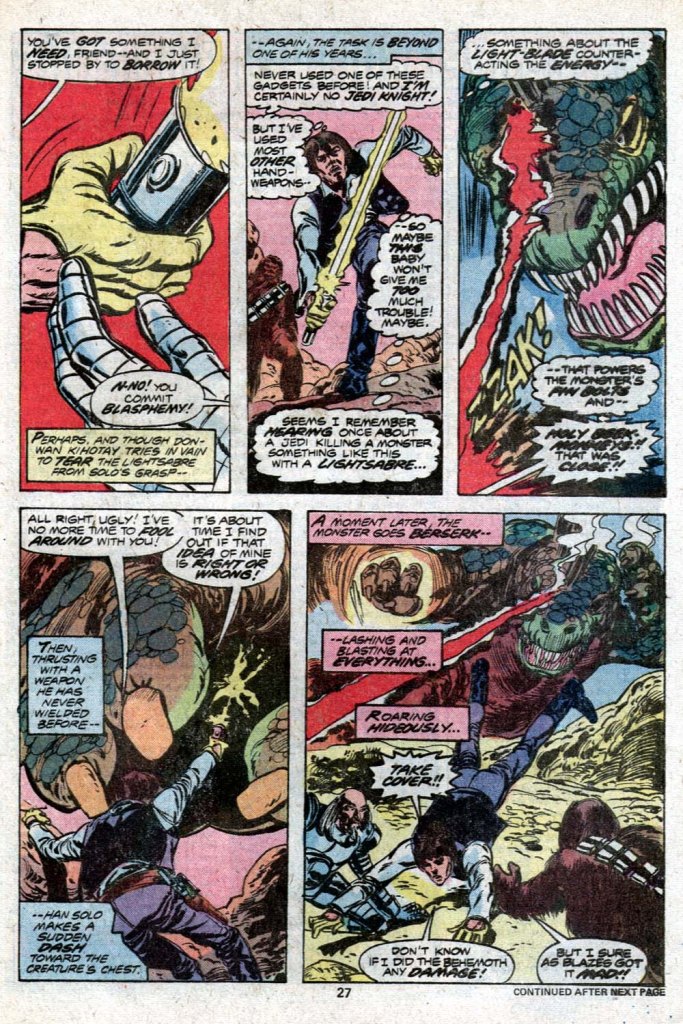
But the day isn’t saved yet, as the irate behemoth continues to stomp around causing chaos and havoc, and Solo figures that it’s up to their crew to put the thing down. But that proves more difficult to accomplish than expected, and his guys are pummeled and almost pulverized by the thing. Ad a key moment, Don-Wan makes a solo attack on the behemoth, and the lightsaber he wields seems to have some aggravating effect on the monster. So Chewbacca carries Solo to where Don-Wan is fighting and relieves him of his weapon, charging the monster with the lightsaber himself. He’s able to stab the behemoth in the chest with the weapon, which causes it to react in agony.
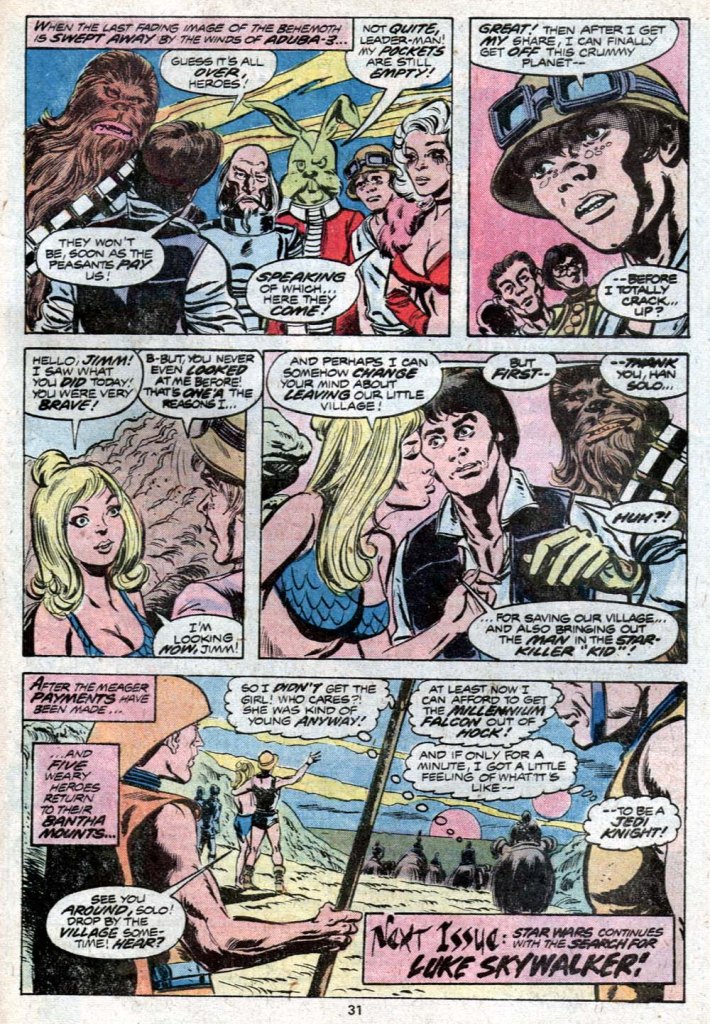
And then the damn thing blows up in an explosion of pyrotechnics, the energy of the lightsaber mixing catastrophically with the internal energies that power the monster’s own cranial energy beams. And that’s a wrap. The crew is paid its meager wages by the surviving villagers and Solo and Chewbacca head out towards new adventures–which include getting the Millennium Falcon out of hock. It was a perfectly fine story, but it doesn’t really feel like STAR WARS. In fact, it could have featured just about any other Marvel licensed property, from JOHN CARTER, WARLORD OF MARS to TARZAN, with only minor adjustments. And that, more than anything else, was its failing. There maybe wasn’t much material to draw upon, but this simply didn’t feel like STAR WARS.
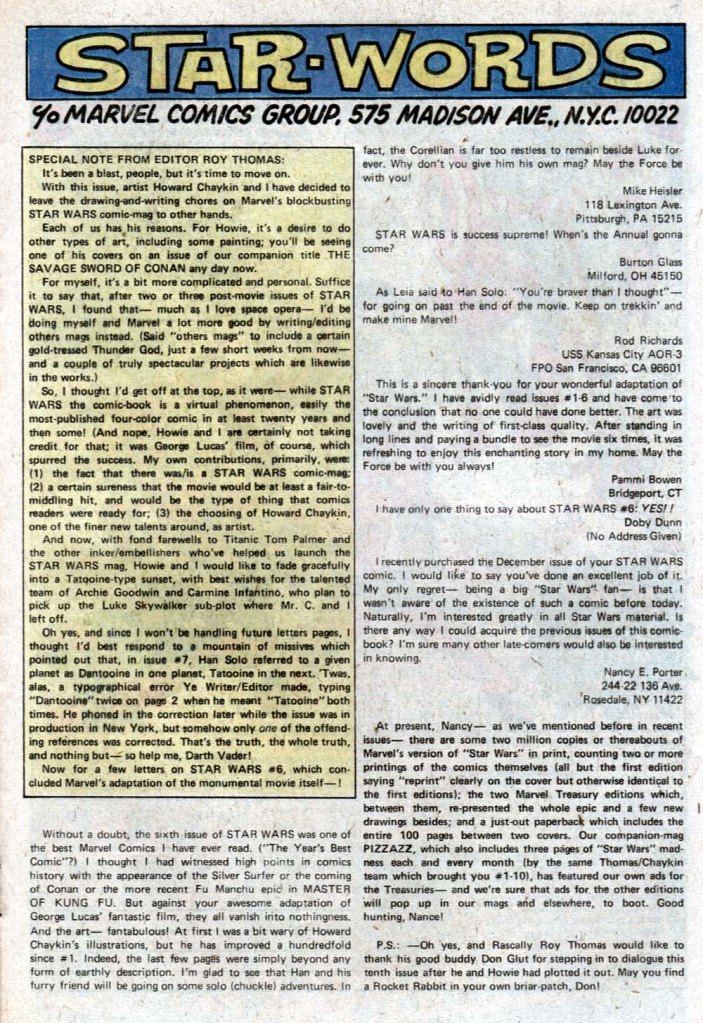
The Star Words letters page includes a note from future Marvel letterer and assistant editor Mike Heisler. It’s also got a bit of editorial text from Roy explaining why both he and Howard Chaykin are leaving the series at this point. One gets the sense that Roy didn’t have any particular strong feelings about the assignment and wasn’t wild about trying to come up with new adventures in and around the single existing film–particularly as talk about a sequel began to pick up.


I knew that Alan Kupperberg had done uncredited layouts for Howard Chaykin on the World of Krypton miniseries in 1979 (I think we talked about that in another of Tom B’s blog posts) but I was not aware that Kupperberg had had the same role, and credited this time, on Star Wars. I wonder how that arrangement came about.
Yeah, Chaykin has expressed on a number of occasions that has no real fondness for Star Wars, in spite of George Lucas apparently being a fan of his work. For Chaykin, it was just another job. I believe he’s said that his only regret is that if he’d had any inkling that his SW stories would be endlessly reprinted over the next five decades, he would have done a better job on the artwork.
LikeLiked by 2 people
A “Western”, huh? “How the Force was Won”, or the “How the Force was One, and One with the Force”…
Confused by the credits. So Chaykin co-plotted with Don, (a Glut of Star Wars mechandise).
Then Alan Kupperberg drew the layouts?
And Howard got “artist” credit for drawing over Alan’s layouts? (As opposed to breakdowns? The 2 are often different, but sometimes used, or misused interchangeably.)
Tom Palmer was “co-artist/embellisher”. Open to interpretation ? We know he inked the drawings. Was it more than that? He’s an accomplished artist in his own right & deserves the title.
But these credits don’t clearly divide the the visual duties. That’s IK. But just poses questions about who did what. Nothing to lose sleep over. Just curious about it.
LikeLiked by 1 person
Roy Thomas and Howard Chaykin co-plotted the story, and Don Glut scripted it. That’s pretty clear.
As for the art credits, yeah, it’s a bit confusing. Alan Kupperberg did layouts, Chaykin then, I don’t know, maybe he tightened them up somewhat, and finally Tom Palmer did finishes?
LikeLiked by 2 people
That’s exactly what happened.
Alan, working as Howard’s assistant, did rough storytelling layouts — and probably did them for issues earlier than this, too. And then Howard would do more polished pencils from those layouts, changing anything he didn’t like and making it look more like his work, since that’s what Marvel was paying for. But he didn’t do full pencils, because (a) there was a deadline and (b) when Tom Palmer’s going to ink it, doing “breakdowns” is fine.
In this case, I’d bet Alan got a credit because they were under enough time pressure that Howard couldn’t do the kind of polish he’d intended, so Alan showed through a lot. Howard would have said, “Yeah, Alan helped,” which was not an unusual thing at the time, and so Marvel credited him.
Joe Staton, early in his career, did layouts for Gil Kane. Howard, I think, may have done layouts for Kane. When Kane was doing BLACKMARK, he had deadline pressure and got a number of different people to help out — including a few pages of Harvey Kurtzman layouts.
Artists using assistants wasn’t remotely uncommon. Dave Hunt started out assisting John Romita; Terry Austin assisted Dick Giordano. Alan probably did layouts for a number of artists, because he was there and willing, and they needed help making deadlines.
LikeLiked by 3 people
Staton discussed doing layouts for Kane in an interview in Comic Book Creator #9. One of the issues Staton revealed he laid out for Kane was Amazing Spider-Man #150.
LikeLiked by 2 people
While all comics with established characters maintain some illusion of change, it would seem those rules would be even stricter with Luke, Hans, Leia and crew. A writer would have to tread even more carefully with relationships and events that could conflict with a future movie. But hey, being a Trekkie and Strange New Worlds fan, I have to give props that to the best of my knowledge, none of the Star Wars comics ever had the characters become muppets in someone’s dream. 😀
LikeLiked by 2 people
Well a later Star Wars annual clearly shows that Anakin and Darth Vader are two separate people. That was, of course, before Lucas had the big twist figured out.
LikeLiked by 4 people
That’s what I mean. Imagine being the writer on a licensed series like this. Every time you think you have clever idea, you may find out that it’s part of an upcoming movie twist. I think Archie Goodwin went through it when they wanted to reconstruct the Death Star only find out that was a no-no in front of Return of the Jedi.
LikeLiked by 2 people
That was actually David Michelinie & Walter Simonson who ran into that problem, with Simonson later joking that their plan was to have the Empire rebuild the Death Star and put chicken wire over the exhaust port 🙂
LikeLiked by 2 people
To say nothing of all those plotlines in which Leia is clearly jealous of Luke getting attentions from other women, before he became her brother.
LikeLike
After getting the polybagged collection of the previous three issues, it took me forever (it seemed) to find this conclusive issue. I don’t even remember how I eventually found it. I was loving the comic at this point, mostly the artwork, and was supremely disappointed by the next issue and follow-up storyline.
And I think it was necessary to take the characters to new places and present new foes, partly because Marvel wasn’t allowed to really progress the movie characters, and because introducing new characters that can show growth and development keeps it interesting.
LikeLiked by 2 people
Having read the early Marvel issues of Star Wars in the Dark Horse collections published in the early 2000s, I do feel that Archie Goodwin, who came onboard as writer & editor with the issue following this one, did a much better job introducing new characters & plotlines and seemingly moving the story forward without actually stepping on George Lucas’ toes. And I get the impression that the Goodwin / Carmine Infantino / Terry Austin issues are among the more highly regarded ones of the original Marvel run.
LikeLiked by 2 people
Goodwin did well with Baron Tagge and The Wheel and some supporting characters. Infantino’s art was, put mildly, divisive. Prior to Empire, there’s really no other run on the book, but there were some good individual stories such as annual #1. From recollections I’ve seen on the internet the most liked run was Micheline and Simonson.
LikeLiked by 1 person
Infantino’s pencils were definitely majorly enhanced by Austin’s inking on those Star Wars issues. I met Austin at a comic con a number of years ago, and I complimented him on his work on those SW issues. Austin informed me that Infantino had just roughed in the spaceships, and it was Austin’s job to put in all the details that made them accurate to what had been seen in the movie.
LikeLiked by 2 people
I enjoyed this when I read it. Nothing earth-shaking but I don’t expect earth-shaking in licensed adaptation books (when I’m wrong, I’m delighted).
LikeLiked by 3 people
Despite the fact that as a 14 year old boy Star Wars was aimed directly at me, seeing it was not the lifechanging event it seems to have been for every other teenage boy on the planet. Actually it may not have been aimed at me at all, as I didn’t see it until 1978. I don’t recall any screeching desire to see it first run. That being said, I liked it well enough to read “Han Solo at Stars’ End” with the cool guy in it and not the whiny one. My older brother had this issue and the others around it, which were enough to turn me off comics until 1983. Then came Empire, which halfway through turned me off Star Wars and I have never looked back.
LikeLike
“So Roy did what he did and […adapted something].”
Or a number of somethings, considering.
This was fun but dumb. And it’s kind of telling that Roy wasn’t interested enough to finish the story and Howard wasn’t interested enough to draw the story. And Tom Palmer pulled it all together and made it look pretty good. But I still think of this as the last bad STAR WARS story for a few years to come, since next issue, in the hands of Archie Goodwin as writer/editor with (usually) Carmine Infantino and good inkers on the art, it suddenly became pretty smart and built on stuff that felt like the movie, not like a weird MAD parody of something else.
I have a faint memory — or maybe I’m completely wrong — that Archie either wrote or at least plotted that one page with Leia that felt more like the movie to you, to foreshadow the next arc. It was included at his request, at any rate.
LikeLiked by 2 people
I never saw Star Wars in theaters but I think I bought every issue of the comic. All I can recall of it was how much I enjoyed Jaxxon and the great twist at the end of the arc that ended the series.
LikeLiked by 1 person
I don’t think I’ve ever read this one, though i have it in a long box somewhere. Seeing some of the art though reinforces something for me. For years, I thought I loved the Walt Simonson issues and the Ron Frenz issues too – BUT what I have come to realize in the last couple of years is that what I truly loved was the Tom Palmer finishes. Of course Walt/Ron are truly amazing. Only took me ~40 years of collecting to figure it out. I also have a soft spot for the Epting Avengers bomber jacket era for the same reason. And he inked the Neal Adams X-Men that I read in the reprint mini-series. RIP.
LikeLiked by 1 person
Don-Wan Kihotay was a bit on the nose. Funny. But seems like parody, as some commented earlier. The Serji-X was a friendly good and even flattering or respectful.
LikeLike
I bought the Star Wars novelization when it was first published in November 1976. I liked the story a lot, so I waited impatiently for the movie to come out. I also immediately bought Splinter of the Mind’s Eye when it was first published. But that was it, I never bought any of the novelizations of the sequels, or the comic adaptations and ongoing series, at least until Dark Horse collected Marvel’s original run. I wasn’t overly impressed with the adaptation or the next four issues, including this one.
I like the design of the behemoth in the interior art (that splash page is great), but I don’t like the artwork on the cover. Besides the color palette used, which doesn’t match the interior colors, the composition looks off to me. As for the story, the less said the better. It was obvious that Thomas had no interest in writing new adventures for our heroes.
LikeLike