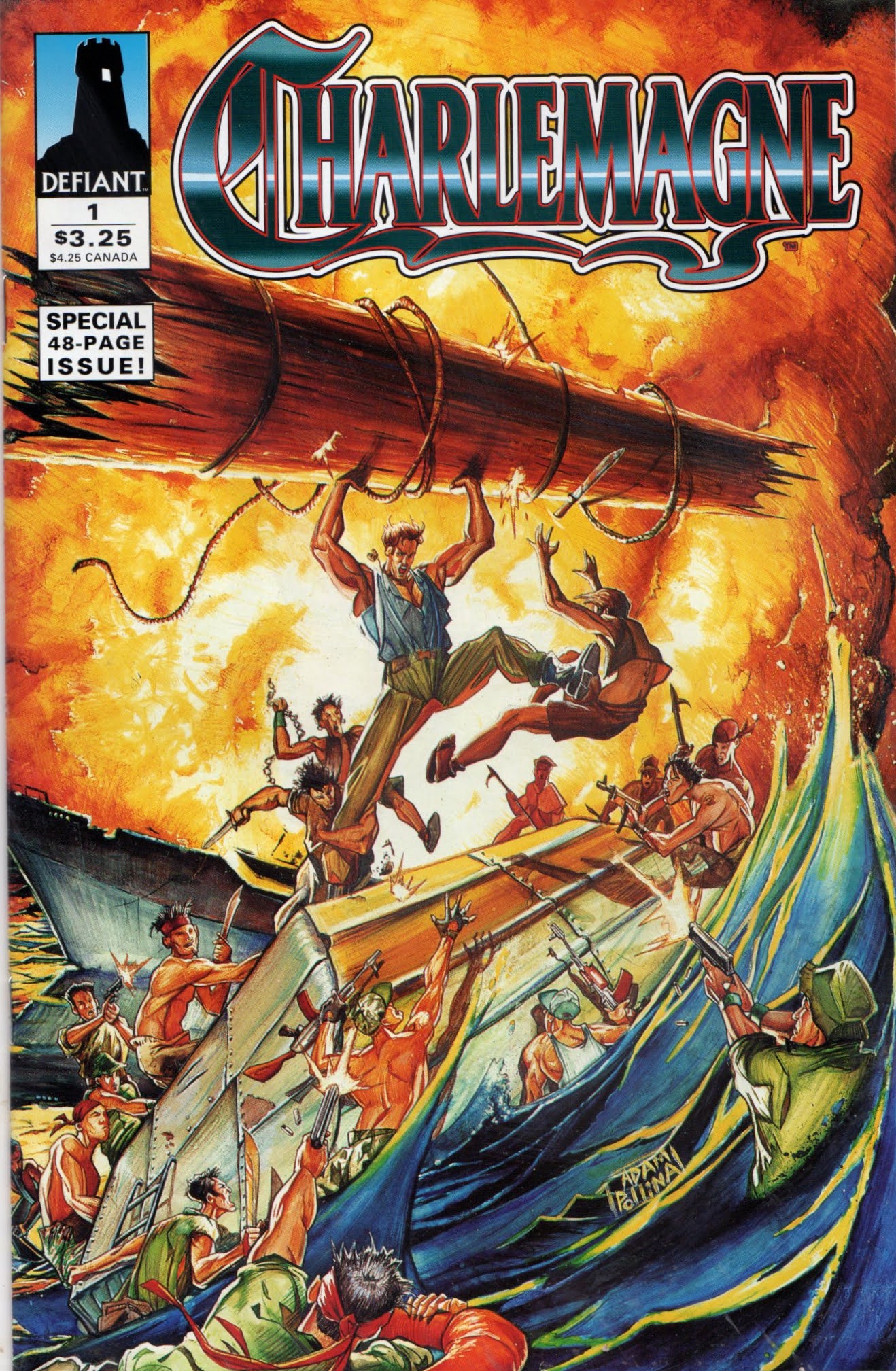


One of the last series launched by Jim Shooter’s ill-fated venture DEFIANT, CHARLEMAGNE was a title that a obvious amount of effort and expectation had clearly been spent on. The initial issue is oversized, and the launch was preceded by the publication of a CHARLEMAGNE #0 lead-in story, which was attached to an issue of the short-lived WIZARD-style industry magazine HERO ILLUSTRATED. But DEFIANT’s fortunes in general were on the rocks, and so CHARLEMAGNE only ran for five issue, disappearing with most of its central mysteries still left unrevealed.
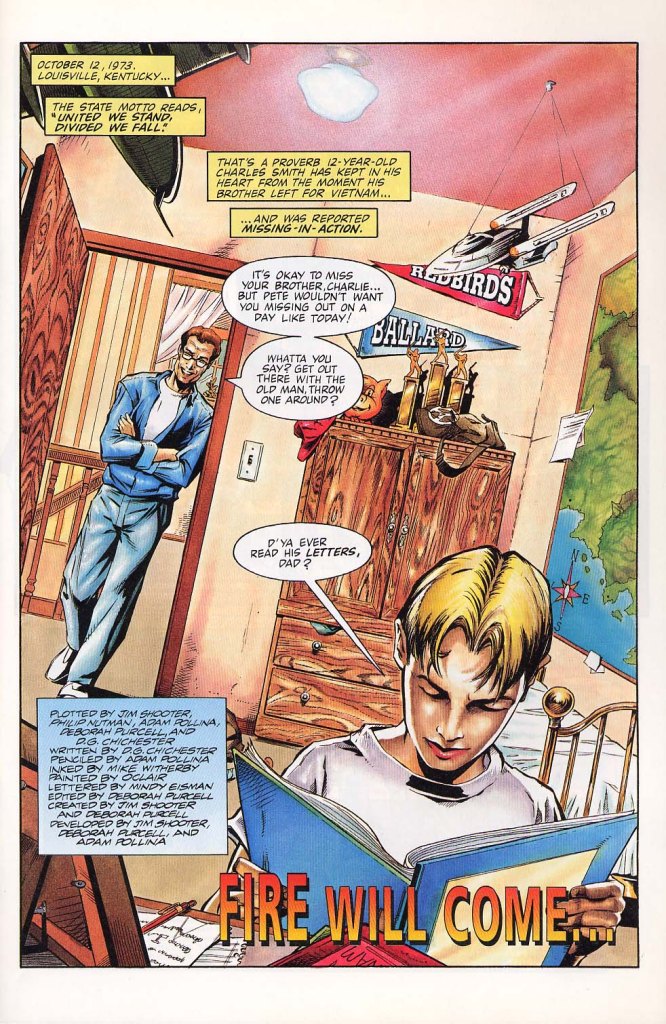
CHARLEMAGNE is the story of Charles Smith, a child of the 1960s who becomes a superhuman by sheer force of will. This initial issue was group plotted by a bunch of people–not just Jim Shooter and artist and co-creator Adam Pollina as you might expect, but also the issue’s scripter D. G. Chichester as well as Philip Nutman and Deborah Purcell. It seems like this was an early experiment on the part of Shooter for an approach he would carry forward into his next company, BROADWAY, in which almost every issue was group plotted. I’m not certain what drove this initiative–possibly it was a way for Shooter to keep his hand in all of the assorted DEFIANT (and later BROADWAY) stories without having to do the actual work of composing written plots and scripts. And it definitely mimicked the approach of a Hollywood writer’s room, so possibly that’s what Jim was thinking.
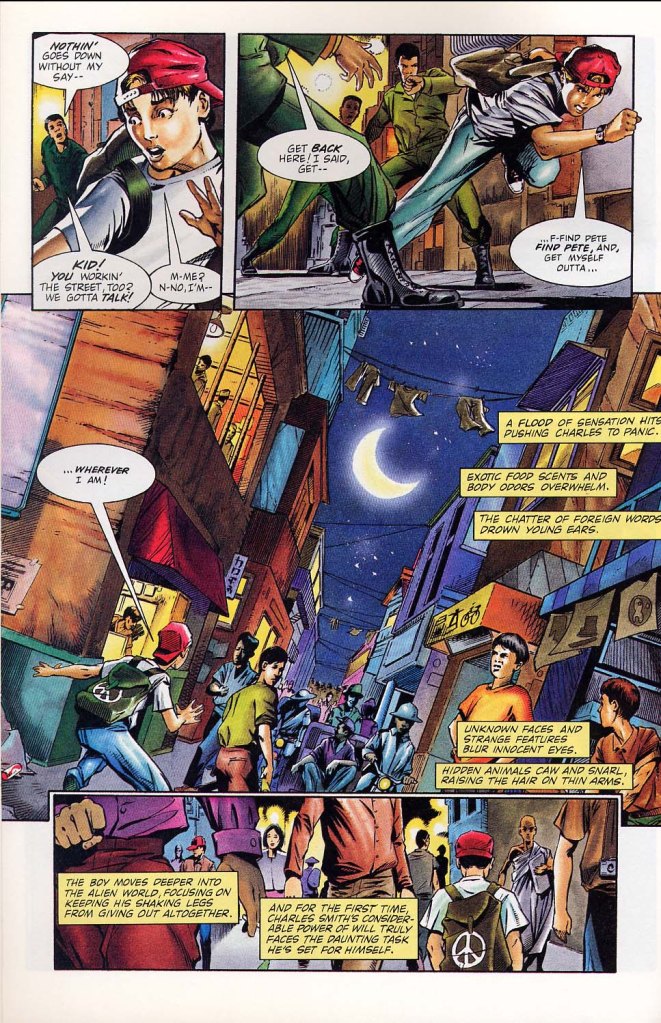
Even as a boy, young Charles is a kid with an indomitable will, and there are hints that there’s something more to him than initially meets the eye. But events really get going after his older brother Peter is drafted and sent to fight in the Vietnam War. Peter is reported missing in action and assumed KIA, but Charles refuses to believe this. Determined to locate his missing brother after the military closes the book on his case, Charles runs away from home and stows away aboard a steamer heading to Viet Nam. Despite the fact that he doesn’t know the language nor anybody in-country, Charles is determined to find his brother, and his unshakable will drives him ever onward despite the risks.
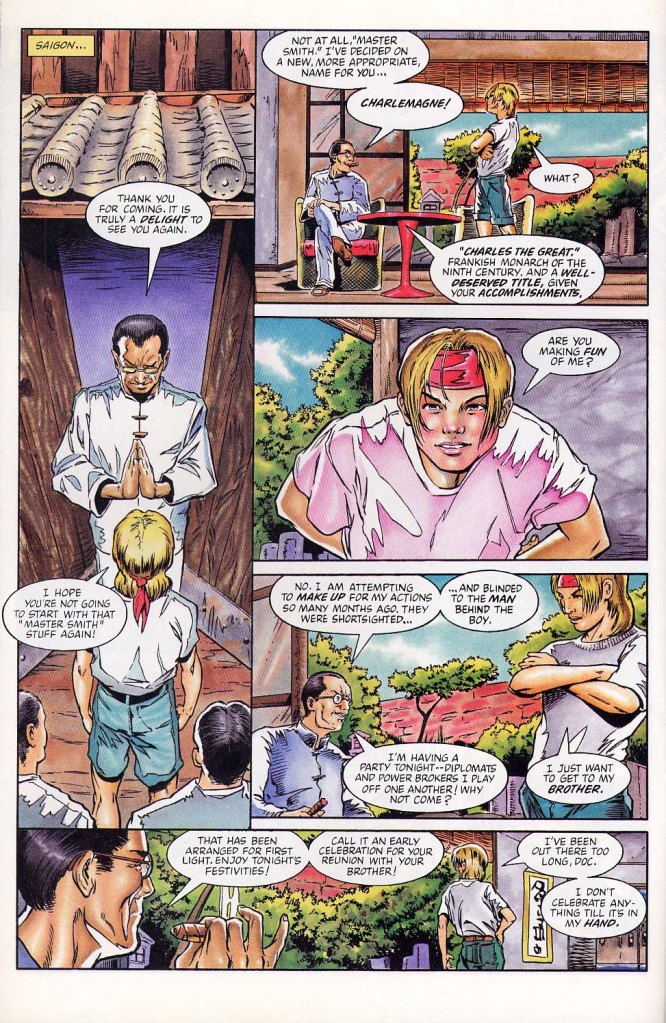
But in addition to his superhuman determination, Charles also appears to have ridiculous amounts of luck–so much so that they seem to be a byproduct of his will rather than something that occurs naturally. In Vietnam, Charles meets Jerry Westerberg, a freelance reporter who is able to bring him into contact with Doctor Tran Nguyen, an influence peddler who works both sides of the street. It’s Doc Nguyen who begins calling Charles Charlemagne once he sees firsthand Charles’ dogged determination to track down his missing brother. For two years, Charles crisscrosses Vietnam, following every lead, speaking with anybody who may have seen his brother or know his whereabouts. Eventually, the trail leads Charles to a small village near the Cambodian border where his brother was reportedly seen.
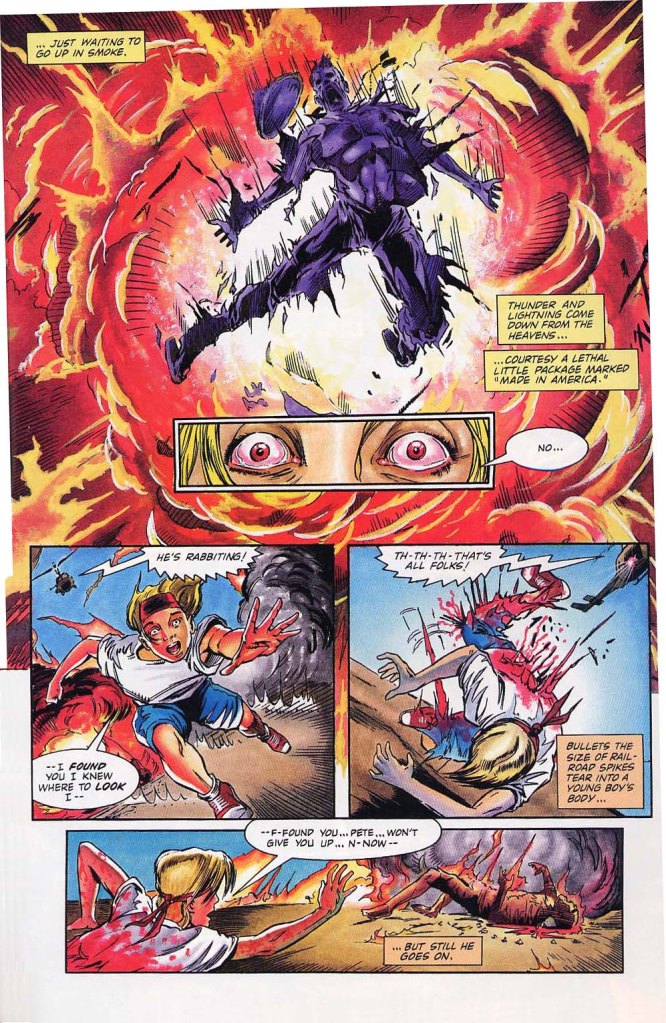
Unfortunately, the town, Hung Dao, is believed to be a V.C. stronghold by the American military, and they move in to annihilate it. Charles sees his brother in the distance and calls to him, just as rockets and machine gun fire begin to strafe the village. Before the brothers can reunite, Peter is caught in an explosion, and when Charles races towards him, he in turn is strafed by machine gun fire that pulverizes his legs. But with undeterred willpower, Charles crawls forward, despite his mangled half-body, and reaches his brother’s now-lifeless form. Grasping Peter’s dogtags, Charles bellows to the heavens that such a thing as this will never happen again. Then he passes out. When troops find his injured but still living body, he’s airlifted to a surgical hospital, where his mangled legs are amputated. (As you can tell, this is a light-hearted story.)
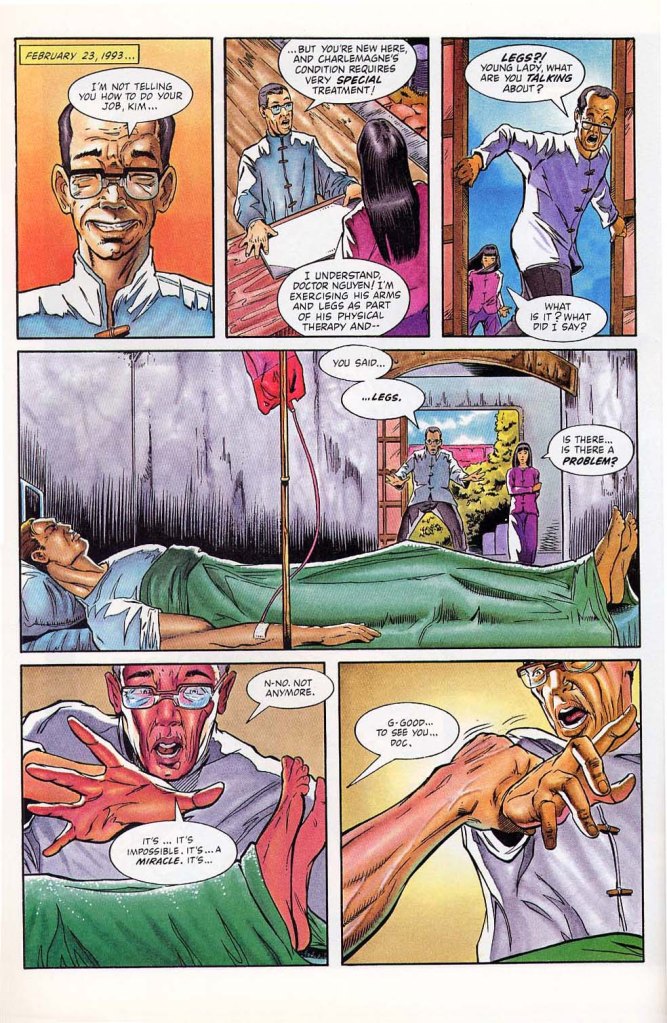
Charles spends the next eighteen years in an unresponsive coma. In his mind, we see his spirit leave his body and head for an ethereal light, before his force-of-will causes him to halt. He tells whatever divine spirit might be behind this light that he’s decided that he needs to stay here, to balance the score and see to it that everyone gets a fair chance at achieving their dreams. It’s at this point that Charles awakens, and his doctors are astounded by his condition. Not only have his amputated legs grown back, but he’s suddenly huge and ripped, a perfect physical specimen. There’s no rational explanation for what’s happened to him, but within a few months, Charles is ready to return home across the ocean back to the United States and his family.
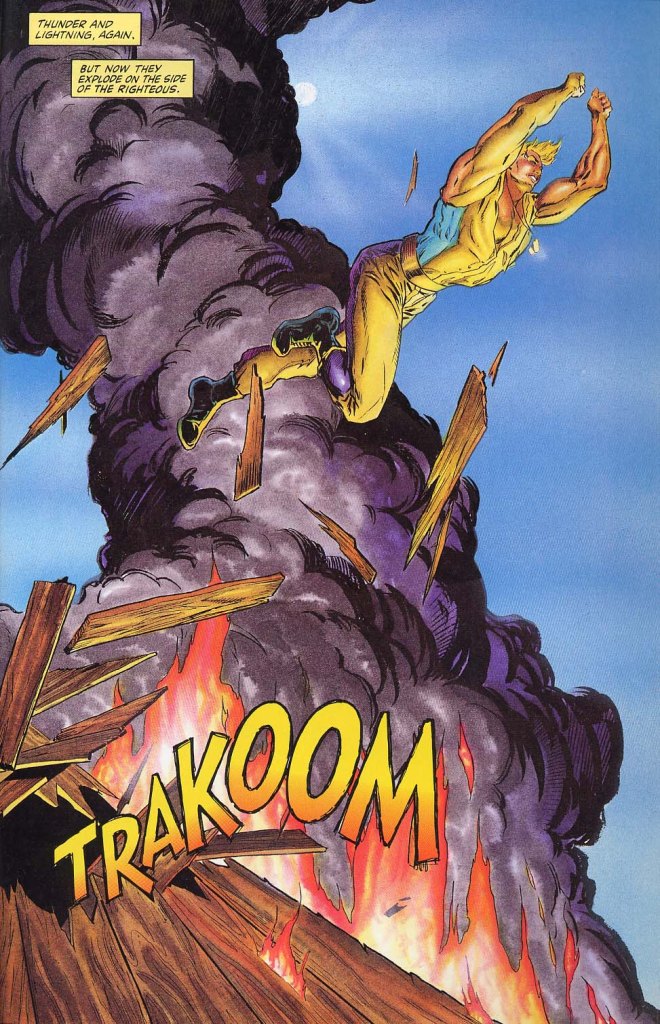
But the boat Charles is taking across the sea is attacked by ruthless pirates. Seeing the people he’s been traveling with trapped and victimized, Charles cries out once more, “Never again!”, and leaps into action. He’s not simply buff, he’s got superhuman strength, can leap enormous distances and is invulnerable to conventional weapons. As such, he clobbers the pirates, transfers his fellow passengers to their ship after their own has been holed, and finishes his journey back to his old home. In the final pages of this first issue, Charles reunited with his parents after two decades. But he can’t stay for long. He realizes that he’s lucked into something extraordinary in his travels, and he’s determined to put his new talents to good use. So the issue wraps up with him heading out into the wider world once again.
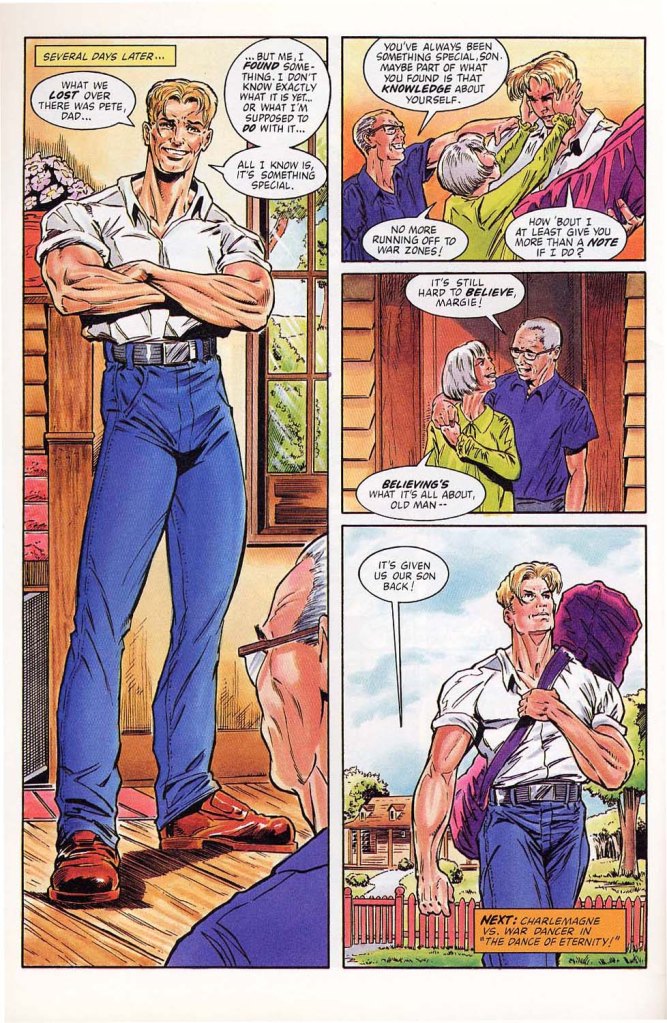
D. G. Chichester and Adam Pollina remained the creative team for the remainder of the run, though Shooter, Anthony Castrillo and Tim Eldred stepped in to help out from time to time across the remaining issues. In these subsequent stories, we begin to get the idea that Charlemagne’s powers are less simply physical prowess and more a will-to-power–put simply, he can do pretty much anything that he believes himself capable of, which begins to expand on his repertoire of abilities over time. Like the other DEFIANT characters, Charlemagne’s talents are explained loosely through quantum physics–essentially, he can willfully manipulate his own quantum state. His brother’s dogtags, which he’s taken to wearing himself, function as a sort of focal talisman for his will-to-power. For all that, the series was relatively mundane and not all that interesting. A connection was drawn between Charles and War Dancer as rival powers, but that thread never got to come to fruition in the brief run. So these issues are fine, but a bit on the bland side, despite some interesting artwork from the young Adam Pollina. (DEFIANT’s overdone painted color didn’t really do the artwork any favors–it was universally a better idea in concept than in execution.)


One of the sillier comics Shooter was involved with, which is saying a lot.
LikeLiked by 2 people
I never heard of this book. I’m glad I’m not the only one who thought the coloring and printing worked against Pollina’s always great art.
LikeLiked by 2 people
Sad to say, but the more Tom posts about the titles published by Shooter’s multiple comic companies the happier I am that I missed them when they were published.
LikeLiked by 2 people
I remember this when it was published. It was a “nah” for me. The colouring was, as said, overdone. And artist Adam Polina would go in to draw better work later.
The concept and story were too simple for me. Though the idea of growing legs back might not be as far fetched as it was back then (especially in the era that tge story was set).
But even a quantum mechanic couldn’t tune-up this vehicle enough to go any long distance.
Maybe if the lead character was a stuffed animal brought to life, with a pet unicorn side-kick who farted rainbows.
LikeLiked by 2 people
I wonder about the POW/MIA trope that there were just bunches of MIA Americans wandering Vietnam. Was it just wishful thinking like the post Sept 11 missing posters?
LikeLike
Slightly more complicated. Nixon got the ball rolling by claiming anyone MIA should be assumed as a POW, therefore we had so many men imprisoned, we needed to fight until we brought the boys home! Other presidents tried to exploit the same principle; Reagan demanded they account for every MIA (not possible. That’s a lot of jungle and it can hide a lot of bodies). Eentually it hardened into a conspiracy theory — in Rambo we don’t want to admit the Vietnamese are keeping hundreds of prisoners because we refused to pay reparations (https://atomicjunkshop.com/they-forgot-they-were-dealing-with-rambo-first-blood-part-ii-1985_/)
Michael J. Allen’s Until the Last Man Comes Home is an excellent book on the subject.
LikeLiked by 1 person
Thanks for the thorough answer. I grew up with Rambo and Chuck Norris’ Missing in Action and wasn’t there even a video game where you rescue Vietnam POWs? The trope was just everywhere. It wasn’t till I was grown I started thinking how absurd it is. I mean they’re still locating remains from WWII, no one is accusing Japan of holding airman for 80 years!
And it was all over comics as well.
LikeLike
Never read this at all. But that’s a very fun cover. The logo’s a little hard to read with that color effect, but the art’s delightful.
LikeLike
Charlemagne: I never heard of or seen this character before but I did in my head want another character to have those powers, I thought that Timely Comics’ WILL POWER[ Marvel Mystery Comics#34 ( August 1942 ) Jimmy Jupiter story –mentioned him on Tom’s BHOC:Invaders#28 ] should live up to his name and manifest powers through his will power. I also saw him with various psionic powers. Comicbook.com — 10 Cosmic Heroes Who Are the Marvel Universe’s First Line of Defense: ( 10 ) Gladiator –As a Stronian, Gladiator possesses all the powers of Superman, ALONG WITH THE ABILITY TO GROW STRONGER BY BELIEVING IN HIMSELF.
LikeLike
Charlemagne ( Before I forget again ): Am I the only one who got a Hugo Danner vibe after ready what Tom wrote after the page with TRAKOOM on it? He’s got superhuman strength, can leap enormous distances and is invulnerable to conventional weapons. I’ve been thinking that Hugo Danner should have been able to survive that lightning strike thanks to his Denser Tissue, Superhuman Strength and Accelerated Healing Factor( Long periods of comatose sleep ( Up to 20 hours. Plus huge meals also aid in his regenerative process, clearly done before he was injured and comatose ) to heal what artillery shells did to him ( A Lightning strike on a normal human body is less damaging than what the artillery shells did to him. He must have been out long enough for them to find him think he was dead, bury him, say words and leave. Once he dug himself free he must have tried to live a normal life like the movie character Shane, but things happen ).
LikeLike
So he’s Green Lantern but he doesn’t even need a power ring, quantum mechanics itself bends to his will. This kind of thing annoys me because it implies that all the people out there with amputated limbs who haven’t grown their limbs back, all the cancer patients, everyone with any kind of chronic problem, they just didn’t WANT it enough. Which is nice and comforting for healthy people (who can tell themselves that if they ever get a health problem they will surely want it enough) but promotes willful blindness to reality.
LikeLike
Honestly, this sounds more like a classic Pulp Magazine tale, like a Doc Savage, than a comic book hero.
LikeLike
I guess I wasn’t as much of a Defiant fan as I thought, because I have no memory of this book either.
LikeLike