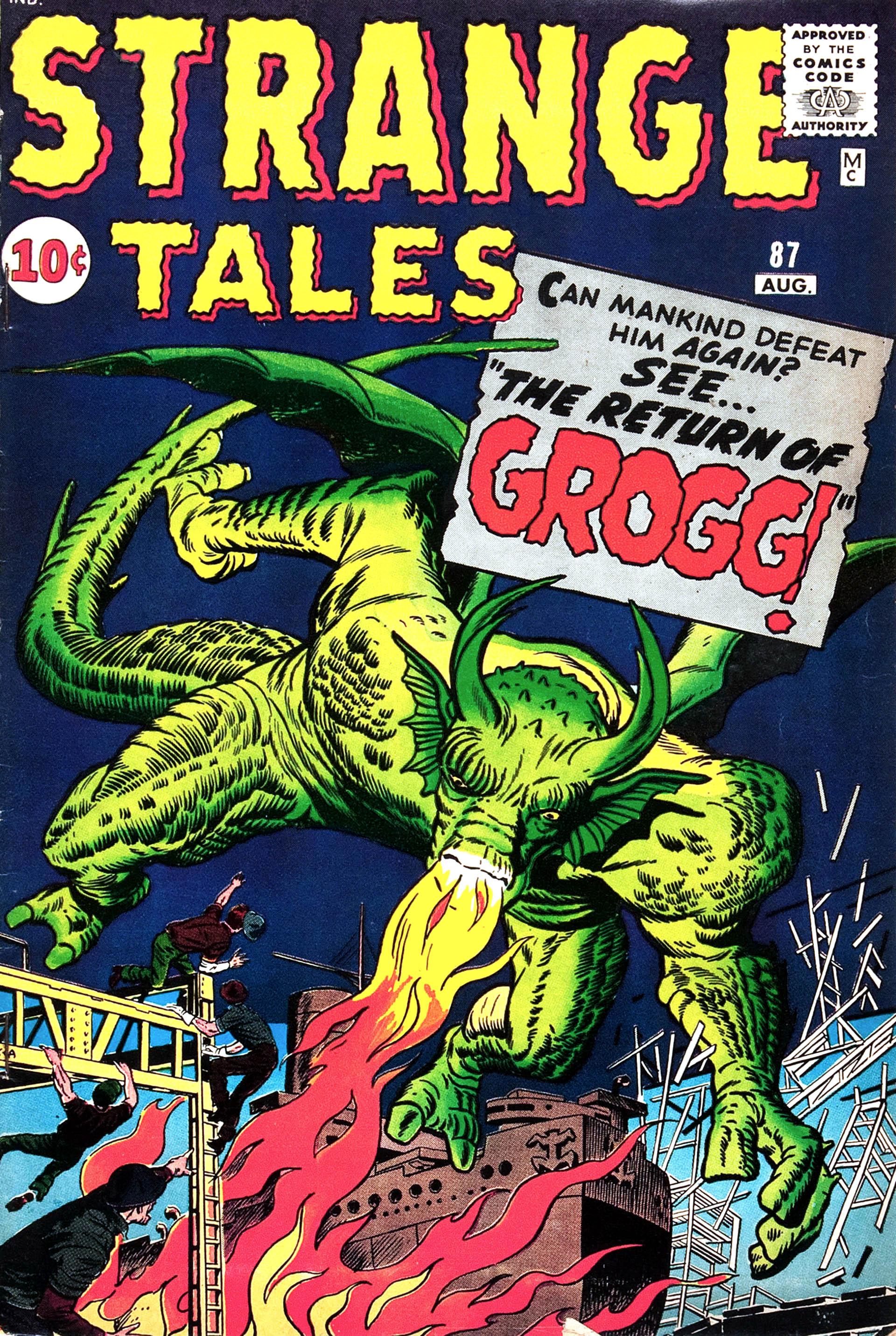


One of the things that I was very obsessed with as a young comic book reader was age. Specifically, how old the comics that I was purchasing were. As much as anything, that’s what led me to pick up this copy of STRANGE TALES #87 on my trip to the Batcave comic book store that weekend–it was old enough that it predated the Marvel Age, and was originally priced at a solitary dime. This was like catnip for me, despite the fact that I wasn’t especially interested in giant monster stories. These pre-hero Marvel books weren’t in any great demand at the time, seen as having scant value to the modern audience. But I really loved them, particularly in their original form (a lot of this material got reprinted in the 1970s, but I didn’t liked the manner in which it was diced up. And, also, that element of age was also missing.) They followed a formula, and they were simplistic, but there was a lot of good artwork to be found in these books.
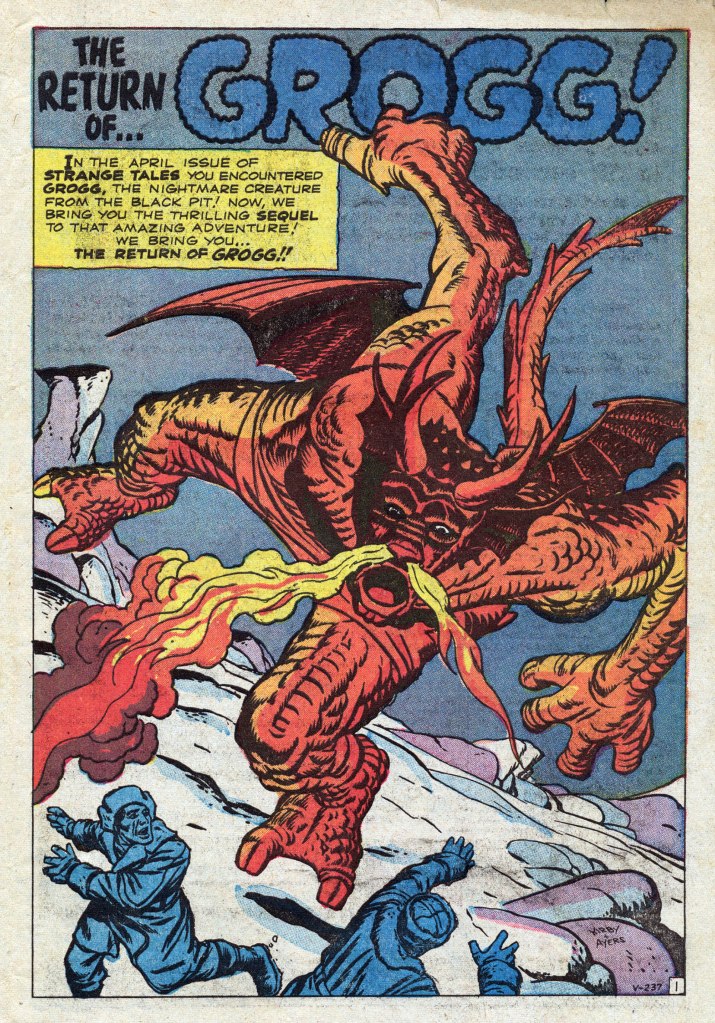
By this point in 1961, editor Stan Lee, artist Jack Kirby and writer Larry Lieber had been producing a number of big monster stories every month for a variety of titles. At a certain point, they began to realize that rather than inventing a new monster every time, it might be advantageous to bring back some of the creatures that they’d already done stories about. Such was the case with this issue’s opener, “The Return of Grogg”. Grogg had been featured in STRANGE TALES a few issues earlier, but like a film sequel, his return was designed to get kids who had read that earlier yarn to pick up this issue as well. These were the nascent beginnings of the Marvel approach to serialized continuity. The thick inking of Dick Ayers maintained Kirby’s dynamic compositions but gave the stories a bit of texture. This too would follow over to the early issues of FANTASTIC FOUR in just a couple more months.
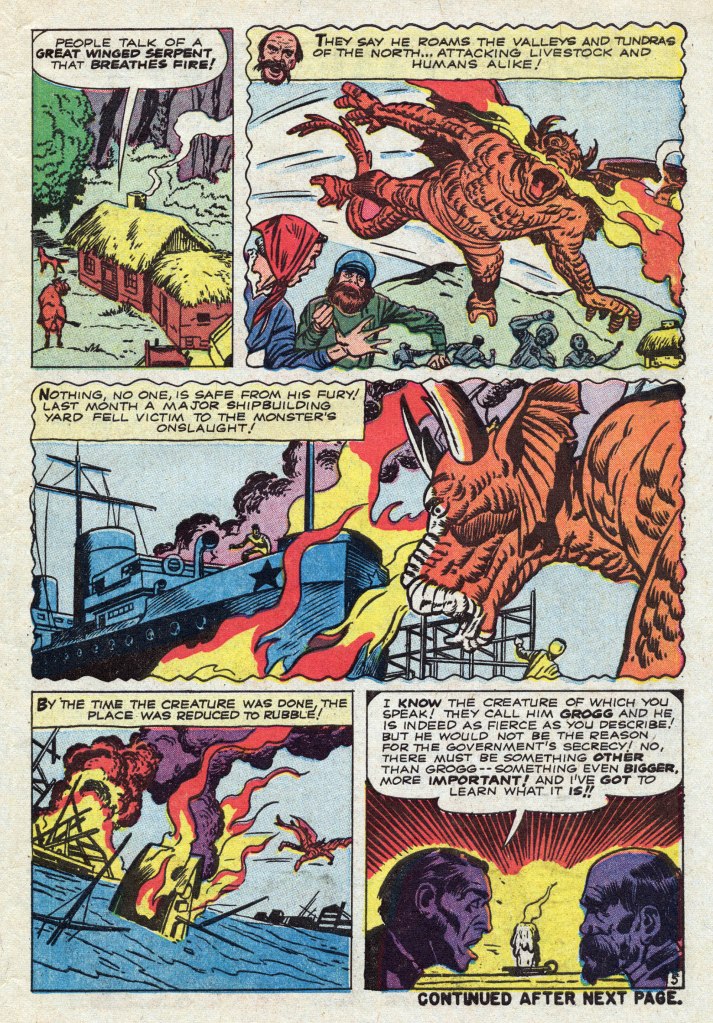
The story helpfully opens with a recap of the prior Grogg adventure. It concerned a captured Freedom Fighter, Miklos Kozlov, caught behind the Iron Curtain who is able to escape his captors thanks to the appearance of Grogg, an ancient fire-breathing dragon who emerges from deep within the Earth, awakened by an atomic test. In this follow-up story, Kozlov is recruited by the CIA to sneak back into Communist territory to discover what is going on in an area where they’ve imposed a complete news blackout. Upon entering the enemy nation, Kozlov is helped by a local farmer to evade the patrols looking for him. When questioned, the farmer tells Kozlov stories of how Grogg is rumored to still be active and preying on cities in the area Kozlov is interested in. But Kozlov thinks there must be something more going on there.
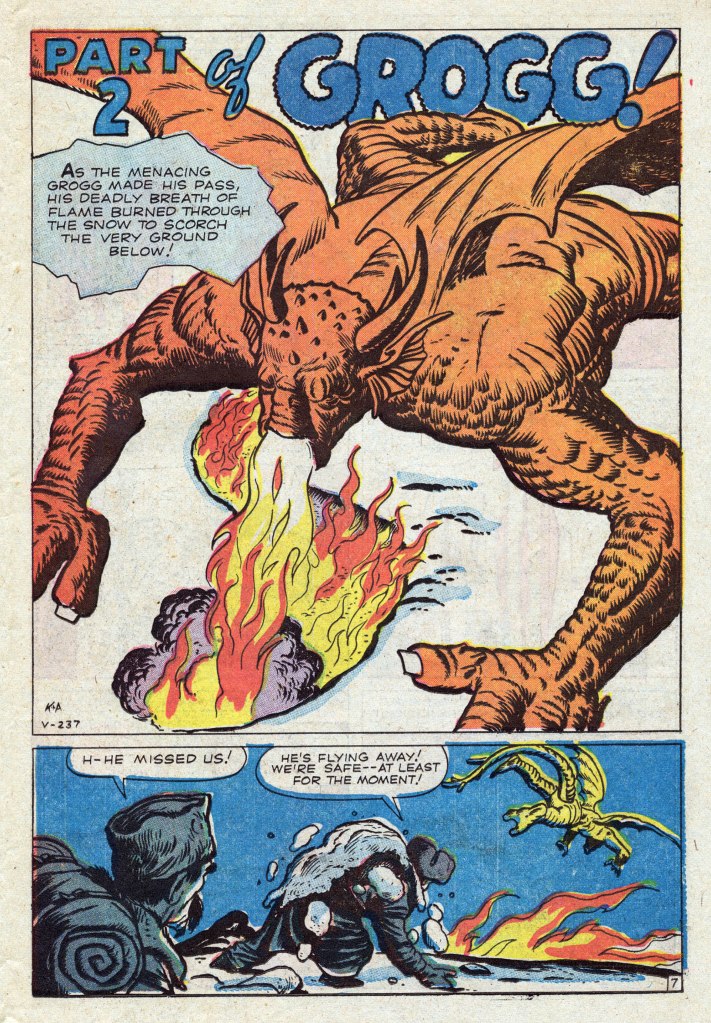
Accompanied by the farmer, Kozlov heads north–right into the path of one of Grogg’s attacks. This helps to give the story the necessary amount of giant monster destructive action that the audience craves. Fortunately, Kozlov and the famer are able to shield themselves from Grogg’s attack and emerge unscathed. Eventually, they come upon a military base where a colossal space rocket has been created. The Communists are planning to send an expeditionary force to Mars, to claim it for their homeland and set up a military base there. Kozlov and his partner can’t allow that to happen, and the spy hits upon a daring plan.
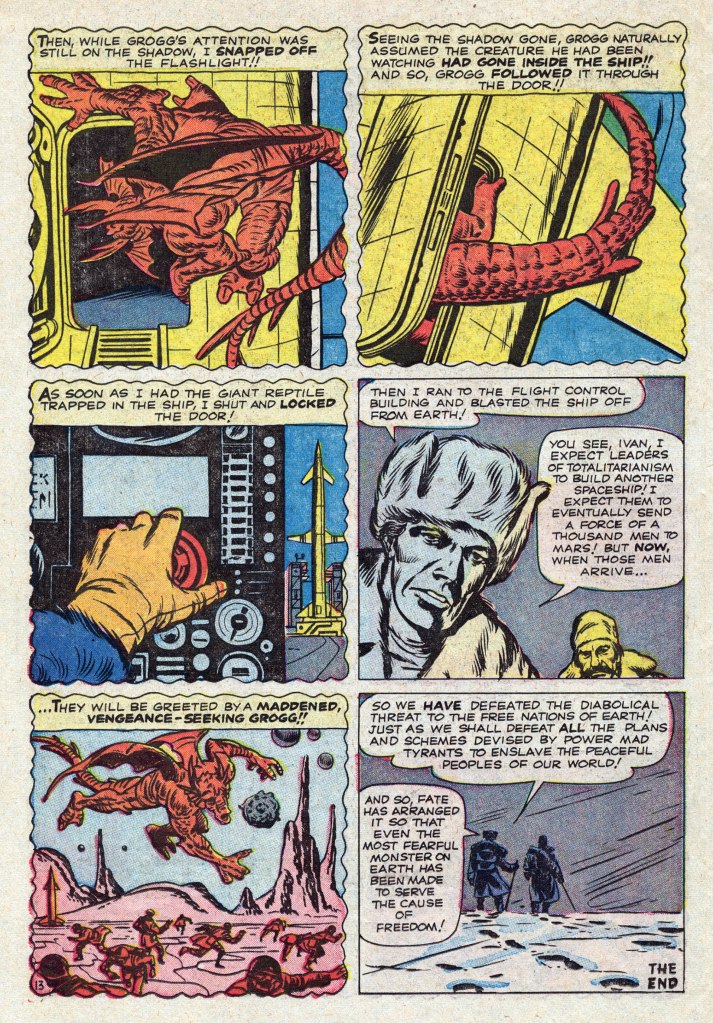
Making a target to himself, Kozlov is able to lure Grogg to the launch site and trick him into entering the rocket. He’s then able to launch the rocket prematurely–fortunately, the controls amount to a single launch button, He and the famer then escape, but the famer is still concerned: if his countrymen could make one such rocket, surely the can manufacture another. But Kozlov tells him that if they ever do manage to make it to Mars, they’ll now be greeted by an angry and vengeance-seeking Grogg. (Or course, the same would be true for any American expedition–Grogg doesn’t differentiate by political affiliation, after all. But why ruin a good, triumphant ending with facts?) The entire story is typical of the sort of propaganda that these pre-Marvel books were often full of in these days (which continued on into the early super hero years), but the story is executed decently enough. The real draw here is Kirby’s artwork.
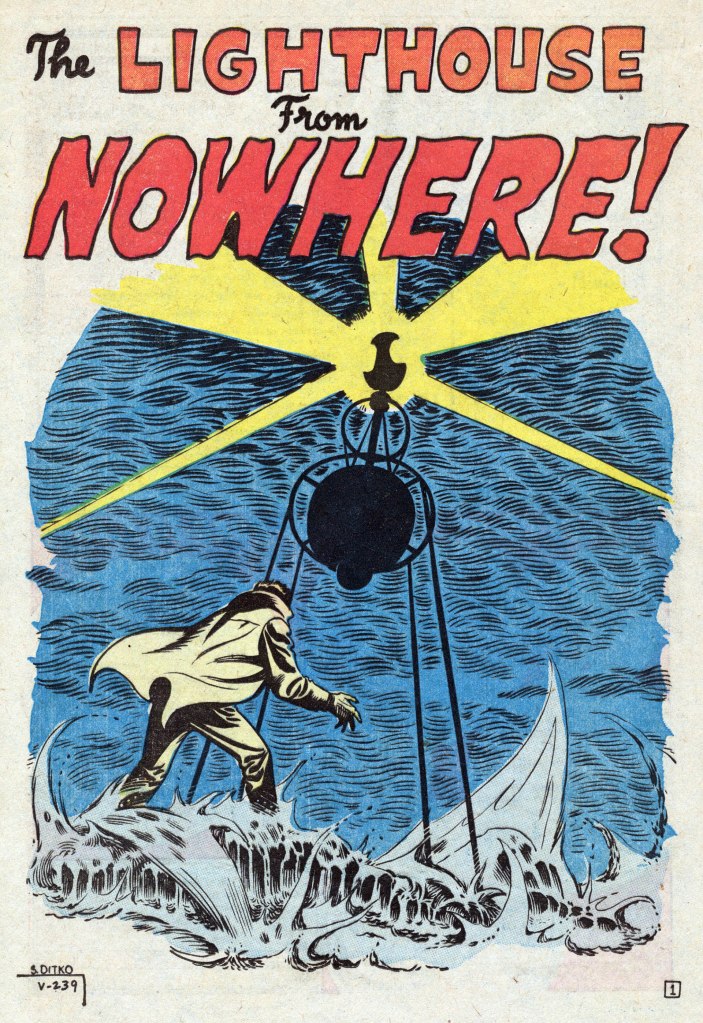
Speaking of great artwork, the next story in the issue is the best-looking one in the magazine. It’s another short 5-page twist ending story illustrated by Steve Ditko–he and Stan Lee mad a minor movement out of doing these sorts of tales together, and one could be found in every issue of the monster books past a certain point, typically in the final story position. Here, though, it’s the middle yarn, a tale about a mysterious lighthouse that appears in a quaint Scottish seaside village. The local schoolteacher destroys the lighthouse, however, not wanting the town to accept something for nothing–and it’s a good thing that he did. Because aliens had set up that lighthouse to be a beacon to their invasion fleet, and without it, they fear their plans have been discovered and withdraw, leaving earth unmolested. The story isn’t much, but Ditko’s beautiful and well-designed images carry the day. And nobody was better during this period at symbolic splash pages, such as the one you see above.
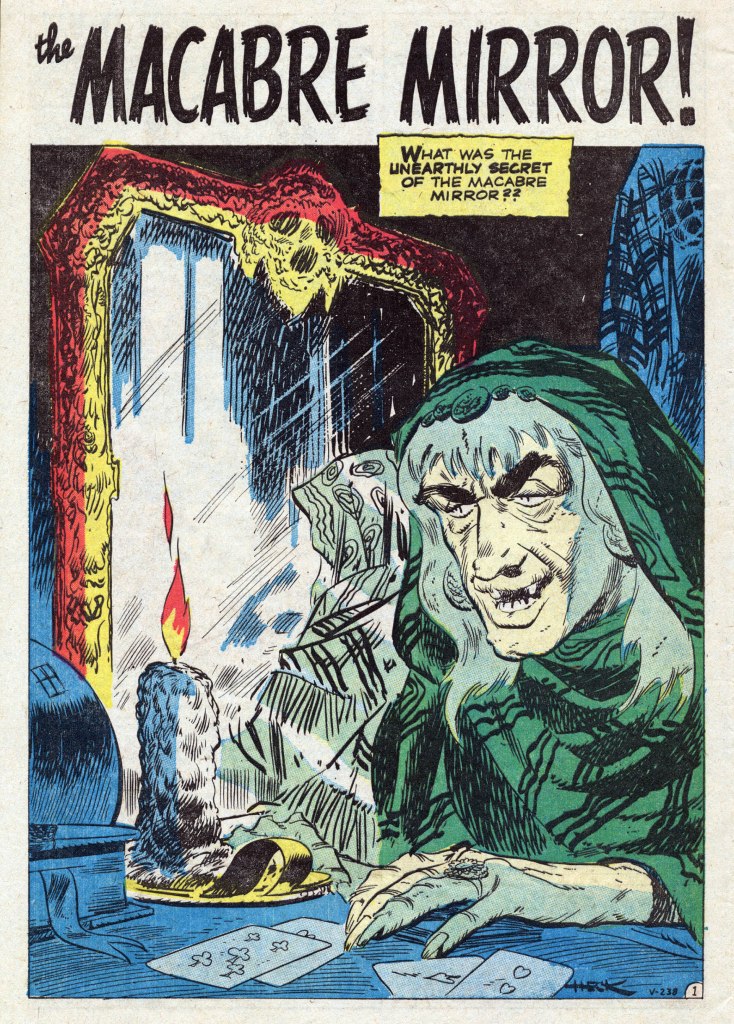
The final story in the issue was illustrated by Don Heck, a very fine artist whose talents didn’t naturally lend themselves towards drawing super heroes. As a result, his work was often met with scorn from fans over the years, particularly later in his life. But a weird suspense story such as this one was much more in his wheelhouse, and while he’s not quite as adept at striking an eerie mood as Ditko is, his work here is still quite nice. The story? It’s about a cruel Duke who attempts to take an enchanted mirror from a Gypsy woman who owes back taxes, and how he winds up inevitably trapped inside the mirror himself. There’s not a whole lot of surprise here, but it’s a competent if forgettable tale. But there’s a reason why Heck’s stories typically occupied the center slot; it’s the weakest thing in the issue, and so leaves a reader feeling a bit underwhelmed when closing the cover.


I used to collect a number of Marvel’s giant-sized comics back in the mid-70’s primarily to check out whatever “monster” story they used to fill out the rest of the book after the lead story. It was akin to opening a box of Cracker Jacks to find out whether I’d savor some visually engaging Kirby creature or be utterly creeped out by whatever eerie twist Ditko brought to his work. While I was perhaps not as appreciative of their work at that time, those old stories reminded me why both artists played such essential roles in the establishment of the Marvel Universe I so thoroughly enjoyed.
The simple-minded and monotonous nature of the stories seemed an unfortunate leftover from a dismal combination of Fredric Wertham and Joseph McCarthy. Even then, my eyes tended to roll when I’d read an early Marvel superhero comic bemoan the dire threat of communism.
(And no! I won’t mention that the word “communism” seems to have resurfaced today. You cannot make me do it!)
LikeLiked by 1 person
As the already much-missed Tim Curry famously explained in Clue, “Communism was just a red herring.” And that’s truer than ever today!
LikeLiked by 2 people
Without diving deeply into politics, that the term “communism” has been brought back to life from one party to taint the other would and should seem a lack of originality on their part. “Should” being the operative word.
LikeLiked by 2 people
According to comics.org in Strange Tales#83 ( April 1961 ) on the last page it includes an editorial note that reads: “Want to see MORE of Grogg? Write Stan Lee, Strange Tales, 655 Madison Ave, N.Y.C. 21. N.Y.”
LikeLike
Other repeat characters: The Hulk ( Xemnu the Living Titan ) [ JIM#62 ( November 1960 –1st story vs. Joe Harper, electrician ) & 66 ( March 1961 –vs. Joe Harper again ) ], Freddy [ Tales to Astonish#8 (March 1960 –a genie and criminal Freddy) & 9 ( May 1960 –Freddy ) –Freddy get the genie’s powers ], Evil ( a statue ) [ Tales to Astonish#7 ( January 1960 –Anton Gorge sculptor & Good his other living statue ) & 8 ( March 1960 ) ], Gorgilla [ Tales to Astonish#12 ( October 1960 –Scotty, Anne, Frank and others –Dr. Druid later given Scotty’s role instead of being identified as one of the not seen clearly other men ) & 18 ( April 1961 –Scotty & Anne ) ], Gorilla-Man ( Franz Radzik, inventor –mind-transfer into a gorilla. on the cover he takes a serum ) [ Tales to Astonish#28 ( February 1962 ) & 30 ( April 1962 — Professor Stuyvesant ) ], It the Living Colossus [ Tales of Suspense#14 ( February 1961 — Ivan Petrovski & Boris Petrovski ) & 20 ( August 1961 — Bob O’Bryan, Diane Cummings & Grant Marshall, Charlie, Ben ) vs. Crab-Creatures of Cancrius III ]. Goom [ Tales of Suspense#15 ( March 1961 — Mark Langley( scientist ) & Helen Langley ) & 17 ( May 1961 — Mark & Helen Langley & Billy Langley( their son ) vs. Googam, son of Goom ) ], Taboo [ Strange Tales#75 ( June 1960 — Lewis Conrad ( popular adventure writer ) & 3 officials near the end of the story who could be identified as Ulysses Bloodstone, Mac Curry/Makkari & Doctor Druid ) & 77 ( October 1960 — Dan, Susan & Taboo’s people ) ] and Gargantus [ Strange Tales#80 ( January 1961 — Dan ( deep sea explorer ) & Billy his son ) & 85 ( June 1961 — Bill ( formerly Billy. adult now ), Anne & Frank ) ]. I wonder why some of the other characters like the alien Sandman or the Monster in the Iron Mask wasn’t used again?
LikeLiked by 2 people
In Journey into Mystery#77 ( February 1962 ) are 2 retellings of Atlas Age stories: Beware! He Isn’t Human! [ JIM#77 –Eric Krugg ( Hollywood special effects man-Roboticists ), Diane Harper ( woman who rejected him who is really a robot ) and his Human looking robot Krugg builds to kill her —retelling in Mystery Tales#7 ( January 1953 ) 5th story – The Iron Man — Alonzo Greer & his Iron Man ( robot ) & Julia Wyatt ( robot ) — Alonzo builds his Iron Man to kill the woman who rejected him ] and I Don’t Believe in…Ghosts! [ JIM#77 — Mr. Jordan ( ghost debunker, paranormal investigator who is a ghost — marvunapp.com profile ) & Wilbur Weems — retelling of Mystery Tales#7 ( January 1953 ) 1st story – The Ghost Hunter — Mr. Hunt ( Explorer of the Supernatural who is a ghost ) ].
LikeLike
I think the only monster book I ever followed was the Living Colossus series but it was a full book, not superficial short stories. I didn’t mind the monsters featured showing up years later in other titles though. Fin Fang Foom (one of Stan Lee’s most fun character names) was the best of those.
LikeLiked by 3 people
I vaguely remember that series. Am I correct that the most excitement it seemed to spawn came from a letter where someone said they’d kick themselves in the butt for putting Tony Isebella and Dick Ayers on this series?
LikeLike
Where’s John Holstein when you need him?
LikeLiked by 2 people
My affection for the Ayers/Isabella IT! series is deep. I can’t explain it. It’s just weird, dumb clunky comics but so fun.
LikeLiked by 1 person
Exactly! Too bad the characters fell under the Must Finish Cancelled Comics Curse…
LikeLike
Yep… he got destroyed by the Hulk, but was later restored.
LikeLike
The Steve Who Is Always right, if you are asking I know anything about Tony Isabella & Dick Ayers on the Astonishing Tales ( I have#24 with Fin Fang Foom ), It the Living Colossus series — I can’t help you there. I did find out on Tony’s wikipedia ( Jenny Blake Isabella ) that “The Friend” is the Ghost Rider series was suppose to be Jesus and the plan was for Johnny Blaze to accept Jesus as his savior and freeing himself from Satan’s power forever, but assistant editor Jim Shooter freaked out and “The Friend” was revealed to be a demon in disguise. I guess Tony was a decade to early because I think Nightcrawler was the first identified religious super-hero, but I could be wrong.
LikeLiked by 1 person
Don’t let anyone kid you. Marv Wolfman all but certainly authorized the Shooter changes to the Isabella Ghost Rider story. Wolfman said under oath that while he didn’t remember the specific circumstances, he would have ordered the changes in “an eighth of a second.” And it’s absurd to believe that Shooter could have unilaterally ordered new art be drawn given his status at Marvel at the time.
LikeLike
Oh man, Kirby’s covers can make me think the stories will be as epic. They never are. Give me DC’s Strange Adventures any day.
That last story by Don Heck — yes, that’s way more interesting than his superhero art.
LikeLiked by 1 person
For all that Heck’s stories tended to be the weakest in these issues, it wasn’t because the art or storytelling were bad, it was just that — well, with Kirby and Ditko in the book, there were very few artists who’d measure up.
Also, I expect that Kirby was coming up with or adding a lot to most of his plots, and Ditko was doing a lot of story refining, too, while Don — ash he once described it, Stan would give him the setup and the twist ending, and he’d fill in the rest. Whether he was working here from full scripts by Larry (or someone else) or drawing the story plot-style, he was doing a dutiful, capable job but not adding much.
Still, it looked good, and having a book with those three artists in it is a nice solid package.
LikeLiked by 2 people
Can Grogg even survive on Mars? He might have just been effectively killed by starvation or thirst, even if he survives the trip (I doubt the ship is designed for his safety). Which I suppose is OK in terms of Code-acceptable killing.
Worse, though, is Mars inhabited? (think of John Carter). If so, hasn’t Kozlov just dumped Grogg on them? Maybe that’s acceptable depending on the status of the natives.
Now I’m thinking of a further story, set on Mars, where a strange spaceship lands, and a hungry and angry fire-breathing dragon emerges …
LikeLiked by 2 people
Maybe that explains why the Martians in the KILLRAVEN series are so hostile to Earth, LOL.
LikeLiked by 1 person
I doubt the ramifications of the story were even thought about, what with the number of stories they were putting out each month. I do agree that a sequel about Grogg on Mars could have been interesting.
LikeLiked by 1 person
For what it’s worth, I recall finding a children’s science book from the late 50’s talking about life on Mars. That I came across this book in a children’s library in the mid-80’s is a whole other story. But there was definitely a preTotal Recall conception of the Red Planet.
LikeLike
There are Human looking Martians on Mars [ Marvel Mystery Comics#3 ( January 1940 ) Human Torch story –vs. Captain Ott and Martians ][ Strange Tales#92 ( January 1962 ) 4th story — marvunapp.com profile ( dressed like Earth humans ) ][ Amazing Adventures#2 ( July 1961 ) 3rd story –Rocky’s Last Ride! –Rocky Baines & Martian criminal whose car Rocky takes Rocky to Mars ][ Mystic#47 ( May 1956 ) 1st story -The Man Who Could Do Anything — Sram ( Mars backwards. white hair and mustache that extends past his face ) is a Martian who at least as strong and as fast as Kraven the Hunter ( captured a lion with his bare hands ), rescued a person from a burning plane without getting burned, swan with his human friend in his arm 100 miles to land after his friend was knocked off a ship into the ocean ] and in Comet Pierce’s alternate future [ Red Raven Comics#1 ( August 1940 ) –Queen Larania ]. Plus other Atlas age Human looking Martians stories and non-human looking Martians ( as well as 1960s non-human Martian stories ) –marvunapp.com has profiles on a large number of the different Martians.
LikeLike
There is a giant Martian who has 2 stories: Zetora ( power to switch bodies ) [ Journey into Mystery#57-58 ( March-May 1960 ) 4th story and 1st story –The Marian Who Stole My Body! ( John Warren ) & The Martian Returns!! ( defeated the same way in his second appearance as H.G. Wells’ Martians –Earth germs ] — in JIM#57 ( The Earth-Crawlers! –2nd story ) there is a Steve Ditko African witch doctor ( bad guy ) with Doctor Voodoo ( Brother Voodoo ) & his brother’s white streak down the middle of their hair.
LikeLike
So, after thinking about it for a bit, I think the reason I didn’t like the Marvel comics of the sixties was because of the artwork by Kirby and Ditko! Since then, I’ve come to enjoy Kirby’s work on Thor and Ditko’s on Doctor Strange, but I don’t like Ditko’s work on The Amazing Spider-Man. However, to be fair to Kirby and Ditko I bought both Marvel Visionaries: Steve Ditko and Marvel Visionaries: Jack Kirby back when they were first published in the mid-naughts. While my opinion of their artwork wasn’t changed, I did like some of the pre-superhero stories included in the books. I was especially impressed with Dream World!*, which beat Inception to the multiple dreams within dreams idea by over 4 decades. It even has a similar ending to the movie I also noticed that Peter Parker’s Uncle Ben and Aunt May are recycled from Goodbye to Linda Brown*.
*both stories in Marvel Visionaries: Steve Ditko
LikeLike
If I squint just a little, Grogg looks a bit like Fin Fang Foom. I imagine one could say it was another former resident of Kakaranathara trapped on earth. I don’t have a fondness for the stories, but the creature designs can be so much fun. I’d love a line of small figures of these creations. I’m totally off-topic now. 😁
LikeLike