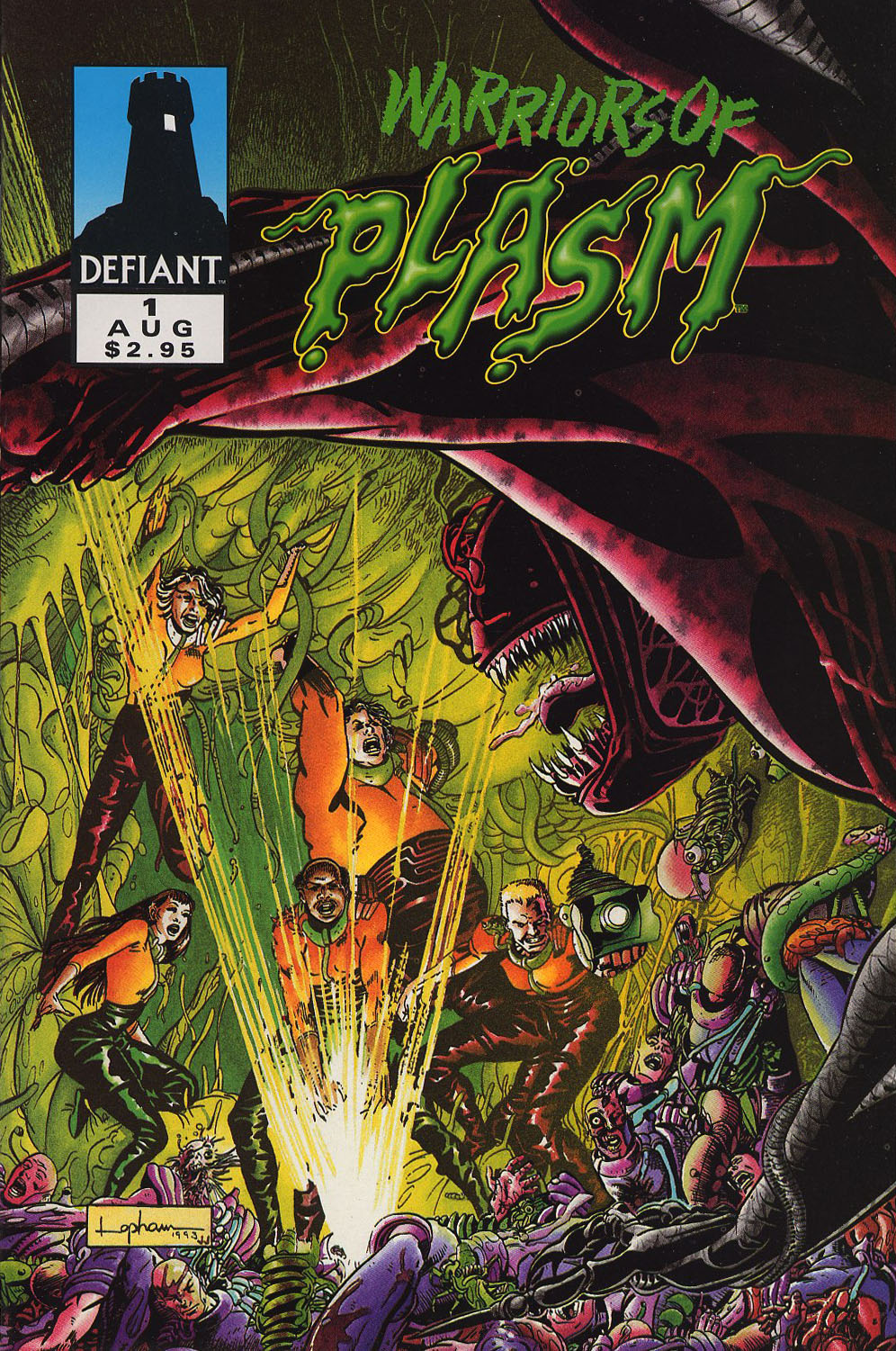


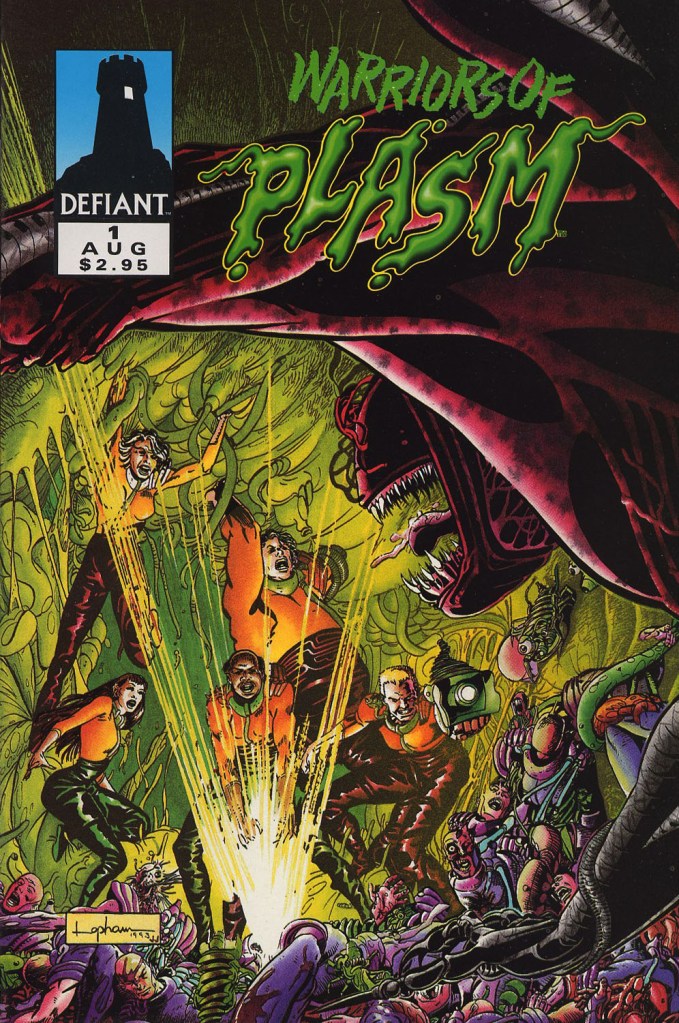
As we’ve talked about here briefly in our sequence on the assorted early launches from VALIANT, Editor in Chief and primary creative voice Jim Shooter found himself ousted from that company shortly after completing work on that company’s UNITY crossover. Different people have given different accounts of exactly what happened and how it all went down, but it’s clear that there was a power struggle for control and that Shooter lost it. Bob Layton remained with VALIANT and took over the position of Editor in Chief, and Shooter moved on. Undaunted, and convinced of the value of his creative instincts, Shooter did what he had done previously: he put together a group of backers and he launched a new comic book publishing venture, boldly named DEFIANT. The initial DEFIANT roll-out announcements included a wonderfully over-the-top illustrated fable of Jim’s history up to this point, positioning him as a force for truth and rightness that was inevitably being stymied by the “bad guys” he found himself surrounded by. (By way of a timeline, WARRIORS OF PLASM #1 was released in the same month that saw the publication of Valiant’s MAGNUS, ROBOT FIGHTER #30 and HARBINGER #22. So DEFIANT was directly competing with Shooter’s old operation.)
Launching DEFIANT was not without its own difficulties. For one thing, the company launched just as the speculator bubble that had been driving the spectacular sales of the early 1990s began to burst, sending everybody’s sales numbers falling towards more reasonable levels. Secondly, the comic book landscape was then littered with additional new companies that were intent on getting their own market share of what was now a dwindling marketplace. But most crucially, DEFIANT immediately ran into a legal battle with Marvel over the title of what was intended to be its inaugural series, then-called PLASM. Marvel’s UK operation was in the process of launching a series called PLASMER, and the company complained that the two names would cause confusion. It all seems very petty, and one of the end results was that Shooter decided to retitle his book WARRIORS OF PLASM in an effort to placate Marvel. The company also wound up burning through a bunch of their available start-up capital in litigating the matter, which put them immediately behind the eightball as well.
It kind of has to be said: WARRIORS OF PLASM is a weird choice to serve as the roll-out of a new interconnected super hero universe. It’s a very strange strip all around, a science fiction fantasy that is built around the “Org” of Plasm, a far-distant planet that is an integrated living world. All of the inhabitants of Plasm as well as all of the matter that is used in the construction of its society is all a part of the greater organism. In order to continue to grow and evolve and expand, Plasm needs to constantly be fed. This is accomplished by conquering and stripping down other worlds, whose essence is added into the greater whole of Plasm. Because Shooter’s financial partners were a trading card concern, the initial set-up story was released initially as a trading card set, in which nine-up arrangements of cards could be arrayed in a trading card binder into pages, allowing one to read the story. This was an era in which super hero trading cards were a momentarily massive thing, and so this approach may have been seen as a smart play. But the reality is that few were going to go to the effort to complete and assemble an entire card set to read the inaugural story of a universe in which they weren’t yet invested.
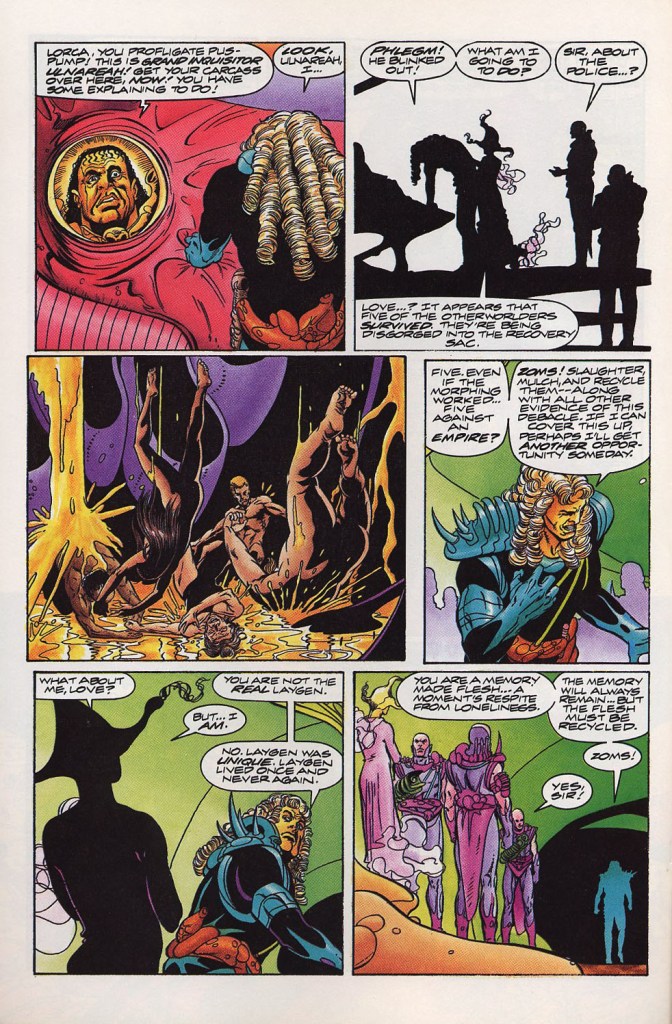
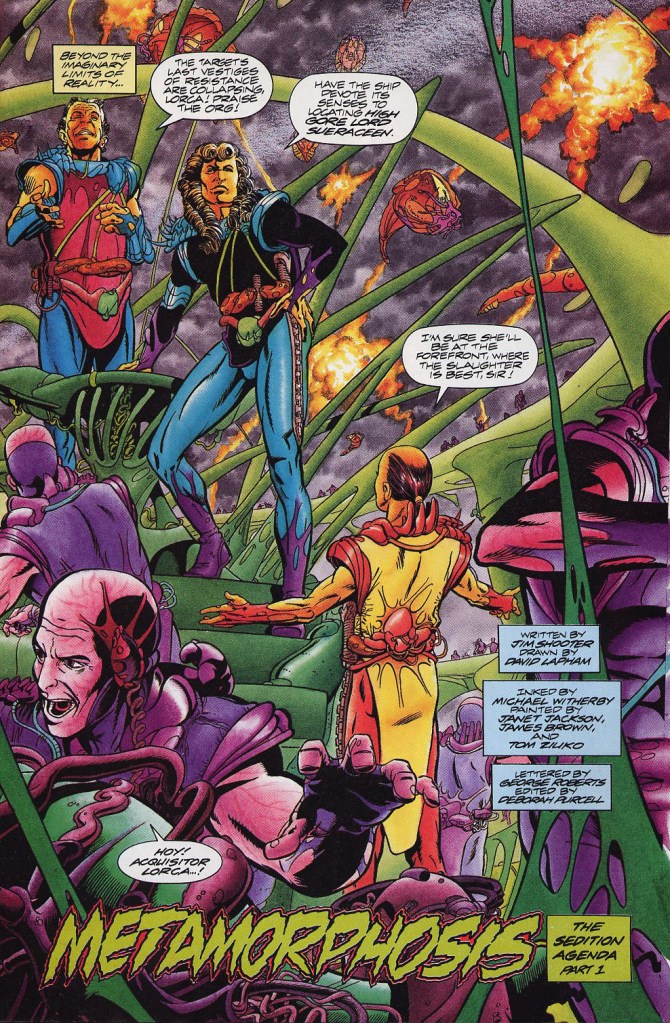
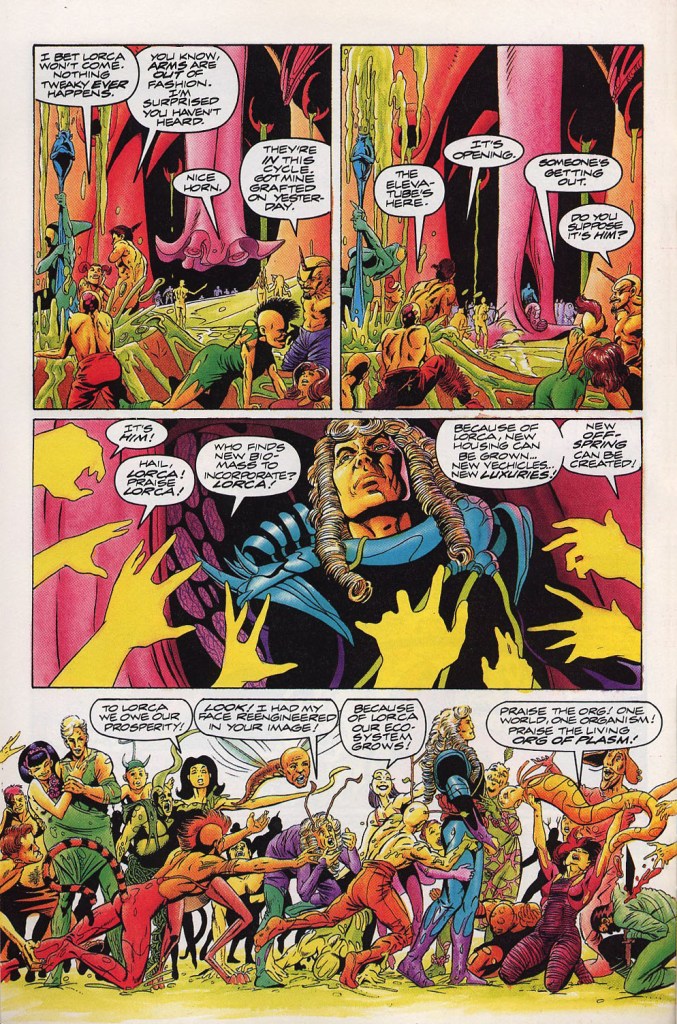
The artwork on WARRIORS OF PLASM #1 was produced by David Lapham and Mike Witherby. Lapham had been a discover of Shooter’s over at VALIANT, where he was touted as being akin to the second coming of Frank Miller. Together with Shooter, Lapham created HARBINGER as Valiant, and took over as that series’s writer for a short time after Jim’s ouster. But after just over a dozen issues, he left Valiant to join his mentor’s new publishing venture. It has to be said that WARRIORS OF PLASM is a pretty good looking book, with Witherby’s tight inking giving Lapham’s pages an appealing and marketable look to them. It certainly wasn’t the flavor of the way–at the time, the field was dominated by Image-style large shock images without a whole lot of storytelling structure. But DEFIANT, like VALIANT before it, stressed fundamental, almost diagrammatical pages centered around a basic grid and emphasizing mid-range establishing shots. They were always very easy to follow. Lapham would remain with the series as artist and occasional scripter right up to its final issue, making it one of the more consistent titles that DEFIANT put out.
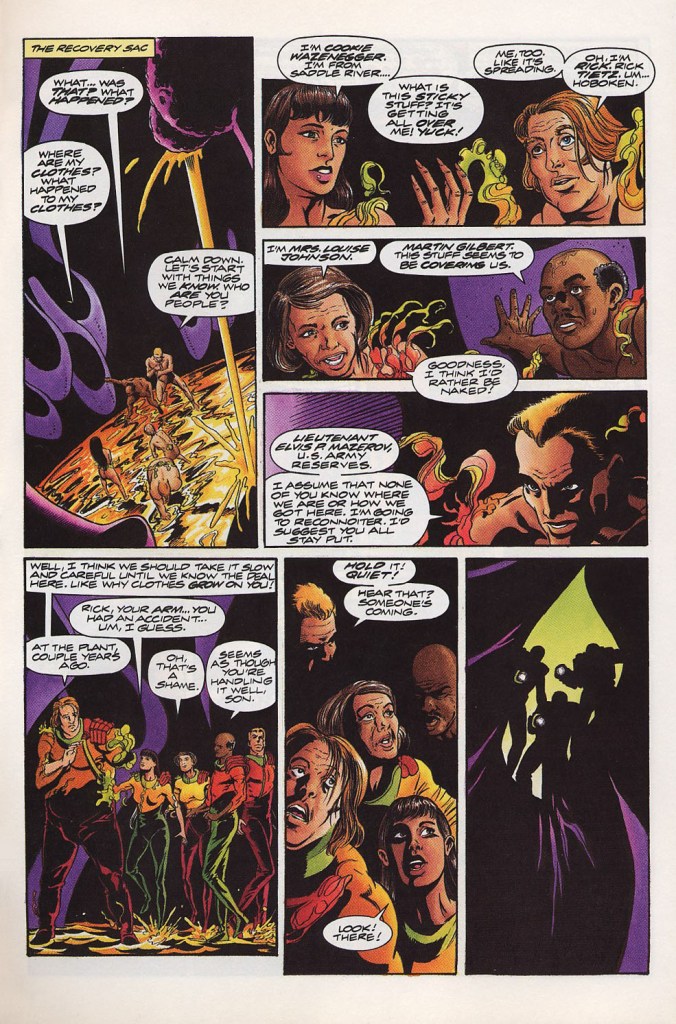
It’s honestly kind of difficult to truly get across the essence of WARRIORS OF PLASM, as so much of the dialogue and interactions are build around the strange culture of the Org, with a surfeit of crazy terminology that’s simple enough to puzzle out but which requires a conscious effort to do so. Accordingly, it isn’t an especially easy read, for all that the story itself isn’t that complicated. (It also becomes difficult not to chuckle at some of the more absurd lines, such as “We’ve been genetically engineered to excel at all your favorite lust-games. High Gore Lord Sueraceen had us made to order for you, sir…”) The main driver of this opening issue is Supreme Acquisitor Lorca, who has located the Earth and sees it as a source of new material for the Org. But Lorca is looking to overthrow the rulers of his world, who were responsible for the death of his true love, Laygen. Accordingly, he sets up to abduct 10,000 random people from Earth and transform them through genetic reengineering into a super-powered army he can lead in a revolt against the current ruling order.
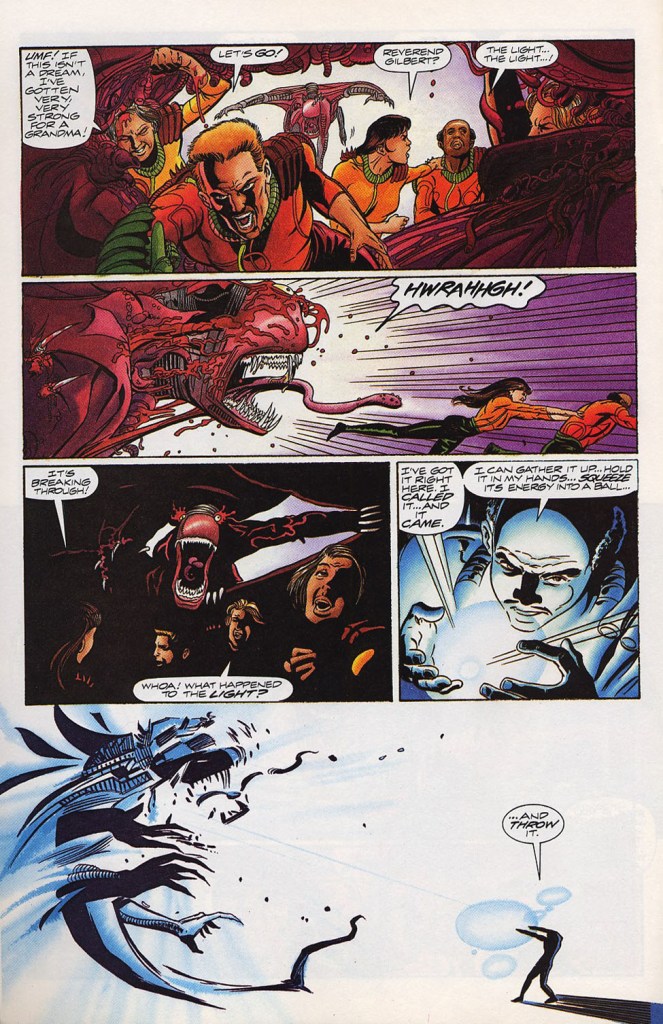
Unfortunately for Lorca’s dreams of revolution, something goes wrong in the process and most of the people who are subjected to this process die horrifically. In the end, there are only five survivors: Louise Johnson, a grandmother who will be known as Glory; Reverend Martin Gilbert, AKA Preach; Lieutenant Elvis Mazerov, called Shooter; shy one-armed auto mechanic Rick Tietz, hereafter Mouse; and cosmetics counter girl Cookie Wazenegger, Nudge. Lorca attempts to have all of the evidence of his betrayal “slaughtered, mulched and recycled” before his duplicity can be discovered by the authorities, leaving the five survivors to use their new powers to escape and go on the run. By the end of the issue, they’re able to fight their way to the gateway through which they were first transported to Plasm and make their way back through it to Earth. But their continued existence represents a threat to Lorca’s well-being, and so he’s got no choice but to go after them and extinguish them, all the while prepping the Earth to eventually be consumed by Plasm.
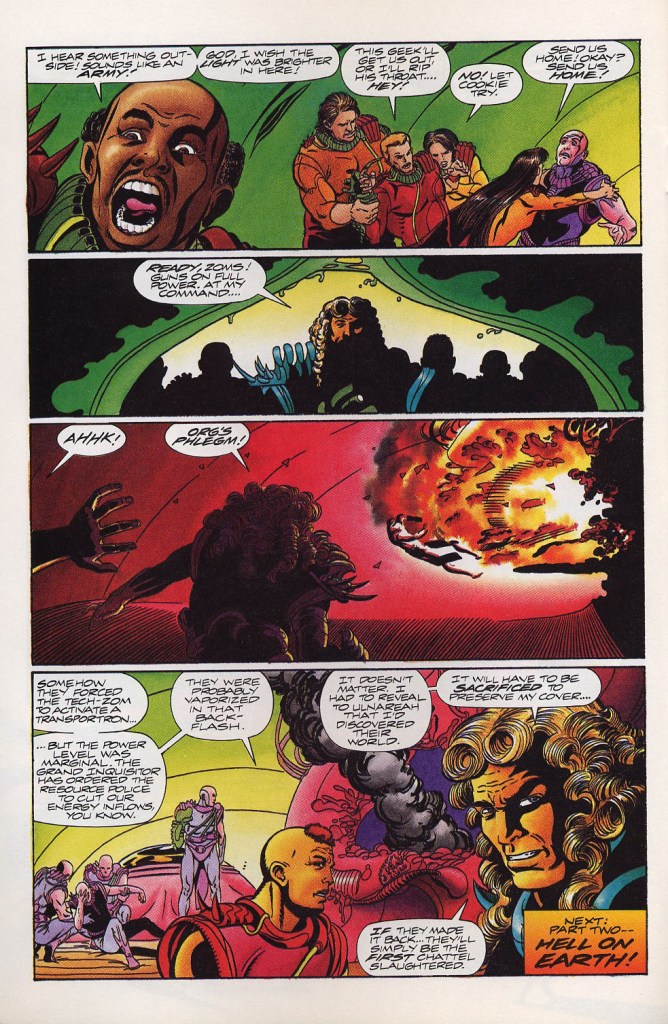
WARRIORS OF PLASM ran for only 13 issues, plus an additional squarebound one-shot, before reaching the end of the road. It expired just as Shooter was attempting to roll out DEFIANT’s first company-wide crossover, SCHISM, his answer to his previous UNITY. But it was too little, too late, and only two of the projected SCHISM chapters would ever see print, the operation running out of money and unable to continue. WARRIRS OF PLASM is a very strange title, but not without its charms, and the level of execution is better and more consistent than much of what DEFIANT would end up fielding.
 The Tom Brevoort Experience
I skipped the defiant bus. But that company logo in the corner box was iconic imagery. It reminded me of a board game in the mid 1980’s that had a larger, black tower with some battery powered light effects at the center of the game. I wanna say “Dark Castle” or “Dark Tower”, but the second was a Stephen King property. Also made me think of the “haunted house” at the Jersey Shore, Brigantine Castle. I never visited , but the TV ads were almost scary enough.
LikeLike
It was indeed Dark Tower and it predated the Stephen King books — it was earlier than you’re thinking, Wikipedia says 1981.
LikeLiked by 1 person
Thank you!
LikeLike
The card set was a major mistake as was taking on Marvel in court.
LikeLiked by 1 person
I bought the first four issues of Warriors of Plasm and the graphic novel “Home for the Holidays” back around when they first came out… and all these years later I don’t remember a thing about them! Seriously, reading Tom’s blog post, all of this felt completely new to me.
Well, actually, several months ago I found a copy of the “Home for the Holidays” book in a dollar bin at a local comic con, and so I picked it up again. It was written by Len Wein and penciled by Dave Cockrum, but I found it sort of confusing and unremarkable. Probably would have made more sense and been more enjoyable if I’d actually remembered what had happened in the regular series. I recall thinking that for a book put out by the same creative team behind the classic Giant-Size X-Men #1 it was a fairly underwhelming.
Also, I felt it was just a bit tacky for Jim Shooter to include a character named after himself in this series.
Having said all of the above, though, I have to say, it was a seriously trashy move on Marvel’s part to launch a nuisance suit over the name of the series. Especially when their own book was an ugly-looking Marvel UK miniseries that would have otherwise no doubt have vanished with a trace under normal circumstances. I really have to wonder if Defiant might have lasted longer if it wasn’t for that. I’m sure that they would have gone under eventually, because the mid-to-late 1990s were a really rough time for smaller publishers, but maybe they would have at least been around for another year or two to produce an alternative to the mainstream superhero books of the Big Two.
LikeLiked by 2 people
As Oscar Wilde might have put it: To be fired as editor-in-chief by one comicbook company may be regarded as a misfortune; to be fired by two begins to look like carelessness.
LikeLike
That was a really good-looking book.
Not very reader-friendly, which is an oddity, since most Shooter stuff is very reader-friendly. I think his “Do SF that expects you to pick up the context as you go” and his “Make everything clear for the readers” instincts were clashing, and the result was hard to get into.
But it looked really nice, that’s for sure.
LikeLiked by 2 people
I skipped Defiant more thoroughly than I did OG Valiant. In fact, I retain so little interest in Defiant i basically skimmed this post.
LikeLike
The trading card stunt did more to discourage new readers for the book than encourage them. After the crash of Defiant and the rest of the comics industry, I bought a box of Warriors of Plasm and Dark Dominion cards and the binders for super cheap and assembled the story. It’s actually a fun little gimmick, but I’d never do it at retail price for a comic. I think I paid $20 for the whole kit and kaboodle.
I always found it sad that Steve Ditko’s work on Dark Dominion, some of the best late Ditko commercial work I’ve ever seen, has gone unseen because nobody bought the cards. And I believe that card issue is the only issue Ditko worked on for Defiant.
LikeLike
How deep are we going into Shooter’s career? Will you eventually cover his considerably ill-fated stint at Broadway?
LikeLike
Defiant (I think Big Jim insisted on it being all-caps, lol) had bad timing in almost every way. Speculator boom was ending and bubble was about to pop, but you still had a lot of product out there and quite a few companies producing work, so it was less like when Shooter launched Valiant and could collect up some experienced pros that were out of favor at the Big Two. The idea of a “writers room” method for storytelling and plotting was interesting, but probably not very functional. And now there were even more people wanting to see Shooter fall on his face running around.
The Marvel lawsuit was exceptionally petty and a real attempt by them to put Defiant out of business before they ever got started; Marvel definitely did not want another Valiant out there that might nibble up some of their market share and there were certainly some people at Marvel nursing grudges there.
I thought the Defiant books had interesting ideas but needed better execution. Some of the art was quite good and interesting, and the story ideas were pretty intriguing, but the dialogue was weak and needed stronger writers. Shooter always struck me as someone whose strengths were plot and storytelling, not dialogue.
I’ve got most of these; picked up a fair amount in the 50 cent boxes over the years and most of them were readable, but not quite there. A good idea that was missing something. An almost rather than something bad.
LikeLike