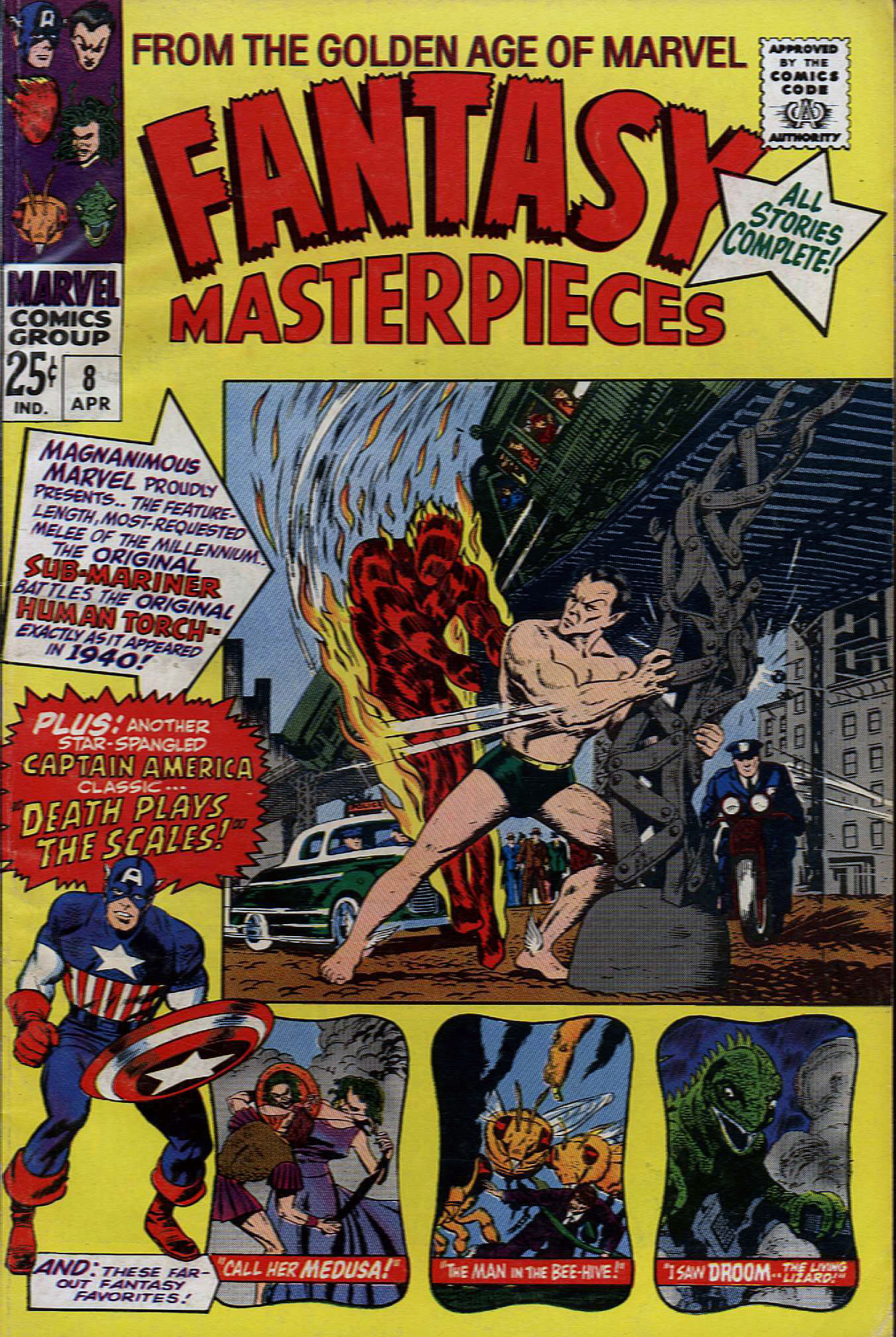


On that selfsame trip to Bush’s Hobbies following my graduation from grade school, I indulged in my interest in golden age comics by picking up this issue of FANTASY MASTERPIECES, which reprinted the first battle between the Human Torch and the Sub-Mariner, a story I had read about previously in Jim Steranko’s HISTORY OF COMICS. These reprint back issues weren’t especially in demand, so they were relatively cheap in 1979. And this particular copy was in extraordinary condition. It looked and felt brand-new, like it had never before been opened until I did it. Which makes what eventually happened to it all the more a shame. Later in the year, when my family went to a Christmas get-together with my Father’s family, I brought the book along. At a certain point, I left it on an end table, just close enough to the crib holding a recently-born cousin. And that’s when disaster struck. The child grabbed the book, tearing its cover in half horizontally. This was a huge tragedy for me, but the adults present at least were able to recover the book and both halves of the cover, so I still had all of the bits. But the fact that the copy had been so utterly pristine made this tragedy smart all the more keenly. A good lesson in being careful where you left your stuff.
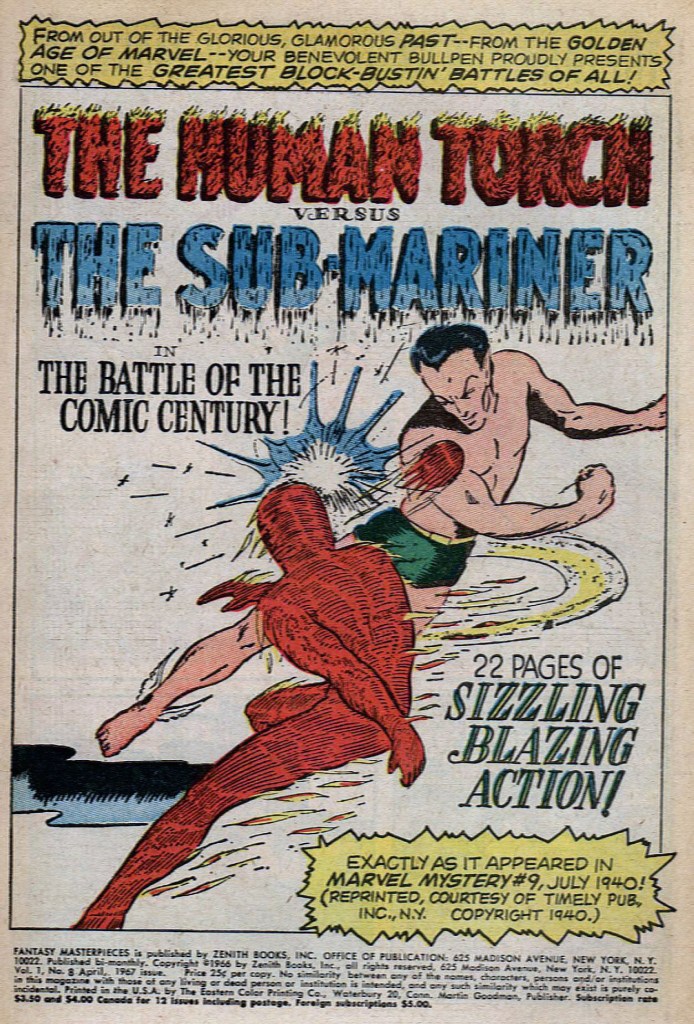
The 1940 battle between the Human Torch and the Sub-Mariner in the pages of MARVEL MYSTERY COMICS #9 was at once a thoroughly innovative and exciting development and at the same time just about the most obvious thing you could do, having a pair of characters who represented fire and water. It was actually a multi-part story, one that started being built up to in issue #7. In that story, the Human Torch, now employed as a policeman, gets words of the rampage of Namor and heads out to confront him, while Betty Dean, the Sub-Mariner’s love interest, warns Namor that the Torch is on his way. In the next issue, the two stories run in parallel, with Namor wrecking the town in the opening and then the Torch showing up to cope with the damage in the second. All of which led up to this, an actual 22-page combined adventure that featured both characters, with their respective creators Carl Burgos and Bill Everett drawing their guys whenever they turned up. John Compton apparently worked with both men on the script.
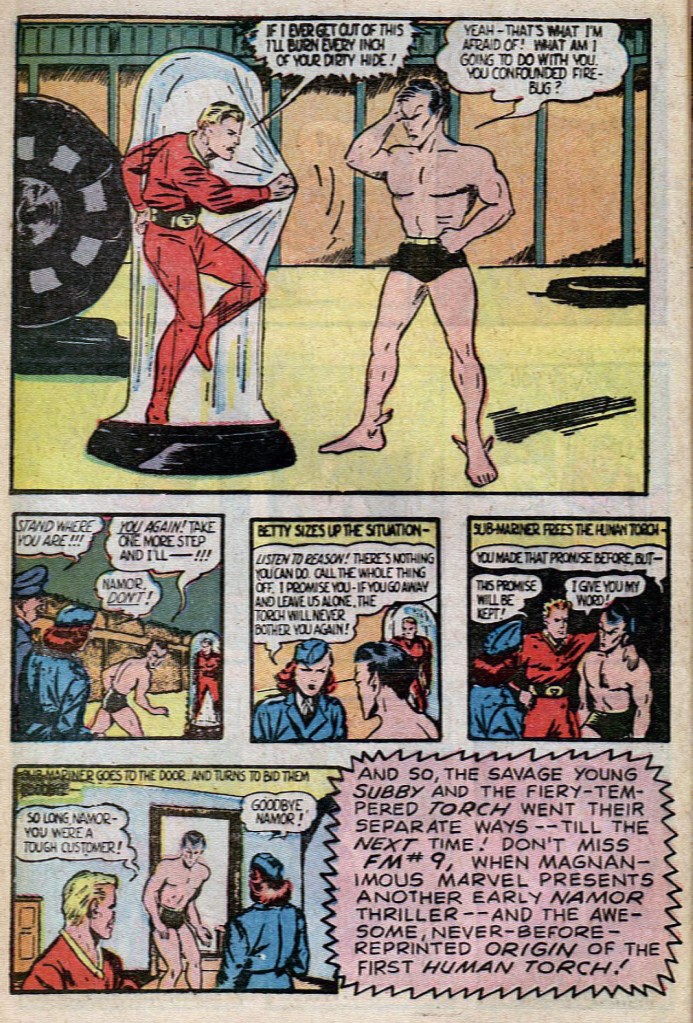
The story is 22 pages of glorious nonsense as the two characters trade blows and barbs all across Manhattan island. It’s definitely the precursor to the formula that Stan Lee would use in the Marvel age whenever two heroes met up with one another. And it ended in a stalemate, with the Torch trapped in a plastic tube that prevented him from activating his flame–but if Namor tried to get at the Torch, the oxygen would cause him to ignite. This was originally a cliffhanger at the end of MARVEL MYSTERY #9, but for this reprinting, a bunch of panels from the single-page wrap-up in MARVEL MYSTERY #10 were added to the final page, in which Betty Dean shows up to in essence convince Namor that the story is over and that he should withdraw peacefully–which he does. I have to say, this was a pretty cool thing even so many years after the fact, and you can totally see why the powers-that-be at Timely Comics went back to this well with additional Torch/Namor battles again and again over the next couple of years.
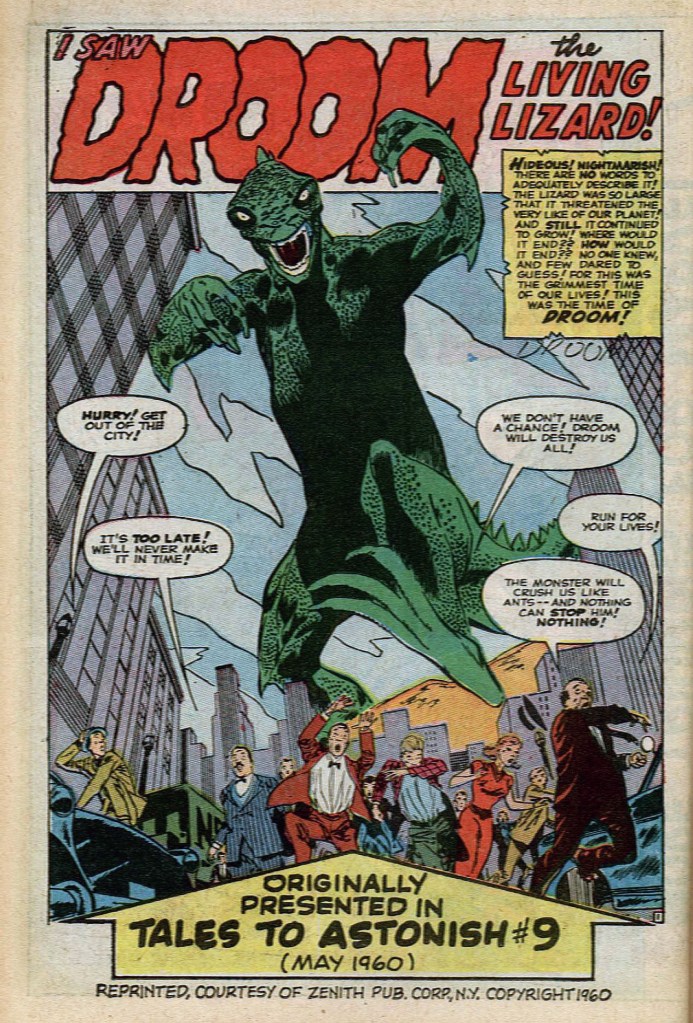
From here, the center portion of the book was strictly B-feature time, containing a trio of short mystery/suspense stories reprinted from the period immediately before Marvel got back into doing super heroes. The first one is nicely drawn by the underrated Don Heck and featured Droom, the living lizard. Larry Lieber’s script tells about a small lizard that’s accidentally exposed to a growth serum similar to the one used by Hank Pym as Giant-Man. After the creature rampages around the city for a number of pages, the military is able to lure Droom onto a rocket that they launch off into outer space. Hooray, crisis averted! But of course, the kicker is that Droom drifts through the void until he comes to another planet, Earth, where he becomes the first dinosaur. Dun-Dun-Duuuuun!
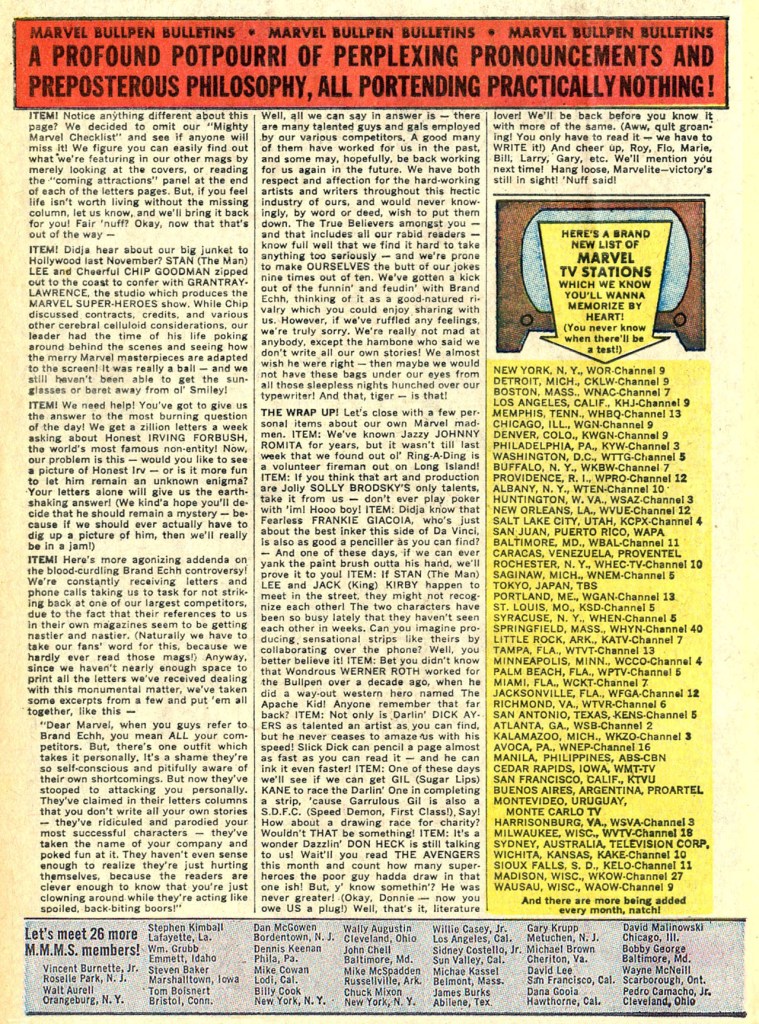
At this point, the Bullpen Bulletins page showed up, which was always a fascinating read for me so many years after the fact. The big news at this time was the impending release of the 1966 MARVEL SUPER-HEROES cartoon series, a show that was already old hat to me (though it had come back into syndication in my area in a big way following the success of the live action INCREDIBLE HULK TV show under the new title THE INCREDIBLE HULK AND FRIENDS). This month, it was so important that a listing of all of the TV stations on which the show would be broadcast was run that the Mighty Marvel Checklist was omitted in the list’s stead. The page also continued the ongoing stunt of listing the names of 26 more members of Marvel’s fan club, which was a pretty compelling perk in terms of joining (assuming you could find your name in whatever issue it wound up turning up in.)
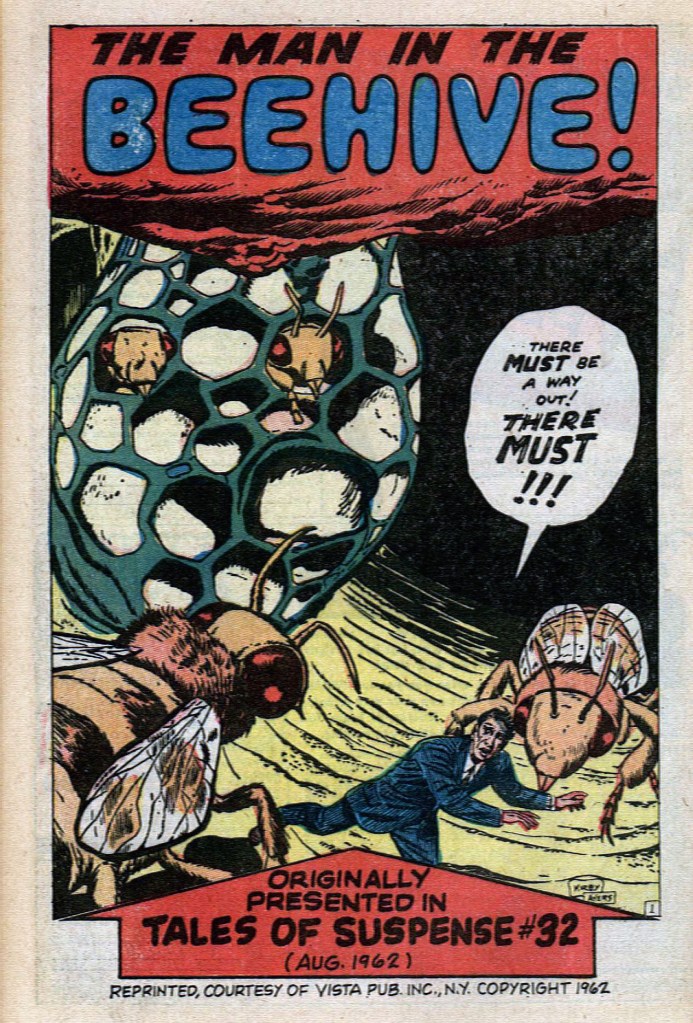
The next story reprinted is noteworthy in that it almost became the prototype for another super hero series. Apparently, inspired by what he was hearing from his road men about the sales of DC’s series THE ATOM, Marvel publisher Martin Goodman ordered editor Stan Lee to come up with a knock-off or two. Stan and Jack Kirby did this by repurposing a one-off fantasy story they’d done about a scientist who invented a reducing formula and was trapped thereafter in an ant hill into the super hero Ant-Man. But apparently, there was some talk about doing the same thing with the protagonist of this other story about a guy trapped in a beehive. In this instance, the beekeeper is a mutant who reduces himself and the criminal who tries to rob him so that they can enter a beehive. At story’s end, there’s an intimation that this was all just the byproduct of hypnosis, but it could have been otherwise if a Bee-Man was needed in addition to or instead of an Ant-Man.
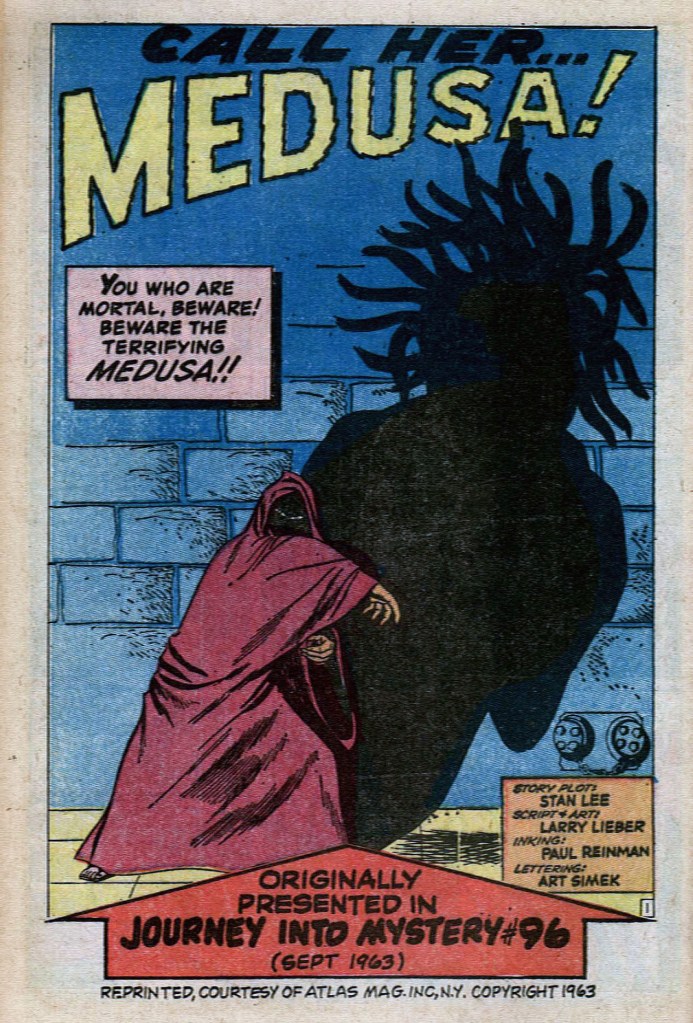
The third and last fantasy story was both written and drawn by Larry Lieber, though Stan as usual tool a story plot credit on it. It was about how an alien race of Gorgons who could turn men to stone sent an envoy back to Earth to see if it might be ripe for conquest. But Medusa, the envoy, learns that her power is ineffective against the people she encounters, and she returns home to call off the invasion–little suspecting that her craft had landed on the ground of a school for the blind, and so her would-be victims couldn’t see her. Stan and company did innumerable variations of this basic concept in the mystery titles over the years.
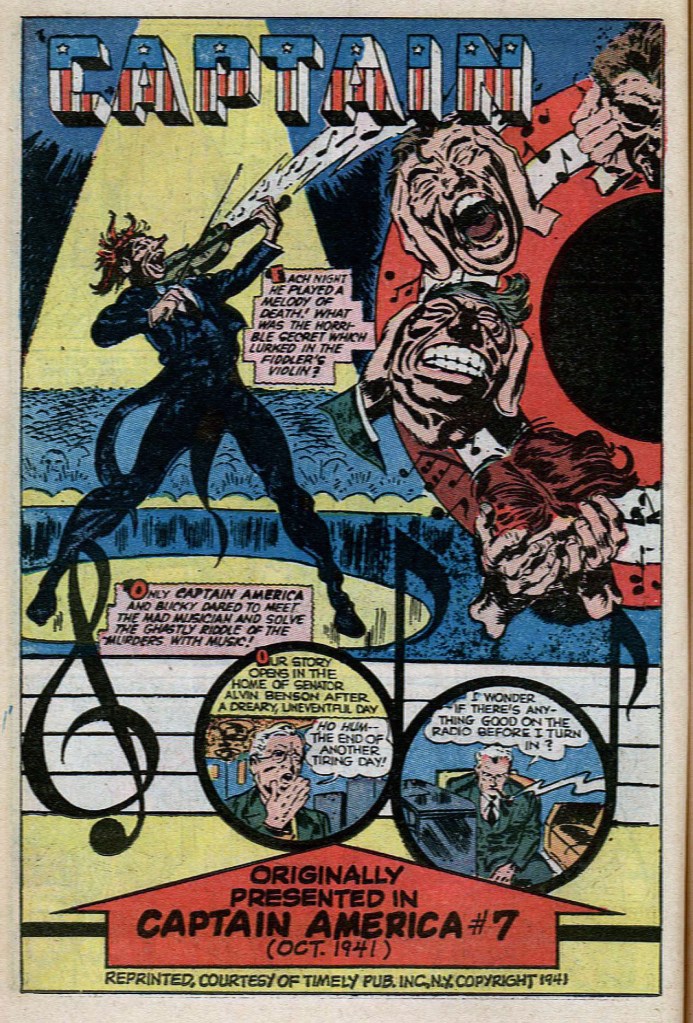
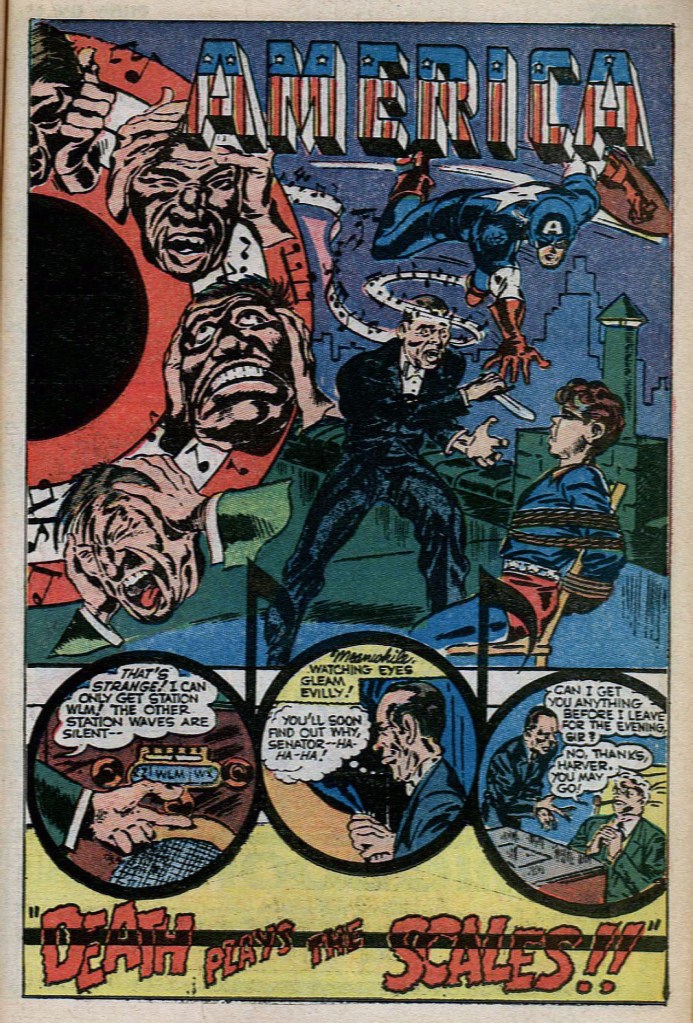
The last story in this issue was a golden age adventure of the Star-Spangled Sentinel of Liberty, Captain America, by his creators Joe Simon and Jack Kirby. Not that anybody could tell that, as Goodman had their credit (as well as Burgos’ and Everett’s on the lead Torch/Namor adventure) stripped out for this reprint. What’s more, the story’s title had to be changed to conform to the Comics Code; originally, it had been titled “Horror Plays the Scales.” It was about an evil Fiddler who was a Nazi agent, using a bogus employment agency to get Nazi stooges into the homes of prominent Senators so that they could plant explosives that would be triggered from afar when the Fiddler played a certain note in his radio broadcasts. If that seems like an overly complicated way of disposing of some Senators, you clearly don’t have the aptitude to become a top Nazi spy. Fortunately, Cap and Bucky are able to put the pieces together and clobber the Fiddler and his goons.


We also get an alien Medusa in Avengers 4 and there was one in Lois Lane many years later.
I think I’d have been disappointed with this collection overall (Marvel’s monster stories of that era rarely worked for me) but the Torch/Subby clash would have made up for it.
LikeLiked by 1 person
“Droom the Living Lizard”? As opposed to the dead one? You’d think he’d have got a nickname based on his size, rather than being alive.
Okay, having gone and read the story, it does kind of make perfect sense. It was a living small lizard that the curator of a museum was keeping there, although the place was normally filled with stuffed lizards and things. And then it got into the growth serum, and you can see how the news would spread describing the accident to a living lizard. I’m impressed by the writing!
LikeLiked by 3 people
From what I’ve read on marvel.fandom.com Droom took Godzilla’s place: Later, Droom returned to Earth and for unknown reasons would both terrorize and protect Japan. He teamed up with Robotman ( I guess Robotman takes Jet Jaguar’s place ) to fight various other giant monsters[ Fantastic Four/Iron Man: Big in Japan#1-3 ]. Also, the Droom seen in the reprint isn’t the one that appears later but the one seen on the cover of his first appearance.
LikeLiked by 1 person
“Droom, the Looming Lizard!”
LikeLiked by 2 people
Much better! If only Droom’s planet had had a writer like you! 🙂
LikeLiked by 1 person
I could be wrong but I think Fantasy Masterpieces would have had a bigger impact it just reprinted 40’s super-hero stuff and left out the more recent monster stuff. The first two issues are only monster stuff and the cover line is still “From the Golden Age of Marvel.” Go figure.
I think I have a number of the issues that feature golden age stories. They were 50 cents to a buck in the late 70’s.
The prominent copyright line at the bottom of each story noting Goodman’s odd tower of publishing house names is strange. Stan would do a thing every now and then when someone would guest star early on in the MU: “The X-men appear courtesy of X-men magazine” as if a lawyer had to ask permission…something I figure was just a way to plug a new title. This is some other thing entirely. Was it a legal strategy to make sure all the copyrights were under the Marvel umbrella and not under a one-off company name?
LikeLiked by 1 person
Two possible reasons for Stan to reprint the monsters from the late 50s/early 60s– the stats were probably readily available in storage, whereas a lot of the real Golden Age stuff wasn’t consistently preserved. Compared to the recent horror tales, not much of the pre-Code material got reprinted, even omitting the few stories that might’ve been too gross for the sixties. Stan probably wanted to give the readers the illusion of getting more for their quarters, and it’s easiest to slot in more short stories than semi-long ones. For instance, even if Marvel possessed a full run of YOUNG ALLIES back then, many of them were book-length and thus harder to slot in. (Incidentally, the previously mentioned Black Talon made his second and last appearance in YA; a villain crossover rare for the time.)
LikeLike
Droom wasn’t the only 1960s lizard to be turned into a monster by a growth serum, see Sserpo, the Creature Who Crushed the World!! [ Amazing Adventures vol.1#6 ( November 1961 ) 1st story ] — A growth serum is abandoned and eaten by a lizard, which grows big enough to menace the Earth ( comics.org and a profile on marvunapp.com ).
LikeLiked by 1 person
THE HUMAN TORCH VS. SUB-MARINER: On the page before the Torch singed one of Namor’s ankle wings Namor tried to punch the Torch and his fist sails right through the Torch’s flame ( words starting with … his fist is in that panel ). The reprint here gives Namor black hair( Brown during Timely Comics ) he first got in the Atlas Age.
LikeLiked by 1 person
The whole Human Torch vs. Sub-Mariner this was sold as Fire vs. Water, to bad the Powers that be at Timely Comics didn’t think to do Fire vs. Ice too. In his first appearance Jack Frost was wanted by the police and USA Comcs#4 ( May 1941 — The Adventures of the Frozen Corpses ) gave them the perfect opportunity to do that Fire vs. Ice story: A deranged research chemist ( Jimmy Crain ), jealous that he has lost “his” girl ( Betty ) to his partner Bob Davis ( because of an accident caused by him that has marred his features ), tries to kill his partner with Liquid Ice and attempts to blame it on Jack Frost.
LikeLike
These reprints were ignored early on by me because I just found the art too primitive to my taste to be satisfying. I’d eventually get to where I could appreciate their place in comics history but never to where I enjoyed them. The monster shorts? It was like getting only one chicken McNugget and nothing else.
LikeLiked by 1 person
I’m the opposite. I received “The Great Comic Book Heroes” by Feiffer in 1975 and the (generally) primitive art of late 30’s and early 40’s super-hero comics made the stories more compelling if anything. Lurid even. I probably wouldn’t have sustained interest on an ongoing monthly basis… but the relative crudity combined with a lack of rules made them cool to me.
LikeLiked by 1 person
This Fiddler in the Golden Age Captain America feature reminded me of the JSA villain, “the Fiddler”, who may or may not have appeared within a few years before or after this Fiddler. Hard to know off the top of my head, as JSA stories in the late 1970’s and early 1980’s “retconned” what happened in the 1940’s a bit. Interesting that both Fiddlers wore green. But I guess color choices were more limited then. And the JSA’s Fiddler may have had white hair. Unless that was only for his appearances decades after WW2.
LikeLike
DC Comics’ Fiddler appeared in All-Flash#32 ( December-January 1947-1948 — last story ), a earlier DC Comics Fiddler ( no special abilities ) fought the Vigilante in Action Comics#59 ( April 1943 ), while Timely Comics’ Fiddler appeared years earlier in Captain America Comics#7 ( October 1941 — 3rd story ). I remember in the letter page of on The Invaders issues someone suggested giving him a brother and renaming him because DC had a Fiddler ( ignoring Marvel’s Fiddler was first and both companies had a Scarecrow villain ). Since the Timely Comics’ Fiddler was immune to the effects of his fiddle throughout the story, I would suggest his “death” was faked ( That “death note” worked the same way the Grim Reaper “killed” the Avengers in his first appearance — The Avengers#52 ( May 1968 ) ) — The Fiddler could have been a lover and not a fighter, so he faked his death. Also as a Nazi operative Marvel could have just gone with the German — Der Geiger ( The Fiddler ). The Patriot fought the Veiled Violinist ( his music caused bones to disintegrate ) [ The Human Torch#5a ( Summer 1941 ) ] — should had The Hand or someone else resurrect him during WW2 and he should have been Klaw’s father instead of Colonel Klaue.
LikeLiked by 1 person
Thank you! Much appreciated.
LikeLike
One more Timely Comics bad guy violinist but different from the others: A violinist named Loufitz who had his hand amputated after an automobile accident goes mad and murders several violinists before he falls to his death battling Torch and Toro [ The Human Torch#18( Spring 1945 ) 1st story — Death Plays the Violin ] — the plot is similar to the Black Talon [ Captain America Comics#9 ( December 1941 ) Captain America 4th story — The Case of the Black Talon ] except the Black Talon ( Pascal Horta ) who had his amputated hand replaced with one from a death row African American murderer called Strangler Burns, and the Black Talon murders several fellow artists who’s murders he paints before he murders them.
LikeLiked by 1 person
DC’s Fiddler was a (Golden Age) Flash villain, and he had white hair from the start. His design sticks in my mind, because he looks like someone you’d see in the subway playing music for donations. There’s supervillains who look like supervillains, that’s common. There’s supervillains who dress average (Silver Age Luthor), or bizarre (Joker) or dapper (Penguin). But DC’s Fiddler just strikes me as looking like he’s a musician going from gig to gig, barely making a living, if that.
https://siskoid.blogspot.com/2024/03/whos-fiddler.html
His missed his era. He would have made a great 1960’s Batman foe. How can you resist a story title like Flash (1940) #93 “The Violin of Villainy”.
LikeLiked by 1 person
Dang! Well done, Mr. Holstein! Bravo. Well researched & delivered.
LikeLike
It was mostly looking up dates for the Flash 1 and Captain America Fiddlers then remembering the Vigilante’s Fiddler ( looking up his issue/date ) and remembering the Patriot’s violinist foe. Then pointing out how Cap’s Fiddler could have survived and pointing out his immunity to his music until he mysteriously wasn’t. All of which I find relaxing. But you are welcome.
LikeLiked by 1 person
🙏
LikeLike
It was interesting, revisiting this battle in MARVELS, trying to streamline it into something that had the impact of the original but ducked out on some of the seller stuff…
LikeLiked by 3 people
Clearly The Man in the Bee-Hive lied about it being hypnosis since on the last page the thief Eric picks up something that fell from Lucius Farnsworth that turned out to be the thief’s gun in tiny size. Lucius Farnworth age might be why they never went with a Bee-Man.
LikeLike
Ah, but Eric the thief could have been hypnotized to also see a tiny gun, as a parting shot to mess with him.
I don’t think Farnworth’s age mattered. If they cared, they could have had Bee-Man be his son or nephew, with similar (maybe not identical) powers. Or de-aged him with bee-produced Royal Jelly or something like that.
Maybe a Bee-Man verges too close to unacceptable horror for the times. A hero who can send a swarm of bees after a crook might be too far for what’s considered acceptable heroic tactics.
LikeLike
There was a DC hero (or Quality maybe) that was bee themed…
LikeLike
The Steve Who Is Always Right, that would be Quality’s Red Bee ( Rick Raleigh, Assistant District Attorney )[ Hit Comics#1 ( July 1940 ) 24 appearances ] who had no superpowers but makes use of a bunch of trained bees ( in some stories, just one bee, Mike ) as a distraction and his stinger gun as a punishment — Jess Nevins Encyclopedia of Golden Age Superheroes.
LikeLiked by 1 person