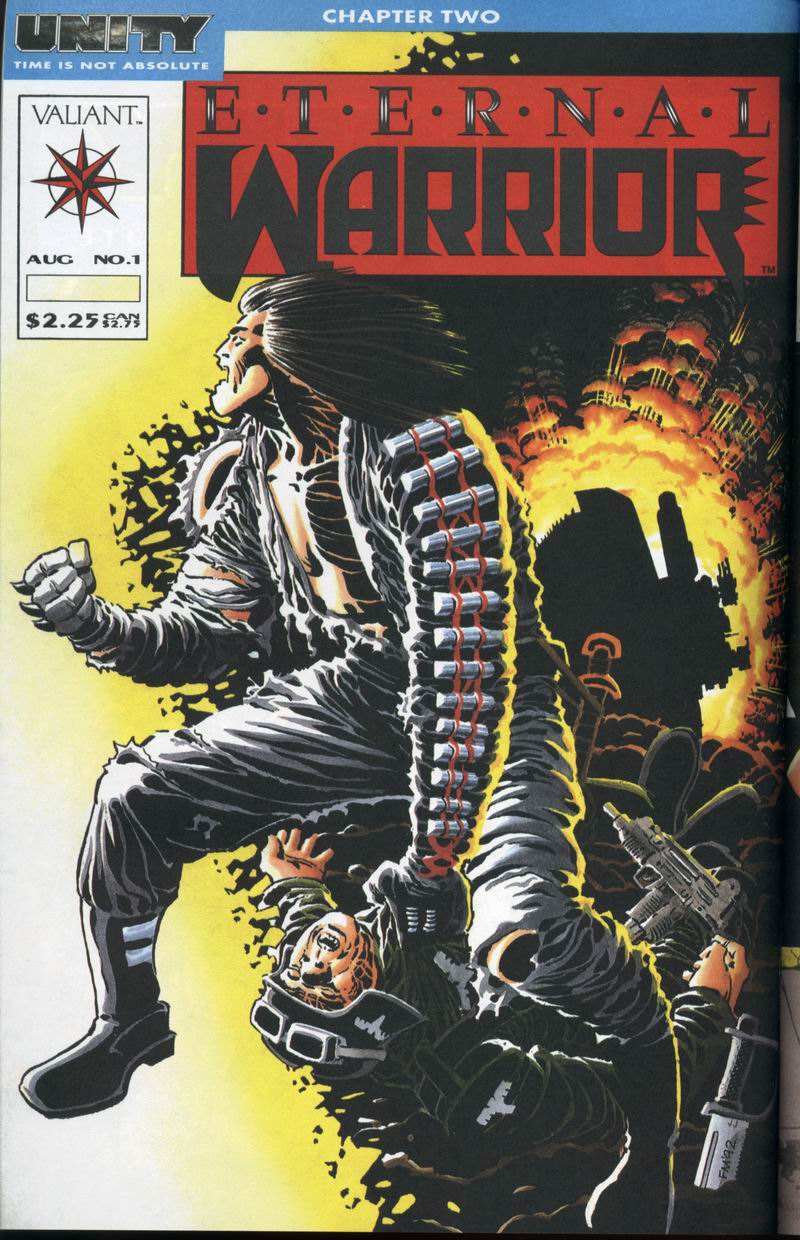


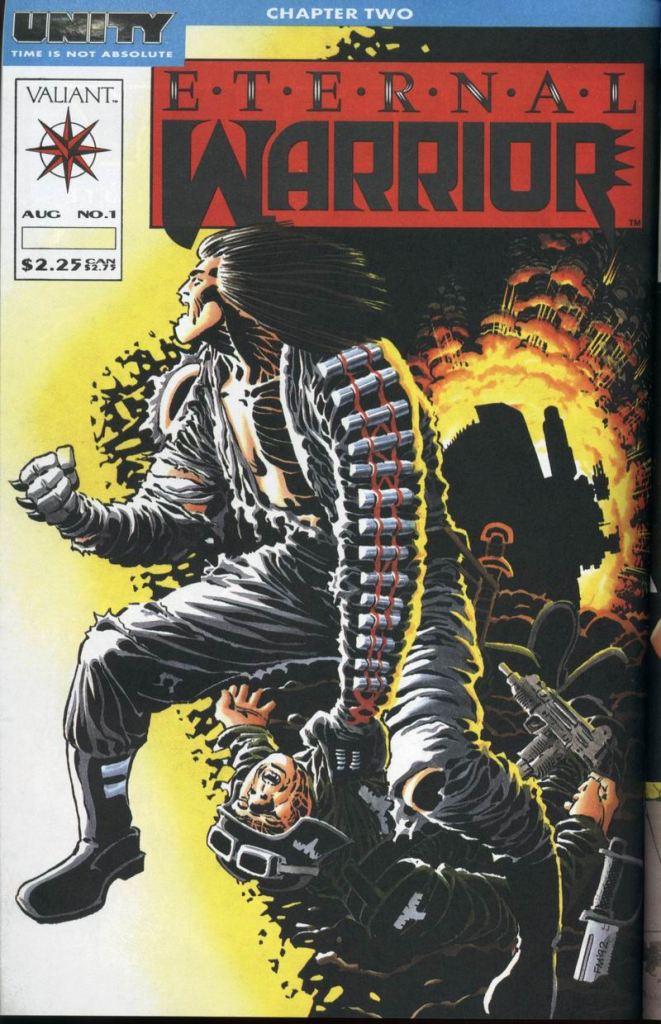
The next series that Valiant released was launched as a part of the UNITY crossover. Labeled as Chapter Two, it really wasn’t such a thing, as the only connective tissue to the crossover storyline is a short epilogue at the end that repurposes panels from UNITY #0 to bring Gilad as well as Archer and Armstrong into the UNITY story. Still, that was probably a smart way to launch a book that would go on to become relatively central to the Valiant line, and it would run for 50 issues in total, not counting later reboots and reimaginings. it was also intimately connected with ARCHER & ARMSTRONG (and eventually, in the years to come, TIMEWALKER)) on a conceptual level, as the lead character was the elder brother of the titular Armstrong, and like him lived a lifetime measured in centuries.
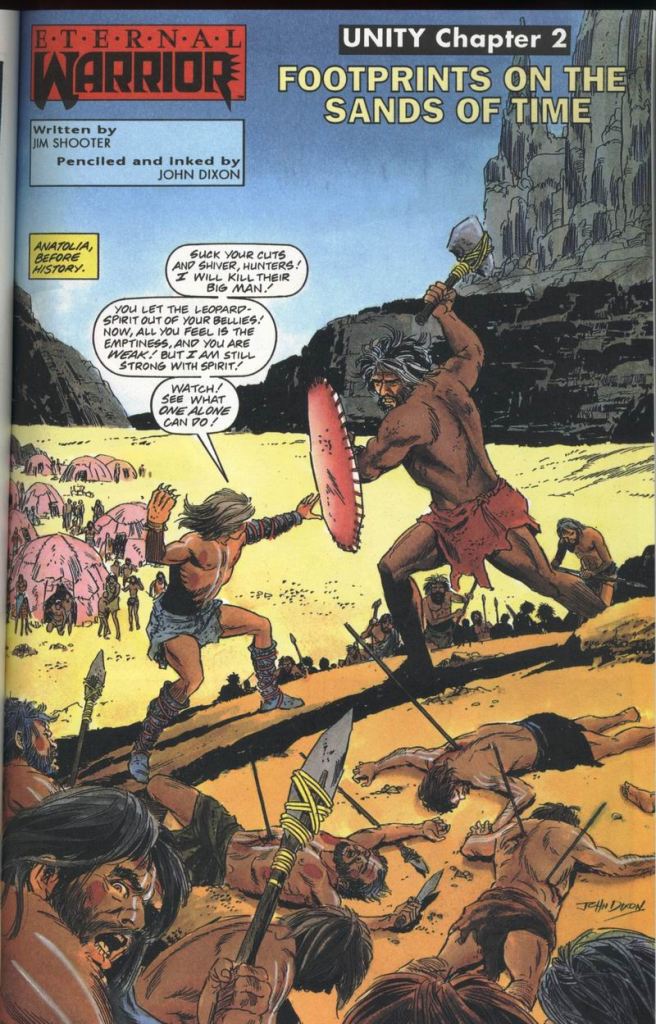
The Eternal Warrior was the creation of Valiant Editor in chief Jim Shooter and color artist Janet Jackson. Don Perlin designed the character in the pages of SOLAR, though Perlin didn’t work on the series. Rather, this first issue was both penciled and inked by John Dixon, with two pages at the very end pulled together from artwork done by Barry Windsor-Smith and Bob Layton for UNITY #0. The cover was contributed by industry legend Frank Miller, and was one of eight interlocking pieces that Miller did for all of the Valiant titles in this first month of the crossover.
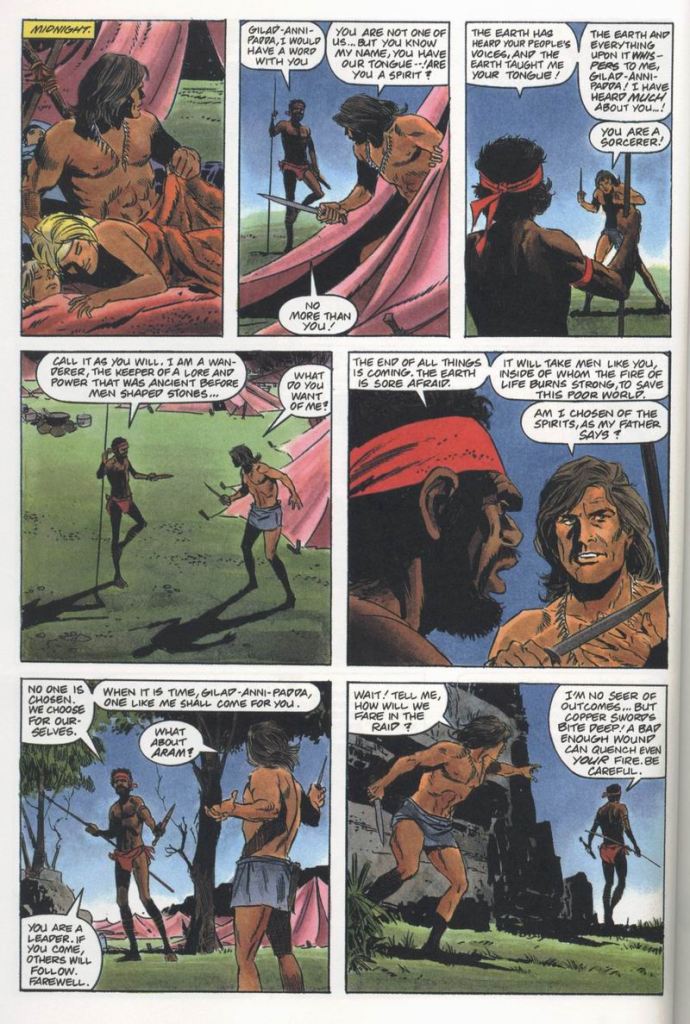
This first issue is an origin story, and lays out a lot of the lore that will be followed up on in future Valiant releases. It opens in a time of prehistory, when the lead character Gilad Anni-Padda is only twelve years old. However, he’s already strong enough and durable enough to fight and defeat fully-grown men–there is something strange about both him and his younger brother Aram, something greater than human. But his tribe simply considers Gilad as touched by the Gods, the inheritor of the warrior’s flame they refer to as the Leopard-Spirit. For all that Aram is similarly blessed with incredible strength, he is no warrior, and prefers a life of play and comfort. Over the course of decades, Gilad, now known as Gilad the One, grows into the natural leader of his tribe, until one evening he is visited in the dead of night by a Geomancer, one of those who are in tune with the spirit of the planet. This Geomancer tells Gilad that a time of great hardship is coming and that it will take men such as Gilad to fight back the spread of darkness. But Gilad is a simple man for all his battle prowess, and he doesn’t quite understand or embrace what he is told.
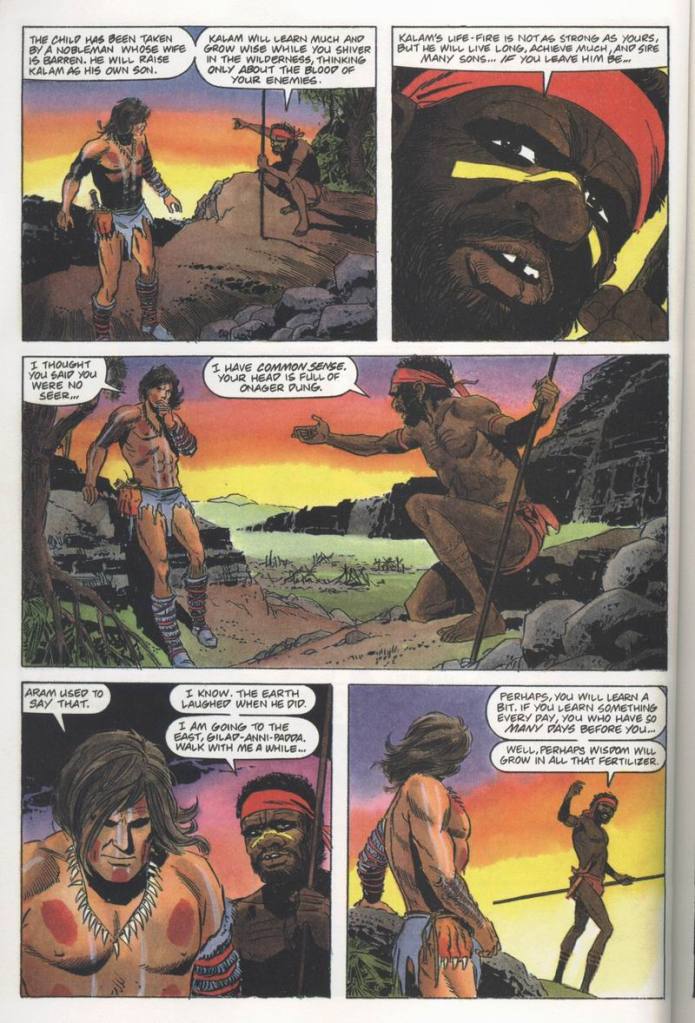
The following week, the tribe makes the foolhardy decision to attempt a raid on a fortified Mesopotamian city. Despite Gilad’s prowess and Aram’s strength, there are simply too many defenders to be overcome, and the tide of battle quickly turns. The tribe retreats, but those they attacked are not content to leave them be. They pursue them back to their camp and slaughter virtually everybody with the exception of Gilad and Aram, who simply cannot seem to be killed. The loss of his wives and his children has a profound effect on Aram, who foreswears violence and, after burying his dead, heads off to find another way of life, leaving his brother entirely on his own. It’s at this point that the Geomancer returns. He tells Gilad that his son survived the slaughter, and that he was taken in and adopted by a nobleman in the city whose wife is barren. The Geomancer convinces Gilad to leave the boy be, convincing him that his child will have a much more prosperous life in his new circumstances than in the barbaric existence that Gilad represents. This is the first lesson about a larger morality that Gilad learns, and the Geomancer invites him to journey alongside him to see the wider world, an offer Gilad takes up.
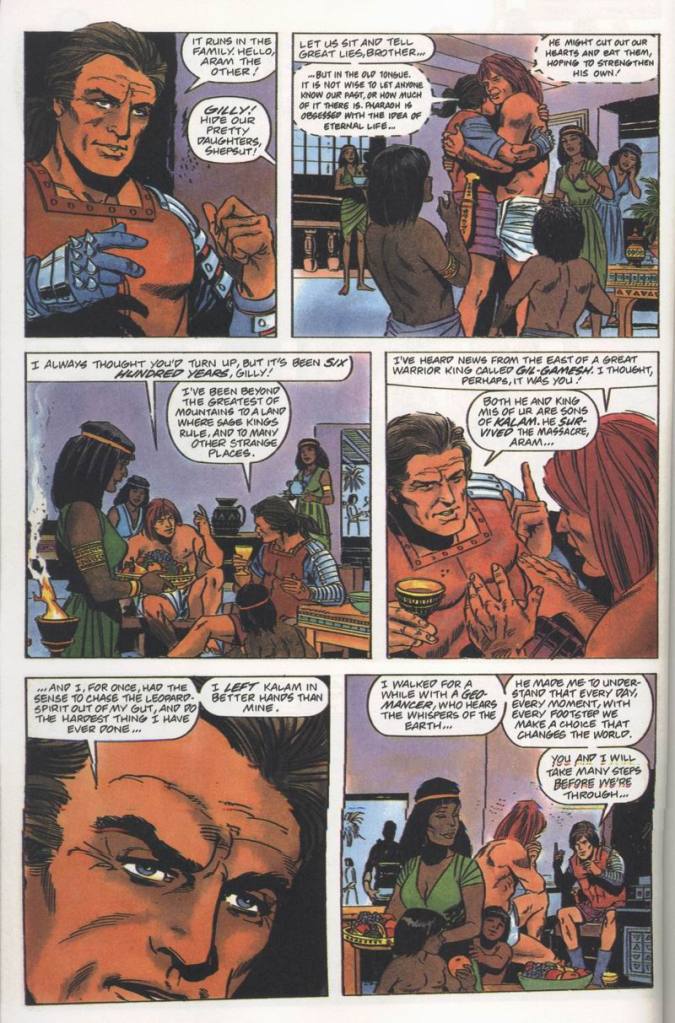
The narrative then jumps 600 years into the future, to the Egyptian court of Pharaoh Cheops. Aram yet lives, earning his keep by entertaining the members of the court with feats of strength. Unexpectedly, and for the first time in centuries, Gilad turns up at Aram’s home, a different more seasoned man than the one he’d known in times past. Having walked with the Geomancer and learned from him, Gilad has strode across the face of the world, learning and bettering himself for the fight to come. He’s returned to see his brother to extract Aram’s promise that when the foretold dark times come, that he can count on Aram’s aid and support. Aram is a peace-loving man still, but he makes his brother that promise before Gilad heads out once more. He’s heard of injustice elsewhere in the world, and its to these places that he journeys, to pit his prowess against those who would do evil, and in so doing slowly shape the destiny of the world for the better.
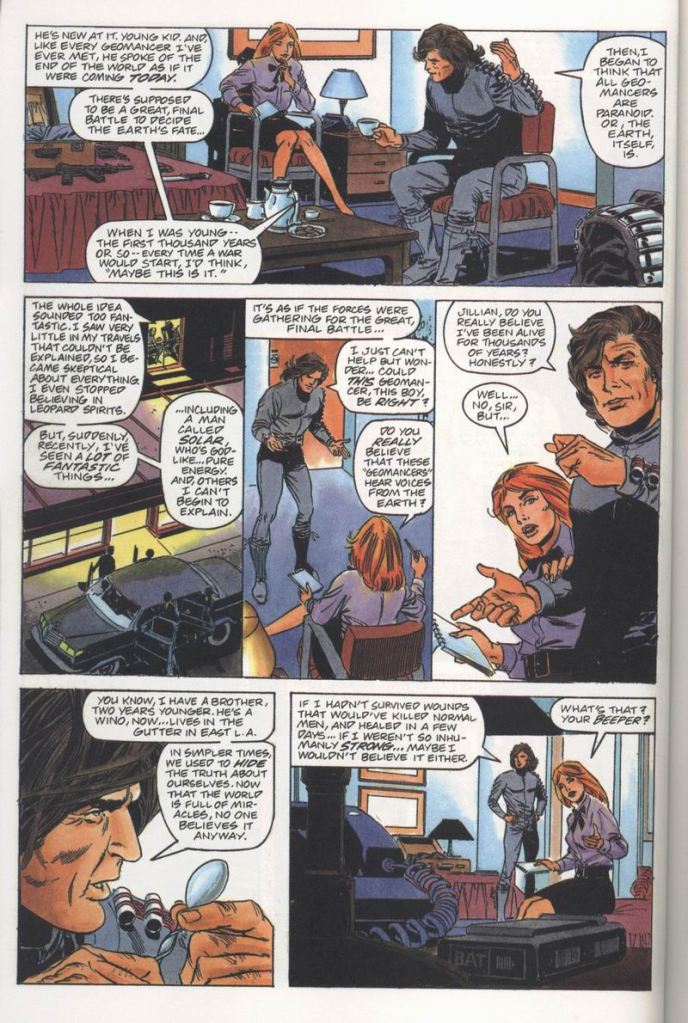
From there, we jump ahead to the present day, where Gilad is operating under the name Gil Abrams and has been plying his trade as an international mercenary. Having finished a job, he calls in to his solicitor, Alcott, who has arranged a next assignment for Gil. Alcott’s daughter Jillian meets Gil at a nearby Sheraton Inn in Tulsa with weapons and the documentation he’ll need for this next assignment. Gilad makes no secret of having lived for thousands of years, but Jillian doesn’t really believe his fanciful stories, even though she’s seen him survive wounds that would have killed anybody else. Gil finds that he’s got two phone messages, one from the modern day Geomancer Geoff McHenry and the other from his contact for this latest assignment. Gliad calls Geoff while Jillian checks in with the contact. And then all hell breaks loose. Geoff is telling wild stories about the time for the great battle being now, just as Jillian learns that their cover has been blown and that agents on the other side are on their way to her and Gil’s present location.
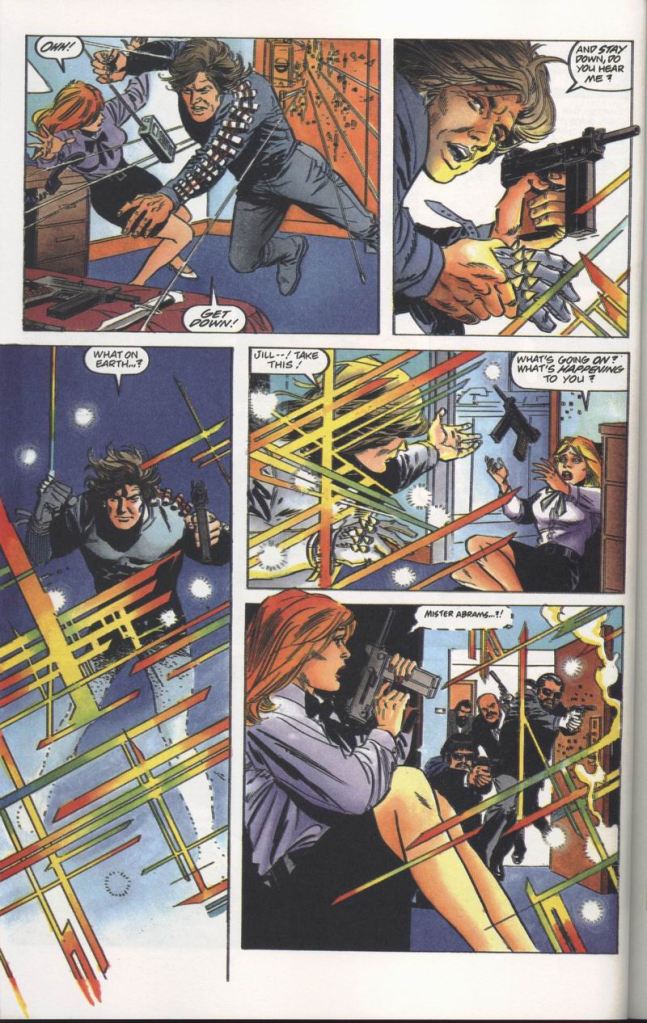
As the enemy operatives begin to batter their way through the door, Gilad snatches up a firearm intending to give battle. But before he can do so, he finds himself vanishing, teleporting away in the signature energy display of Solar, whom he’d encountered previously in an issue of that hero’s own series. When the dust clears, Gilad is gone, leaving Jillian to face the homicidal killers on her own. To Be Continued…except that isn’t quite where events leave off.
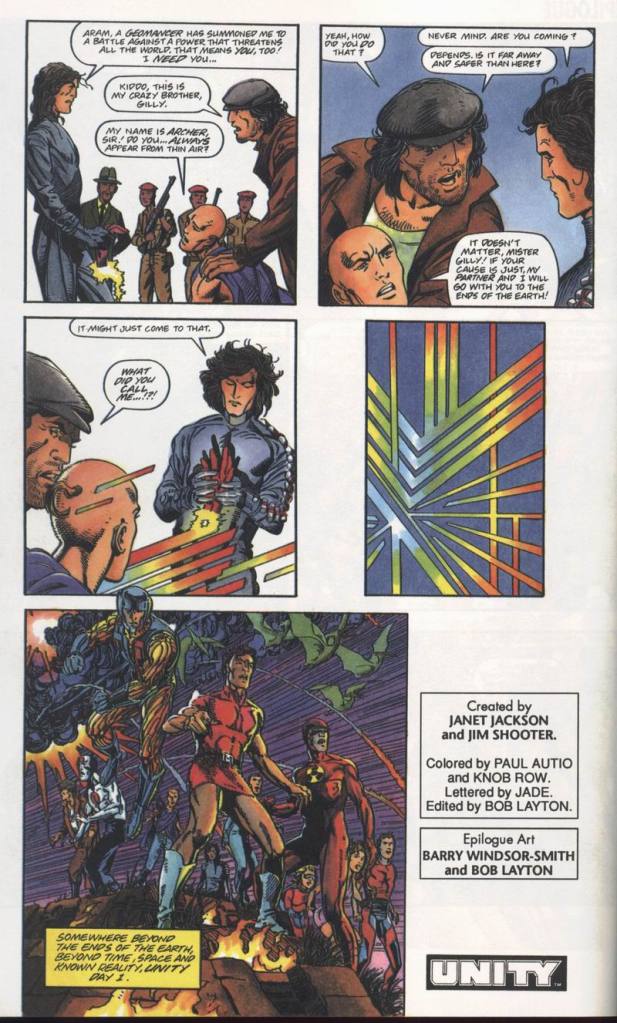
Because the final two pages reprise a number of panels from UNITY #0 and show Gilad appearing in front of Geoff, who tells him more about what is to come. Hearing this, Gilad insists on gathering up his brother Aram, now known as Armstrong, and he winds up getting Aram’s new friend Archer along the way. And at that point the story is legitimately To Be Continued. But not in the next issue of ETERNAL WARRIOR, but rather in the following chapter of UNITY. This is honestly not a great first issue, it doesn’t really do anything to interest a reader in who Gilad is or what his life and conflicts are like. and while it does lay out a bunch of important history that will be relevant to the burgeoning Valiant universe, it does so in an almost textbook fashion, without a lot in the way of drama or inventiveness. It’s definitely Shooter at his most direct and diagrammatical. Still, the underlying concept of the character was enough to give the strip legs and it ran for a good long while, so while I don’t think this was an especially strong opening, the connection to UNITY was enough to reel in at least a certain amount of the readers who first encountered the character in that context.


There was briefly magic in those Valiant books. Not sure if that ended during or at conclusion of Unity. Oh what could have been……..
LikeLiked by 1 person
I feel that Valiant continued to publish good comics for a couple of years after Unity, but by the time The Chaos Effect crossover came out in 1994 the bloom was definitely off the rose, and that the Birthquake in 1995 was the beginning of the end for the company.
LikeLike
I’ve never read an Eternal Warrior book and based on how boring this one looked, even if I had cracked it open I doubt that would have changed. I had liked many Shooter stories, especially on Avengers, but he would never be a writer I followed with disregard to art and character.
LikeLiked by 1 person
I skipped the whole Shooter/Valiant line after sampling an issue or two. I have a lot of respect for Windsor-Smith, but what I remember of Shooter’s writing on these books cemented what I thought of his writing at Marvel. Wasn’t for me.
Thia story had some interesting ideas. I’ve haven’t been a big fan of his most of his characters’ dialog. Outside of a few colorful zingers in “Secret Wars” (Hulk referring to Cap as a “star-spangled tin tyrant” still makes me smile), the characterizations and over the top dialog was a mess.
My limited but longtime experience with Jim’s writing was he had some strong ideas, but I was rarely sold on the execution. By the time I was 14 or 15, I think I’d aged out of the style he was writing in. I know he attempted “real world” relevancy in the “New Universe” titles, but they came off as stilted and stale.
No question he was a huge part of Marvel’s ascendance in the late 1970’s to mid-1980’s. And his LoSH’s legacy still looms large to longtime fans. He’s Hall of Fame level, for sure.
I run the risk of savage reprisal from RS Martin, a steadfast, consistent Shooter champion on here. But my comments are from my own observations and opinion. The Valiant line just didn’t hold my interest long.
The art on this, by John Dixon? Not the most dynamic, but still tasteful. Reminds me of some Thomas Yeates from his Eclipse Comics days. Even some Mike Manley, too. Maybe Dixon was also influenced by the great (and visually dynamic) Al Williamson.
LikeLiked by 2 people
I very much enjoyed Shooter’s first run on Avengers… and in general… his 70’s Marvel output on other titles like Daredevil are solid and compare well to the general output at the time. There are a few specific stories I like in his second run of Avengers….. but taken as a whole it’s a sad slog, and the dialog noticeably doesn’t match the “lilt” that a number of other Marvel writers of the early 80’s (Claremont, Moench, Michelinie, Stern, Simonson, Miller) were able to bring.
I think he was a guy with obvious skills and possibly his craft fell when he became management. Carmine Infantino lamented a similar thing about his art suffering when he became a boss and off the boards. It is a muscle. There was a time when I think I would have been excited if he was writing Ironman.. because of all of the Avengers he seemed to get him right more times than not… at least within the team dynamic.
I had no interest in the New Universe and Secret Wars was shark jumping. I didn’t follow his work at Valiant or Defiant.
That said… my single interaction with him in the early 80’s was positive. He was gracious, supportive, and kind.
LikeLiked by 2 people
Very well said.
Thematically, he seemed to keep going back to a theme of a “benevolent despot”. It got old. Korvac. The Beyonder.
History proves ultimate power, ultimately corrupts. And “ultimate” is an illusion. Most get taken down, eventually. Its the high cost in life in order to do end them that makes it so tragic and devastating. The 3 Axis pricktators make WW2 only one example.
LikeLiked by 1 person
I think highly of Jim Shooter as an editorial and publishing figure. I don’t think I’ve ever been much of a champion of his scriptwriting, other than pushing back on people who indulge in tendentious analysis of it to attack his character.
Putting cards on the table, I lost interest as a reader in most of what Marvel and DC were publishing around 1984, when I began my sophomore year of high school. I didn’t read all of SECRET WARS until I was researching my “Second Opinion” article a dozen or so years ago. With SECRET WARS 2, I’ve only read the first issue, and that was research for my Steve Gerber business history. I’ve never read a New Universe comic. I’ve never read anything from Valiant. Our host’s postings are my first extended exposure to the Valiant material. I’m not very familiar with Shooter’s pre-Marvel work for DC, either. Pretty much everything I’ve known as a reader is his AVENGERS work, and I can’t say I’d recommend any of it.
LikeLiked by 1 person
Thanks for the honest & thoughtful reply.
LikeLiked by 1 person
Come to think of it, this may be what threw me out of ARCHER & ARMSTRONG.
It started in a line-wide crossover, which I didn’t follow and so I didn’t get all that was going on. Then I stuck with it, and in issue 8 there was a crossover with ETERNAL WARRIOR (both issues combined in one) and I didn’t understand what was going on again, so I said screw it, I’m outta here.
Shared universes can be great. But they can also feel like a burden, if you can’t just read the parts you like and let the rest do what it likes.
LikeLiked by 2 people
I guess I’ve grown to agree. If a book I read crosses over with one I dislike, I’ve stopped getting the parts in that other book.
LikeLiked by 2 people
Reading the later Archer and Armstrong series in TPB, I found some of the crossovers similarly jarring.
LikeLike
Shooter’s dialogue for Gilad and his tribe is painful to read. Very much in the school of ancient people talking in stiff, formal archaic manner.
LikeLike