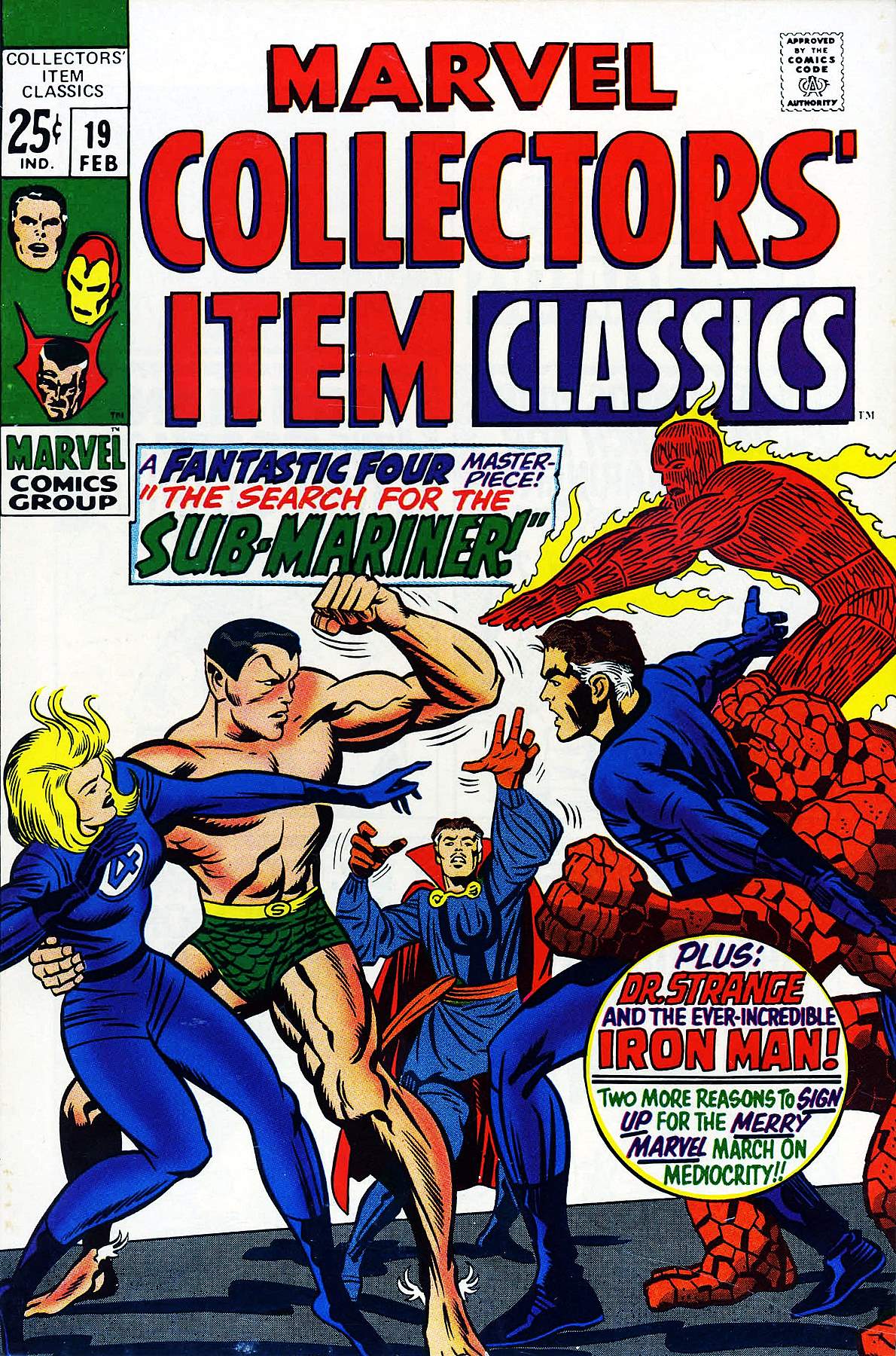


Here’s another book that I picked up on my post-grade school graduation trip to Bush’s Hobbies in Ronkonkoma. I had been slowly filling in a complete run of MARVEL COLLECTORS’ ITEM CLASSICS, the title that eventually changed its name to MARVEL’S GREATEST COMICS and in which the earliest FANTASTIC FOUR stories were reprinted. I wanted to read the stories, and this was a far more affordable way to do so than trying to purchase the actual originals. Plus, it also gave me exposure to classic stories featuring other characters, in this particular issue Iron Man, Doctor Strange and the Watcher. Strangely, I wasn’t as active in picking up the early issues of MARVEL TALES, which was in a similar squarebound format and which contained the earliest adventures of Spider-Man, Thor, the Human Torch and others. The fantastic Four were still my go-to series for Marvel, so that’s where my interests centered.
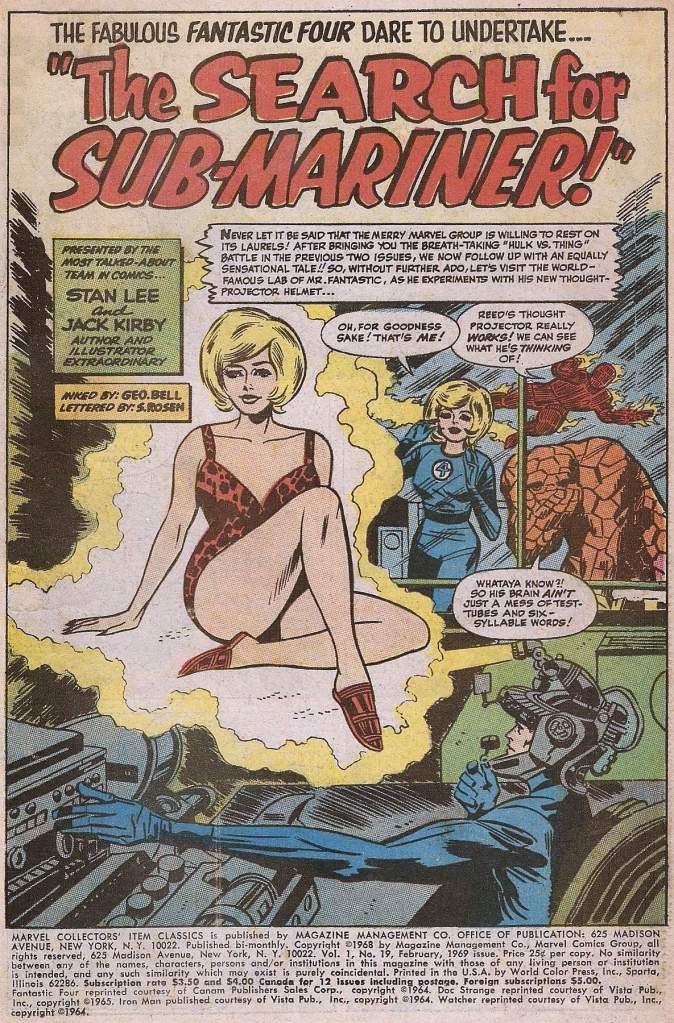
The opening story in this issue came from FANTASTIC FOUR #27 and was the last issue of that series inked by George Bell (operating under the pseudonym of George Bell to throw off his DC editors who might not like him moonlighting for the competition.) Roussos had history going back to the earliest days of Batman, but his inking on these early FF stories was really rough. He did manage to capture something of the raw energy that penciler Jack Kirby was putting down, but his rendering also tended to make pages look a bit muddy and crude. In later years, George would come on staff at Marvel as the firm’s designated cover colorist. Otherwise, this was a fun romp by Stan Lee and Jack Kirby, one that showed them gaining greater confidence and command over the characters they’d created and the evolving world in which they existed.
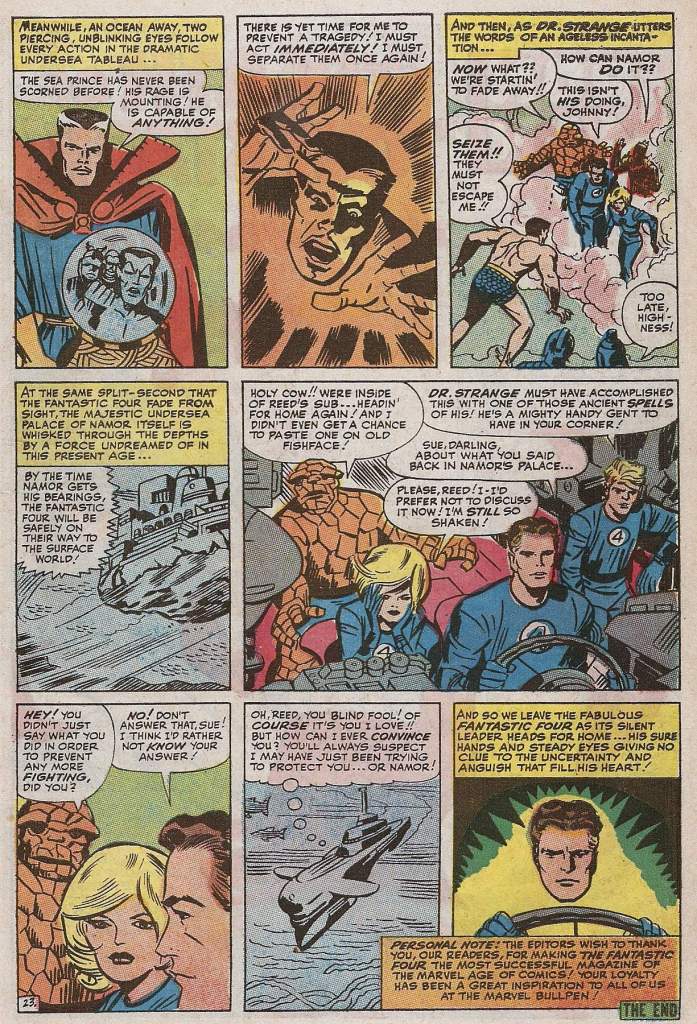
The story is one of significance, bringing to a close the Reed-Sue-Namor romantic triangle that had been running since the Sub-Mariner was revived. Here, Namor spirits Sue away intent on trying to woo her, which leads Reed to storm off on a solo rescue mission to get her back. Ben and Johnny seek out the help of Doctor strange in order to themselves give chase. Much of the story is dedicated to an all-out battle between the Sub-Mariner and Mister Fantastic, well-choreographed by Kirby of course and showcasing that Reed has a lot more fight in him than some give him credit for. At the story’s close, Sue makes her choice perfectly clear–she’s with Reed, not Namor (which hasn’t kept assorted writers over the years from revisiting the Sue/Namor relationship) This paved the way for the eventual wedding of Reed and sue a little bit more than a year later.
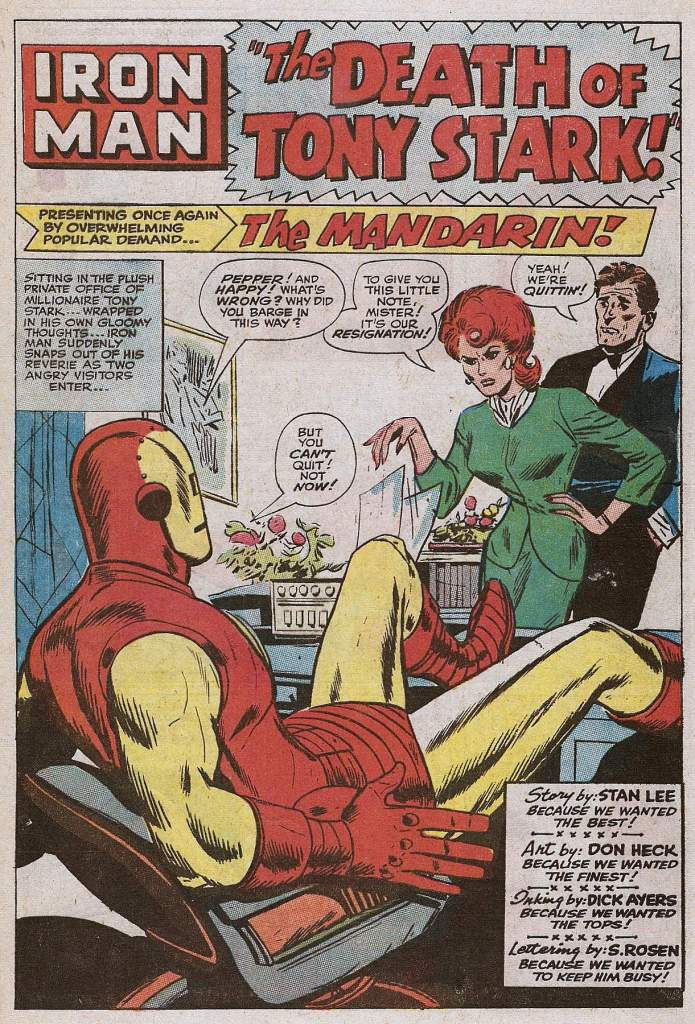
The next story featured Iron Man and was in the middle of an extended multi-part sequence in which Tony Stark was forced to remain in his armor full time to keep his injured heart beating, causing his friends to think that the Armored Avenger has perhaps done away with his employer Stark. This was a tricky sequence for me to follow, both because MARVEL COLLECTORS’ ITEM CLASSICS didn’t reprint all of the chapters in the proper sequence. So it often felt as though I was missing bits, even when I had two contiguous parts. Anyway, by this time, writer Stan Lee had worked out that it was the continuing soap opera elements that helped keep readers coming back, and so he steered into those aspects of the series in a big way. After an initial year-to-18-months in which Iron Man kind of languished as a character, all of a sudden interest in his series started to grow.
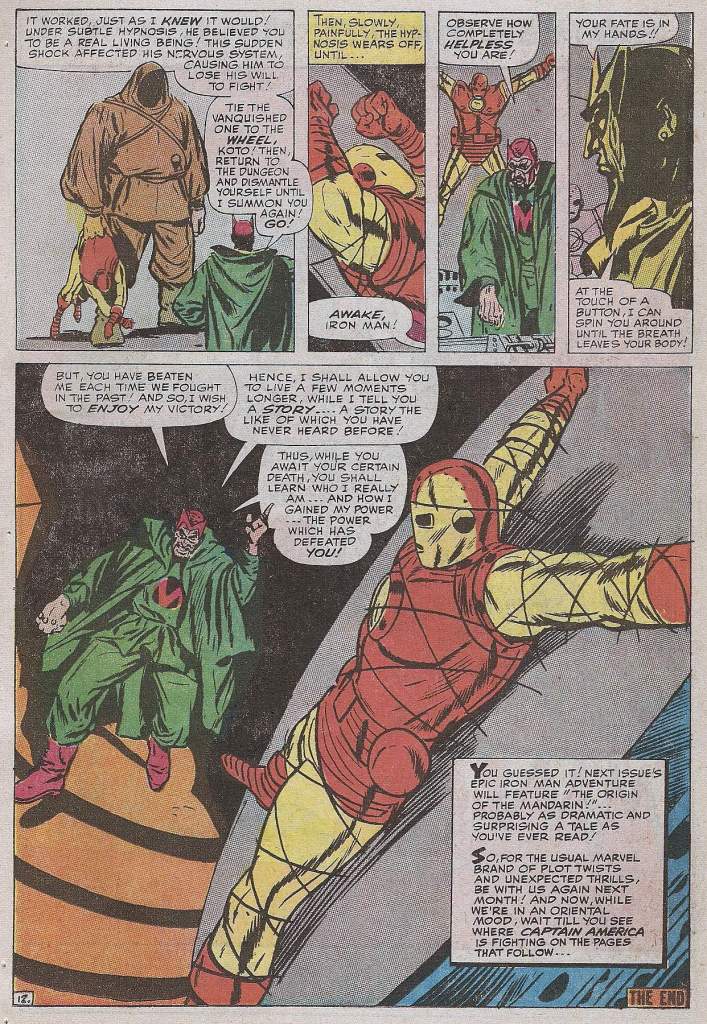
In these efforts, Stan was aided greatly by artist Don Heck, who wound up doing a lot of the plotting as the pair worked “Marvel style.” Heck’s artwork wasn’t as dynamic or exciting as that of Jack Kirby, but he was great at drama and he drew good-looking ladies, so he was able to give Iron Man’s world an attractive sheen. In this story, Iron Man’s old foe the Mandarin takes advantage of the supposed illness of Tony Stark to strike at the industrialist with a deadly ray that destroys the apartment that he was staying in. Fortunately, Iron Man was elsewhere when the ray hit, but now everybody thinks that Stark is really and truly dead. With bigger fish to fry, Iron Man heads behind the Iron Curtain for a showdown with his would-be killer, only to be undone by the Mandarin’s colossal-sized minion. he awakens attached to a giant wheel–a cliffhanger that I remembered dimly from the MARVEL SUPER-HEROES animated cartoon series, which I’d seen some years earlier. In reprinting this story, nobody bothered to change the final blurb, which plugged a Captain America story for the issue of TALES OF SUSPENSE that was the source of this reprint but which wasn’t included in this issue. didn’t mind that, though–I always preferred my reprints untampered with.
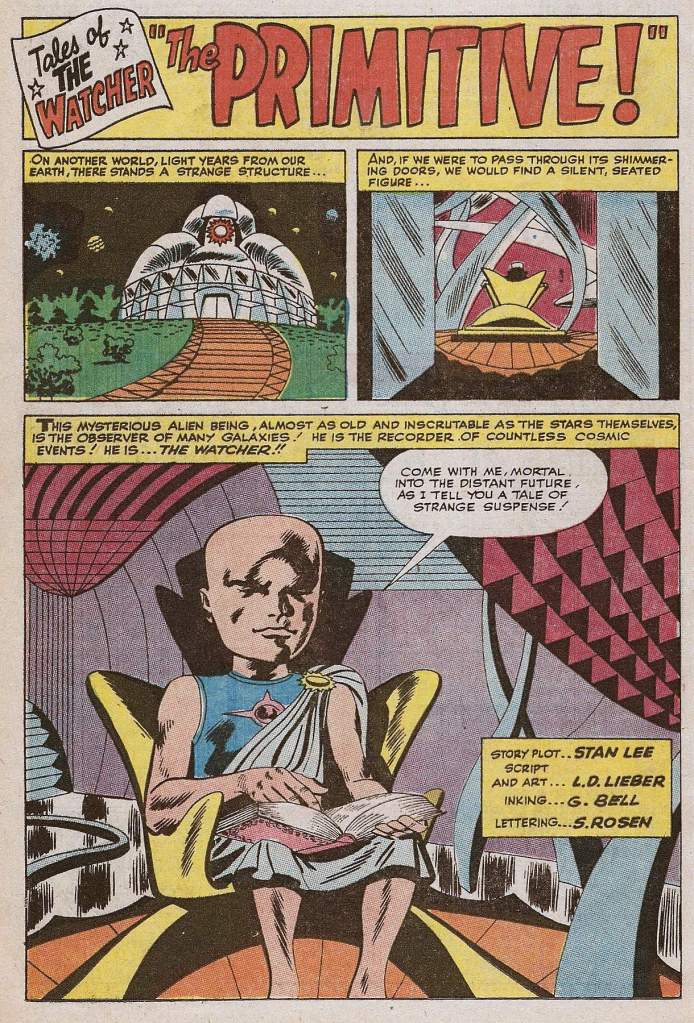
The third story in this issue was a Tale of the Watcher from the short-lived series that used him effectively as a horror host, introducing and narrating one-off fantasy stories of the sort that used to be ubiquitous throughout Marvel’s line. it was both written and illustrated by Larry Lieber, Stan’s younger brother, who worked in and around the Bullpen for a number of decades. It’s about a space explorer who searches the stars desperately for another civilization as advanced as that of humanity. But all he finds is a race of primitives. But had he looked closer, he might have found the ancient plaque that marked the creation of that world’s first Cobalt Anti-Matter Bomb, a weapon so devastating that it wiped out that civilization, reducing them once more to simple primitives. The explorer, having missed this, returns to Earth and gives up his quest, and agrees to go to work for his brother’s Used Aero-Car company. It’s a bit of a blah slog without much of a point or a twist, but hey, they can’t all be classics.
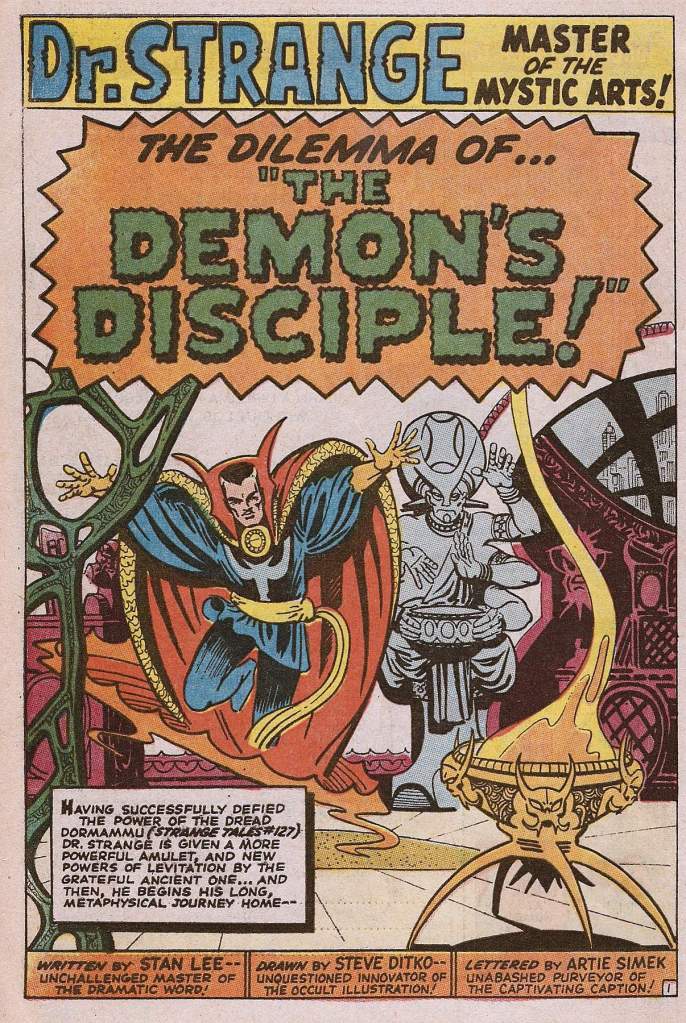
The final story, and the best-looking in this issue, was illustrated by Steve Ditko. It was a self-contained Doctor Strange adventure, one that followed up on the classic Dormammu two-parter that had ended with Strange receiving among other things a new red Cloak of Levitation that made him look a little bit more like a proper super hero. I had previously read this story earlier in the first DOCTOR STRANGE Pocket Books edition.
But it was still nice to get to experience it at full size rather than the reduced pages of that paperback. In it, Doc comes to the aid of the apprentice to a malevolent sorcerer known as the Demon, who wants to split with his master having discovered just how evil the guy is. You would think that the name The Demon might have provided a small clue in that regard. Anyway, Doc cleans the Demon’s clock, showing off the power of his new cloak and amulet in the process. There isn’t much more to it than that, apart from Ditko’s always-evocative mystic artwork.


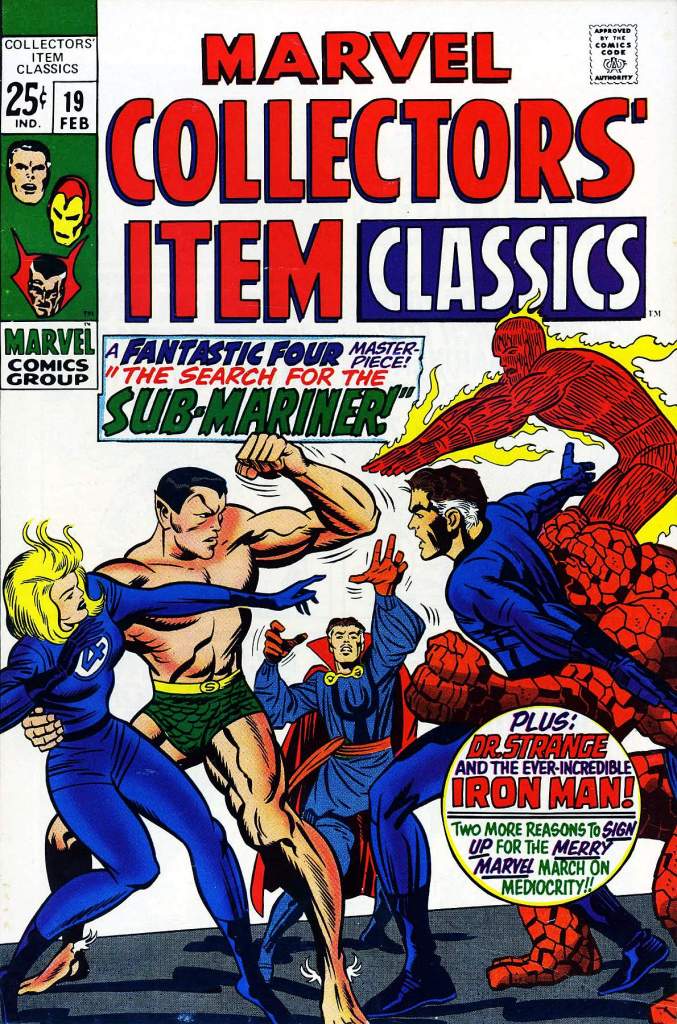
I wonder why Stan Lee had Jack Kirby re-draw the cover of Fantastic Four #27 for this issue, instead of just using the original, which I feel is a stronger image, anyway. More effective coloring on FF #27 cover than on this one, too.
The first page of the FF story has one of Kirby’s rare cheesecake images. I’ve always argued that Kirby could draw beautiful women.
That Doctor Strange splash page by Steve Ditko is gorgeous.
I agree that Don Heck was very underrated, especially when he inked his own pencils. The pages of the Iron Man story shown here look nice. It’s just that, from a modern perspective, the story feels a bit silly in that there’s really no good reason why Iron Man shouldn’t just confide in Pepper and Happy that he’s really Tony Stark.
LikeLiked by 1 person
At this point, Happy and Pepper have only been around for 16 issues — they’re not newcomers, but they’re not yet the longtime friends we think of them as these days — even if they’re the only supporting characters in the strip.
LikeLiked by 2 people
Okay, you must know this stuff like the back of your hand from writing The Iron Age miniseries. Thanks for the information.
LikeLike
One of my first comics was Untold Tales of Spider-Man Annual 97 and I remember being intrigued when Iron Man first appears in the story and mentions how he’s trapped in his own armor. It took a few years before I got the Essential Iron Man to see what he was talking about.
LikeLike
First time I saw Mr. Fantastic’s Thought Projector was in Fantastic Four#250 ( January 1983 ) — read about it in the Fantastic Four Index. I thought “The Death of Tony Stark!” looked familiar, I saw it on The Marvel Super Heroes cartoon too.
LikeLiked by 1 person
The Demon got a name upgrade in Doctor Strange vol.2#56 ( December 1982 ) teamed-up with 2 other Doctor Strange foes ( Adria & Kaecilius ) and was called Demonicus. Steve Ditko drew a different runaway apprentice story in Tales to Astonish#16 ( February 1961 ) fourth story “I Am the Victim of the Sorcerer!” — A bedraggled man wanders through a misty night, unsure of his identity. He is finally forced to return to his prison in a painting where he has been trapped since betraying a sorcerer ( comics.org and profile on marvunapp.com ).
LikeLike
I’ve also wondered if the Devil Incarnate the Defenders battle in #6 wasn’t the Demon giving himself a name upgrade — same sort of over-ambitious loser, similar costume.
LikeLike
Frasersherman the Devil Incarnate is Cyrus Black whose first appearance was Defenders#6 ( June 1973 ) –see marvel.fandom.com.
LikeLike
Marvel Collectors’ Item Classic#3 ( June 1966 ) which reprints FF#4 ( May 1962 –Sub-Mariner first modern appearance. Plus first appearance of Giganto ), Tales of Suspense#40 ( April 1963 — Iron Man’s original armour gets painted gold & fights alien robot and aliens ), Strange Tales#110 ( July 1963 — first appearance of Doctor Strange, Wong, Ancient One, Nightmare and his horse ), Tales of Suspense#49 ( January 1964 — Tales of the Watcher; story of the Sneepers who after watching humanity decides they won’t pose a threat because atomic bomb and cold war will probably lead to their self annihilation ) and The Incredible Hulk#3 ( September 1962 — Rick Jones can control the Hulk but only while awake ). Can’t remember if it was my city or another city I picked it up in or which story ( FF, Doctor Strange, Iron Man or the Hulk ) that made do so.
LikeLiked by 1 person
That is where I first saw the Death of Tony Stark too. Marvel Collectors Item Classics was a great way to read back issues. I remember buying my first one as a kid. On vacation in Oscoda MI. I used to walk through the woods to get to the store to buy comic books. That was always the highlight of the trip.
LikeLiked by 2 people
i hope Namor didn’t lose the fight to Mister Fantastic. I’m fine with Sue staying with Reed. Just not him beating Namor. 🤣
Maybe “N’amor” does mean “no love” as the MCU told us. 😉
LikeLike
That was such a cool arc — Iron Man having to cover for his alter ego’s absence, Pepper and Happy wondering if he’s done away with their boss … and then at the end, Tony announces he was off having a whirlwind engagement he didn’t want anyone to know about.
And the next issue it’s all forgotten. Not even “she broke off the engagement.” I’m guessing Lee and Heck blanked on how to end it but they could still have resolved it better.
LikeLiked by 1 person
Yeah, I get the impression from those Iron Man stories that Stan wasn’t really thinking about them a lot — he completely messed up the scripting a few issues later, writing in an explanation of how the Dream-Maker was really Count Nefaria, when Nefaria actually showed up the following issue, and Stan had just confused the two.
This makes me wonder if Stan was the guy behind the soap opera plotting or if that was virtually all Don Heck, too — and once the plot was resolved, Don may have expected Stan to continue referencing the aftermath in dialogue, and Stan just forgot about anything that wasn’t in the border notes.
LikeLiked by 2 people
That’s a plausible theory.
LikeLike
Nefaria’s skills as the Dream Maker make a call back in his most important appearance. He tricks Powerman with an illusion in Avengers 164.
But… yeah.. the brief ID change in Tales of Suspense is sloppy. It’s also a comic trope of choosing a less cooler name ala Kilgrave: the Purple man.
LikeLike
I love that splash page. It’s a good visual, a good way to re-establish that Reed loves Sue, and it’s funny, besides. Good thing Reed’s thoughts of Sue are G-rated, though!
And I like Roussos’s inks. They’re rough, but going back to the Meskin days, that was a workable approach, and it’s got punch.
Can’t argue that Sinnott’s not better, but given a choice between Roussos and Colletta I’d take Roussos any day.
LikeLiked by 1 person
My very first comic was a Marvel Collectors’ Item Classic! Like Tom, the cover to mine was also mangled – although for reasons I’ll never recall.
In terms of this issue, I don’t mind Roussos’s inks on the FF story as it gives the book a fun, rather quirky appearance that would end once Sinnott took over. (And yes, good thing the Comics Code Authority had control over that thought image of Sue!)
As for the Iron Man story, while I’ll never be a big fan of Don Heck (don’t hate me!), it would seem this story plays more to his strengths as an artist. I would also agree that it seemed my favorite hero was not a top priority of Stan’s in terms of the writing with all the inconsistencies. I also have to confess that I don’t mind those dorky rivets on Iron Man’s face mask from that era.
And you just can never go wrong with Dr. Strange drawn by Steve Ditko.
LikeLike
Heck seemed to struggle with the scalloped pointy helmet that Ditko introduced. I presume Heck brought the rivets back to make the suit look more like armor when he eliminated the scalloped mask. Unfortunately… it didn’t leave a hard line for the colorist to trap so the red and the yellow on the helmet looked inconsistent and sloppy until the hard line widow’s peak replaced the rivets in issue 66…. though I think Kirby was drawing the helmet with the hard line widow’s peak on the covers prior to that.
With the exception of the mid-70’s nose the suit stayed pretty much the same until the mid 80’s.
LikeLiked by 1 person
I write a blog with reviews of 70’s Iron Man and just prepared a future post on his 60’s armors, noting the variations from Ditko’s initial revision. I like how you’ve noted the struggles presented by those changes. I also agree that once they landed on that smoother look with TOS 66, it stayed pretty consistent until that dreadful nose in IM #68.
LikeLike
The Nose was worth it for the hysterical behind the scenes reason for its debut!
LikeLiked by 1 person
The nose is dumb… but since he had it on the the first issue of Ironman I ever read it never bothered me much.
Years ago I had a conversation with Dave Cockrum and he said the key to making the nose work was adding a brow and that his Ironman was inspired by The Colossus of New York.
LikeLiked by 2 people
That’s wild, David. Dave Cockrum became my favorite Iron Man artist not only because of how he captured that metal suit, but also because he made that awful nose work. Fascinating to know how he did it. And yes, Steve, the backstory to that nose is remarkable.
LikeLike