

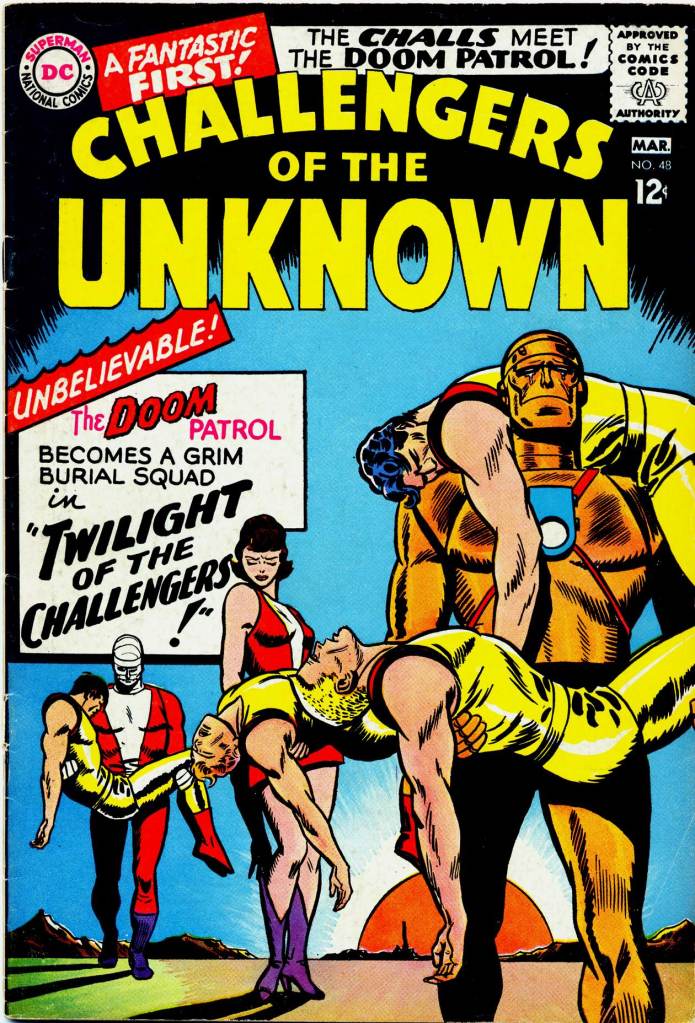
Every time that I’d gone to Ed’s Coins and Stamps in the Sun-Vet Mall, I had availed myself of their back issues of DOOM PATROL. They had an extensive run of issues, and I had started out by buying #100 and continuing forward chronologically. But the next issue of DOOM PATROL that I was to purchase, #102, was the second half of a cross-series crossover with CHALLENGERS OF THE UNKNOWN. Being flush with cash from my 6th grade graduation, I bought both issues, since Ed had the Challs book in his boxes as well. I’d read a couple of modern day Challengers stories, but I wasn’t particularly enamored of them. They lacked that extra something that DC’s super heroes had in terms of powers and color and personality. But still, they were a mainstay all throughout the Silver Age.
CHALLENGERS OF THE UNKNOWN had apparently been the brainchild of Jack Kirby and Joe Simon in the final days of their partnership. When the two men split up, they divided their remaining assets, and Jack got custody of the Challengers concept. He thereafter sold the strip to DC, where it debuted in the pages of SHOWCASE #6. In short order, and in no small part due to Jack’s growing prowess as an artist, it graduated to its own series, the first strip launched in SHOWCASE to do so. It also inspired a bevy of imitations–DC was rife with similar four-person teams of human explorers, including the Sea Devils, Rip Hunter and his time masters, the Suicide Squad, Cave Carson and his underground crew, and a couple of others. And the Fantastic Four, introduced by Kirby a short time later, were little more than the Challengers with super-powers and more sharply defined personalities.
Kirby had left CHALLENGERS with issue #8 after having had a legal tussle with one of DC’s editors. In his place, the strip was handed to artist Bob Brown. Brown was a solid craftsman, but didn’t have the same manner of visual imagination that Kirby possessed. The stories, too, by such DC stalwarts as Ed Herron and Bill Finger, began to skew more in the direction of the rest of the line, becoming more lightweight and formulaic. Eventually, Arnold Drake shook out as the more-or-less permanent writer of the series, but by 1966, he and everybody else at DC was being heavily influenced by the success of the live action Batman TV show as well as the growing success of Marvel. So the scripts became more overtly daffy, the situations more over-the-top, and the vibe of the series started to feel just this side of camp. This was the state of play at the time of this particular crossover.
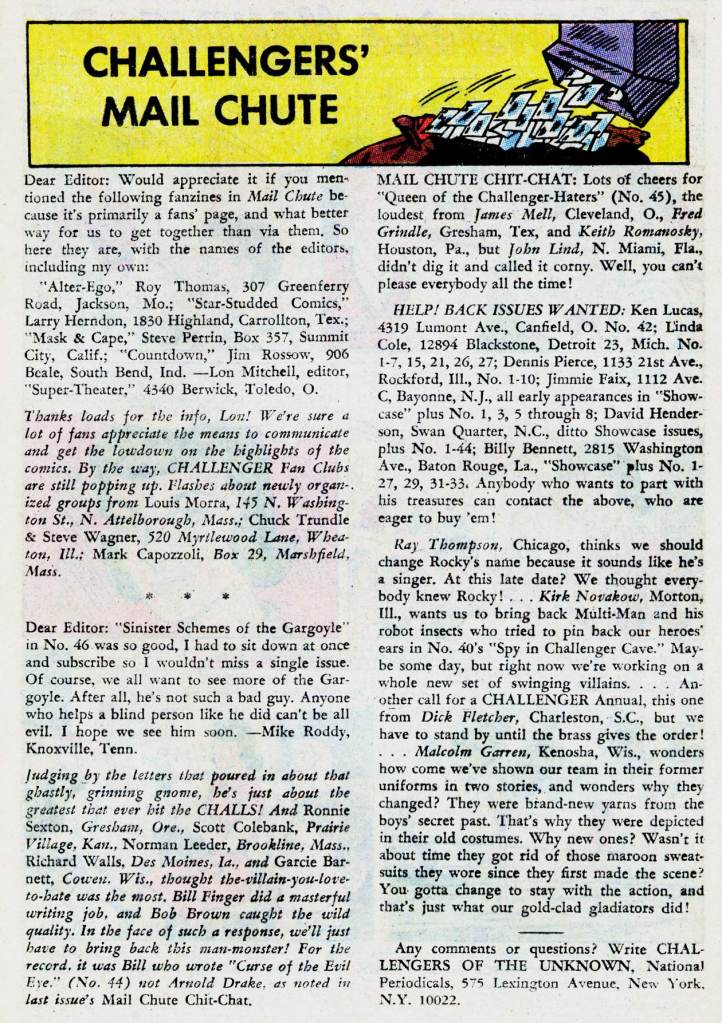
A quick pause at this point for the Challengers’ Mail Chute letters page. Editor Murray Boltinoff had a different approach to his letters pages than the rest of DC’s editors. Rather than simply running a batch of letters and responding to them, Murray tended to print excerpts from a wider amount of the fan mail he’d received. he also set up trading departments, where his readership could swap back issues with one another. In this particular page, he prints a letter giving a call-out to several of the more prominent comic book fanzines of the day, including Alter Ego by Roy Thomas. Roy would soon after have a short two-week career as a DC assistant editor before switching over to rival Marvel, where he made his bones.
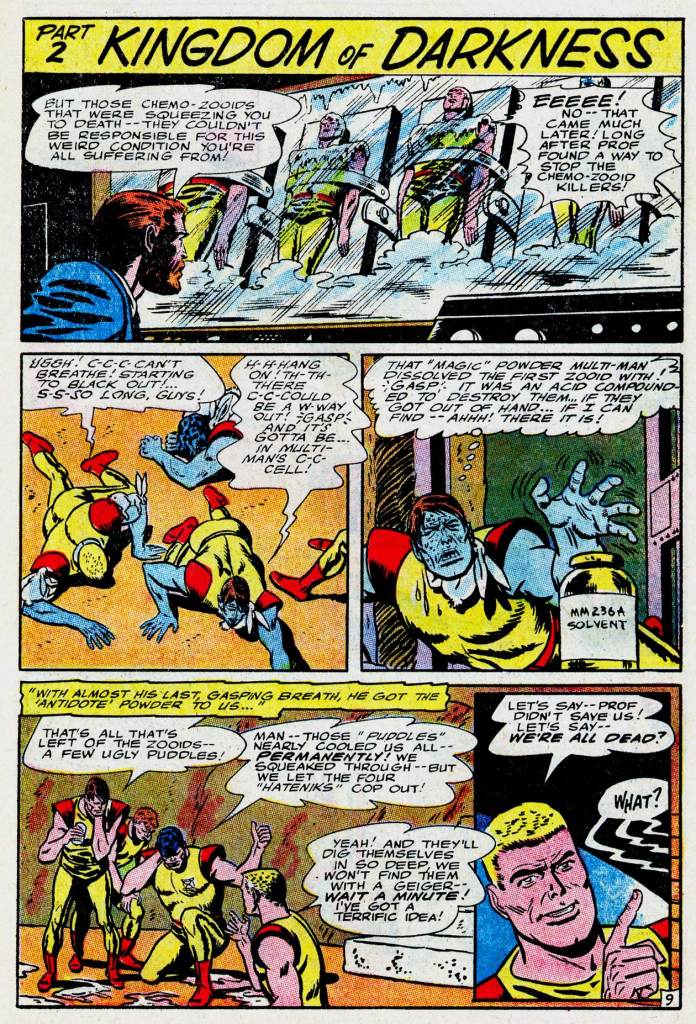
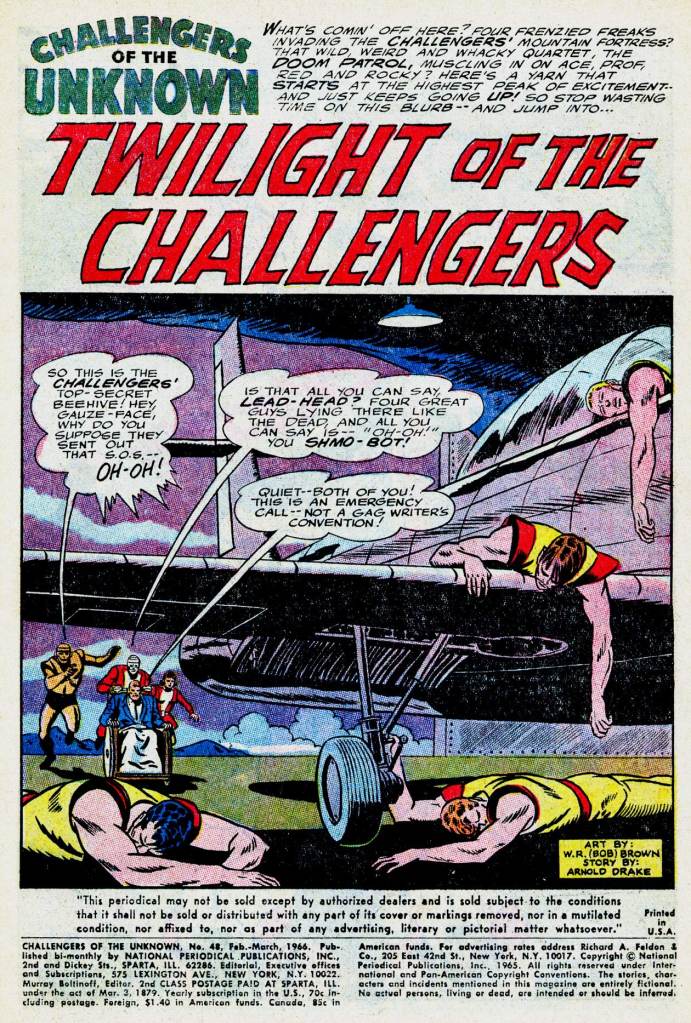
This particular crossover was the very first cross-title crossover of the Silver Age. Marvel had toyed with such a thing but hadn’t quite yet pulled the trigger on it. And there had been some cross-book stories in the Golden Age. But Arnold Drake beat everybody else of the period to the punch, uniting the casts of his two regular strips. At the end of this month’s issue of DOOM PATROL, the DP had received an urgent SOS from the Challengers. As this story opens, the heroic freaks have made their way to the Challs’ mountain headquarters, where they find the team on the verge of death. The Chief of the Patrol is able to put the Challs into suspended animation in a “Life Cabinet” at Patrol headquarters. What’s more, he’s able to make contact with Ace Morgan’s slumbering form to find out just how the death-cheaters got themselves into such a state.
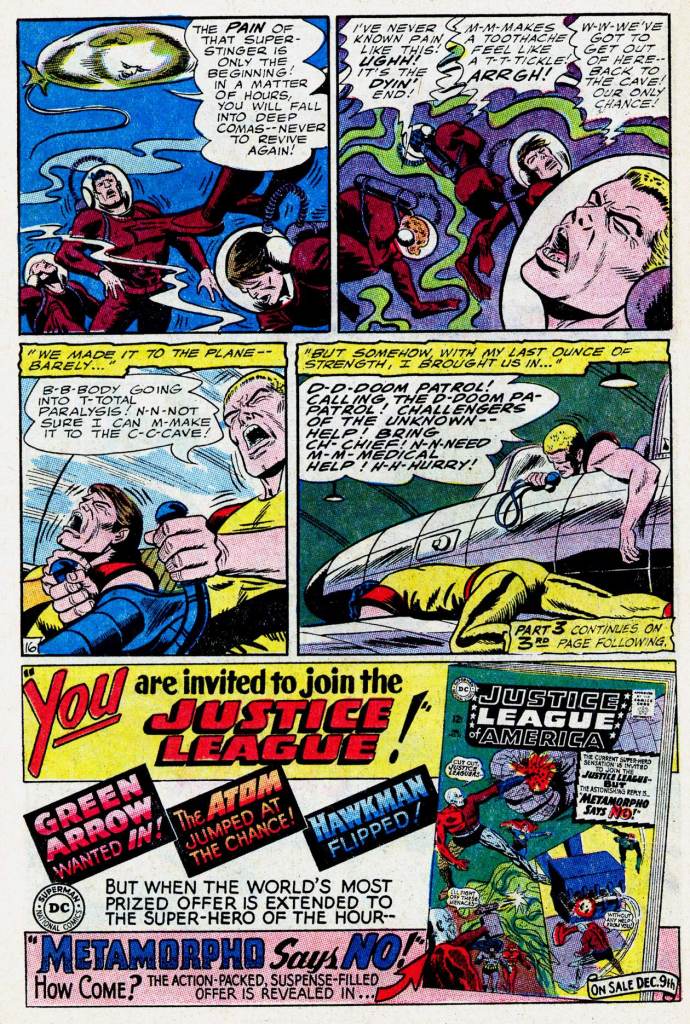
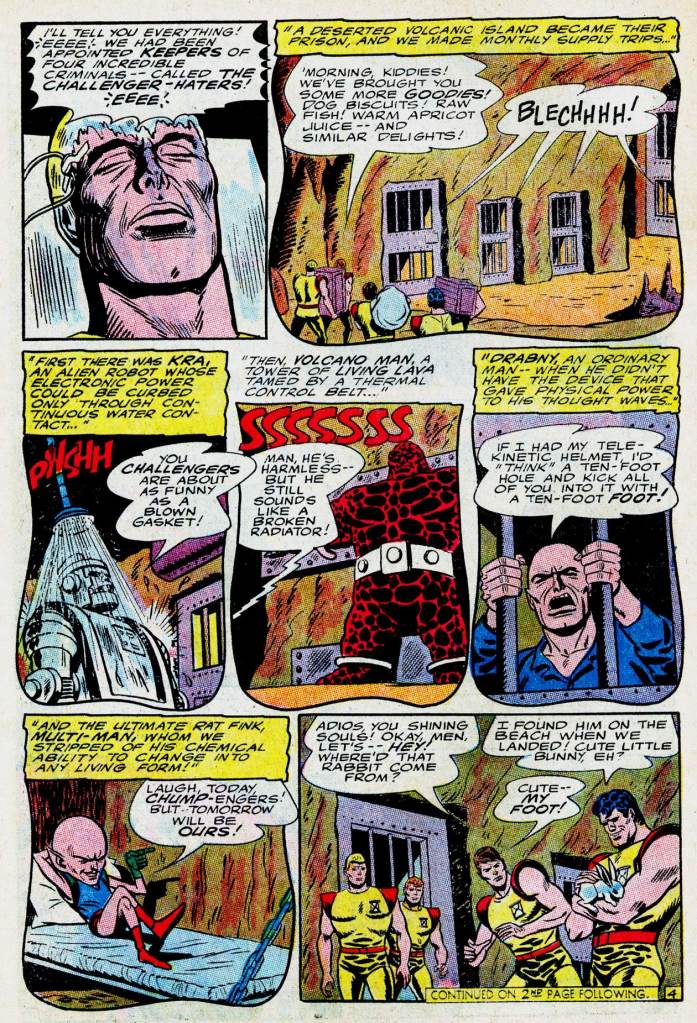
Ace tells the Chief that a quartet of the team’s greatest foes, whom they’d had incarcerated in their mountain headquarters, were able to escape custody, almost killing the Challengers in the process. These villains were united as the Challenger-Haters; the shape-changing Multi-Man, Kra the mechanoid, Volcano Man (who is pretty self-explanatory) and Drabny, who once possessed a helmet that gave him mind over matter powers. The Challs were able to save themselves, but allowed the world to think them dead in order to flush out the Haters. (Which raises the question: if the Challs were reported dead, why weren’t the DP surprised to get their distress call?) Multi-Man had gone ahead with a scheme for the group to dominate the oceans, and from there the world, but the Challs showed up alive to intercede. But after a pitched battle, the Challs were struck down by Multi-Man in the form of a gigantic jellyfish. With the last of their strength, the challengers retreated to HQ, and before they all fell into deadly comas, Ace was able to send the SOS that the Doom Patrol responded to.
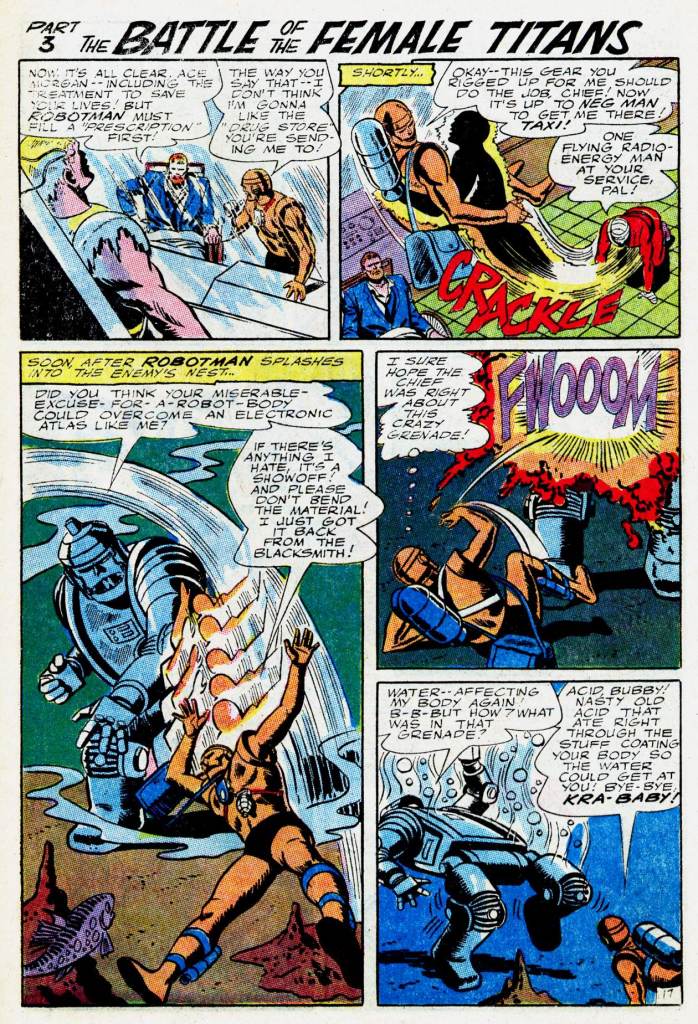
At this point, the chief has all of the information he needs to diagnose the Challengers’ condition. He dispatches Robotman to engage the Challenger-Haters and to bring back what he’ll need to whip up an antidote: a piece of the stinger-tail of the Multi-Man jellyfish. Cliff Steele is able to retrieve the necessary chunk of tail, and from it the Chief is able to synthesize a solution that gets the Challs back on their feet. The Haters, meanwhile, realizing that they’re now facing two teams of enemies, decide to pack up and leave their hidden base behind, but not before booby-trapping it to kill anybody who might find it. But it’s Drabny who winds up on the receiving end of the fatal explosion when he accidentally sets off the booby trap himself. Oops. The remaining Haters–including now a colossal robotic woman that Multi-Man has constructed and named Multi-Woman–salute their fallen comrade despite his errant stupidity.
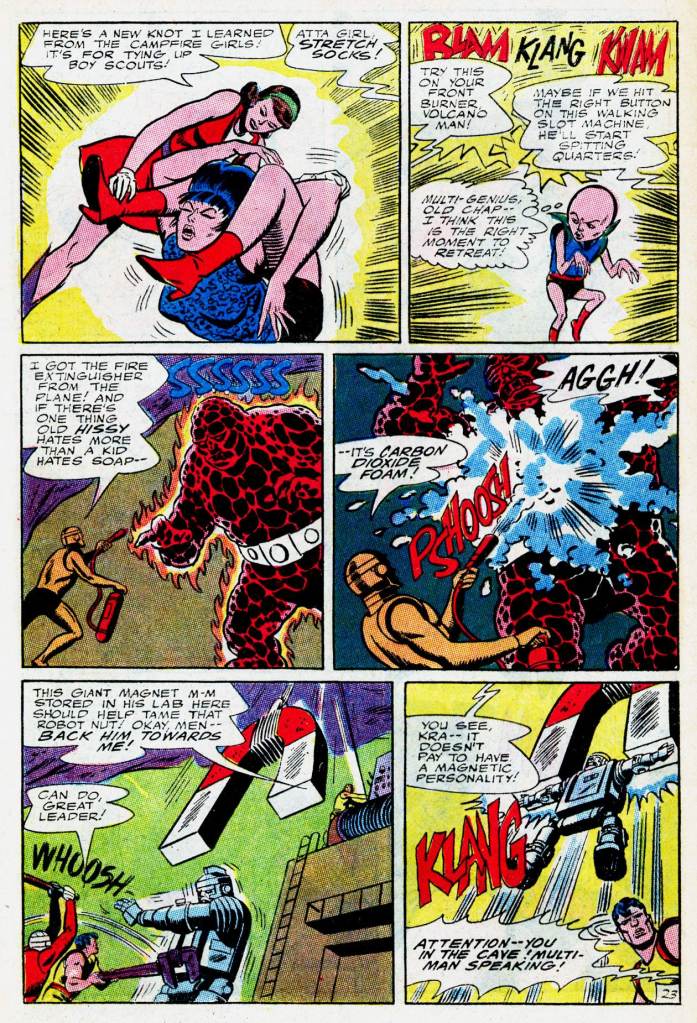
But we’re almost to the end of the first part of tis crossover, so it’s now time for a big Marvel-style slobberknocker. The Challs and the Doom Patrol locate the Haters in their new temporary digs and the battle is joined. Elasti-Girl expands to giant-size to go one-on-one with Multi-Woman while her teammates aid Prof, Rocky, Red and Ace against the remaining Haters. As chaos reins, there’s an absolutely hysterical panel of Multi-Man daintily tiptoing away from the battle, running off to save himself. But he’s actually better than that–he gets the drop on the wheelchair-bound Chief and uses him as a bargaining chip to force the assembled heroes to allow the Haters to get away scot free.
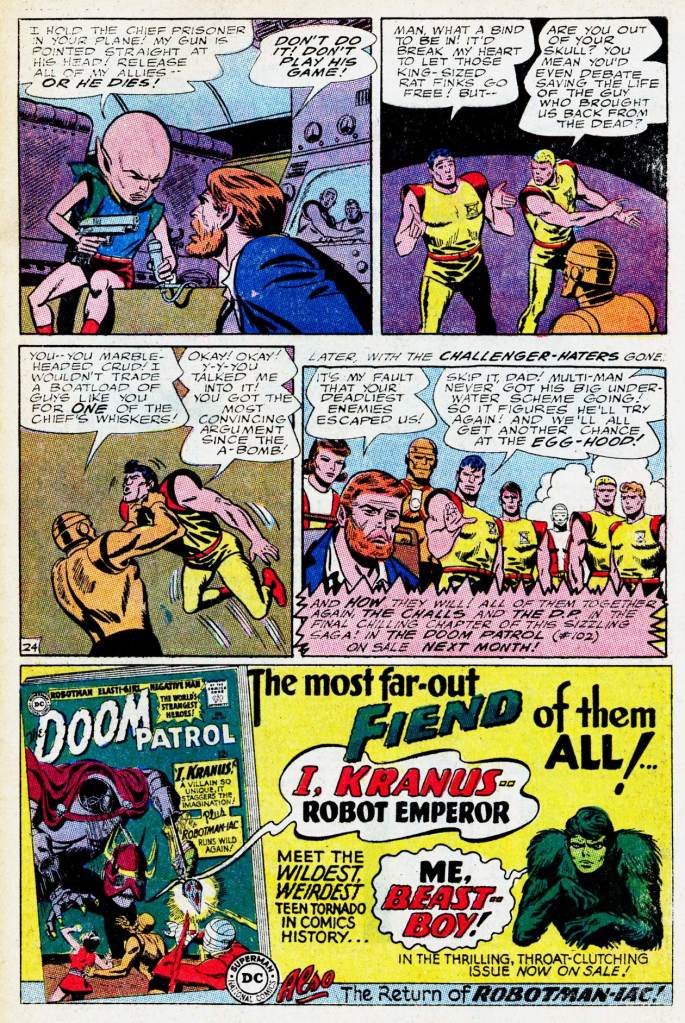
But of course, this is merely the first part, and so a blurb tells readers to pick up the story in DOOM PATROL #102 in a few weeks. The story was fun, but the dialogue is trying just a bit to hard to be hip and zippy in a Stan Lee manner. Writer Drake was one of the few who was paying enough attention to what Marvel was doing that was catching on to get it, but in this camp-influenced period, he dialed up the jazz a bit too much, to the point where all of the characters sounded very much alike, making the same sorts of corny jokes while they fought and declaimed. The series definitely had a vibe, but it was a far cry from the more serious-minded early days of the strip.
 The Tom Brevoort Experience
I love that their arch-enemies are literally called “The League of Challenger-Haters”. That’s even more on-the-nose than The Superman Revenge Squad. And that panel of Multi-Man gingerly sneaking away is hilarious.
LikeLiked by 1 person
”Challenger-Haters” is so very junior high school, and not in a good way. It’s just so petulant — and impotently petulant at that, since we know they will never triumph, so they’re defining themselves as losers. “We lost to the Challs, we’re mad about it and we can’t get over it! Ooo, we hate them!”
Like you say, even more on the nose than the Superman Revenge Squad, which is also loser-y but more dramatic.
But hey, what better name for a group made up of Multi-Man, Kra the Mechanoid, Volcano Man…and Drabny? It sounds like a parody already.
At least they didn’t have to fight giant sponges, like the Sea Devils.
LikeLike
I don’t disagree with you. But, as a real-life case, a decidedly older than junior high school group against Harlan Ellison did call itself “Enemies of Ellison”. I guess that’s better than “The League of Ellison-Haters” or “The Ellison Revenge Squad”, but same idea.
LikeLike
Also losers.
LikeLiked by 1 person
Of course, the Revenge Squad has the additional embarrassment that they started out as the SuperBOY Revenge Squad. You can imagine the awkward meetings that took place after Clark’s 18th birthday.
“Our spies indicate that the Kryptonian has reached full maturity. You know what that means…”
“Time to print new business cards?”
LikeLiked by 1 person
And not only did the name change tell the universe they’d been losers for years, the original name had said that they’d all been beaten by a child.
LikeLike
Believe it or not, an uncredited writer gave us, in TOMAHWAK #54 (1958), “the League of Tomahawk Haters.”
LikeLike
I know young me had no problems with 4 non-powered guys on TV ( The A-Team —- I love it when a plan comes together ), but would he have enjoyed the Challengers of the Unknown even if Jack Kirby stayed with them? I know I enjoyed John Byrne’s non-powered “Fantastic Four” [ What If?#36 ( December 1982 ) first story ] and wanted to see more of them. Plus enjoyed the mostly non-powered Challengers of the Fantastic [Challengers of the Fantastic#1 ( June 1997 ) — thought the Four-Armed Thing looked cool. Sue as a SHIELD Agent, that was cool too ].
LikeLiked by 1 person
Instead of creating Volcano Man as a foe of the Challengers they should have used Jack Kirby’s Volcano Men [ Tales of the Unexpected#22 ( February 1958 ) last story — Invasion of the Volcano Men ( seen on the cover — comics.org ) — they look better ].
LikeLike
Interesting that Boltinoff was good with readers exchanging back-issues. Makes sense for readers, and is admirable. The Sales department must’ve been less “aggressive” than in recent times. Sales is the life-blood of any for-profit business. I guess that’s one reason we stopped seeing anyone promoting readers’ exchanging comics in letters pages. And then the letters pages have been pretty much extinct.
I liked the Justice League ad. Surprised they revealed the outcome. I guess his reasons for declining and the way it would be told would still be enticing enough to lure readers in? I’d still buy the issue. But would it have been as effective for sales if the ad left it as, “Will He Join?”
Notably, he’d eventually (15-20 years later?) join another JLA-decliner, Black Lightning, in Batman’s Outsiders.
LikeLike
That was my first encounter with Metamorpho. As I’d buy JLA in that era any time I had the money, it didn’t influence me in buying that one.
LikeLiked by 1 person
IIRC, Julius Schwartz was told that Metamorpho was popular, put him in a JLA issue, but he was adamant the character didn’t fit. So perhaps the title was Schwartz re-emphasizing his viewpoint.
LikeLiked by 1 person
The reason lettercolumns disappeared has nothing to do with sales departments. Readers sent in fewer and fewer letters, because they could air their thoughts online, so it became harder to do lettercolumns. And the Post Office regulation that had required a text piece in comics in order to qualify for the subscription mailing permit had vanished long ago by then, so they petered out.
Since publishers didn’t lose any money if fans swapped old comics, since they didn’t sell back issues or TPBs or subscriptions to online libraries, their sales people would have had no reason to discourage lending and swapping. Indeed, they included estimated “pass-along readership” in their circulation for ad sales, so they had reason to encourage it.
Murray was simply an editor willing to fill his column that way. I would assume he thought that the more fans’ names he printed and engaged with, the more fans would want to get his books to see if they’d been included. The excerpt style got more names in an the swapping fostered more direct engagement.
LikeLiked by 1 person
Thanks, Kurt! Your second paragraph answered my question.
Your first paragraph was a reply to a point I didn’t intend to make. I didn’t mean to imply DC’s Sales team was responsible for the letters pages disappearing.
I should’ve split my paragraph in where I (admittedly, wrongly) went from thinking the Sales dept wouldn’t want encourage letter writers to swap back issues, to then just closing the paragraph with the separate fact that letters pages went away.
I was somewhere in my mid to late 20’s when online message boards took over. There still continued to be letters pages for some years after that. Til maybe the early 2000’s?
And Ive seen a few pop up over the last few years. I’d always figured letters pages were up to the editorial dept. Likely each individual group or series editor.
LikeLike
There’s a great moment after Rocky starts petting that rabbit where he learns it’s toxic and Multi-Man gives the Challs a “free us or he dies speech.” Rocky demands they amputate his arm instead; one of his buddies decks him (“I couldn’t have done that if you had both arms.”) and lets the villains out. The kind of thing that made me love Drake’s work on this and DP.
LikeLiked by 1 person
I remember this issue, but don’t think I ever read the conclusion–I was still young enough to be terrified by the killer rabbits.
LikeLike
Yellow uniforms. Rarely a good look.
LikeLike
These days, they are up to the editor, yeah. If it’s a book that still gets enough letters.
LikeLike