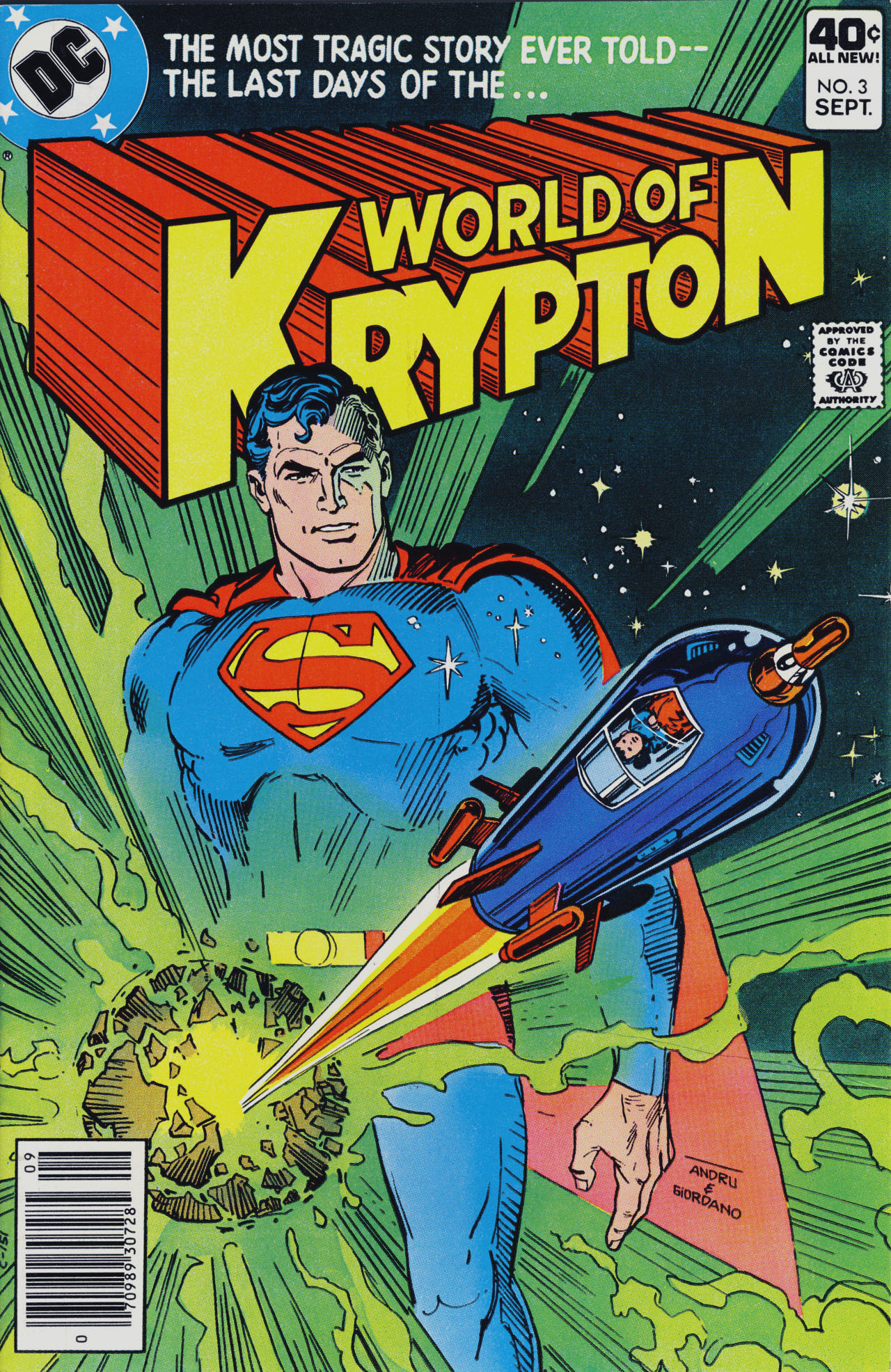


Another benefit to my new comic-buying locale, the Stationery Store in the new supermarket mall, was that it also carried all of the limited series that started to appear at this time. Inspired by the television success of projects such as ROOTS, which aired for a limited span of time and was promoted as a big event, first DC and then Marvel began issuing short-run series of three or four issues, self-contained stories that were intended to end at a predetermined time rather than go on indefinitely as all comic book releases at this point were pretty much intended to. The first of DC’s limited series was WORLD OF KRYPTON, dedicated to the backstory of the Man of Steel, and created in response to the hugely-popular SUPERMAN THE MOVIE. I never saw copies of the first two issues, but #3 was there waiting for me at the new outlet, so I bought it.
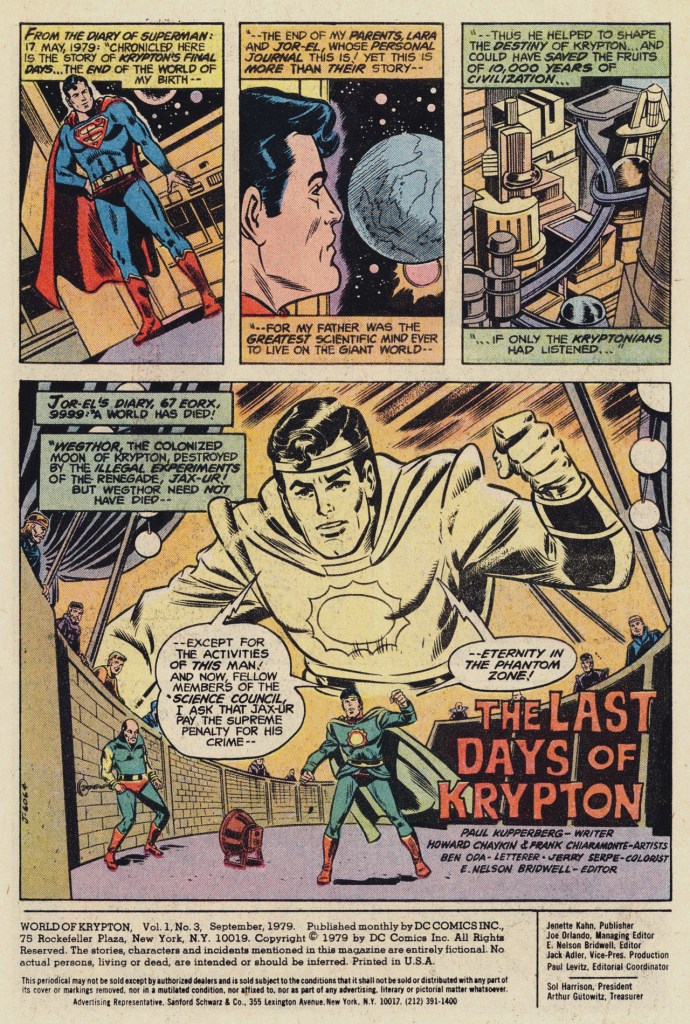
WORLD OF KRYPTON was edited by E. Nelson Bridwell, and while I don’t know this with any certainty, it certainly feels like a project he would have initiated. Nelson had an encyclopedic memory for old comic book stories and had become the defacto keeper of Superman’s lore. So while the book was produced by Paul Kupperberg and Howard Chaykin, I have to expect that much of the research and even the outlining itself (of what specific events from older stories he wanted covered) came from Nelson. Initially, the three issues of WORLD OF KRYPTON were intended to run in SHOWCASE, DC’s stories try-out series. But after SHOWCASE was binned in the DC Implosion, the choice was made to release these books anyway as a limited series.
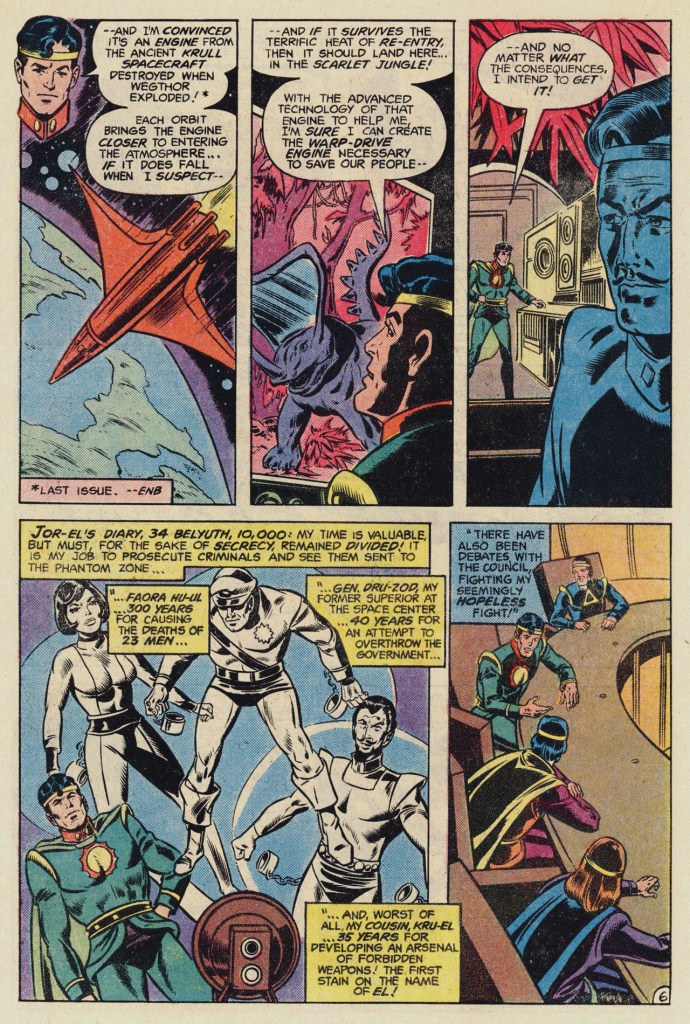
As a story, this issue of WORLD OF KRYPTON plays a lot more like an entry in the OFFICIAL HANDBOOK OF THE MARVEL UNIVERSE. While it attempts to couch everything with some degree of dramatics, it’s more concerned with imparting (fictitious) factual information than it is in delivering an exciting adventure. As such, I found the book pretty dull. Howard Chaykin may have felt similarly, as his storytelling for this issue is relatively wooden and lifeless, a far cry from what he was capable of. Of course, his pages were being finished by Julie Schwartz-office stalwart inker Frank Chiaramonte, which had the effect of trying to make the art look as though Curt Swan had drawn it. It doesn’t really work, to be honest. And story-wise, the issue lurches from one bit of nonsense business to the next, as the creators attempt to reconcile a number of individual flashbacks that had been shown to Krypton before its demise all of which were presented in a vacuum as far as the others were concerned. All lined up in this fashion, the narrative is a bit of a mess.
This final issue of the limited series focuses on the activities of Superman’s father, the scientist Jor-El, in the weeks and months leading up to Krypton’s destruction. The Man of Steel is reviewing his father’s recently-recovered personal journal in the present, which provides a rationale for revisiting these events. The book opens with the sentencing of Jax-Ur, a Kryptonian criminal who would later return to plague Superman, to the ethereal Phantom Zone for the crime of destroying one of Krypton’s moons. Jor-El had discovered the Phantom Zone and invented the technology that made it possible for the State to deposit its criminal element into it, where they’d exist as insubstantial phantoms unable to interact with the tangible world. With Jax-Ur’s sentence carried out, the Science Council moves on to its next item of business: a resolution to ban all space travel on Krypton.
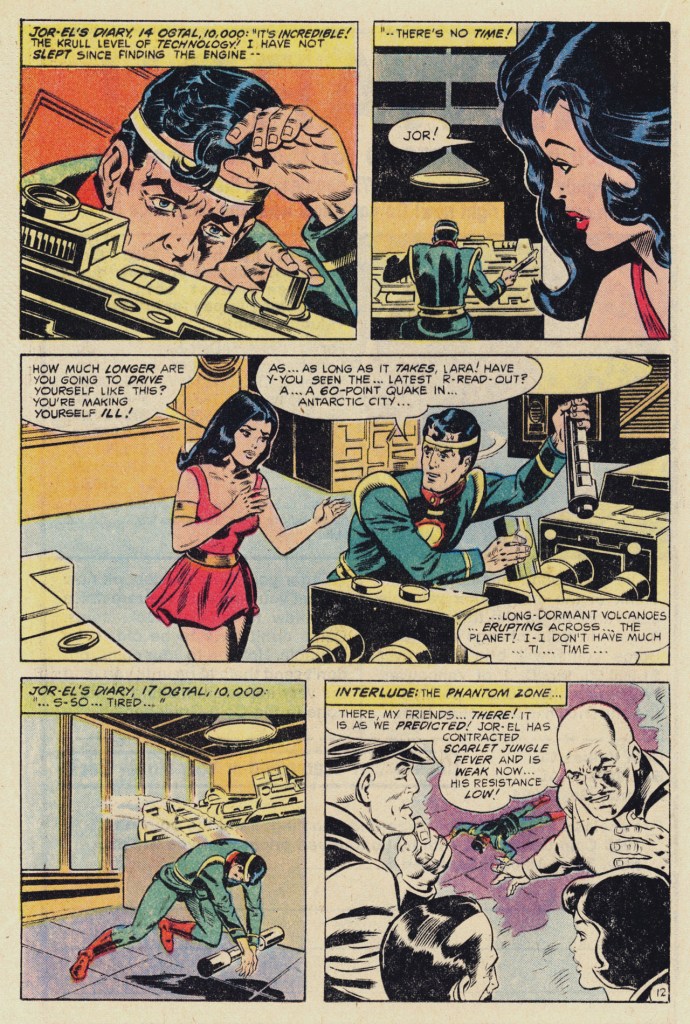
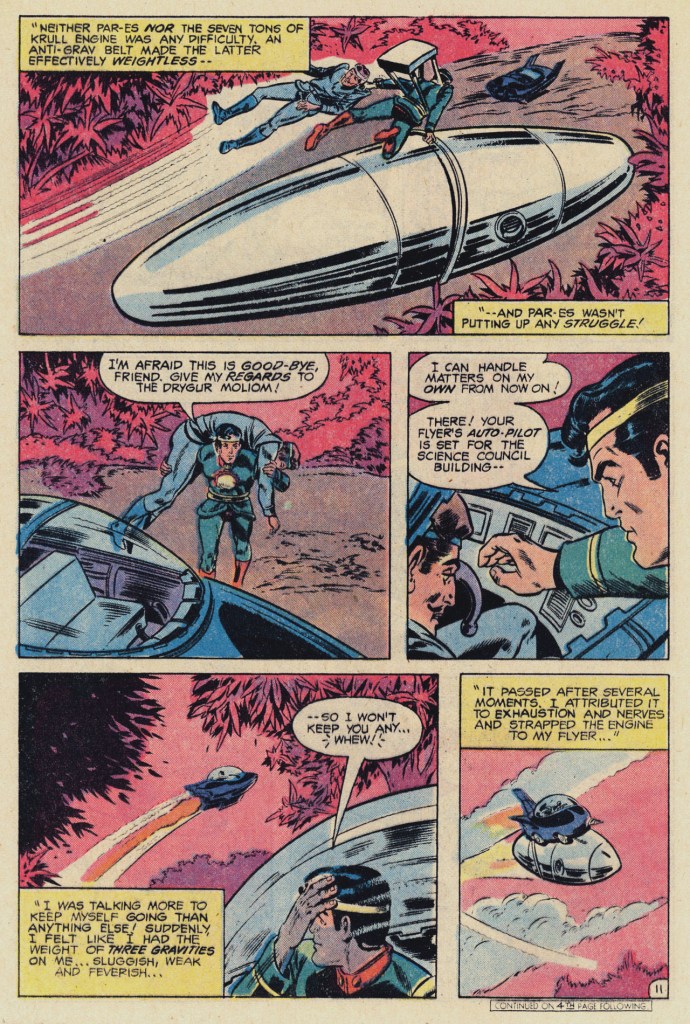
Jor-El, of course, argues against this resolution–it’s his belief that Krypton is growing ever more unstable and may soon explode, dooming them all. But the Science Council doesn’t pay heed to Jor-El’s “crackpot” theories and the resolution is passed with only Jor-El himself abstaining from making the vote unanimous. With the Science Council’s ruling in place, Jor-El cannot continue his experiments in creating a warp drive outwardly. So he’s forced to be secretive as he journeys into Krypton’s Scarlet Jungle in the hopes of retrieving a fallen Krull spacecraft whose engine design might help the scientist to perfect his own theories. Jor-El manages to retrieve the engine, despite having to dodge the watchful eyes of Par-Es, who has been tasked with surveilling him. But while there, he’s also caught a debilitating case of Scarlet Fever, a disease originating in that region.
But Jor-El knows that time is short, so even while sick, he continues to work. In rapid succession, we see him test his engine design, with his son’s dog Krypto as the passenger. He’s also called upon to help out Lar Gand, a space traveler who has found his way to Krypton and whom Superboy in later years will dub Mon-El. As Jor-El grows sicker, the Phantom Zone criminals take advantage of his debilitated mental state. Combining their telepathic abilities–because that’s the manner in which the Zone’s inhabitants communicate with one another–they attempt to force Jor-El to use his Phantom Zone projector to liberate them from captivity. Fortunately, Lara is able to waylay her husband before he can activate the device and rematerialize the criminals.
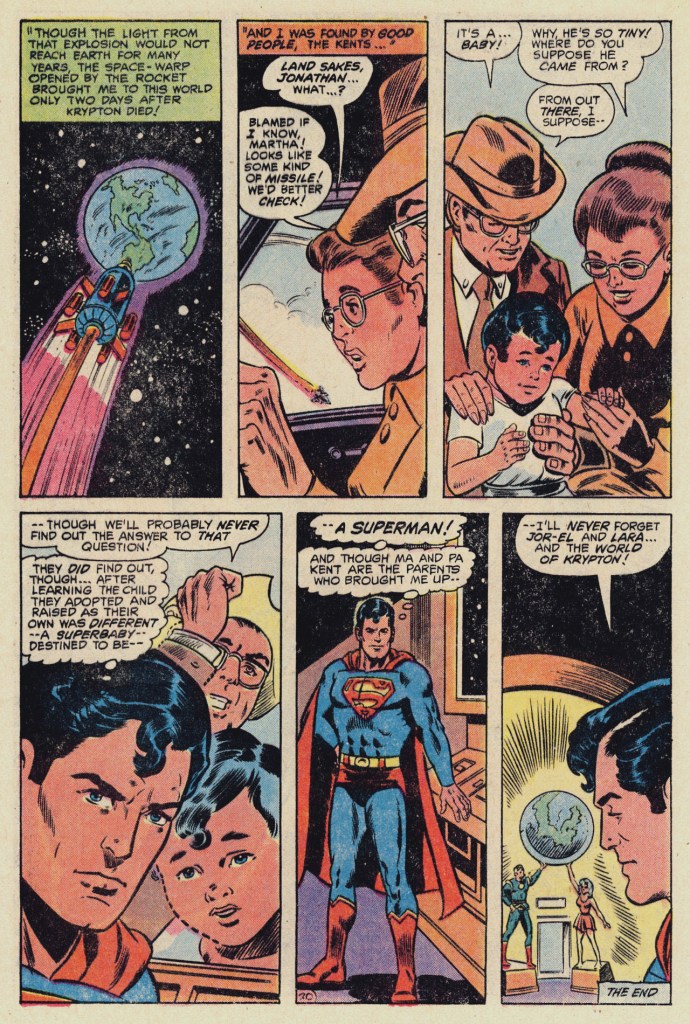
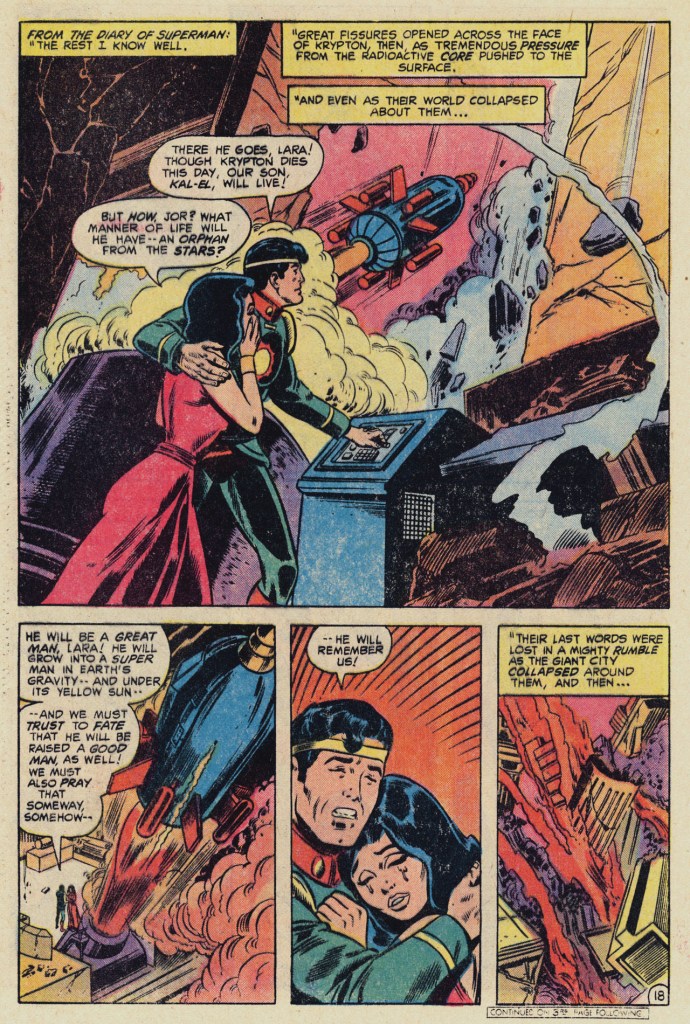
But finally, the story reaches the moment of truth. Jor-El loads up his son Kal-El into his prototype rocket ship (in which the monkey Beppo stows away, insuring that he’ll be around to become a Super-Monkey in later stories) and launches him through space towards far-off Earth. The ship’s warp drive enables it to make the journey in two days, but also punches a wormhole in space through which much of the debris from the exploded planet pass, thus explaining why there’s so much kryptonite on Earth. We see Ma and Pa Kent find the boy in an abbreviated sequence, and then we segue back to Superman for a quick three-panel summation. I don’t really think any of the preceding puts this story in contention for being the most tragic story ever told, as the cover blurb promoted it. But as a primer, it’s all right, if a bit lifeless.


Yeah, this was pretty much a grind to read.
My instinct, once SHOWCASE died, would have been to make it a special feature in SUPERMAN FAMILY. But I gather it sold pretty well, so their instinct was better than mine.
LikeLiked by 1 person
Ugh! Howard Chaykin’s pencils are completely buried by Frank Chiaramonte’s inking here. I’ve mentioned on more than one occasion in comments on this blog that I really disliked Chiaramonte’s work over Curt Swan during the Bronze Age. Well, seeing this post reinforces my opinion regarding Chiaramonte. Probably also my least-favorite inker that Dave Cockrum was paired with during his first X-Men run. I’m trying to think of a job where I actually liked Chiaramonte’s inks. My apologies, I really try not to be so negative.
LikeLiked by 1 person
Very conservative layouts from Chaykin. I also have to wonder how detailed his pencils were. This piece doesn’t look like his work at all.
LikeLiked by 1 person
Google is your best friend! I looked up this miniseries, and found Paul Kupperberg’s recollections of it on the 13th Dimension blog, where he stated the following:
“The art was credited to Howard Chaykin and Murphy Anderson in the first two issues and Howard and Frank Chiaramonte for the third, but my brother Alan was the ghost layout artist for all three. Everyone involved did a great job, but, man, Murphy’s inks (and likely some of his ghosts/background artists) really drew the entire series together.”
That certainly explains the layouts & storytelling not looking like Chaykin.
Anyway, I found some scans of pages from the first two issues… and it basically looks like Murphy Anderson, with nary a trace of Chaykin there, either. Really not sure why you would hire someone like Chaykin with his distinctive style and then pair him with inkers who are going to bury him. They could have just gotten Alan Kupperberg to do full pencils while they were at it.
PAUL KUPPERBERG: My 13 Favorite WORLD OF KRYPTON Miniseries Moments — RANKED | 13th Dimension, Comics, Creators, Culture
LikeLiked by 1 person
Howard was hired to do straightforward layouts here and there at this point in his career. He could do very striking work, but if you needed someone to stand in for John Buscema on a CONAN arc, under heavy Ernie Chan or Tony DeZuniga finished, or various others (as here), he was available and willing. He wasn’t making big money as a visionary stylist yet, and bills are bills.
And if he farmed out the layouts on jobs he had zero creative interest in, well, the editors wanted clear storytelling roughs for Murphy to finish, and they got it. Having Chiaramonte finish issue 3 was probably an emergency replacement, not actually intended when the layouts were assigned.
LikeLiked by 2 people
I’ve always been fascinated by Krypton’s lore, so I totally ate this up. But yes, as a comic book story, I’ll admit it’s not exactly a thrill ride. I suspect Kurt’s correct that Bridwell did a lot of the heavy lifting here, stringing 50 years of retcons together into a relatively coherent narrative. Len Wein in UNTOLD LEGEND OF THE BATMAN pulled off a similar feat a little more elegantly (of course, Batman’s canon is not quite as sprawling as Superman’s, or at least it wasn’t at the time).
LikeLike
Tom was the one to suggest Nelson was heavily involved, not me. But I agree.
I suspect he was also involved in feeding Len data for UNTOLD LEGEND OF THE BATMAN, but Len was better at weaving it all into what felt like a thriller, not a lecture.
LikeLiked by 1 person
Something that’s always struck me as strange about the Silver Age Superman lore that’s repeated here is the idea that Jor-El was the one to discover the Phantom Zone. That could only have been a few years before Krypton exploded. So, exactly how much crime was there on the planet that within just a short amount time the authorities there had sentenced hundreds of violent, evil criminal masterminds to the Phantom Zone?
LikeLiked by 1 person
Just a wild idea – and perhaps one that’s already been done – it’s a shame that Jor-El had sentenced criminals to the Phantom Zone. If he’d been able to find a way to escape it, wouldn’t it have made sense for all of Krypton or at least he and family to have been transported there instead of going boom.
LikeLike
I believe the question of “Why didn’t Jor-El use the Phantom Zone?” has definitely come up, perhaps as soon as the Phantom Zone was introduced, though I don’t recall the official explanation. It’s a pretty easy hole to plug though. Just say the projectors are hard to construct and tightly controlled, and Jor-El was overwhelmed with his spaceship project. Even if Jor-El had a projector as a backup/Plan-B, all the damage from Krypton starting to explode, broke it before he could use it. That’s very easy to believe, as even a relatively minor earthquake can cause stuff to topple over. Thus, e.g. he has it unprotected in a secret room, something heavy moves and falls on it, it’s smashed.
LikeLiked by 1 person
The Phantom Zone Projector [ Adventure Comics#283 ( April 1961 ) Superboy story –a box containing 3 Kryptonian weapons ( Ray Gun, Enlarger & Phantom Zone Projector were launched into space by Jor-El. Wikipedia.org/wiki/Phantom_Zone: In the Steve Gerber miniseries The Phantom Zone#1-4 ( January-April 1982 ), it is revealed that the Zone has a breach through which other inmates had escaped, but they were never heard from again. The imprisoned Superman and Quex-Ul used this method and travel through several dimensional “layers” seeking the exit into the physical universe.
LikeLiked by 1 person
Or Seth Finkelstein, if Jor-El was some how able launch a number of satellites into orbit around Krypton that contained Phantom Zone Projectors he could have saved the Kryptonians that way. By the way am I the only one to notice the similarities between Rom, Space Knight banishing Dire Wraiths into Limbo with his Neutralizer and Kryptonian banishing criminals into the Phantom Zone with their Projector?
LikeLiked by 1 person
Kara’s father attempted to project his people into a parallel dimension, the “Survival Zone,” but wound up only saving himself and Allura.
LikeLiked by 1 person
My thanks to everyone! My knowledge of DC lore is not nearly as extensive as it is of Marvel. I had suspected that such an idea has developed long before it popped up in my caffeine-soaked mind. I appreciate all of you sharing your knowledge.
BTW, I was also thinking that it might be really cool if it turned out that Darth Vader was Luke Skywalker’s father. 😉
LikeLike
I’d readily believe that the Kryptonian authorities got a bit “enthusiastic” about using this new system. And it doesn’t contradict anything to imagine that the years just before Krypton exploded were a bit politically tense, with a lot of high-level jockeying for power. And a bunch of ambitious people who might have lived quietly in calmer times, snapped and went full I’ll-rule/kill-the-world instead. Something like that would also fit very well in explaining while there was such suspicion of Jor-El. Many authorities could have thought he was cooking up some sort of convoluted power-grab himself (I think something along these lines appears in some version of the history).
LikeLiked by 2 people
“Officer, I’d like to report a crime.”
That’s my attempt at a clever means of agreeing with everyone in the comments that it is indeed criminal to delve into the fascinating mythology of Krypton with an artist of Howard Chaykin’s talents and produce a comic that’s as stale as 3-day old toast.
LikeLiked by 1 person
If Howard Chaykin’s name hadn’t been in the credits I would never have guessed that he had been anywhere near this story. Really mediocre stuff all round.
LikeLike
Howard Chaykin might not of done the layouts for World of Krypton but he did plot and pencils ( Steve Gerber did script & Joe Sinnott inks) the first 2 Tales of Atlantis [ Sub-Mariner#62-66 ( June-October 1973 ) ], I bring this up be cause I find it interesting that Howard took part in the back stories of 2 fictional people for 2 different comic book companies. The second World of Krypton series ( 1 to 4 ( December-March 1987-1988 ) ) I did pick up.
LikeLike
Also, the original World of Krypton series was reprinted in 1982 ( comics.org ).
LikeLike
The cover is so awkwardly designed with the exploding planet and rocket at crotch level that I wonder if Andru was being intentionally provocative or joking? Andru was a very aware as an artist of action happening in a space. Granted this is a metaphorical cover and not Spiderman leaping around in an alley but c’mon.
LikeLike
IKR? Talk about a crotch-rocket!
LikeLike
Funnily enough I get a Joe Staton vibe from the art!
LikeLike
I must admit that while the criticisms of the miniseries are valid, I thoroughly ate it up. It was a blast having all Krypton’s history coordinated into one story, particularly in those days when the only good resource was Fleischer’s Superman Encyclopedia.
LikeLike