

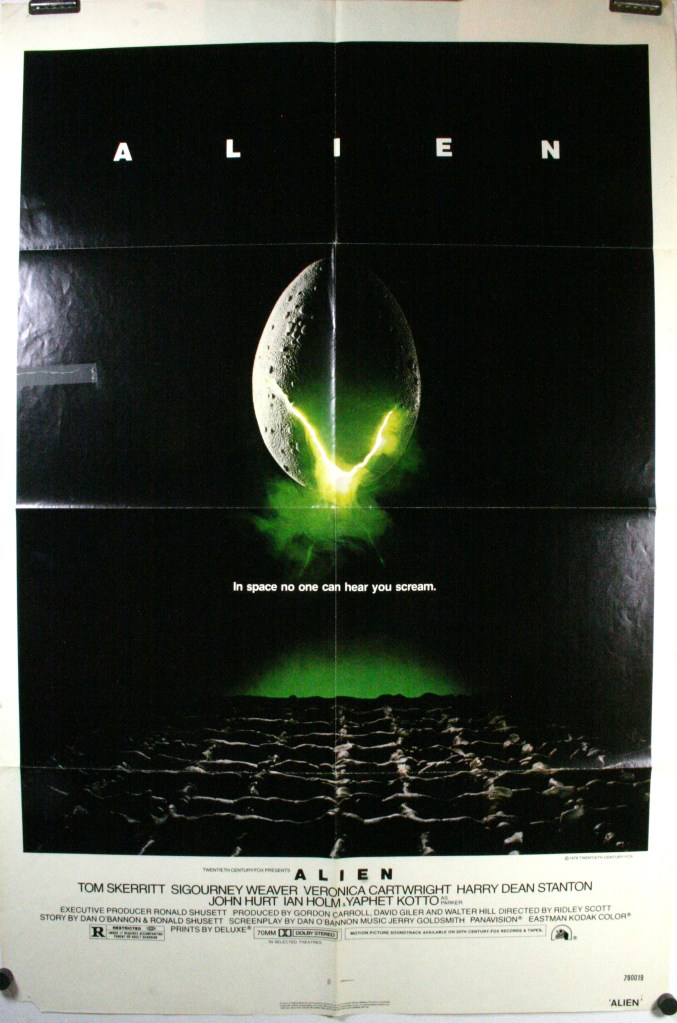
A couple noteworthy events happened at around this time. The first is that my Mom took me and my brother to see the movie ALIEN, which had just opened. She was a fan of science fiction and fantasy in film and on television, and so during this time she would regularly want to see any such picture that opened. Taking my brother and me provided a handy excuse. I still wasn’t much into movies per se, but in the aftermath of STAR WARS anything that was a science fiction film held the promise of great adventure and cinematic thrills. ALIEN definitely wasn’t that. I really remember relatively little about the experience, apart from the fact that I was bored for most of the opening and completely grossed out when the chest-bursting alien made its first appearance. So in short, I can’t say that I liked it, and even today, while I can appreciate how well it was done, the movie doesn’t hold the same allure for me as other fare from that era. (It is worth nothing that my mother didn’t really have much of a problem taking kids to an R-Rated film; I would have been twelve in 1979, and my brother Ken nine. Today, I sort of wonder if it was a good thing that she let us see such features, but at the time I appreciated that I had access to such things when I wanted to and she agreed.)
But ALIEN doesn’t really have anything particular to do with today’s comic. What does is the fact that, for a time in grade school and junior high school, I was in the band. Those who know me today are likely to be stunned by that statement, as I evidence precious little aptitude for music of any kind. But it’s true–and I apparently was quite good at it. I played the Baritone, alternately known as the “Tenor Tuba”, a massive instrument. I kinds of fell into doing so backwards, but I kept it up for four-plus years until my family relocated to Delaware and I couldn’t be bothered any longer. But as part of the duties of the band, we marched in that year’s Memorial Day Parade, a goo couple of miles from the center of my home in Farmingville all the way to Ronkonkoma. I can recall that after going a fraction of that distance, it became difficult to both walk and play at the same time, so I’m sure we sounded crummy–just like any grade school band might. But we did it.
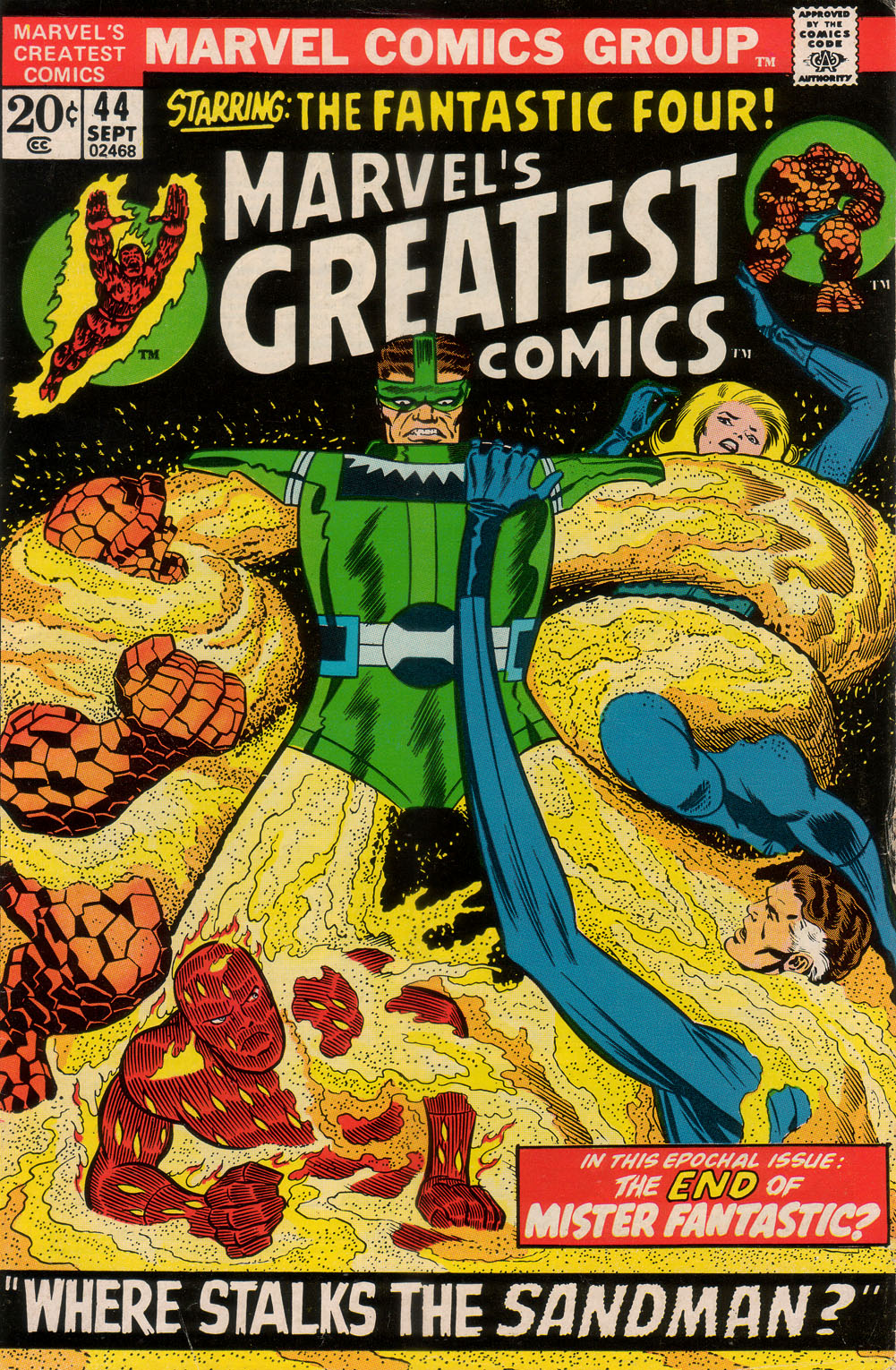
The parade finished up in Ronkonkoma at Hawkins Avenue, which happened to be the block that Bush’s Hobbies was located on. It was a general collectibles store primarily focused on coins, stamps and sports cards. But Bush maintained a large supply of comic book back issues, and so any chance to head over there and peruse the back issue bins in those days before I could transport myself was a rare and noteworthy event. On this particular week, I don’t think I had much in the way of spare cash to work with. Which is perhaps why what I wound up buying at the conclusion of that visit was three issues of MARVEL’S GREATEST COMICS, #44-46, which comprised a full reprinting of the three-part story that introduced Blastaar, the Living Bomb-Burst to the world of the Fantastic Four. I would have known the length of the story from my FANTASTIC FOUR INDEX, and the prices for these back issue reprint books were dirt cheap, so I came away relatively satisfied.
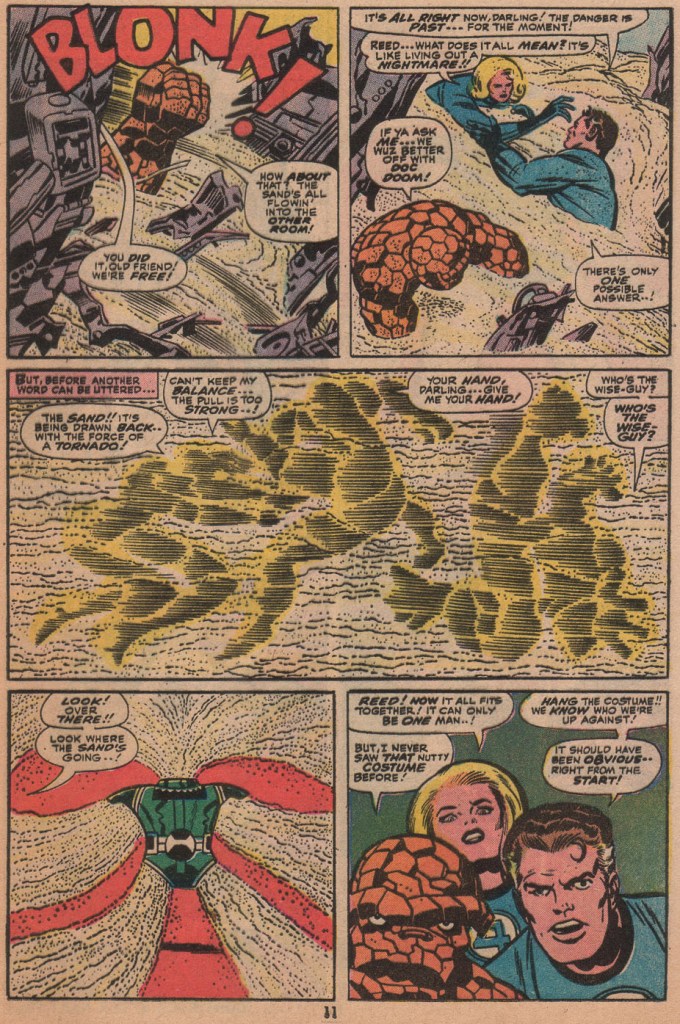
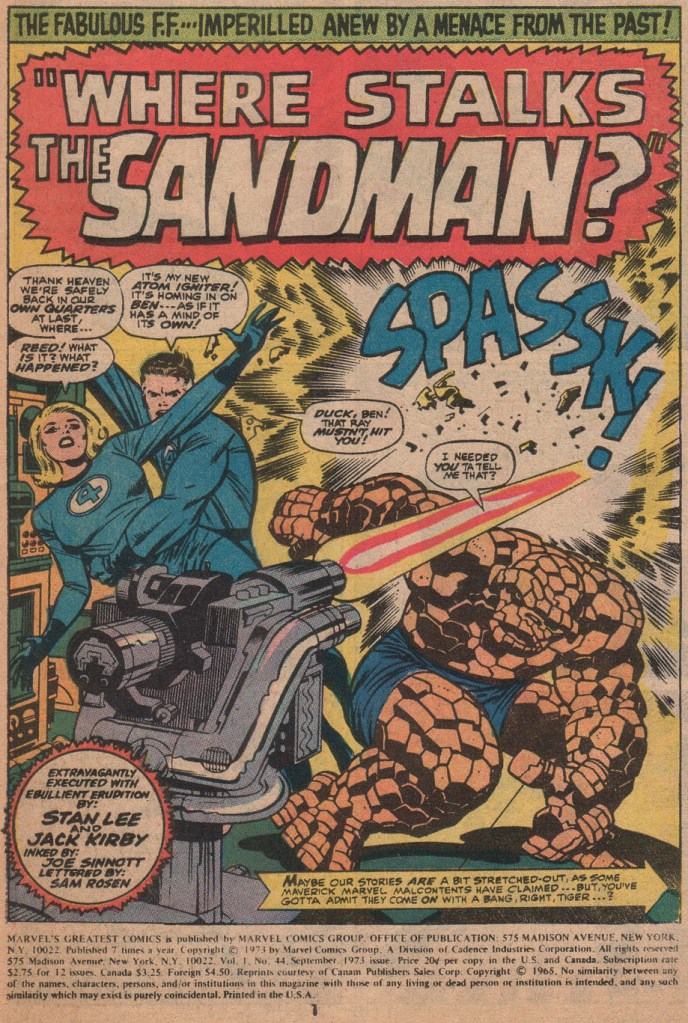
The story in this issue was originally published in FANTASTIC FOUR #61 and came out just about the time when I was being born. This was the prime period for series creators Stan Lee and Jack Kirby working on the series–any initial kinks had been worked out long before, and the book was in the midst of its most fruitful period in terms of introducing new characters and concepts. The original artwork in this period was still being done at twice-up size–it would shortly be reduced to 1 1/2 size to make it more affordable to photograph, but here, the larger canvas was expertly exploited by Kirby and his best inker Joe Sinnott. I tend to believe that the artwork on these three issues was as good and polished as this excellent team got, and even the slight decay in quality due to this being a reprint doesn’t diminish the full effect of these images. It’s beautiful work, expertly composed and energetically delivered.
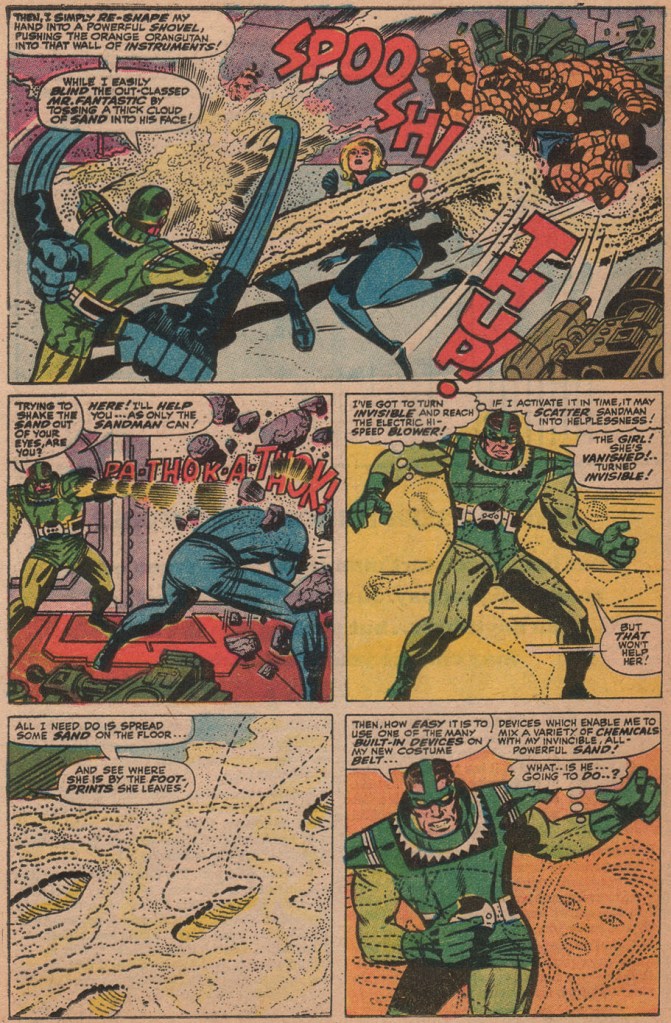
Story-wise, this adventure is the cool-down from the four-part sequence in which Doctor Doom had stolen the cosmic power of the silver Surfer and threatened to dominate the world. The FF had just managed to eke out a win last time by tricking Doom into flying into the barrier that Galactus had set up to contain his herald on Earth. So this story opens with them returning to their Baxter Building headquarters–only to be attacked by their own defensive systems. This allows Lee and Kirby to open with immediate action, as Reed, Sue and Ben fight to stay alive (Johnny is elsewhere, still looking for a way to rescue the trapped Crystal, little realizing that she and her fellow Inhumans have effected their own liberation from the Great Barrier that had contained them.)
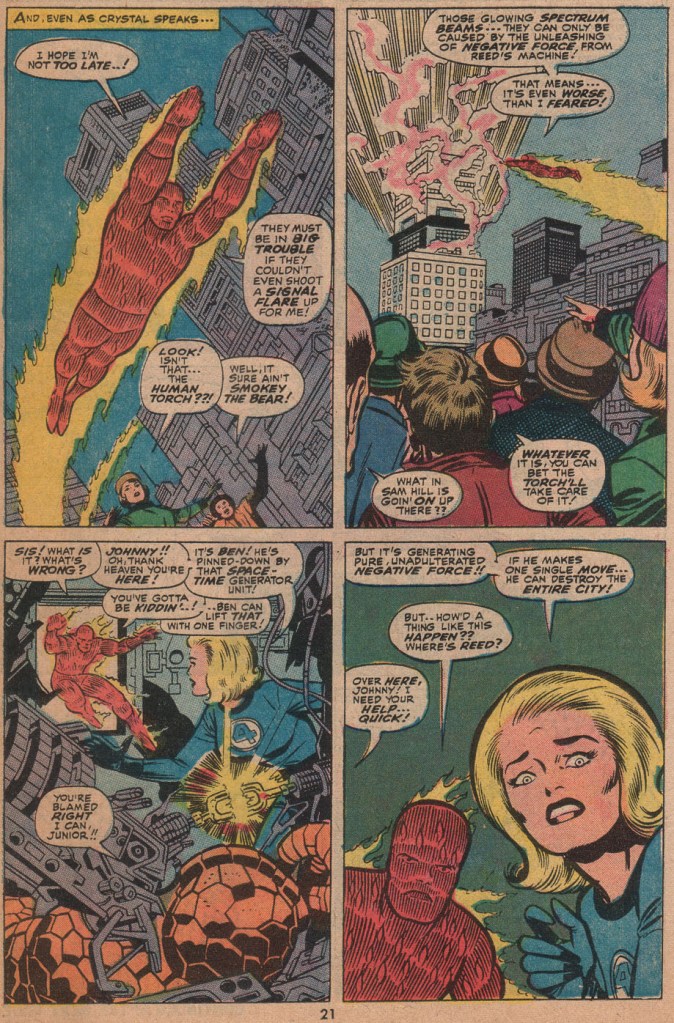
It turns out that the person pulling the strings on the FF’s own defenses is a powered-up version of the Sandman, the iconic Spider-Man villain created by Lee and Steve Ditko. In a recent issue, he’d escaped from prison and got away with some devices of Reed’s, and here, he’s used them to create for himself a costume that allowed him to do much more interesting things with his sandy body. Or at least that’s what plotter Jack Kirby intended. Lee, on the other hand, possibly thinking that readers woudn’t remember or care about this plot thread from four months earlier, drops in a line about the Sandman having taken a refresher night school course in science which allowed him to build his new gear. It’s a pretty unconvincing cover, but typical of the disconnect that would sometimes happen between Kirby’s intention and Lee’s interpretation. Anyway, the juiced-up Sandman seems like a legitimate threat here, batting the FF around for page after page. Even the return of the Human Torch isn’t enough to hold him at bay.
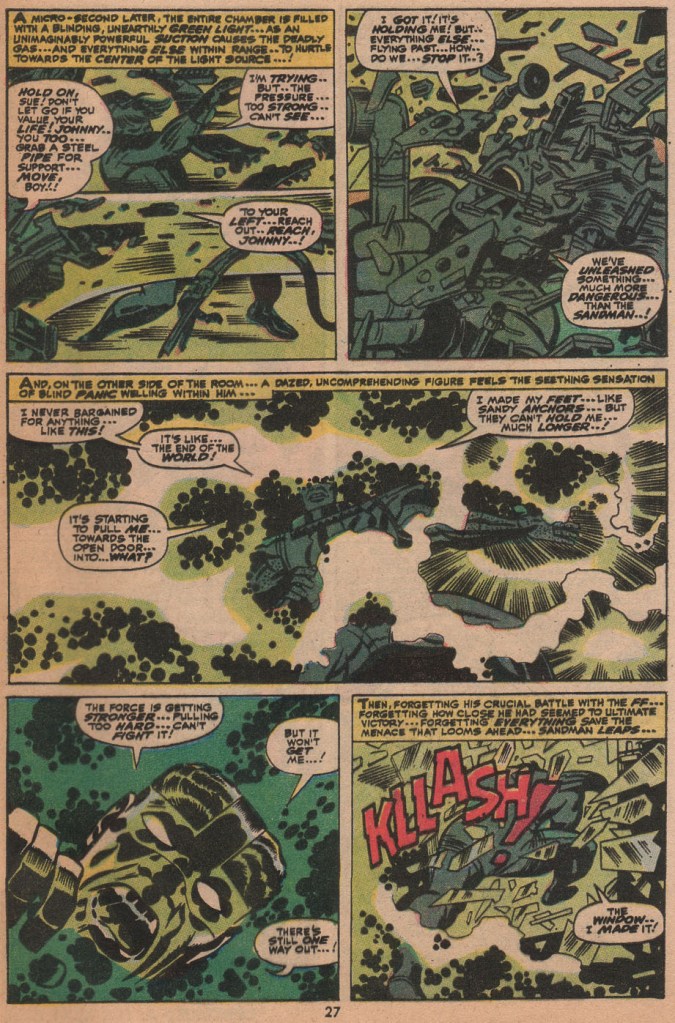
The battle continues throughout the entirety of the issue, with just a few cut-aways to the Silver Surfer (who regains his powers and has his vengeance on Doom’s torturers) and Crystal (who heads to New York to find Johnny only to run into Wyatt Wingfoot at a college football game also attended by Peter Parker and Mary Jane Watson.) Ultimately, though, the Thing gets trapped under a generator harnessing the power of the Negative Zone which might detonate if he tries to get it off him, destroying the city. So Reed and Johnny pursue the Sandman deeper into the Negative Zone chamber, intent on cutting the circuit and eliminating the danger while also putting the Sandman to heel. In a pinch, Reed chooses to open the aperture to the Negative Zone, which created a powerful tractor effect, pulling everything and everyone in the room towards it. Faced with catastrophe, the Sandman books it out the window, leaving Johnny and Reed caught in the grip of the vortex.
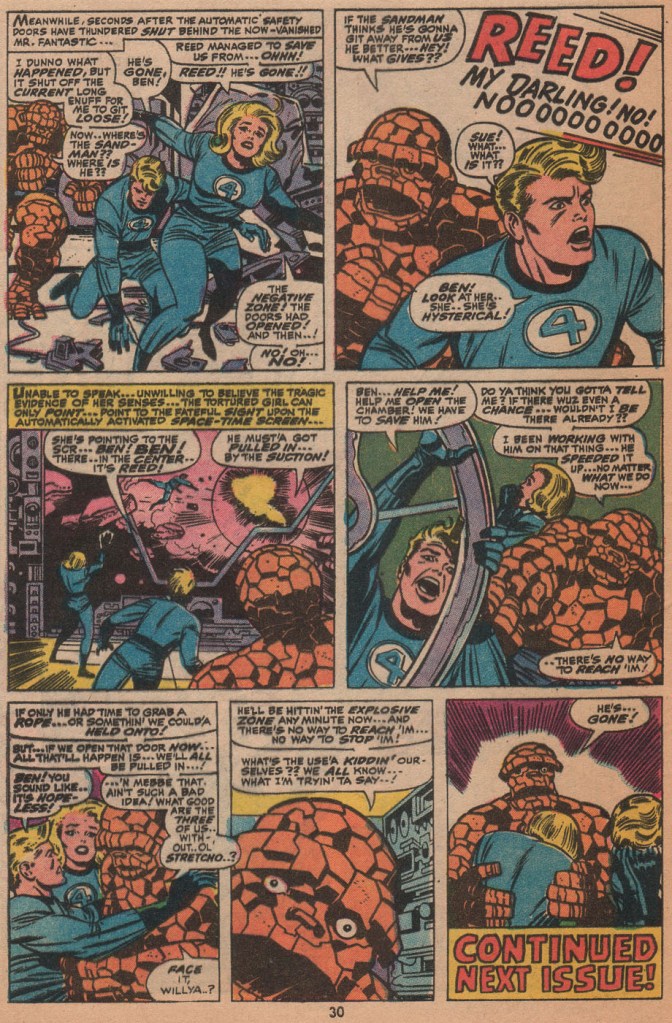
Then, suddenly, the chamber closes once again and everything is calm. The Thing is able at last to liberate himself from where he’s been trapped. But the true situation then becomes apparent: Reed Richards has been sucked into the Negative Zone, where there’s no way for the remaining members of the team to reach him. What’s more, he’s being pulled inexorably towards the explosive area of the zone, where matter and anti-matter collide in annihilating detonations. And that’s the ominous note that this issue goes out on: Mister Fantastic is facing certain death with no hope of rescue, and his friends and family are helpless to go to his aid. To Be Continued! Fortunately, I’d bought the next two issues of MARVEL’S GREATEST COMICS as well, so I didn’t have to wait a month to see what would happen next.
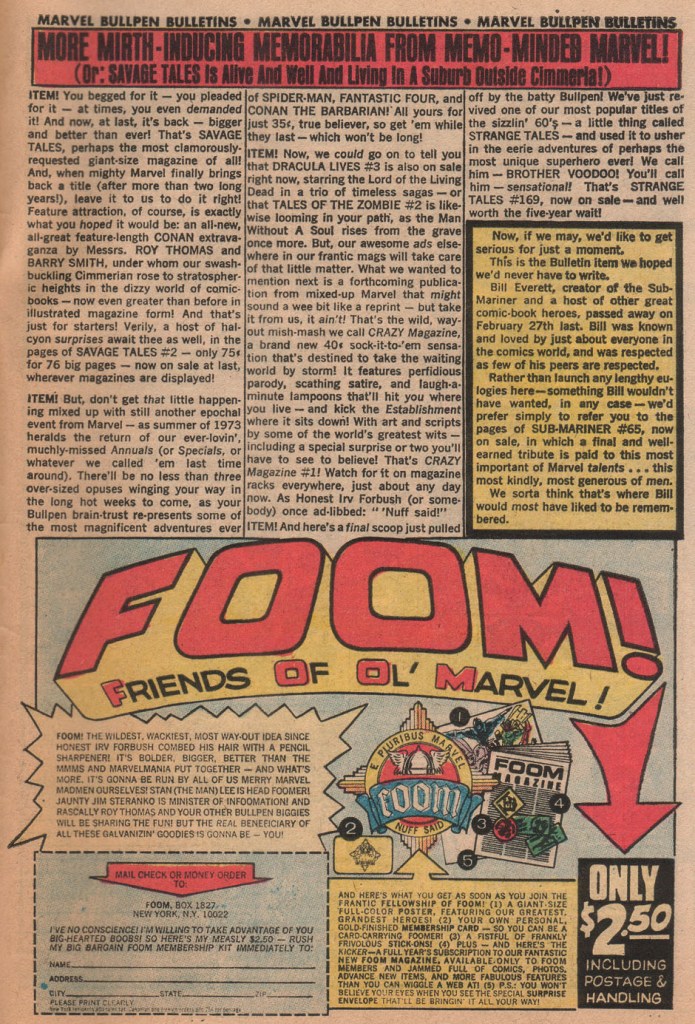
These issues were published in 1973, the year when I first started reading comic books. But I hadn’t been a Marvel fan at that point, and so the house ads were of interest to me as well. This reprint really only includes one, the month’s Marvel Bullpen Bulletins page plugging other magazines and upcoming events. And even that had been reduced to only half a page in order to plug Marvel’s then-latest venture, the fan club FOOM. While 1973 wasn’t really that long ago in 1979, to a kid of twelve, this all felt like ancient history, like staring at stone tablets of antiquity. It was all interesting to me–even if I didn’t really have much love for Marvel’s black and white magazines or CRAZY or Brother Voodoo, the stuff they were plugging at that particular moment.


A parent not only willing but excited to go to a movie theater? That itself is science fiction to me! My family went to the drive-in a few times, but never to an actual theater, and even that stopped in 1971 when I was 8. Going out places interfered with my parents’ obsessive watching of sports and their parallel desire to never leave the house except for work.
LikeLiked by 1 person
I stumbled into MARVEL’S GREATEST COMICS around issue 49, which had to be in back issues, because I wasn’t reading comics yet when the issue came out. I didn’t get the idea of reprints yet, so I spent a little time wondering how they made sure that the greatest stories went into MGC, while the merely-ordinary stories went into the regular FF title.
However they did it, the stuff in MGC was clearly the better stories…!
LikeLiked by 2 people
One of my first Marvel Comics was MGC #49, and it was definitely my first glimpse of the FF. I remember being equally puzzled and dazzled. To my 8 year old self it was pretty trippy. I was most likely attracted by the cover, but I don’t think I could suss out what was going on in the story since it was before I could read “Kirby Crackle.” All the male characters seemed so massive and thick. Don’t think I realized Johnny and Crystal were supposed to be teen agers.
I don’t think it was the first time I saw Kirby’s work though… that was in a barber shop, and a tattered copy of Tales to Astonish / Sub-mariner vs Ironman. Likely not much earlier.
About this particular issue… any thoughts why Kirby would have been interested in using Sandman when he was a DItko/Lee creation? A little odd isn’t it?
LikeLiked by 1 person
Being a card-carrying member of the Frightful Four and the one with the most visual power, I’m guessing Kirby saw more potential for him with an upgrade in his powers. That and Blastarr probably worked best with a less-intellectual villain. But that’s just a guess. If there’s a real story behind this, I’d love to read it!
LikeLiked by 1 person
Do we know that it was Kirby’s idea to use him? I can see Stan saying, “Hey, Ditko came up with this Sand Guy, he’s a little over-powered for Spidey, let’s try to work him into FF.”
LikeLike
Stan had already brought him into Strange Tales to fight Johnny so it wasn’t that much of a leap.
LikeLike
That Sandman wasn’t Marvel’s only Sandman, see Journey into Mystery#70 ( July 1961 ) The Sandman Cometh! – Plot ( Stan Lee? ), Script ( Larry Lieber ), Pencils ( Jack Kirby ), Inks ( Dick Ayers ) – A family ( Steve Bronson, Anne Bronson & Bobby Bronson ( their young son ) stumbles across a hostile alien made of sand ( arrived hundred of years ago called the Sandman ( took on human appearance ) ). The military are helpless, but it is defeated by the family’s bookish son, who uses water to dissolve it and traps it in a bucket ( On the last page there are soldiers guarding the place it is being kept — Area 51 type place )– comics.org for must of the words and see profiles at marvunapp.com and marvel.fandom.com. To bad Jack Kirby never got to use both of them in a story.
LikeLike
I too recalled that Kirby had done one story with an alien Sandman before Ditko did his version for Spider-Man. I don’t imagine Kirby had any emotional investment in his sand-alien, but we can theorize that Lee and Kirby discussed the possibility of creating an evil FF. Kirby could have remembered his teamup of Wizard and Old Paste-Pot in HUMAN TORCH, and Lee could have suggested adding Sandman, whom Ditko hadn’t used as a main villain since late ’64. (Ditko did include Sandy in the “Spidey Goes Mad” tale as an illusion, which appeared after the first Frightful story, so maybe Ditko hadn’t quite given up on using the character– though he might’ve been aware of Sandy being used in a yet earlier TORCH story.)
Assuming the second FF was Lee’s idea, he would have known Marvel had no workable lady villains to be a counterpart to Sue Storm, and would have told Kirby to toss off a new character. There’s no indication in that first evil FF tale that Kirby has any idea of who Medusa is or what motivates her, and Lee writes the character as a cipher to make the story work. Kirby was probably the only other artist up to getting mileage out of Sandy’s powers, so when Ditko departed, Sandy made no appearances in Romita’s SPIDEY tenure, possibly because Lee didn’t think Romita would work well with the villain. But Lee did let Sandy gravitate into the HULK title a couple years later, possibly because Lee thought Trimpe could handle the sand-action scenes.
LikeLike
It’s pretty clear to me that when Medusa was introduced, she is unquestionably French…as she’s wearing an outfit that befits an “adajo dancer”, and the police who are pursuing her are arguably Frenchmen. I think the entire image of her hair pulled back and her haughty appearance screams French to me. It’s her NEXT appearance, when the headdress changes, and the Trapster is introduced, where I think the formula is in place…. until Goodman mandates some new books and characters to compete with the rumored debut of Tower Comics… and therefore, Black Bolt, Gorgan, Medusa and the rest of the Inhumans go from a pitch for a new group/title, to supporting guest-stars in the continuing saga of the Fantastic Four.
LikeLike
Medusa could have been more interesting if that had not happened.
LikeLike
The term I was trying to come up with is: Apache (dance) – Wikipedia . I also thought of another example. In FF #38, when Medusa entraps Sue, she is dressed as a French fashion designer, complete with french style sunglasses, etc. So there it is again…
LikeLike
I have to smile at Tom’s recollection of he and his brother seeing Alien courtesy of his mother. There was a summer in the mid-70’s where my father spent several weeks away, working on the road. During that time, my mother would take a friend and I to whatever movies we both were at least vaguely interested in seeing. This was partly out of boredom with Dad being away and that he really didn’t like going to movies anyway. I distinctly recall seeing “Blazing Saddles” during this time – and being so young and naive that the flatulence scene was probably about all my buddy and I understood. I also know it included a couple R-rated films as well. A fond memory that I appreciate looking back on.
As for MGC #44,, like I noted in Alan Stewart’s excellent post earlier today (Eternals #1 (July, 1976) | Attack of the 50 Year Old Comic Books), I really didn’t care for Jack Kirby’s new work when he returned to Marvel. But that said, I was all over his art in these FF reprints. I loved the “Kirby Krackle” and power in all those panels. But yeah, try to turn me onto his Capt. America, Eternals, or previous DC work and I was not having any of it.
Why? Who knows? Can I blame it on seeing those R-rated movies when I was so young?
LikeLike
I saw Animal House with my mom when I was 12 and Westworld with my dad when I was 8. No eye contact leaving either theater.
LikeLiked by 1 person
Animal House? One of the true classics! It was filmed less than an hour from where I lived. I knew a couple of the extras in that movie.
“And can you get three dates for my friends?”
The classics never get old! 🙂
LikeLike
Lucky dog. My high school was where they filmed part of The Fish That Saved Pittsburgh when I was a junior.
LikeLiked by 1 person
A friend of mine went to see a Western with her father. They weren’t prepared for Midnight Cowboy.
LikeLiked by 1 person
Alien first: Someone warned me about the chest bursting so I had my knees up so I didn’t see where it burst from. The part where the alien jumped out at the captain? We all must must have been drawn to the edge of the seats because when the jump scare happened, the sound of everyone hitting the seat back was very loud. And that scene where she rescues the cat but obviously the cat didn’t cooperate so they used a dummy. I thought it was supposed to be a dead cat and became the only person laughing at the scene.
I prefer Sandman as a F4 villain and wish he’d never been stolen back by the Spider-Office. I also liked his reforming and haven’t liked any story where he is unambiguously eeeeeevil since.
LikeLiked by 2 people
The Sandman reformed stuff was done very well. There was never any reason to revert the Character’s development other than lazy writing. Apologies to the writing folk here but its what I feel.
LikeLiked by 1 person
In his first appearance the Sandman tried to make the principal of Peter Parker’s high school award him a diploma because he’d always wanted one, so the idea of him becoming a science guy had some foundation…?
LikeLiked by 1 person
I think it was alright that he had some respect for Ben Grimm, loved his mum, and wasn’t the worst of the worst, but I think it was maybe a bridge too far to make him an Avenger? I do agree that his return to villainy was pretty clunky. Sandman is a guy who gets divided up and reconstituted… I think that’s a pretty good explanation for why he might seem like a different guy from day to day…. better than he was just faking it.
I think he maybe is best as a dirtbag who can sometimes surprise, or draw a line before going too far?
LikeLiked by 1 person
I thought the creation of Quicksand [ Thor#392 ( June 1988 ) ] was to makeup for the loss of the Sandman as a villain ( Since no one thought to use the Lee-Kirby alien Sandman as a replacement ), which was why I was shocked when they had the Wizard use his ID Machine to turn Sandman back into a villain.
LikeLike
I remember walking through the deep snows of January to buy the original FF issue where this took place. It was a shock to see the Sandman adopting a new costume… especial as it was green instead of purple to fit in with the Frightful Four. I’m still not on board that Flint Marco could have designed it himself, especially as he just swiped all the equipment he could carry from the FF only a few issues earlier.
In my head cannon, I think the wizard told him how to use the ID machine on himself, to boost his intellect and come up with a new costume… OR that the wizard already had planned this, and the ID machine “told” sandman where the costume was, or what principles to pursue. Otherwise, I just don’t buy that the old Sandman could transform himself into this new deadlier threat.
PS: I also was taken in by “Is this the End of Mister Fantastic” and thought they really were going to kill Reed off. Lots of fans have suggested they knew it was going to be the silver surfer who rescued Reed, but it didn’t pan out that way now, did it? Looking at the cover of #62, it certainly appears that Kirby wanted it to look that way. I wonder what the story behind that switch up really is?
LikeLiked by 1 person
According to https://marvel.fandom.com/wiki/William_Baker_(Earth-616) the Sandman briefly used an armored suit that the Wizard created with Reed Richards’ stolen equipment ( under Paraphernalia ).
LikeLiked by 1 person
It’s worth noting the brief mention on the Bullpen Bulletins page shown above of the passing of one of Marvel’s creative architects, the great Bill Everett. Only 55 when he died, he left an indelible mark on the comics industry as a whole, and on Timely/Atlas/Marvel Comics specifically.
LikeLiked by 2 people
Issue 61 was the first FF I ever read. Somehow I got it in a trade – darned if I can remember from who and for what. I especially liked that they just had people names; it would be several issues before I learned their superhero names.
in those days there were no comic book shops, so getting the next issue was often a matter of luck. I did get issue 62 – eventually.
LikeLike
Reading your memories of growing up with comics (and movies) in the 70s warms my heart. My family came to Canada in the summer of ’74, I was 5 and starting school a week later without being able to read or speak English, let alone French. An older cousin would actively collect all Marvel/DC/Harvey comics so they became my gateway to understanding the language; he would bring me stacks of issues and I would read them all, always in chronological order even if the reprint titles would confuse me as to what had already occurred in the Spidey, FF, and Hulk series.
Those were the days!!
LikeLike